
Chapter 4 Cell Structure and Function Image from






















- Slides: 65
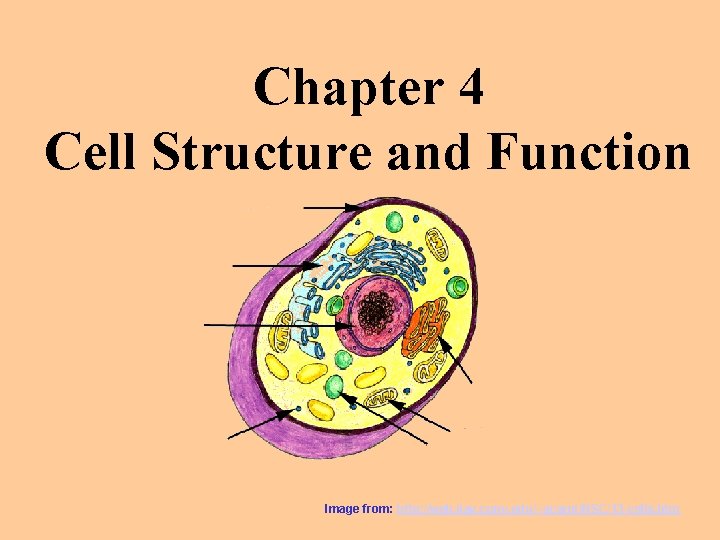
Chapter 4 Cell Structure and Function Image from: http: //web. jjay. cuny. edu/~acarpi/NSC/13 -cells. htm
CELL THEORY 1. All living things are made of cells. 2. The cell is the basic unit of structure and function in living things. (CELL= the basic unit of life) 3. Cells come from the reproduction of 4. existing cells.
WHICH IS BIGGER? Plant cell Animal cell bacteria _________ > ___________
A CELL is. . . Image from: http: //www. biology 4 kids. com/files/cell_membrane. html made of MOLECULES ATOMS ______ MOLECULES ORGANELLES ___________
CELL THEORY CELL SIZE 1. All living things are made of _______. 2. Cells are the basic unit of structure & function in an organism (= basic unit of _____) 3. Cells come from the reproduction of __________ cells > _____________
CELL MEMBRANE (also called plasma membrane) Cell membranes are made of PHOSPHOLIPIDS PROTEINS ________ & _________
LIPID TAILS ARE HYDROPHOBIC HYDROPHILIC HYDROPHOBIC
Oil and water don’t mix! Image from: http: //employees. csbsju. edu/hjakubowski/classes/ch 112/lipids/micbilayer. gif
PHOSPHOLIPID BILAYER Image from: http: //employees. csbsju. edu/hjakubowski/classes/ch 112/lipids/micbilayer. gif
CELL MEMBRANE Proteins that stick on the surface = (either inside or outside of cell) PERIPHERAL _______ INTEGRAL Proteins that stick INTO membrane = ________ (can go part way in or all the way through)
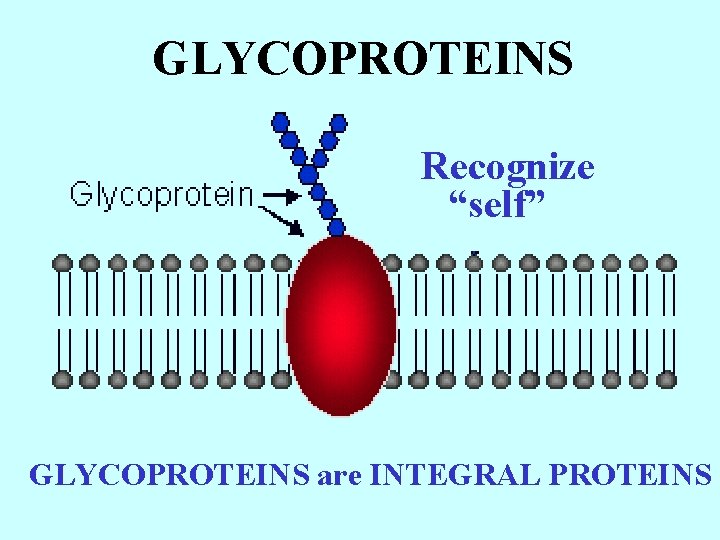
GLYCOPROTEINS Recognize “self” GLYCOPROTEINS are INTEGRAL PROTEINS
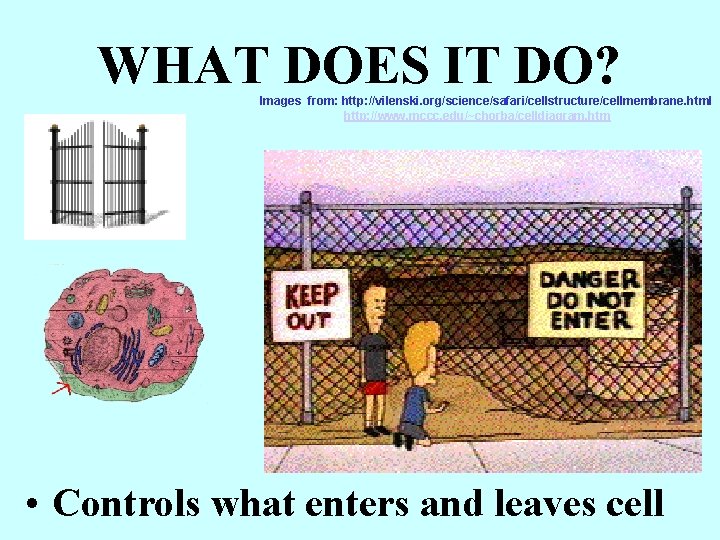
WHAT DOES IT DO? Images from: http: //vilenski. org/science/safari/cellstructure/cellmembrane. html http: //www. mccc. edu/~chorba/celldiagram. htm • Controls what enters and leaves cell
SELECTIVELY PERMEABLE (semi-permeable)
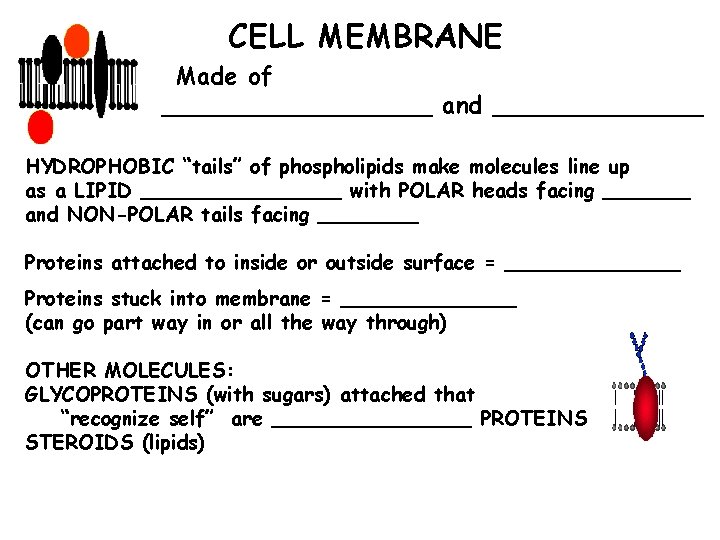
CELL MEMBRANE Made of _________ and _______ HYDROPHOBIC “tails” of phospholipids make molecules line up as a LIPID ________ with POLAR heads facing _______ and NON-POLAR tails facing ____ Proteins attached to inside or outside surface = _______ Proteins stuck into membrane = _______ (can go part way in or all the way through) OTHER MOLECULES: GLYCOPROTEINS (with sugars) attached that “recognize self” are ________ PROTEINS STEROIDS (lipids)
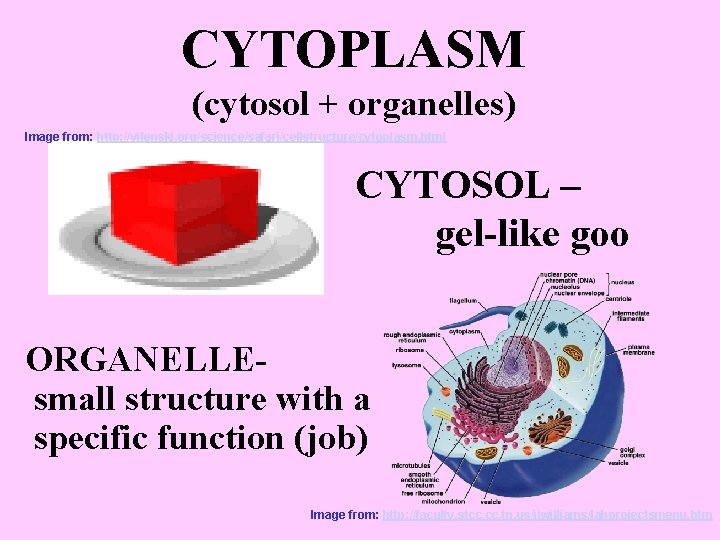
CYTOPLASM (cytosol + organelles) Image from: http: //vilenski. org/science/safari/cellstructure/cytoplasm. html CYTOSOL – gel-like goo ORGANELLEsmall structure with a specific function (job) Image from: http: //faculty. stcc. tn. us/jiwilliams/labprojectsmenu. htm
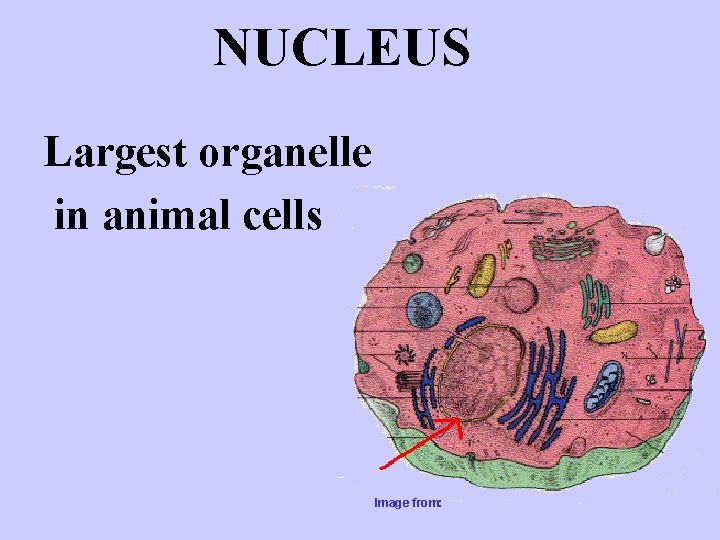
NUCLEUS Largest organelle in animal cells Image from: http: //www. mccc. edu/~chorba/celldiagram. htm
NUCLEUS Surrounded by DOUBLE bilayer membrane = NUCLEAR ENVELOPE (nuclear membrane) Image from: http: //www. agen. ufl. edu/~chyn/age 2062/lect_06/5_11. GIF
NUCLEUS NUCLEAR PORES Openings to allow molecules to move in and out of nucleus Image from: http: //www. emc. maricopa. edu/faculty/farabee/BIOBK/Bio. Book. CELL 2. html
WHAT DOES IT DO? • Contains genetic material (DNA) DNA is spread out as CHROMATIN in non-dividing cells DNA is scrunched up as CHROMOSOMES in dividing cells
WHAT DOES IT DO? • Control center of cell Image from: Genetic code tells the cell’s parts what to do Image from: http: //web. jjay. cuny. edu/~acarpi/NSC/12 -dna. htm
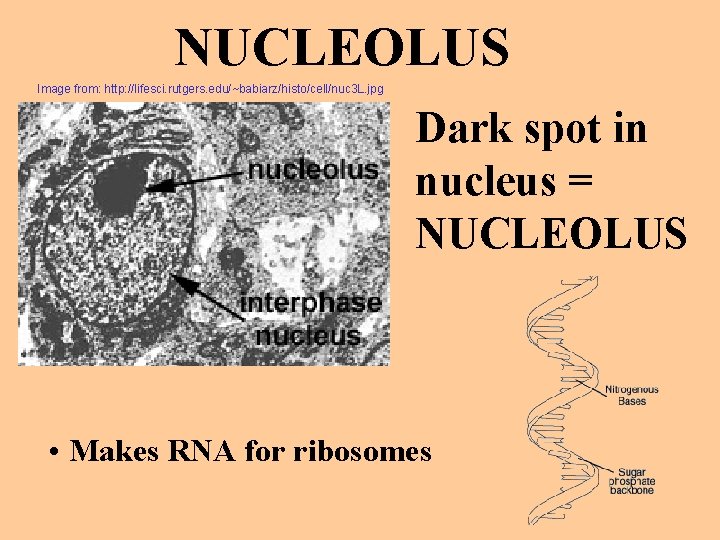
NUCLEOLUS Image from: http: //lifesci. rutgers. edu/~babiarz/histo/cell/nuc 3 L. jpg Dark spot in nucleus = NUCLEOLUS • Makes RNA for ribosomes
NUCLEUS NUCLEOLUS Surrounded by _______ bilayer MEMBRANE (called the NUCLEAR ENVELOPE) CONTROL CENTER OF CELL CONTAINS GENETIC MATERIAL (DNA) Dark spot = NUCLEOLUS makes __________ (RNA) DNA is scrunched up as _______ in dividing cells. DNA is spread out as ________ in non-dividing cells.
Image from: http: //anthro. palomar. edu/animal/default. htm CYTOSKELETON • Gives cell shape & support • Help move organelles around Made of PROTEINS called MICROFILAMENTS & MICROTUBULES Image from: http: //www. emc. maricopa. edu/faculty/farabee/BIOBK/Bio. Book. CELL 2. html
CYTOSKELETON
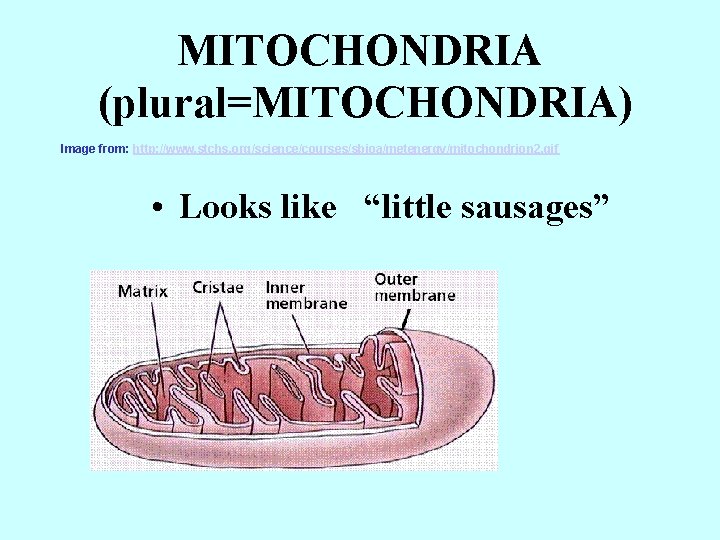
MITOCHONDRIA (plural=MITOCHONDRIA) Image from: http: //www. stchs. org/science/courses/sbioa/metenergy/mitochondrion 2. gif • Looks like “little sausages”
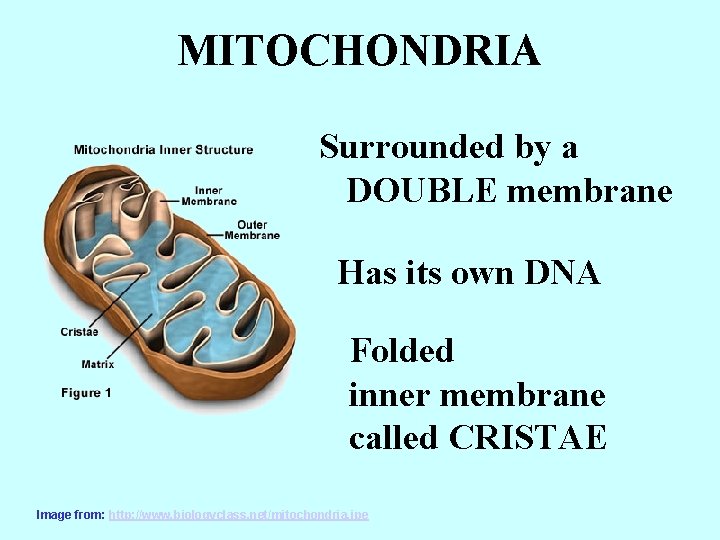
MITOCHONDRIA Surrounded by a DOUBLE membrane Has its own DNA Folded inner membrane called CRISTAE Image from: http: //www. biologyclass. net/mitochondria. jpe
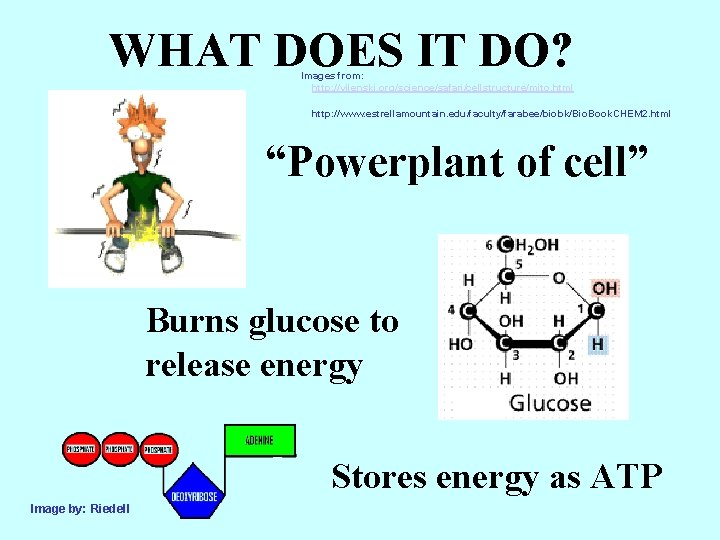
WHAT DOES IT DO? Images from: http: //vilenski. org/science/safari/cellstructure/mito. html http: //www. estrellamountain. edu/faculty/farabee/biobk/Bio. Book. CHEM 2. html “Powerplant of cell” Burns glucose to release energy Stores energy as ATP Image by: Riedell
MITOCHONDRIA Surrounded by _______ membrane Contains its own _________________ of cell Burns ______ Stores energy as ______ Folded inner membrane = _________ (increases surface area for more chemical reactions)
ENDOPLASMIC RETICULUM Image from: http: //www. mccc. edu/~chorba/celldiagram. htm Network of hollow tubules 2 KINDS: SMOOTH or ROUGH Image from: http: //www. agen. ufl. edu/~chyn/age 2062/lect_06/5_10 B. GIF
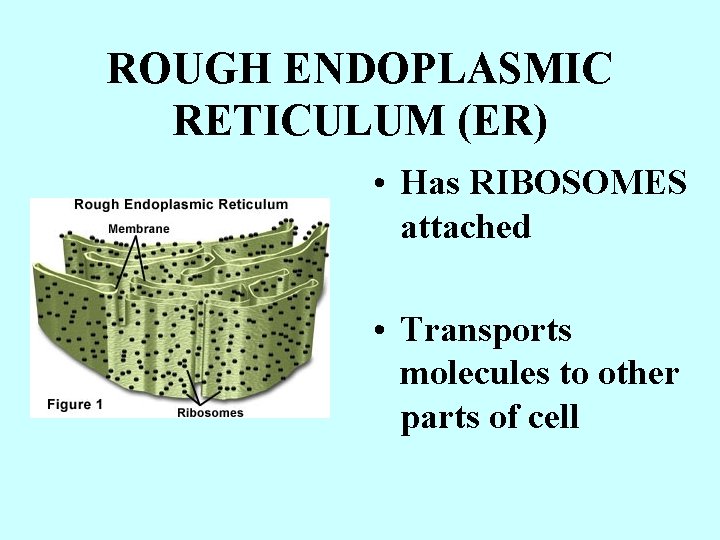
ROUGH ENDOPLASMIC RETICULUM (Rough ER) Animation from: http: //vilenski. org/science/safari/cellstructure/er. html Moves substances around inside cell = “Intracellular highway” Image from: http: //www. biologyclass. net/endoplasmic. jpe Has RIBOSOMES attached
ROUGH ENDOPLASMIC RETICULUM (ER) • Has RIBOSOMES attached • Transports molecules to other parts of cell
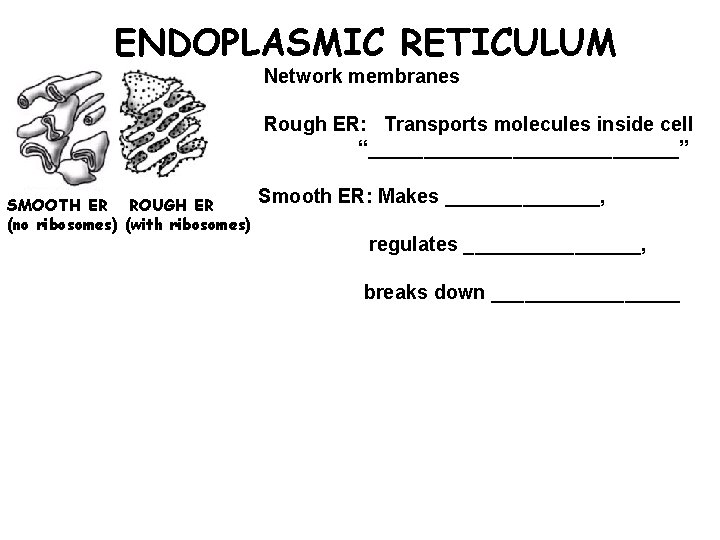
SMOOTH ENDOPLASMIC RETICULUM (smooth ER) Image from: http: //www. science. siu. edu/plant-biology/PLB 117/JPEGs%20 CD/0073. JPG • Has NO ribosomes attached • Makes steroids • Regulates calcium • Destroys toxic substances
ENDOPLASMIC RETICULUM Network membranes Rough ER: Transports molecules inside cell “______________” SMOOTH ER ROUGH ER (no ribosomes) (with ribosomes) Smooth ER: Makes _______, regulates ________, breaks down _________
RIBOSOMES • Made of PROTEINS and RNA • Protein factory for cell Image by: RIedell Image from: http: //www. ust. hk/roundtable/hi-tech. series/1_b 1. jpg
RIBOSOMES Image from: http: //www. biologyclass. net/endoplasmic. jpe Can be attached to Rough ER OR free in cytoplasm Image from: http: //www. mccc. edu/~chorba/celldiagram. htm
RIBOSOMES
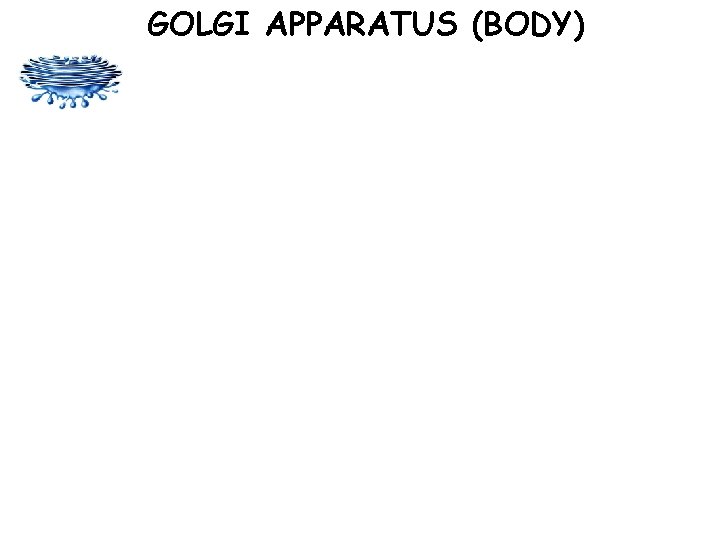
GOLGI APPARATUS (BODY) Image from: http: //vilenski. org/science/safari/cellstructure/golgi. h Image from: http: //www. rsbs. anu. edu • Pancake like membrane stacks • Packages molecules for transport out of cell Image from: http: //vilenski. org/science/safari/cellstructure/golgi. h
GOLGI APPARATUS (BODY)
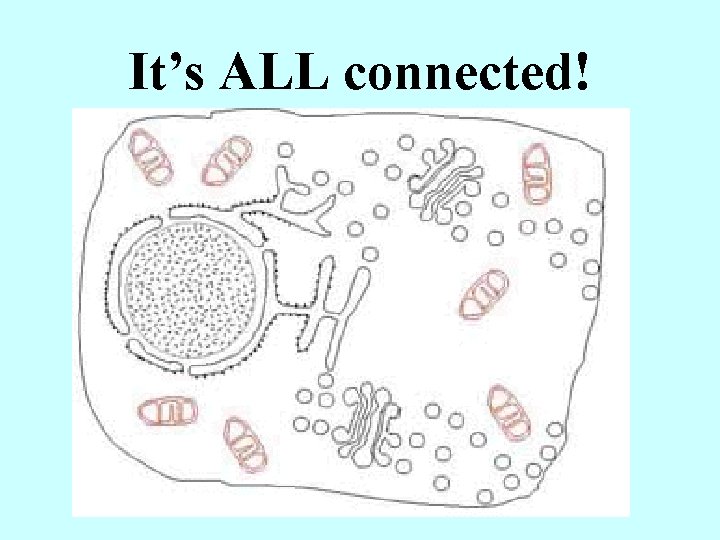
It’s ALL connected!
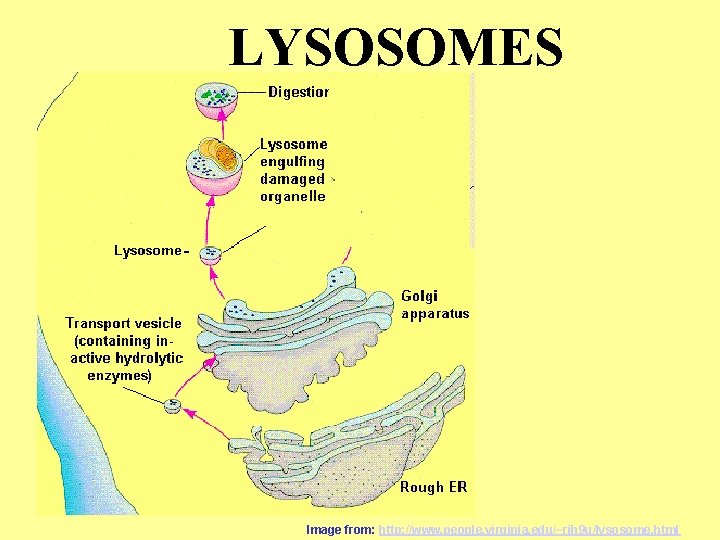
LYSOSOMES Animation from: http: //vilenski. org/science/safari/cellstructure/lysosomes. html • Membrane bound sacs that contain PROTEINS called digestive enzymes • Digest food, unwanted molecules, old organelles, cells, bacteria, etc
LYSOSOMES Image modified from: http: //www. people. virginia. edu/~rjh 9 u/lysosome. html
LYSOSOMES Image from: http: //www. people. virginia. edu/~rjh 9 u/lysosome. html
LYSOSOMES
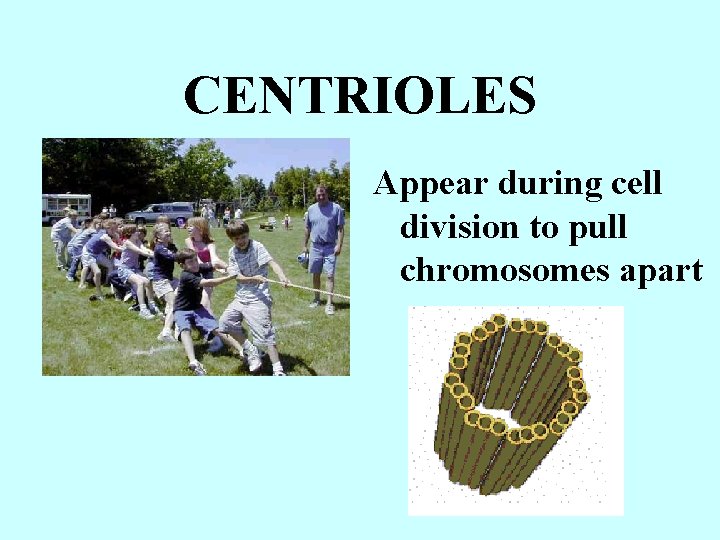
CENTRIOLES Appear during cell division to pull chromosomes apart
CENTRIOLES Made of PROTEINS called MICROTUBULES Image from: http: //www. coleharbourhigh. ednet. ns. ca/library/organelle_worksheet. htm
CENTRIOLES
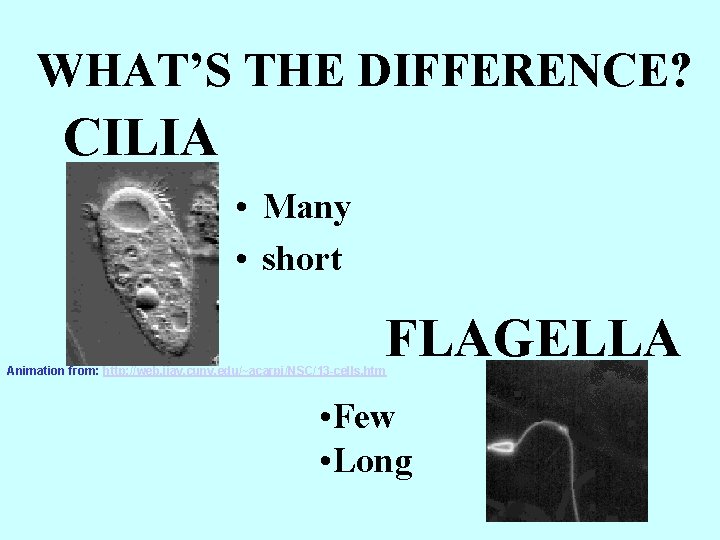
FLAGELLA & CILIA Made of PROTEINS called MICROTUBULES (9 + 2 arrangement) Image from: http: //www. stchs. org/science/courses/sbioa/metenergy/flagella. jpg
FLAGELLA Help in cell movement
CILIA Animation from: http: //web. jjay. cuny. edu/~acarpi/NSC/13 -cells. htm Move cell itself
CILIA Move substances past cells Image from: http: //academic. pg. cc. md. us/~aimholtz/Aand. P/206_ONLINE/Immune/Innate_Images/cilia. jpg
WHAT’S THE DIFFERENCE? CILIA • Many • short FLAGELLA Animation from: http: //web. jjay. cuny. edu/~acarpi/NSC/13 -cells. htm • Few • Long
CILIA FLAGELLA
WHAT’S SPECIAL ABOUT PLANT CELLS? • • Cell wall HUGE vacuoles Chloroplasts No centrioles
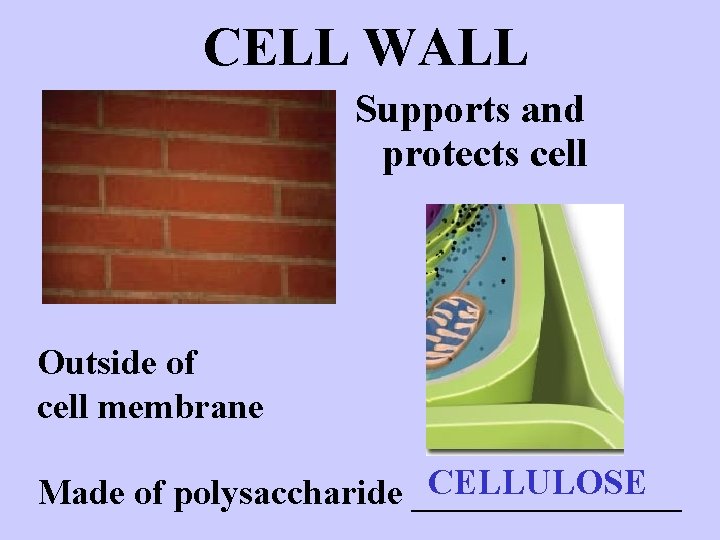
CELL WALL Supports and protects cell Outside of cell membrane CELLULOSE Made of polysaccharide ________
VACUOLES Image from: http: //www. biologycorner. com/resources/plant_cell. gif Storage space
VACUOLES Image from: http: //www. metoliusfriends. org/csca/images/tupperware. jpg • Storage space for WATER, enzymes, and waste Vacuoles SMALL in ANIMAL CELLS NO VACUOLES IN BACTERIA
VACUOLES
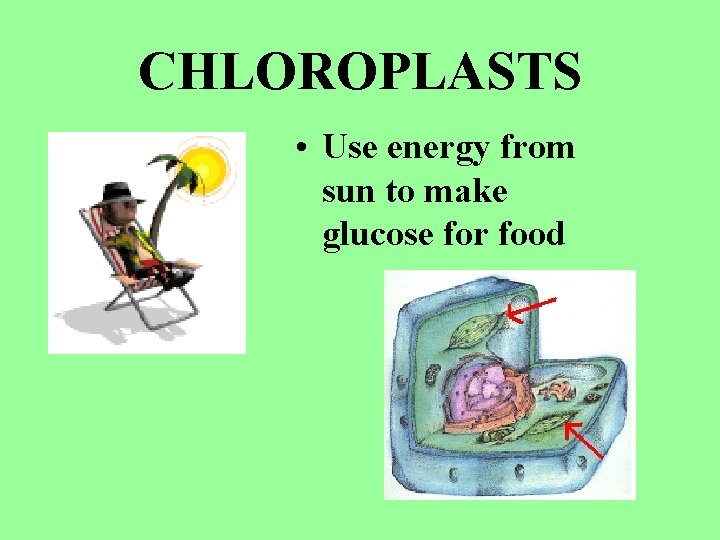
CHLOROPLASTS • Use energy from sun to make glucose for food
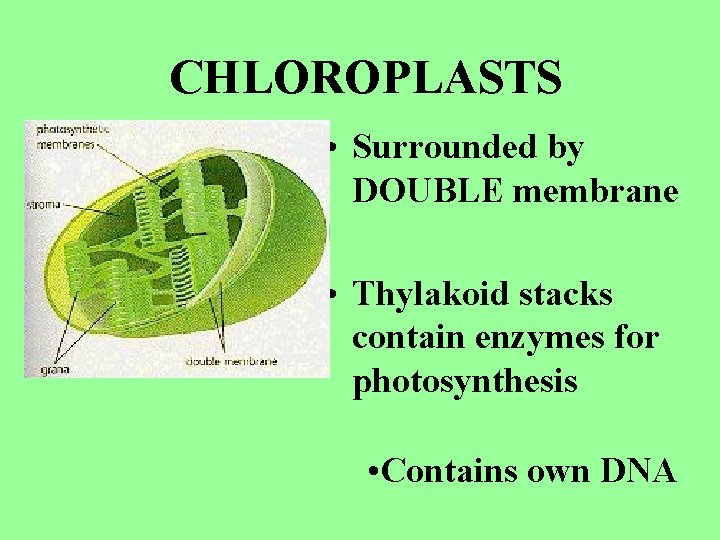
CHLOROPLASTS • Surrounded by DOUBLE membrane • Thylakoid stacks contain enzymes for photosynthesis • Contains own DNA
CHLOROPLAST
WHAT’S SPECIAL ABOUT BACTERIAL CELLS? • Cell wall • NO NUCLEAR MEMBRANE • DNA is circular • No membrane bound organelles
BACTERIA have a CELL WALL BUT… Image from: http: //micro. magnet. fsu. edu/cells/procaryotes/images/procaryote. jpg ITS MADE OF DIFFERENT MOLECULES than Plant cell walls! NO CELLULOSE! Image from: http: //bioweb. wku. edu/courses/BIOL 115/Wyatt/Biochem/Carbos/Carb_poly. gif
DIFFERENCES IN ANIMAL CELLS, PLANT CELLS, AND BACTERIA ANIMAL CELL PLANT CELL BACTERIA Cell membrane NO cell wall Cell wall made of CELLULOSE Cell wall made of PROTEINS Has ribosomes Nuclear membrane Eukaryotes Prokaryotes DNA in chromosomes DNA is a circular ring No chloroplasts Chloroplasts No chloroplasts Small vacuoles Really big vacuole No vacuoles Has lysosomes Lysosomes rare No lysosomes SMALLER SMALLEST NO nuclear membrane
The Biology Coloring Book, Robert D. Griffin, Barnes and Noble Books, 1986
The Biology Coloring Book, Robert D. Griffin, Barnes and Noble Books, 1986