
CHAPTER 4 CELL REPRODUCTION BELLRINGER Why do you
CHAPTER 4 CELL REPRODUCTION BELLRINGER Why do you think cell division is important?
SECTION 1: CELL DIVISION AND MITOSIS Many-celled organisms grow because cell division increases the total number of cells in an organism. Ex. Every day red blood cells wear out and are replaced One-celled organisms also use cell division to reproduce
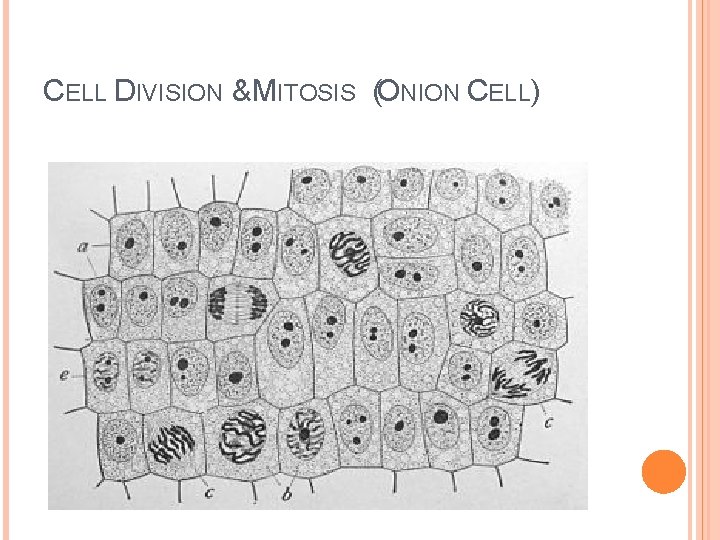
CELL DIVISION & MITOSIS (ONION CELL)
THE CELL CYCLE 1. ) Interphase – most of the life cycle of a cell is spent in this phase Cell grows and functions, and organelles duplicate DNA is copied; chromosomes duplicate Cell grows and prepares for mitosis 2. ) Mitosis occurs – division of the NUCLEUS of a cell 3. ) Cytoplasm divides A copy of the hereditary material (DNA) must be made so that each new cell gets a complete copy
MITOSIS Nucleus divides to form 2 nuclei Chromosome – contains the hereditary material When the nucleus is ready to divide, the chromosomes that were duplicated during interphase coil tightly into two thickened, identical strands called sister chromatids
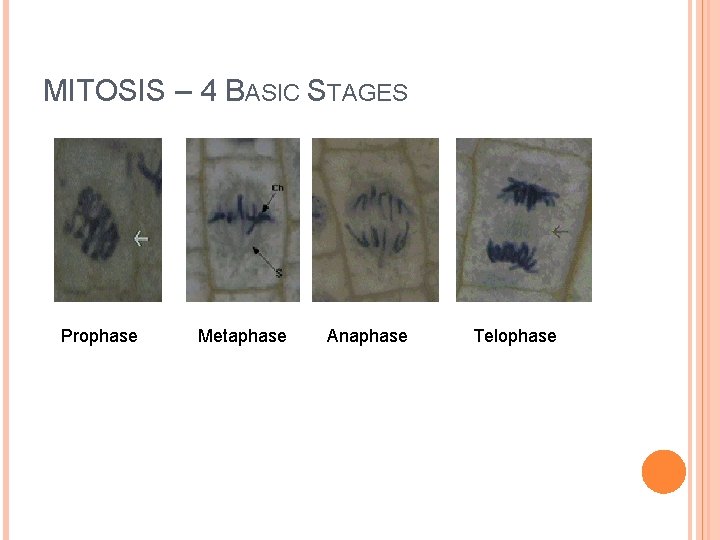
MITOSIS – 4 BASIC STAGES Prophase Metaphase Anaphase Telophase
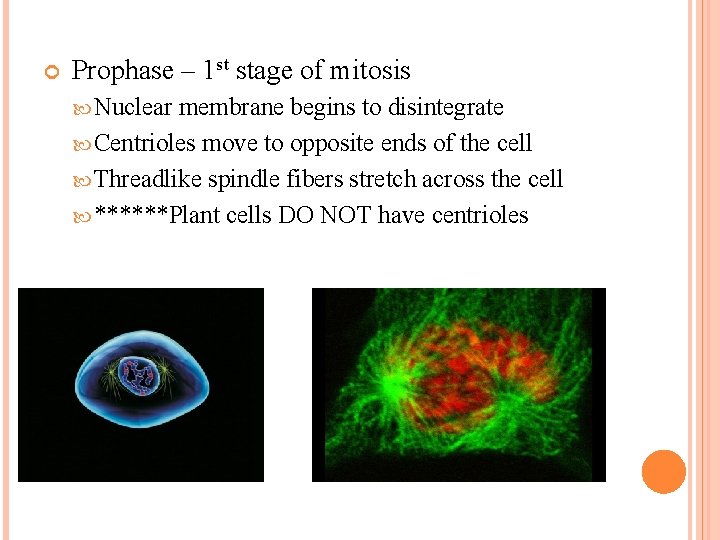
Prophase – 1 st stage of mitosis Nuclear membrane begins to disintegrate Centrioles move to opposite ends of the cell Threadlike spindle fibers stretch across the cell ******Plant cells DO NOT have centrioles
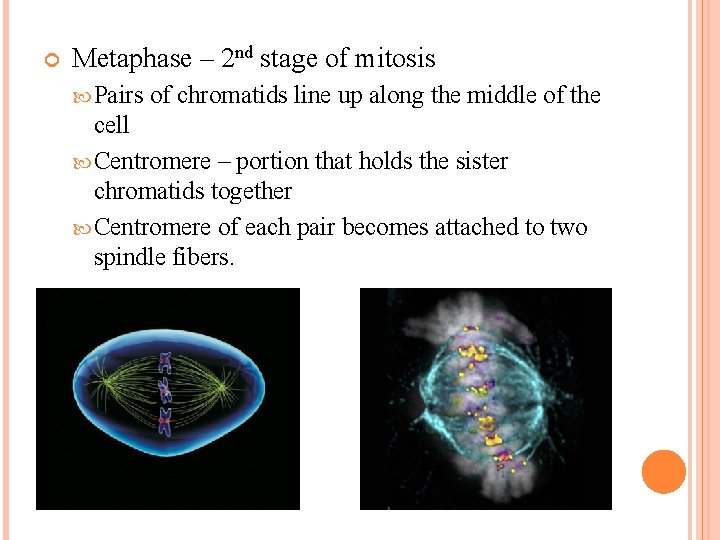
Metaphase – 2 nd stage of mitosis Pairs of chromatids line up along the middle of the cell Centromere – portion that holds the sister chromatids together Centromere of each pair becomes attached to two spindle fibers.
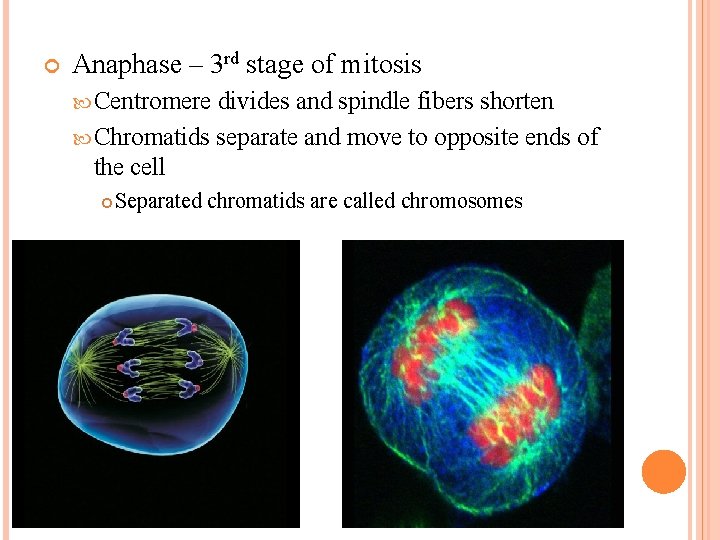
Anaphase – 3 rd stage of mitosis Centromere divides and spindle fibers shorten Chromatids separate and move to opposite ends of the cell Separated chromatids are called chromosomes
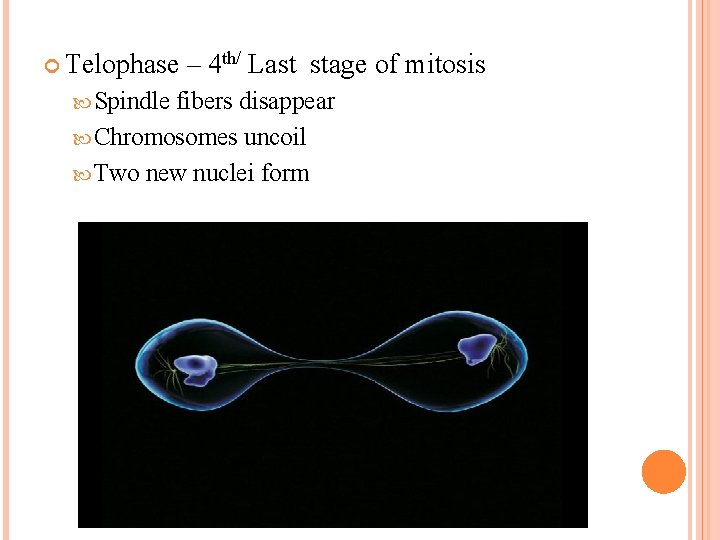
Telophase Spindle – 4 th/ Last stage of mitosis fibers disappear Chromosomes uncoil Two new nuclei form
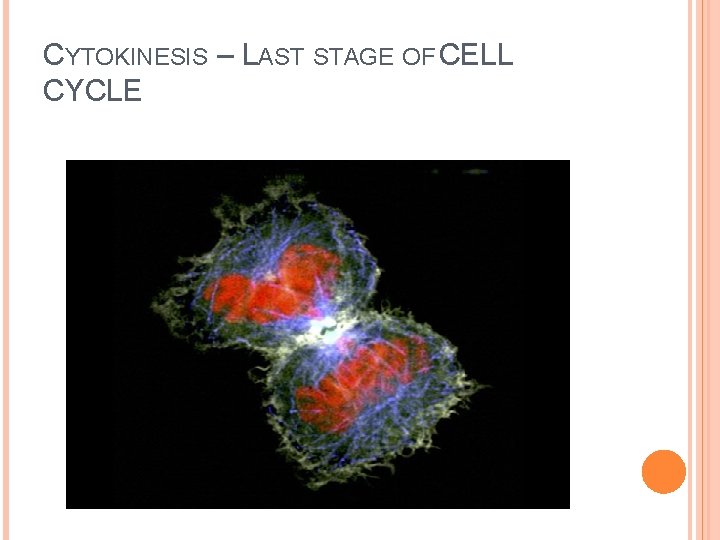
CYTOKINESIS – LAST STAGE OF CELL CYCLE
2 important things about mitosis 1. ) Mitosis is the division of a nucleus 2. ) Mitosis produces new nuclei that are identical to each other and the original nucleus Every cell, except for the reproductive cells, has 46 chromosomes
Reproduction – process by which an organism produces others of its same kind.
Asexual reproduction A new organism is produced from one organism Hydra Reproduces by budding A type of asexual reproduction made possible because of cell division. Regeneration Process that uses cell division to re-grow body parts Ex. Sponges, sea stars. Bacterial cells reproduce asexually by fission. Fission – organism divides They cannot undergo mitosis because they do not have a nucleus.
EXIT SLIP List the 3 steps to the cell cycle and the 4 steps to mitosis.
- Slides: 15