
CHAPTER 4 BREAKDOWN IN SOLID DIELECTRIC INTRODUCTION INTRINSIC
CHAPTER 4. BREAKDOWN IN SOLID DIELECTRIC • INTRODUCTION • INTRINSIC BREAKDOWN • ELECTROMECHANICAL BREAKDOWN • THERMAL BREAKDOWN • BREAKDOWN OF SOLID DIELECTRICS IN PRACTICE • BREAKDOWN IN COMPOSITE DILECTRICS • SOLID DILECTRICS USED IN PRACTICE 1
INTRODUCTION Solid dielectric materials are used in all kinds of electrical apparatus and device to insulate one current carrying part from another when they operate at different voltages. Solid dielectric have higher breakdown strength compared to liquids and gases A good dielectric should have : • Low dielectric loss • High mechanical strength • Should be free from gaseous inclusions and moisture • Resistant to thermal and chemical deterioration Types of Solid insulating materials: • Organic materials (paper, wood and rubber) • Inorganic materials (Mica, glass and porcelain and synthetic 2 polymers)
Breakdown in solid dielectric occurs, if solid dielectric strength less than electric stress. Breakdown Mechanism in solid dielectric depend on the time of application of voltage, and can be classified as follows: 1. Intrinsic or ionic breakdown 2. Electromechanical breakdown 3. Failure due to treeing and tracking 4. Thermal Breakdown 5. Electrochemical Breakdown, and 6. Breakdown due to internal discharges 3
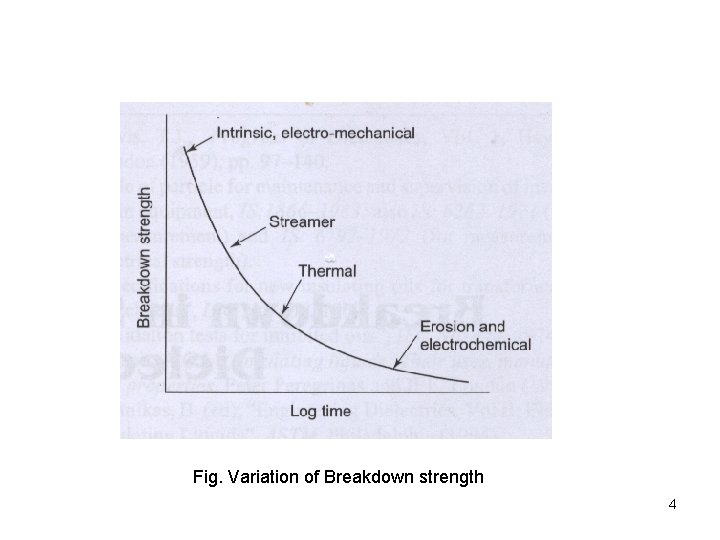
Fig. Variation of Breakdown strength 4
Intrinsic Breakdown occurs if the applied on solid dielectric increases to 10 6 Volt/cm in short duration in order 10 -8 sec. This breakdown depends upon the presence of free electrons which are capable of migration through the lattice of the dielectric. Based on experiment the maximum electrical strength recorded is 15 MV/cm for Polyvinyl at -196 0 C. The maximum strength usually obtainable ranges from 5 MV/cm to 10 MV/cm There are two types of intrinsic breakdown mechanism e. g Electronic Breakdown and Streamer Breakdown (avalanche). 5
Electronic Breakdown The initial density of conduction (free) electrons is also assumed to be large, and electron-electron collision occur. When an electric field is applied, electrons gain energy from the electric field and cross the forbidden energy gap from the valency to the conduction band. When the process is repeated, more and more electrons become available in the conduction band, eventually leading to BD 6
Streamer Breakdown Conduction electron gain sufficient energy above a certain critical electric field and cause liberation of electrons from the lattice atoms by collisions. An electron within the dielectric, starting from cathode will drift towards the anode and during this motion gains energy from the field and loses it during collision. When the energy gained by an electron exceeds the lattice ionization potential, an additional electron will be liberated due to collision on the first electron. This process repeats itself resulting in the formation of an electron avalanche. BD will occur, when the avalanche exceeds a certain critical size. 7
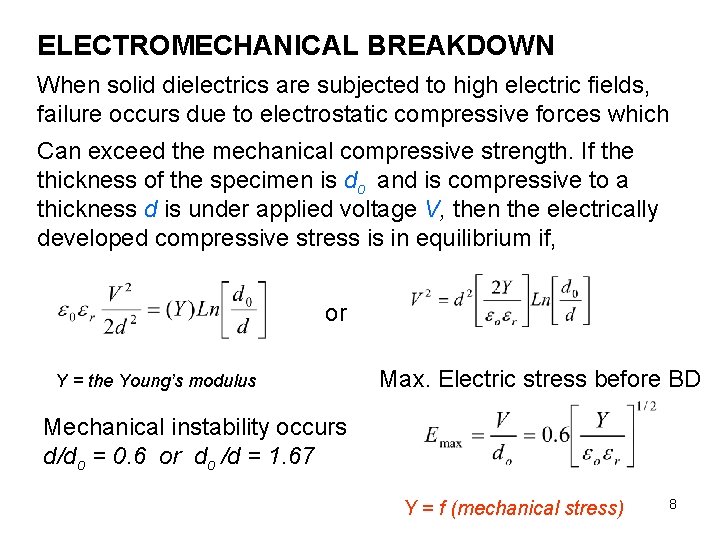
ELECTROMECHANICAL BREAKDOWN When solid dielectrics are subjected to high electric fields, failure occurs due to electrostatic compressive forces which Can exceed the mechanical compressive strength. If the thickness of the specimen is do and is compressive to a thickness d is under applied voltage V, then the electrically developed compressive stress is in equilibrium if, or Y = the Young’s modulus Max. Electric stress before BD Mechanical instability occurs d/do = 0. 6 or do /d = 1. 67 Y = f (mechanical stress) 8
Thermal Breakdown When an electric field is applied to a dielectric, conduction current, however small it may be, flows through the material. The current heats up the specimen and the temperature rises. The heat generated is transferred to the surrounding medium by conduction through the solid dielectric and by radiation from its outer surfaces. Equilibrium is reached when the heat used to raise the temperature of the dielectric, plus the heat radiated out, equals the heat generated. 9
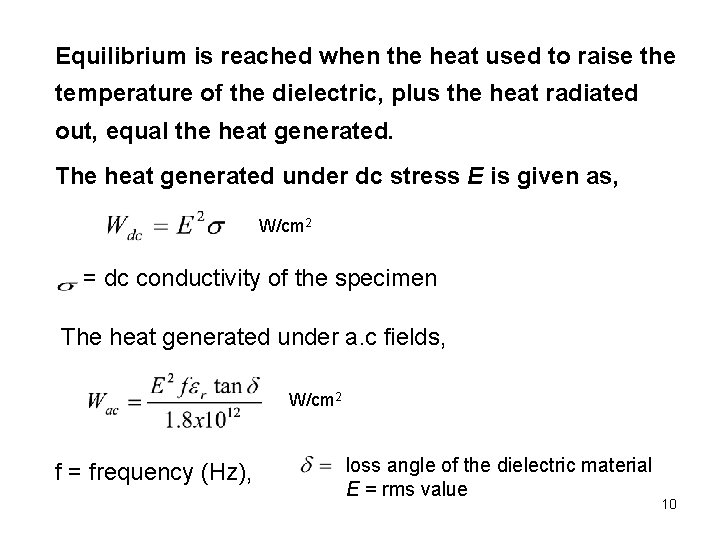
Equilibrium is reached when the heat used to raise the temperature of the dielectric, plus the heat radiated out, equal the heat generated. The heat generated under dc stress E is given as, W/cm 2 = dc conductivity of the specimen The heat generated under a. c fields, W/cm 2 f = frequency (Hz), loss angle of the dielectric material E = rms value 10
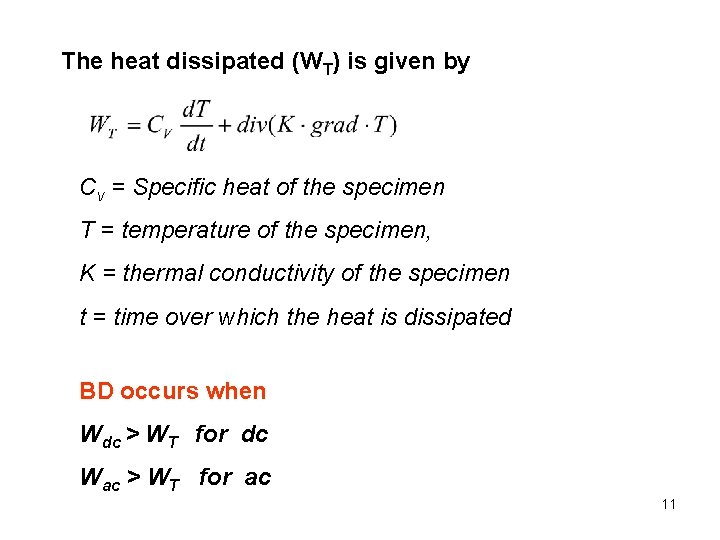
The heat dissipated (WT) is given by Cv = Specific heat of the specimen T = temperature of the specimen, K = thermal conductivity of the specimen t = time over which the heat is dissipated BD occurs when Wdc > WT for dc Wac > WT for ac 11
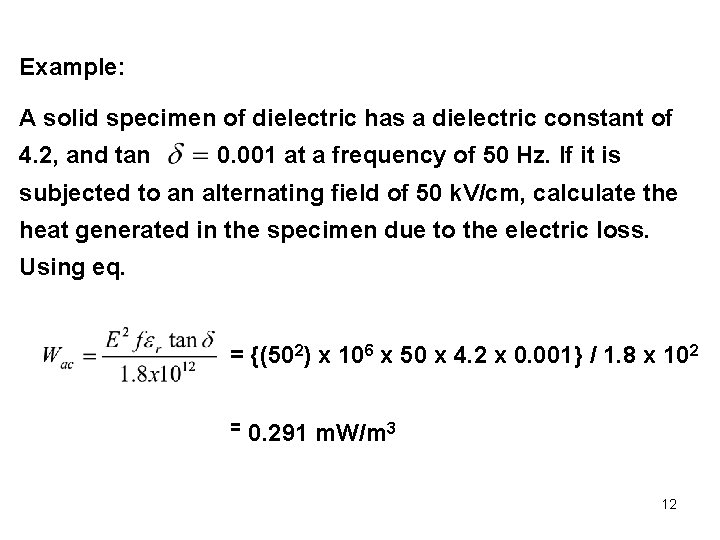
Example: A solid specimen of dielectric has a dielectric constant of 4. 2, and tan 0. 001 at a frequency of 50 Hz. If it is subjected to an alternating field of 50 k. V/cm, calculate the heat generated in the specimen due to the electric loss. Using eq. = {(502) x 106 x 50 x 4. 2 x 0. 001} / 1. 8 x 102 = 0. 291 m. W/m 3 12
BD OF SOLID DIELECTRICS IN PRACTICE BD actually can occurred after prolonged operation, and can be classified in two e. g • BD due to Treeing and Tracking • Chemical and Electrochemical BD • BD due to internal discharges 13
Chemical and Electrochemical BD The Electrochemical BD caused by transformation such as electrolysis, formation ozone. Failure also occurs due to partial discharges which are brought about in the air pockets inside the insulation. This BD is very important in the impregnated paper insulation used in HV cables and capacitors. In the presence of air and other gases some dielectric materials undergo chemical changes when subjected to continuous electrical stresses. 14
Some of the important chemical reactions that occur are; Oxidation: in the presence Air or O 2 in materials such as rubber and polyethylene undergo oxidation giving rise to surface cracks. Hydrolysis: When moisture or water vapor is present on the surface of a solid dielectric, hydrolysis occurs and the materials such as paper, cotton tape, and other cellulose materials deteriorate very rapidly due to hydrolysis. Plastic like polyethylene undergo changes, and their service life considerably reduces. 15
Chemical action: progressive chemical degradation of insulating materials can occurs due to variety of processes such as chemical instability at high temperature, oxidation and cracking in the presence of air or ozone, and hydrolysis due to moisture and heat. 16
BD due to Tracking and Treeing BD due to tracking in which dry conducting tracks are formed on the insulator surface leading to gradual bd along the surface of the insulator. When a solid dielectric subjected to electrical stresses for long time fails, normally two kinds of visible markings are observed on the electric materials. They are 1. The presence of a conducting path across the surface of insulation 2. Leakage current passes through the conducting path finally leading to the formation of a spark. This spark causes insulation deterioration occurs. 17
Tracking is the formation of a continuous conducting path across the surface of the insulation mainly due to surface erosion under voltage application. The spreading of a spark channels during tracking, in the form of the branches of the tree is called treeing. Tracking occurs even at very low voltages of the order of a bout 100 V, whereas treeing requires high voltage Treeing occurs due to the erosion of material at the tips of the spark. Erosion results in the roughening of the surface and hence becomes a source of dirt contamination. Under a. c voltage condition treeing can occur in a few minutes or several hours. . 18
Treeing can be prevented by having clean, dry, and undamaged surface and a clean environment. The material chosen should be resistant to tracking. Standard testing for tracking: IEC 587 (1984), ASTM-D 495 (1973) etc. Sometimes moistures repellant greases are used. But this needs frequent cleaning and regressing. Treeing phenomenon is observed in capacitors and cables, and extensive work is being done to investigate the real and natural causes of this phenomenon. 19
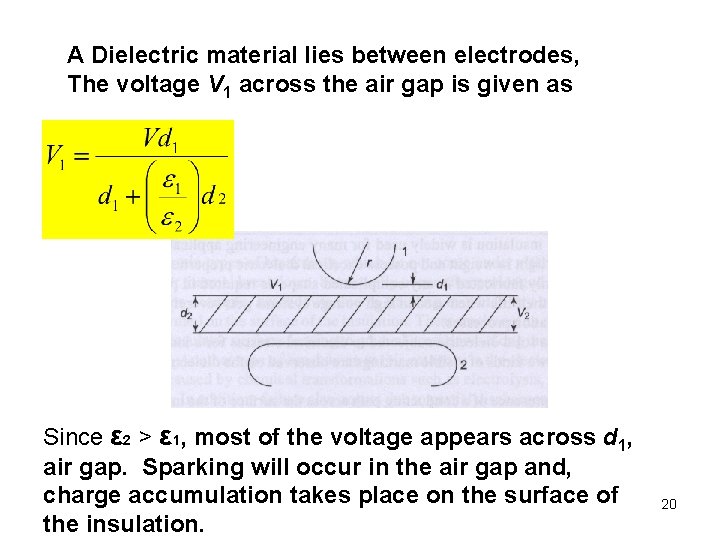
A Dielectric material lies between electrodes, The voltage V 1 across the air gap is given as Since ε 2 > ε 1, most of the voltage appears across d 1, air gap. Sparking will occur in the air gap and, charge accumulation takes place on the surface of the insulation. 20
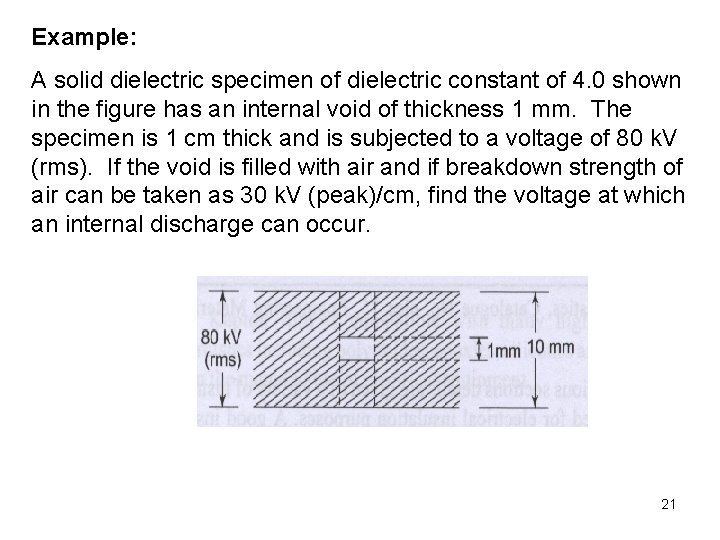
Example: A solid dielectric specimen of dielectric constant of 4. 0 shown in the figure has an internal void of thickness 1 mm. The specimen is 1 cm thick and is subjected to a voltage of 80 k. V (rms). If the void is filled with air and if breakdown strength of air can be taken as 30 k. V (peak)/cm, find the voltage at which an internal discharge can occur. 21
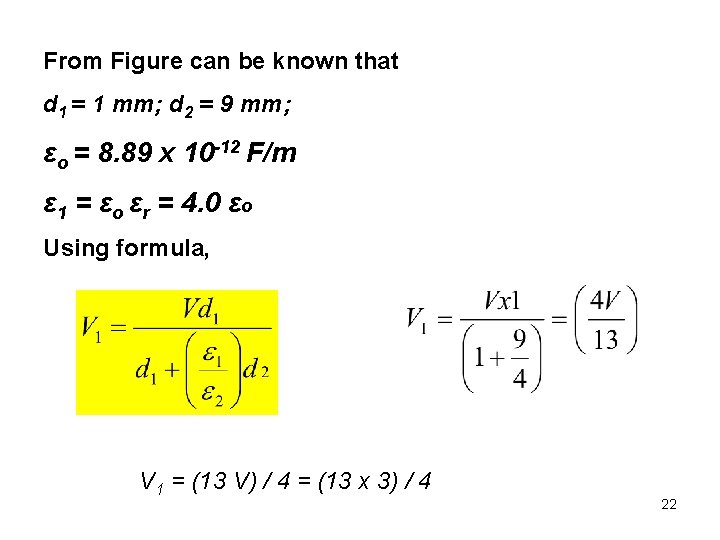
From Figure can be known that d 1 = 1 mm; d 2 = 9 mm; εo = 8. 89 x 10 -12 F/m ε 1 = εo εr = 4. 0 εo Using formula, V 1 = (13 V) / 4 = (13 x 3) / 4 22
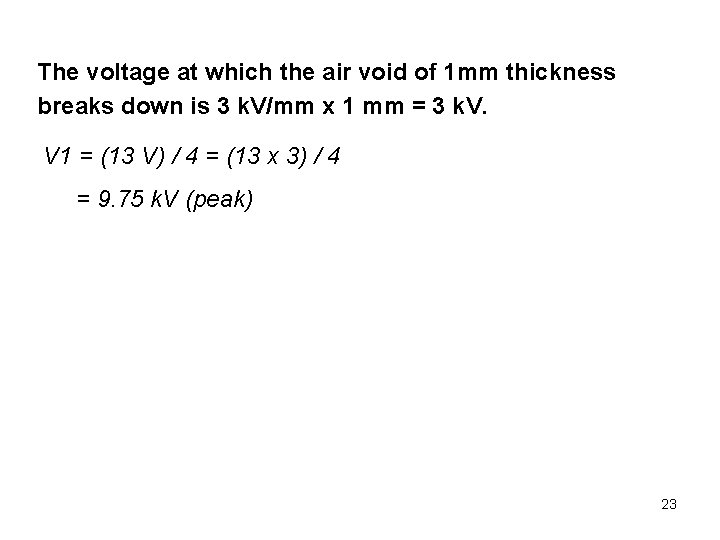
The voltage at which the air void of 1 mm thickness breaks down is 3 k. V/mm x 1 mm = 3 k. V. V 1 = (13 V) / 4 = (13 x 3) / 4 = 9. 75 k. V (peak) 23

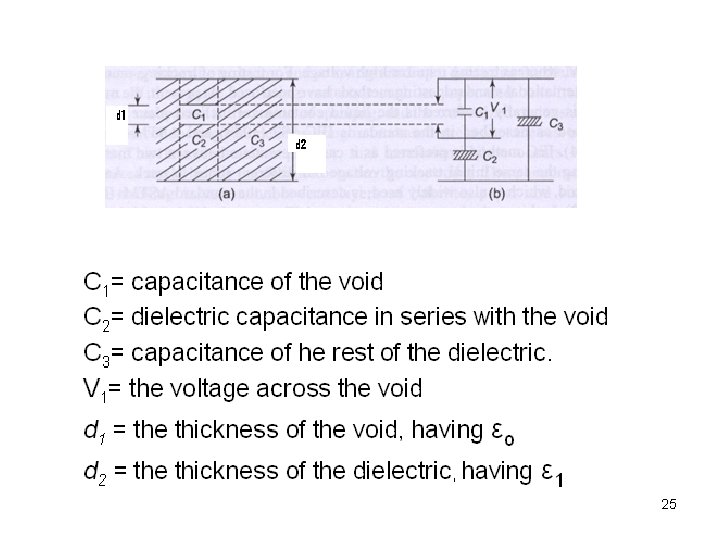
BD due to Internal Discharges Solid insulating materials contain voids or cavities within the medium or at the boundaries between the dielectric and the electrodes. These voids are generally filled with a medium of lower dielectric strength, and the dielectric constant of the medium in the voids is lower than that insulation. Hence the electric field higher than that across the dielectric. Therefore, even under normal working voltages the field in the voids may exceed their BD value, and BD occur. 24
25
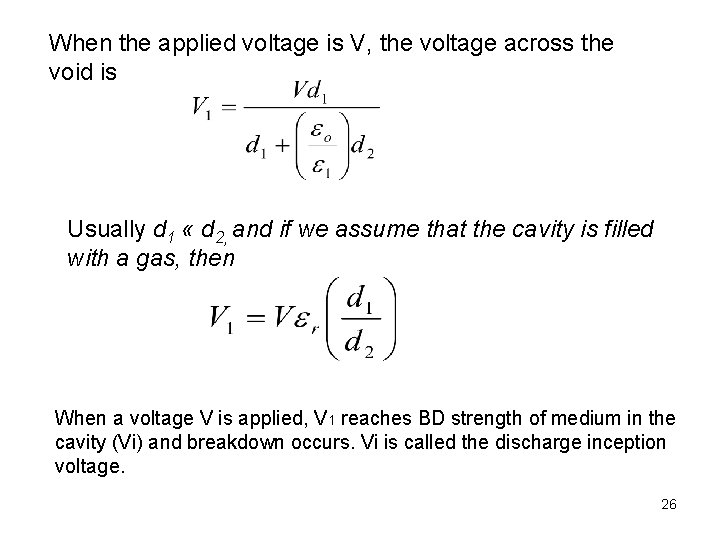
When the applied voltage is V, the voltage across the void is Usually d 1 « d 2, and if we assume that the cavity is filled with a gas, then When a voltage V is applied, V 1 reaches BD strength of medium in the cavity (Vi) and breakdown occurs. Vi is called the discharge inception voltage. 26
BD IN COMPOSITE DIELECTRIC • Composite materials are composed of different chemical substances or with materials of different compositions in series or parallel. • Chemical reactions occurs when a voltage is applied to them and there will be a substantial increase, if the applied voltage is continuous and high temperature are present. • These conditions, the composites undergo chemical deterioration leading to reduction in both the electrical and mechanical strength. • example composite Solid/solid : Cable Solid/Liquid : Capacitor, transformer, oil-filled switchgear Solid/SF 6 : Circuit breaker etc 27
Composite Dielectric Properties of the layered construction a). Effect of multiple layers b). Effect of layer thickness c). Effect of Interfaces Effect of multiple layers The simplest dielectric composite consist of two layers of the same material. Advantages * Have a higher dielectric strength than single sheet of the same total thickness * Have a wide variation in dielectric strength values at different points on its surface 28
Effect of Layer Thickness • Increase in layer thickness gives increased BD voltage BD channels occur at the interface only not directly through another layer. • Layered construction is very important in the case of insulating paper since the paper thickness itself varies from point to point and consequently the dielectric strength across its surface is not homogeneous. 29
• The differences in the thickness impart a rough surface to paper which can produce an electric field stress comparable to that of the discharge channel. • The rough surface of the paper also helps in better impregnation when tightly wound. The existence of areas with lower thickness in the paper can cause BD at these point at considerably lower voltage 30
Effect of interface Discharge usually occur at the interfaces and the magnitude of the discharge depend on the associated surface resistance and capacitance. If the surface conductivity increase, the discharge magnitude also increases, resulting in damage to the dielectric. The others composite dielectric properties • The discharge inception voltage depends on the thickness of the solid dielectric, the dielectric constant of the both • The difference in the dielectric constant between the liquid and solid does not significantly affect the rate of change of electric field at the electrode edge 31
MECHANISME OF BREAKDOWN IN COMPOSITE DIELECTRICS Short-term breakdown, If the electric field stresses are very high, failure may occur in seconds or even faster without any substantial damage to the insulating surface prior to BD. Its due to result from one or more discharges when the applied voltage is close to the breakdown value. rapidly when the electric field in the insulation is such that assists the Breakdown occurs more charged particles in the discharge to penetrate into insulation. 32
Long-term Breakdown, is also the ageing of insulation. This BD result in process thermal and partial discharge. Partial discharge normally occur within volume of the composite insulation systems. The charge accumulation and conduction on the surface of the insulation also contributes significantly toward the ageing and failure of insulation. i) Ageing and breakdown due to partial discharge ii) Ageing and breakdown due to accumulation of charge on insulator surface. 33
SOLID DIELECTRICS USED IN PRACTICE Organic materials Inorganic materials Synthetic polymers Organic Materials Produced from vegetable or animal matter Good insulators and can be easily adopted for practical application Mechanical and electrical properties always deteriorate rapidly when temperature exceed 100 C degree. Used after treating with a varnish or impregnation with an oil. For example: paper and press board used in cables, capacitors and transformers. 34
Inorganic Material Mechanical and electrical properties, not show appreciable reduction temperature up to 250 C degree. For example: glasses and ceramics resistance to atmospheric pollutant, excellent performance under varying conditions of temperature and pressure. widely used for insulators, bushing. Synthetic polymers Posses excellent insulating properties Easy fabricated and applied to the apparatus Have low melting temperature in the range 100 – 120 C degree Very flexible and can be molded and extruded Widely used for bushing, insulators etc. 35
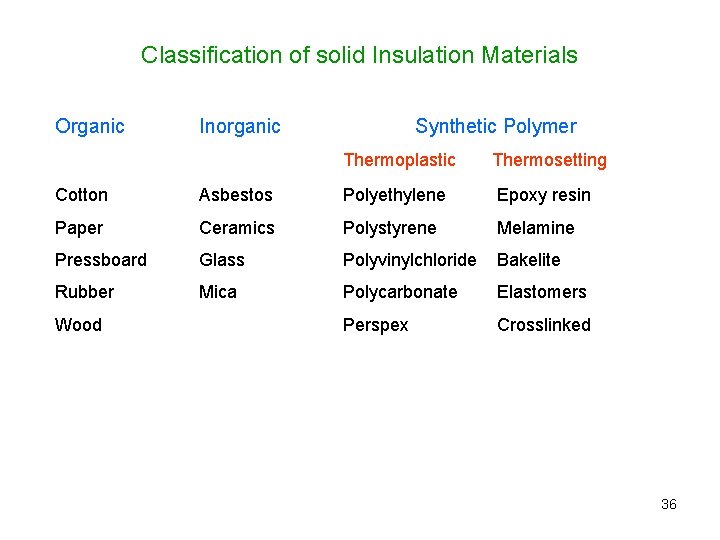
Classification of solid Insulation Materials Organic Inorganic Synthetic Polymer Thermoplastic Thermosetting Cotton Asbestos Polyethylene Epoxy resin Paper Ceramics Polystyrene Melamine Pressboard Glass Polyvinylchloride Bakelite Rubber Mica Polycarbonate Elastomers Perspex Crosslinked Wood 36
Paper and Boards Paper is hygroscopic, Tissue paper or Kraft paper used for insulation purposes. Pressboard used in transformers and bushings as supporting materials and insulating barrier. Fibres When used for electrical purposes will have the ability to combine strength And durability with extreme fineness and flexibility. Types of fibres: cotton, jute, falx, wool, silk, nylon, teflon and fibreglass Fibreglass absorb very little water and hence have very high resistance. Mica Posses high dielectric strength (700 kv/mm-1000 k. V/mm), low dielectric losses (0. 03), good mechanical strength, resistance to high temperature. 37

Glass Dielectric constant varies 3. 7 – 10 Dielectric loss varies 0. 004 – 0. 02 Dielectric strength varies 3000 to 5000 k. V/cm and decrease with Increase temperature. Used as a cover and for internal supports in electric bulb, capacitor. Ceramics Can be divided two groups: Low permittivity ceramics ( εr <12) are used as insulators High permittivity ceramics ( εr >12) are used as Capacitors Rubber High elastic properties. General impurities, chemical changes due to aging, moisture content, variation in temperature and frequency have effect on the electrical properties of rubber. 38

Plastic Epoxy resin Polyester Polystyrenes 39

40
- Slides: 40