
Chapter 4 B SOLAR IRRADIATION CALCULATION Agami Reddy
Chapter 4 B: SOLAR IRRADIATION CALCULATION Agami Reddy (rev- Dec 2018) 1. 2. 3. Extraterrestrial solar radiation and solar constant Calculation of extraterrestrial irradiation Effect of atmosphere on incoming solar radiation: attenuation, direct, diffuse and global radiation 4. Measuring instruments 5. Air mass 6. ASHRAE clear sky model for beam and diffuse radiation 7. Transposition models- radiation on flat inclined surfaces - isotropic and anistropic models 8. Statistical correlation models- monthly mean values - radiation on vertical surfaces - daily diffuse from daily global - hourly diffuse and global from daily global and diffuse HCB-3 Chap 4 B: Solar Irradiation 1
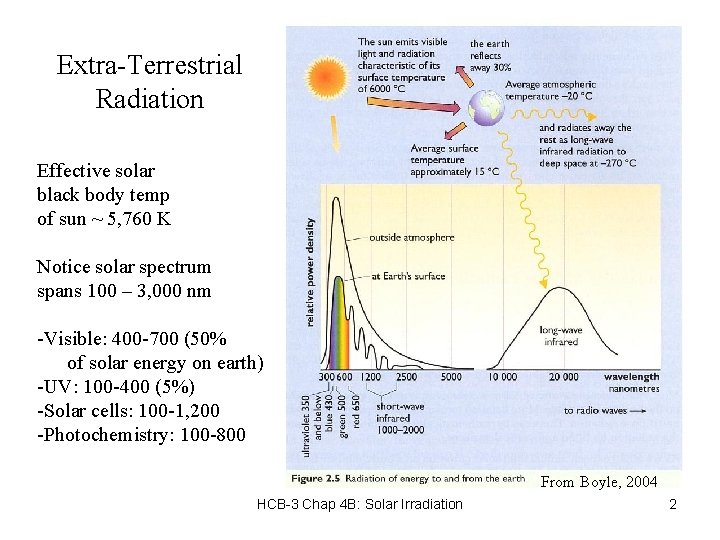
Extra-Terrestrial Radiation Effective solar black body temp of sun ~ 5, 760 K Notice solar spectrum spans 100 – 3, 000 nm -Visible: 400 -700 (50% of solar energy on earth) -UV: 100 -400 (5%) -Solar cells: 100 -1, 200 -Photochemistry: 100 -800 From Boyle, 2004 HCB-3 Chap 4 B: Solar Irradiation 2
Extra-terrestrial Solar Radiation Solar constant: radiation intensity normal to the solar rays outside the atmosphere at the mean sun-earth distance = 1367 W/m 2 Factor causing variability in extra-terrestrial solar radiation - Changes in sun-earth distance over year HCB-3 Chap 4 B: Solar Irradiation 3
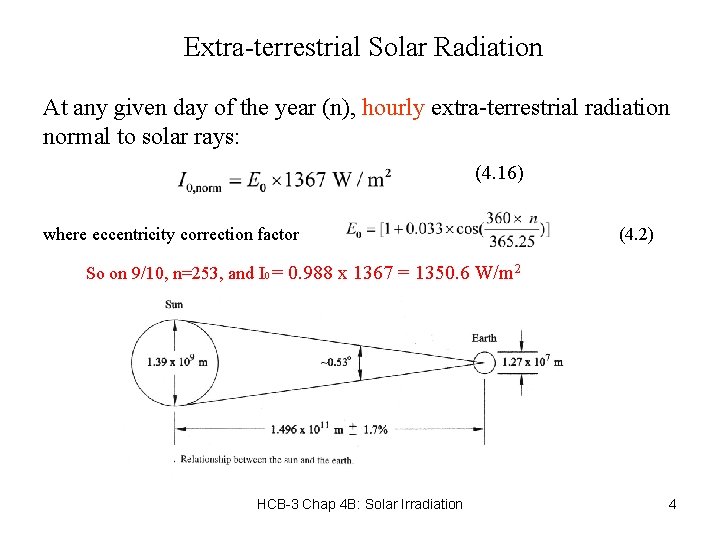
Extra-terrestrial Solar Radiation At any given day of the year (n), hourly extra-terrestrial radiation normal to solar rays: (4. 16) where eccentricity correction factor (4. 2) So on 9/10, n=253, and I 0 = 0. 988 x 1367 = 1350. 6 W/m 2 HCB-3 Chap 4 B: Solar Irradiation 4
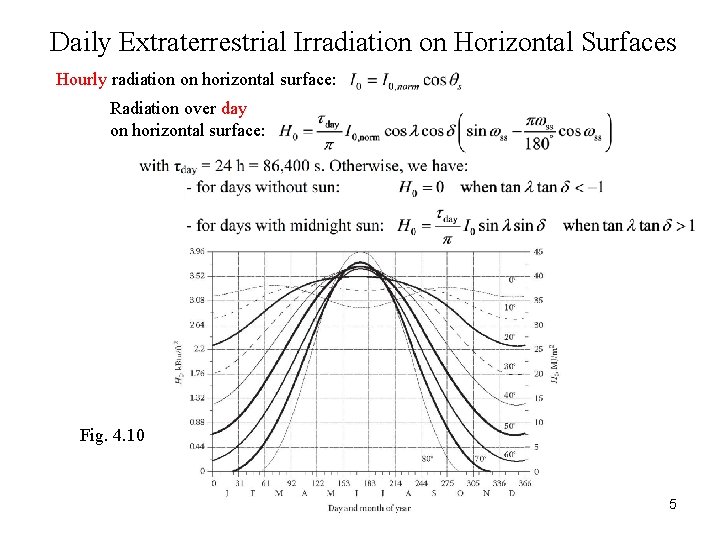
Daily Extraterrestrial Irradiation on Horizontal Surfaces Hourly radiation on horizontal surface: Radiation over day on horizontal surface: Fig. 4. 10 HCB-3 Chap 4 B: Solar Irradiation 5
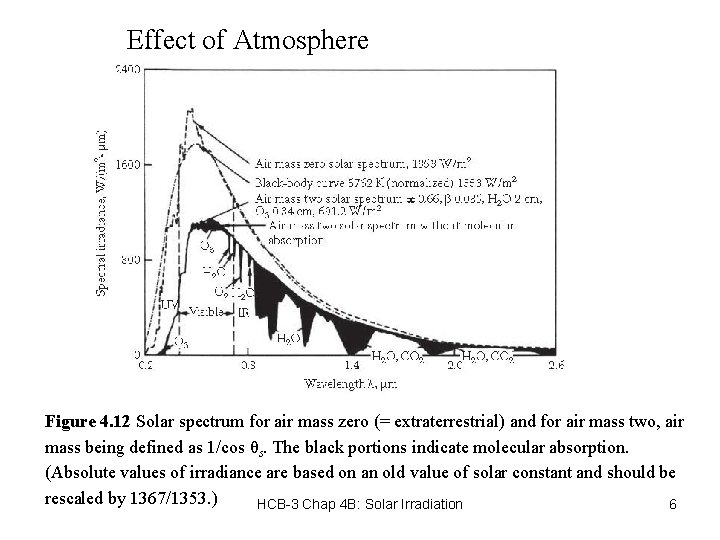
Effect of Atmosphere Figure 4. 12 Solar spectrum for air mass zero (= extraterrestrial) and for air mass two, air mass being defined as 1/cos θs. The black portions indicate molecular absorption. (Absolute values of irradiance are based on an old value of solar constant and should be rescaled by 1367/1353. ) HCB-3 Chap 4 B: Solar Irradiation 6
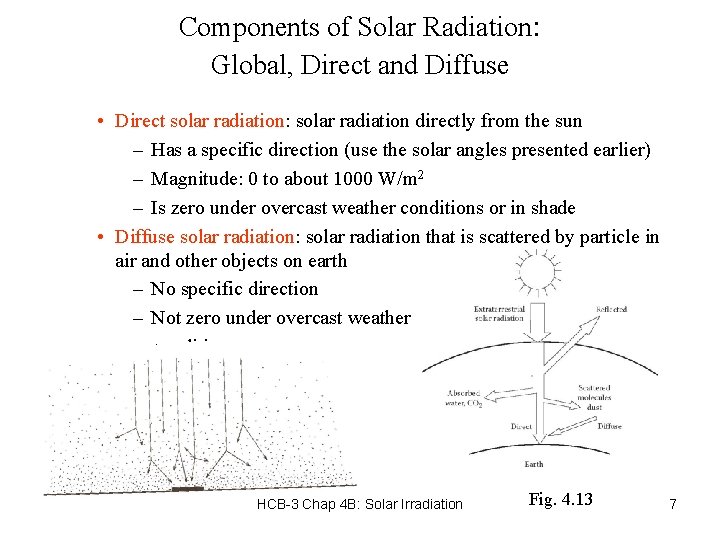
Components of Solar Radiation: Global, Direct and Diffuse • Direct solar radiation: solar radiation directly from the sun – Has a specific direction (use the solar angles presented earlier) – Magnitude: 0 to about 1000 W/m 2 – Is zero under overcast weather conditions or in shade • Diffuse solar radiation: solar radiation that is scattered by particle in air and other objects on earth – No specific direction – Not zero under overcast weather condition or in shade HCB-3 Chap 4 B: Solar Irradiation Fig. 4. 13 7
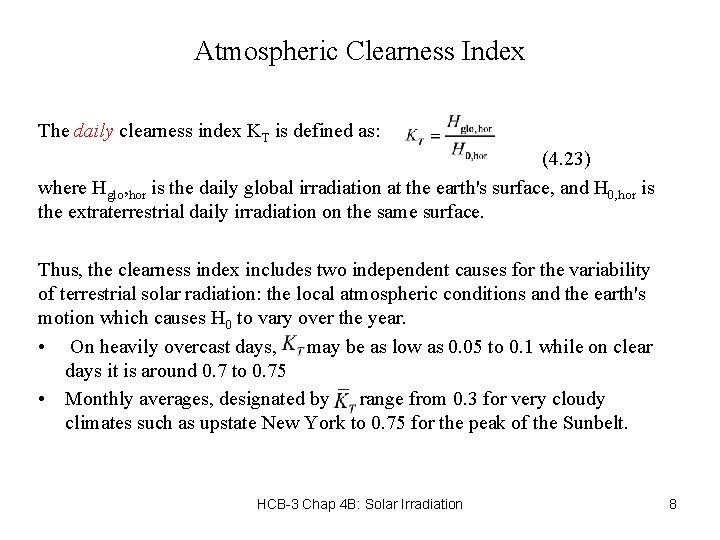
Atmospheric Clearness Index The daily clearness index KT is defined as: (4. 23) where Hglo, hor is the daily global irradiation at the earth's surface, and H 0, hor is the extraterrestrial daily irradiation on the same surface. Thus, the clearness index includes two independent causes for the variability of terrestrial solar radiation: the local atmospheric conditions and the earth's motion which causes H 0 to vary over the year. • On heavily overcast days, may be as low as 0. 05 to 0. 1 while on clear days it is around 0. 7 to 0. 75 • Monthly averages, designated by range from 0. 3 for very cloudy climates such as upstate New York to 0. 75 for the peak of the Sunbelt. HCB-3 Chap 4 B: Solar Irradiation 8
Radiation Availability Three analysis trends: (a) on-site measurements (b) location independent correlations (lot of research done in this area in the 1970 s, 80 s and 90 s when radiation data was limited) (c) Satellite data: remote sensing used to create database (software tools developed where one can use Google-earth to get preliminary cost estimates of various solar installations) HCB-3 Chap 4 B: Solar Irradiation 9
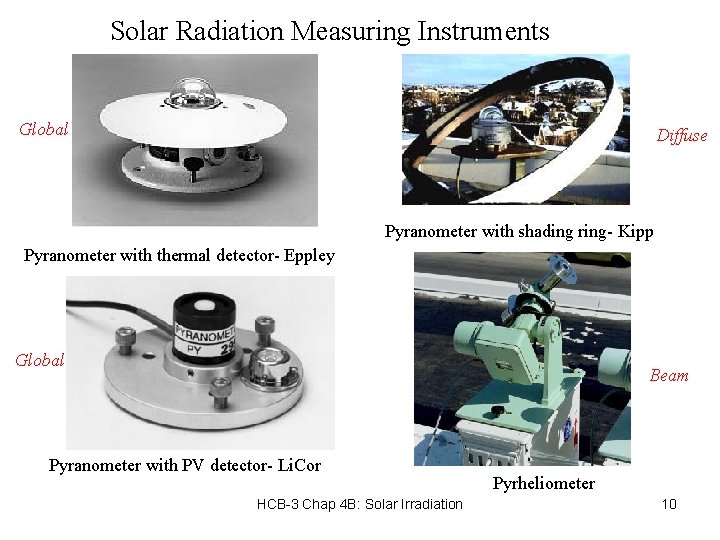
Solar Radiation Measuring Instruments Global Diffuse Pyranometer with shading ring- Kipp Pyranometer with thermal detector- Eppley Global Beam Pyranometer with PV detector- Li. Cor HCB-3 Chap 4 B: Solar Irradiation Pyrheliometer 10
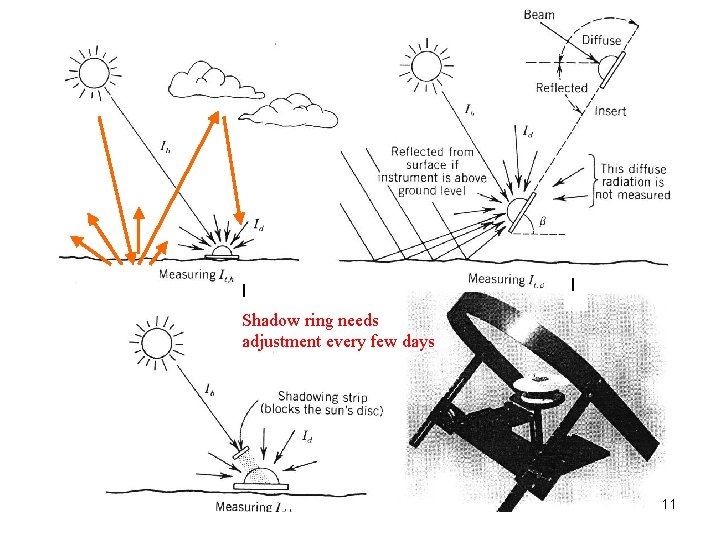
I I Shadow ring needs adjustment every few days HCB-3 Chap 4 B: Solar Irradiation 11
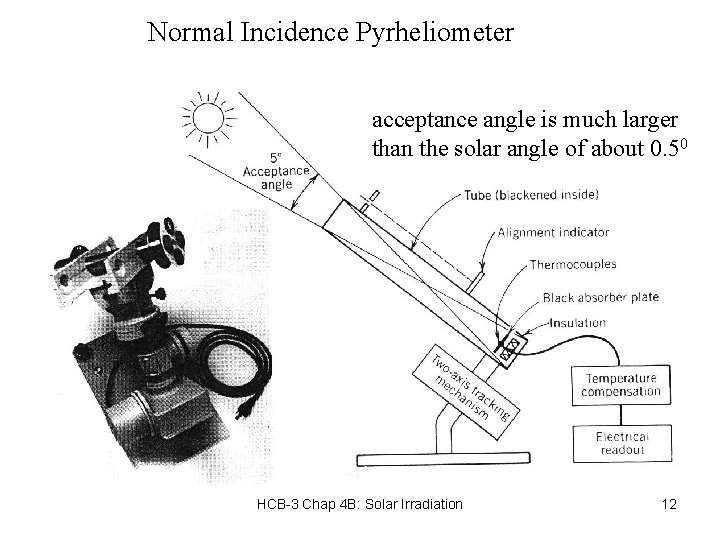
Normal Incidence Pyrheliometer acceptance angle is much larger than the solar angle of about 0. 50 HCB-3 Chap 4 B: Solar Irradiation 12
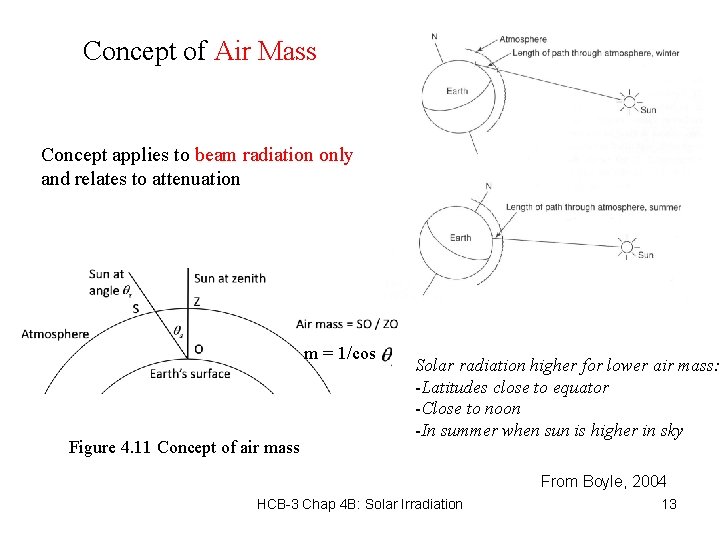
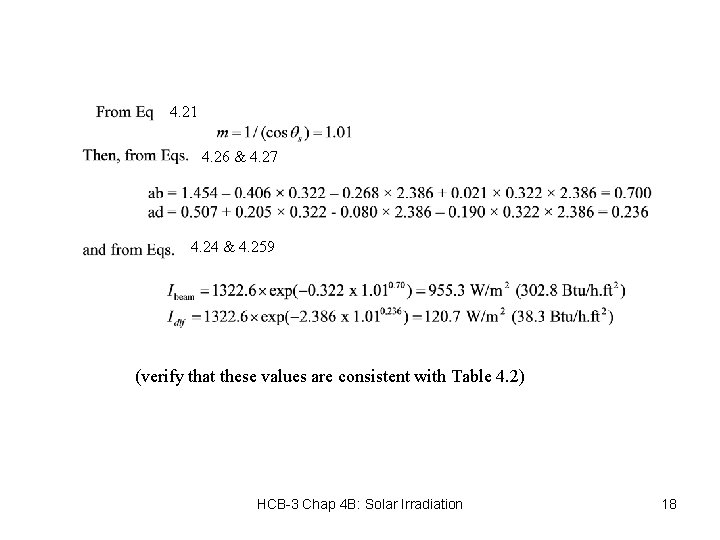
Concept of Air Mass Concept applies to beam radiation only and relates to attenuation m = 1/cos Figure 4. 11 Concept of air mass Solar radiation higher for lower air mass: -Latitudes close to equator -Close to noon -In summer when sun is higher in sky From Boyle, 2004 HCB-3 Chap 4 B: Solar Irradiation 13
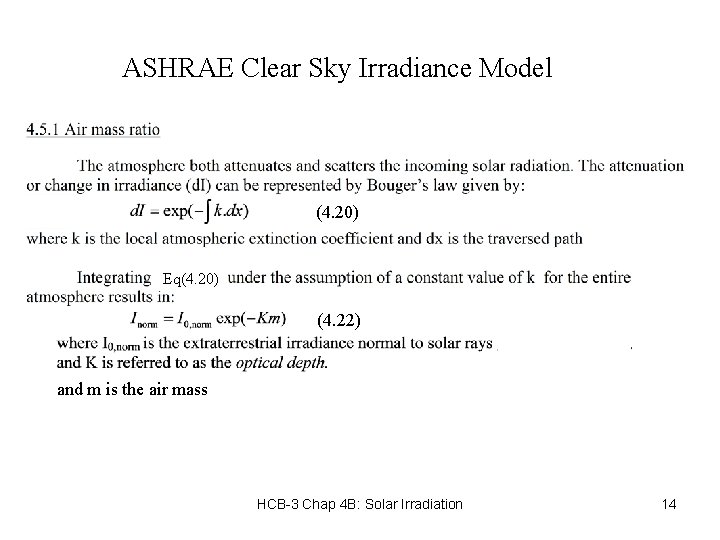
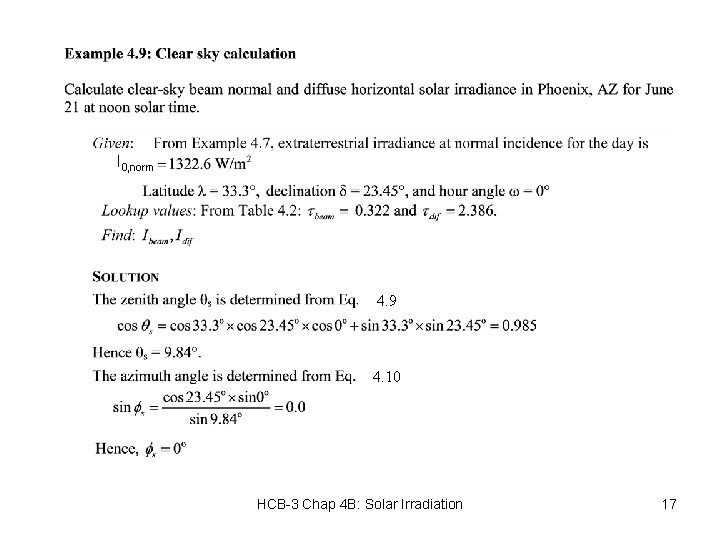
ASHRAE Clear Sky Irradiance Model (4. 20) Eq(4. 20) (4. 22) and m is the air mass HCB-3 Chap 4 B: Solar Irradiation 14
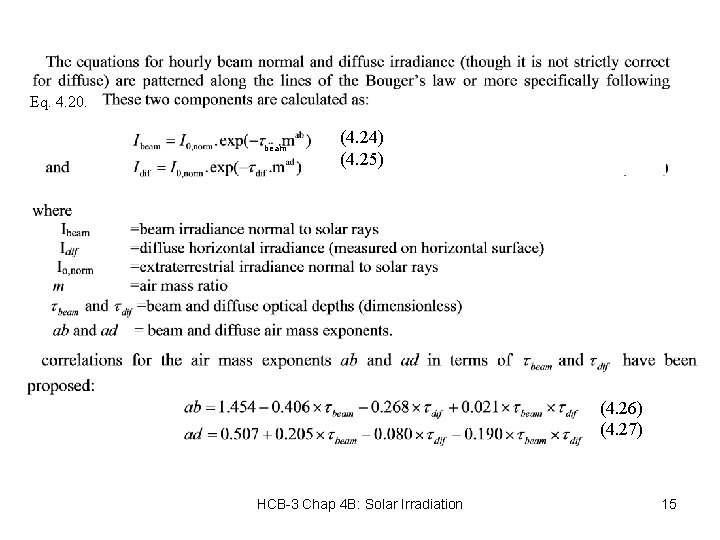
Eq. 4. 20. beam (4. 24) (4. 25) (4. 26) (4. 27) HCB-3 Chap 4 B: Solar Irradiation 15
HCB-3 Chap 4 B: Solar Irradiation 16
I 0, norm 4. 9 4. 10 HCB-3 Chap 4 B: Solar Irradiation 17
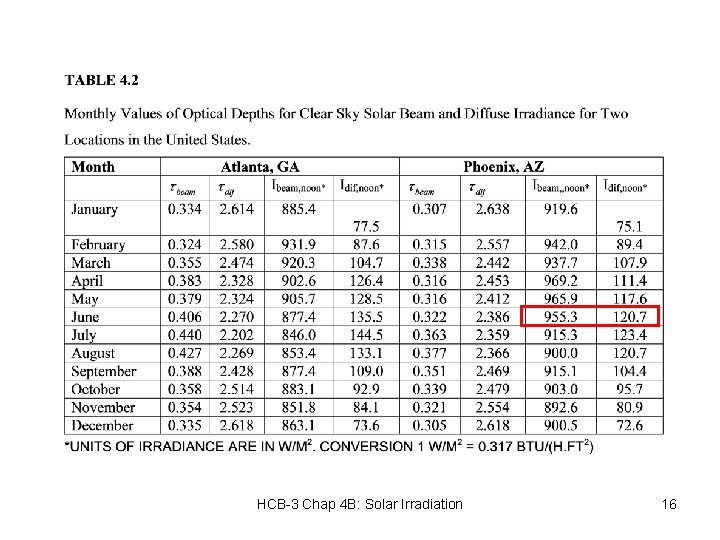
4. 21 4. 26 & 4. 27 4. 24 & 4. 259 (verify that these values are consistent with Table 4. 2) HCB-3 Chap 4 B: Solar Irradiation 18
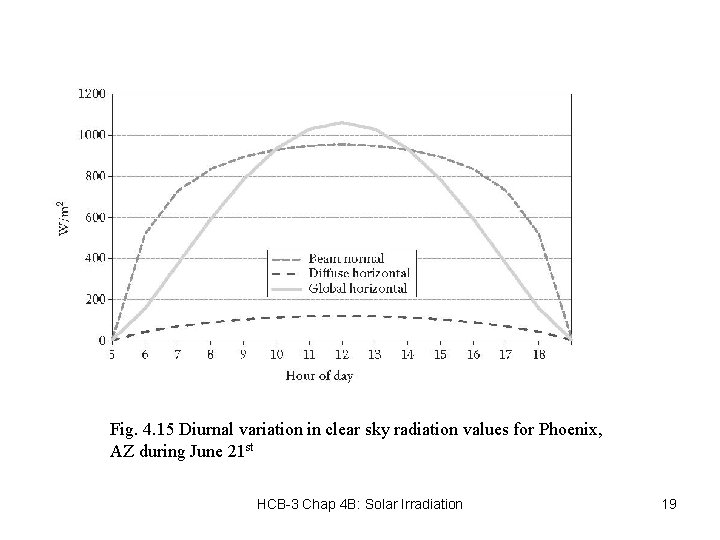
Fig. 4. 15 Diurnal variation in clear sky radiation values for Phoenix, AZ during June 21 st HCB-3 Chap 4 B: Solar Irradiation 19
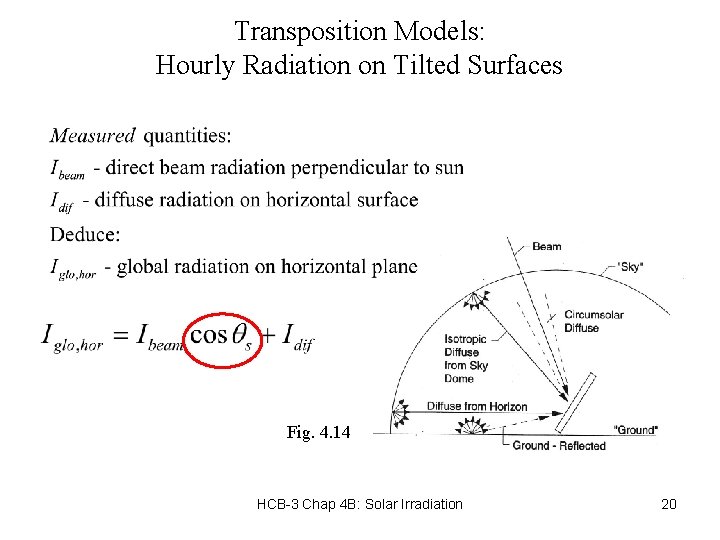
Transposition Models: Hourly Radiation on Tilted Surfaces Fig. 4. 14 HCB-3 Chap 4 B: Solar Irradiation 20
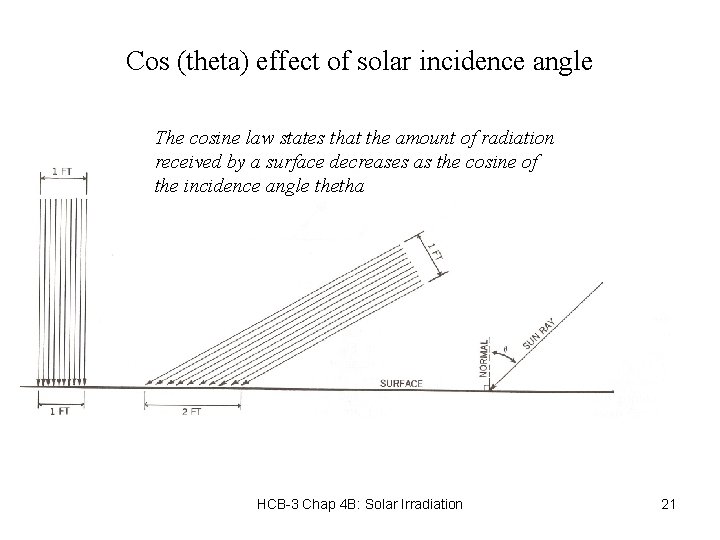
Cos (theta) effect of solar incidence angle The cosine law states that the amount of radiation received by a surface decreases as the cosine of the incidence angle thetha HCB-3 Chap 4 B: Solar Irradiation 21
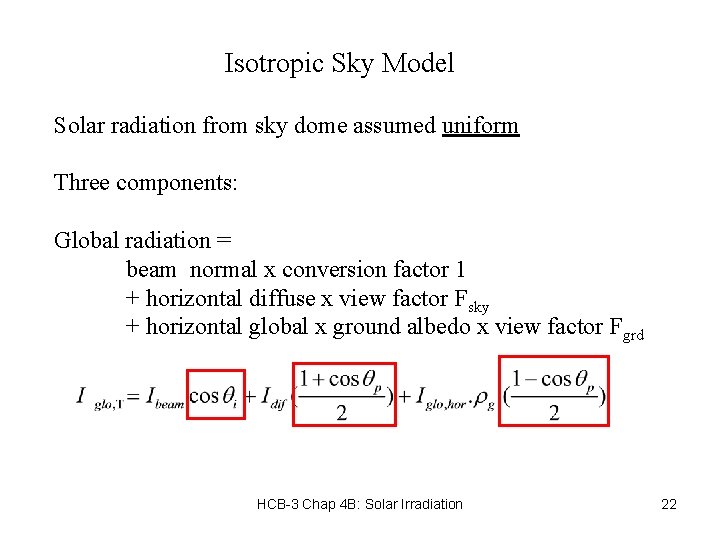
Isotropic Sky Model Solar radiation from sky dome assumed uniform Three components: Global radiation = beam normal x conversion factor 1 + horizontal diffuse x view factor Fsky + horizontal global x ground albedo x view factor Fgrd HCB-3 Chap 4 B: Solar Irradiation 22
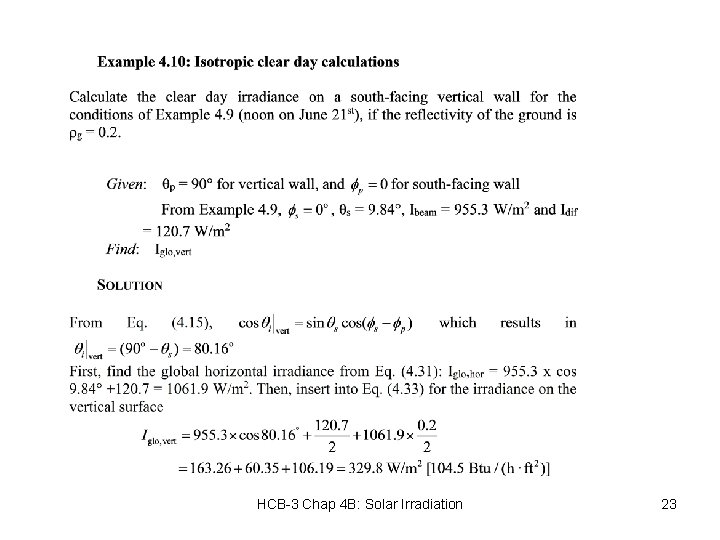
HCB-3 Chap 4 B: Solar Irradiation 23
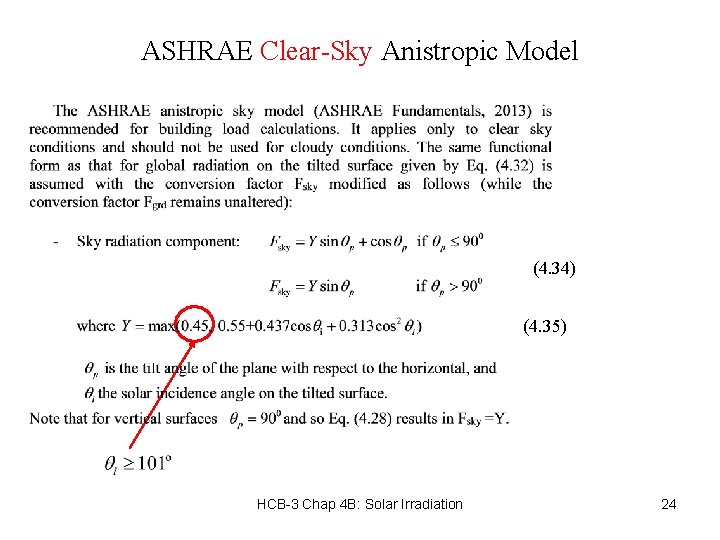
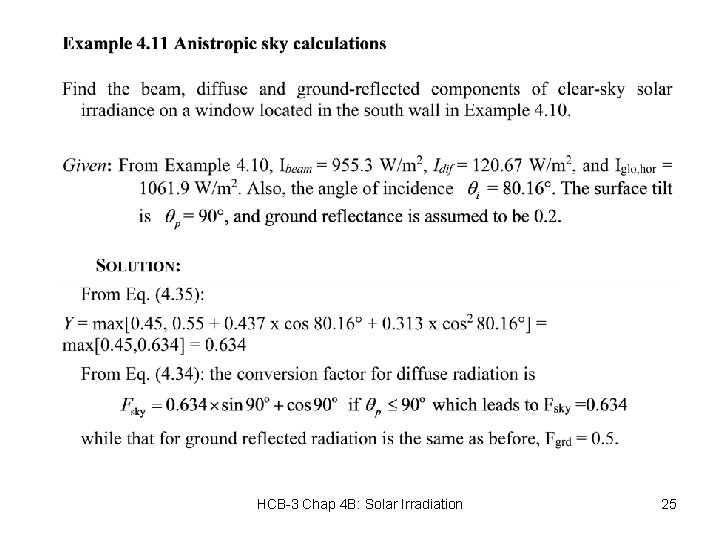
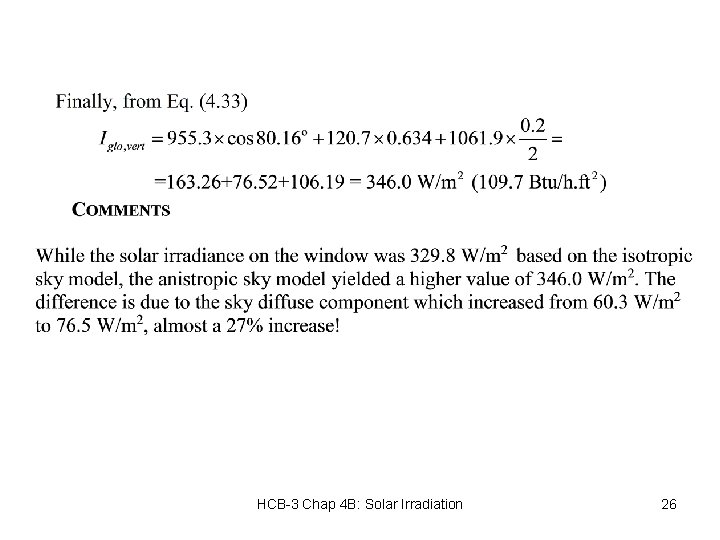
ASHRAE Clear-Sky Anistropic Model (4. 34) (4. 35) HCB-3 Chap 4 B: Solar Irradiation 24
HCB-3 Chap 4 B: Solar Irradiation 25
HCB-3 Chap 4 B: Solar Irradiation 26
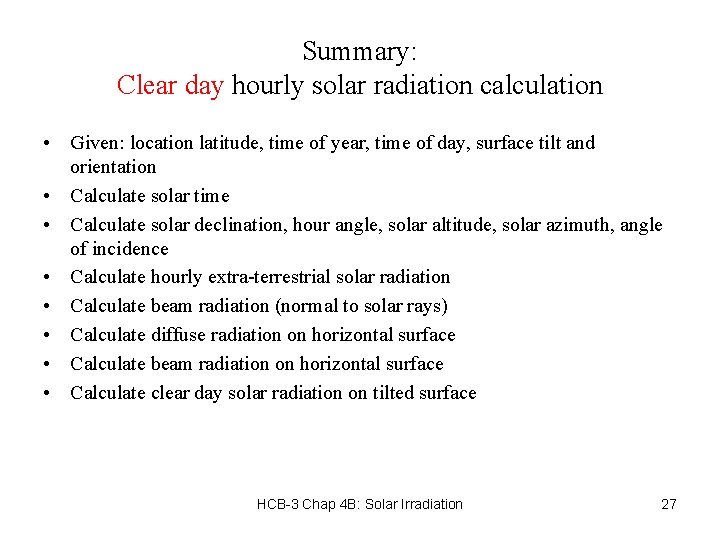
Summary: Clear day hourly solar radiation calculation • Given: location latitude, time of year, time of day, surface tilt and orientation • Calculate solar time • Calculate solar declination, hour angle, solar altitude, solar azimuth, angle of incidence • Calculate hourly extra-terrestrial solar radiation • Calculate beam radiation (normal to solar rays) • Calculate diffuse radiation on horizontal surface • Calculate beam radiation on horizontal surface • Calculate clear day solar radiation on tilted surface HCB-3 Chap 4 B: Solar Irradiation 27
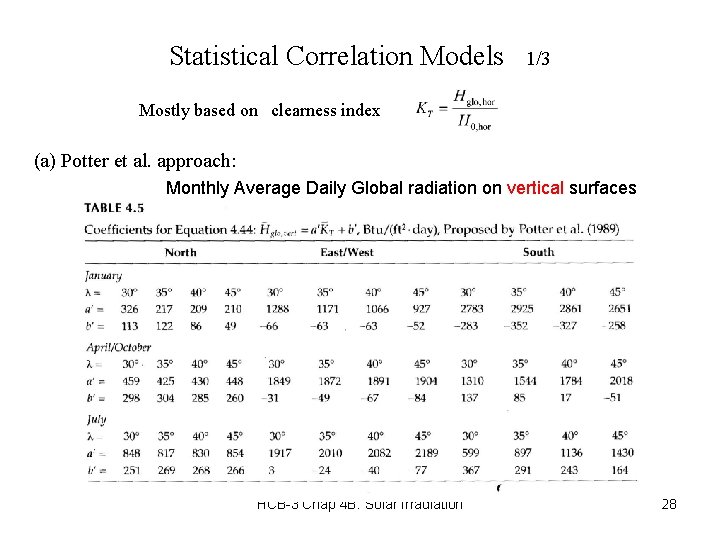
Statistical Correlation Models 1/3 Mostly based on clearness index (a) Potter et al. approach: Monthly Average Daily Global radiation on vertical surfaces HCB-3 Chap 4 B: Solar Irradiation 28
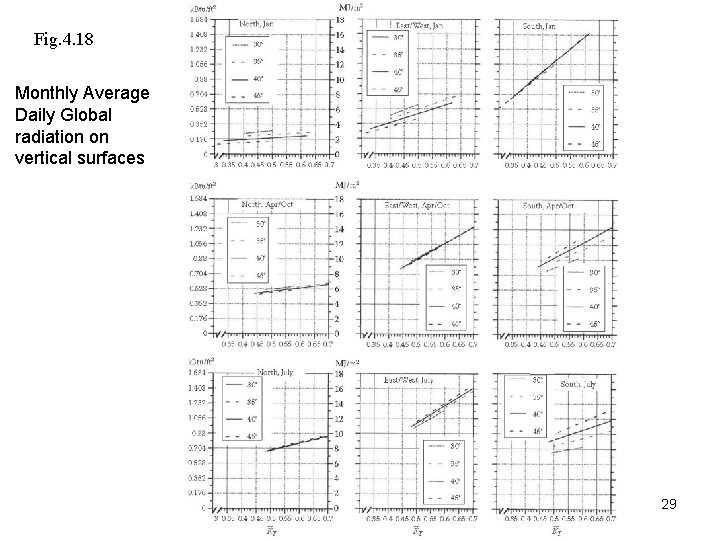
Fig. 4. 18 Monthly Average Daily Global radiation on vertical surfaces HCB-3 Chap 4 B: Solar Irradiation 29
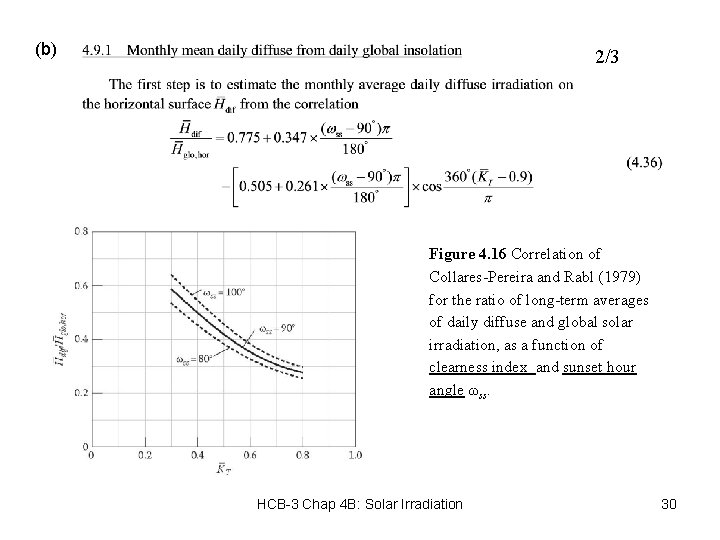
(b) 2/3 Figure 4. 16 Correlation of Collares-Pereira and Rabl (1979) for the ratio of long-term averages of daily diffuse and global solar irradiation, as a function of clearness index and sunset hour angle ωss. HCB-3 Chap 4 B: Solar Irradiation 30
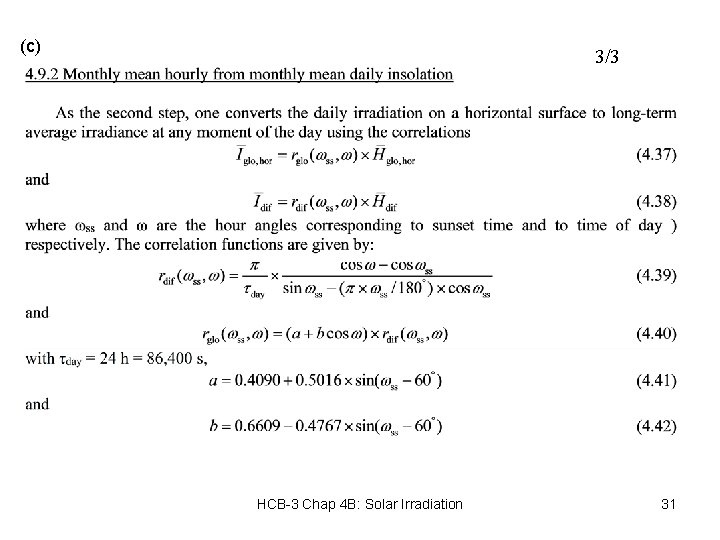
(c) 3/3 HCB-3 Chap 4 B: Solar Irradiation 31
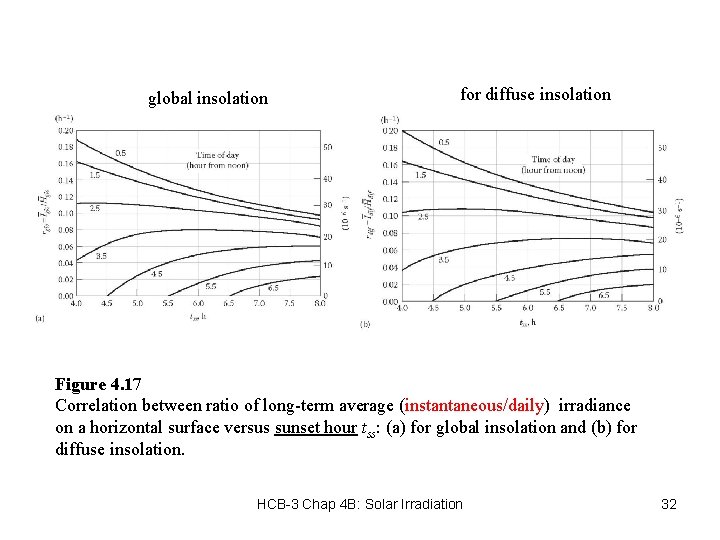
global insolation for diffuse insolation Figure 4. 17 Correlation between ratio of long-term average (instantaneous/daily) irradiance on a horizontal surface versus sunset hour tss: (a) for global insolation and (b) for diffuse insolation. HCB-3 Chap 4 B: Solar Irradiation 32
Outcomes • • • Understanding the concept of solar constant and its magnitude Be able to calculate extraterrestrial irradiation- hourly and daily Understanding effect of atmosphere and clearness index Understanding the different components of solar radiation Working knowledge on how to use the ASHRAE clear-sky model Working knowledge on how to compute radiation on surfaces with arbitrary tilt and orientation using isotropic sky model Working knowledge on how to compute clear sky radiation on surfaces with arbitrary tilt and orientation using ASHRAE anistropic sky model Familiarity with statistical empirical correlations at monthly time scales Working knowledge of how to determine long term radiation on vertical surfaces using the Potter approach HCB-3 Chap 4 B: Solar Irradiation 33
- Slides: 33