
Chapter 4 b parsing UMBC n Honors Univ
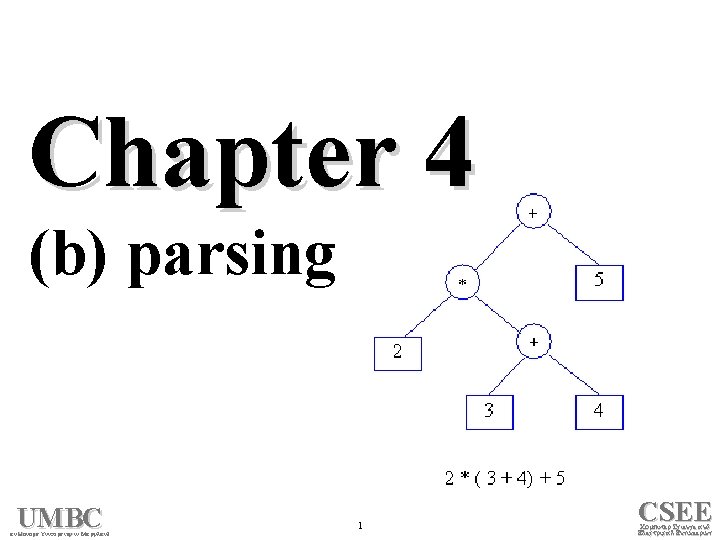
Chapter 4 (b) parsing UMBC n Honors Univ rsity in M ryl n 1 CSEE Comput r Sci nc n El ctric l Engin ring
Parsing • A grammar describes the strings of tokens that are syntactically legal in a PL • A recogniser simply accepts or rejects strings. • A generator produces sentences in the language described by the grammar • A parser construct a derivation or parse tree for a sentence (if possible) • Two common types of parsers: – bottom-up or data driven – top-down or hypothesis driven • A recursive descent parser is a way to implement a top-down parser that is particularly simple. UMBC n Honors Univ rsity in M ryl n 2 CSEE Comput r Sci nc n El ctric l Engin ring
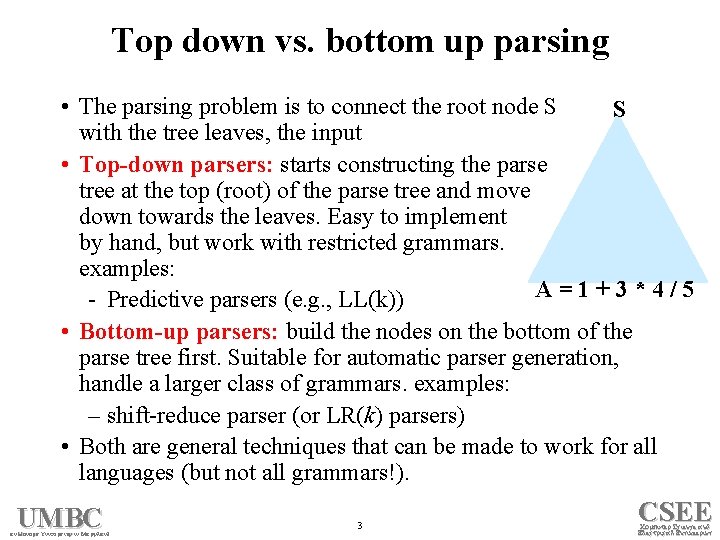
Top down vs. bottom up parsing • The parsing problem is to connect the root node S S with the tree leaves, the input • Top-down parsers: starts constructing the parse tree at the top (root) of the parse tree and move down towards the leaves. Easy to implement by hand, but work with restricted grammars. examples: A=1+3*4/5 - Predictive parsers (e. g. , LL(k)) • Bottom-up parsers: build the nodes on the bottom of the parse tree first. Suitable for automatic parser generation, handle a larger class of grammars. examples: – shift-reduce parser (or LR(k) parsers) • Both are general techniques that can be made to work for all languages (but not all grammars!). UMBC n Honors Univ rsity in M ryl n 3 CSEE Comput r Sci nc n El ctric l Engin ring
Top down vs. bottom up parsing • Both are general techniques that can be made to work for all languages (but not all grammars!). • Recall that a given language can be described by several grammars. • Both of these grammars describe the same language E -> E + Num E -> Num + E E -> Num • The first one, with it’s left recursion, causes problems for top down parsers. • For a given parsing technique, we may have to transform the grammar to work with it. CSEE UMBC n Honors Univ rsity in M ryl n 4 Comput r Sci nc n El ctric l Engin ring
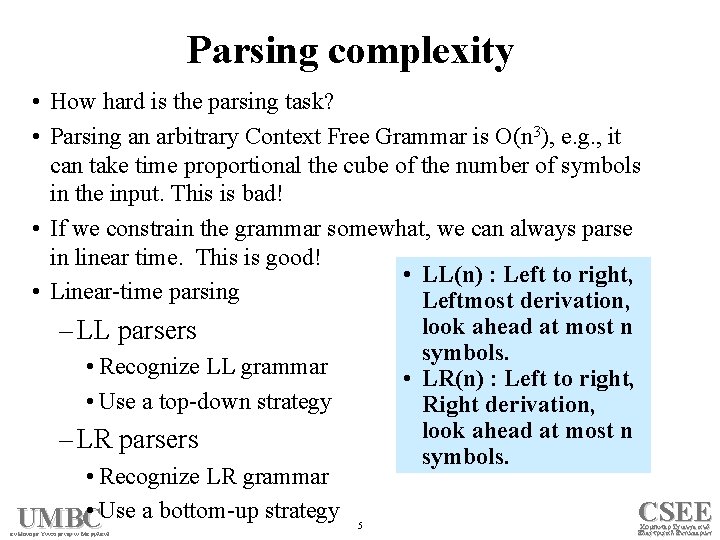
Parsing complexity • How hard is the parsing task? • Parsing an arbitrary Context Free Grammar is O(n 3), e. g. , it can take time proportional the cube of the number of symbols in the input. This is bad! • If we constrain the grammar somewhat, we can always parse in linear time. This is good! • LL(n) : Left to right, • Linear-time parsing Leftmost derivation, look ahead at most n – LL parsers symbols. • Recognize LL grammar • LR(n) : Left to right, • Use a top-down strategy Right derivation, look ahead at most n – LR parsers symbols. • Recognize LR grammar • Use a bottom-up strategy 5 CSEE UMBC n Honors Univ rsity in M ryl n Comput r Sci nc n El ctric l Engin ring
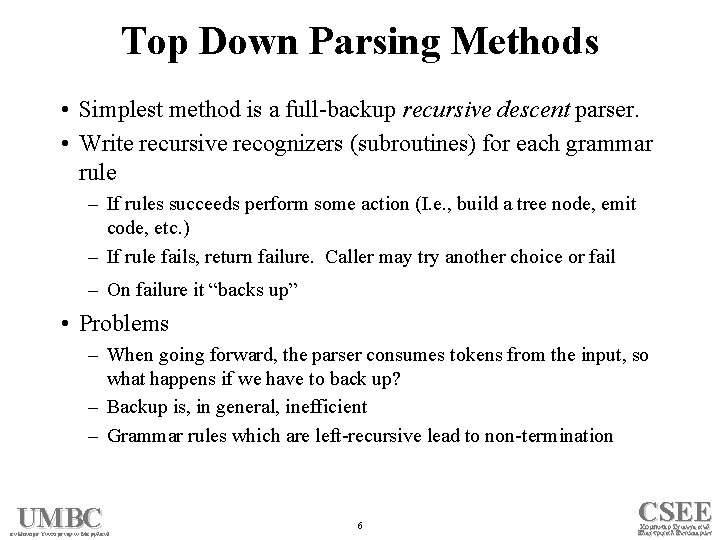
Top Down Parsing Methods • Simplest method is a full-backup recursive descent parser. • Write recursive recognizers (subroutines) for each grammar rule – If rules succeeds perform some action (I. e. , build a tree node, emit code, etc. ) – If rule fails, return failure. Caller may try another choice or fail – On failure it “backs up” • Problems – When going forward, the parser consumes tokens from the input, so what happens if we have to back up? – Backup is, in general, inefficient – Grammar rules which are left-recursive lead to non-termination UMBC n Honors Univ rsity in M ryl n 6 CSEE Comput r Sci nc n El ctric l Engin ring

Recursive Decent Parsing Example: For the grammar: <term> -> <factor> {(*|/)<factor>} We could use the following recursive descent parsing subprogram (this one is written in C) UMBC n Honors Univ rsity in M ryl n void term() { factor(); /* parse first factor*/ while (next_token == ast_code || next_token == slash_code) { lexical(); /* get next token */ factor(); /* parse next factor */ } } 7 CSEE Comput r Sci nc n El ctric l Engin ring
Informal recursive descent parsing UMBC n Honors Univ rsity in M ryl n 8 CSEE Comput r Sci nc n El ctric l Engin ring
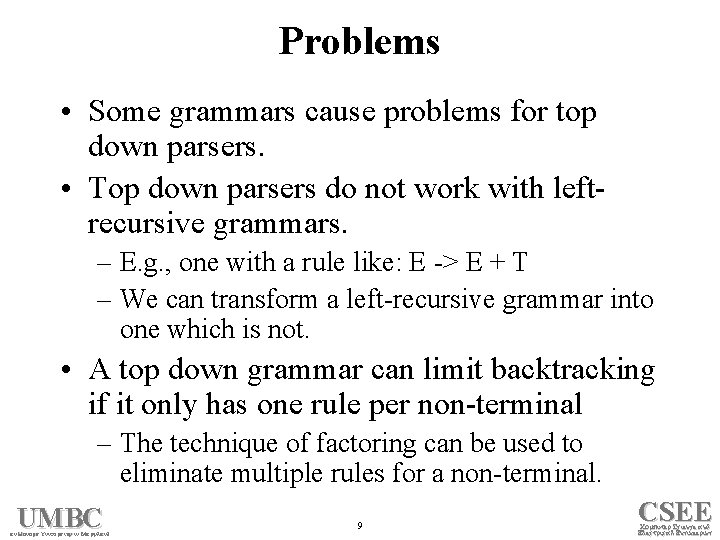
Problems • Some grammars cause problems for top down parsers. • Top down parsers do not work with leftrecursive grammars. – E. g. , one with a rule like: E -> E + T – We can transform a left-recursive grammar into one which is not. • A top down grammar can limit backtracking if it only has one rule per non-terminal – The technique of factoring can be used to eliminate multiple rules for a non-terminal. UMBC n Honors Univ rsity in M ryl n 9 CSEE Comput r Sci nc n El ctric l Engin ring
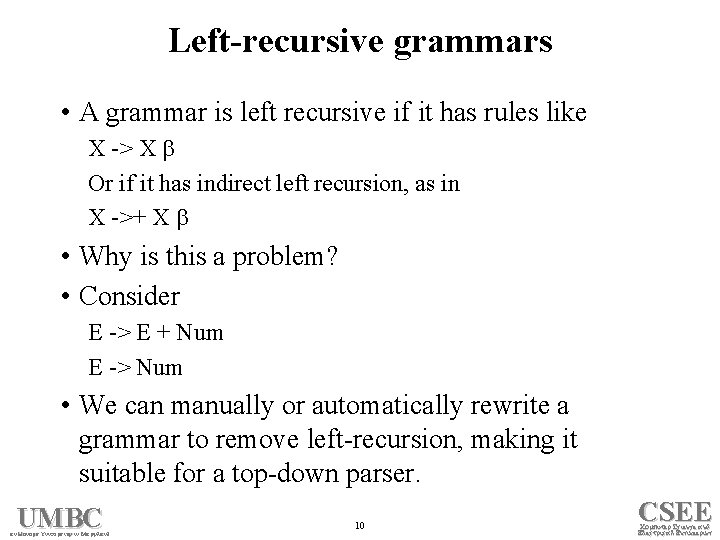
Left-recursive grammars • A grammar is left recursive if it has rules like X -> X Or if it has indirect left recursion, as in X ->+ X • Why is this a problem? • Consider E -> E + Num E -> Num • We can manually or automatically rewrite a grammar to remove left-recursion, making it suitable for a top-down parser. UMBC n Honors Univ rsity in M ryl n 10 CSEE Comput r Sci nc n El ctric l Engin ring
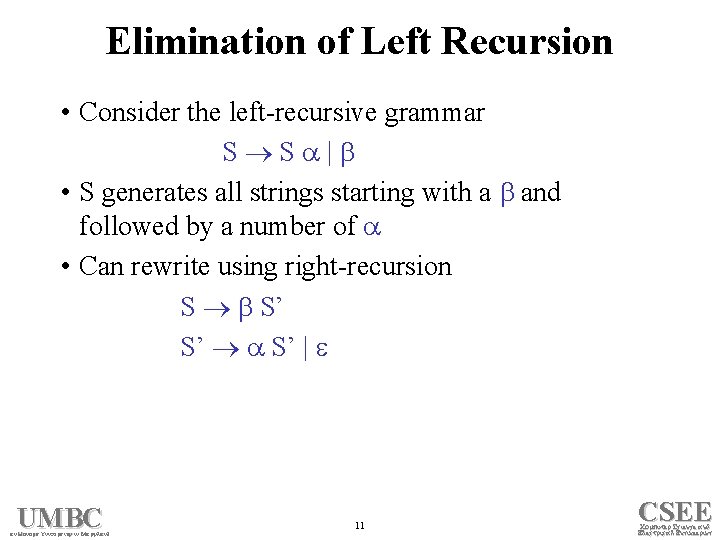
Elimination of Left Recursion • Consider the left-recursive grammar S S | • S generates all strings starting with a and followed by a number of • Can rewrite using right-recursion S S’ S’ S’ | UMBC n Honors Univ rsity in M ryl n 11 CSEE Comput r Sci nc n El ctric l Engin ring
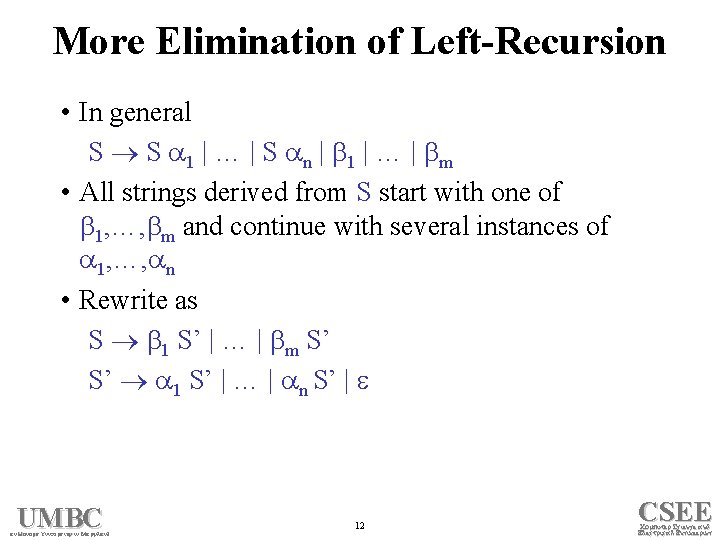
More Elimination of Left-Recursion • In general S S 1 | … | S n | 1 | … | m • All strings derived from S start with one of 1, …, m and continue with several instances of 1, …, n • Rewrite as S 1 S’ | … | m S’ S’ 1 S’ | … | n S’ | UMBC n Honors Univ rsity in M ryl n 12 CSEE Comput r Sci nc n El ctric l Engin ring
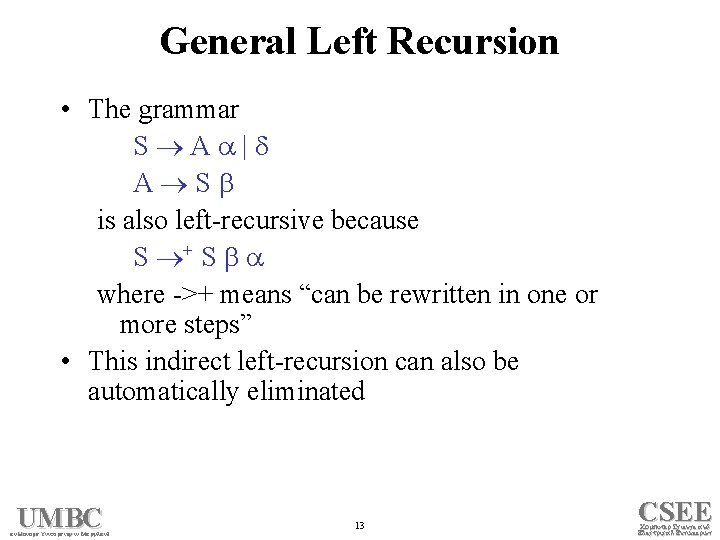
General Left Recursion • The grammar S A | A S is also left-recursive because S + S where ->+ means “can be rewritten in one or more steps” • This indirect left-recursion can also be automatically eliminated UMBC n Honors Univ rsity in M ryl n 13 CSEE Comput r Sci nc n El ctric l Engin ring
Summary of Recursive Descent • Simple and general parsing strategy – Left-recursion must be eliminated first – … but that can be done automatically • Unpopular because of backtracking – Thought to be too inefficient • In practice, backtracking is eliminated by restricting the grammar, allowing us to successfully predict which rule to use. UMBC n Honors Univ rsity in M ryl n 14 CSEE Comput r Sci nc n El ctric l Engin ring
Predictive Parser • A predictive parser uses information from the first terminal symbol of each expression to decide which production to use. • A predictive parser is also known as an LL(k) parser because it does a Left-to-right parse, a Leftmost-derivation, and k-symbol lookahead. • A grammar in which it is possible to decide which production to use examining only the first token (as in the previous example) are called LL(1) • LL(1) grammars are widely used in practice. – The syntax of a PL can be adjusted to enable it to be described with an LL(1) grammar. UMBC n Honors Univ rsity in M ryl n 15 CSEE Comput r Sci nc n El ctric l Engin ring
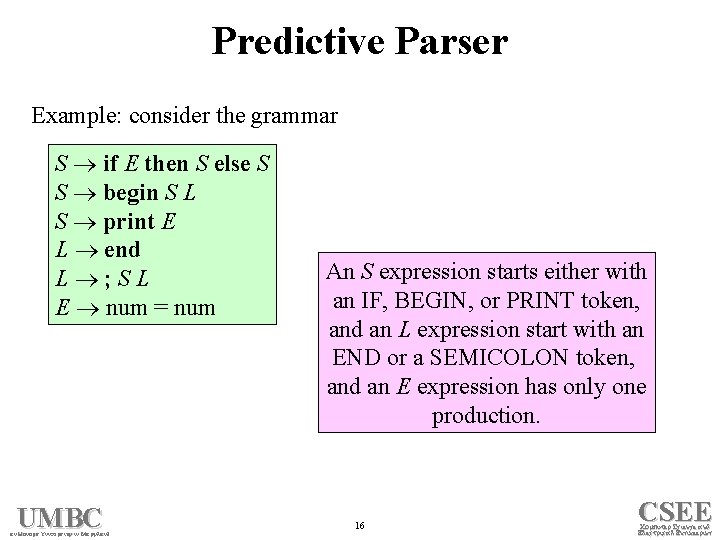
Predictive Parser Example: consider the grammar S if E then S else S S begin S L S print E L end L ; SL E num = num UMBC n Honors Univ rsity in M ryl n An S expression starts either with an IF, BEGIN, or PRINT token, and an L expression start with an END or a SEMICOLON token, and an E expression has only one production. 16 CSEE Comput r Sci nc n El ctric l Engin ring
LL(k) and LR(k) parsers • Two important classes of parsers are called LL(k) parsers and LR(k) parsers. • The name LL(k) means: – L - Left-to-right scanning of the input – L - Constructing leftmost derivation – k – max number of input symbols needed to select a parser action • The name LR(k) means: – L - Left-to-right scanning of the input – R - Constructing rightmost derivation in reverse – k – max number of input symbols needed to select a parser action • So, a LL(1) parser never needs to “look ahead” more than one input token to know what parser production to apply. UMBC n Honors Univ rsity in M ryl n 17 CSEE Comput r Sci nc n El ctric l Engin ring
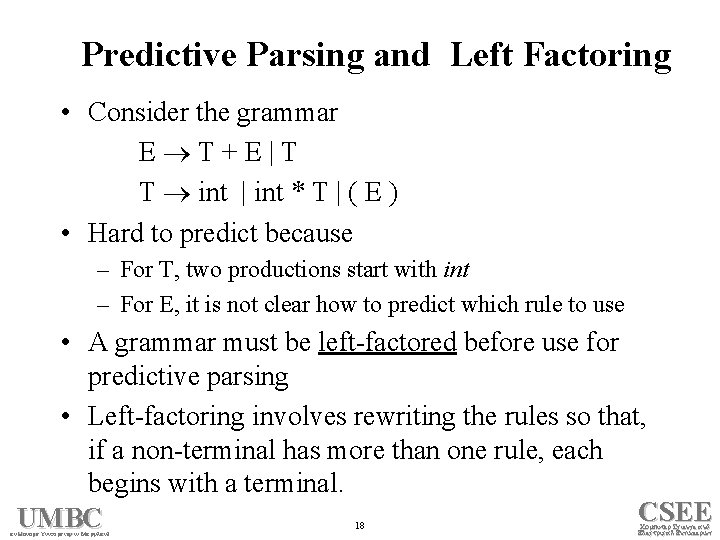
Predictive Parsing and Left Factoring • Consider the grammar E T+E|T T int | int * T | ( E ) • Hard to predict because – For T, two productions start with int – For E, it is not clear how to predict which rule to use • A grammar must be left-factored before use for predictive parsing • Left-factoring involves rewriting the rules so that, if a non-terminal has more than one rule, each begins with a terminal. CSEE UMBC n Honors Univ rsity in M ryl n 18 Comput r Sci nc n El ctric l Engin ring
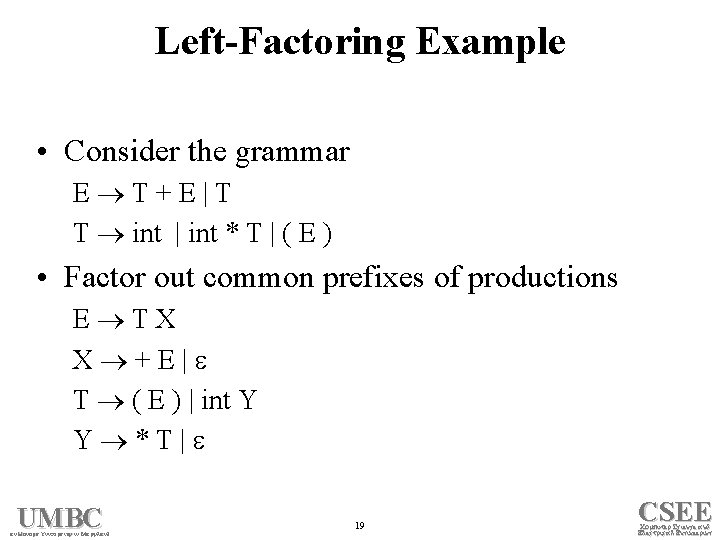
Left-Factoring Example • Consider the grammar E T+E|T T int | int * T | ( E ) • Factor out common prefixes of productions E TX X +E| T ( E ) | int Y Y *T| UMBC n Honors Univ rsity in M ryl n 19 CSEE Comput r Sci nc n El ctric l Engin ring
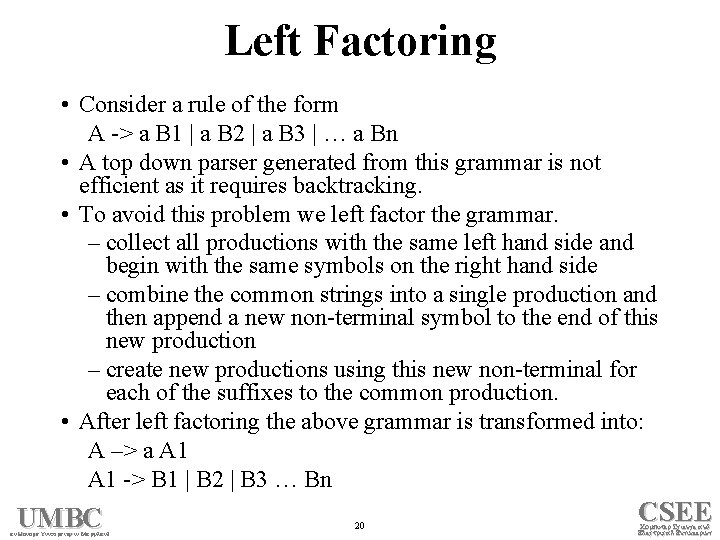
Left Factoring • Consider a rule of the form A -> a B 1 | a B 2 | a B 3 | … a Bn • A top down parser generated from this grammar is not efficient as it requires backtracking. • To avoid this problem we left factor the grammar. – collect all productions with the same left hand side and begin with the same symbols on the right hand side – combine the common strings into a single production and then append a new non-terminal symbol to the end of this new production – create new productions using this new non-terminal for each of the suffixes to the common production. • After left factoring the above grammar is transformed into: A –> a A 1 -> B 1 | B 2 | B 3 … Bn UMBC n Honors Univ rsity in M ryl n 20 CSEE Comput r Sci nc n El ctric l Engin ring
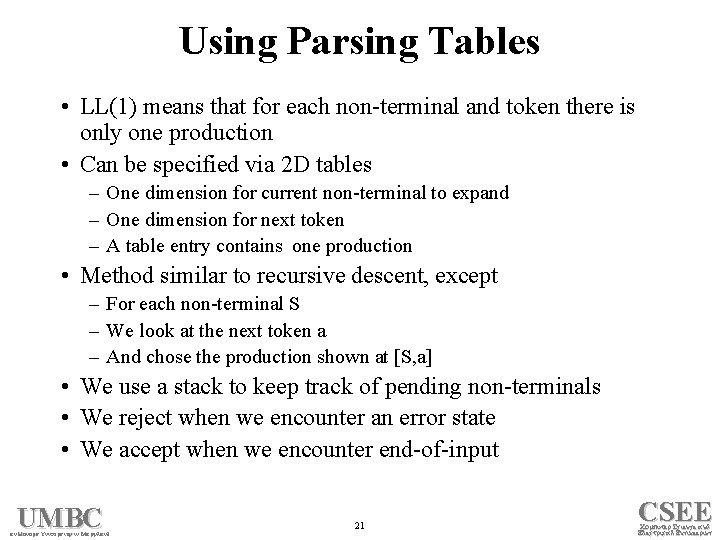
Using Parsing Tables • LL(1) means that for each non-terminal and token there is only one production • Can be specified via 2 D tables – One dimension for current non-terminal to expand – One dimension for next token – A table entry contains one production • Method similar to recursive descent, except – For each non-terminal S – We look at the next token a – And chose the production shown at [S, a] • We use a stack to keep track of pending non-terminals • We reject when we encounter an error state • We accept when we encounter end-of-input UMBC n Honors Univ rsity in M ryl n 21 CSEE Comput r Sci nc n El ctric l Engin ring
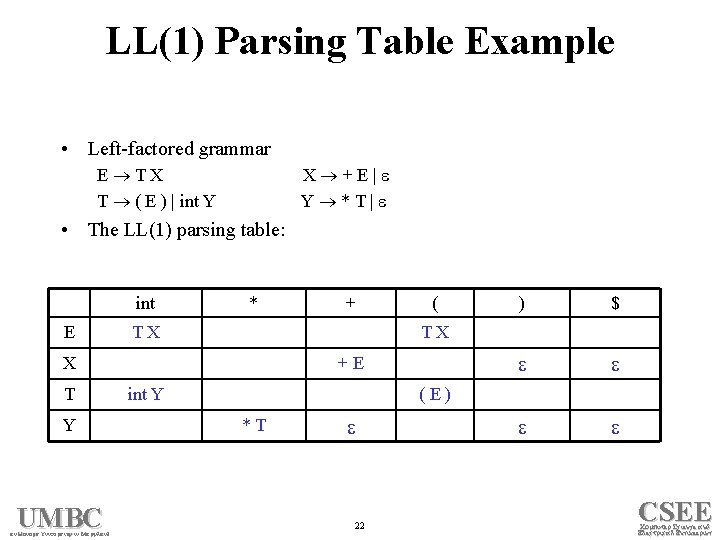
LL(1) Parsing Table Example • Left-factored grammar E TX T ( E ) | int Y X +E| Y *T| • The LL(1) parsing table: int E * TX Y UMBC n Honors Univ rsity in M ryl n ( ) $ TX X T + +E int Y (E) *T 22 CSEE Comput r Sci nc n El ctric l Engin ring
![LL(1) Parsing Table Example • Consider the [E, int] entry – “When current non-terminal](http://slidetodoc.com/presentation_image/87e5d3785b04757dbd6798764c23c7dd/image-23.jpg "LL(1) Parsing Table Example • Consider the [E, int] entry – “When current non-terminal")
LL(1) Parsing Table Example • Consider the [E, int] entry – “When current non-terminal is E and next input is int, use production E T X – This production can generate an int in the first place • Consider the [Y, +] entry – “When current non-terminal is Y and current token is +, get rid of Y” – Y can be followed by + only in a derivation in which Y • Blank entries indicate error situations – Consider the [E, *] entry – “There is no way to derive a string starting with * from non-terminal E” UMBC n Honors Univ rsity in M ryl n 23 CSEE Comput r Sci nc n El ctric l Engin ring
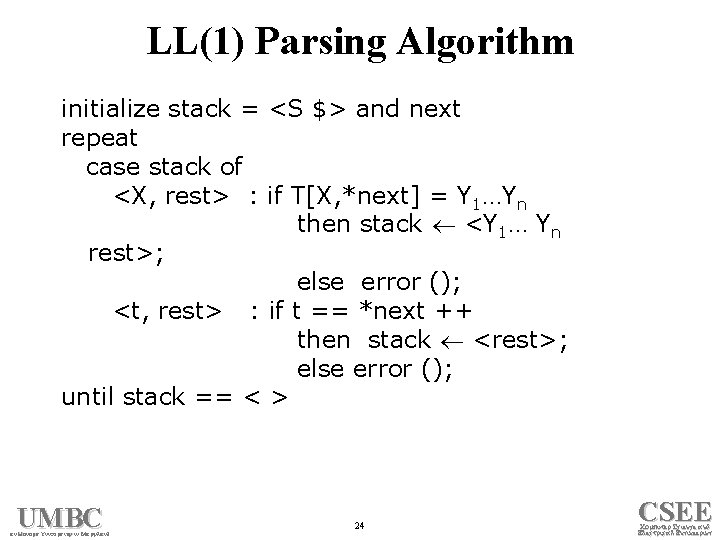
LL(1) Parsing Algorithm initialize stack = <S $> and next repeat case stack of <X, rest> : if T[X, *next] = Y 1…Yn then stack <Y 1… Yn rest>; else error (); <t, rest> : if t == *next ++ then stack <rest>; else error (); until stack == < > UMBC n Honors Univ rsity in M ryl n 24 CSEE Comput r Sci nc n El ctric l Engin ring
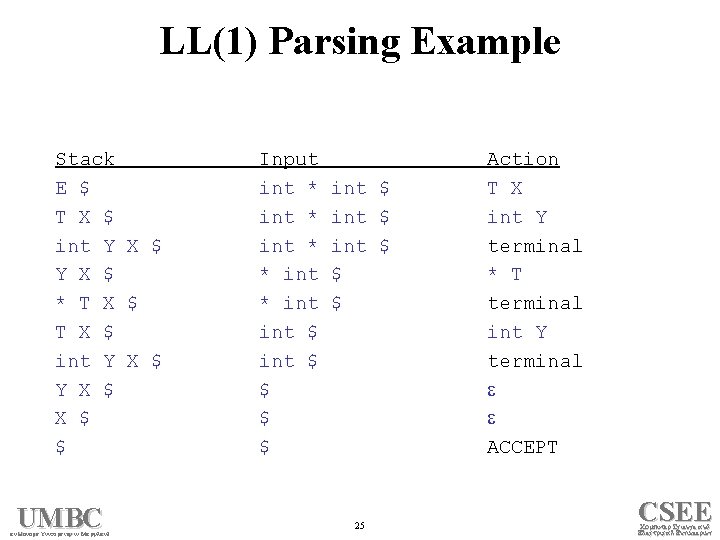
LL(1) Parsing Example Stack E $ T X $ int Y X $ * T X $ int Y X $ X $ $ UMBC n Honors Univ rsity in M ryl n Input int * * int int $ $ $ $ int $ $ $ 25 Action T X int Y terminal * T terminal int Y terminal ACCEPT CSEE Comput r Sci nc n El ctric l Engin ring
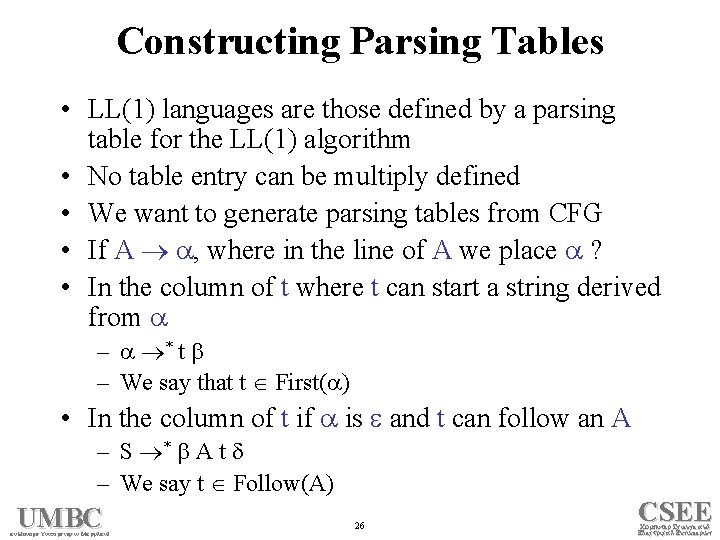
Constructing Parsing Tables • LL(1) languages are those defined by a parsing table for the LL(1) algorithm • No table entry can be multiply defined • We want to generate parsing tables from CFG • If A , where in the line of A we place ? • In the column of t where t can start a string derived from – * t – We say that t First( ) • In the column of t if is and t can follow an A – S * A t – We say t Follow(A) UMBC n Honors Univ rsity in M ryl n 26 CSEE Comput r Sci nc n El ctric l Engin ring
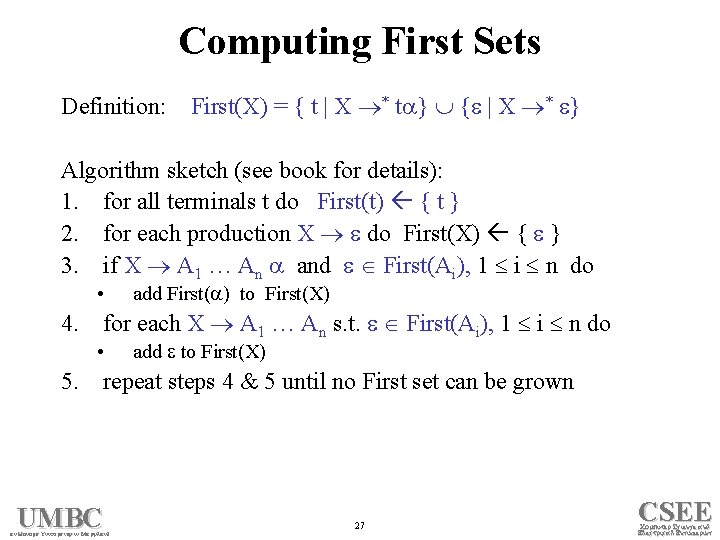
Computing First Sets Definition: First(X) = { t | X * t } { | X * } Algorithm sketch (see book for details): 1. for all terminals t do First(t) { t } 2. for each production X do First(X) { } 3. if X A 1 … An and First(Ai), 1 i n do • add First( ) to First(X) 4. for each X A 1 … An s. t. First(Ai), 1 i n do • add to First(X) 5. repeat steps 4 & 5 until no First set can be grown UMBC n Honors Univ rsity in M ryl n 27 CSEE Comput r Sci nc n El ctric l Engin ring
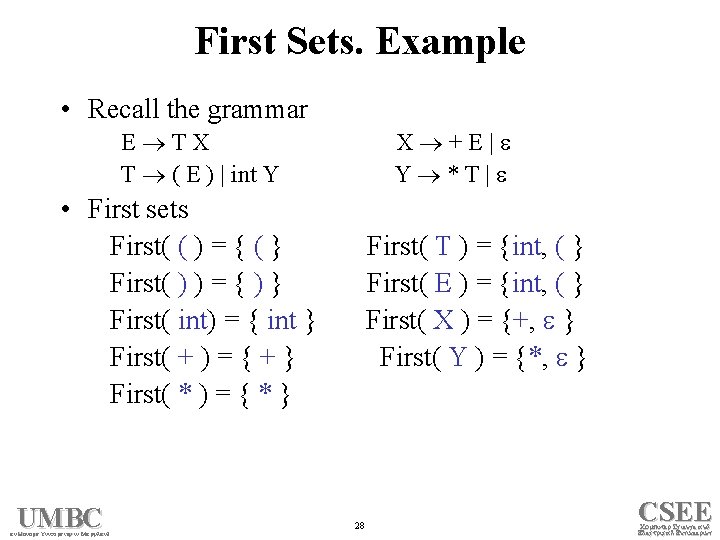
First Sets. Example • Recall the grammar E TX T ( E ) | int Y X +E| Y *T| • First sets First( ( ) = { ( } First( ) ) = { ) } First( int) = { int } First( + ) = { + } First( * ) = { * } UMBC n Honors Univ rsity in M ryl n First( T ) = {int, ( } First( E ) = {int, ( } First( X ) = {+, } First( Y ) = {*, } 28 CSEE Comput r Sci nc n El ctric l Engin ring
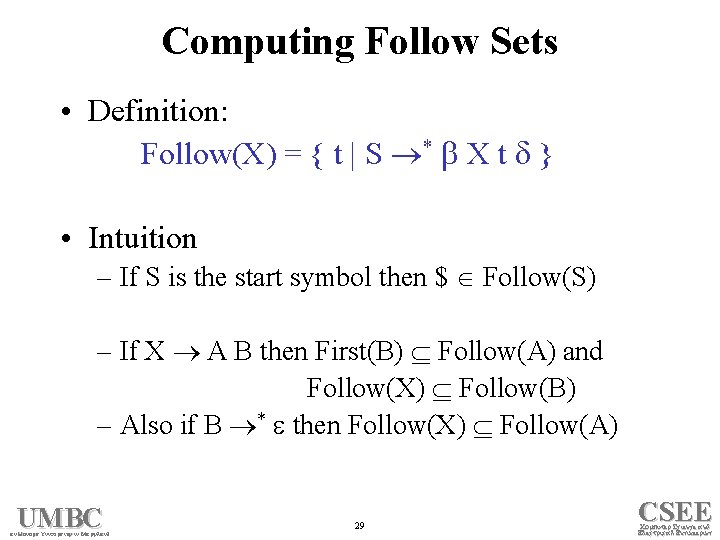
Computing Follow Sets • Definition: Follow(X) = { t | S * X t } • Intuition – If S is the start symbol then $ Follow(S) – If X A B then First(B) Follow(A) and Follow(X) Follow(B) – Also if B * then Follow(X) Follow(A) UMBC n Honors Univ rsity in M ryl n 29 CSEE Comput r Sci nc n El ctric l Engin ring
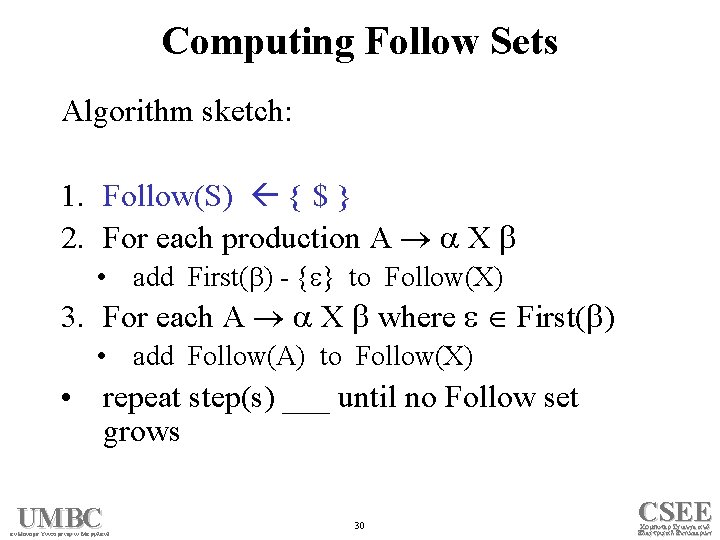
Computing Follow Sets Algorithm sketch: 1. Follow(S) { $ } 2. For each production A X • add First( ) - { } to Follow(X) 3. For each A X where First( ) • add Follow(A) to Follow(X) • repeat step(s) ___ until no Follow set grows UMBC n Honors Univ rsity in M ryl n 30 CSEE Comput r Sci nc n El ctric l Engin ring
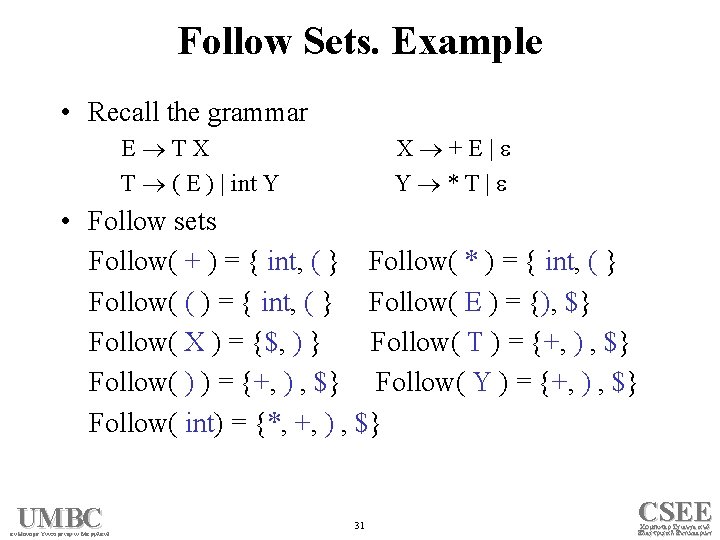
Follow Sets. Example • Recall the grammar E TX T ( E ) | int Y X +E| Y *T| • Follow sets Follow( + ) = { int, ( } Follow( * ) = { int, ( } Follow( ( ) = { int, ( } Follow( E ) = {), $} Follow( X ) = {$, ) } Follow( T ) = {+, ) , $} Follow( ) ) = {+, ) , $} Follow( Y ) = {+, ) , $} Follow( int) = {*, +, ) , $} UMBC n Honors Univ rsity in M ryl n 31 CSEE Comput r Sci nc n El ctric l Engin ring
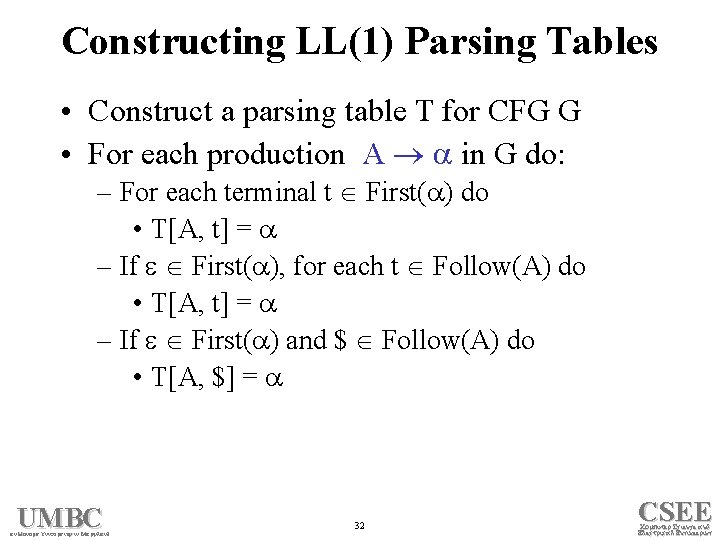
Constructing LL(1) Parsing Tables • Construct a parsing table T for CFG G • For each production A in G do: – For each terminal t First( ) do • T[A, t] = – If First( ), for each t Follow(A) do • T[A, t] = – If First( ) and $ Follow(A) do • T[A, $] = UMBC n Honors Univ rsity in M ryl n 32 CSEE Comput r Sci nc n El ctric l Engin ring
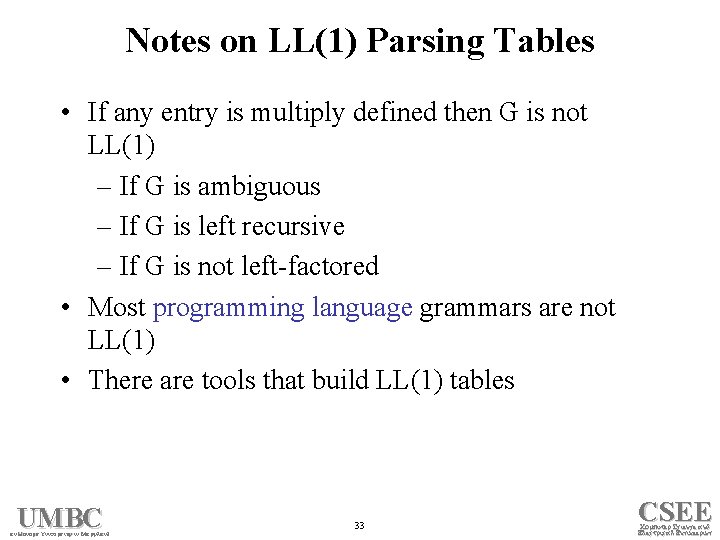
Notes on LL(1) Parsing Tables • If any entry is multiply defined then G is not LL(1) – If G is ambiguous – If G is left recursive – If G is not left-factored • Most programming language grammars are not LL(1) • There are tools that build LL(1) tables UMBC n Honors Univ rsity in M ryl n 33 CSEE Comput r Sci nc n El ctric l Engin ring
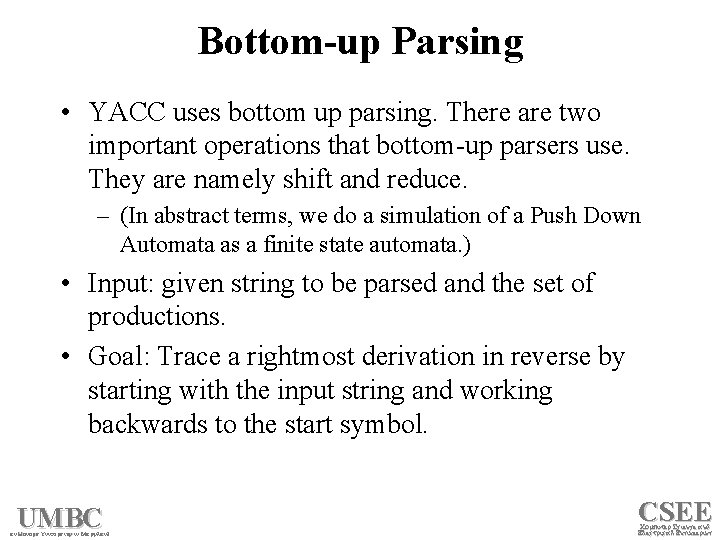
Bottom-up Parsing • YACC uses bottom up parsing. There are two important operations that bottom-up parsers use. They are namely shift and reduce. – (In abstract terms, we do a simulation of a Push Down Automata as a finite state automata. ) • Input: given string to be parsed and the set of productions. • Goal: Trace a rightmost derivation in reverse by starting with the input string and working backwards to the start symbol. UMBC n Honors Univ rsity in M ryl n CSEE Comput r Sci nc n El ctric l Engin ring
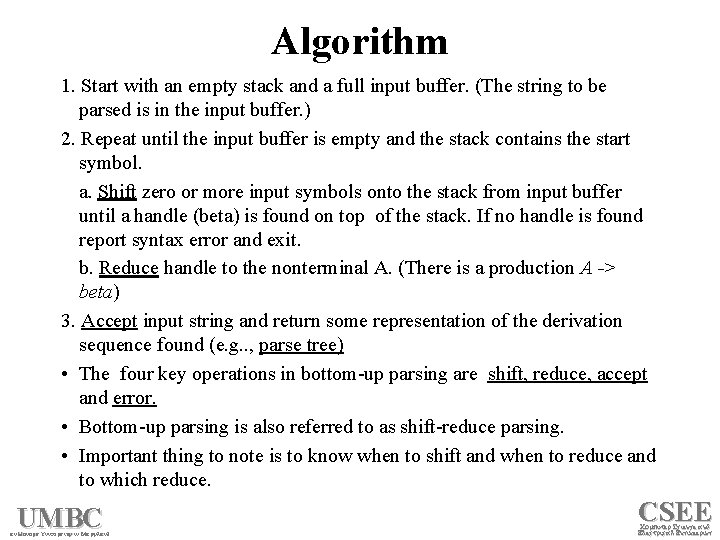
Algorithm 1. Start with an empty stack and a full input buffer. (The string to be parsed is in the input buffer. ) 2. Repeat until the input buffer is empty and the stack contains the start symbol. a. Shift zero or more input symbols onto the stack from input buffer until a handle (beta) is found on top of the stack. If no handle is found report syntax error and exit. b. Reduce handle to the nonterminal A. (There is a production A -> beta) 3. Accept input string and return some representation of the derivation sequence found (e. g. . , parse tree) • The four key operations in bottom-up parsing are shift, reduce, accept and error. • Bottom-up parsing is also referred to as shift-reduce parsing. • Important thing to note is to know when to shift and when to reduce and to which reduce. UMBC n Honors Univ rsity in M ryl n CSEE Comput r Sci nc n El ctric l Engin ring
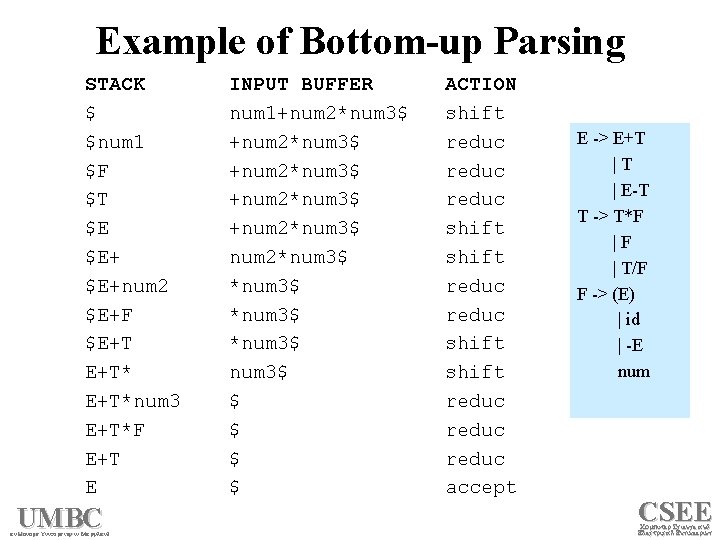
Example of Bottom-up Parsing STACK $ $num 1 $F $T $E $E+num 2 $E+F $E+T E+T*num 3 E+T*F E+T E UMBC n Honors Univ rsity in M ryl n INPUT BUFFER num 1+num 2*num 3$ +num 2*num 3$ *num 3$ $ $ ACTION shift reduc shift reduc accept E -> E+T |T | E-T T -> T*F |F | T/F F -> (E) | id | -E num CSEE Comput r Sci nc n El ctric l Engin ring
- Slides: 36