
Chapter 4 Aqueous solutions Types of reactions Parts

- Slides: 44
Chapter 4 Aqueous solutions Types of reactions
Parts of Solutions �Solution- homogeneous mixture. �Solute- what gets dissolved. �Solvent- what does the dissolving. �Soluble- Can be dissolved. �Miscible- liquids dissolve in each other.
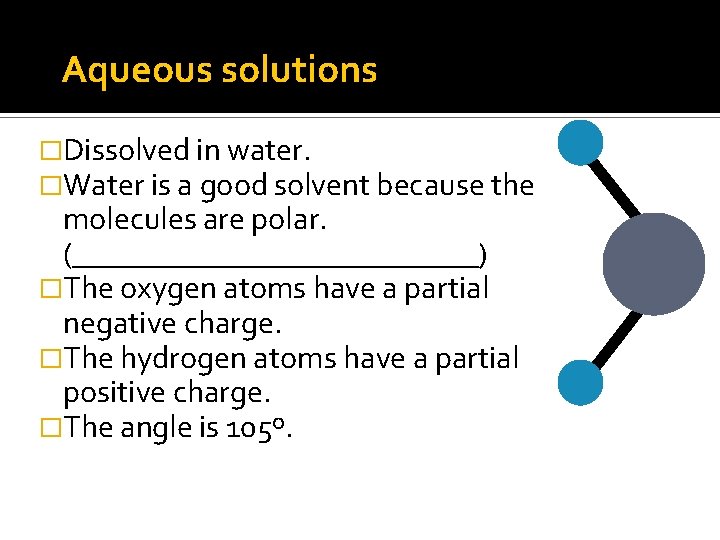
Aqueous solutions �Dissolved in water. �Water is a good solvent because the molecules are polar. (_____________) �The oxygen atoms have a partial negative charge. �The hydrogen atoms have a partial positive charge. �The angle is 105º.
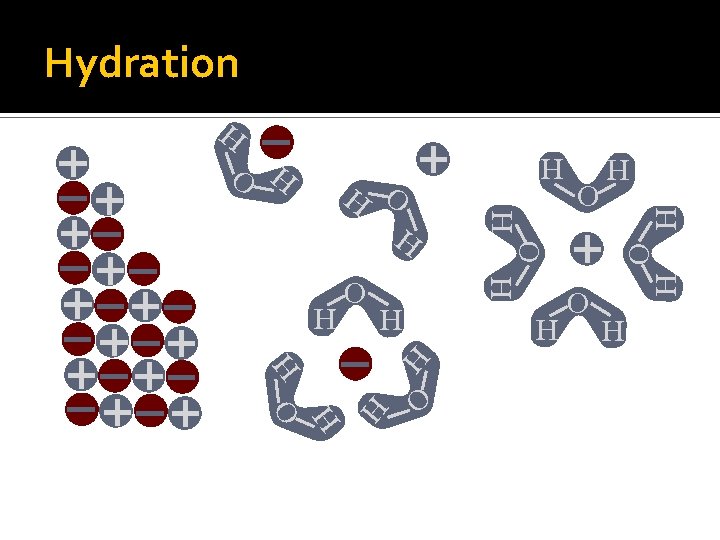
Hydration �The process of breaking the ions of salts apart. �Ions have charges and attract the opposite charges on the water molecules.
Hydration H O H O H H H H O O H H H O H H
Solubility �How much of a substance will dissolve in a given amount of water. �Usually g/100 m. L �Varies greatly, but if they do dissolve the ions are separated, �and they can move around. �Water can also dissolve non-ionic compounds if they have polar bonds.
Electrolytes �Electricity is moving charges. �The ions that are dissolved can move. �Solutions of ionic compounds can conduct electricity. �Electrolytes. �Solutions are classified three ways.
Types of solutions �Strong electrolytes- completely dissociate (fall apart into ions). �Many ions- Conduct well. �Weak electrolytes- Partially fall apart into ions. �Few ions -Conduct electricity slightly. �Non-electrolytes- Don’t fall apart. �No ions- Don’t conduct.
Types of solutions �Acids- form H+ ions when dissolved. �Strong acids fall apart completely. �many ions �H 2 SO 4 HNO 3 HCl HBr HI HCl. O 4 �Weak acids- don’ dissociate completely. �Bases - form OH- ions when dissolved. �Strong bases- many ions. �KOH Na. OH
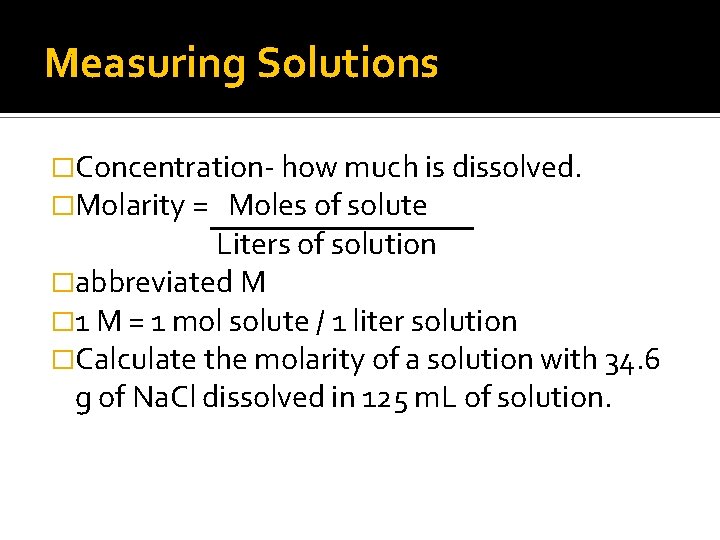
Measuring Solutions �Concentration- how much is dissolved. �Molarity = Moles of solute Liters of solution �abbreviated M � 1 M = 1 mol solute / 1 liter solution �Calculate the molarity of a solution with 34. 6 g of Na. Cl dissolved in 125 m. L of solution.
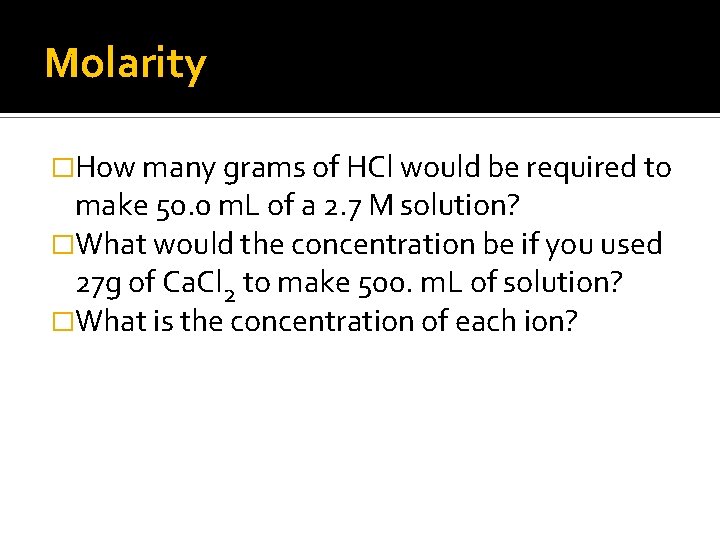
Molarity �How many grams of HCl would be required to make 50. 0 m. L of a 2. 7 M solution? �What would the concentration be if you used 27 g of Ca. Cl 2 to make 500. m. L of solution? �What is the concentration of each ion?
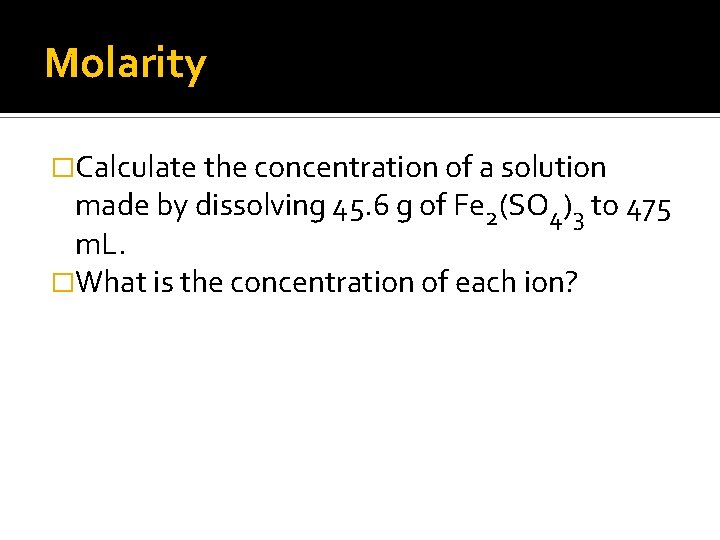
Molarity �Calculate the concentration of a solution made by dissolving 45. 6 g of Fe 2(SO 4)3 to 475 m. L. �What is the concentration of each ion?
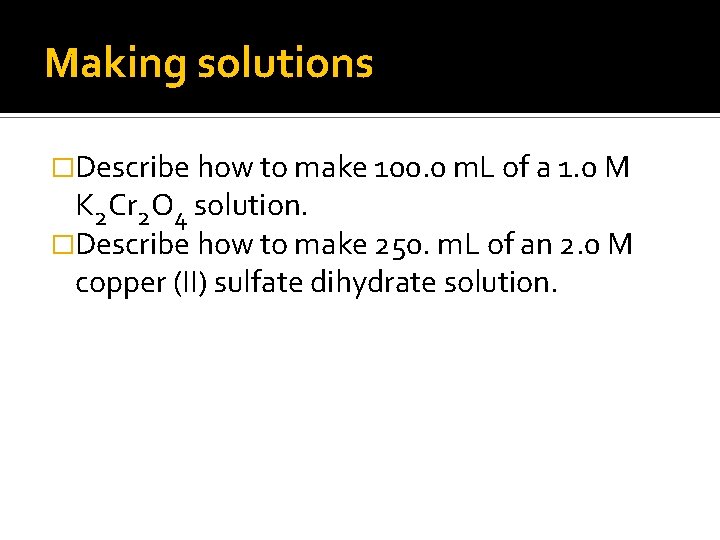
Making solutions �Describe how to make 100. 0 m. L of a 1. 0 M K 2 Cr 2 O 4 solution. �Describe how to make 250. m. L of an 2. 0 M copper (II) sulfate dihydrate solution.
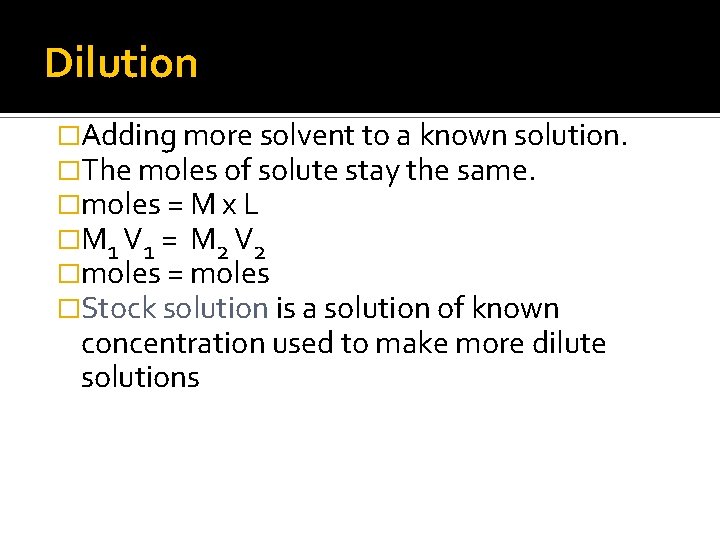
Dilution �Adding more solvent to a known solution. �The moles of solute stay the same. �moles = M x L �M 1 V 1 = M 2 V 2 �moles = moles �Stock solution is a solution of known concentration used to make more dilute solutions
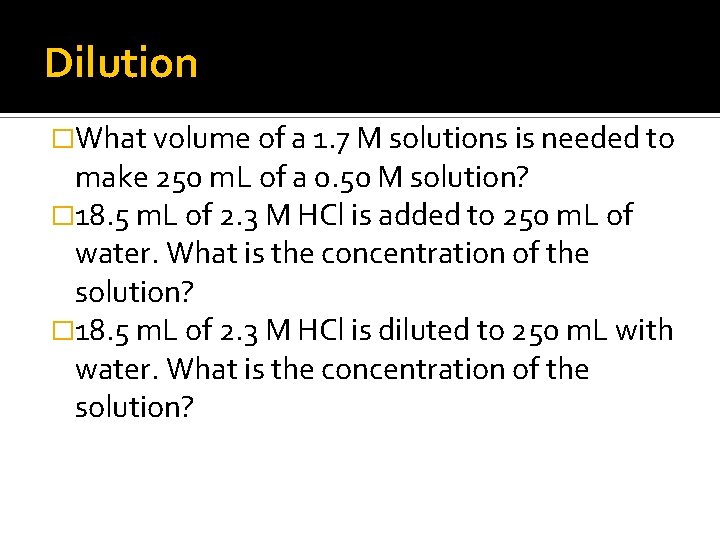
Dilution �What volume of a 1. 7 M solutions is needed to make 250 m. L of a 0. 50 M solution? � 18. 5 m. L of 2. 3 M HCl is added to 250 m. L of water. What is the concentration of the solution? � 18. 5 m. L of 2. 3 M HCl is diluted to 250 m. L with water. What is the concentration of the solution?
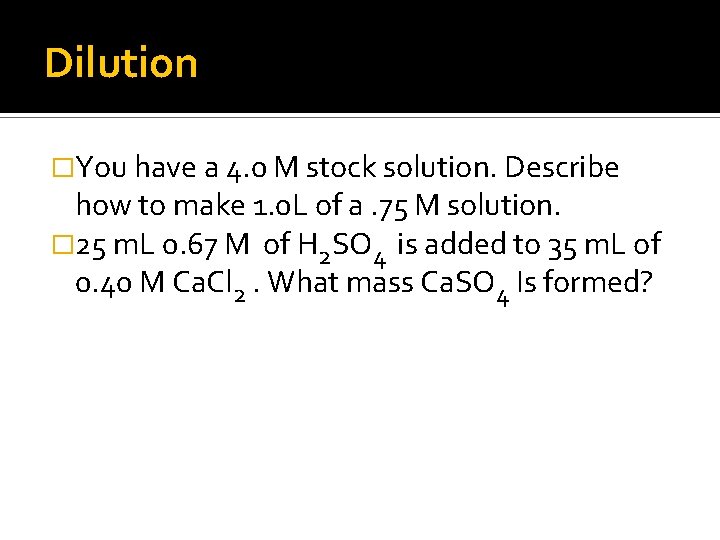
Dilution �You have a 4. 0 M stock solution. Describe how to make 1. 0 L of a. 75 M solution. � 25 m. L 0. 67 M of H 2 SO 4 is added to 35 m. L of 0. 40 M Ca. Cl 2. What mass Ca. SO 4 Is formed?
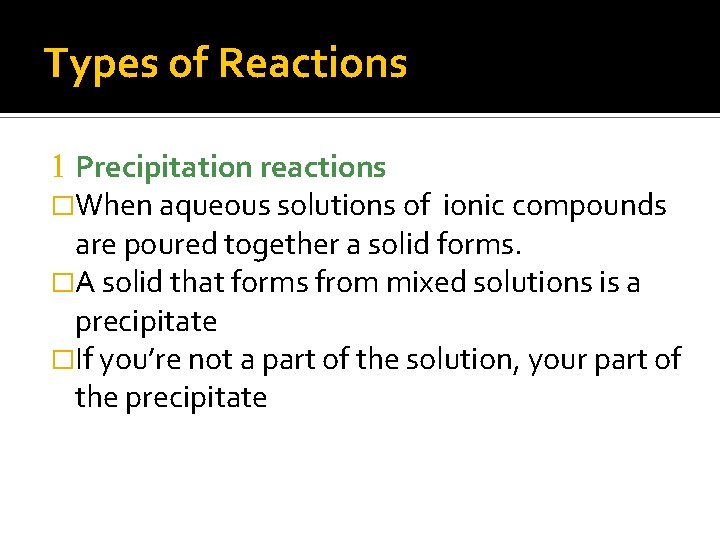
Types of Reactions 1 Precipitation reactions �When aqueous solutions of ionic compounds are poured together a solid forms. �A solid that forms from mixed solutions is a precipitate �If you’re not a part of the solution, your part of the precipitate
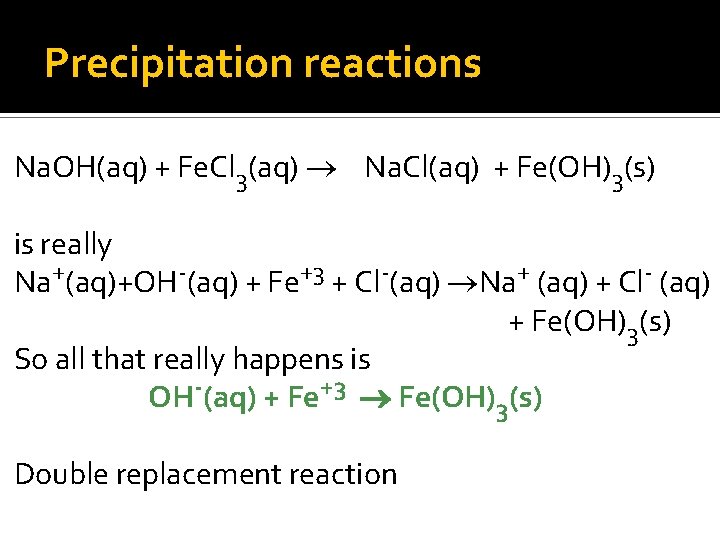
Precipitation reactions Na. OH(aq) + Fe. Cl 3(aq) ® Na. Cl(aq) + Fe(OH)3(s) is really Na+(aq)+OH-(aq) + Fe+3 + Cl-(aq) ®Na+ (aq) + Cl- (aq) + Fe(OH)3(s) So all that really happens is OH-(aq) + Fe+3 ® Fe(OH)3(s) Double replacement reaction
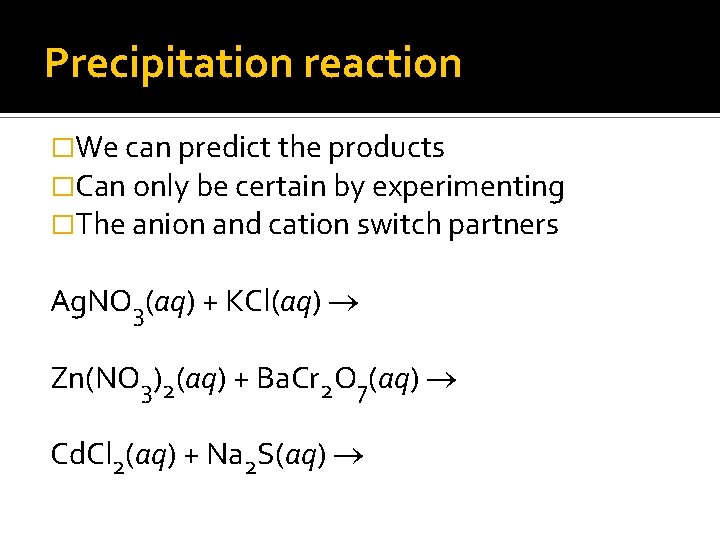
Precipitation reaction �We can predict the products �Can only be certain by experimenting �The anion and cation switch partners Ag. NO 3(aq) + KCl(aq) ® Zn(NO 3)2(aq) + Ba. Cr 2 O 7(aq) ® Cd. Cl 2(aq) + Na 2 S(aq) ®
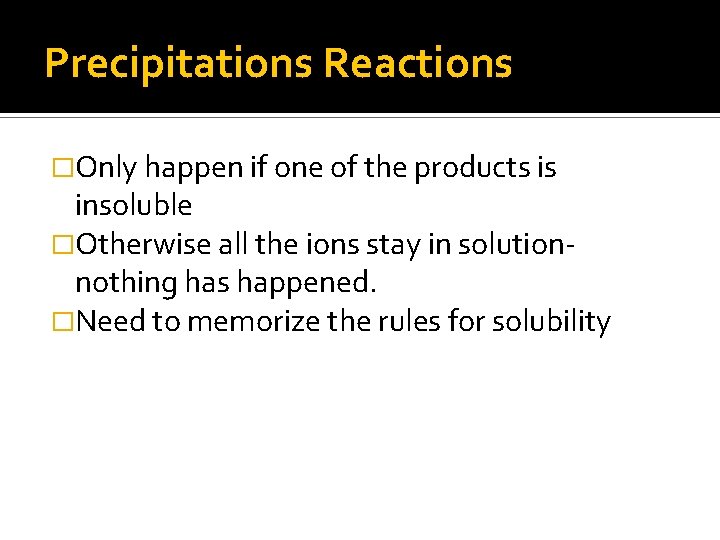
Precipitations Reactions �Only happen if one of the products is insoluble �Otherwise all the ions stay in solutionnothing has happened. �Need to memorize the rules for solubility
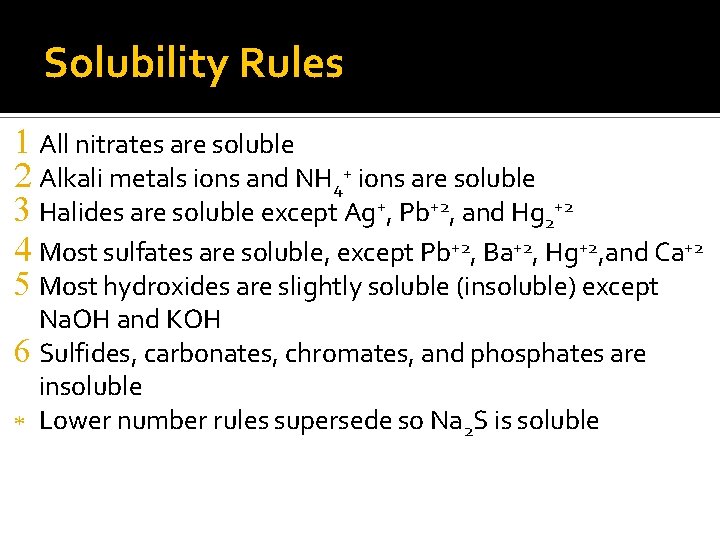
Solubility Rules 1 All nitrates are soluble 2 Alkali metals ions and NH 4+ ions are soluble 3 Halides are soluble except Ag+, Pb+2, and Hg 2+2 4 Most sulfates are soluble, except Pb+2, Ba+2, Hg+2, and Ca+2 5 Most hydroxides are slightly soluble (insoluble) except Na. OH and KOH 6 Sulfides, carbonates, chromates, and phosphates are insoluble * Lower number rules supersede so Na 2 S is soluble
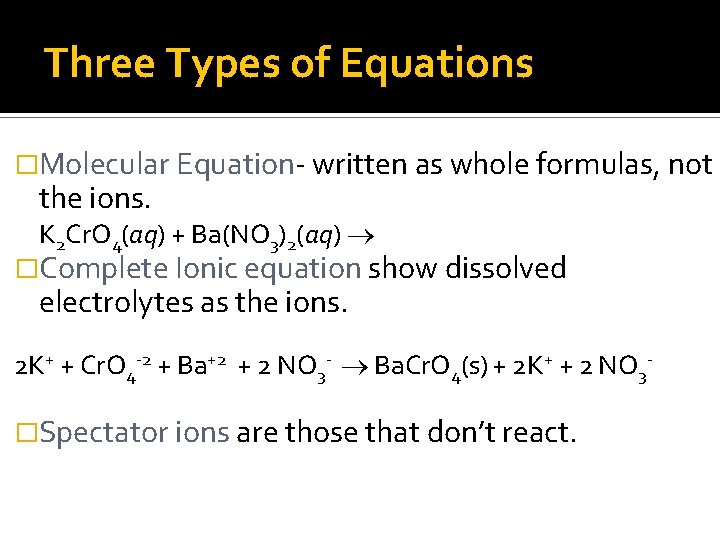
Three Types of Equations �Molecular Equation- written as whole formulas, not the ions. K 2 Cr. O 4(aq) + Ba(NO 3)2(aq) ® �Complete Ionic equation show dissolved electrolytes as the ions. 2 K+ + Cr. O 4 -2 + Ba+2 + 2 NO 3 - ® Ba. Cr. O 4(s) + 2 K+ + 2 NO 3�Spectator ions are those that don’t react.
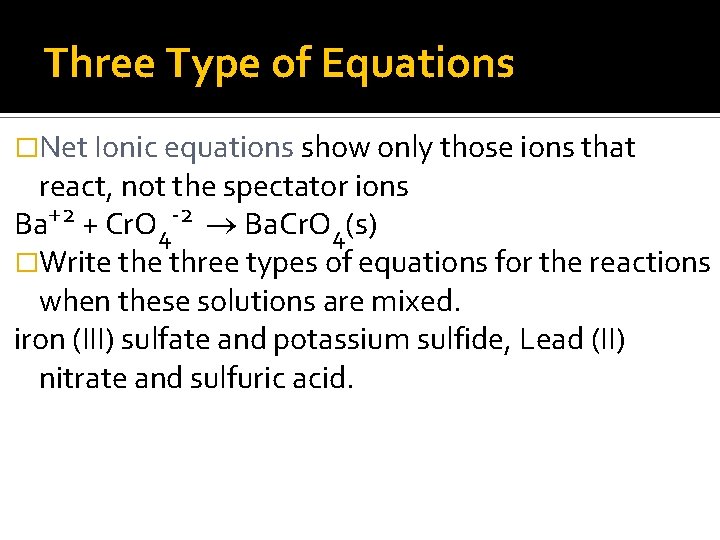
Three Type of Equations �Net Ionic equations show only those ions that react, not the spectator ions Ba+2 + Cr. O 4 -2 ® Ba. Cr. O 4(s) �Write three types of equations for the reactions when these solutions are mixed. iron (III) sulfate and potassium sulfide, Lead (II) nitrate and sulfuric acid.
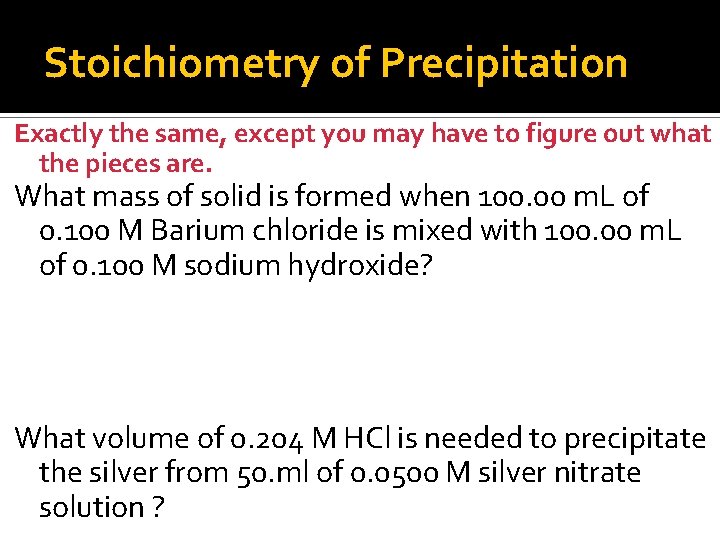
Stoichiometry of Precipitation Exactly the same, except you may have to figure out what the pieces are. What mass of solid is formed when 100. 00 m. L of 0. 100 M Barium chloride is mixed with 100. 00 m. L of 0. 100 M sodium hydroxide? What volume of 0. 204 M HCl is needed to precipitate the silver from 50. ml of 0. 0500 M silver nitrate solution ?
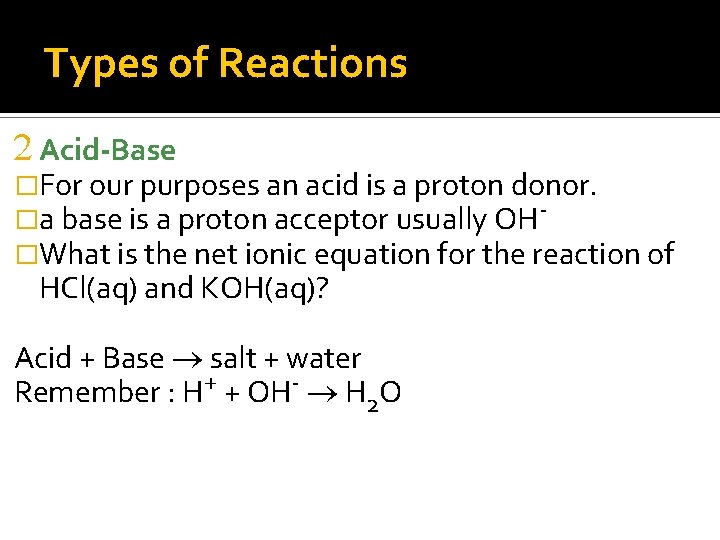
Types of Reactions 2 Acid-Base �For our purposes an acid is a proton donor. �a base is a proton acceptor usually OH�What is the net ionic equation for the reaction of HCl(aq) and KOH(aq)? Acid + Base ® salt + water Remember : H+ + OH- ® H 2 O
Acid - Base Reactions �Often called a neutralization reaction Because the acid neutralizes the base. �Often titrate to determine concentrations. �Solution of known concentration (titrant), is added to the unknown (analyte), �until the equivalence point is reached where enough titrant has been added to neutralize it.
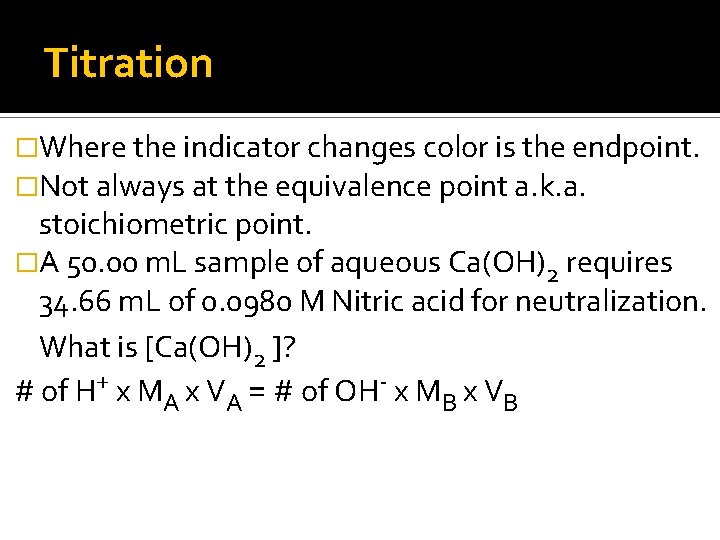
Titration �Where the indicator changes color is the endpoint. �Not always at the equivalence point a. k. a. stoichiometric point. �A 50. 00 m. L sample of aqueous Ca(OH)2 requires 34. 66 m. L of 0. 0980 M Nitric acid for neutralization. What is [Ca(OH)2 ]? # of H+ x MA x VA = # of OH- x MB x VB
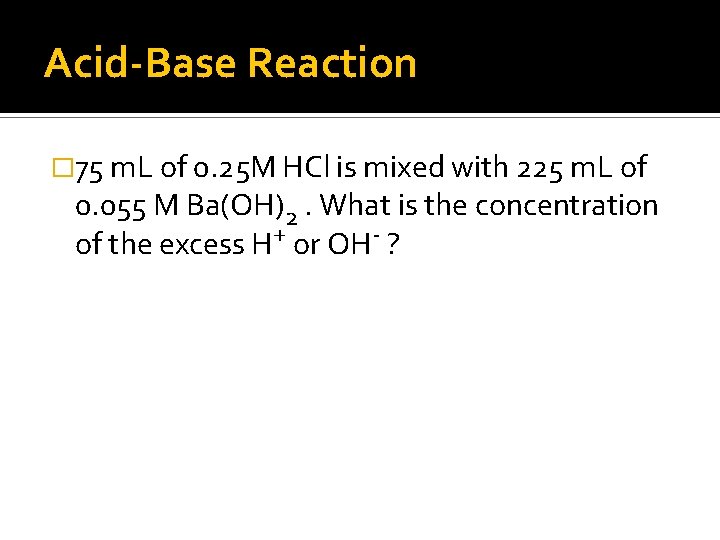
Acid-Base Reaction � 75 m. L of 0. 25 M HCl is mixed with 225 m. L of 0. 055 M Ba(OH)2. What is the concentration of the excess H+ or OH- ?
Types of Reaction 3 Oxidation-Reduction called Redox �Ionic compounds are formed through the transfer of electrons. �An Oxidation-reduction reaction involves the transfer of electrons. �We need a way of keeping track of the electrons. �Not necessarily true of what is in nature, but it works.
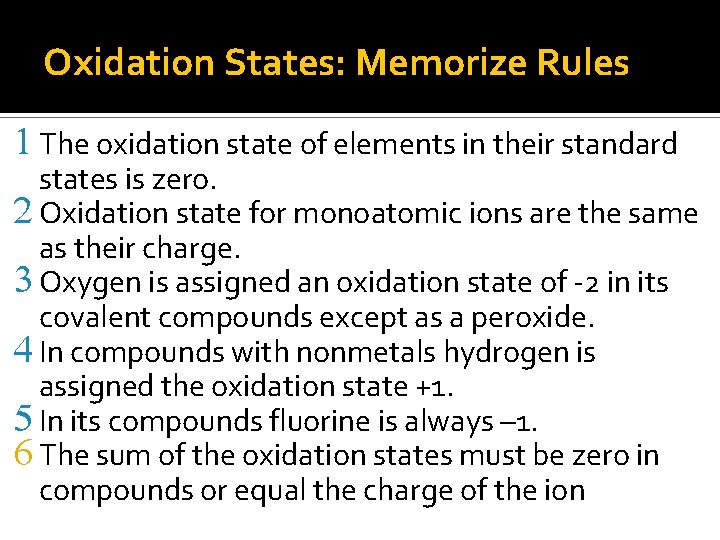
Oxidation States: Memorize Rules 1 The oxidation state of elements in their standard states is zero. 2 Oxidation state for monoatomic ions are the same as their charge. 3 Oxygen is assigned an oxidation state of -2 in its covalent compounds except as a peroxide. 4 In compounds with nonmetals hydrogen is assigned the oxidation state +1. 5 In its compounds fluorine is always – 1. 6 The sum of the oxidation states must be zero in compounds or equal the charge of the ion
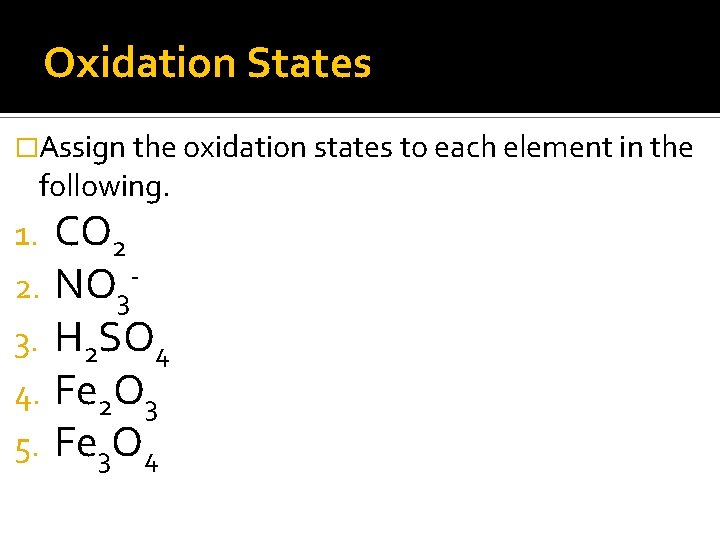
Oxidation States �Assign the oxidation states to each element in the following. 1. 2. 3. 4. 5. CO 2 NO 3 H 2 SO 4 Fe 2 O 3 Fe 3 O 4
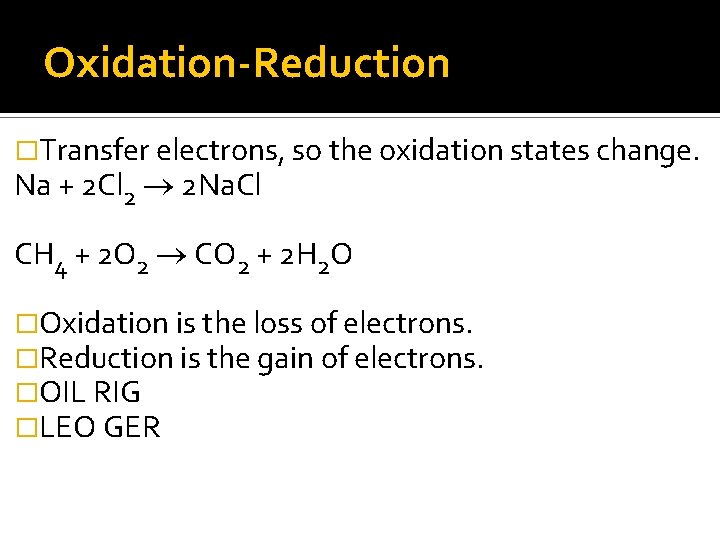
Oxidation-Reduction �Transfer electrons, so the oxidation states change. Na + 2 Cl 2 ® 2 Na. Cl CH 4 + 2 O 2 ® CO 2 + 2 H 2 O �Oxidation is the loss of electrons. �Reduction is the gain of electrons. �OIL RIG �LEO GER
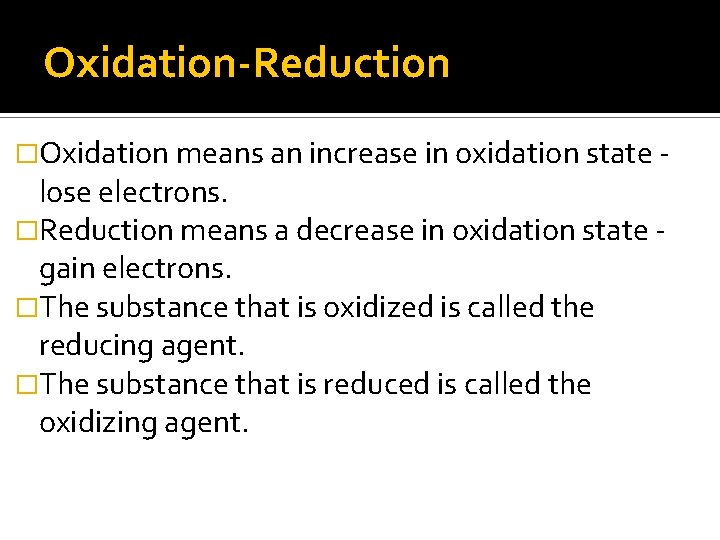
Oxidation-Reduction �Oxidation means an increase in oxidation state - lose electrons. �Reduction means a decrease in oxidation state gain electrons. �The substance that is oxidized is called the reducing agent. �The substance that is reduced is called the oxidizing agent.
Redox Reactions
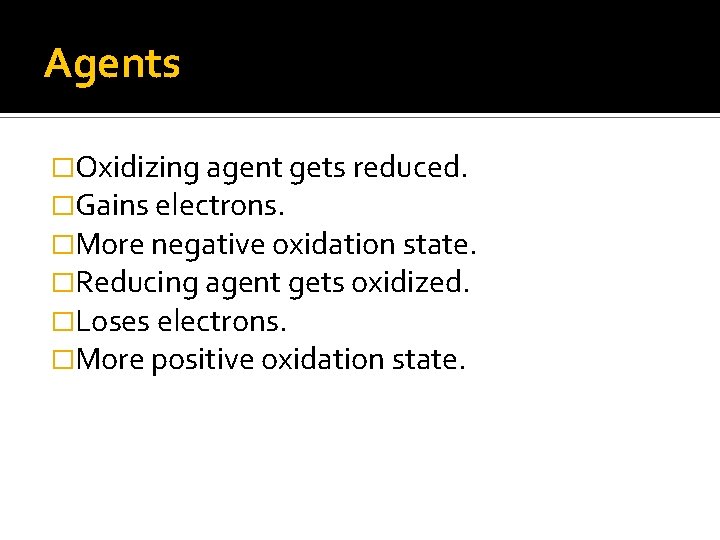
Agents �Oxidizing agent gets reduced. �Gains electrons. �More negative oxidation state. �Reducing agent gets oxidized. �Loses electrons. �More positive oxidation state.
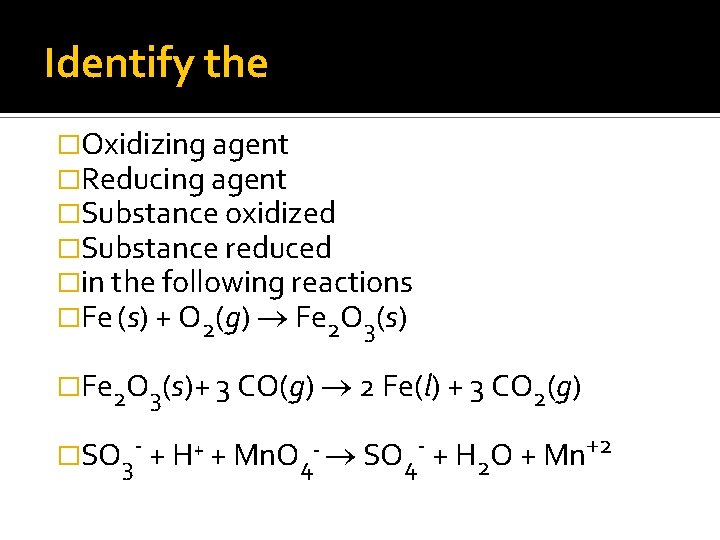
Identify the �Oxidizing agent �Reducing agent �Substance oxidized �Substance reduced �in the following reactions �Fe (s) + O 2(g) ® Fe 2 O 3(s) �Fe 2 O 3(s)+ 3 CO(g) ® 2 Fe(l) + 3 CO 2(g) �SO 3 - + H+ + Mn. O 4 - ® SO 4 - + H 2 O + Mn+2
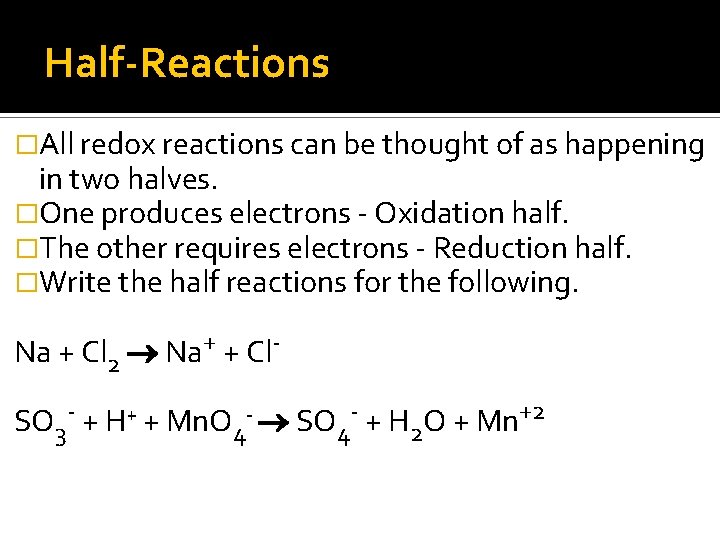
Half-Reactions �All redox reactions can be thought of as happening in two halves. �One produces electrons - Oxidation half. �The other requires electrons - Reduction half. �Write the half reactions for the following. Na + Cl 2 ® Na+ + Cl. SO 3 - + H+ + Mn. O 4 - ® SO 4 - + H 2 O + Mn+2
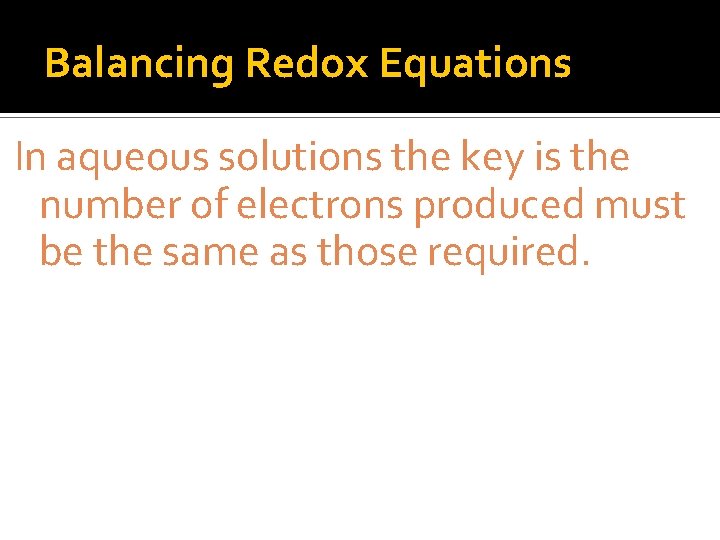
Balancing Redox Equations In aqueous solutions the key is the number of electrons produced must be the same as those required.
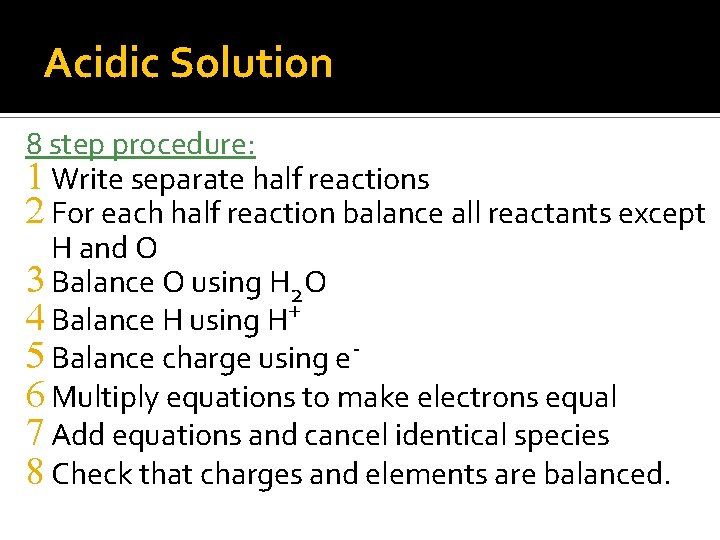
Acidic Solution 8 step procedure: 1 Write separate half reactions 2 For each half reaction balance all reactants except H and O 3 Balance O using H 2 O 4 Balance H using H+ 5 Balance charge using e 6 Multiply equations to make electrons equal 7 Add equations and cancel identical species 8 Check that charges and elements are balanced.
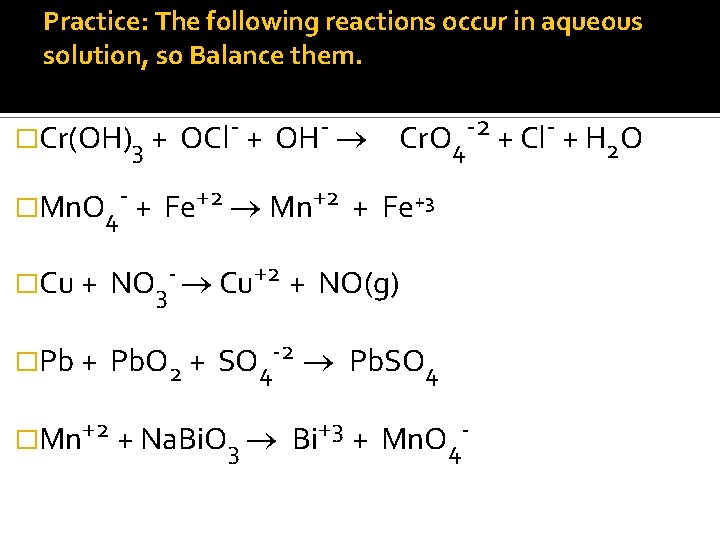
Practice: The following reactions occur in aqueous solution, so Balance them. �Cr(OH)3 + OCl + OH ® �Mn. O 4 -2 Cr. O 4 + Cl + H 2 O - + Fe+2 ® Mn+2 + Fe+3 �Cu + NO 3 - ® Cu+2 + NO(g) �Pb + Pb. O 2 + SO 4 -2 ® Pb. SO 4 �Mn+2 + Na. Bi. O 3 ® Bi+3 + Mn. O 4 -
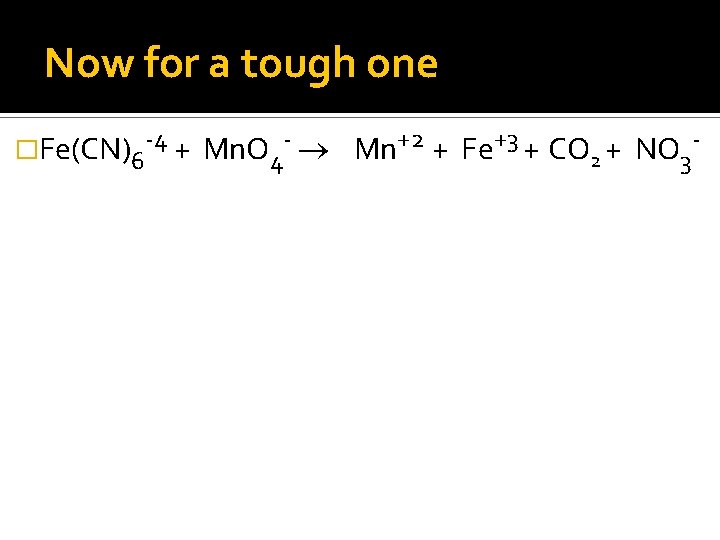
Now for a tough one �Fe(CN)6 -4 + Mn. O 4 - ® Mn+2 + Fe+3 + CO 2 + NO 3 -
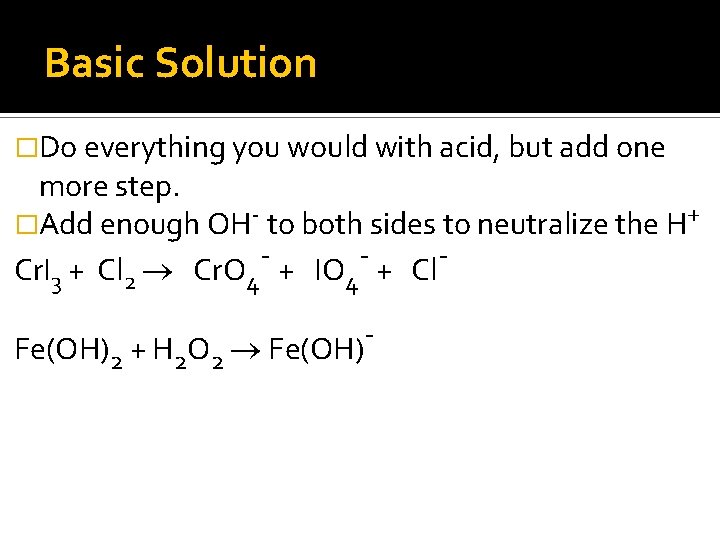
Basic Solution �Do everything you would with acid, but add one more step. �Add enough OH- to both sides to neutralize the H+ Cr. I 3 + Cl 2 ® Cr. O 4 - + IO 4 - + Cl. Fe(OH)2 + H 2 O 2 ® Fe(OH)-
Redox Titrations �Same as any other titration. �the permanganate ion is used often because it is its own indicator. Mn. O 4 - is purple, Mn+2 is colorless. When reaction solution remains clear, Mn. O 4 - is gone. �Chromate ion is also useful, but color change, orangeish yellow to green, is harder to detect.
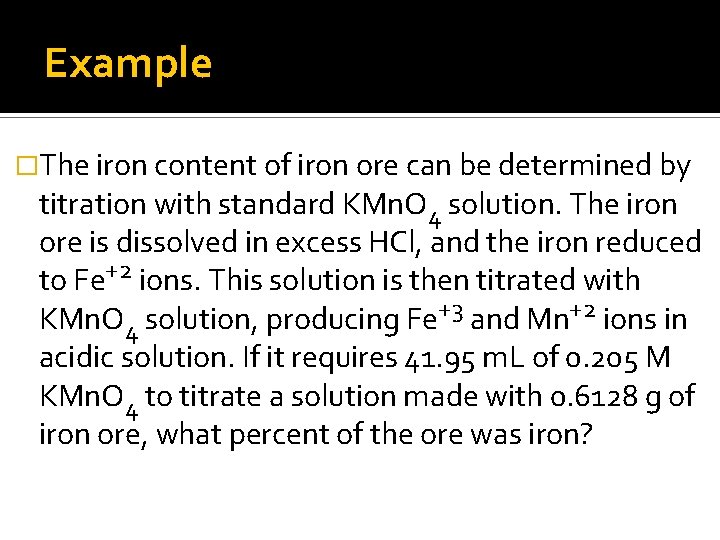
Example �The iron content of iron ore can be determined by titration with standard KMn. O 4 solution. The iron ore is dissolved in excess HCl, and the iron reduced to Fe+2 ions. This solution is then titrated with KMn. O 4 solution, producing Fe+3 and Mn+2 ions in acidic solution. If it requires 41. 95 m. L of 0. 205 M KMn. O 4 to titrate a solution made with 0. 6128 g of iron ore, what percent of the ore was iron?