
Chapter 4 Advanced IR Models 4 1 Probabilistic
Chapter 4: Advanced IR Models 4. 1 Probabilistic IR 4. 2 Statistical Language Models (LMs) 4. 2. 1 Principles and Basic LMs 4. 2. 2 Smoothing Methods 4. 2. 3 Extended LMs 4. 3 Latent-Concept Models IRDM WS 2005
4. 2. 1 What is a Statistical Language Model? generative model for word sequence (generates probability distribution of word sequences, or bag-of-words, or set-of-words, or structured doc, or. . . ) Example: P[„Today is Tuesday“] = 0. 001 P[„Today Wednesday is“] = 0. 00001 P[„The Eigenvalue is positive“] = 0. 000001 LM itself highly context- / application-dependent Examples: • speech recognition: given that we heard „Julia“ and „feels“, how likely will we next hear „happy“ or „habit“? • text classification: given that we saw „soccer“ 3 times and „game“ 2 times, how likely is the news about sports? • information retrieval: given that the user is interested in math, how likely would the user use „distribution“ in a query? IRDM WS 2005
![Source-Channel Framework [Shannon 1948] Source X Transmitter (Encoder) P[X] Noisy Channel Y Receiver (Decoder)](http://slidetodoc.com/presentation_image_h/0db8fffb5aa16a3a416a24696cd1850c/image-3.jpg "Source-Channel Framework [Shannon 1948] Source X Transmitter (Encoder) P[X] Noisy Channel Y Receiver (Decoder)")
Source-Channel Framework [Shannon 1948] Source X Transmitter (Encoder) P[X] Noisy Channel Y Receiver (Decoder) P[Y|X] Destination X‘ P[X|Y]=? X is text P[X] is language model Applications: speech recognition machine translation OCR error correction summarization information retrieval IRDM WS 2005 X: word sequence X: English sentence X: correct word X: summary X: document Y: speech signal Y: German sentence Y: erroneous word Y: document Y: query 3
![Text Generation with (Unigram) LM LM : P[word | ] LM for topic 1:](http://slidetodoc.com/presentation_image_h/0db8fffb5aa16a3a416a24696cd1850c/image-4.jpg "Text Generation with (Unigram) LM LM : P[word | ] LM for topic 1:")
Text Generation with (Unigram) LM LM : P[word | ] LM for topic 1: IR&DM . . . text mining n-gram cluster. . . food sample document d 0. 2 0. 1 0. 02 text mining paper 0. 000001 different d for different d LM for topic 2: Health IRDM WS 2005 . . . food 0. 25 nutrition 0. 1 healthy 0. 05 diet 0. 02. . . food nutrition paper
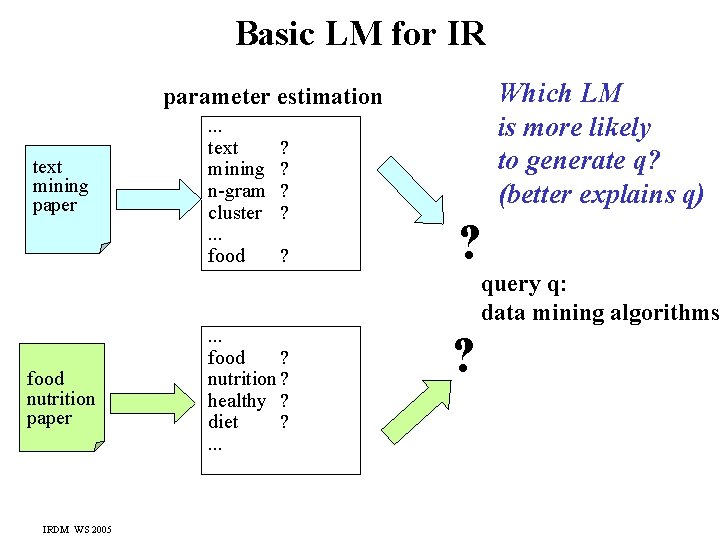
Basic LM for IR Which LM is more likely to generate q? (better explains q) parameter estimation text mining paper food nutrition paper IRDM WS 2005 . . . text mining n-gram cluster. . . food ? ? ? . . . food ? nutrition ? healthy ? diet ? . . . ? query q: data mining algorithms ?
![IR as LM Estimation P[R|d, q] user likes doc (R) given that it has](http://slidetodoc.com/presentation_image_h/0db8fffb5aa16a3a416a24696cd1850c/image-6.jpg "IR as LM Estimation P[R|d, q] user likes doc (R) given that it has")
IR as LM Estimation P[R|d, q] user likes doc (R) given that it has features d and user poses query q prob. IR statist. LM query likelihood: top-k query result: MLE would be tf IRDM WS 2005 6
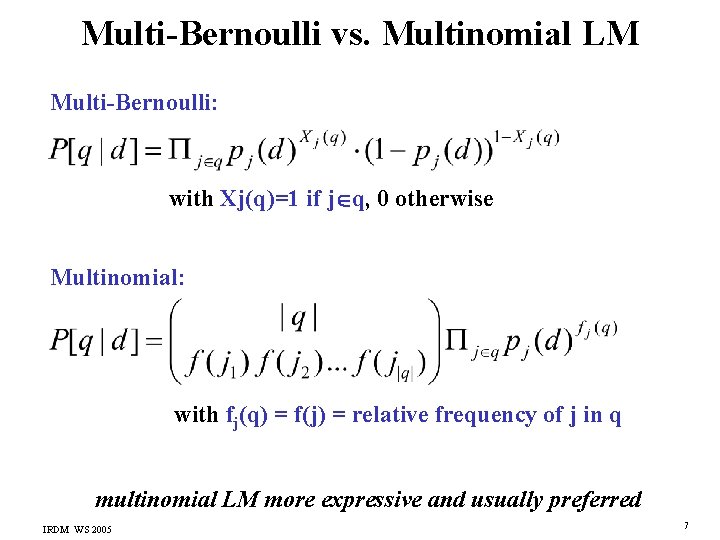
Multi-Bernoulli vs. Multinomial LM Multi-Bernoulli: with Xj(q)=1 if j q, 0 otherwise Multinomial: with fj(q) = f(j) = relative frequency of j in q multinomial LM more expressive and usually preferred IRDM WS 2005 7
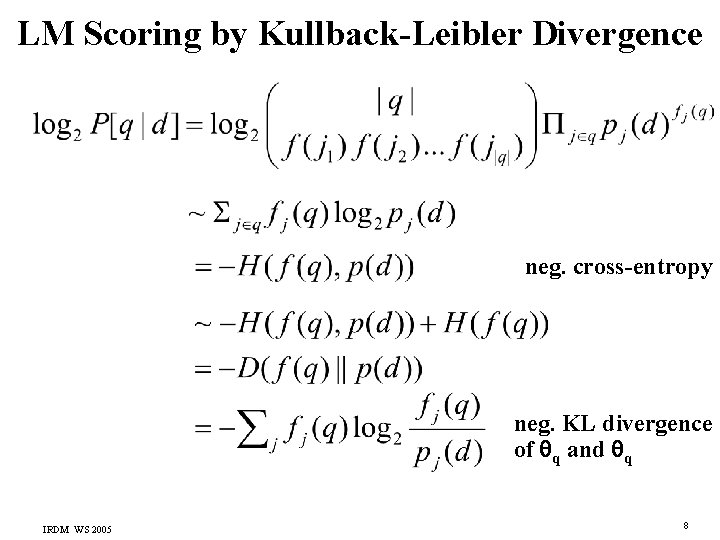
LM Scoring by Kullback-Leibler Divergence neg. cross-entropy neg. KL divergence of q and q IRDM WS 2005 8
4. 2. 2 Smoothing Methods absolutely crucial to avoid overfitting and make LMs useful (one LM per doc, one LM per query !) possible methods: • Laplace smoothing • Absolute Discouting • Jelinek-Mercer smoothing • Dirichlet-prior smoothing • . . . most with their own parameters IRDM WS 2005 choice and parameter setting still pretty much black art (or empirical)
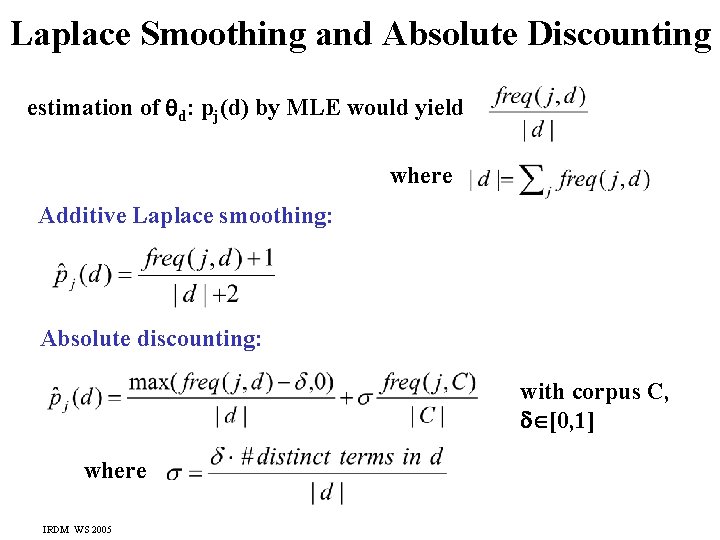
Laplace Smoothing and Absolute Discounting estimation of d: pj(d) by MLE would yield where Additive Laplace smoothing: Absolute discounting: with corpus C, [0, 1] where IRDM WS 2005
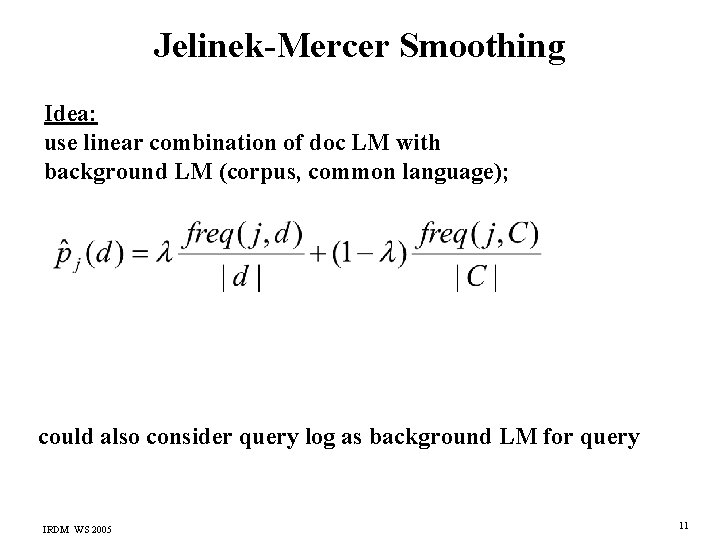
Jelinek-Mercer Smoothing Idea: use linear combination of doc LM with background LM (corpus, common language); could also consider query log as background LM for query IRDM WS 2005 11
![Dirichlet-Prior Smoothing with MLEs P[j|d], P[j|C] tf j with from corpus where 1=s. P[1|C],](http://slidetodoc.com/presentation_image_h/0db8fffb5aa16a3a416a24696cd1850c/image-12.jpg "Dirichlet-Prior Smoothing with MLEs P[j|d], P[j|C] tf j with from corpus where 1=s. P[1|C],")
Dirichlet-Prior Smoothing with MLEs P[j|d], P[j|C] tf j with from corpus where 1=s. P[1|C], . . . , m=s. P[m|C] are the parameters of the underlying Dirichlet distribution, with constant s > 1 typically set to multiple of document length derived by MAP with Dirichlet distribution as prior for parameters of multinomial distribution if with multinomial Beta: (Dirichlet is conjugate prior for parameters of multinomial distribution: Dirichlet prior implies Dirichlet posterior, only with different parameters) IRDM WS 2005 12
4. 2. 3 Extended LMs large variety of extensions: • Term-specific smoothing (JM with term-specific j, e. g. based on idf values) • Parsimonious LM (JM-style smoothing with smaller feature space) • N-gram (Sequence) Models (e. g. HMMs) • (Semantic) Translation Models • Cross-Lingual Models • Query-Log- & Click-Stream-based LM IRDM WS 2005 13
![(Semantic) Translation Model with word-word translation model P[j|w] Opportunities and difficulties: • synonymy, hypernymy/hyponymy,](http://slidetodoc.com/presentation_image_h/0db8fffb5aa16a3a416a24696cd1850c/image-14.jpg "(Semantic) Translation Model with word-word translation model P[j|w] Opportunities and difficulties: • synonymy, hypernymy/hyponymy,")
(Semantic) Translation Model with word-word translation model P[j|w] Opportunities and difficulties: • synonymy, hypernymy/hyponymy, polysemy • efficiency • training estimate P[j|w] by overlap statistics on background corpus (Dice coefficients, Jaccard coefficients, etc. ) IRDM WS 2005 14
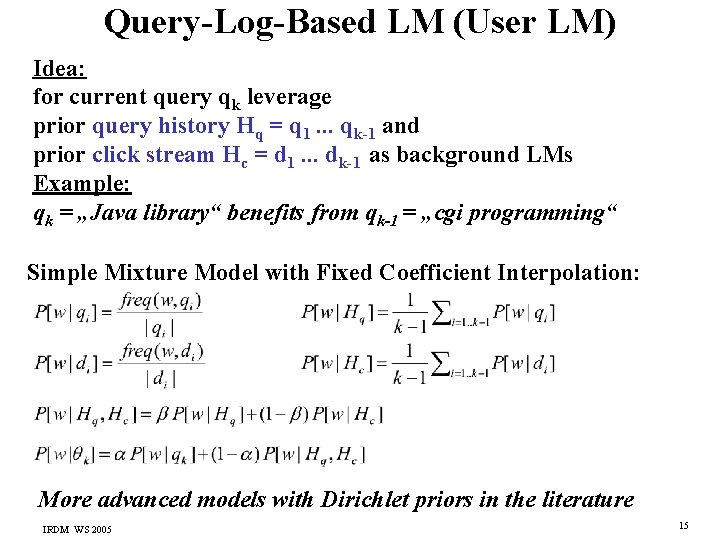
Query-Log-Based LM (User LM) Idea: for current query qk leverage prior query history Hq = q 1. . . qk-1 and prior click stream Hc = d 1. . . dk-1 as background LMs Example: qk = „Java library“ benefits from qk-1 = „cgi programming“ Simple Mixture Model with Fixed Coefficient Interpolation: More advanced models with Dirichlet priors in the literature IRDM WS 2005 15
Additional Literature for Chapter 4 Statistical Language Models: • • • Grossman/Frieder Section 2. 3 W. B. Croft, J. Lafferty (Editors): Language Modeling for Information Retrieval, Kluwer, 2003 C. Zhai: Statistical Language Models for Information Retrieval, Tutorial Slides, SIGIR 2005 X. Liu, W. B. Croft: Statistical Language Modeling for Information Retrieval, Annual Review of Information Science and Technology 39, 2004 J. Ponte, W. B. Croft: A Language Modeling Approach to Information Retrieval, SIGIR 1998 C. Zhai, J. Lafferty: A Study of Smoothing Methods for Language Models Applied to Information Retrieval, TOIS 22(2), 2004 C. Zhai, J. Lafferty: A Risk Minimization Framework for Information Retrieval, Information Processing and Management 42, 2006 X. Shen, B. Tan, C. Zhai: Context-Sensitive Information Retrieval Using Implicit Feedback, SIGIR 2005 M. E. Maron, J. L. Kuhns: On Relevance, Probabilistic Indexing, and Information Retrieval, Journal of the ACM 7, 1960 IRDM WS 2005
- Slides: 16