
Chapter 4 Advanced IR Models 4 1 Probabilistic
Chapter 4: Advanced IR Models 4. 1 Probabilistic IR 4. 1. 1 Principles 4. 1. 2 Probabilistic IR with Term Independence 4. 1. 3 Probabilistic IR with 2 -Poisson Model (Okapi BM 25) 4. 1. 4 Extensions of Probabilistic IR 4. 2 Statistical Language Models 4. 3 Latent-Concept Models IRDM WS 2005
![4. 1. 1 Probabilistic Retrieval: Principles [Robertson and Sparck Jones 1976] Goal: Ranking based](http://slidetodoc.com/presentation_image/62bf1113cabe38f5d0d2e1b7d739f0c5/image-2.jpg "4. 1. 1 Probabilistic Retrieval: Principles [Robertson and Sparck Jones 1976] Goal: Ranking based")
4. 1. 1 Probabilistic Retrieval: Principles [Robertson and Sparck Jones 1976] Goal: Ranking based on sim(doc d, query q) = P[R|d] = P [ doc d is relevant for query q | d has term vector X 1, . . . , Xm ] Assumptions: • Relevant and irrelevant documents differ in their terms. • Binary Independence Retrieval (BIR) Model: • Probabilities for term occurrence are pairwise independent for different terms. • Term weights are binary {0, 1}. • For terms that do not occur in query q the probabilities for such a term occurring are the same for relevant and irrelevant documents. IRDM WS 2005
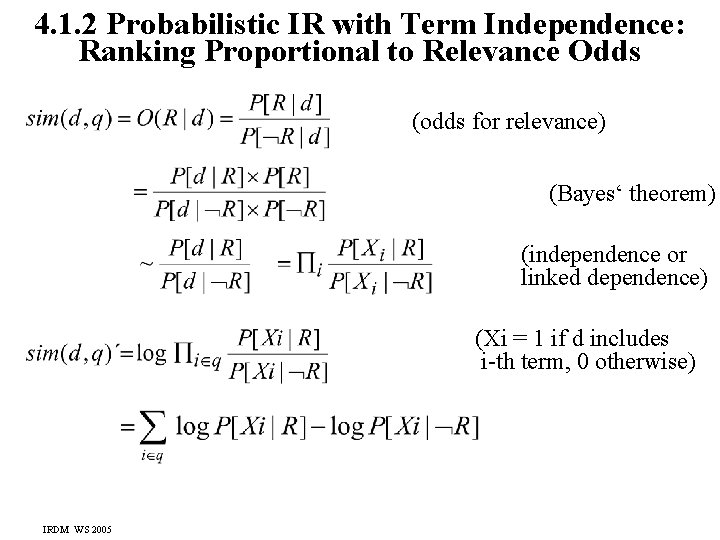
4. 1. 2 Probabilistic IR with Term Independence: Ranking Proportional to Relevance Odds (odds for relevance) (Bayes‘ theorem) (independence or linked dependence) (Xi = 1 if d includes i-th term, 0 otherwise) IRDM WS 2005
![Probabilistic Retrieval: Ranking Proportional to Relevance Odds (cont. ) (binary features) with estimators pi=P[Xi=1|R]](http://slidetodoc.com/presentation_image/62bf1113cabe38f5d0d2e1b7d739f0c5/image-4.jpg "Probabilistic Retrieval: Ranking Proportional to Relevance Odds (cont. ) (binary features) with estimators pi=P[Xi=1|R]")
Probabilistic Retrieval: Ranking Proportional to Relevance Odds (cont. ) (binary features) with estimators pi=P[Xi=1|R] and qi=P[Xi=1| R] IRDM WS 2005
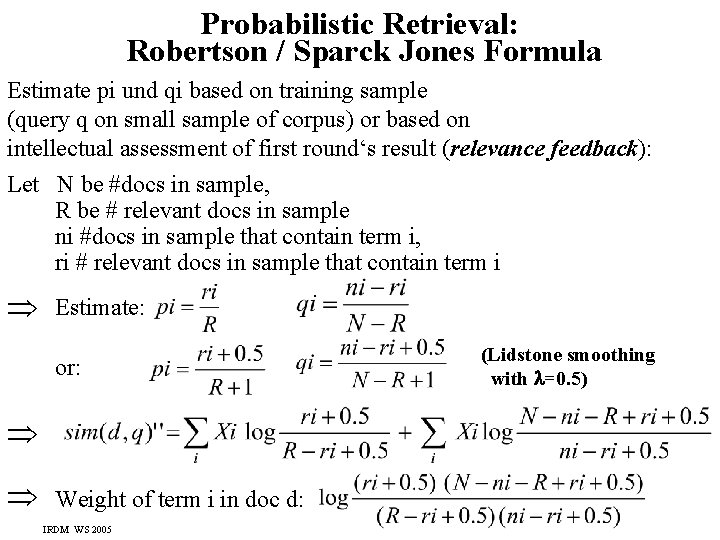
Probabilistic Retrieval: Robertson / Sparck Jones Formula Estimate pi und qi based on training sample (query q on small sample of corpus) or based on intellectual assessment of first round‘s result (relevance feedback): Let N be #docs in sample, R be # relevant docs in sample ni #docs in sample that contain term i, ri # relevant docs in sample that contain term i Estimate: or: Weight of term i in doc d: IRDM WS 2005 (Lidstone smoothing with =0. 5)
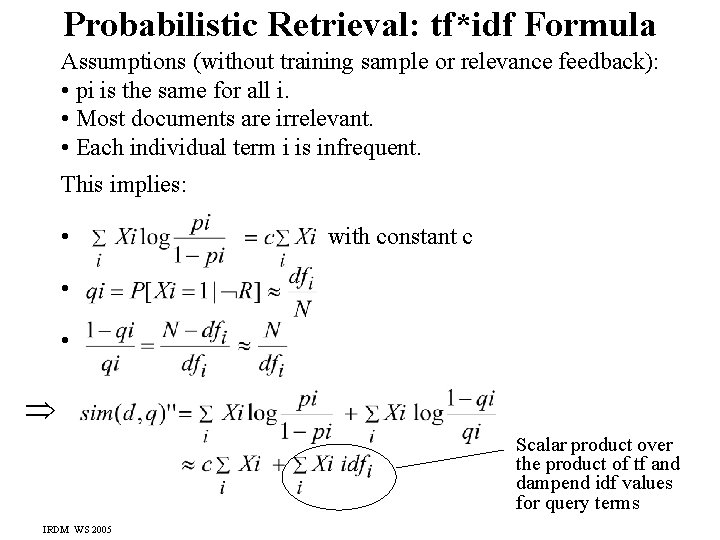
Probabilistic Retrieval: tf*idf Formula Assumptions (without training sample or relevance feedback): • pi is the same for all i. • Most documents are irrelevant. • Each individual term i is infrequent. This implies: • with constant c • • Scalar product over the product of tf and dampend idf values for query terms IRDM WS 2005
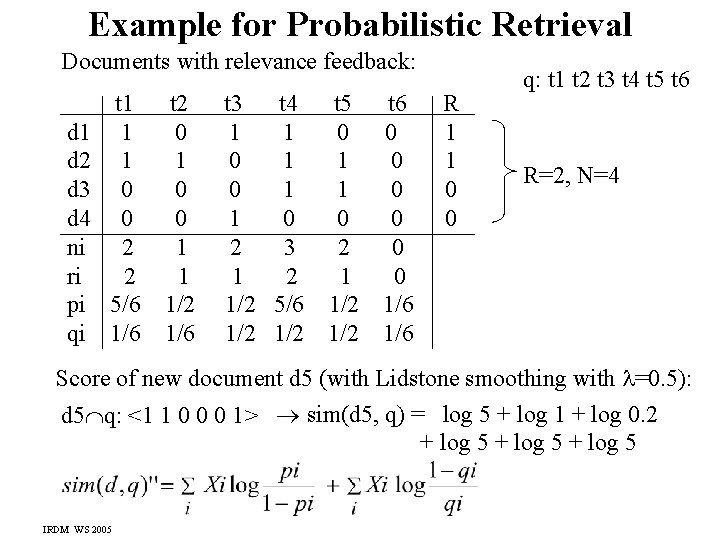
Example for Probabilistic Retrieval Documents with relevance feedback: d 1 d 2 d 3 d 4 ni ri pi qi t 1 1 1 0 0 2 2 5/6 1/6 t 2 0 1 0 0 1 1 1/2 1/6 t 3 t 4 1 1 0 2 3 1 2 1/2 5/6 1/2 t 5 0 1 1 0 2 1 1/2 t 6 0 0 0 1/6 R 1 1 0 0 q: t 1 t 2 t 3 t 4 t 5 t 6 R=2, N=4 Score of new document d 5 (with Lidstone smoothing with =0. 5): d 5 q: <1 1 0 0 0 1> sim(d 5, q) = log 5 + log 1 + log 0. 2 + log 5 IRDM WS 2005
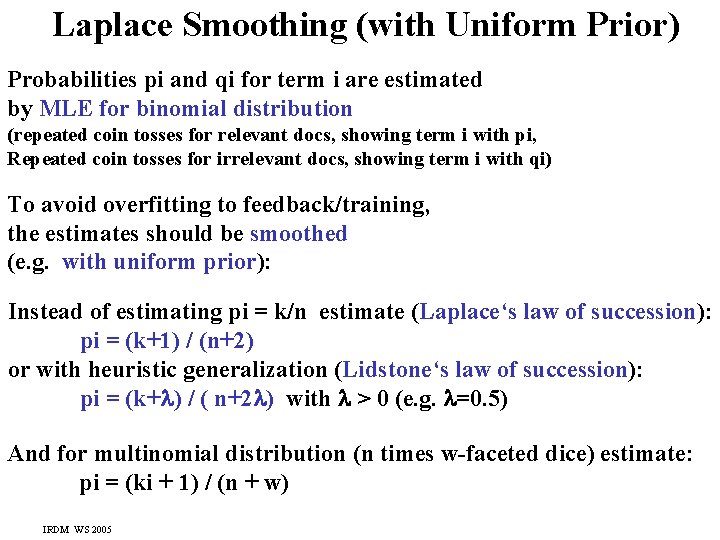
Laplace Smoothing (with Uniform Prior) Probabilities pi and qi for term i are estimated by MLE for binomial distribution (repeated coin tosses for relevant docs, showing term i with pi, Repeated coin tosses for irrelevant docs, showing term i with qi) To avoid overfitting to feedback/training, the estimates should be smoothed (e. g. with uniform prior): Instead of estimating pi = k/n estimate (Laplace‘s law of succession): pi = (k+1) / (n+2) or with heuristic generalization (Lidstone‘s law of succession): pi = (k+ ) / ( n+2 ) with > 0 (e. g. =0. 5) And for multinomial distribution (n times w-faceted dice) estimate: pi = (ki + 1) / (n + w) IRDM WS 2005
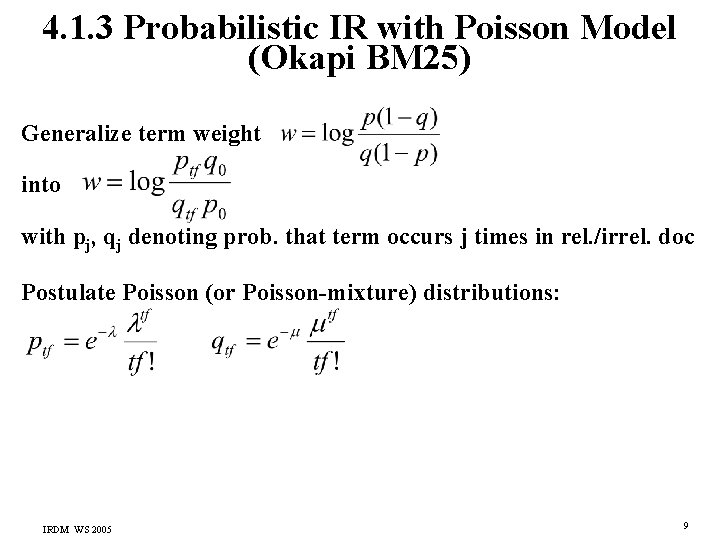
4. 1. 3 Probabilistic IR with Poisson Model (Okapi BM 25) Generalize term weight into with pj, qj denoting prob. that term occurs j times in rel. /irrel. doc Postulate Poisson (or Poisson-mixture) distributions: IRDM WS 2005 9
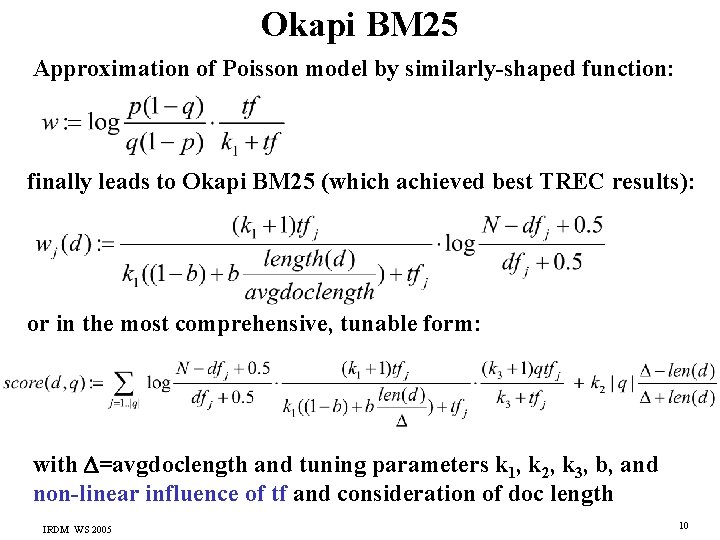
Okapi BM 25 Approximation of Poisson model by similarly-shaped function: finally leads to Okapi BM 25 (which achieved best TREC results): or in the most comprehensive, tunable form: with =avgdoclength and tuning parameters k 1, k 2, k 3, b, and non-linear influence of tf and consideration of doc length IRDM WS 2005 10
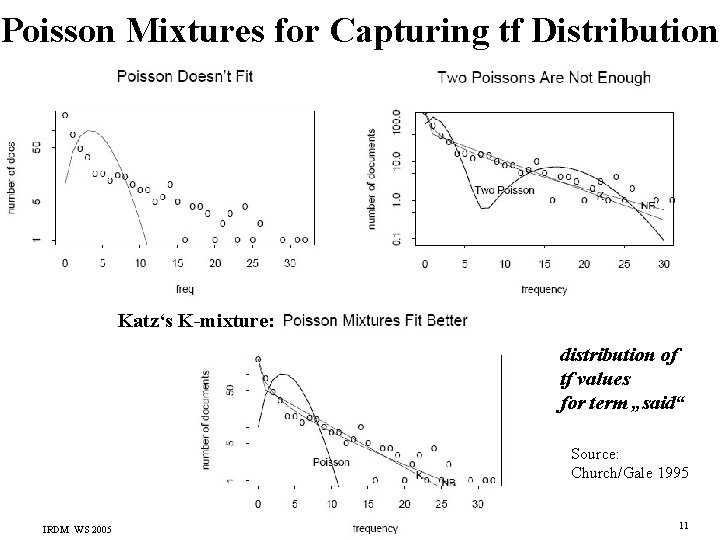
Poisson Mixtures for Capturing tf Distribution Katz‘s K-mixture: distribution of tf values for term „said“ Source: Church/Gale 1995 IRDM WS 2005 11
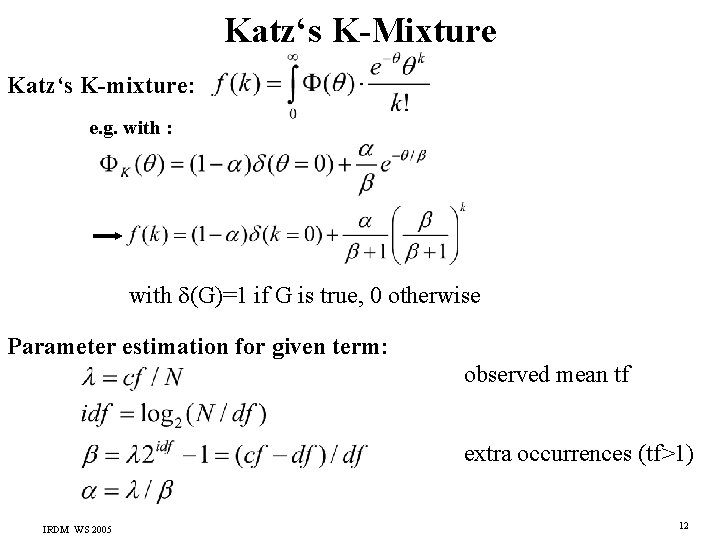
Katz‘s K-Mixture Katz‘s K-mixture: e. g. with : with (G)=1 if G is true, 0 otherwise Parameter estimation for given term: observed mean tf extra occurrences (tf>1) IRDM WS 2005 12
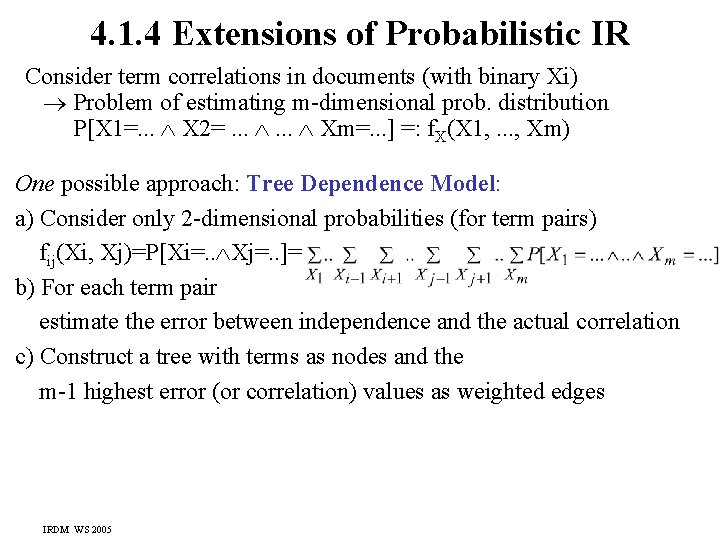
4. 1. 4 Extensions of Probabilistic IR Consider term correlations in documents (with binary Xi) Problem of estimating m-dimensional prob. distribution P[X 1=. . . X 2=. . . Xm=. . . ] =: f. X(X 1, . . . , Xm) One possible approach: Tree Dependence Model: a) Consider only 2 -dimensional probabilities (for term pairs) fij(Xi, Xj)=P[Xi=. . Xj=. . ]= b) For each term pair estimate the error between independence and the actual correlation c) Construct a tree with terms as nodes and the m-1 highest error (or correlation) values as weighted edges IRDM WS 2005
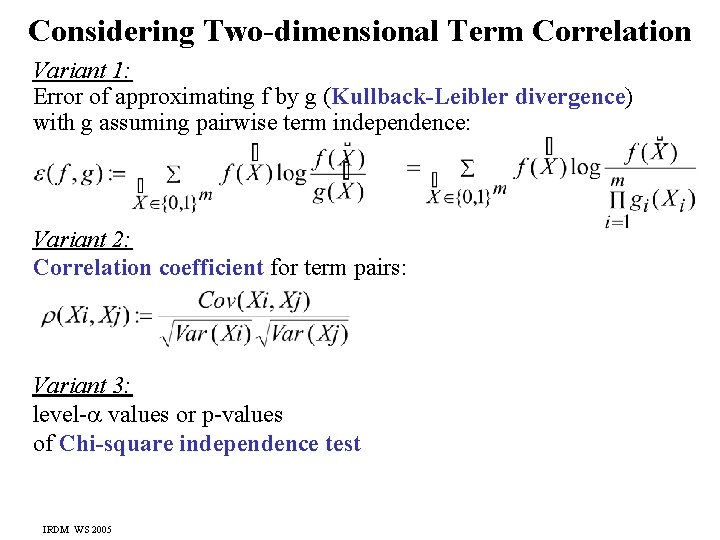
Considering Two-dimensional Term Correlation Variant 1: Error of approximating f by g (Kullback-Leibler divergence) with g assuming pairwise term independence: Variant 2: Correlation coefficient for term pairs: Variant 3: level- values or p-values of Chi-square independence test IRDM WS 2005
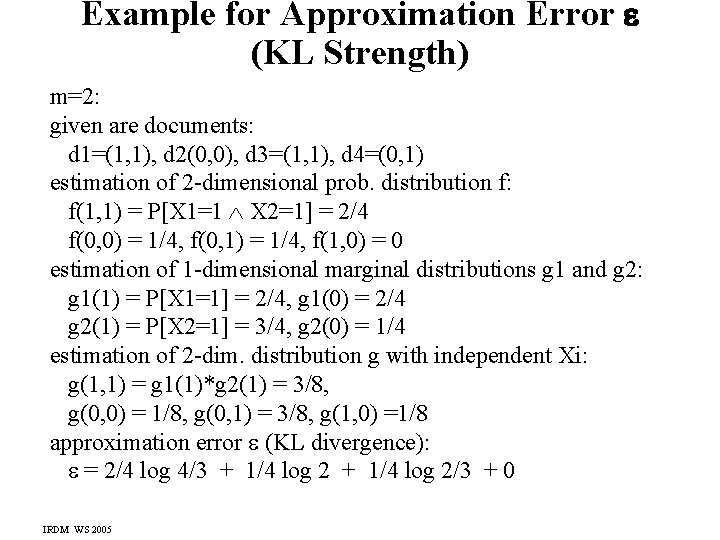
Example for Approximation Error (KL Strength) m=2: given are documents: d 1=(1, 1), d 2(0, 0), d 3=(1, 1), d 4=(0, 1) estimation of 2 -dimensional prob. distribution f: f(1, 1) = P[X 1=1 X 2=1] = 2/4 f(0, 0) = 1/4, f(0, 1) = 1/4, f(1, 0) = 0 estimation of 1 -dimensional marginal distributions g 1 and g 2: g 1(1) = P[X 1=1] = 2/4, g 1(0) = 2/4 g 2(1) = P[X 2=1] = 3/4, g 2(0) = 1/4 estimation of 2 -dim. distribution g with independent Xi: g(1, 1) = g 1(1)*g 2(1) = 3/8, g(0, 0) = 1/8, g(0, 1) = 3/8, g(1, 0) =1/8 approximation error (KL divergence): = 2/4 log 4/3 + 1/4 log 2/3 + 0 IRDM WS 2005
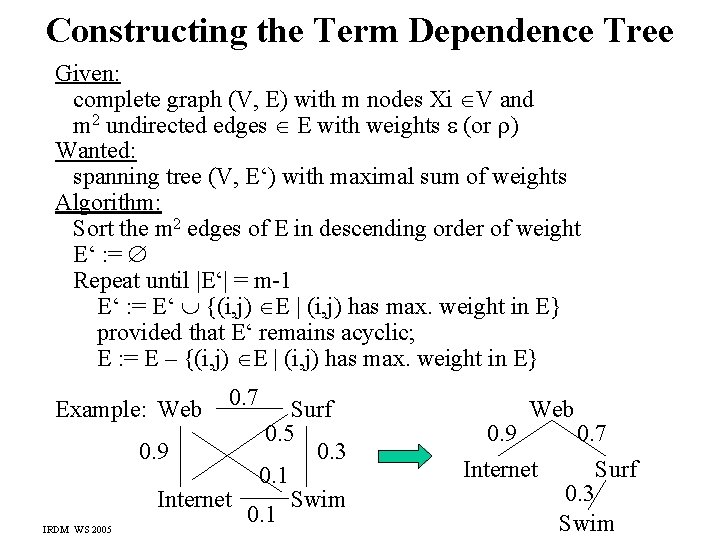
Constructing the Term Dependence Tree Given: complete graph (V, E) with m nodes Xi V and m 2 undirected edges E with weights (or ) Wanted: spanning tree (V, E‘) with maximal sum of weights Algorithm: Sort the m 2 edges of E in descending order of weight E‘ : = Repeat until |E‘| = m-1 E‘ : = E‘ {(i, j) E | (i, j) has max. weight in E} provided that E‘ remains acyclic; E : = E – {(i, j) E | (i, j) has max. weight in E} Example: Web IRDM WS 2005 0. 7 Surf 0. 5 0. 9 0. 3 0. 1 Internet Swim 0. 1 0. 9 Web Internet 0. 7 Surf 0. 3 Swim
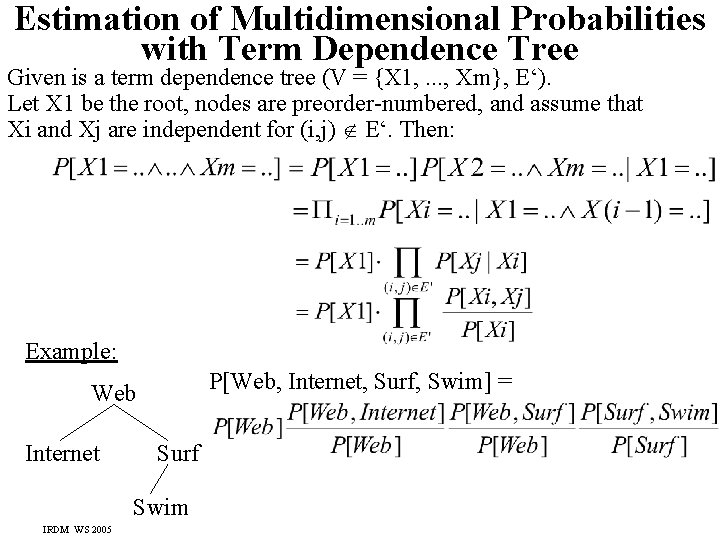
Estimation of Multidimensional Probabilities with Term Dependence Tree Given is a term dependence tree (V = {X 1, . . . , Xm}, E‘). Let X 1 be the root, nodes are preorder-numbered, and assume that Xi and Xj are independent for (i, j) E‘. Then: Example: P[Web, Internet, Surf, Swim] = Web Internet Surf Swim IRDM WS 2005
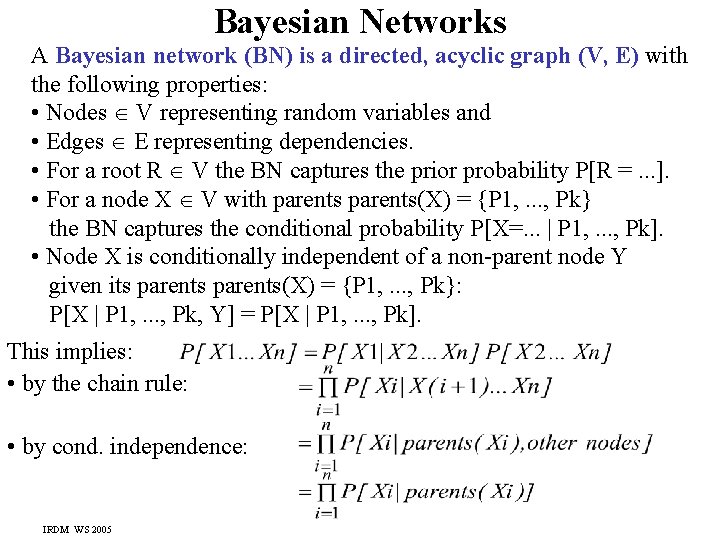
Bayesian Networks A Bayesian network (BN) is a directed, acyclic graph (V, E) with the following properties: • Nodes V representing random variables and • Edges E representing dependencies. • For a root R V the BN captures the prior probability P[R =. . . ]. • For a node X V with parents(X) = {P 1, . . . , Pk} the BN captures the conditional probability P[X=. . . | P 1, . . . , Pk]. • Node X is conditionally independent of a non-parent node Y given its parents(X) = {P 1, . . . , Pk}: P[X | P 1, . . . , Pk, Y] = P[X | P 1, . . . , Pk]. This implies: • by the chain rule: • by cond. independence: IRDM WS 2005
![Example of Bayesian Network (Belief Network) P[C]: P[C] P[ C] Cloudy 0. 5 P[R](http://slidetodoc.com/presentation_image/62bf1113cabe38f5d0d2e1b7d739f0c5/image-19.jpg "Example of Bayesian Network (Belief Network) P[C]: P[C] P[ C] Cloudy 0. 5 P[R")
Example of Bayesian Network (Belief Network) P[C]: P[C] P[ C] Cloudy 0. 5 P[R | C]: P[S | C]: C F T Sprinkler P[S] P[ S] 0. 5 0. 1 0. 9 Rain Wet P[W | S, R]: IRDM WS 2005 S F F T T R F T C F T P[R] P[ R] 0. 2 0. 8 0. 2 P[W] 0. 0 0. 99 P[ W] 1. 0 0. 1 0. 01
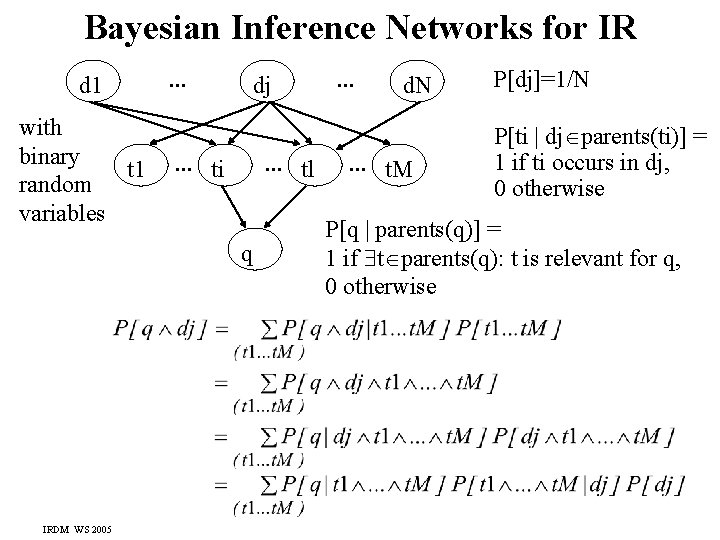
Bayesian Inference Networks for IR d 1 with binary t 1 random variables . . . dj . . . ti . . . tl q IRDM WS 2005 . . . d. N . . . t. M P[dj]=1/N P[ti | dj parents(ti)] = 1 if ti occurs in dj, 0 otherwise P[q | parents(q)] = 1 if t parents(q): t is relevant for q, 0 otherwise
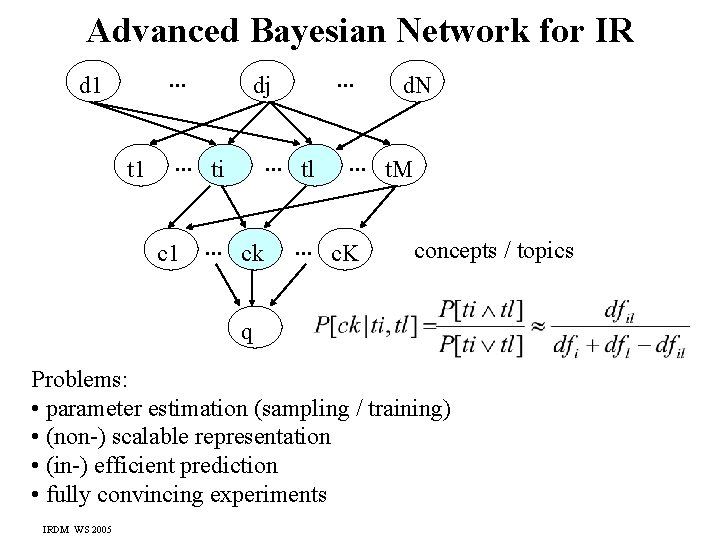
Advanced Bayesian Network for IR. . . d 1 t 1 . . . ti c 1 . . . dj. . . tl . . . ck d. N . . . t. M . . . c. K concepts / topics q Problems: • parameter estimation (sampling / training) • (non-) scalable representation • (in-) efficient prediction • fully convincing experiments IRDM WS 2005
Additional Literature for Chapter 4 Probabilistic IR: • Grossman/Frieder Sections 2. 2 and 2. 4 • S. E. Robertson, K. Sparck Jones: Relevance Weighting of Search Terms, JASIS 27(3), 1976 • S. E. Robertson, S. Walker: Some Simple Effective Approximations to the 2 -Poisson Model for Probabilistic Weighted Retrieval, SIGIR 1994 K. W. Church, W. A. Gale: Poisson Mixtures, Natural Language Engineering 1(2), 1995 • C. T. Yu, W. Meng: Principles of Database Query Processing for Advanced Applications, Morgan Kaufmann, 1997, Chapter 9 • D. Heckerman: A Tutorial on Learning with Bayesian Networks, Technical Report MSR-TR-95 -06, Microsoft Research, 1995 IRDM WS 2005
- Slides: 22