
Chapter 4 A SocietyCentered Approach to Trade Politics





- Slides: 65
Chapter 4 A Society-Centered Approach to Trade Politics
Examples • A society-centered approach argues that a government’s trade policy objectives are shaped by politicians’ responses to interest groups’ demands. • The European Union’s (EU) reluctance to liberalize European agriculture reflects EU policymakers’ responses to the demands of European farmers. • The Japanese government’s commitment to high tariffs on imported rice reflects the Japanese government’s need to respond to the demands of Japanese rice growers.
• The American effort to open foreign markets to American high technology and service exports while continuing to protect the American textile, apparel, and steel industries reflects the influence that industry-based interest groups exert on American trade policy.
Trade Policy Preferences • Because a society-centered approach argues that trade policy reflects interest-group demands, it devotes considerable attention to the source, content, and organization of these demands. • Two standard models of trade policy preferences are: the factor model and the sector model. • The two models agree that raising and lowering tariffs redistributes income, and they agree that these income consequences are the source of trade policy preferences.
Factor Incomes and Class Conflict • The factor model argues that trade politics are driven by competition between factors of production— that is, by competition between labor and capital, between workers and capitalists. • Labor and capital have distinct trade policy preference because trade’s income effects divide society along factor lines.
• Whenever tariffs are lowered and trade expanded (or tariffs raised and trade restricted), one factor will experience rising income, whereas the other will see its income fall. • Trade, therefore, places labor and capital in direct competition with each other over the distribution of national income. • To fully understand the reason for this competition, we need to look at how trade affects factor incomes. • To do so, we are going to make some assumptions. First, we will assume that there are only two countries in the world: the United States and China.
• Second, we will assume that both countries produce two goods: shirts and computers. • Third, we will assume that each country uses two factors of production, labor and capital, to produce both goods. • Fourth, we will assume that shirt production relies heavily on labor and less heavily on capital, whereas computer production requires a lot of capital and little labor. • Finally, we will assume that the United States is endowed with a lot of capital and little labor, whereas China is endowed with a lot of labor and little capital.
• These assumptions merely restate the standard trade model that we learned in Chapter 3. • These assumptions establish who produces what. • First, capital will be relatively cheap and labor will be relatively expensive in the United States, whereas the opposite will be the case in China. • Consequently, the United States will export the capitalintensive good (computers) and will import the laborintensive good (shirts). • China will export the labor-intensive good and import the capital-intensive good. We can now see what happens to factor incomes in the United States and China as they engage in trade.
• We look first at the United States. When the United States begins to import shirts from China, demand for American-made shirts falls. • As demand for American shirts falls, American firms manufacture fewer of them. • As shirt production falls, apparel firms liquidate the capital they had invested in shirt factories, and they lay off their employees.
• At the same time, American computer firms are expanding production in response to the growing Chinese demand for American computers. • As American computer production expands, computer firms demand more capital and labor, and they begin to employ capital and labor released by the shirt industry.
• There is an imbalance, however, between the amount of labor and capital being released by the shirt industry and the amount being absorbed into the computer industry. • The imbalance arises because the two industries use labor and capital in different proportions. • The labor-intensive shirt industry uses a lot of labor and little capital, and so as it shrinks, it releases a lot of labor and less capital. • The capital-intensive computer industry employs lots of capital and less labor, and so as it expands it demands more capital and less labor than the shirt industry is releasing. Consequently, the price of capital and labor will change.
• More capital is being demanded than is being released, causing the price of capital to rise. • People who own capital, therefore, now earn a higher return than they did prior to trade with China. • Less labor is being demanded than is being released, causing the price of labor to fall. • Workers, therefore, now earn less than they did prior to trade with China.
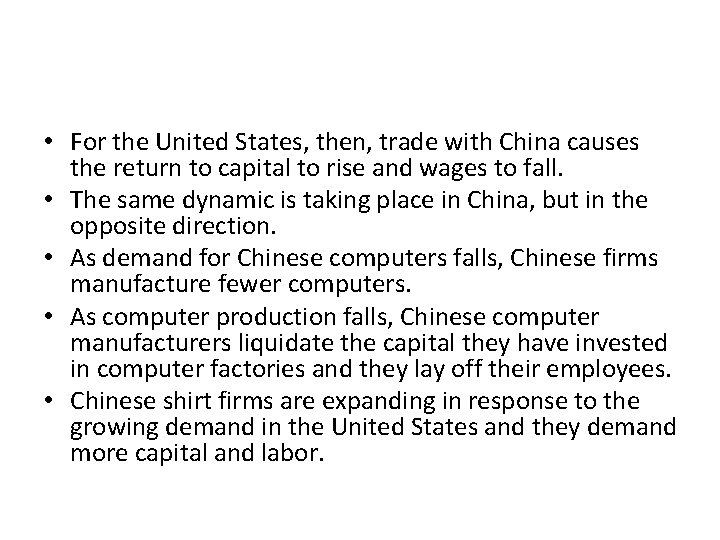
• For the United States, then, trade with China causes the return to capital to rise and wages to fall. • The same dynamic is taking place in China, but in the opposite direction. • As demand for Chinese computers falls, Chinese firms manufacture fewer computers. • As computer production falls, Chinese computer manufacturers liquidate the capital they have invested in computer factories and they lay off their employees. • Chinese shirt firms are expanding in response to the growing demand in the United States and they demand more capital and labor.
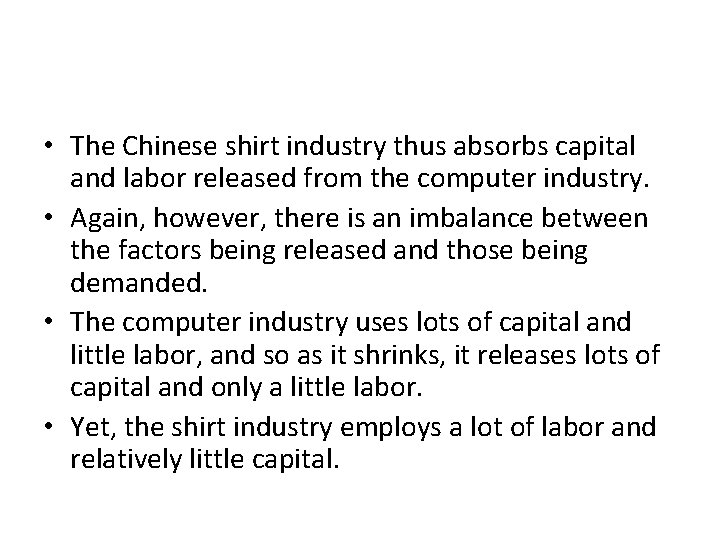
• The Chinese shirt industry thus absorbs capital and labor released from the computer industry. • Again, however, there is an imbalance between the factors being released and those being demanded. • The computer industry uses lots of capital and little labor, and so as it shrinks, it releases lots of capital and only a little labor. • Yet, the shirt industry employs a lot of labor and relatively little capital.
• So as it expands, it is demanding more labor and less capital than the computer industry is releasing. • Consequently, the relative prices of capital and labor change. • More labor is being demanded than is being released, causing the price of labor to rise.
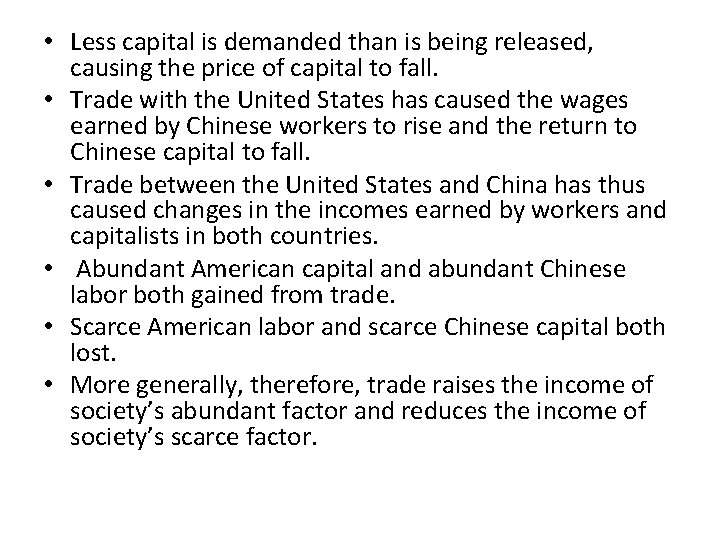
• Less capital is demanded than is being released, causing the price of capital to fall. • Trade with the United States has caused the wages earned by Chinese workers to rise and the return to Chinese capital to fall. • Trade between the United States and China has thus caused changes in the incomes earned by workers and capitalists in both countries. • Abundant American capital and abundant Chinese labor both gained from trade. • Scarce American labor and scarce Chinese capital both lost. • More generally, therefore, trade raises the income of society’s abundant factor and reduces the income of society’s scarce factor.
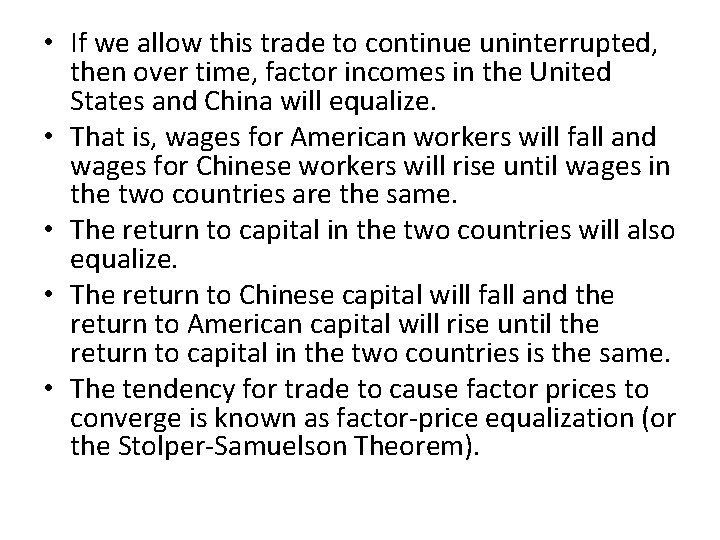
• If we allow this trade to continue uninterrupted, then over time, factor incomes in the United States and China will equalize. • That is, wages for American workers will fall and wages for Chinese workers will rise until wages in the two countries are the same. • The return to capital in the two countries will also equalize. • The return to Chinese capital will fall and the return to American capital will rise until the return to capital in the two countries is the same. • The tendency for trade to cause factor prices to converge is known as factor-price equalization (or the Stolper-Samuelson Theorem).
Factor Mobility • The ease with which factors of production can move from one industry to another. • All factors are mobile in the long run, but many are relatively immobile in the short run. • Different assumptions about the mobility of factors underlie two different political theories of trade politics. • The factor model assumes a high degree of factor mobility, whereas the sectoral model assumes that at least one factor is immo-bile in the short run.
Factor Model • A political model that argues that the politics of trade policy is characterized by competition between labor and capital. • Each of these two groups has a distinct trade policy preference because international trade has a differential effect on the groups’ incomes. • The scarce factor will be harmed by trade and therefore lobby for protection. The abundant factor will benefit from trade and therefore lobby for trade liberalization.
Factor-Price Equalization (Stolper. Samuleson Theorem) • In open economies, international trade will cause the price of the factors of production to equalize. • In a two-country world, the price of each country’s scarce factor will fall, whereas the price of each country’s abundant factor will rise. • Eventually, the price of labor will be the same in both countries and the price of capital will be the same in both countries.
• Abundant factors thus prefer low tariffs in order to capture the gains from trade. • In the United States and other capital abundant countries, the factor model predicts that owners of capital (the abundant factor) will prefer liberal trade policies, whereas workers (the scarce factor) will prefer protectionist trade policies. In developing countries, the factor model predicts that labor will prefer liberal trade policies, whereas owners of capital will prefer protection. • Trade politics are thus driven by conflict between labor and business (or capital). Because this competition pits workers against capitalists, the factor model is often called a class-based model of trade politics.
• The factor model suggests that the debate over trade policy is a conflict over the distribution of national income between American labor and American business. • Because trade reduces the income of American workers, these workers, and the organizations that represent them, have an incentive to oppose further liberalization and to advocate more protectionist policies. • And indeed, American labor unions have been very critical of globalization. The AFL-CIO, a federation of 64 labor unions representing 13 million American workers, has been among the most prominent critics of globalization.
• Although the AFL-CIO does not consider itself protectionist, it has fought consistently to prevent passage of fast-track authority. • It is also highly critical of the North American Free Trade Agreement (NAFTA) and the proposed Free Trade Area of the Americas (FTAA). • Conversely, because trade raises the return to American capital, American businesses should be strong supporters of globalization.
• And American business has been very supportive of globalization. • The Business Roundtable, a business association composed of the chief executives of the largest American corporations, strongly supports globalization. • It has been an active lobbyist for fast-track authority, it supports NAFTA and the FTAA, and it strongly supported China’s entry into the WTO. • The National Association of Manufacturers, which represents about 14, 000 American manufacturing firms, also supports the WTO and regional trade arrangements.
• Trade policy demands from American labor and capital thus reflect the income consequences that the factor model highlights. • American trade politics does seem to be shaped by competition over national income between workers and capitalists.
• However, an important qualification is: • The emergence of conflict between workers and capitalists is based on the assumption, embodied in our simple two-factor model, that American labor is homogeneous— all workers are identical.
• Workers are not homogeneous, however, and at a minimum, we need to divide labor into distinct skill categories, such as low-and high-skill, and treat each category as a distinct factor of production. • A model that allows for different skill categories among workers yields different conclusions about trade’s impact on the incomes of American workers. • Trade still reduces the income of low-skill American workers; high-skill workers, however, which are an abundant factor in the United States, would see their incomes rise.
Sectoral Model • A political model that argues that the politics of trade policy is characterized by competition between importcompeting and export-oriented industries. • Each industry has a distinct trade policy preference because international trade has a differential effect on the industries’ incomes. • Industries that rely heavily on the economy’s scarce factor will be harmed by trade and therefore lobby for protection. • Industries that rely heavily on the economy’s abundant factor will benefit from trade and therefore lobby for trade liberalization.
Sector Incomes and Industry Conflict • The sector model argues that trade politics are driven by competition between industries. • Industries have distinct preferences because trade’s income effects divide society along industry lines.
• Whenever tariffs are raised or lowered, wages and the return to capital employed in some industries both rise, whereas wages and the return to capital employed in other industries both fall. • Trade, therefore, pits the workers and capitalists employed in one industry against the workers and capitalists employed in another industry in the conflict over the distribution of national income.
• The sector model argues that trade divides society across industry rather than factor lines because the assumptions it makes about factor mobility are different from the assumptions embodied in the factor model. • Factor mobility refers to the ease with which labor and capital can move from one industry to another. • The factor model assumes that factors are highly mobile; labor and capital can move easily from one industry to another.
• Thus, capital currently employed in the apparel industry can be quickly shifted to the computer industry. • Similarly, workers currently engaged in apparel production can easily shift to computer production. • When factors are mobile, people’s economic interests are determined by their factor ownership.
• Workers care about what happens to labor, whereas capitalists care about the return to capital. • The sector model assumes that factors are not easily moved from one industry to another. • Instead, factors are tied, or specific, to the sector in which they are currently employed. • Capital currently employed in apparel production cannot easily move to the computer industry. What use does a loom or a spinning machine have in the computer industry?
• Workers also often have industry-specific skills that do not transfer easily from one sector to another. • A worker who has spent 15 years maintaining sophisticated automated looms and spinning machines in an apparel plant cannot easily transfer these skills to computer production. • In addition, the geography of industry location often means that quitting a job in one industry to take a job in another requires workers to physically relocate.
• Shifting from apparel production to automobile production might require a worker to move from North Carolina to Michigan. • Logistical obstacles to physical relocation can be insurmountable. • A worker may not be able to sell his house because the decline of the local industry has contributed to a more general economic decline in his community.
• Complex social and psychological factors also intervene, as it is difficult to abandon the network of social relations that one has developed over many years. • The combination of specific skills, logistical problems, and attachments to an established community mean that labor cannot always move from one industry to another. • When factors are immobile, trade affects the incomes of all factors employed in a given industry in the same way. • We can see why by returning to our U. S. – China example.
• Consider the apparel industry first. • Shirt imports from China lead to less shirt production in the United States. • Factories are closed and workers are laid off. • As in the factor model, apparel workers see their incomes fall.
• In contrast to the factor model, however, the owners of capital employed in apparel production also see their incomes fall. • Why? • Because capital is immobile and therefore capital employed in apparel production cannot move into the computer industry. • As demand for American shirts falls, demand for capital employed in the American shirt industry must also fall.
• As it does, the return to this capital must also fall. • Workers and business owners in the apparel sector thus both suffer from trade. • The opposite consequences are evident in the computer industry. • Trade’s impact on the return to capital employed in the computer industry is similar to the factor model.
• As computer production expands, increasing demand for capital raises the return to capital employed in the computer industry. • Trade’s impact on the incomes of workers employed in the computer industry is quite different from the factor model’s prediction. • The factor model tells us that computer workers see their incomes fall as they compete against the workers released by the apparel industry.
• With more people chasing fewer jobs, all workers’ incomes fall. • The sector model argues that computer workers’ incomes rise. • Because labor is immobile, the workers released by the apparel industry cannot move into the computer industry. Greater demand for labor in the computer industry increases the wages paid to workers already employed in the industry.
• Thus, capital and labor employed in the American computer industry both gain from trade. • When factors are immobile, it makes little sense to speak of the interests of a unified labor or capital class. • The apparel worker loses from trade; the computer worker gains. Roger Milliken (owner of the world’s largest privately owned textile firm, Milliken & Company) loses from trade while Michael Dell (founder of Dell Computers) gains. • Consequently, trade policy interests are defined in terms of the industry in which people work or have invested their capital.
• Apparel workers and Roger Milliken will have a common interest in trade policy. • Computer workers and Michael Dell will have a common interest in trade policy. • Trade politics is then driven by competition between the workers and capitalists who gain from trade and the workers and capitalists who lose. • The result is not class conflict, but conflict between industries.
• We can be very precise about which industries gain and which lose from trade. • Labor and capital employed in industries that rely intensively on society’s abundant factor (that is, the country’s comparatively advantaged industries) both gain from trade. • In the advanced industrialized countries, this means that labor and capital employed in capital-intensive and hightechnology industries, such as computers, pharmaceuticals, and biotechnology, gain from trade. • As a group, these industries are referred to as the exportoriented sector. Conversely, labor and capital employed in industries that rely intensively on society’s scarce factor (that is, the country’s comparatively disadvantaged industries) lose from trade.
• In the advanced industrialized countries, this means that the incomes of owners of capital and workers employed in labor-intensive sectors such as apparel and footwear will fall as a result of trade. • As a group, these industries are commonly referred to as the import-competing sector. • Thus, the sector model argues that trade politics is driven by competition between the importcompeting and export-oriented sectors.
• The factor and sector models thus both argue that trade policy preferences are determined by the income consequences of trade. • Trade raises the incomes of some groups and lowers the incomes of others. • Those who gain from trade prefer trade liberalization, whereas those who lose prefer protectionism.
• The factor model states that trade divides society across factor lines and that, consequently, trade politics is driven by conflict between labor and capital. • The sector model states that trade divides society along sector lines and that, consequently trade politics is driven by conflict between import-competing and export-oriented industries.
Collective Action Problem • Applies to instances in which the action of a number of individuals is required to achieve a common goal. • The problem arises because people will not voluntarily invest time, energy, or money to achieve a common goal, but will instead allow others to bear these costs. • That is, each free rides on the efforts of others.
• Because all members of the interested group act in the same way, insufficient time, energy, and money are dedicated to the achievement of the goal, and the goal is therefore not achieved. • In international political economy, it has been used to understand interest-group formation, and in particular, why consumer interests are underrepresented in trade policy.
Organizing Interests: The Collective Action Problem and Trade Policy Demands • Individuals’ preferences are not transformed automatically into political pressure for specific trade policies. • Transforming individual preferences into political demands requires that the individuals who share a common preference organize in order to exert influence on the policy-making process. • Organizing can be so difficult that individuals with common interests may not organize at all.
• This might seem counterintuitive. • If trade affects incomes in predictable ways, and if people are rational, then why wouldn’t people with common interests join forces to lobby for their desired policy? • Groups often can’t organize because they confront a public goods problem or collective action problem (Olson 1965).
• Collective action problems are similar to the problem of public goods provision. Consider consumers and trade policy. • As a group, the 200 million or so consumers who live in the United States would all gain from free trade. • These 200 million people thus have a common interest in unilateral trade liberalization. • To achieve this goal, however, consumers will have to lobby the government. Such lobbying is costly— money is required to create an organization, to pay for a lobbyist, and to contribute to politicians’ campaigns, and time must be dedicated to fundraising and organization.
• Consequently, most consumers will perform the following very simple calculation: My contribution to this campaign will make no perceptible difference to the group’s ability to achieve free trade. • Moreover, I will benefit from free trade if the group is successful regardless of whether I have contributed or not. • Therefore, I will let other consumers spend their money and time; that is, I will free ride.
• Because all consumers have an incentive to free ride, no one contributes time and money, no one lobbies, and consumer interests fail to influence trade policy. • Thus, even though consumers share a common goal, the collective action problem prevents them from exerting pressure on politicians to achieve this goal. • The incentive to free ride makes collective action in pursuit of a common goal very difficult.
• The logic of collective action helps us understand three important characteristics of trade politics. • First, it helps us understand why producers rather than consumers dominate trade politics. • Consumers are a large and homogeneous group, and each individual consumer faces a strong incentive to free ride. • Consequently, contributions to a “Consumers for Free Trade” interest group are substantially less than the underlying common interest in free trade would seem to dictate.
• In contrast, most industries are made up of a relatively small number of firms. • Producer groups can thus more readily organize to lobby the government in pursuit of their desired trade policy. • The logic of collective action helps us understand why producers’ interests dominate trade politics, whereas consumer interests are often neglected.
• Second, the logic of collective action suggests that trade politics will exhibit a bias toward protectionism. • A tariff provides large benefits to the few firms producing in the protected industry. • The costs of a tariff, however, are distributed across a large number of individuals and firms. • A higher tariff on steel, for example, provides large benefits to the relatively small number of American steel producers and their workers.
• The costs of a steel tariff fall on everyone who consumes steel, a group that includes most American consumers as well as all firms that use steel as an input in their production processes. • The small group of steel producers that benefits from the higher tariff can fairly easily overcome the collective action problem to lobby for protection. • The large and heterogeneous group that bears the costs of the tariff finds it much more difficult to organize for collective action.
• Consequently, trade politics is dominated by import-competing industries demanding protection. • Finally, the logic of collective action helps us understand why governments rarely liberalize trade unilaterally, but have been willing to do so through negotiated agreements.
• Reciprocal trade agreements make it easier for exportoriented industries to overcome the collective action problem. • Reciprocal trade agreements provide large benefits in the form of access to foreign markets to small groups of exportoriented firms. • Reducing foreign tariffs on microprocessors for personal computers, for example, provides substantial gains to the three American firms that dominate this industry (Intel, Advanced Micro Devices [AMD], and Motorola). • These three firms will solve the collective action problem they face and lobby for trade liberalization at home in exchange for the removal of foreign barriers to their exports.
• In a society-centered approach, therefore, trade politics are shaped by competition between organized interest groups. • This competition sometimes revolves around class conflict that pits workers against business owners and at other times revolves around industry conflict that pits import-competing industries against export-oriented industries. • In all cases, however, the core conflict in, and the ultimate stakes of, this competition remain the same: the distribution of national income.
• The winners of this political competition are rewarded with rising incomes. • The losers become poorer.
Political Institutions and the Supply of Trade Policy • While scholars have devoted considerable attention to developing conceptual models of the demand side of trade politics, they have focused less on the supply side of trade politics. • Supply-side models strive to say something systematic about who wins the competition over trade policy. • Here we find considerable agreement that political institutions play an important role in transforming interest-group demands into actual policies, but substantially less agreement about how exactly they do so.
Political Institutions • The formal and informal rules that structure collective decision making (politics). • These rules establish who can legitimately participate in the political process, how these participants will make collective decisions, and how they will ensure compliance with the decisions they make. • Such rules thus enable groups in countries and groups of countries in the international state system to reach and enforce collective decisions.
Three weaknesses of the societycentered approach to international trade • Explains the political dynamics influencing trade policies, but cannot determine any concrete outcomes. • Assumes that politicians passively and loyally represent various groups’ interests. • Excludes non-economic forces such as environmental and human-rights organizations.