
Chapter 4 6 Isosceles Equilateral and Right Triangles
- Slides: 11
Chapter 4. 6 Isosceles, Equilateral, and Right Triangles
Objectives/Assignment n Use properties of isosceles and equilateral triangles n Use properties of right triangles n Assignment: 1 -25 all
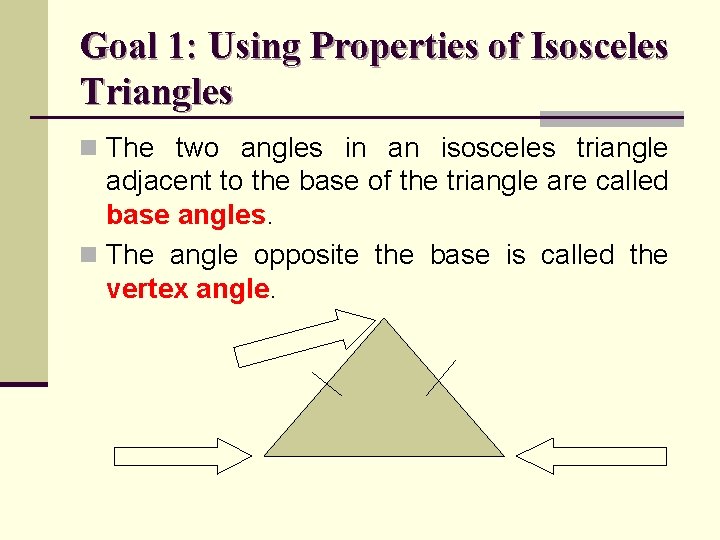
Goal 1: Using Properties of Isosceles Triangles n The two angles in an isosceles triangle adjacent to the base of the triangle are called base angles. n The angle opposite the base is called the vertex angle.
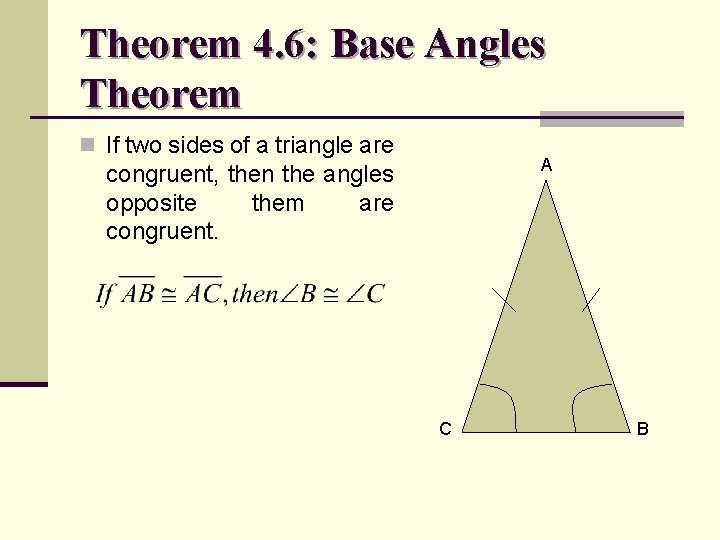
Theorem 4. 6: Base Angles Theorem n If two sides of a triangle are A congruent, then the angles opposite them are congruent. C B
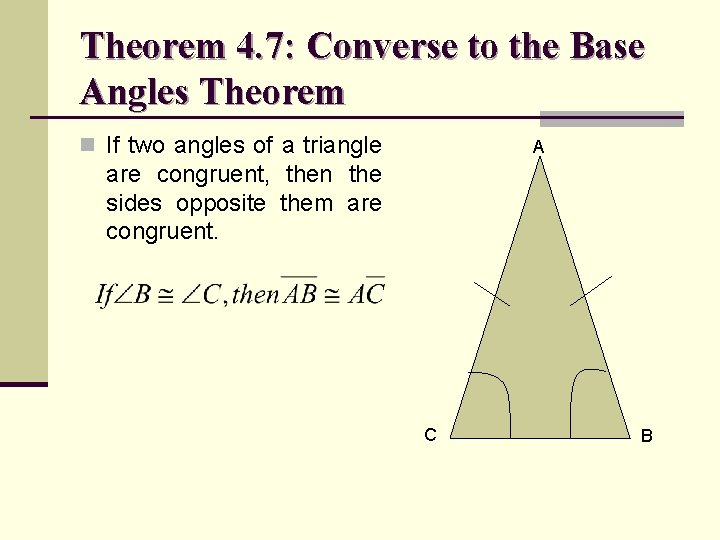
Theorem 4. 7: Converse to the Base Angles Theorem n If two angles of a triangle A are congruent, then the sides opposite them are congruent. C B
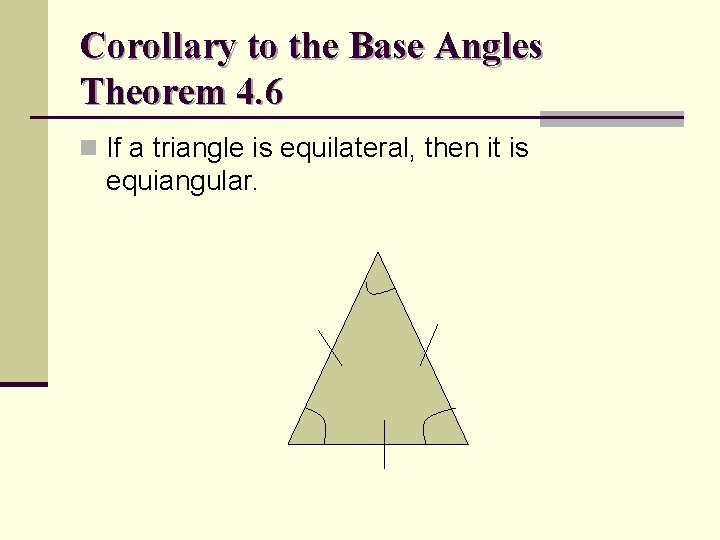
Corollary to the Base Angles Theorem 4. 6 n If a triangle is equilateral, then it is equiangular.
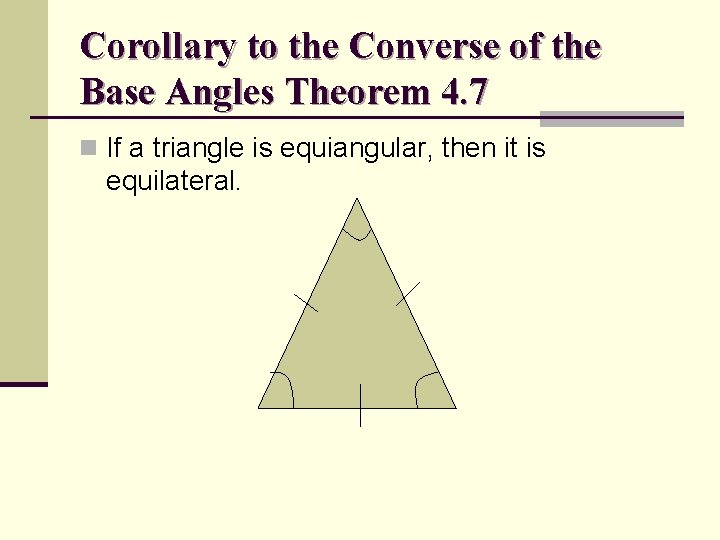
Corollary to the Converse of the Base Angles Theorem 4. 7 n If a triangle is equiangular, then it is equilateral.
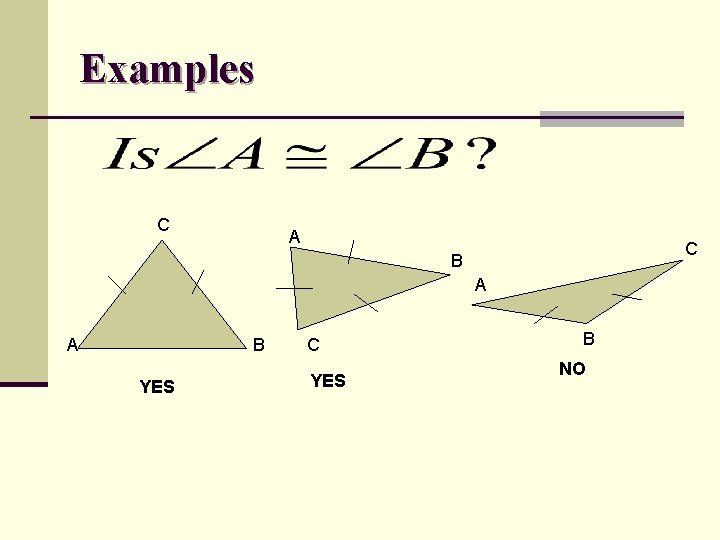
Examples C A C B A A B YES C YES B NO
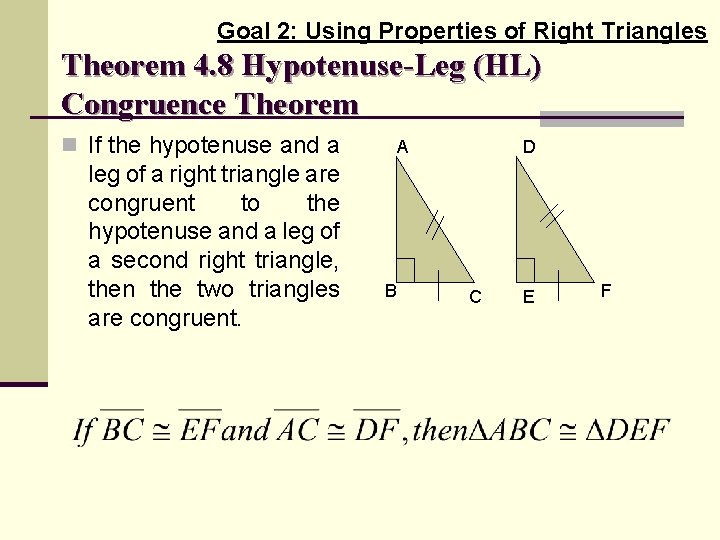
Goal 2: Using Properties of Right Triangles Theorem 4. 8 Hypotenuse-Leg (HL) Congruence Theorem n If the hypotenuse and a leg of a right triangle are congruent to the hypotenuse and a leg of a second right triangle, then the two triangles are congruent. A B D C E F
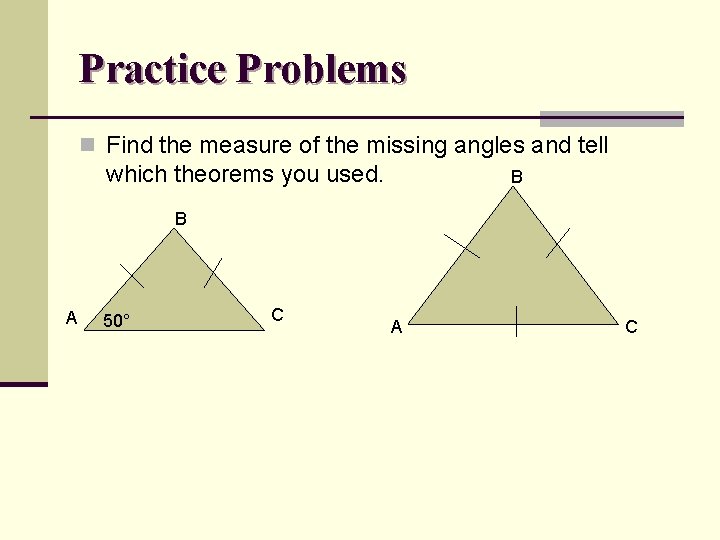
Practice Problems n Find the measure of the missing angles and tell which theorems you used. B B A 50° C A C
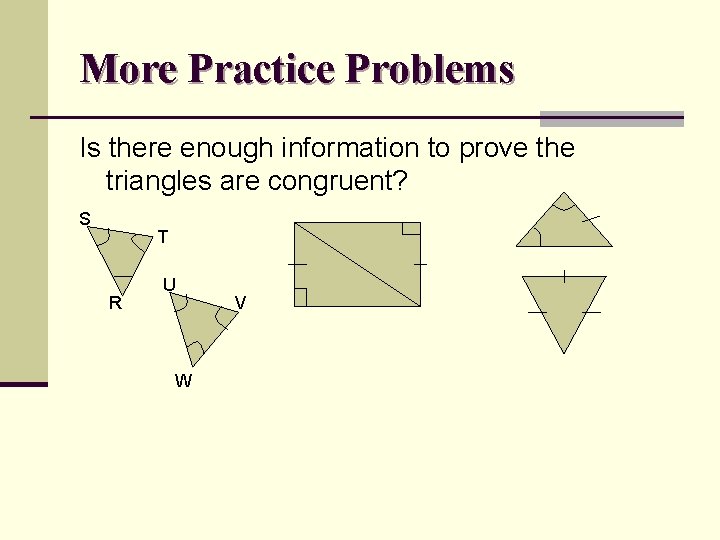
More Practice Problems Is there enough information to prove the triangles are congruent? S T R U W V