
Chapter 4 1 Species Interactions and Community Ecology
- Slides: 15
Chapter 4. 1 Species Interactions and Community Ecology
Species interactions • Species interactions are the backbone of communities • Most important categories – Competition = both species are harmed – Predation, parasitism, and herbivory = one species benefits and the other is harmed – Mutualism = both species benefit
Competition • Competition = relationship where multiple organisms seek the same limited resources they need to survive: - Food - Water - Space - Shelter - Mates - Sunlight • Intraspecific competition = between members of the same species • Interspecific competition = between members of 2 or more species
Results of interspecific competition • Competitive exclusion = one species completely excludes another species from using the resource • Species coexistence = neither species fully excludes the other from resources, so both live side by side - This produces a stable point of equilibrium, with stable population sizes - Species adjust to minimize competition by using only a part of the available resource
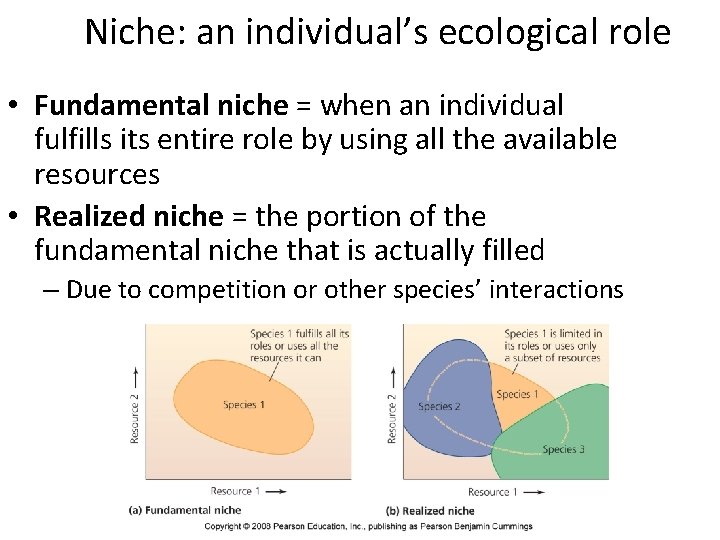
Niche: an individual’s ecological role • Fundamental niche = when an individual fulfills its entire role by using all the available resources • Realized niche = the portion of the fundamental niche that is actually filled – Due to competition or other species’ interactions
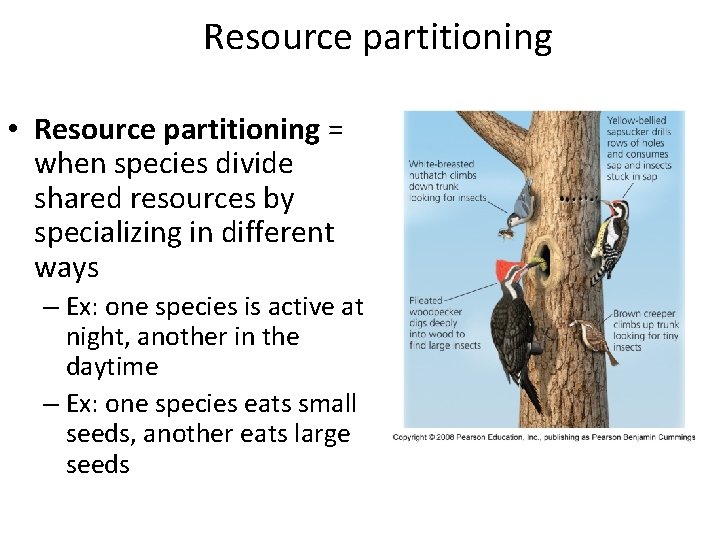
Resource partitioning • Resource partitioning = when species divide shared resources by specializing in different ways – Ex: one species is active at night, another in the daytime – Ex: one species eats small seeds, another eats large seeds
Effects of resource partitioning • Character displacement = competing species evolve physical characteristics that reflect their reliance on the portion of the resource they use – Ex: birds that eat larger seeds evolve larger bills – Ex: birds that eat smaller seeds evolve smaller bills Competition is reduced when two species become more different
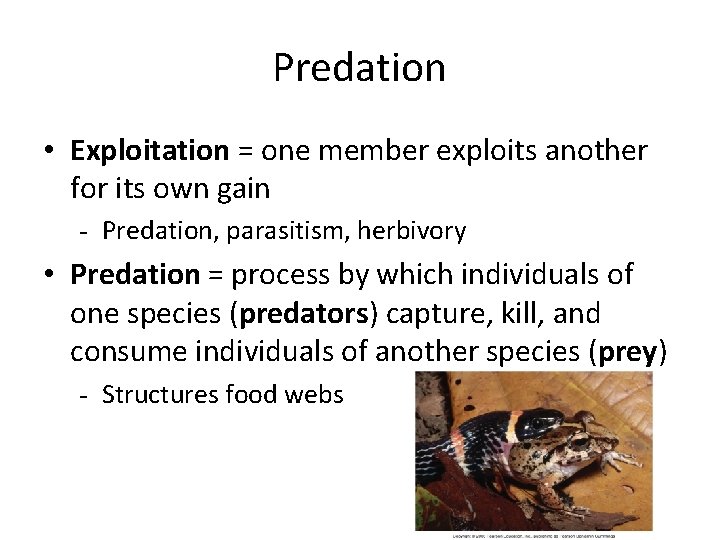
Predation • Exploitation = one member exploits another for its own gain - Predation, parasitism, herbivory • Predation = process by which individuals of one species (predators) capture, kill, and consume individuals of another species (prey) - Structures food webs
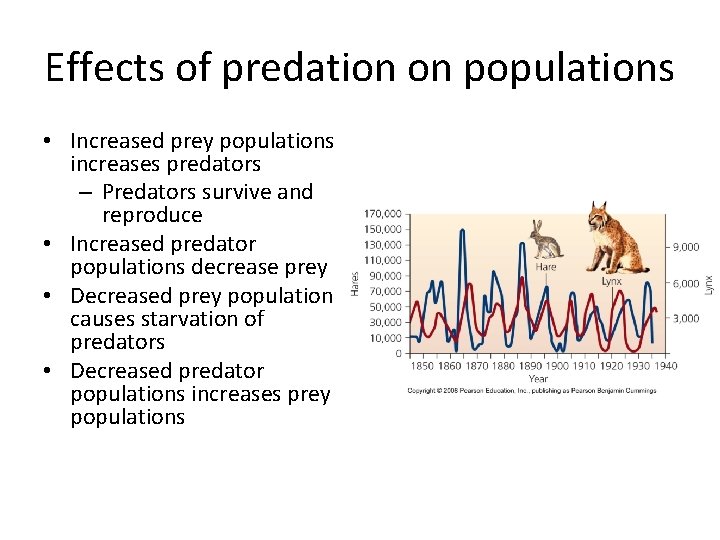
Effects of predation on populations • Increased prey populations increases predators – Predators survive and reproduce • Increased predator populations decrease prey • Decreased prey population causes starvation of predators • Decreased predator populations increases prey populations
Natural selection • Natural selection leads to evolution of adaptations that make predators better hunters • Individuals who are better at catching prey: – Live longer, healthier lives – Take better care of offspring • Predation pressure: prey are at risk of immediate death – Prey develops elaborate defenses against being eaten
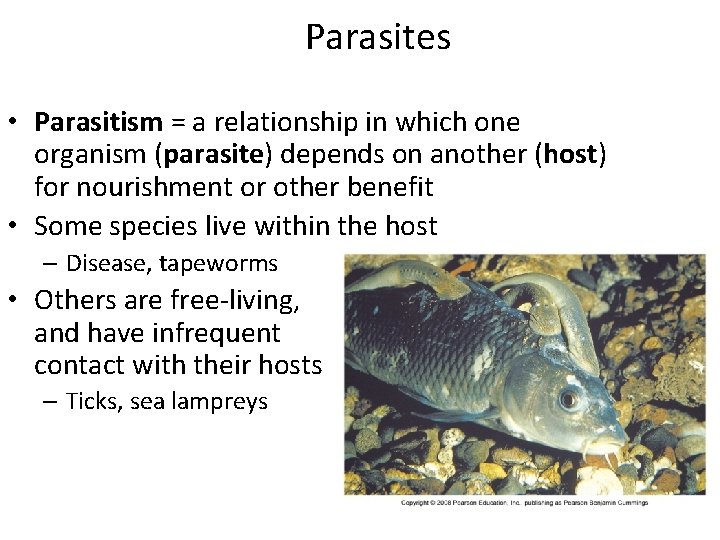
Parasites • Parasitism = a relationship in which one organism (parasite) depends on another (host) for nourishment or other benefit • Some species live within the host – Disease, tapeworms • Others are free-living, and have infrequent contact with their hosts – Ticks, sea lampreys
Coevolution • Coevolution = hosts and parasites become locked in a duel of escalating adaptations – Has been called an “evolutionary arms race” – Each evolves new responses to the other – It may not be beneficial to the parasite to kill its host
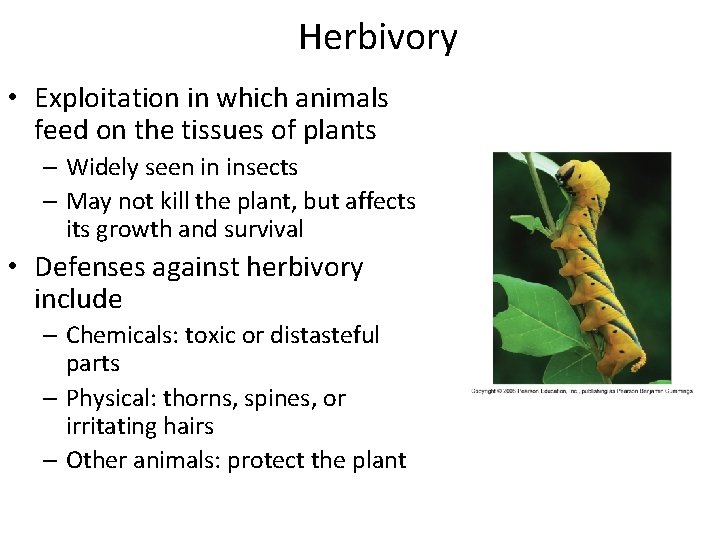
Herbivory • Exploitation in which animals feed on the tissues of plants – Widely seen in insects – May not kill the plant, but affects its growth and survival • Defenses against herbivory include – Chemicals: toxic or distasteful parts – Physical: thorns, spines, or irritating hairs – Other animals: protect the plant
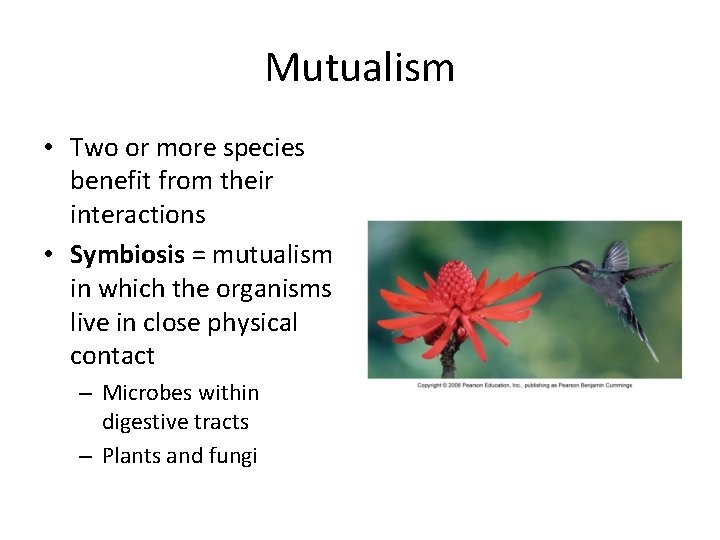
Mutualism • Two or more species benefit from their interactions • Symbiosis = mutualism in which the organisms live in close physical contact – Microbes within digestive tracts – Plants and fungi
Commensalism • a relationship in which one organism benefits, while the other remains unaffected – Facilitation = plants that create shade and leaf litter allow seedlings to grow