
Chapter 39 The Model of Human Occupation Kirsty
- Slides: 15
Chapter 39 The Model of Human Occupation Kirsty Forsyth, Renée R. Taylor, Jessica M. Kramer, Susan Prior, Lynn Richie, Jaqueline Whitehead, Christine Owen, and Jane Melton Copyright © 2014 Wolters Kluwer Health | Lippincott Williams & Wilkins
Learning Objectives After reading this chapter you will be able to: 1. Describe the personal factors addressed by the Model of Human Occupation and articulate how each concept affects occupational life. 2. Describe the environmental factors that are addressed by the Model of Human Occupation and articulate how each concept affects occupational life. 3. Identify dimensions of doing that the Model of Human Occupation uses to describe and examine a person’s engagement in occupations. Copyright © 2014 Wolters Kluwer Health | Lippincott Williams & Wilkins
Learning Objectives (Continued) 4. Describe the steps of therapeutic reasoning in the Model of Human Occupation. 5. Articulate how change occurs in occupational therapy and identify client actions and therapeutic strategies that lead to change. 6. Describe how the Model of Human Occupation can be applied to clients with a variety of diagnoses across the life course in different practice contexts. Copyright © 2014 Wolters Kluwer Health | Lippincott Williams & Wilkins
Introduction • The Model of Human Occupation (MOHO) is an occupationfocused, evidence-based, client-centered approach to OT practice • MOHO is now the most widely used occupation-based model in practice worldwide • MOHO has been developed through the efforts of an international community of scholars and practitioners Over 400 articles and chapters present theoretical, applied, and/or research evidence Copyright © 2014 Wolters Kluwer Health | Lippincott Williams & Wilkins
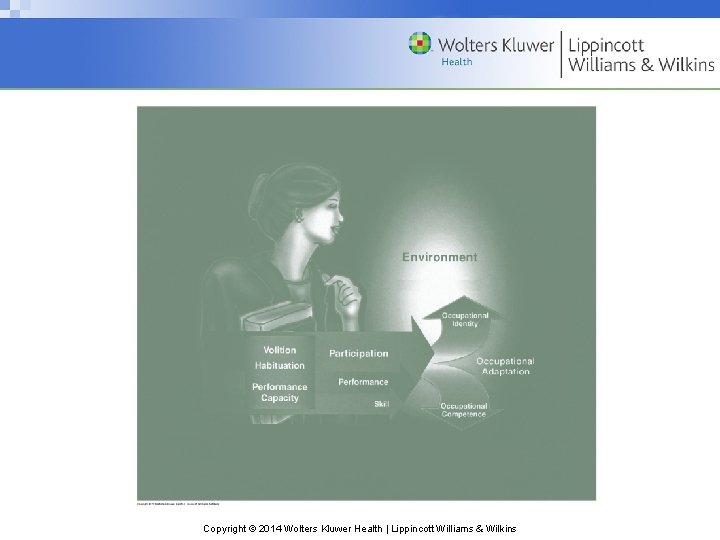
The Model of Human Occupation Concepts • MOHO is concerned with how people can participate in daily life occupations and achieve a state of competence and identity • MOHO conceptualizes OT as a process in which practitioners support client engagement in occupations in order to shape the clients’: – skills; – habits and routines; and – thoughts and feelings about themselves Copyright © 2014 Wolters Kluwer Health | Lippincott Williams & Wilkins
Copyright © 2014 Wolters Kluwer Health | Lippincott Williams & Wilkins
MOHO Concepts Related to the Person • Volition: The process by which people are motivated toward and choose what activities they do – Includes personal causation, values, and interests • Habituation: A process whereby people organize their actions into patterns and routines – Includes habits and roles • Performance capacity: Underlying mental and physical abilities and how they are used and experienced in occupational performance Copyright © 2014 Wolters Kluwer Health | Lippincott Williams & Wilkins
MOHO Concepts Related to the Environment • All occupation results from an interaction of the person with physical and social environments • The environment includes the physical, social, cultural, economic, and political features within a person’s context that influence the motivation, organization, and performance of occupation Copyright © 2014 Wolters Kluwer Health | Lippincott Williams & Wilkins
Dimensions of Doing MOHO identifies three levels at which we can examine what a person does: 1. Occupational participation refers to engaging in work, play, or ADLs that are part of one’s sociocultural context and are desired and/or necessary for well-being 2. Occupational performance is doing a task related to participation in a major life area 3. Skills are goal-directed actions that a person uses for occupational performance Copyright © 2014 Wolters Kluwer Health | Lippincott Williams & Wilkins
Occupational Identity, Competence, and Adaptation • What people do creates their occupational identity • Occupational competence is the degree to which people are able to sustain a pattern of doing that enacts their occupational identity • Occupational adaptation entails the: – creation of an occupational identity; and – ability to enact this identity in a variety of circumstances Copyright © 2014 Wolters Kluwer Health | Lippincott Williams & Wilkins
The Process of Change and Therapy • All change in OT is driven by the client’s occupational engagement • Occupational engagement refers to clients’ doing, thinking, and feeling under certain environmental conditions in the midst of therapy or as a planned consequence of therapy Copyright © 2014 Wolters Kluwer Health | Lippincott Williams & Wilkins
Process of Change and Therapy (Continued) Dimensions of occupational engagement include: – – – – – choose/decide; commit; explore; identify; negotiate; plan; practice; re-examine; and sustain Each of these dimensions shape the change process Copyright © 2014 Wolters Kluwer Health | Lippincott Williams & Wilkins
Using MOHO in Practice: The Six Steps of Therapeutic Reasoning 1. Generating questions about the client 2. Gathering information on and with the client 3. Using the information gathered to create an explanation of the client’s situation 4. Generating goals and strategies for therapy 5. Implementing and monitoring therapy 6. Determining outcomes of therapy Copyright © 2014 Wolters Kluwer Health | Lippincott Williams & Wilkins
A Sample of MOHO Assessments • Assessment of Communication and Interaction Skills (ACIS) • Assessment of Occupational Functioning (AOF) • Model of Human Occupation Screening Tool (MOHOST) • Occupational Circumstances Assessment Interview and Rating Scale (OCAIRS) • Occupational Performance History Interview-II (OPHI-II) • Occupational Self-Assessment (OSA) • Worker Role Interview (WRI) Copyright © 2014 Wolters Kluwer Health | Lippincott Williams & Wilkins
Therapeutic Strategies Identified by MOHO • Validating • Structuring • Identifying • Coaching • Giving feedback • Encouraging • Advising • Physical support • Negotiating Copyright © 2014 Wolters Kluwer Health | Lippincott Williams & Wilkins