
Chapter 39 Rehabilitation Nursing Mosby items and derived
Chapter 39 Rehabilitation Nursing Mosby items and derived items © 2011, 2007 by Mosby, Inc. , an affiliate of Elsevier Inc.
Rehabilitation……. restoring the individual to the fullest physical, mental, social, vocational, and economic capacity of which he or she is capable Mosby items and derived items © 2011, 2007 by Mosby, Inc. , an affiliate of Elsevier Inc. Slide 2
Rehabilitation Relearning of former skills; learning new skills necessary to adapt and live fully in an altered lifestyle Must begin from the very onset of a traumatic event or diagnosis of a chronic illness Every aspect of the individual’s needs and care assessed and addressed Mosby items and derived items © 2011, 2007 by Mosby, Inc. , an affiliate of Elsevier Inc. Slide 3
Issues in Rehabilitation Quality of Life versus Quantity of Life ◦ Rehabilitation focuses on continually improving the quality of the person’s life, not merely maintaining life itself. Care versus Cure ◦ Many conditions are irreversible; therefore, the focus of care is related to adaptation and acceptance of an altered life rather than to resolving an illness. Mosby items and derived items © 2011, 2007 by Mosby, Inc. , an affiliate of Elsevier Inc. Slide 4
Issues in Rehabilitation High Cost of Interdisciplinary Care (with many professional team members MD, Physical Therapist, etc. ) versus Long-term Care ◦ Rehabilitation is expensive. Success is sometimes seen as a return to productive employment; if the individual becomes sufficiently independent that no caregiver is required. Mosby items and derived items © 2011, 2007 by Mosby, Inc. , an affiliate of Elsevier Inc. Slide 5
Who needs rehab? 5 key areas ◦ Impairment Any loss or abnormality of psychologic, physical, or anatomic structure or function ◦ Disability Any restriction or lack of an ability to perform an activity in the manner or within the range considered normal for a human being Handicap Impairment or disability that limits or prevents fulfillment of a role that is normal for that particular individual Mosby items and derived items © 2011, 2007 by Mosby, Inc. , an affiliate of Elsevier Inc. Slide 6
Who Needs Rehab? Functional limitation ◦ Any loss of ability to perform tasks and obligations of usual roles and normal daily life Chronic illness ◦ An irreversible disease state Mosby items and derived items © 2011, 2007 by Mosby, Inc. , an affiliate of Elsevier Inc. Slide 7
Goals of Rehabilitation ◦ Maximize the quality of life of the individual ◦ Address the individual’s specific needs ◦ Assist with adjusting to an altered lifestyle ◦ Promoting wellness and minimizing complications ◦ Attaining the highest degree of function and self-sufficiency possible ◦ Assist the individual to return to home Mosby items and derived items © 2011, 2007 by Mosby, Inc. , an affiliate of Elsevier Inc. Slide 8
Cornerstones of Rehabilitation ◦ Individually centered ◦ Community reentry ◦ Independence ◦ Functional ability ◦ Team approach ◦ Quality of life ◦ Prevention and wellness ◦ Change process ◦ Adaptation ◦ Patient/family education Mosby items and derived items © 2011, 2007 by Mosby, Inc. , an affiliate of Elsevier Inc. Slide 9
Rehabilitation Team Patient Psychiatrist Rehab RN Physical Therapist Occupational Therapist Speech Therapist Recreational Therapist Clinical Psychologist Mosby items and derived items © 2011, 2007 by Mosby, Inc. , an affiliate of Elsevier Inc. Slide 10
Rehabilitation Team Rehabilitation Nurse ◦ broad knowledge base of pathophysiology of a wide range of medical-surgical conditions ◦ highly specialized knowledge and skills regarding rehabilitation ◦ Specialized training in rehab ◦ Practices in a variety of settings Mosby items and derived items © 2011, 2007 by Mosby, Inc. , an affiliate of Elsevier Inc. Slide 11
Rehabilitation Nurse The nurse is the 24 hour reinforcement to the patient for all the team members for example – the nurse encourages what the patient has learned in their 1 hour PT session, or session with OT Mosby items and derived items © 2011, 2007 by Mosby, Inc. , an affiliate of Elsevier Inc. Slide 12
Rehabilitation Team Comprehensive Rehabilitation Plan ◦ Initiated within 24 hours of admission and ready for review and revision by the team within 3 days of admission for each individual. ◦ The plan is developed based on the results of the interdisciplinary admission assessment. ◦ All clinicians treating the patient will use this comprehensive plan of care. Mosby items and derived items © 2011, 2007 by Mosby, Inc. , an affiliate of Elsevier Inc. Slide 13
Patient Education Crucial for the rehabilitation process to be comprehensive An ongoing and integral process for patients and families build knowledge, skills, and confidence to regain physical and psychosocial functioning following an illness or injury Mosby items and derived items © 2011, 2007 by Mosby, Inc. , an affiliate of Elsevier Inc. Slide 14
Patient Education – Nursing Process! ◦ Assess the patient's and family’s needs, abilities, and concerns. ◦ Plan interventions based on these needs, abilities, and concerns. ◦ Implement the educational plan. ◦ Evaluate the educational plan. ◦ Review the educational plan. Mosby items and derived items © 2011, 2007 by Mosby, Inc. , an affiliate of Elsevier Inc. Slide 15
Pediatric Rehabilitation Nursing Improved survival rate for illnesses & injuries that were once fatal led to the increase of Pediatric Rehab Nursing Primary difference with Pediatric Rehab and the rehabilitation of adults is the developmental potential for the child Mosby items and derived items © 2011, 2007 by Mosby, Inc. , an affiliate of Elsevier Inc. Slide 16
Gerontologic Rehabilitation Nursing This specialty practice focuses on the unique requirements of older adult rehabilitation patients. The main goal is to assist older adult patients in achieving their personal optimal level of health and well-being by providing holistic care in a therapeutic environment. Mosby items and derived items © 2011, 2007 by Mosby, Inc. , an affiliate of Elsevier Inc. Slide 17
Polytrauma Soldiers wounded in conflicts Also known as polytrauma-blast related injury (PT/BRI) Four categories ◦ Primary ◦ Secondary ◦ Tertiary ◦ Quaternary Mosby items and derived items © 2011, 2007 by Mosby, Inc. , an affiliate of Elsevier Inc. Slide 18
Polytrauma Primary – compression damage from blast to airfilled cavities (head) Secondary – airborne debris, sharpnel Tertiary- thrown from shock of the explosion (fractures, spinal cord injury) Quaternary – inhalation of chemicals from the blast Mosby items and derived items © 2011, 2007 by Mosby, Inc. , an affiliate of Elsevier Inc. Slide 19
Polytrauma Treat ALL injuries to the patient - not just the visible ones Mosby items and derived items © 2011, 2007 by Mosby, Inc. , an affiliate of Elsevier Inc. Slide 20
PTSD Mosby items and derived items © 2011, 2007 by Mosby, Inc. , an affiliate of Elsevier Inc. Slide 21
Posttraumatic Stress Disorder (PTSD) First identified in 1980 Goal is patient empowerment and regaining control over symptoms Previously known as “shell shock” or “war neurosis” Now applies to various forms of traumas ◦ Natural disasters ◦ Rape Mosby items and derived items © 2011, 2007 by Mosby, Inc. , an affiliate of Elsevier Inc. Slide 22
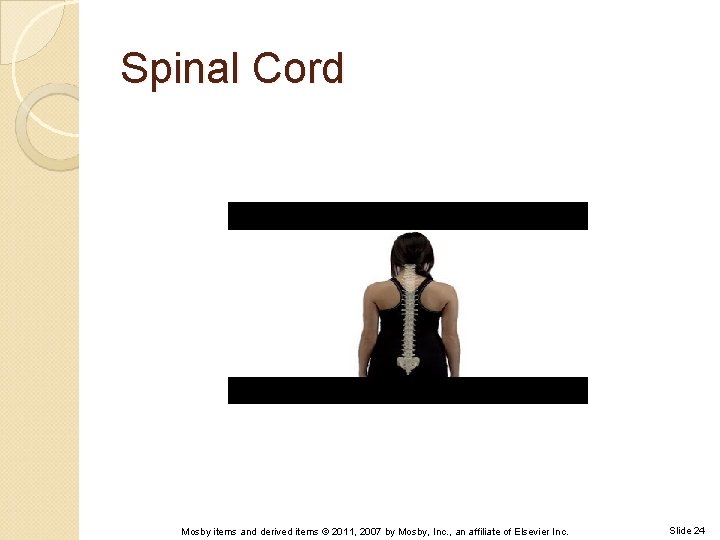
Disabling Disorders Spinal Cord Injuries ◦ These injuries occur mainly as a result of traumatic accident, and the individuals paralyzed are primarily young males. ◦ Functional abilities are related to injury level and extent of damage to the spinal cord; the higher the injury point, the higher the level and loss of function. ◦ Injury to the spinal cord is irreversible in that the cord is unable to repair itself. Mosby items and derived items © 2011, 2007 by Mosby, Inc. , an affiliate of Elsevier Inc. Slide 23
Spinal Cord Mosby items and derived items © 2011, 2007 by Mosby, Inc. , an affiliate of Elsevier Inc. Slide 24
Spinal cord injuries – handout pg 1215 Complete – no motor/sensory function below level of injury Incomplete – some/all motor or sensory function below level of injury Quadriplegia (Hemi) damage to cervical spine weakness or paralysis in all four extremities Mosby items and derived items © 2011, 2007 by Mosby, Inc. , an affiliate of Elsevier Inc. Slide 25
Spinal cord injuries Paraplegia – damage below the cervical area that involves weakness or paralysis in the trunk and lower extremities Paresis – a slight paralysis, incomplete loss of muscular power or weakness of a limb Mosby items and derived items © 2011, 2007 by Mosby, Inc. , an affiliate of Elsevier Inc. Slide 26
Spinal Cord Injuries Mosby items and derived items © 2011, 2007 by Mosby, Inc. , an affiliate of Elsevier Inc. Slide 27
Spinal Cord Injuries - Medical Complications ◦ Postural hypotension – drop in blood pressure while in wheelchair (caused pooling of blood in the lower extremities) ◦ To do – get patient back into bed. . before placing them in wheelchair HOB up 15 to 20 mins prior. . also abdominal binders, TEDs Mosby items and derived items © 2011, 2007 by Mosby, Inc. , an affiliate of Elsevier Inc. Slide 28
Spinal Cord Injuries –Medical Complications ◦ Autonomic dysreflexia -patients with spinal cord lesions above T 5 may experience sudden and extreme elevations in blood pressure caused by a reflex action of the autonomic nervous system. It is produced by stimulation of the body below the level of injury, usually by a distended bladder. Mosby items and derived items © 2011, 2007 by Mosby, Inc. , an affiliate of Elsevier Inc. Slide 29
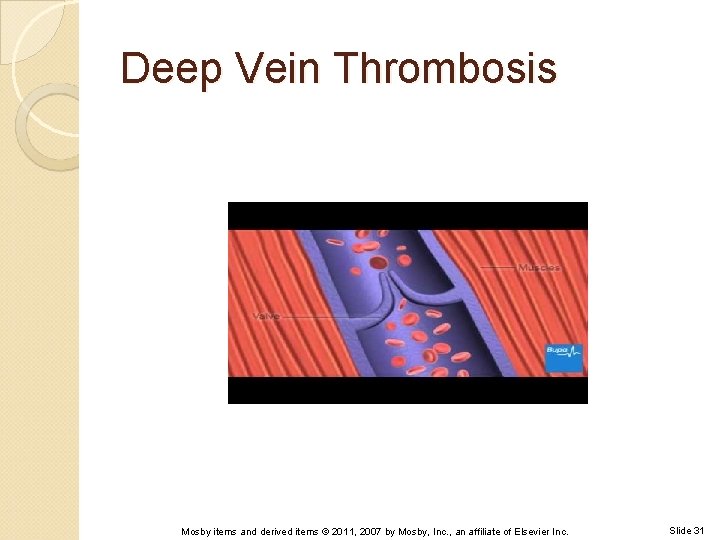
Spinal Cord Injuries – Medical Complications ◦ Heterotopic ossification This is the abnormal formation of bone cells in joints usually the hip or knee It is commonly seen in people with spinal cord injuries, and it occurs below the level of the lesion. ◦ Deep vein thrombosis This is clotting of blood within vessels of the legs caused by slowing of the circulation or an alteration in the blood vessel wall. Nursing assessment ? Swelling, redness, heat in the area (patient will not c/o pain) Mosby items and derived items © 2011, 2007 by Mosby, Inc. , an affiliate of Elsevier Inc. Slide 30
Deep Vein Thrombosis Mosby items and derived items © 2011, 2007 by Mosby, Inc. , an affiliate of Elsevier Inc. Slide 31
Traumatic Brain Injuries ◦ Most brain-related disabilities, including physical, cognitive, and psychosocial difficulties, require 5 to 10 years of difficult and painful rehabilitation; many require lifelong treatment and attention. ◦ Goal : restore the person to the highest possible level of independent functioning. Mosby items and derived items © 2011, 2007 by Mosby, Inc. , an affiliate of Elsevier Inc. Slide 32
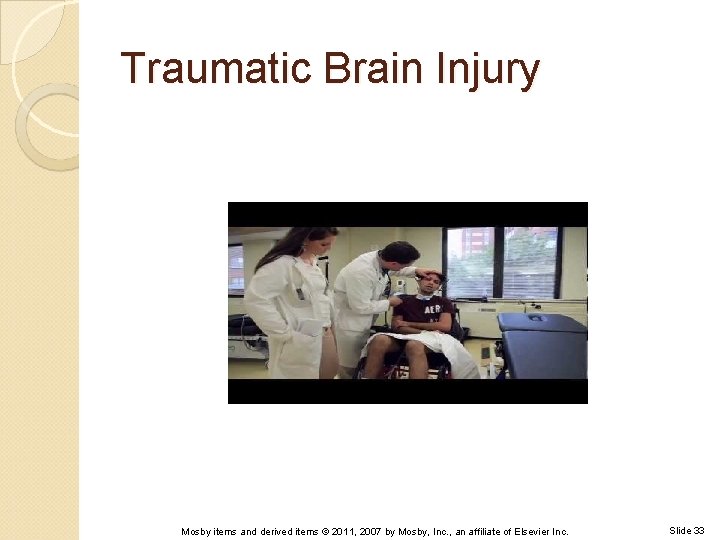
Traumatic Brain Injury Mosby items and derived items © 2011, 2007 by Mosby, Inc. , an affiliate of Elsevier Inc. Slide 33
Traumatic Brain Injuries ◦ Classified as mild, moderate, severe, or catastrophic Mild: Brief or no loss of consciousness; neurologic examinations often normal Moderate: Unconsciousness ranging from 1 to 24 hours; usually cognitive impairments Mosby items and derived items © 2011, 2007 by Mosby, Inc. , an affiliate of Elsevier Inc. Slide 34
Traumatic Brain Injuries Severe: Unconsciousness or posttrauma amnesia in excess of 8 days; cognitive, psychosocial, and behavioral disabilities Catastrophic: Coma lasting several months or longer; generally never regains significant meaningful communication Mosby items and derived items © 2011, 2007 by Mosby, Inc. , an affiliate of Elsevier Inc. Slide 35
Terms to know Rehabilitation Heterotopic ossification Impairment DVT Disability Traumatic Brain injury Functional limitation Chronic illness Polytrauma Impairment Disability PTSD Spinal Cord Injuries Posterial hypotension Autonomic dysreflexia Mosby items and derived items © 2011, 2007 by Mosby, Inc. , an affiliate of Elsevier Inc. Slide 36
- Slides: 36