
Chapter 38 Photons Electrons and Atoms What led

- Slides: 30
Chapter 38 Photons, Electrons, and Atoms What led to Quantum Theory Power. Point® Lectures for University Physics, Twelfth Edition – Hugh D. Young and Roger A. Freedman Lectures by James Pazun Copyright © 2008 Pearson Education Inc. , publishing as Pearson Addison-Wesley
The Photoelectric Effect: if photons come in bundles of energy equal to hf, then the maximum kinetic energy of electrons removed from a metal’s surface for monochromatic bombardment is Kmax = hf – φ, where φ is the work function (work to remove electrons from that surface). The stopping potential, V 0, thus is related to wavelength of the photons: e. V 0 = hc/λ – φ. Photons are thus bundles of energy E = hf (Einstein) Copyright © 2008 Pearson Education Inc. , publishing as Pearson Addison-Wesley
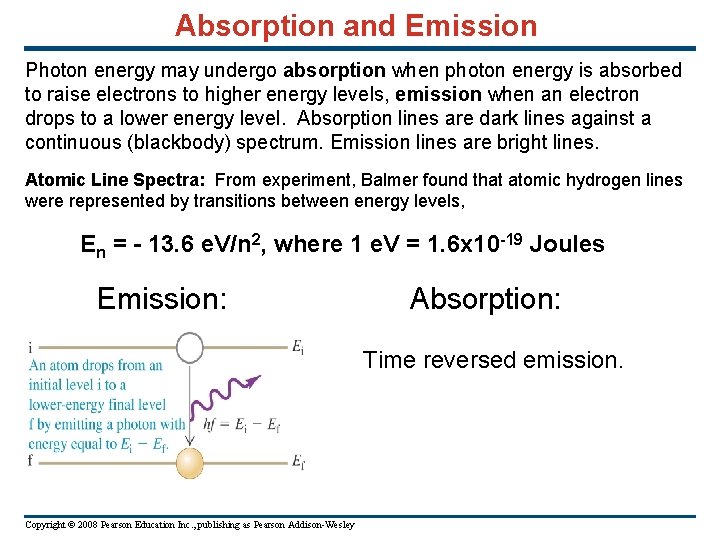
Absorption and Emission Photon energy may undergo absorption when photon energy is absorbed to raise electrons to higher energy levels, emission when an electron drops to a lower energy level. Absorption lines are dark lines against a continuous (blackbody) spectrum. Emission lines are bright lines. Atomic Line Spectra: From experiment, Balmer found that atomic hydrogen lines were represented by transitions between energy levels, En = - 13. 6 e. V/n 2, where 1 e. V = 1. 6 x 10 -19 Joules Emission: Absorption: Time reversed emission. Copyright © 2008 Pearson Education Inc. , publishing as Pearson Addison-Wesley
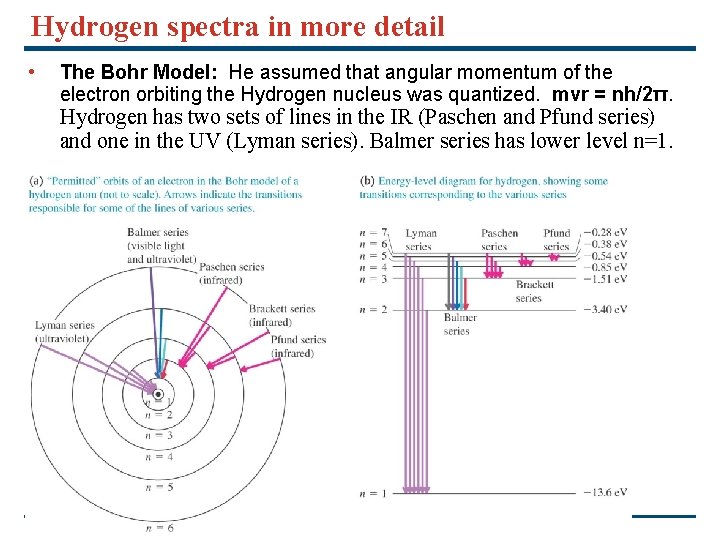
Hydrogen spectra in more detail • The Bohr Model: He assumed that angular momentum of the electron orbiting the Hydrogen nucleus was quantized. mvr = nh/2π. Hydrogen has two sets of lines in the IR (Paschen and Pfund series) and one in the UV (Lyman series). Balmer series has lower level n=1. Copyright © 2008 Pearson Education Inc. , publishing as Pearson Addison-Wesley
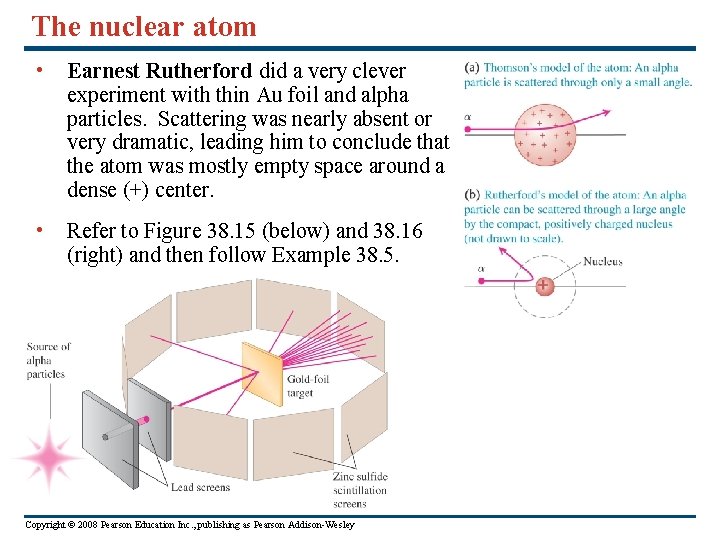
The nuclear atom • Earnest Rutherford did a very clever experiment with thin Au foil and alpha particles. Scattering was nearly absent or very dramatic, leading him to conclude that the atom was mostly empty space around a dense (+) center. • Refer to Figure 38. 15 (below) and 38. 16 (right) and then follow Example 38. 5. Copyright © 2008 Pearson Education Inc. , publishing as Pearson Addison-Wesley
The Bohr model The Bohr Model: He assumed that angular momentum of the electron orbiting the Hydrogen nucleus was quantized. As before, mvr = nh/2π. From that and classical physics, he derived the formula above for H spectra. He also got that the orbital radii r were proportional to n. All this can be derived in later quantum theory by assuming that the electron is a standing wave with wavelength proposed by De. Broglie: λ = h/mv. Copyright © 2008 Pearson Education Inc. , publishing as Pearson Addison-Wesley
Balmer Lines of Hydrogen Atomic Line Spectra: From experiment, Balmer found that atomic hydrogen lines were represented by transitions between energy levels Can be proven from Bohr’s formula, En = - 13. 6 e. V/n 2, where 1 e. V = 1. 6 x 10 -19 Joules. This was later derived by Neils Bohr from a theory of quantization. Other atoms are more complex, but still have levels related to n. Copyright © 2008 Pearson Education Inc. , publishing as Pearson Addison-Wesley
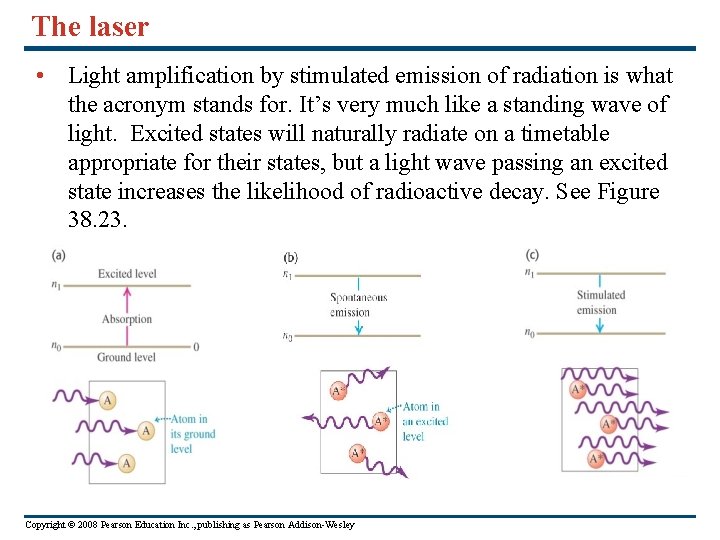
The laser • Light amplification by stimulated emission of radiation is what the acronym stands for. It’s very much like a standing wave of light. Excited states will naturally radiate on a timetable appropriate for their states, but a light wave passing an excited state increases the likelihood of radioactive decay. See Figure 38. 23. Copyright © 2008 Pearson Education Inc. , publishing as Pearson Addison-Wesley
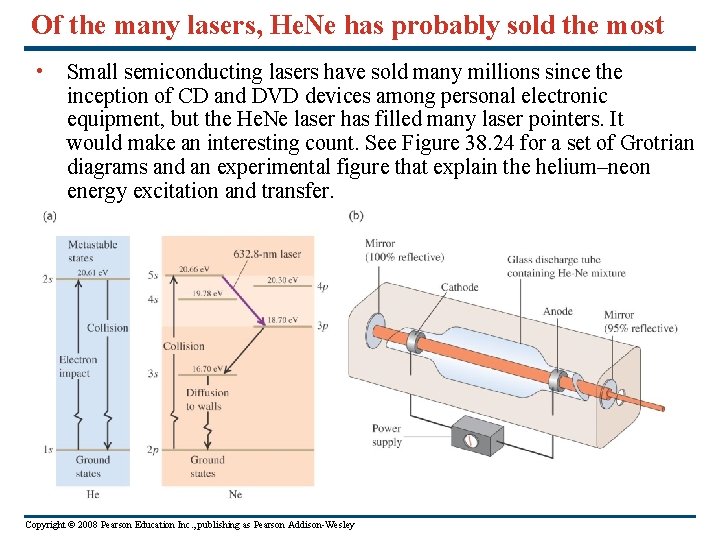
Of the many lasers, He. Ne has probably sold the most • Small semiconducting lasers have sold many millions since the inception of CD and DVD devices among personal electronic equipment, but the He. Ne laser has filled many laser pointers. It would make an interesting count. See Figure 38. 24 for a set of Grotrian diagrams and an experimental figure that explain the helium–neon energy excitation and transfer. Copyright © 2008 Pearson Education Inc. , publishing as Pearson Addison-Wesley
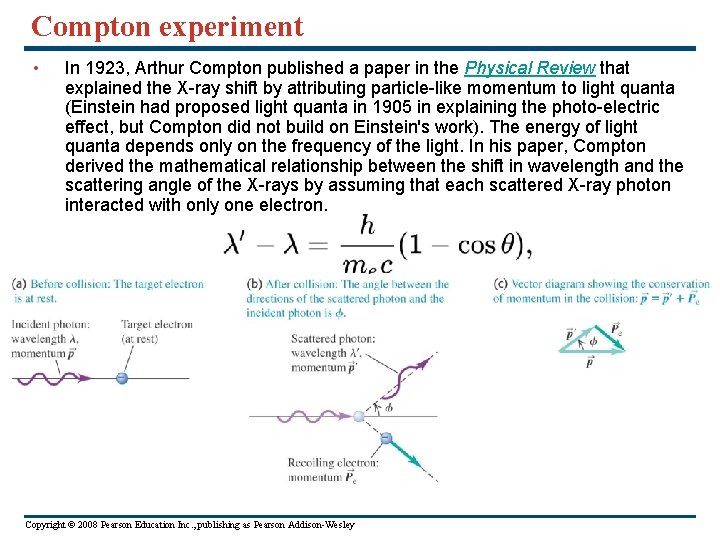
Compton experiment • In 1923, Arthur Compton published a paper in the Physical Review that explained the X-ray shift by attributing particle-like momentum to light quanta (Einstein had proposed light quanta in 1905 in explaining the photo-electric effect, but Compton did not build on Einstein's work). The energy of light quanta depends only on the frequency of the light. In his paper, Compton derived the mathematical relationship between the shift in wavelength and the scattering angle of the X-rays by assuming that each scattered X-ray photon interacted with only one electron. Copyright © 2008 Pearson Education Inc. , publishing as Pearson Addison-Wesley
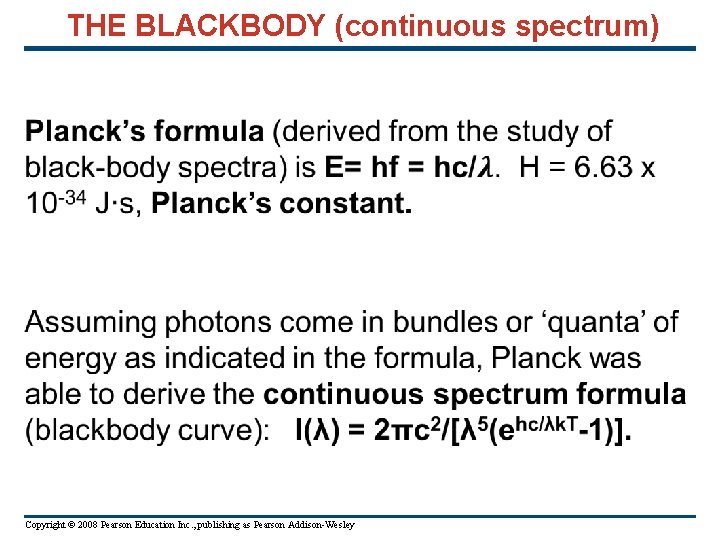
THE BLACKBODY (continuous spectrum) Copyright © 2008 Pearson Education Inc. , publishing as Pearson Addison-Wesley
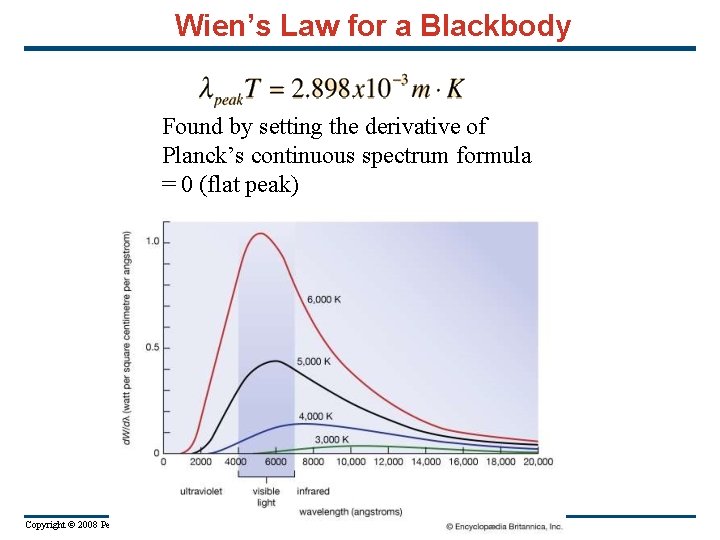
Wien’s Law for a Blackbody Found by setting the derivative of Planck’s continuous spectrum formula = 0 (flat peak) Copyright © 2008 Pearson Education Inc. , publishing as Pearson Addison-Wesley
Chapter 39 The Wave Nature of Particles Power. Point® Lectures for University Physics, Twelfth Edition – Hugh D. Young and Roger A. Freedman Lectures by James Pazun Copyright © 2008 Pearson Education Inc. , publishing as Pearson Addison-Wesley
Introduction • At the turn of the 20 th century, Albert Einstein helped lead science to light as a particle and wave–particle duality. The next logical step was not far behind. De Broglie, Heisenberg, and eventually Schrödinger developed a formalism to treat the particle (an electron) as a wave spawning the new adventure, quantum theory. Copyright © 2008 Pearson Education Inc. , publishing as Pearson Addison-Wesley
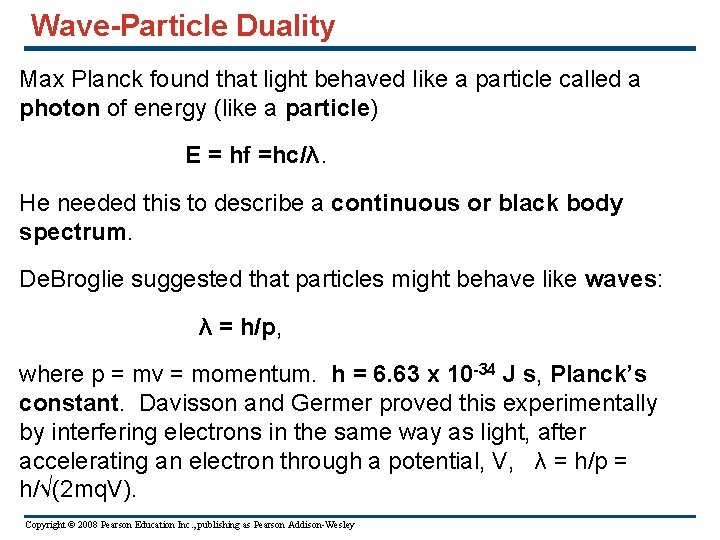
Wave-Particle Duality Max Planck found that light behaved like a particle called a photon of energy (like a particle) E = hf =hc/λ. He needed this to describe a continuous or black body spectrum. De. Broglie suggested that particles might behave like waves: λ = h/p, where p = mv = momentum. h = 6. 63 x 10 -34 J s, Planck’s constant. Davisson and Germer proved this experimentally by interfering electrons in the same way as light, after accelerating an electron through a potential, V, λ = h/p = h/√(2 mq. V). Copyright © 2008 Pearson Education Inc. , publishing as Pearson Addison-Wesley
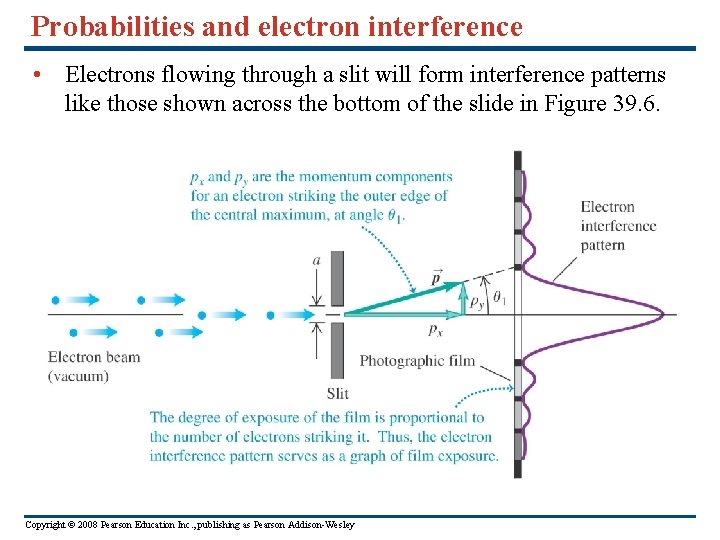
Probabilities and electron interference • Electrons flowing through a slit will form interference patterns like those shown across the bottom of the slide in Figure 39. 6. Copyright © 2008 Pearson Education Inc. , publishing as Pearson Addison-Wesley
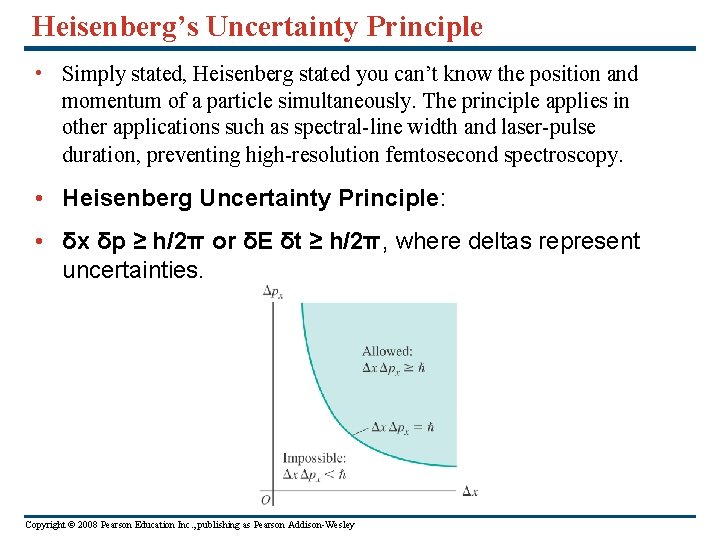
Heisenberg’s Uncertainty Principle • Simply stated, Heisenberg stated you can’t know the position and momentum of a particle simultaneously. The principle applies in other applications such as spectral-line width and laser-pulse duration, preventing high-resolution femtosecond spectroscopy. • Heisenberg Uncertainty Principle: • δx δp ≥ h/2π or δE δt ≥ h/2π, where deltas represent uncertainties. Copyright © 2008 Pearson Education Inc. , publishing as Pearson Addison-Wesley
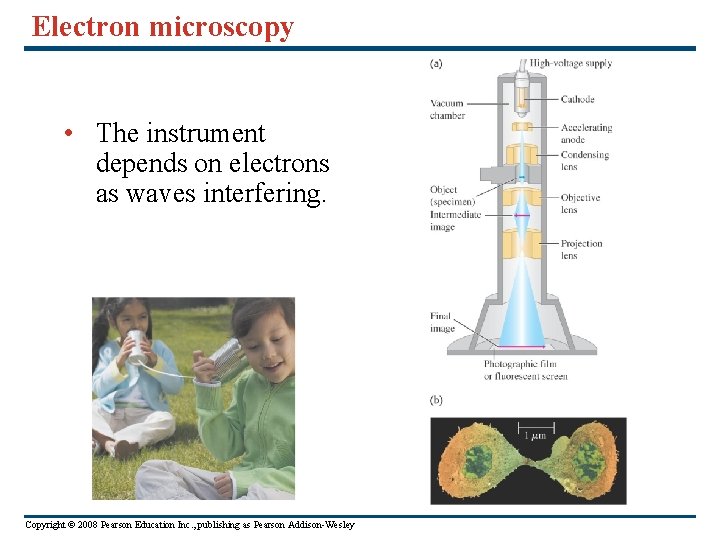
Electron microscopy • The instrument depends on electrons as waves interfering. Copyright © 2008 Pearson Education Inc. , publishing as Pearson Addison-Wesley
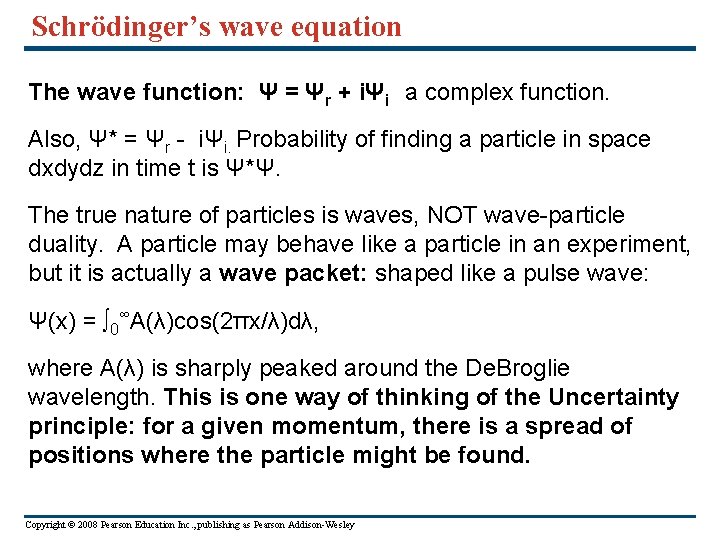
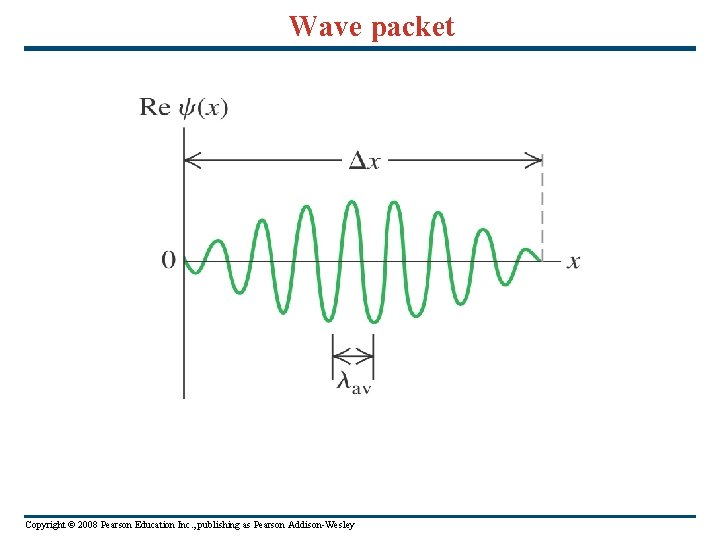
Schrödinger’s wave equation The wave function: Ψ = Ψr + iΨi a complex function. Also, Ψ* = Ψr - iΨi. Probability of finding a particle in space dxdydz in time t is Ψ*Ψ. The true nature of particles is waves, NOT wave-particle duality. A particle may behave like a particle in an experiment, but it is actually a wave packet: shaped like a pulse wave: Ψ(x) = ∫ 0∞A(λ)cos(2πx/λ)dλ, where A(λ) is sharply peaked around the De. Broglie wavelength. This is one way of thinking of the Uncertainty principle: for a given momentum, there is a spread of positions where the particle might be found. Copyright © 2008 Pearson Education Inc. , publishing as Pearson Addison-Wesley
Wave packet Copyright © 2008 Pearson Education Inc. , publishing as Pearson Addison-Wesley
Chapter 40 Quantum Mechanics Power. Point® Lectures for University Physics, Twelfth Edition – Hugh D. Young and Roger A. Freedman Lectures by James Pazun Copyright © 2008 Pearson Education Inc. , publishing as Pearson Addison-Wesley
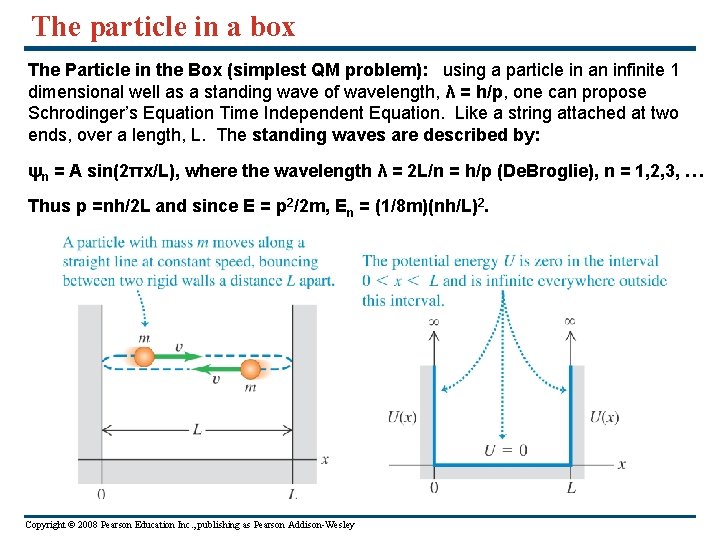
The particle in a box The Particle in the Box (simplest QM problem): using a particle in an infinite 1 dimensional well as a standing wave of wavelength, λ = h/p, one can propose Schrodinger’s Equation Time Independent Equation. Like a string attached at two ends, over a length, L. The standing waves are described by: ψn = A sin(2πx/L), where the wavelength λ = 2 L/n = h/p (De. Broglie), n = 1, 2, 3, … Thus p =nh/2 L and since E = p 2/2 m, En = (1/8 m)(nh/L)2. Copyright © 2008 Pearson Education Inc. , publishing as Pearson Addison-Wesley
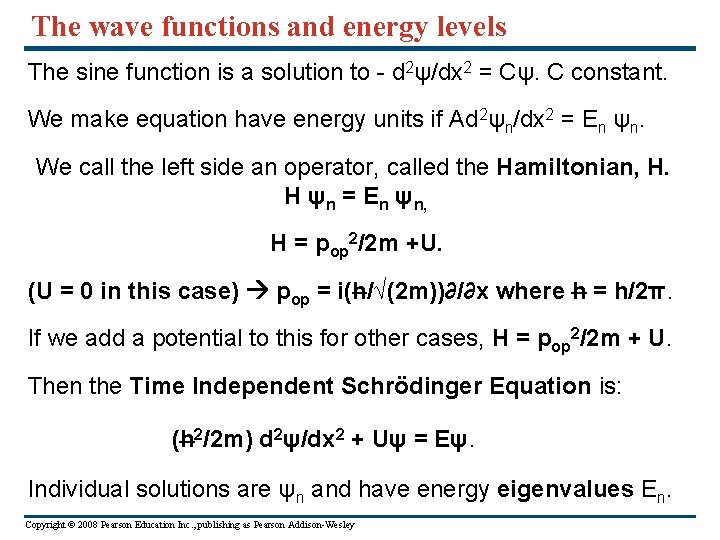
The wave functions and energy levels The sine function is a solution to - d 2ψ/dx 2 = Cψ. C constant. We make equation have energy units if Ad 2ψn/dx 2 = En ψn. We call the left side an operator, called the Hamiltonian, H. H ψn = En ψn, H = pop 2/2 m +U. (U = 0 in this case) pop = i(h/√(2 m))∂/∂x where h = h/2π. If we add a potential to this for other cases, H = pop 2/2 m + U. Then the Time Independent Schrödinger Equation is: (h 2/2 m) d 2ψ/dx 2 + Uψ = Eψ. Individual solutions are ψn and have energy eigenvalues En. Copyright © 2008 Pearson Education Inc. , publishing as Pearson Addison-Wesley
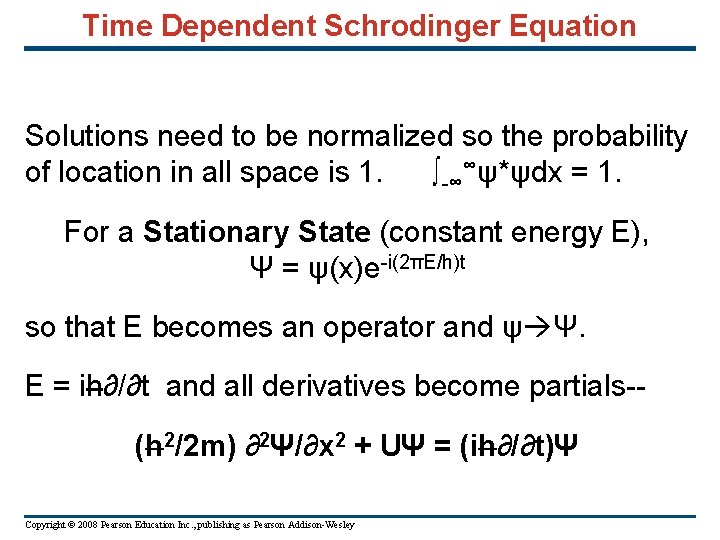
Time Dependent Schrodinger Equation Solutions need to be normalized so the probability of location in all space is 1. ∫-∞∞ψ*ψdx = 1. For a Stationary State (constant energy E), Ψ = ψ(x)e-i(2πE/h)t so that E becomes an operator and ψ Ψ. E = ih∂/∂t and all derivatives become partials-(h 2/2 m) ∂2Ψ/∂x 2 + UΨ = (ih∂/∂t)Ψ Copyright © 2008 Pearson Education Inc. , publishing as Pearson Addison-Wesley
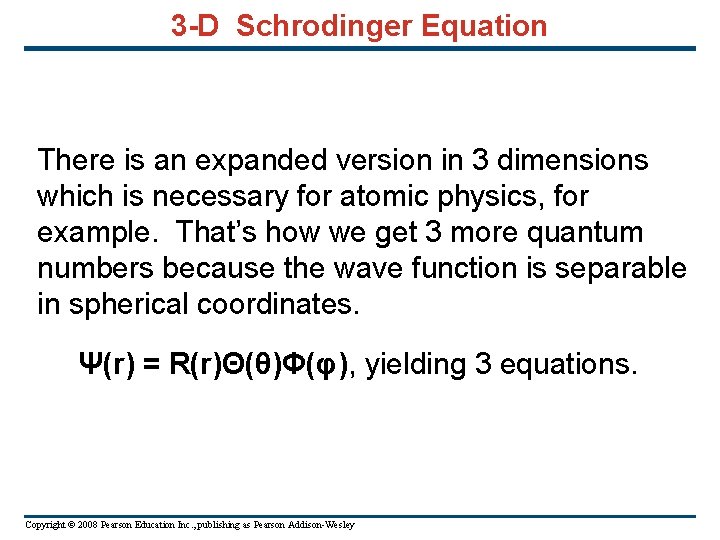
3 -D Schrodinger Equation There is an expanded version in 3 dimensions which is necessary for atomic physics, for example. That’s how we get 3 more quantum numbers because the wave function is separable in spherical coordinates. Ψ(r) = R(r)Θ(θ)Φ(φ), yielding 3 equations. Copyright © 2008 Pearson Education Inc. , publishing as Pearson Addison-Wesley
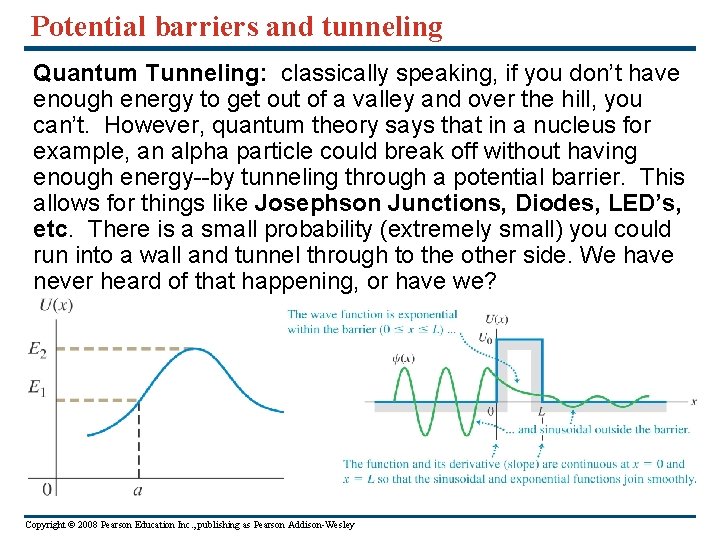
Potential barriers and tunneling Quantum Tunneling: classically speaking, if you don’t have enough energy to get out of a valley and over the hill, you can’t. However, quantum theory says that in a nucleus for example, an alpha particle could break off without having enough energy--by tunneling through a potential barrier. This allows for things like Josephson Junctions, Diodes, LED’s, etc. There is a small probability (extremely small) you could run into a wall and tunnel through to the other side. We have never heard of that happening, or have we? Copyright © 2008 Pearson Education Inc. , publishing as Pearson Addison-Wesley
Quantum Oscillators The Quantum Harmonic Oscillator: two atoms in a diatomic molecule like O 2 act like they have a linear spring between them with Force = -kx. The oscillatory potential energy between them is thus U(x) = (1/2)kx 2. Plugging this into the one dimensional time independent Schrödinger Equation and applying boundary conditions, we get the energy eigenvalues En = (n + ½)hω ω =√(k/m) n = 0, 1, 2, 3, … This can be done in three dimensions as well for solids, for example. Copyright © 2008 Pearson Education Inc. , publishing as Pearson Addison-Wesley
The Quantum Rotator A diatomic molecule can rotate too. The angular solutions to rigid body rotation are the same as for the hydrogen atom with angular momentum L 2 = L(L+1)h 2, l = 0, 1, 2, 3, … Classically, the rotational KE is the total energy E = L 2/2 I, in this case I is the Rotational Inertia. Therefore the energy eigenvalues are: En = L(L+1) h 2/2 I For a diatomic molecule I = mrr 02, where the reduced mass, mr = m 1 m 2/( m 1 + m 2). Copyright © 2008 Pearson Education Inc. , publishing as Pearson Addison-Wesley
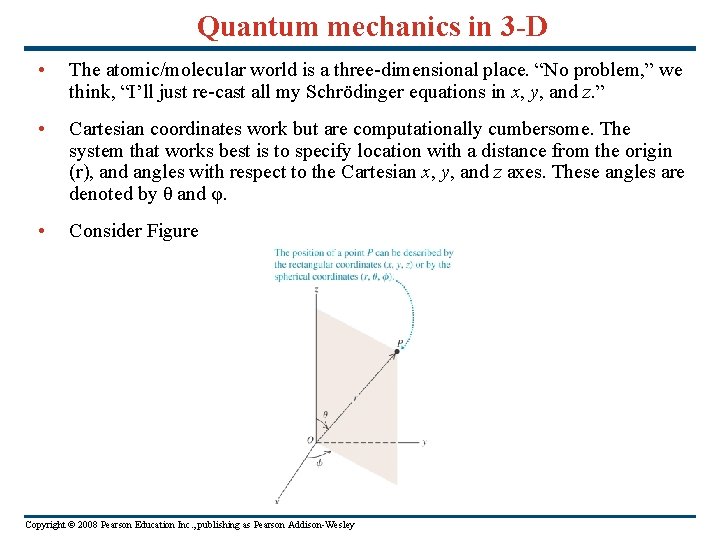
Quantum mechanics in 3 -D • The atomic/molecular world is a three-dimensional place. “No problem, ” we think, “I’ll just re-cast all my Schrödinger equations in x, y, and z. ” • Cartesian coordinates work but are computationally cumbersome. The system that works best is to specify location with a distance from the origin (r), and angles with respect to the Cartesian x, y, and z axes. These angles are denoted by θ and φ. • Consider Figure Copyright © 2008 Pearson Education Inc. , publishing as Pearson Addison-Wesley
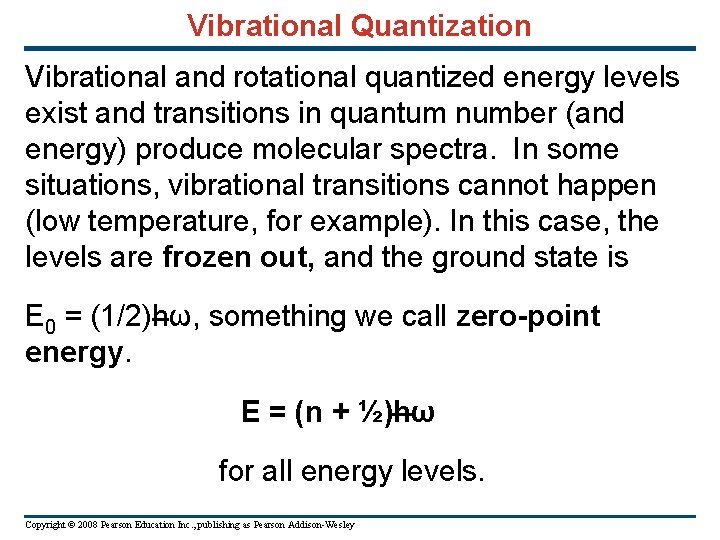
Vibrational Quantization Vibrational and rotational quantized energy levels exist and transitions in quantum number (and energy) produce molecular spectra. In some situations, vibrational transitions cannot happen (low temperature, for example). In this case, the levels are frozen out, and the ground state is E 0 = (1/2)hω, something we call zero-point energy. E = (n + ½)hω for all energy levels. Copyright © 2008 Pearson Education Inc. , publishing as Pearson Addison-Wesley