
Chapter 38 Manual Transmissions and Transaxles 2015 Cengage
- Slides: 55
Chapter 38 Manual Transmissions and Transaxles © 2015 Cengage Learning. All Rights Reserved. May not be scanned, copied, duplicated, or posted to a publicly accessible website, in whole or in part.
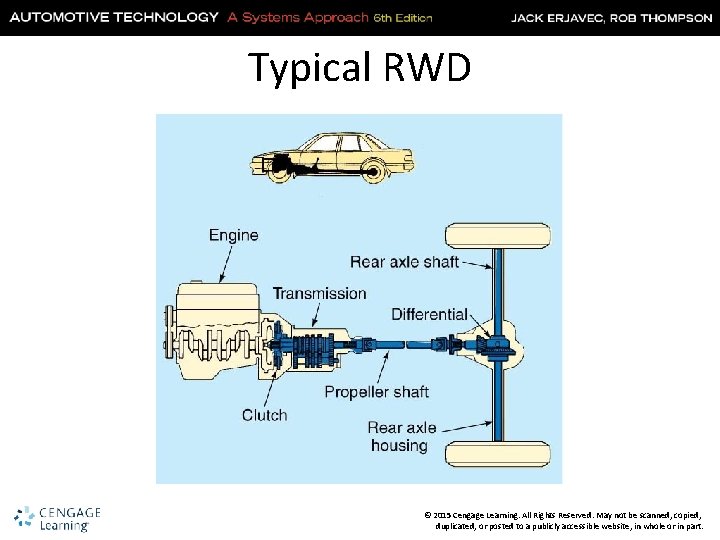
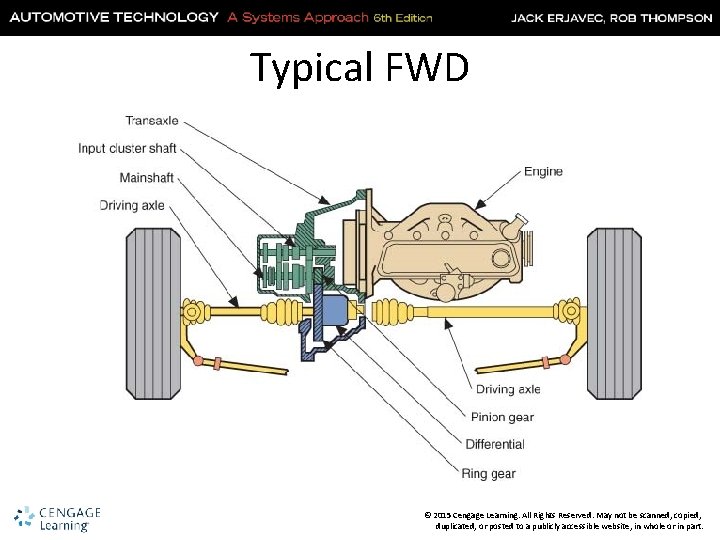
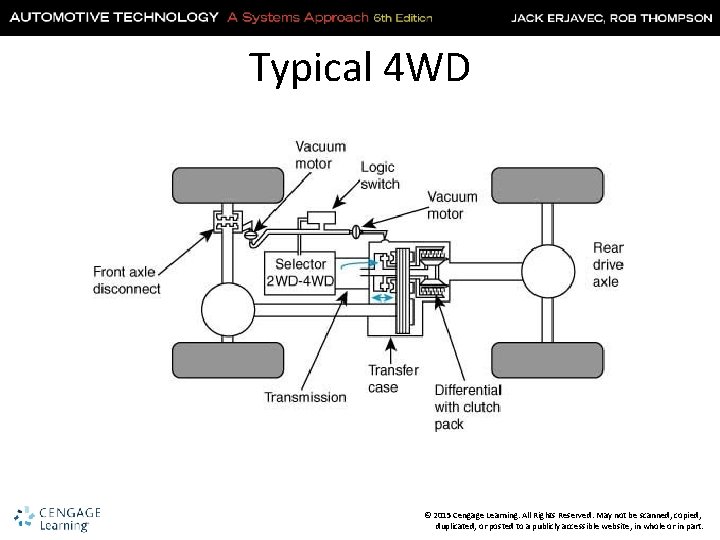
Transmission Versus Transaxle • RWD vehicles use a transmission – A drive shaft links the transmission to the differential and drive axles • FWD vehicles use a transaxle – Combines transmission gearing, differential, and drive axle connections • 4 WD vehicles use a transmission and transfer case © 2015 Cengage Learning. All Rights Reserved. May not be scanned, copied, duplicated, or posted to a publicly accessible website, in whole or in part.
Typical RWD © 2015 Cengage Learning. All Rights Reserved. May not be scanned, copied, duplicated, or posted to a publicly accessible website, in whole or in part.
Typical FWD © 2015 Cengage Learning. All Rights Reserved. May not be scanned, copied, duplicated, or posted to a publicly accessible website, in whole or in part.
Typical 4 WD © 2015 Cengage Learning. All Rights Reserved. May not be scanned, copied, duplicated, or posted to a publicly accessible website, in whole or in part.
Transmission Designs • Modern transmissions use four to seven forward speeds • Six speeds are most common • Fifth and sixth gears are overdrive gears © 2015 Cengage Learning. All Rights Reserved. May not be scanned, copied, duplicated, or posted to a publicly accessible website, in whole or in part.
Gears • Transmit rotation motion from one parallel shaft to another • The shaft can drive the gear, the gear can drive the shaft, or the gear can be free to turn on the shaft • Gears can increase or decrease torque and speed © 2015 Cengage Learning. All Rights Reserved. May not be scanned, copied, duplicated, or posted to a publicly accessible website, in whole or in part.
© 2015 Cengage Learning. All Rights Reserved. May not be scanned, copied, duplicated, or posted to a publicly accessible website, in whole or in part.
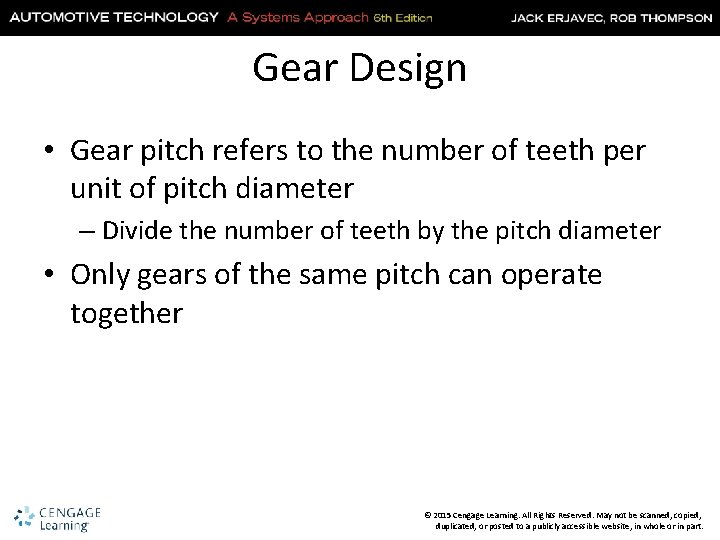
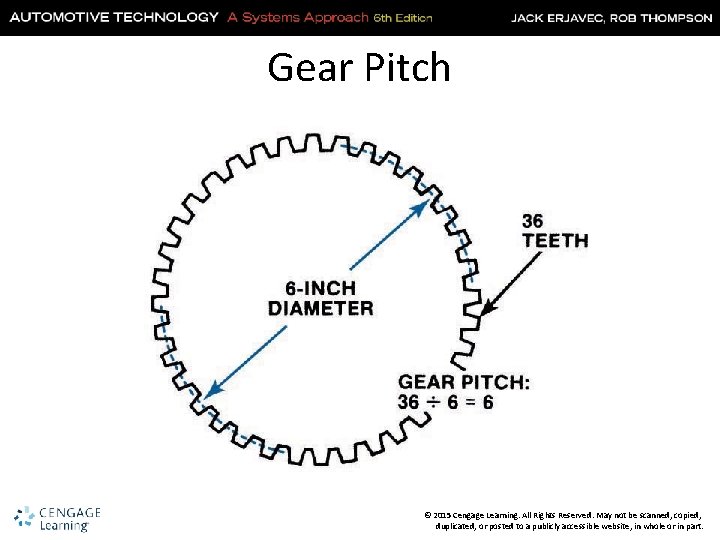
Gear Design • Gear pitch refers to the number of teeth per unit of pitch diameter – Divide the number of teeth by the pitch diameter • Only gears of the same pitch can operate together © 2015 Cengage Learning. All Rights Reserved. May not be scanned, copied, duplicated, or posted to a publicly accessible website, in whole or in part.
Gear Pitch © 2015 Cengage Learning. All Rights Reserved. May not be scanned, copied, duplicated, or posted to a publicly accessible website, in whole or in part.
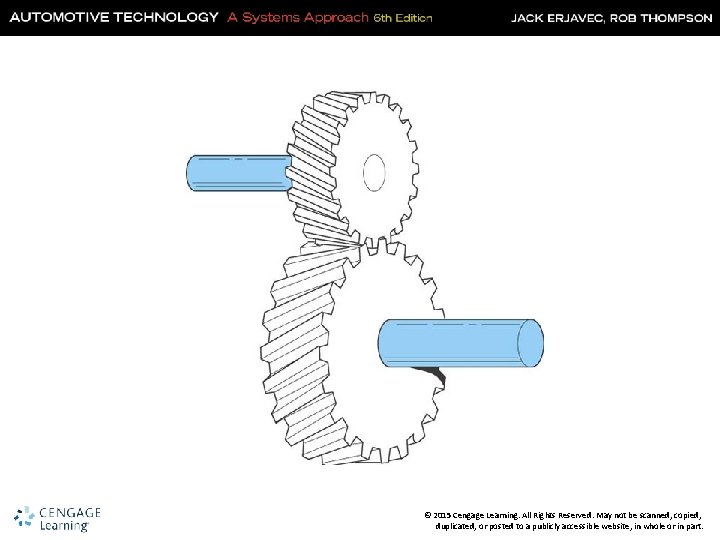
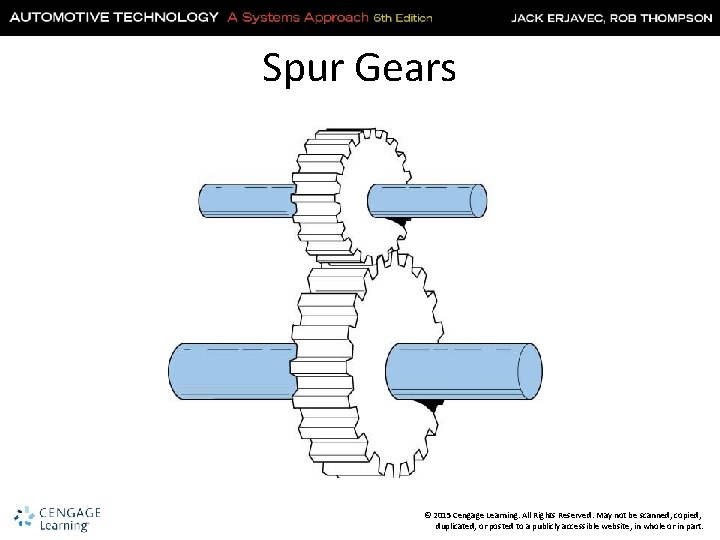
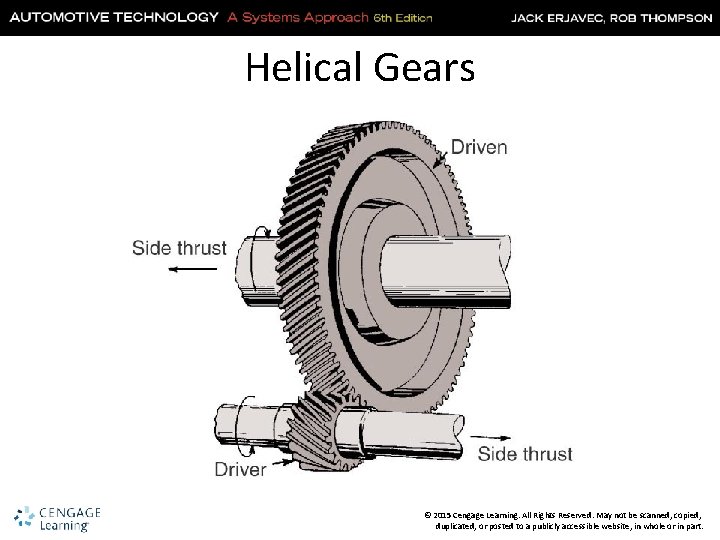
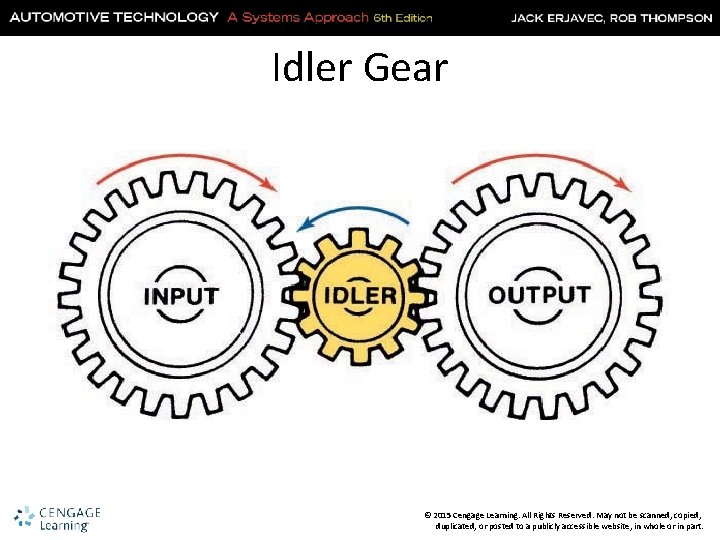
Gear Designs (Cont. ) • Spur Gears – Simplest design, tooth contact causes clicking • Helical Gears – Can be right or left handed – Allows for two or more teeth to mesh at the same time • Idler Gears – Placed between the drive and driven gears © 2015 Cengage Learning. All Rights Reserved. May not be scanned, copied, duplicated, or posted to a publicly accessible website, in whole or in part.
Spur Gears © 2015 Cengage Learning. All Rights Reserved. May not be scanned, copied, duplicated, or posted to a publicly accessible website, in whole or in part.
Helical Gears © 2015 Cengage Learning. All Rights Reserved. May not be scanned, copied, duplicated, or posted to a publicly accessible website, in whole or in part.
Idler Gear © 2015 Cengage Learning. All Rights Reserved. May not be scanned, copied, duplicated, or posted to a publicly accessible website, in whole or in part.
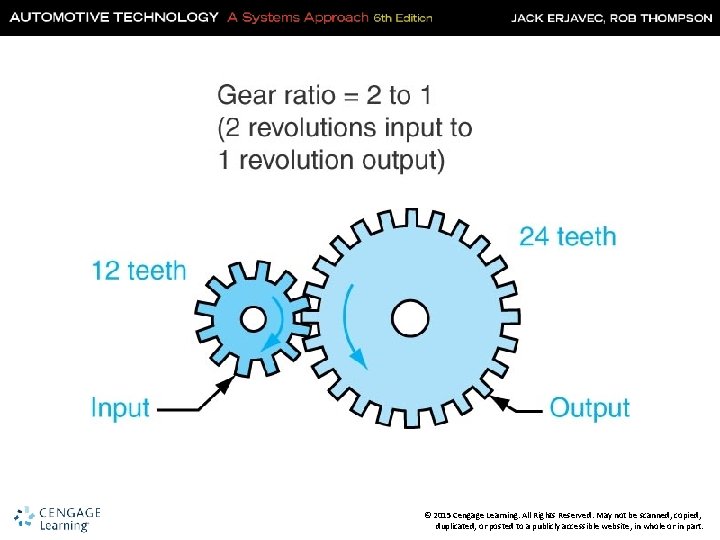
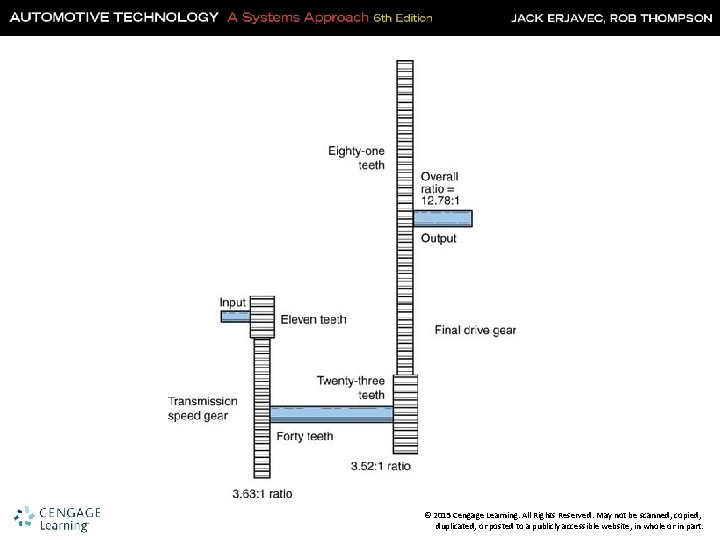
Definition of Gear Ratios • Express the mathematical relationship of one gear to another • Express the amount of torque multiplication between gears • Tell how many times one gear turns in relation to the other © 2015 Cengage Learning. All Rights Reserved. May not be scanned, copied, duplicated, or posted to a publicly accessible website, in whole or in part.
© 2015 Cengage Learning. All Rights Reserved. May not be scanned, copied, duplicated, or posted to a publicly accessible website, in whole or in part.
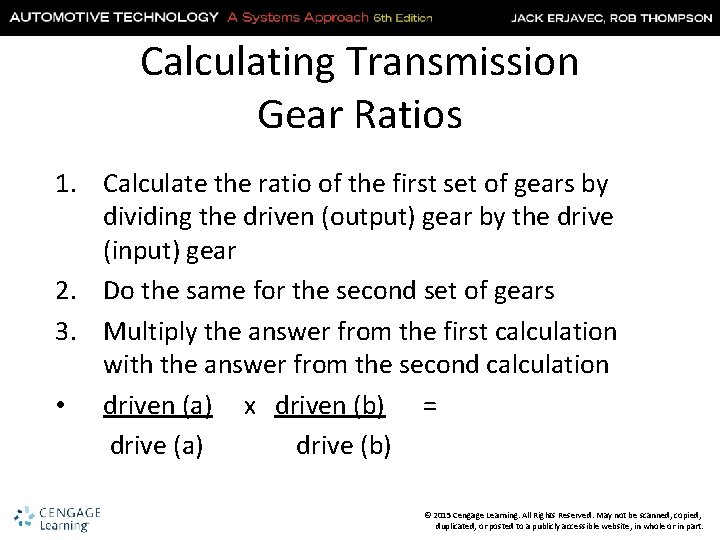
Calculating Transmission Gear Ratios 1. Calculate the ratio of the first set of gears by dividing the driven (output) gear by the drive (input) gear 2. Do the same for the second set of gears 3. Multiply the answer from the first calculation with the answer from the second calculation • driven (a) x driven (b) = drive (a) drive (b) © 2015 Cengage Learning. All Rights Reserved. May not be scanned, copied, duplicated, or posted to a publicly accessible website, in whole or in part.
© 2015 Cengage Learning. All Rights Reserved. May not be scanned, copied, duplicated, or posted to a publicly accessible website, in whole or in part.
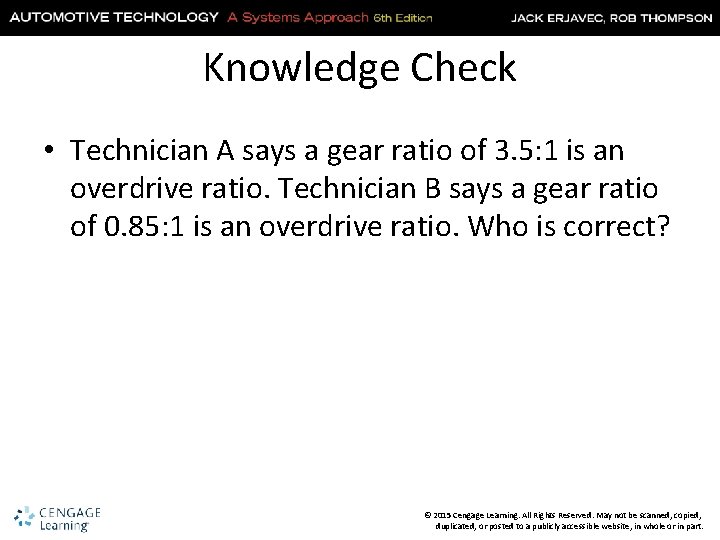
Knowledge Check • Technician A says a gear ratio of 3. 5: 1 is an overdrive ratio. Technician B says a gear ratio of 0. 85: 1 is an overdrive ratio. Who is correct? © 2015 Cengage Learning. All Rights Reserved. May not be scanned, copied, duplicated, or posted to a publicly accessible website, in whole or in part.
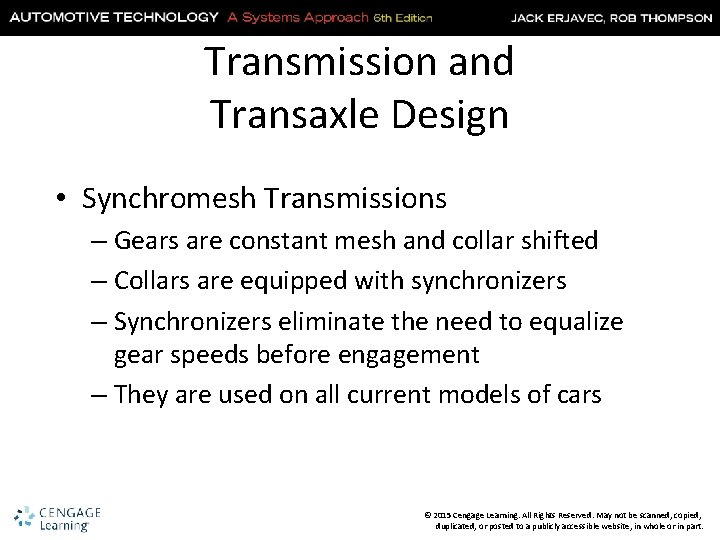
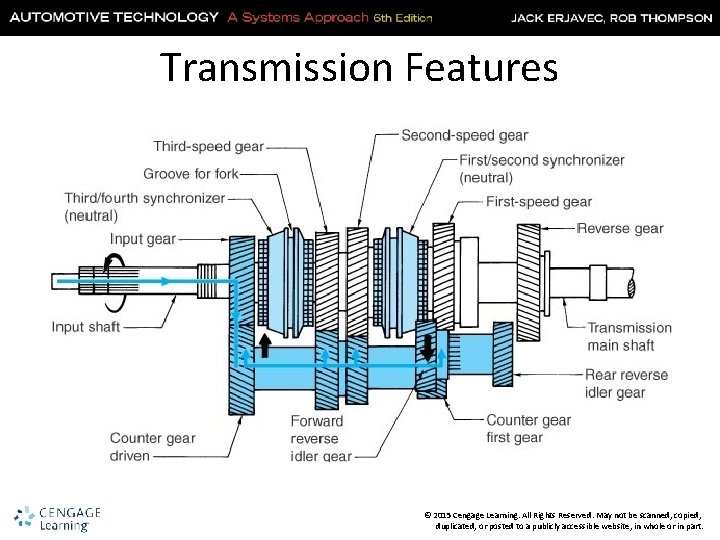
Transmission and Transaxle Design • Synchromesh Transmissions – Gears are constant mesh and collar shifted – Collars are equipped with synchronizers – Synchronizers eliminate the need to equalize gear speeds before engagement – They are used on all current models of cars © 2015 Cengage Learning. All Rights Reserved. May not be scanned, copied, duplicated, or posted to a publicly accessible website, in whole or in part.
Transmission Features © 2015 Cengage Learning. All Rights Reserved. May not be scanned, copied, duplicated, or posted to a publicly accessible website, in whole or in part.
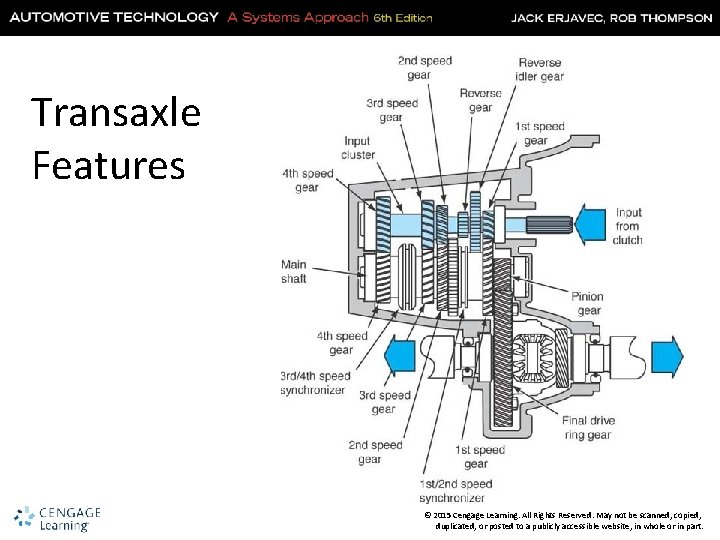
Transaxle Features © 2015 Cengage Learning. All Rights Reserved. May not be scanned, copied, duplicated, or posted to a publicly accessible website, in whole or in part.
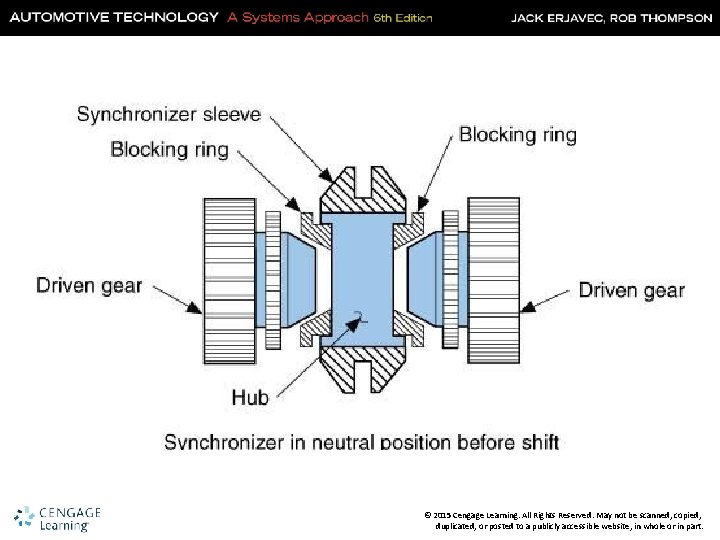
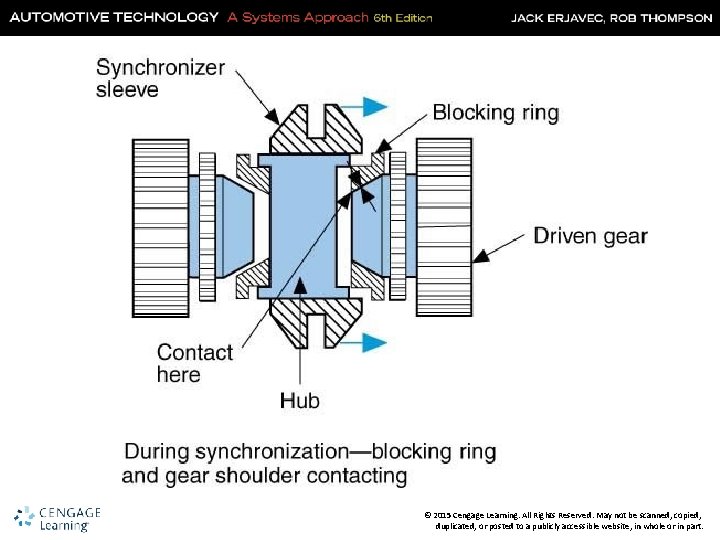
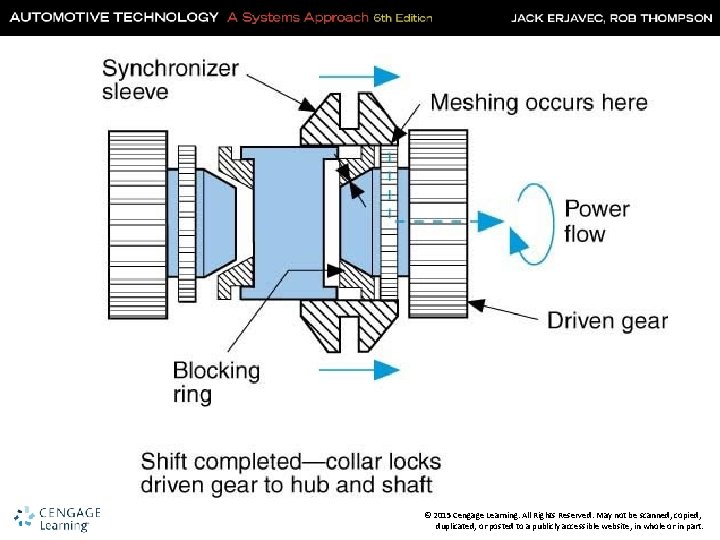
Synchronizers • Brings components at different speeds to one synchronized speed • Locks the pinion shaft and speed gear • May have spur gear teeth cut into outside and act as reverse gear • All forward gears synchronized in modern transmissions/transaxles © 2015 Cengage Learning. All Rights Reserved. May not be scanned, copied, duplicated, or posted to a publicly accessible website, in whole or in part.
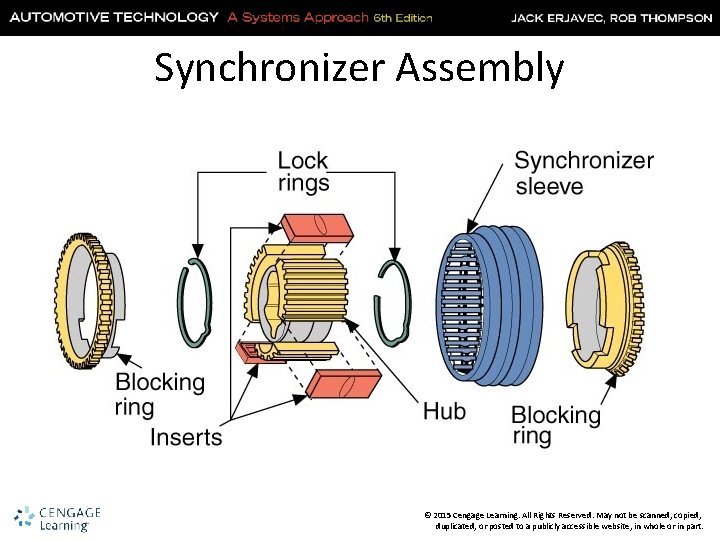
Synchronizer Assembly © 2015 Cengage Learning. All Rights Reserved. May not be scanned, copied, duplicated, or posted to a publicly accessible website, in whole or in part.
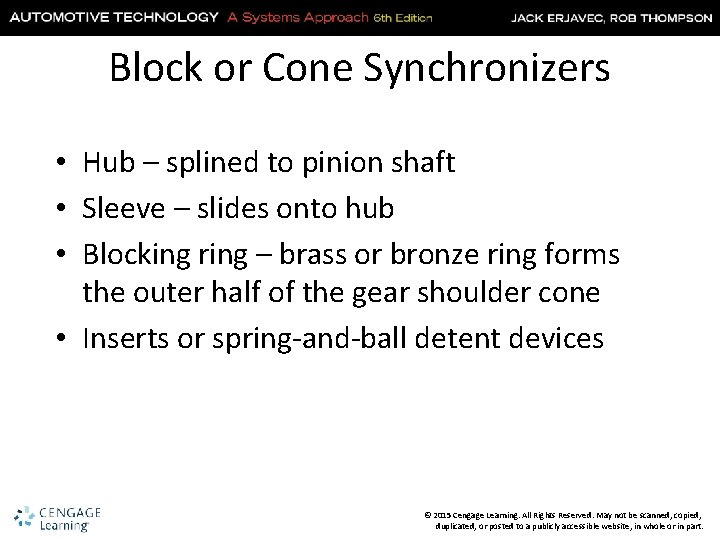
Block or Cone Synchronizers • Hub – splined to pinion shaft • Sleeve – slides onto hub • Blocking ring – brass or bronze ring forms the outer half of the gear shoulder cone • Inserts or spring-and-ball detent devices © 2015 Cengage Learning. All Rights Reserved. May not be scanned, copied, duplicated, or posted to a publicly accessible website, in whole or in part.
© 2015 Cengage Learning. All Rights Reserved. May not be scanned, copied, duplicated, or posted to a publicly accessible website, in whole or in part.
© 2015 Cengage Learning. All Rights Reserved. May not be scanned, copied, duplicated, or posted to a publicly accessible website, in whole or in part.
© 2015 Cengage Learning. All Rights Reserved. May not be scanned, copied, duplicated, or posted to a publicly accessible website, in whole or in part.
Advanced Synchronizer Designs • Multiple cone-type synchronizers • Use friction material on both sides of the synchronizer rings • Decreases shift effort and increases durability • Reduces transmission size since a smaller synchronizer can perform as a larger one © 2015 Cengage Learning. All Rights Reserved. May not be scanned, copied, duplicated, or posted to a publicly accessible website, in whole or in part.
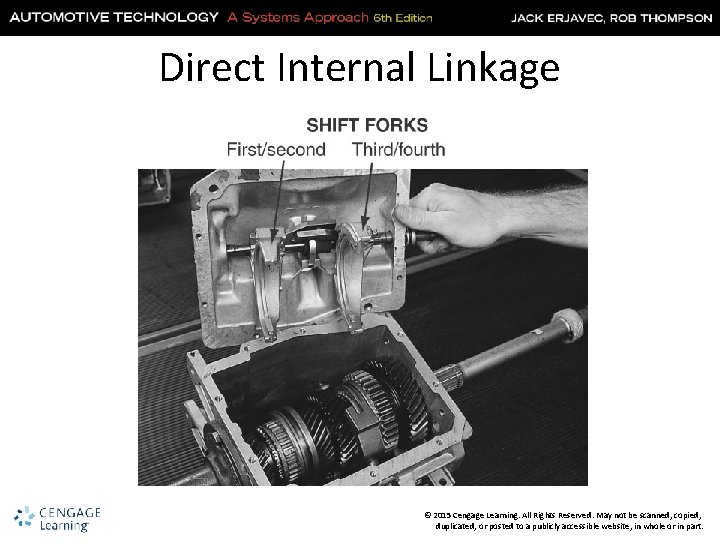
Gearshift Mechanisms • Shift rails transfer motion from the gearshift to the shift forks • The shift forks rest in grooves in the synchronizer sleeves • Linkage can be direct or remote and internal or external © 2015 Cengage Learning. All Rights Reserved. May not be scanned, copied, duplicated, or posted to a publicly accessible website, in whole or in part.
Direct Internal Linkage © 2015 Cengage Learning. All Rights Reserved. May not be scanned, copied, duplicated, or posted to a publicly accessible website, in whole or in part.
Gearshift Linkage • Internal-Type – May be located at the top or side of the transmission – Uses a shift rail and detents to select and maintain gear selection • External-Type – Uses levers and rods that are connected to the outside of the transmission © 2015 Cengage Learning. All Rights Reserved. May not be scanned, copied, duplicated, or posted to a publicly accessible website, in whole or in part.
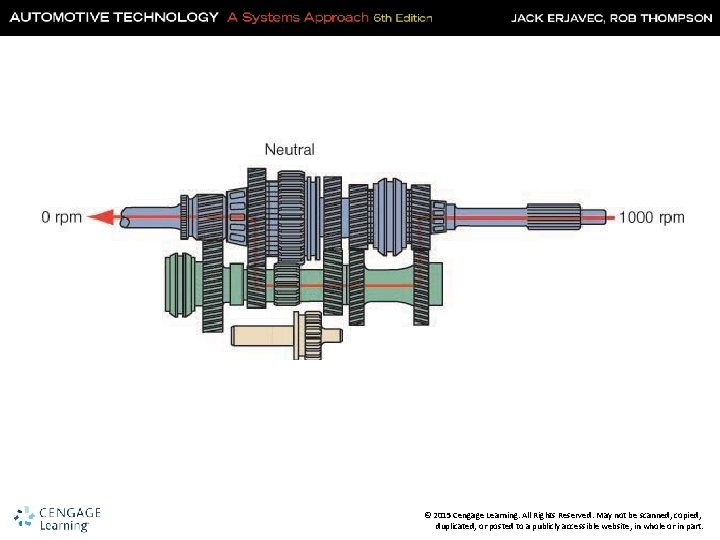
Transmission Power Flow • Neutral – The input shaft drives the counter shaft – All of the gears on the main shaft rotate – The synchronizers are not engaged with any gear – No power is transferred to the output shaft © 2015 Cengage Learning. All Rights Reserved. May not be scanned, copied, duplicated, or posted to a publicly accessible website, in whole or in part.
© 2015 Cengage Learning. All Rights Reserved. May not be scanned, copied, duplicated, or posted to a publicly accessible website, in whole or in part.
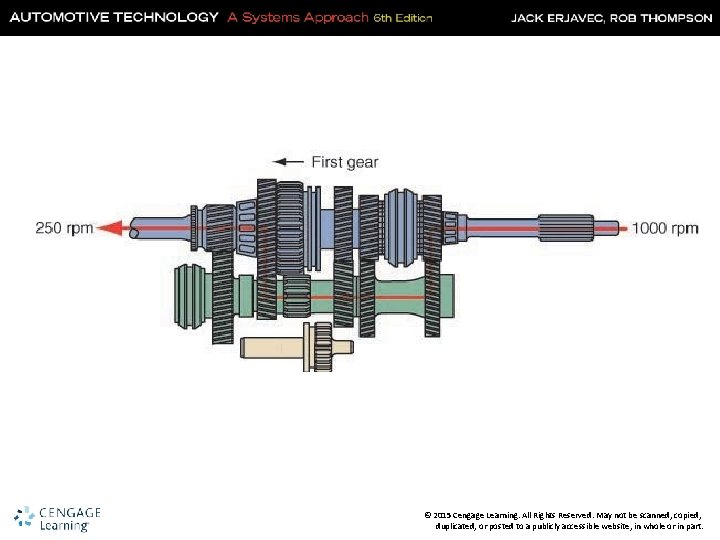
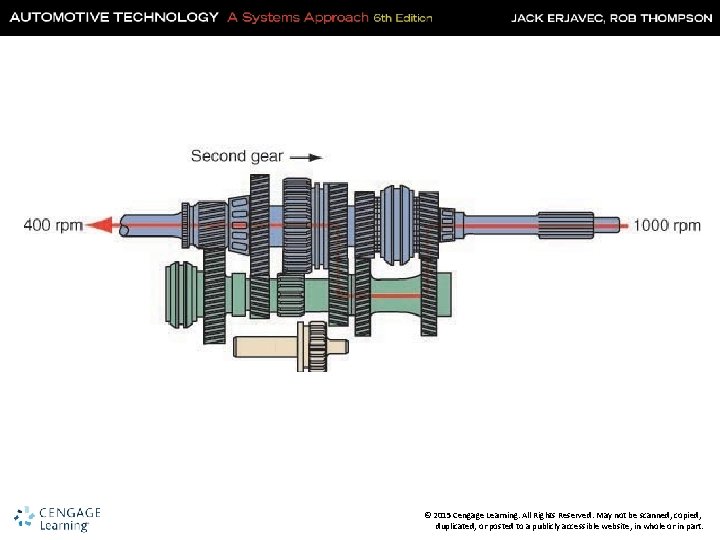
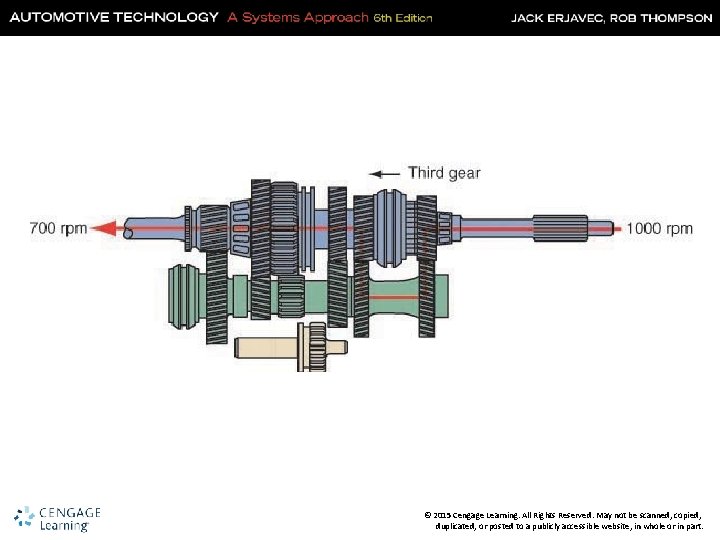
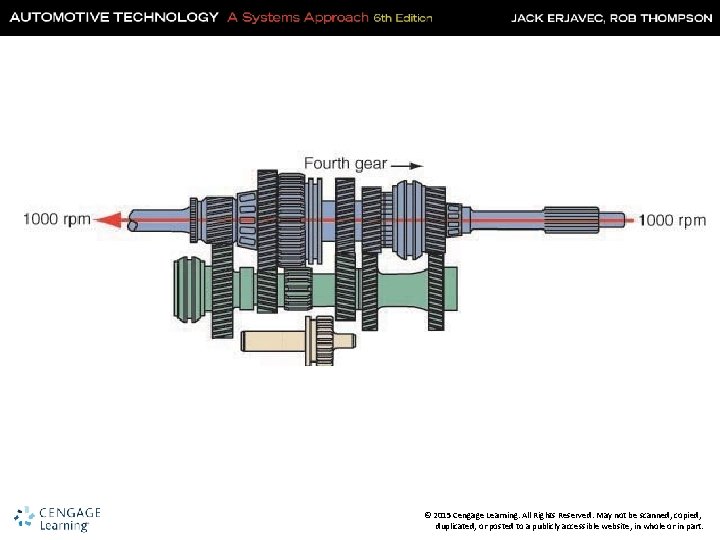
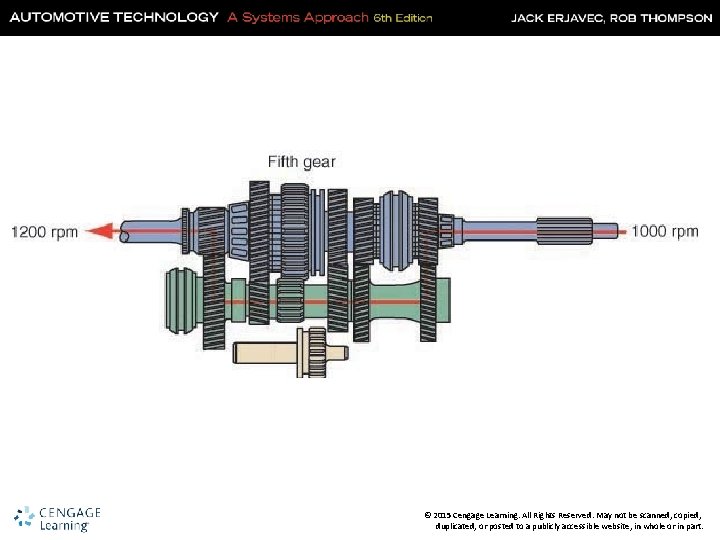
Power Flow (Cont. ) • Forward Gears – The power enters transmission through the input shaft – The synchronizer sleeve is engaged with the dog teeth of the selected gear – The power is transferred from the input shaft, through the counter shaft, and up to the selected gear – The gear drives the output shaft © 2015 Cengage Learning. All Rights Reserved. May not be scanned, copied, duplicated, or posted to a publicly accessible website, in whole or in part.
© 2015 Cengage Learning. All Rights Reserved. May not be scanned, copied, duplicated, or posted to a publicly accessible website, in whole or in part.
© 2015 Cengage Learning. All Rights Reserved. May not be scanned, copied, duplicated, or posted to a publicly accessible website, in whole or in part.
© 2015 Cengage Learning. All Rights Reserved. May not be scanned, copied, duplicated, or posted to a publicly accessible website, in whole or in part.
© 2015 Cengage Learning. All Rights Reserved. May not be scanned, copied, duplicated, or posted to a publicly accessible website, in whole or in part.
© 2015 Cengage Learning. All Rights Reserved. May not be scanned, copied, duplicated, or posted to a publicly accessible website, in whole or in part.
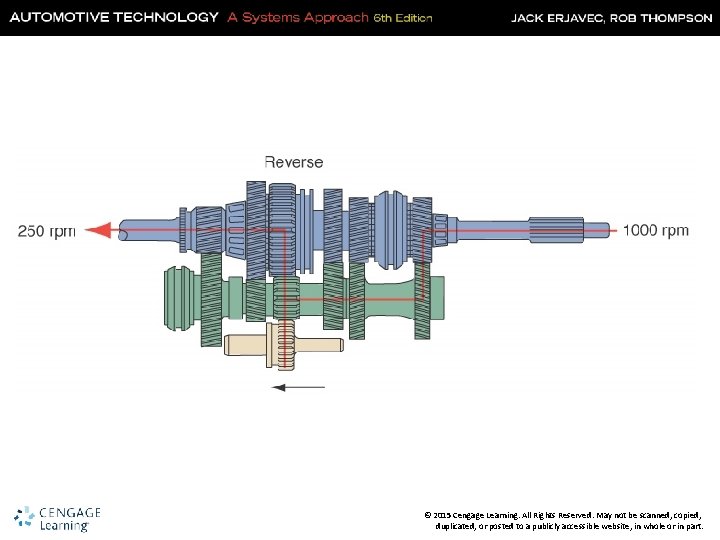
Power Flow (Cont. ) • Reverse – The power enters transmission through the input shaft – The reverse gear synchronizer sleeve is engaged with the reverse gear dog teeth – The power is transferred from the input shaft, through the counter shaft, through the reverse idler gear, and up to the reverse gear – The reverse gear drives the output shaft in reverse © 2015 Cengage Learning. All Rights Reserved. May not be scanned, copied, duplicated, or posted to a publicly accessible website, in whole or in part.
© 2015 Cengage Learning. All Rights Reserved. May not be scanned, copied, duplicated, or posted to a publicly accessible website, in whole or in part.
Transaxle Power Flow • Neutral – The input shaft is being turned by the engine – The synchronizer collars are centered between their gear positions – The drive gears are not locked to the output shaft – No power is applied to the differential © 2015 Cengage Learning. All Rights Reserved. May not be scanned, copied, duplicated, or posted to a publicly accessible website, in whole or in part.
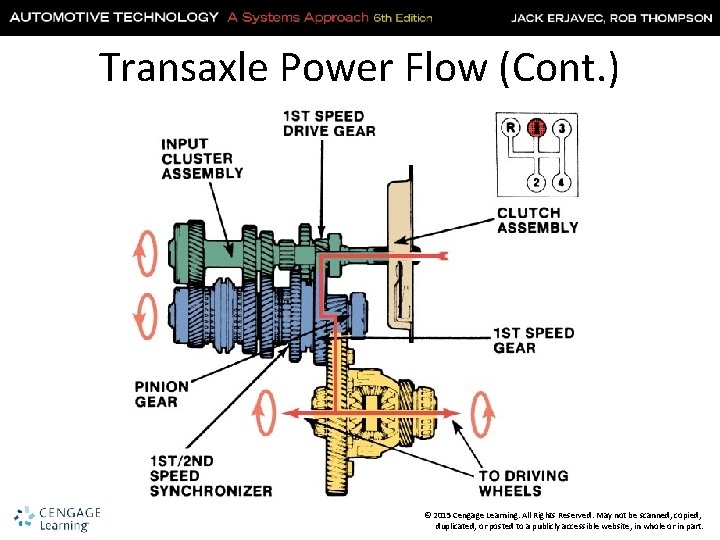
Transaxle Power Flow (Cont. ) • Forward Gears – The gears on the input shaft are in constant mesh with those on the output shaft – The synchronizer hub is splined to the output shaft – When a gear is selected, the synchronizer collar engages the hub – The power flows from the gear on the input shaft through the selected gear on the output shaft © 2015 Cengage Learning. All Rights Reserved. May not be scanned, copied, duplicated, or posted to a publicly accessible website, in whole or in part.
Transaxle Power Flow (Cont. ) © 2015 Cengage Learning. All Rights Reserved. May not be scanned, copied, duplicated, or posted to a publicly accessible website, in whole or in part.
Transaxle Power Flow (Cont. ) • Reverse – Most transaxles use a sliding reverse gear – The shift fork moves the sliding gear in mesh with a gear on the input shaft and one on the output shaft – The additional gear causes the output shaft to turn in the direction opposite to the input gear © 2015 Cengage Learning. All Rights Reserved. May not be scanned, copied, duplicated, or posted to a publicly accessible website, in whole or in part.
Knowledge Check • Which of the gears in a typical RWD transmission is not synchronized? © 2015 Cengage Learning. All Rights Reserved. May not be scanned, copied, duplicated, or posted to a publicly accessible website, in whole or in part.
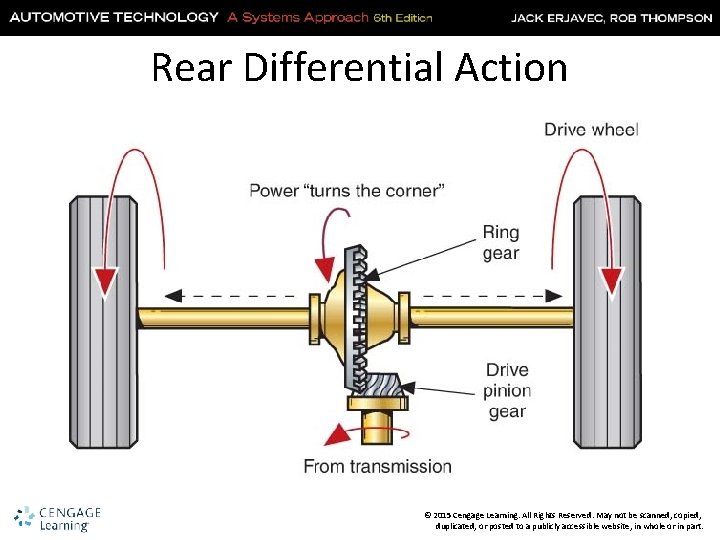
Differential Action • Final drive ring gear driven by the output shaft • Usually does not need to turn 90 degrees • Only provides torque multiplication and divide the torque to the axle shafts • Provides additional gear reduction beyond the transmission/transaxle called the final drive gear © 2015 Cengage Learning. All Rights Reserved. May not be scanned, copied, duplicated, or posted to a publicly accessible website, in whole or in part.
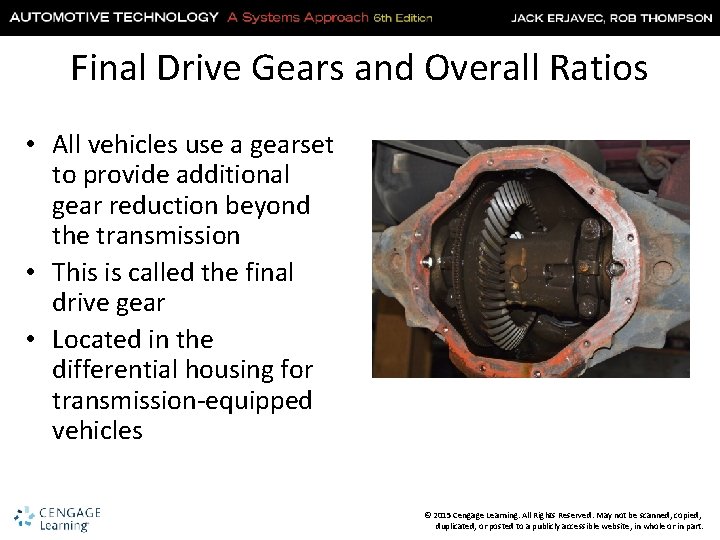
Final Drive Gears and Overall Ratios • All vehicles use a gearset to provide additional gear reduction beyond the transmission • This is called the final drive gear • Located in the differential housing for transmission-equipped vehicles © 2015 Cengage Learning. All Rights Reserved. May not be scanned, copied, duplicated, or posted to a publicly accessible website, in whole or in part.
Rear Differential Action © 2015 Cengage Learning. All Rights Reserved. May not be scanned, copied, duplicated, or posted to a publicly accessible website, in whole or in part.
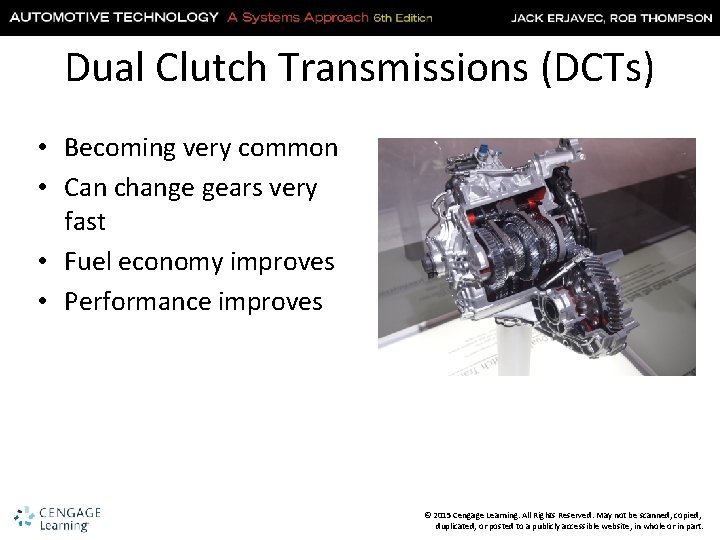
Dual Clutch Transmissions (DCTs) • Becoming very common • Can change gears very fast • Fuel economy improves • Performance improves © 2015 Cengage Learning. All Rights Reserved. May not be scanned, copied, duplicated, or posted to a publicly accessible website, in whole or in part.
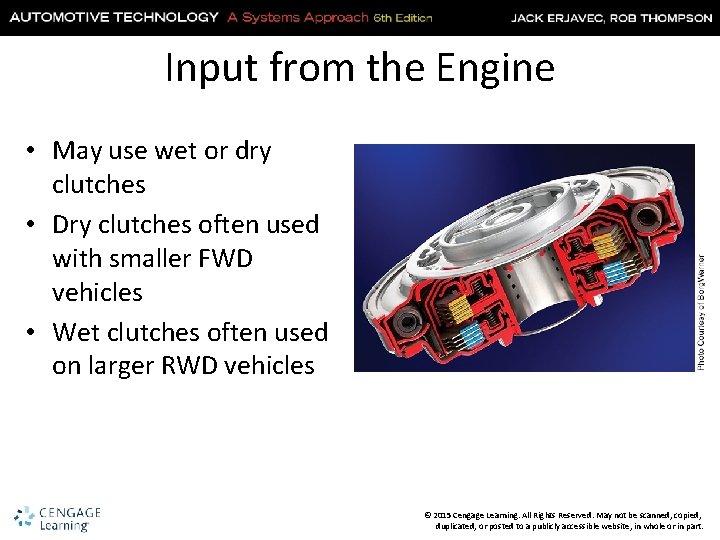
Input from the Engine • May use wet or dry clutches • Dry clutches often used with smaller FWD vehicles • Wet clutches often used on larger RWD vehicles © 2015 Cengage Learning. All Rights Reserved. May not be scanned, copied, duplicated, or posted to a publicly accessible website, in whole or in part.
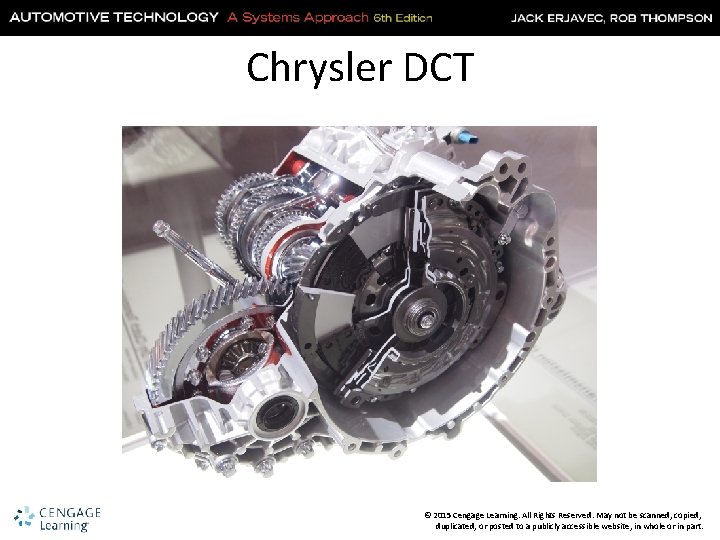
Operation • A DCT has two separate shafts and sets of gears • One shaft has the even gears, the other shaft the odd gears • One clutch is for 1 st, 3 rd, and 5 th gears • The other clutch is for 2 nd, 4 th, and 6 th gears © 2015 Cengage Learning. All Rights Reserved. May not be scanned, copied, duplicated, or posted to a publicly accessible website, in whole or in part.
Chrysler DCT © 2015 Cengage Learning. All Rights Reserved. May not be scanned, copied, duplicated, or posted to a publicly accessible website, in whole or in part.
Electrical Systems • Reverse Lamp Switch – Usually on transmission but can be on linkage • Vehicle Speed Sensor – Sends speed signal to PCM • Reverse Lockout Systems – Prevents accidental shifting into reverse • Shift Blocking – Used to improve fuel economy © 2015 Cengage Learning. All Rights Reserved. May not be scanned, copied, duplicated, or posted to a publicly accessible website, in whole or in part.