
Chapter 38 1 38 2 Angiosperm Reproduction Power
- Slides: 27
Chapter 38 -1 & 38 -2 Angiosperm Reproduction Power. Point Lectures for Biology, Seventh Edition Neil Campbell and Jane Reece Copyright © 2005 Pearson Education, Inc. publishing as Benjamin Cummings Plant Reproductive Cycle
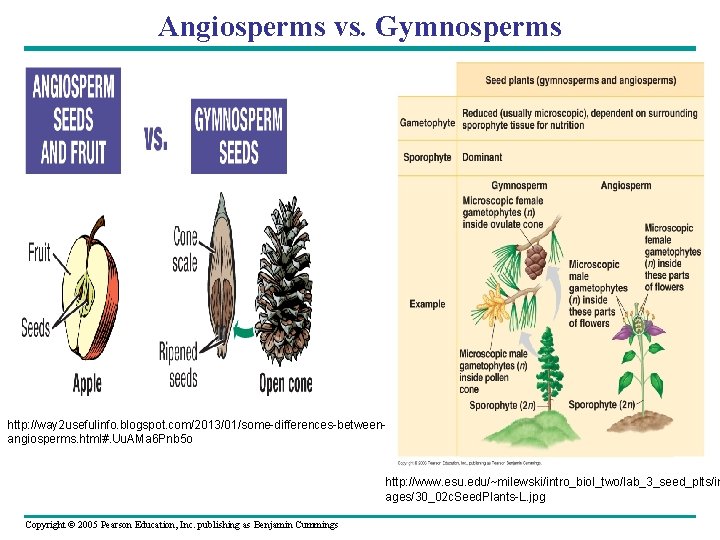
Angiosperms vs. Gymnosperms http: //way 2 usefulinfo. blogspot. com/2013/01/some-differences-betweenangiosperms. html#. Uu. AMa 6 Pnb 5 o http: //www. esu. edu/~milewski/intro_biol_two/lab_3_seed_plts/im ages/30_02 c. Seed. Plants-L. jpg Copyright © 2005 Pearson Education, Inc. publishing as Benjamin Cummings
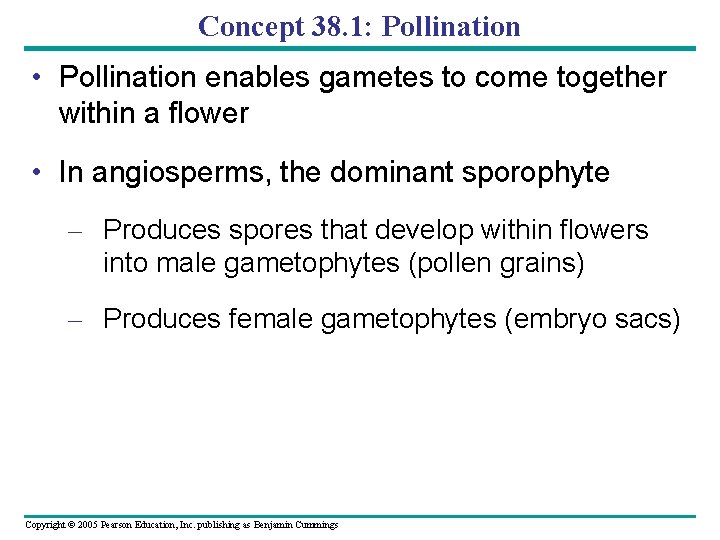
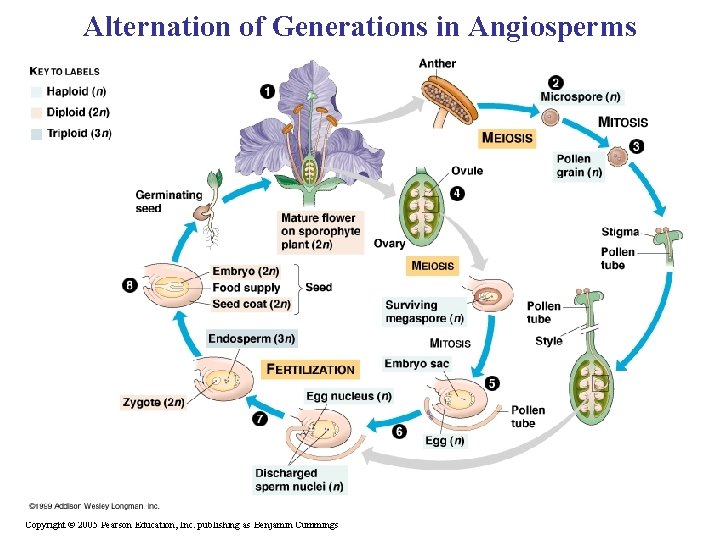
Concept 38. 1: Pollination • Pollination enables gametes to come together within a flower • In angiosperms, the dominant sporophyte – Produces spores that develop within flowers into male gametophytes (pollen grains) – Produces female gametophytes (embryo sacs) Copyright © 2005 Pearson Education, Inc. publishing as Benjamin Cummings
Alternation of Generations in Angiosperms Copyright © 2005 Pearson Education, Inc. publishing as Benjamin Cummings
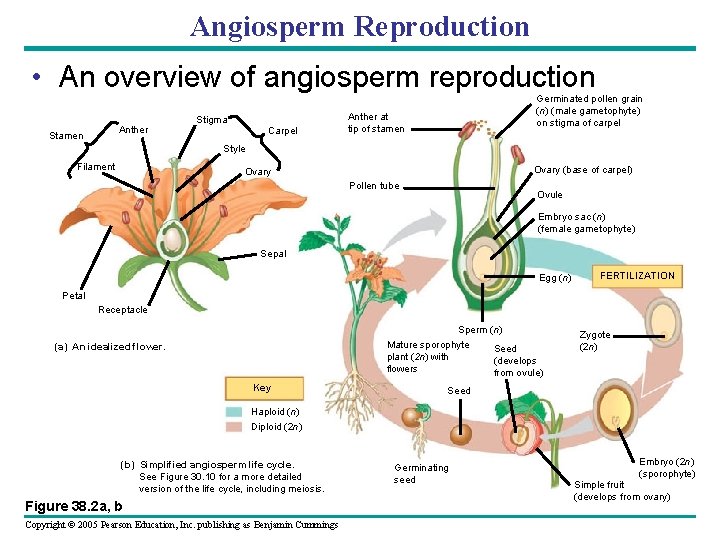
Angiosperm Reproduction • An overview of angiosperm reproduction Anther Stamen Stigma Carpel Germinated pollen grain (n) (male gametophyte) on stigma of carpel Anther at tip of stamen Style Filament Ovary (base of carpel) Ovary Pollen tube Ovule Embryo sac (n) (female gametophyte) Sepal Egg (n) FERTILIZATION Petal Receptacle Sperm (n) Mature sporophyte Seed plant (2 n) with (develops flowers from ovule) (a) An idealized flower. Key Zygote (2 n) Seed Haploid (n) Diploid (2 n) (b) Simplified angiosperm life cycle. See Figure 30. 10 for a more detailed version of the life cycle, including meiosis. Figure 38. 2 a, b Copyright © 2005 Pearson Education, Inc. publishing as Benjamin Cummings Germinating seed Embryo (2 n) (sporophyte) Simple fruit (develops from ovary)
Flower Structure • Flowers – Are the reproductive shoots of the angiosperm sporophyte – Are composed of four floral organs: sepals, petals, stamens, and carpels Copyright © 2005 Pearson Education, Inc. publishing as Benjamin Cummings
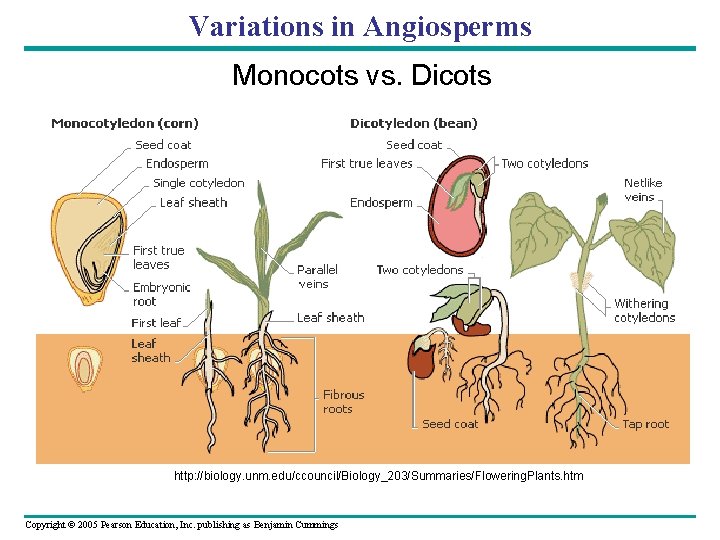
Variations in Angiosperms Monocots vs. Dicots http: //biology. unm. edu/ccouncil/Biology_203/Summaries/Flowering. Plants. htm Copyright © 2005 Pearson Education, Inc. publishing as Benjamin Cummings
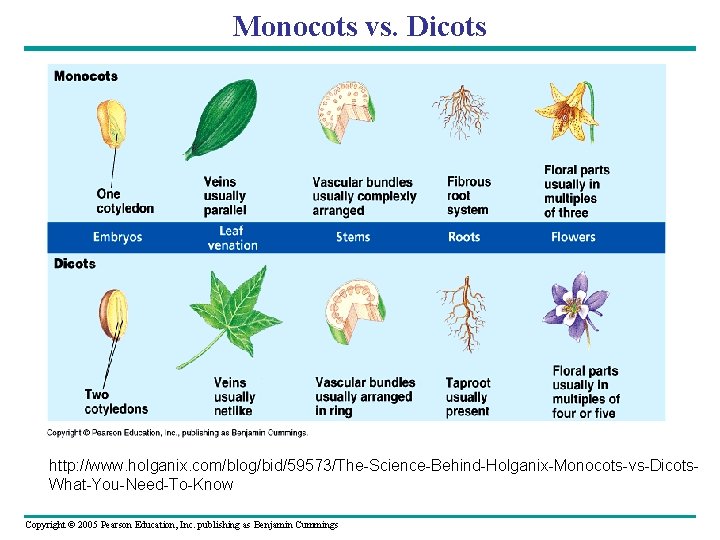
Monocots vs. Dicots http: //www. holganix. com/blog/bid/59573/The-Science-Behind-Holganix-Monocots-vs-Dicots. What-You-Need-To-Know Copyright © 2005 Pearson Education, Inc. publishing as Benjamin Cummings
Gametophyte Development and Pollination • In angiosperms – Pollination is the transfer of pollen from an anther to a stigma – If pollination is successful, a pollen grain produces a structure called a pollen tube, which grows down into the ovary and discharges sperm near the embryo sac Copyright © 2005 Pearson Education, Inc. publishing as Benjamin Cummings
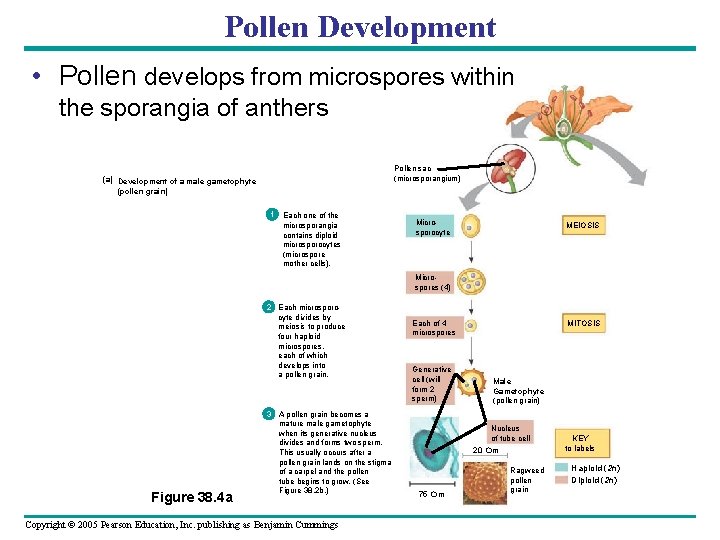
Pollen Development • Pollen develops from microspores within the sporangia of anthers Pollen sac (microsporangium) (a) Development of a male gametophyte (pollen grain) 1 Each one of the microsporangia contains diploid microsporocytes (microspore mother cells). Microsporocyte MEIOSIS Microspores (4) 2 Each microsporocyte divides by meiosis to produce four haploid microspores, each of which develops into a pollen grain. Figure 38. 4 a 3 A pollen grain becomes a mature male gametophyte when its generative nucleus divides and forms two sperm. This usually occurs after a pollen grain lands on the stigma of a carpel and the pollen tube begins to grow. (See Figure 38. 2 b. ) Copyright © 2005 Pearson Education, Inc. publishing as Benjamin Cummings Each of 4 microspores Generative cell (will form 2 sperm) MITOSIS Male Gametophyte (pollen grain) Nucleus of tube cell 20 m 75 m Ragweed pollen grain KEY to labels Haploid (2 n) Diploid (2 n)
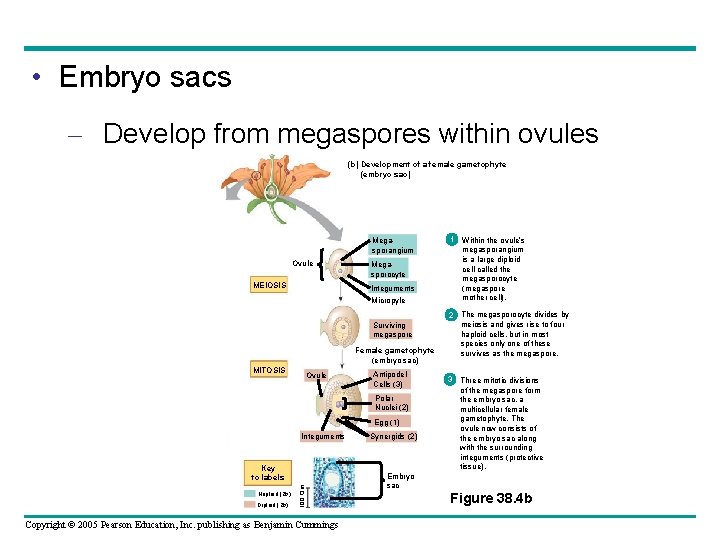
• Embryo sacs – Develop from megaspores within ovules (b) Development of a female gametophyte (embryo sac) Megasporangium Ovule MEIOSIS Megasporocyte Integuments Micropyle Surviving megaspore Female gametophyte (embryo sac) MITOSIS Ovule Antipodel Cells (3) Polar Nuclei (2) Egg (1) Integuments Haploid (2 n) Diploid (2 n) 100 m Key to labels Copyright © 2005 Pearson Education, Inc. publishing as Benjamin Cummings Synergids (2) 1 Within the ovule’s megasporangium is a large diploid cell called the megasporocyte (megaspore mother cell). 2 The megasporocyte divides by meiosis and gives rise to four haploid cells, but in most species only one of these survives as the megaspore. 3 Three mitotic divisions of the megaspore form the embryo sac, a multicellular female gametophyte. The ovule now consists of the embryo sac along with the surrounding integuments (protective tissue). Embryo sac Figure 38. 4 b
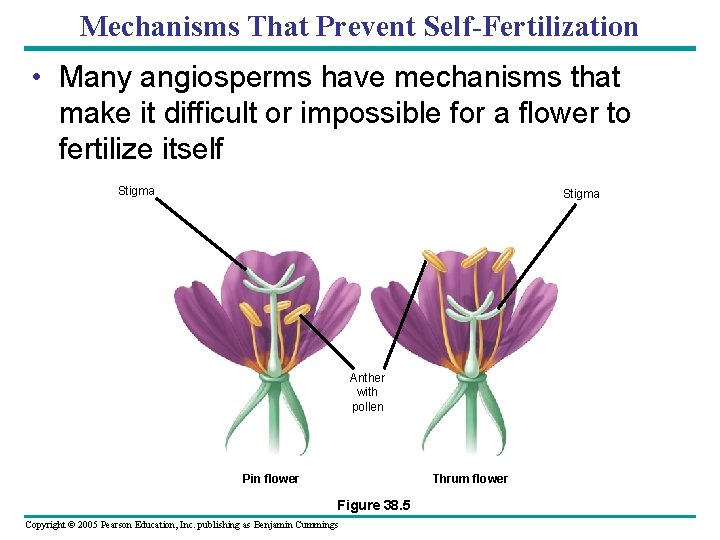
Mechanisms That Prevent Self-Fertilization • Many angiosperms have mechanisms that make it difficult or impossible for a flower to fertilize itself Stigma Anther with pollen Pin flower Thrum flower Figure 38. 5 Copyright © 2005 Pearson Education, Inc. publishing as Benjamin Cummings
Anti-Self-fertilization Mechnaisms • The most common anti-selfing mechanism in flowering plants is known as self-incompatibility, the ability of a plant to reject its own pollen • Some plants reject pollen that has an S-gene matching an allele in the stigma cells • Recognition of self pollen triggers a signal transduction pathway leading to a block in growth of a pollen tube Copyright © 2005 Pearson Education, Inc. publishing as Benjamin Cummings
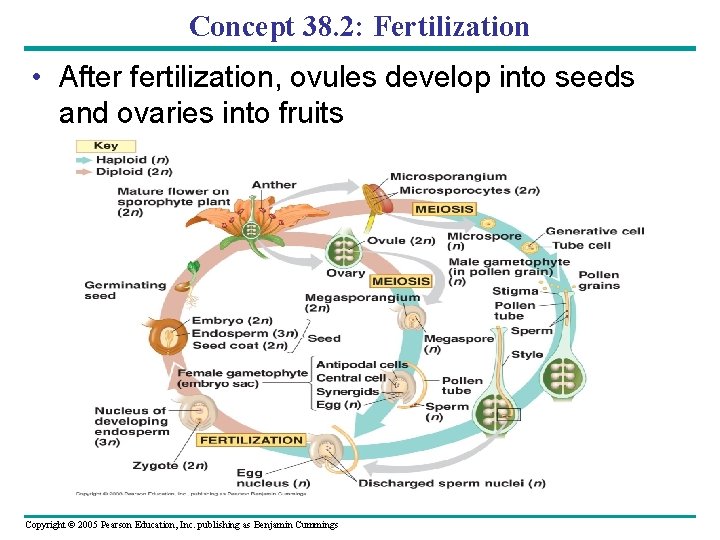
Concept 38. 2: Fertilization • After fertilization, ovules develop into seeds and ovaries into fruits Copyright © 2005 Pearson Education, Inc. publishing as Benjamin Cummings
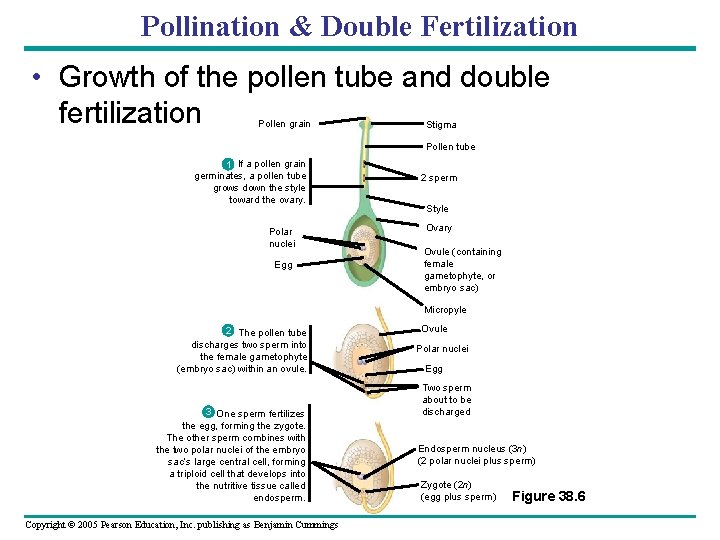
Double Fertilization • After landing on a receptive stigma a pollen grain germinates and produces a pollen tube that extends down between the cells of the style toward the ovary • The pollen tube then discharges two sperm into the embryo sac • In double fertilization one sperm fertilizes the egg and the other sperm combines with the polar nuclei, giving rise to the food-storing endosperm Copyright © 2005 Pearson Education, Inc. publishing as Benjamin Cummings
Pollination & Double Fertilization • Growth of the pollen tube and double fertilization Pollen grain Stigma Pollen tube 1 If a pollen grain germinates, a pollen tube grows down the style toward the ovary. Polar nuclei Egg 2 sperm Style Ovary Ovule (containing female gametophyte, or embryo sac) Micropyle 2 The pollen tube discharges two sperm into the female gametophyte (embryo sac) within an ovule. 3 One sperm fertilizes the egg, forming the zygote. The other sperm combines with the two polar nuclei of the embryo sac’s large central cell, forming a triploid cell that develops into the nutritive tissue called endosperm. Copyright © 2005 Pearson Education, Inc. publishing as Benjamin Cummings Ovule Polar nuclei Egg Two sperm about to be discharged Endosperm nucleus (3 n) (2 polar nuclei plus sperm) Zygote (2 n) (egg plus sperm) Figure 38. 6
From Ovule to Seed • After double fertilization – Each ovule develops into a seed – The ovary develops into a fruit enclosing the seed(s) Copyright © 2005 Pearson Education, Inc. publishing as Benjamin Cummings
Endosperm Development • Endosperm development usually precedes embryo development • In most monocots and some eudicots the endosperm stores nutrients that can be used by the seedling after germination • In other eudicots the food reserves of the endosperm are completely exported to the cotyledons Copyright © 2005 Pearson Education, Inc. publishing as Benjamin Cummings
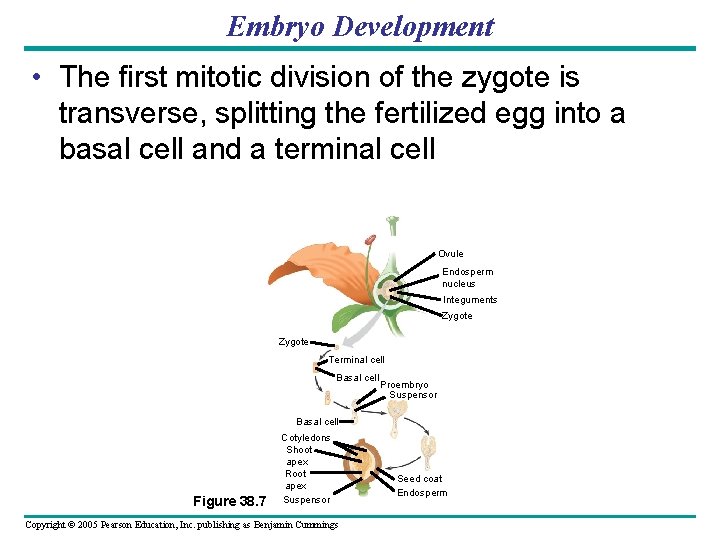
Embryo Development • The first mitotic division of the zygote is transverse, splitting the fertilized egg into a basal cell and a terminal cell Ovule Endosperm nucleus Integuments Zygote Terminal cell Basal cell Proembryo Suspensor Basal cell Figure 38. 7 Cotyledons Shoot apex Root apex Suspensor Copyright © 2005 Pearson Education, Inc. publishing as Benjamin Cummings Seed coat Endosperm
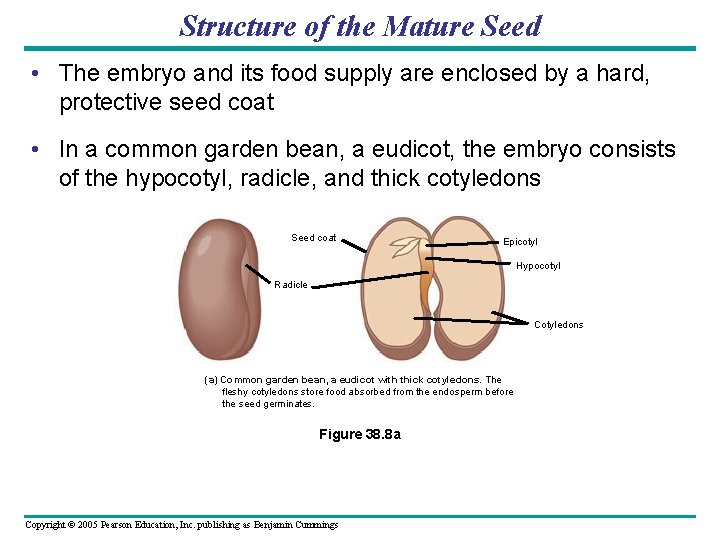
Structure of the Mature Seed • The embryo and its food supply are enclosed by a hard, protective seed coat • In a common garden bean, a eudicot, the embryo consists of the hypocotyl, radicle, and thick cotyledons Seed coat Epicotyl Hypocotyl Radicle Cotyledons (a) Common garden bean, a eudicot with thick cotyledons. The fleshy cotyledons store food absorbed from the endosperm before the seed germinates. Figure 38. 8 a Copyright © 2005 Pearson Education, Inc. publishing as Benjamin Cummings
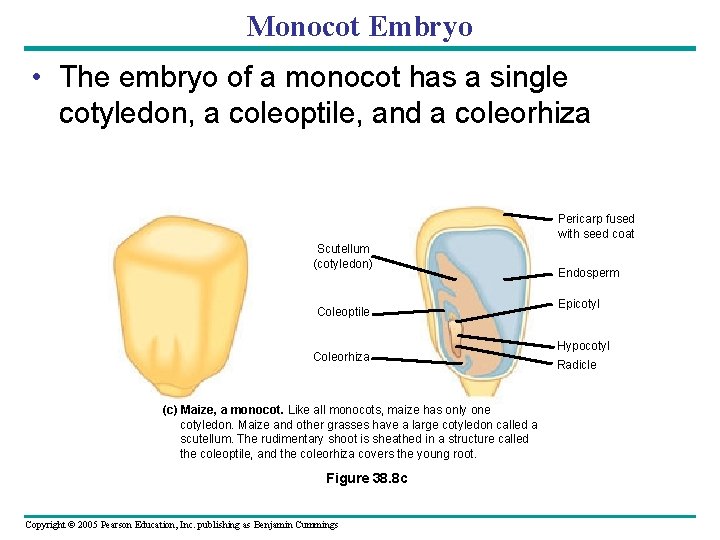
Monocot Embryo • The embryo of a monocot has a single cotyledon, a coleoptile, and a coleorhiza Pericarp fused with seed coat Scutellum (cotyledon) Coleoptile Coleorhiza (c) Maize, a monocot. Like all monocots, maize has only one cotyledon. Maize and other grasses have a large cotyledon called a scutellum. The rudimentary shoot is sheathed in a structure called the coleoptile, and the coleorhiza covers the young root. Figure 38. 8 c Copyright © 2005 Pearson Education, Inc. publishing as Benjamin Cummings Endosperm Epicotyl Hypocotyl Radicle
From Ovary to Fruit • A fruit – Develops from the ovary – Protects the enclosed seeds – Aids in the dispersal of seeds by wind or animals Copyright © 2005 Pearson Education, Inc. publishing as Benjamin Cummings
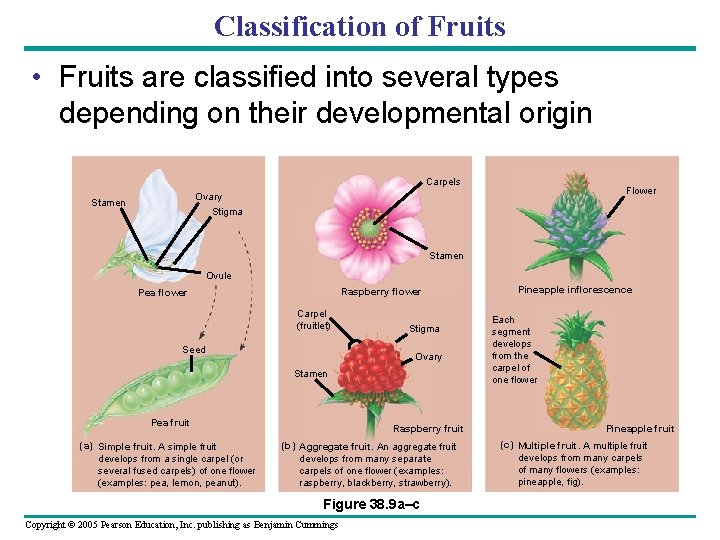
Classification of Fruits • Fruits are classified into several types depending on their developmental origin Carpels Flower Ovary Stigma Stamen Ovule Raspberry flower Pea flower Carpel (fruitlet) Seed Stigma Ovary Stamen Pea fruit (a) Simple fruit. A simple fruit develops from a single carpel (or several fused carpels) of one flower (examples: pea, lemon, peanut). Raspberry fruit (b) Aggregate fruit. An aggregate fruit develops from many separate carpels of one flower (examples: raspberry, blackberry, strawberry). Figure 38. 9 a–c Copyright © 2005 Pearson Education, Inc. publishing as Benjamin Cummings Pineapple inflorescence Each segment develops from the carpel of one flower Pineapple fruit (c) Multiple fruit. A multiple fruit develops from many carpels of many flowers (examples: pineapple, fig).
Seed Germination & Dormancy • As a seed matures it dehydrates and enters a phase referred to as dormancy • Seed dormancy increases the chances that germination will occur at a time and place most advantageous to the seedling • The breaking of seed dormancy often requires environmental cues, such as temperature or lighting cues Copyright © 2005 Pearson Education, Inc. publishing as Benjamin Cummings
From Seed to Seedling • Germination of seeds depends on the physical process called imbibition – The uptake of water due to low water potential of the dry seed Copyright © 2005 Pearson Education, Inc. publishing as Benjamin Cummings
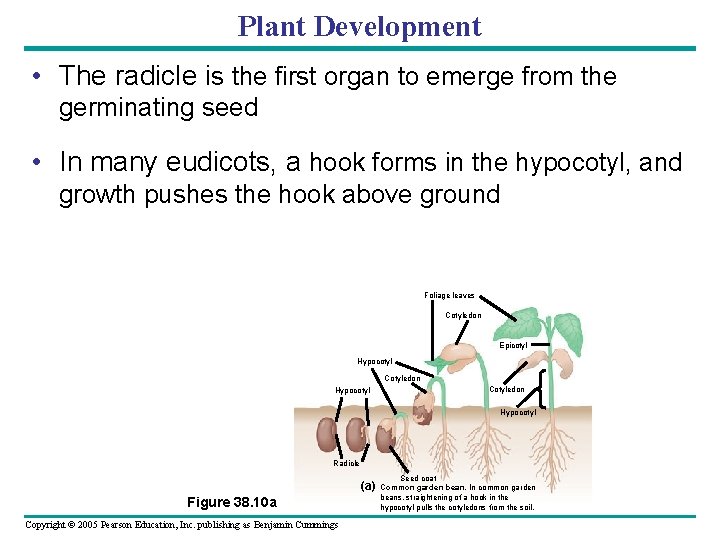
Plant Development • The radicle is the first organ to emerge from the germinating seed • In many eudicots, a hook forms in the hypocotyl, and growth pushes the hook above ground Foliage leaves Cotyledon Epicotyl Hypocotyl Cotyledon Hypocotyl Radicle (a) Figure 38. 10 a Copyright © 2005 Pearson Education, Inc. publishing as Benjamin Cummings Seed coat Common garden bean. In common garden beans, straightening of a hook in the hypocotyl pulls the cotyledons from the soil.
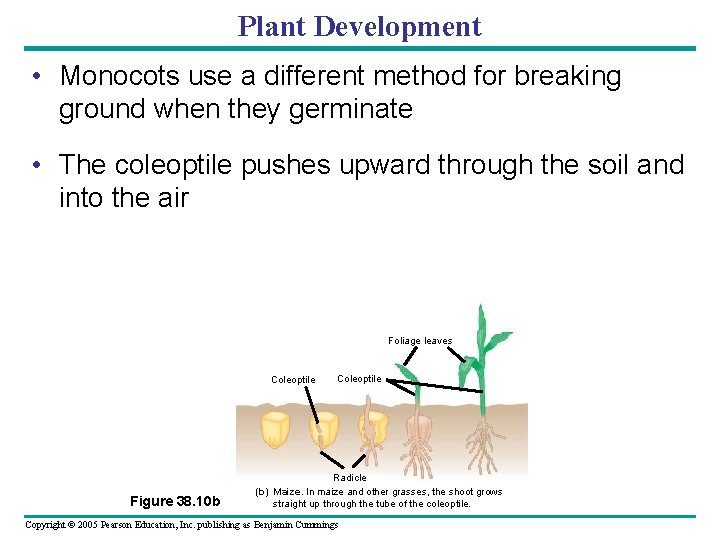
Plant Development • Monocots use a different method for breaking ground when they germinate • The coleoptile pushes upward through the soil and into the air Foliage leaves Coleoptile Figure 38. 10 b Coleoptile Radicle (b) Maize. In maize and other grasses, the shoot grows straight up through the tube of the coleoptile. Copyright © 2005 Pearson Education, Inc. publishing as Benjamin Cummings