
Chapter 37 Endocrine System 37 General Biology II
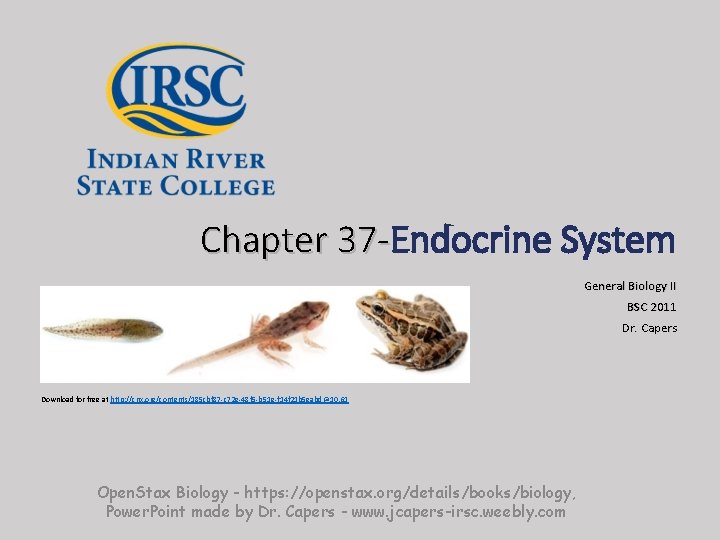
Chapter 37 -Endocrine System 37 General Biology II BSC 2011 Dr. Capers Download for free at http: //cnx. org/contents/185 cbf 87 -c 72 e-48 f 5 -b 51 e-f 14 f 21 b 5 eabd@10. 61 Open. Stax Biology - https: //openstax. org/details/books/biology, Power. Point made by Dr. Capers - www. jcapers-irsc. weebly. com
Hormones • Hormone • Regulatory chemical that is secreted into extracellular fluid and carried by the blood • Can act at a distance from source • Multicellular animals need hormones to help homeostasis • Hormone will travel to cell that has receptor for that hormone, attachment to the receptor will induce cellular response • Watch this video: https: //www. youtube. com/watch? v=A 0 Run 0 Hcub. E • Endocrine system • Organs and tissues that produce hormones
Comparison of Nervous & Endocrine Systems • Neuroendocrine System Nervous system controls through nerve impulses conducted by axons. Responses occur within milliseconds. Relatively local, specific effects. Stops when stimulus stops, adapts quickly.
Comparison of Nervous & Endocrine Systems Endocrine system controls through hormones transported in the blood. May have widespread general effects. Responses occur after seconds to days & are more prolonged, adapts slowly
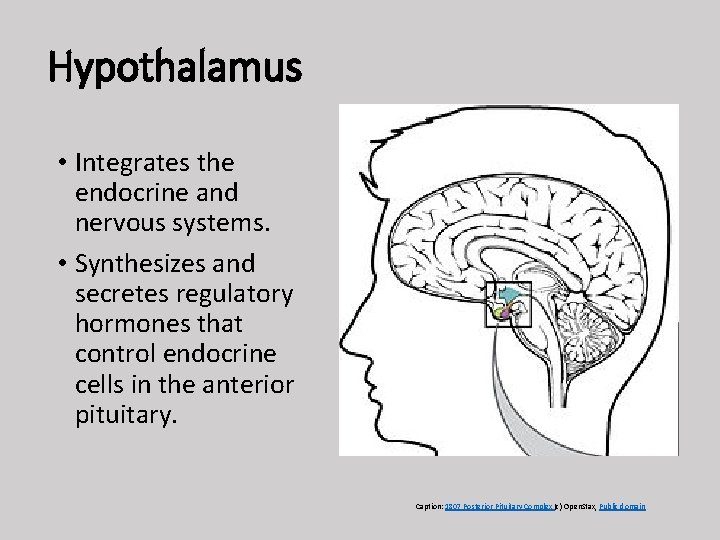
Hypothalamus • Integrates the endocrine and nervous systems. • Synthesizes and secretes regulatory hormones that control endocrine cells in the anterior pituitary. Caption: 1807 Posterior Pituitary Complex (c) Open. Stax, Public domain
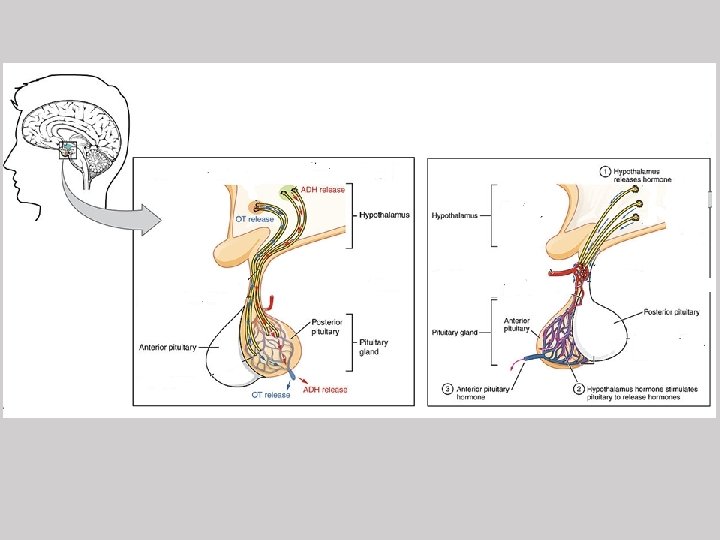
The Pituitary Gland • Hangs by a stalk from the hypothalamus • Consists of two parts • Anterior pituitary • Appears glandular • Not part of brain • Hypothalamus releases neurohormones into anterior pituitary, causing the anterior pituitary to release tropic hormones (these hormones then work on other endocrine glands) • Posterior pituitary • Appears fibrous because it contains axons from Hypothalamus • Part of brain • Releases ADH and oxytocin 6
The Anterior Pituitary • Produces at least 7 essential hormones • Peptide Hormones • Adrenocorticotropic hormone (ACTH) – stimulates adrenal to make cortisol • Melanin-stimulating hormone (MSH) – stimulates dispersion of pigment • Protein Hormones • Growth hormone (h. GH) • Prolactin (PL) – stimulate mammary glands • Glycoprotein Hormones • Thyroid-stimulating hormone (TSH) – acts on thyroid • Luteinizing hormone (LH) – acts on ovaries, testes • Follicle-stimulating hormone (FSH) – development of ovarian follicles, development of sperm
The Posterior Pituitary • 2 hormones are produced in the hypothalamus, and stored in special cells in the posterior pituitary. • Antidiuretic hormone (ADH) • Oxytocin 9
Hormonal Regulation of Body Processes Excretory System • Maintains water balance • Antidiuretic hormone (ADH) • Regulates amounts of water excreted by kidneys therefore regulating blood pressure • Released when water levels of bloodstream is lower (function of osmo-receptors) • Underproduction causes diabetes insipidus • Different from diabetes mellitus (type 1 and type II)
Excretory System • Aldosterone (steroid hormone) • Produced by adrenal cortex • Main regulator of water and electrolytes such as sodium and potassium in the body • Promotes reabsorption of water • Released due to the signaling of the renin angiotensin system, whereas ADH is released with the function of osmo-receptors • Watch this video (don’t need to learn everything on this video, it’s just to help explain): https: //www. youtube. com/watch? v=fq. Of. Ovwlz-g
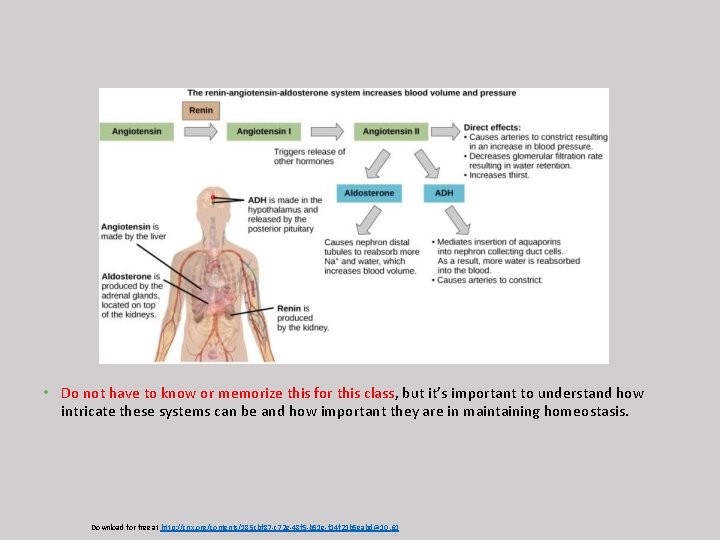
• Do not have to know or memorize this for this class, but it’s important to understand how intricate these systems can be and how important they are in maintaining homeostasis. Download for free at http: //cnx. org/contents/185 cbf 87 -c 72 e-48 f 5 -b 51 e-f 14 f 21 b 5 eabd@10. 61
Reproductive System • Follicle Stimulating Hormone (FSH) • Males: maturation of sperm cells • Females: development of egg cells • Luteinizing Hormone (LH) • Males: production of testosterone • Females: surge causes ovulation • Oxytocin • Stimulates uterine contraction during childbirth
Metabolism • Insulin • Produced by beta cells of pancreas • Lowers blood sugar by increasing cellular uptake and utilization by cells • Deficiency results in diabetes mellitus • Glucagon • Released when blood glucose levels fall • Produced by alpha cells of pancreas • Raises blood sugar by targeting liver to break down glycogen
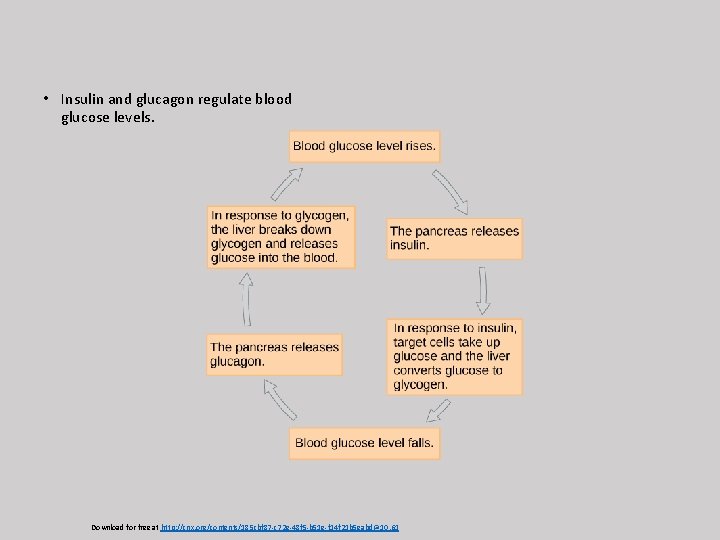
• Insulin and glucagon regulate blood glucose levels. Download for free at http: //cnx. org/contents/185 cbf 87 -c 72 e-48 f 5 -b 51 e-f 14 f 21 b 5 eabd@10. 61
Regulation of Metabolism by Thyroid Hormones • Basal metabolism rate (amount of calories required by body at rest) • determined by thyroxine (T 4) and triiodothyronine (T 3). • Released from thyroid gland in response to stimulation by TSH • Hypothyroidism=low metabolic rate • Weight gain, sensitivity to cold, lethargy • Hyperthyroidism=high metabolic rate • Weight loss, irritability, increased heart rate
Hormonal Control of Blood Calcium • Calcium regulated by: • PTH (produced by parathyroid glands) • Released in response to low blood calcium levels • Antagonist is Calcitonin (produced by thyroid gland) • Antagonist hormone has opposite effects on body • What does the body need calcium for? • Strong bones and teeth • Muscle contraction – transmission of messages (signals) in the synaptic cleft of neuromuscular junctions
Hormonal Control of Growth • Growth and cell replication regulated by: • GH (Growth Hormone) • Stimulates growth, cell reproduction, and cell regeneration • Increases rate of protein synthesis • Is glucose sparing • Regulated by growth hormone releasing and inhibiting hormones from hypothalamus
Hormonal Control of Stress • Short Term Stress • Epinephrine for “fight or flight” from adrenal gland • Cortisol helps to tap into energy stores in protein • Long Term Stress • Cortisol from adrenal gland • Anti-inflammatory • Increases blood glucose levels, can lead to weight gain and digestive problems
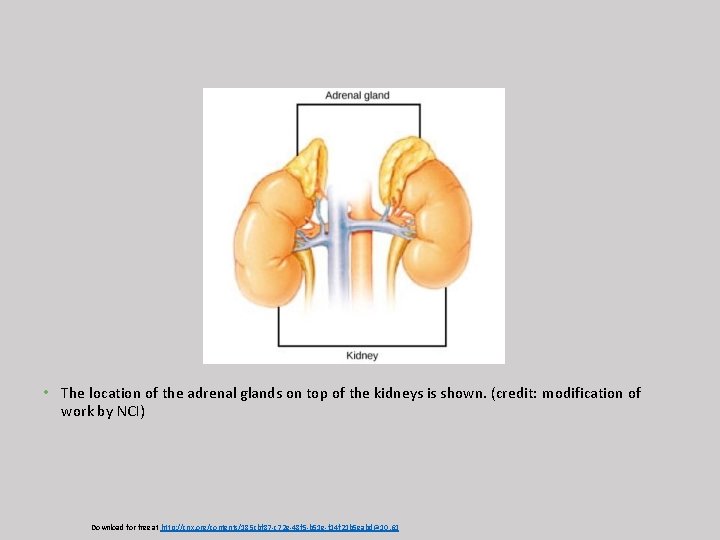
• The location of the adrenal glands on top of the kidneys is shown. (credit: modification of work by NCI) Download for free at http: //cnx. org/contents/185 cbf 87 -c 72 e-48 f 5 -b 51 e-f 14 f 21 b 5 eabd@10. 61
How Hormones Work Hormones are very specific • Need a specific receptor in order to work Receptors change with cellular activity • Receptors may be found on many different cells or limited to a small number of specialized cells • Number of receptors can change • Up-regulation • Down-regulation • Hormone receptors may be found within the cell or on the plasma membranes
Intracellular Hormone Receptors Lipid-derived hormones bind to transport proteins • Once they reach the target cell, they are released from their carrier protein and pass through the plasma membrane and bind to a target within the cell. • Lipophilic – cross membrane and bind to intra-cellular receptor • The hormone/receptor complex regulates transcription by increasing or decreasing the synthesis of m. RNA.
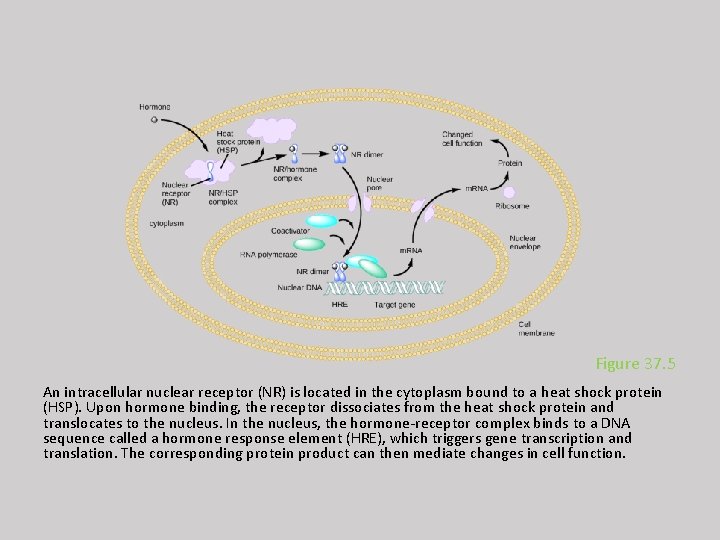
Figure 37. 5 An intracellular nuclear receptor (NR) is located in the cytoplasm bound to a heat shock protein (HSP). Upon hormone binding, the receptor dissociates from the heat shock protein and translocates to the nucleus. In the nucleus, the hormone-receptor complex binds to a DNA sequence called a hormone response element (HRE), which triggers gene transcription and translation. The corresponding protein product can then mediate changes in cell function.
Plasma Membrane Hormone Receptors • Amino acid derived hormones and peptides cannot pass thorough the plasma membrane • Hydrophilic – cannot cross the membrane, have to bind to receptor on the membrane • Bind to receptors on the outer surface of the plasma membrane and initiates signaling pathway (called the 2 nd messenger system)
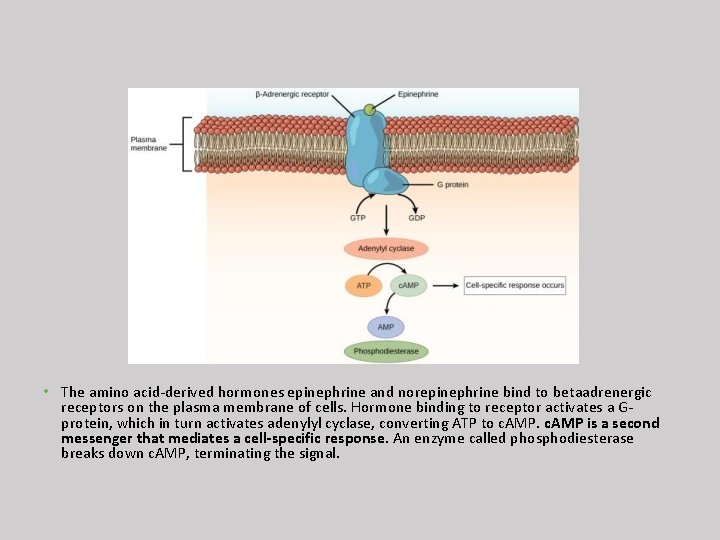
• The amino acid-derived hormones epinephrine and norepinephrine bind to betaadrenergic receptors on the plasma membrane of cells. Hormone binding to receptor activates a Gprotein, which in turn activates adenylyl cyclase, converting ATP to c. AMP is a second messenger that mediates a cell-specific response. An enzyme called phosphodiesterase breaks down c. AMP, terminating the signal.
- Slides: 25