
Chapter 36 Transport in Vascular Plants A Physical
- Slides: 41
Chapter 36 Transport in Vascular Plants
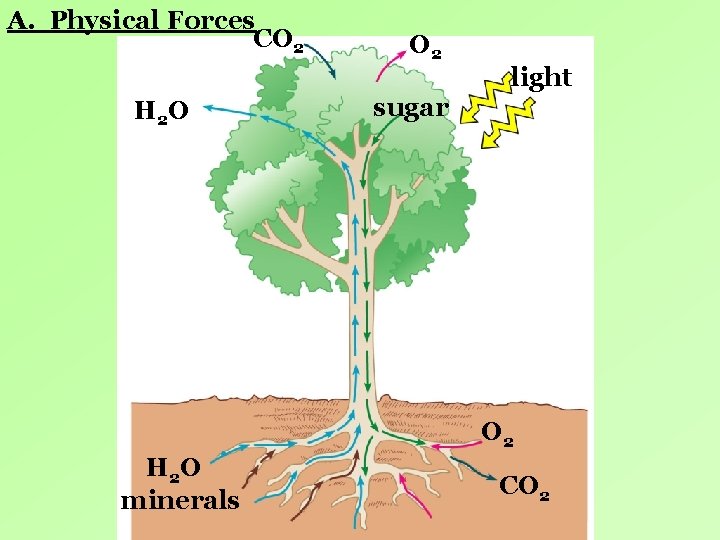
A. Physical Forces CO 2 H 2 O O 2 light sugar O 2 H 2 O minerals CO 2
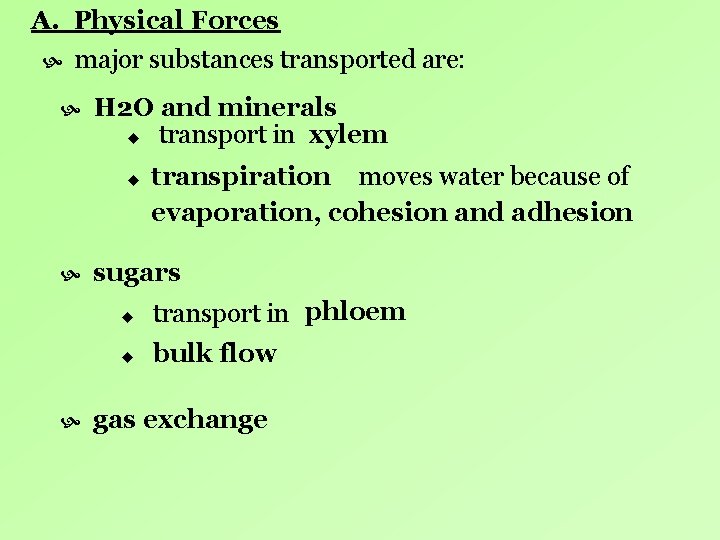
A. Physical Forces major substances transported are: H 2 O and minerals u transport in xylem u transpiration moves water because of evaporation, cohesion and adhesion sugars u transport in phloem u bulk flow gas exchange
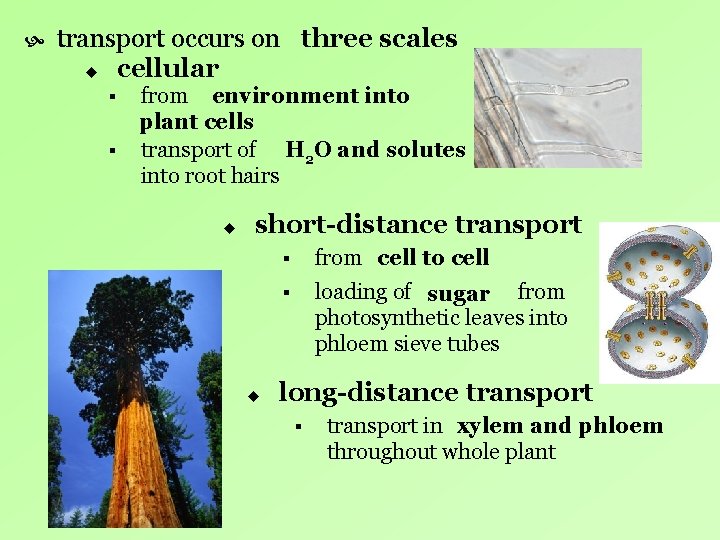
transport occurs on three scales u cellular § § from environment into plant cells transport of H 2 O and solutes into root hairs u short-distance transport u § from cell to cell § loading of sugar from photosynthetic leaves into phloem sieve tubes long-distance transport § transport in xylem and phloem throughout whole plant
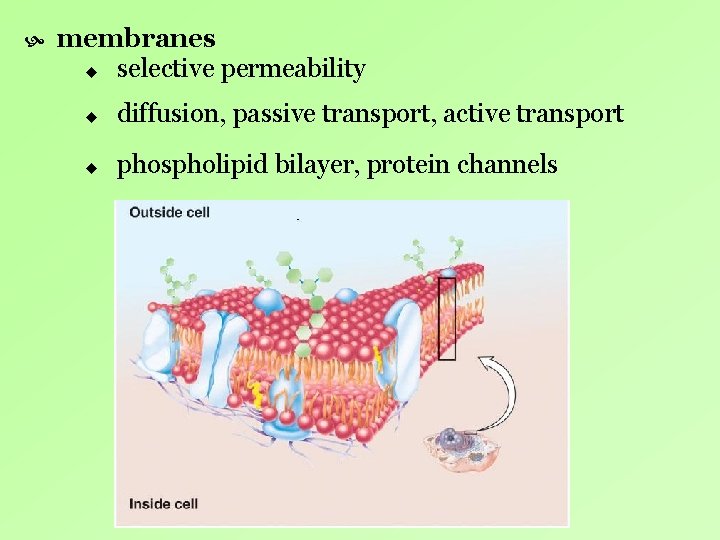
membranes u selective permeability u diffusion, passive transport, active transport u phospholipid bilayer, protein channels
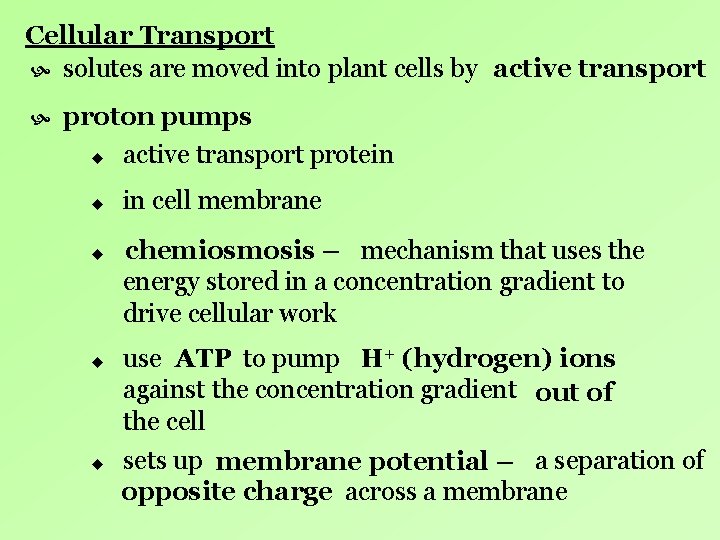
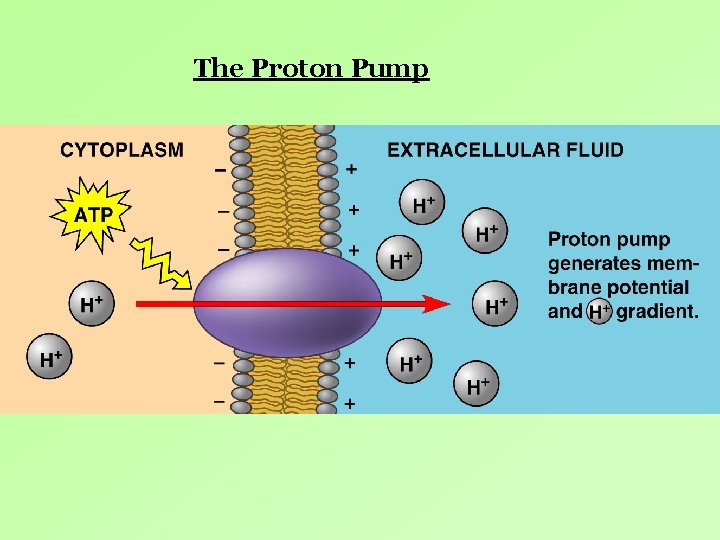
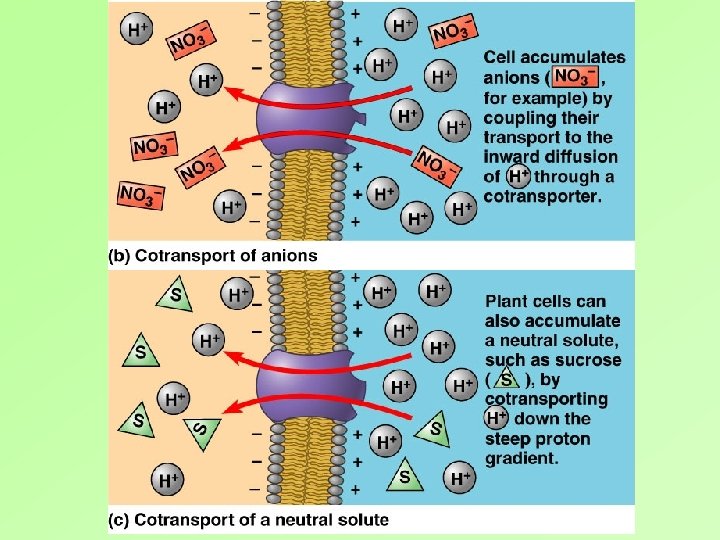
Cellular Transport solutes are moved into plant cells by active transport proton pumps u active transport protein u u in cell membrane chemiosmosis – mechanism that uses the energy stored in a concentration gradient to drive cellular work use ATP to pump H+ (hydrogen) ions against the concentration gradient out of the cell sets up membrane potential – a separation of opposite charge across a membrane
The Proton Pump
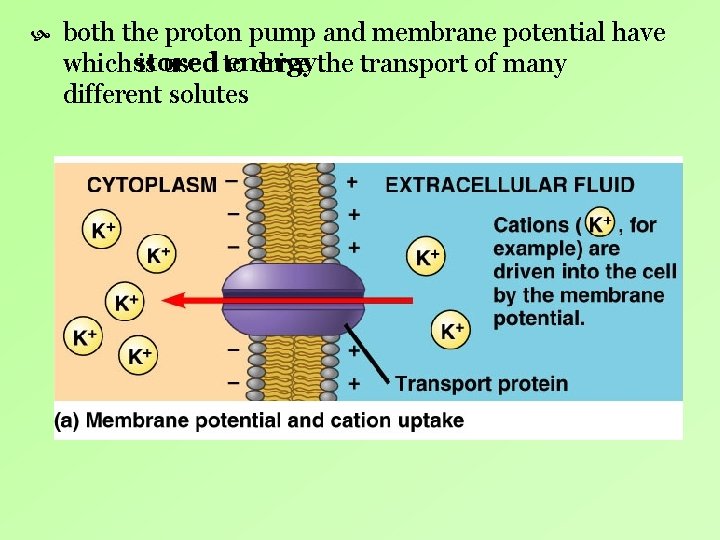
both the proton pump and membrane potential have energy which stored is used to drive the transport of many different solutes
Water Potential water uptake and loss must be balanced water moves by osmosis cell walls add physical pressure which affects osmosis water potential, Ψ , takes both solute (dissolved substances) concentration and physical into account pressure measured in megapascals, MPa (or bars)
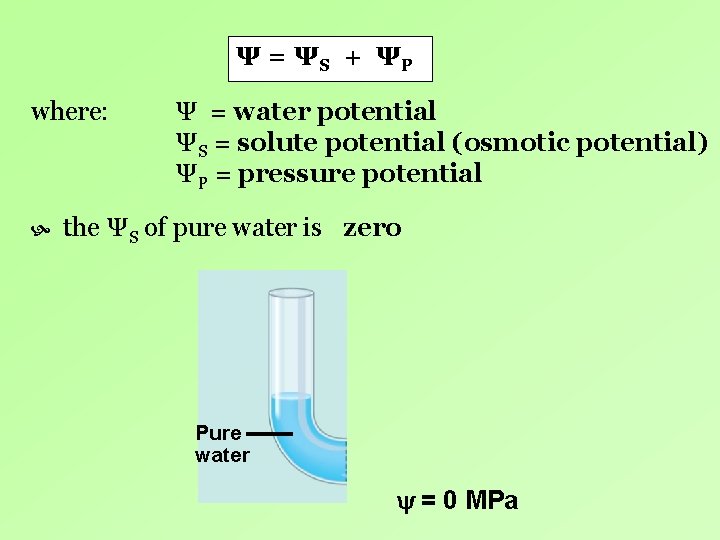
Ψ = ΨS + Ψ P where: Ψ = water potential ΨS = solute potential (osmotic potential) ΨP = pressure potential the ΨS of pure water is zero Pure water = 0 MPa
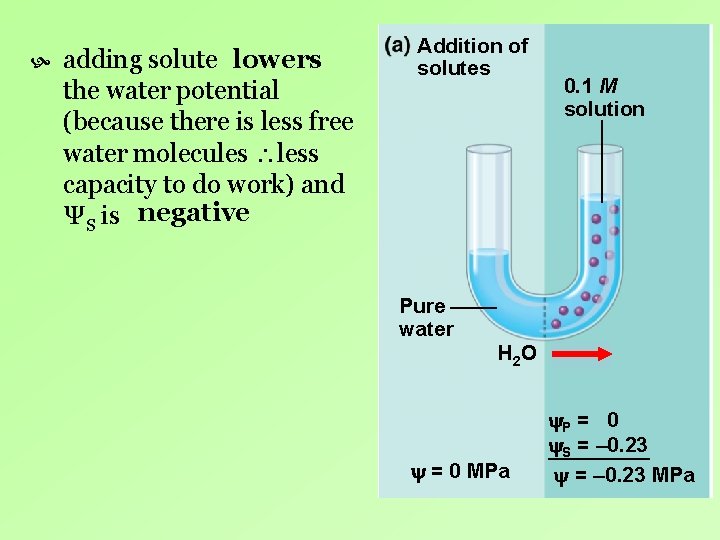
adding solute lowers the water potential (because there is less free water molecules less capacity to do work) and ΨS is negative Addition of solutes 0. 1 M solution Pure water H 2 O = 0 MPa P = 0 S = – 0. 23 MPa
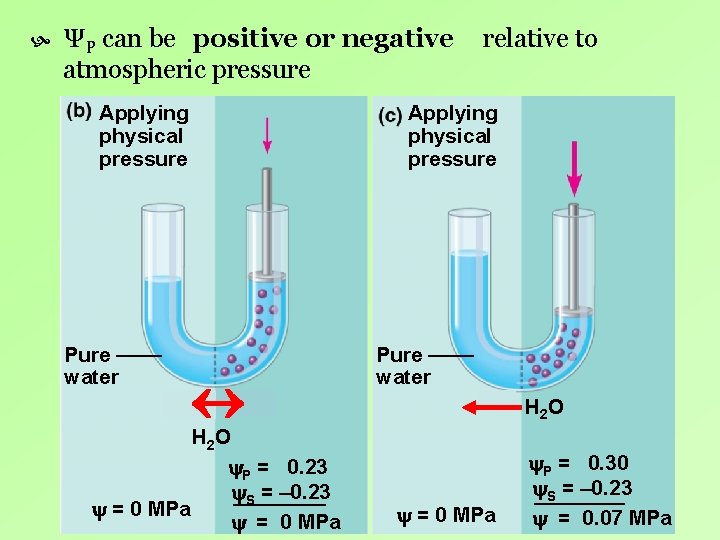
ΨP can be positive or negative atmospheric pressure Applying physical pressure Pure water relative to Applying physical pressure H 2 O P = 0. 23 S = – 0. 23 = 0 MPa Pure water H 2 O = 0 MPa P = 0. 30 S = – 0. 23 = 0. 07 MPa
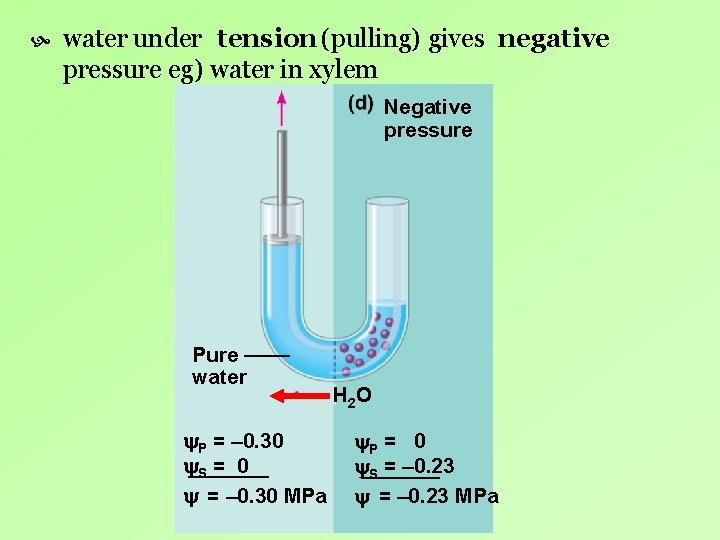
water under tension (pulling) gives negative pressure eg) water in xylem Negative pressure Pure water P = – 0. 30 S = 0 = – 0. 30 MPa H 2 O P = 0 S = – 0. 23 MPa
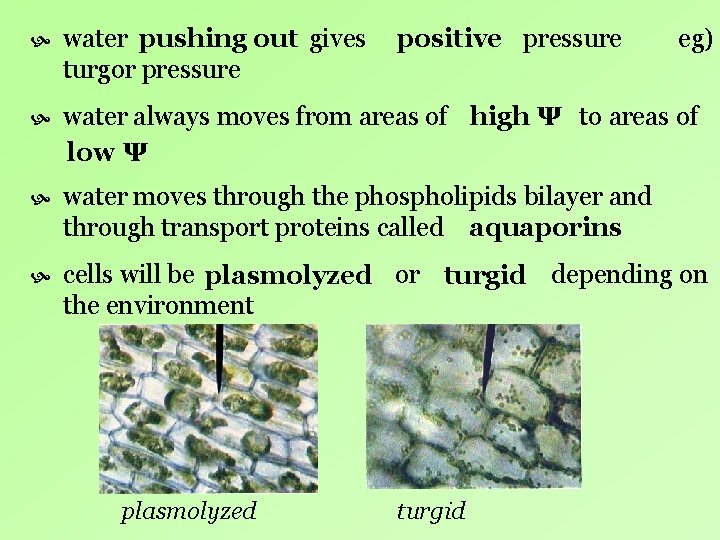
water pushing out gives turgor pressure water always moves from areas of high Ψ to areas of low Ψ water moves through the phospholipids bilayer and through transport proteins called aquaporins cells will be plasmolyzed or turgid depending on the environment plasmolyzed positive pressure turgid eg)
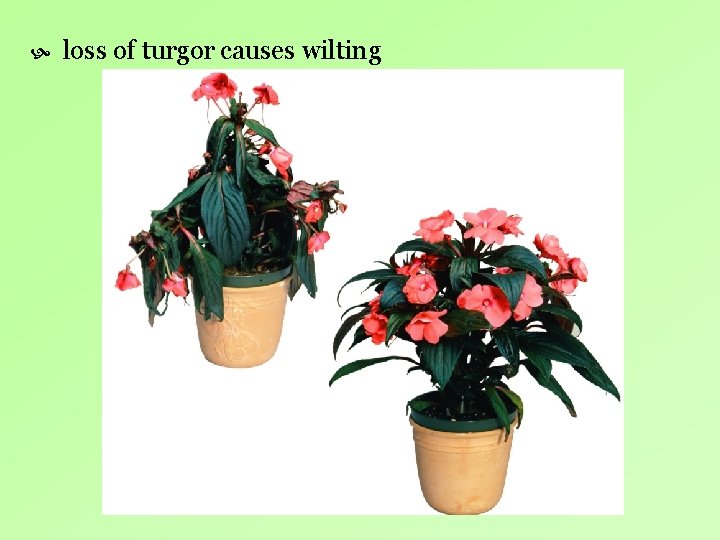
loss of turgor causes wilting
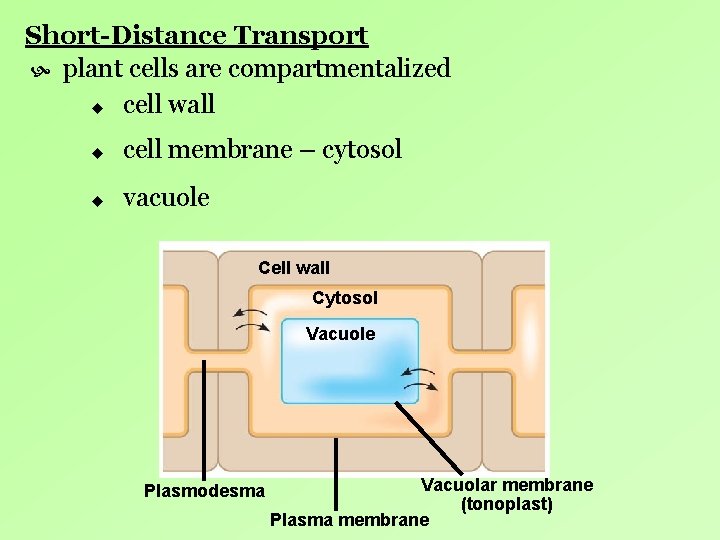
Short-Distance Transport plant cells are compartmentalized u cell wall u cell membrane – cytosol u vacuole Cell wall Cytosol Vacuole Plasmodesma Vacuolar membrane (tonoplast) Plasma membrane
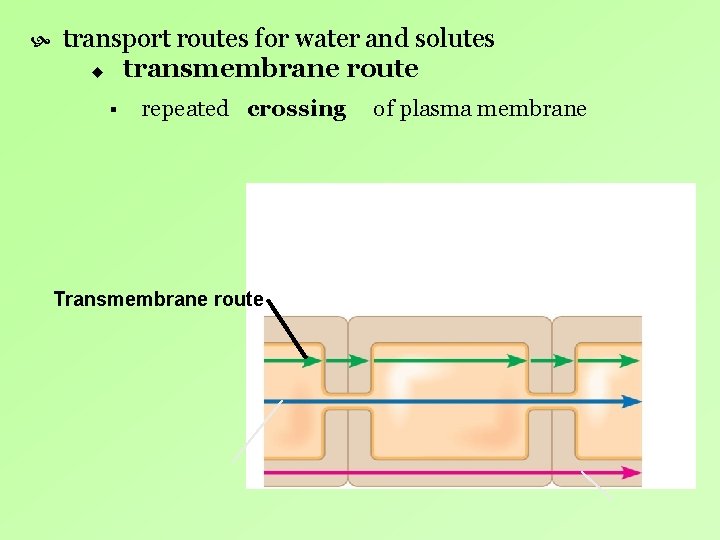
transport routes for water and solutes u transmembrane route § repeated crossing Transmembrane route of plasma membrane
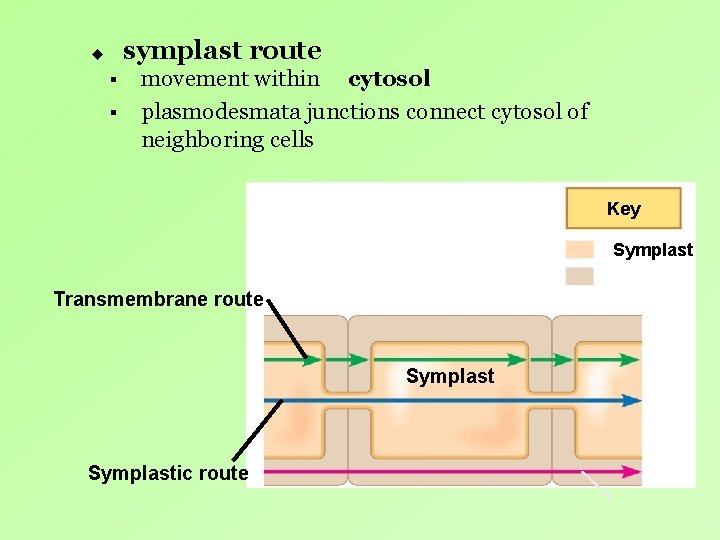
symplast route u § § movement within cytosol plasmodesmata junctions connect cytosol of neighboring cells Key Symplast Transmembrane route Symplastic route
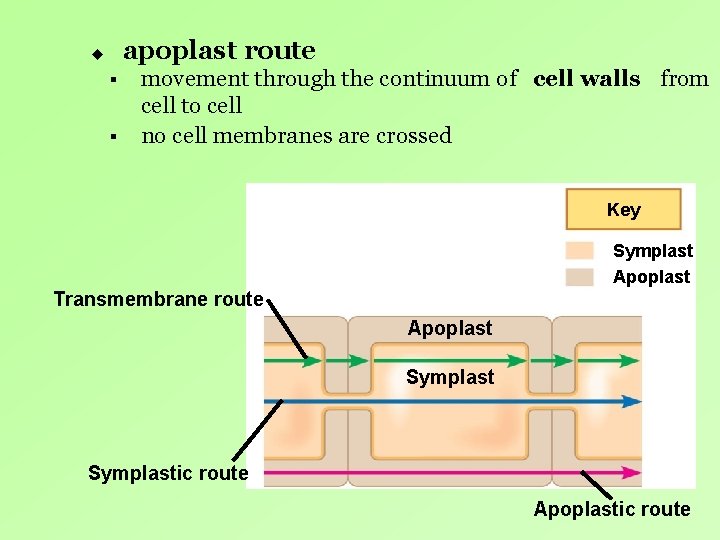
apoplast route u § § movement through the continuum of cell walls from cell to cell no cell membranes are crossed Key Symplast Apoplast Transmembrane route Apoplast Symplastic route Apoplastic route
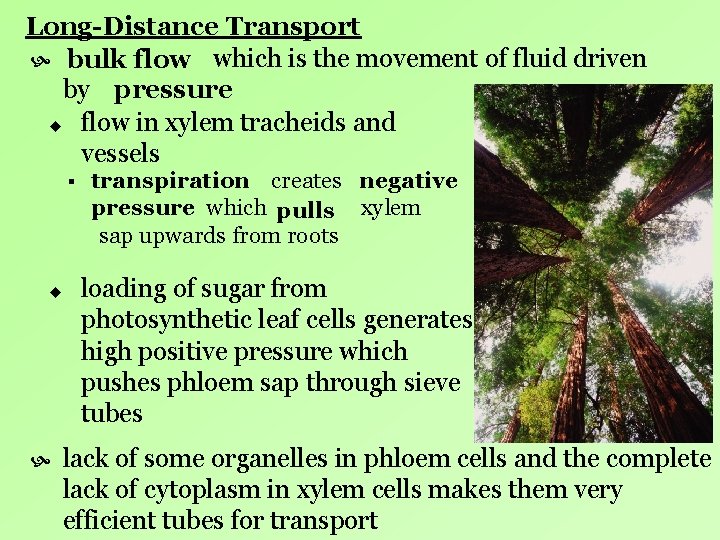
Long-Distance Transport bulk flow which is the movement of fluid driven by pressure u flow in xylem tracheids and vessels § u transpiration creates negative pressure which pulls xylem sap upwards from roots loading of sugar from photosynthetic leaf cells generates high positive pressure which pushes phloem sap through sieve tubes lack of some organelles in phloem cells and the complete lack of cytoplasm in xylem cells makes them very efficient tubes for transport
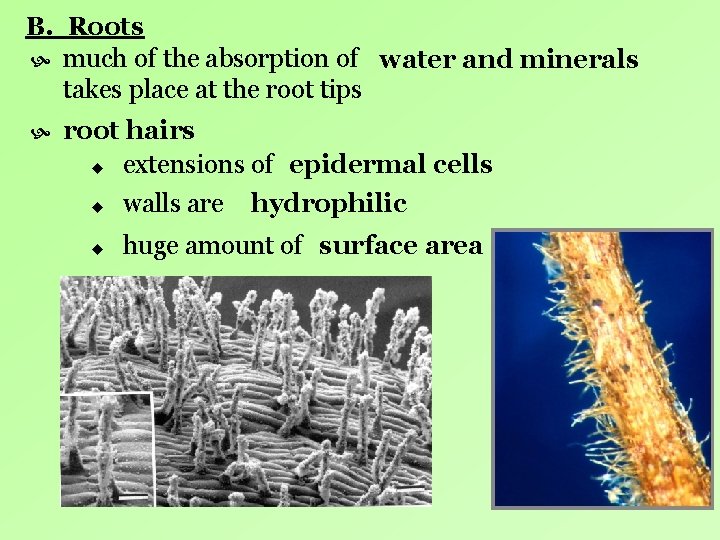
B. Roots much of the absorption of water and minerals takes place at the root tips root hairs u extensions of epidermal cells u walls are hydrophilic u huge amount of surface area
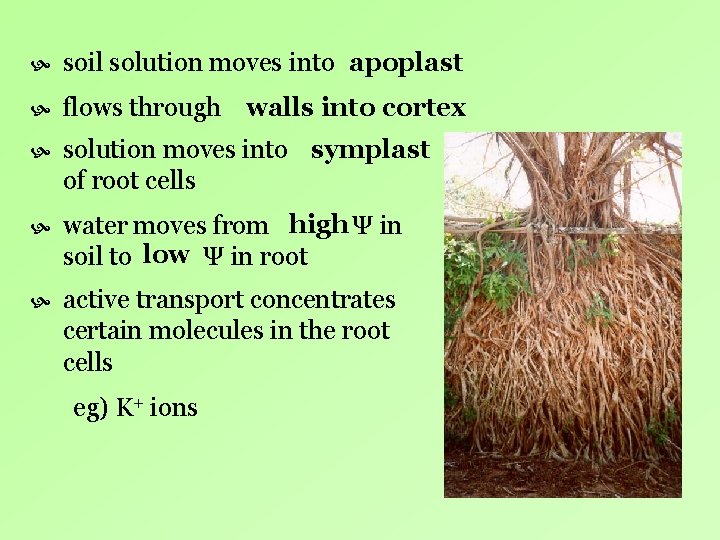
soil solution moves into apoplast flows through walls into cortex solution moves into symplast of root cells water moves from high Ψ in soil to low Ψ in root active transport concentrates certain molecules in the root cells eg) K+ ions
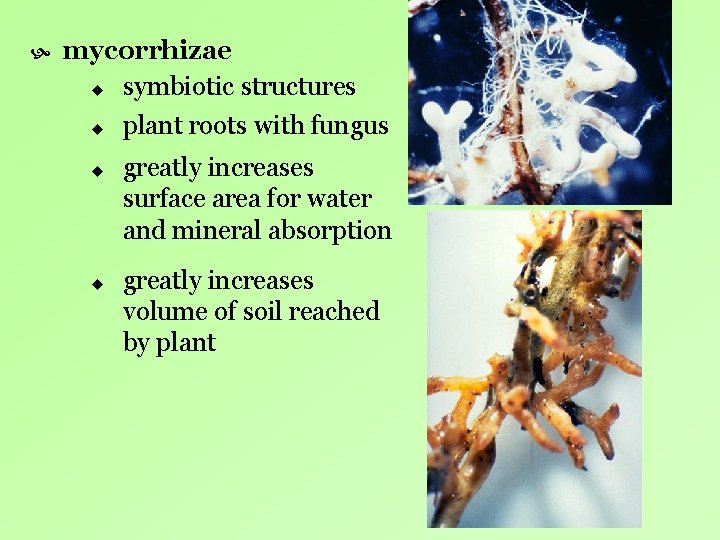
mycorrhizae u symbiotic structures u u u plant roots with fungus greatly increases surface area for water and mineral absorption greatly increases volume of soil reached by plant
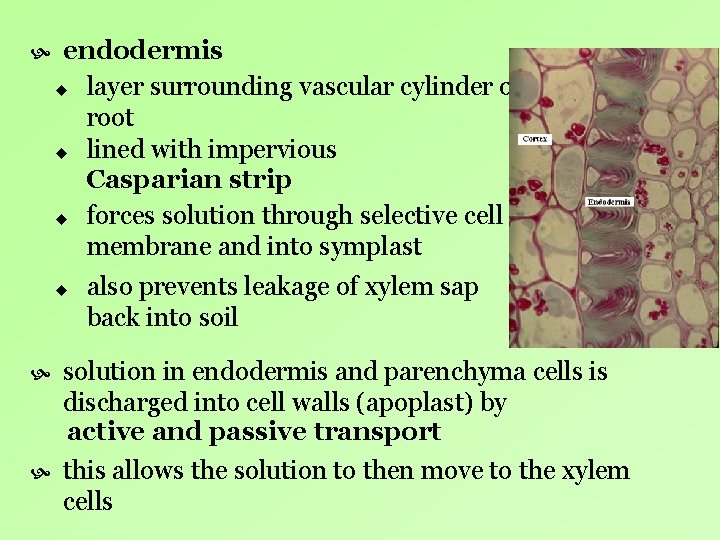
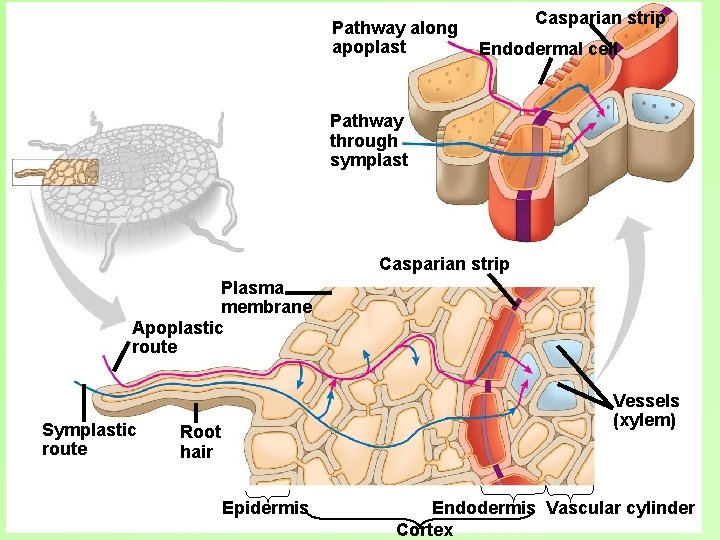
endodermis u layer surrounding vascular cylinder of root u lined with impervious Casparian strip u forces solution through selective cell membrane and into symplast u also prevents leakage of xylem sap back into soil solution in endodermis and parenchyma cells is discharged into cell walls (apoplast) by active and passive transport this allows the solution to then move to the xylem cells
Pathway along apoplast Casparian strip Endodermal cell Pathway through symplast Casparian strip Plasma membrane Apoplastic route Symplastic route Vessels (xylem) Root hair Epidermis Endodermis Vascular cylinder Cortex
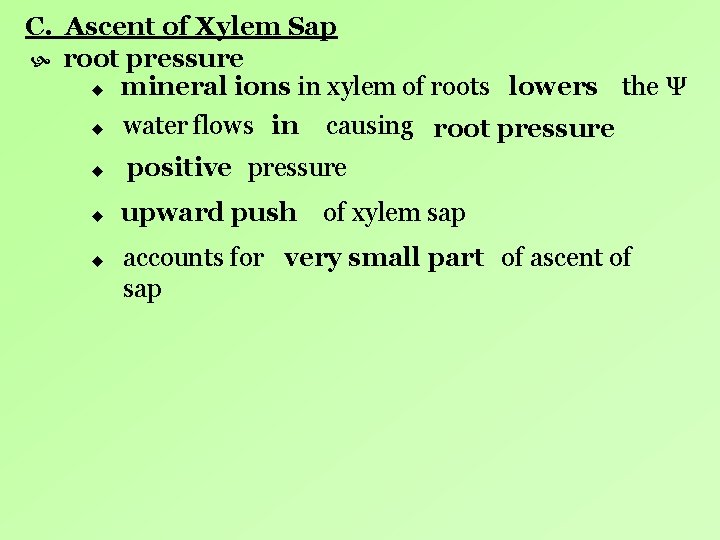
C. Ascent of Xylem Sap root pressure u mineral ions in xylem of roots lowers the Ψ u u water flows in causing root pressure positive pressure upward push of xylem sap accounts for very small part of ascent of sap
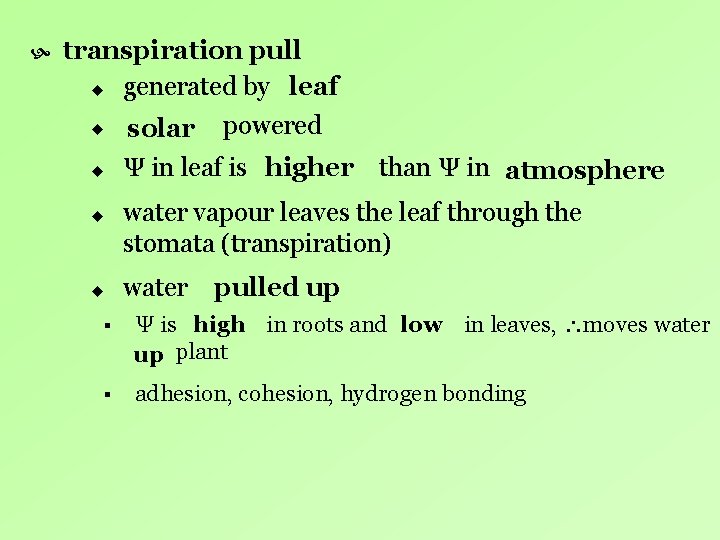
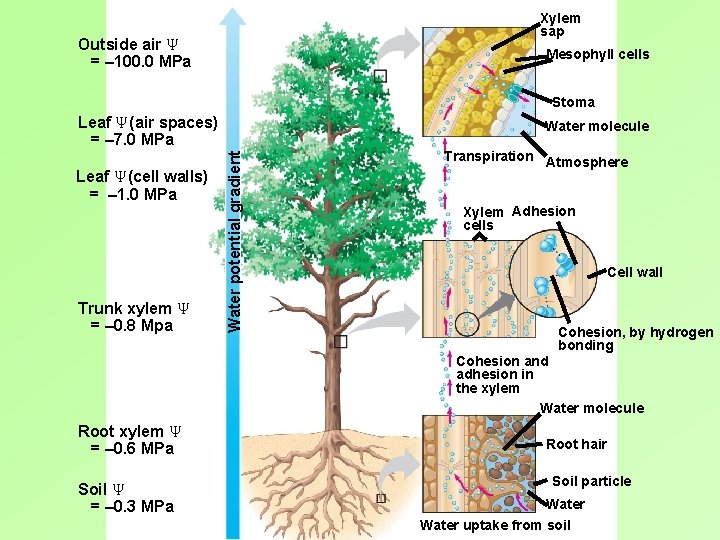
transpiration pull u generated by leaf u u solar powered Ψ in leaf is higher than Ψ in atmosphere water vapour leaves the leaf through the stomata (transpiration) water pulled up § Ψ is high in roots and low in leaves, moves water up plant § adhesion, cohesion, hydrogen bonding
Xylem sap Outside air Ψ = – 100. 0 MPa Mesophyll cells Stoma Leaf Ψ(air spaces) = – 7. 0 MPa Trunk xylem Ψ = – 0. 8 Mpa Water potential gradient Leaf Ψ(cell walls) = – 1. 0 MPa Water molecule Transpiration Atmosphere Xylem Adhesion cells Cell wall Cohesion, by hydrogen bonding Cohesion and adhesion in the xylem Water molecule Root xylem Ψ = – 0. 6 MPa Soil Ψ = – 0. 3 MPa Root hair Soil particle Water uptake from soil
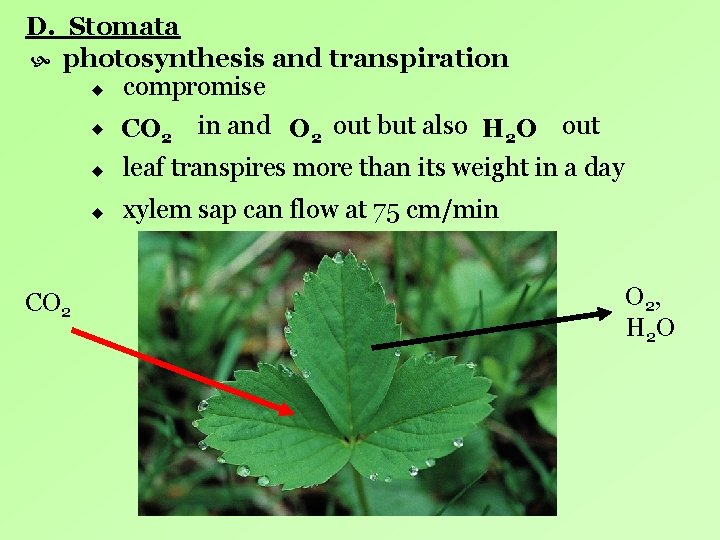
D. Stomata photosynthesis and transpiration u compromise CO 2 in and O 2 out but also H 2 O out u CO 2 u leaf transpires more than its weight in a day u xylem sap can flow at 75 cm/min O 2 , H 2 O
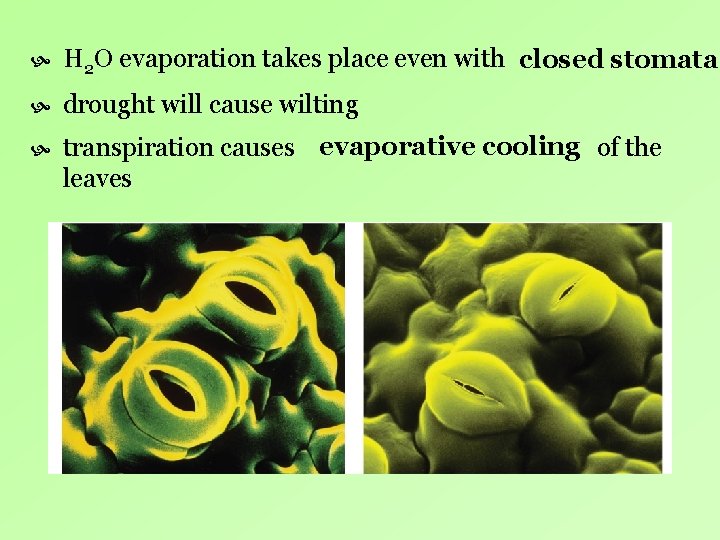
H 2 O evaporation takes place even with closed stomata drought will cause wilting transpiration causes evaporative cooling of the leaves
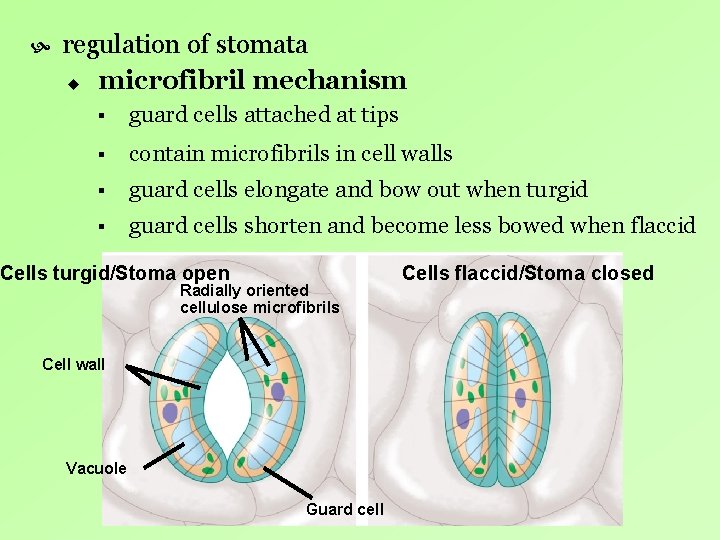
regulation of stomata u microfibril mechanism § guard cells attached at tips § contain microfibrils in cell walls § guard cells elongate and bow out when turgid § guard cells shorten and become less bowed when flaccid Cells turgid/Stoma open Radially oriented cellulose microfibrils Cell wall Vacuole Guard cell Cells flaccid/Stoma closed
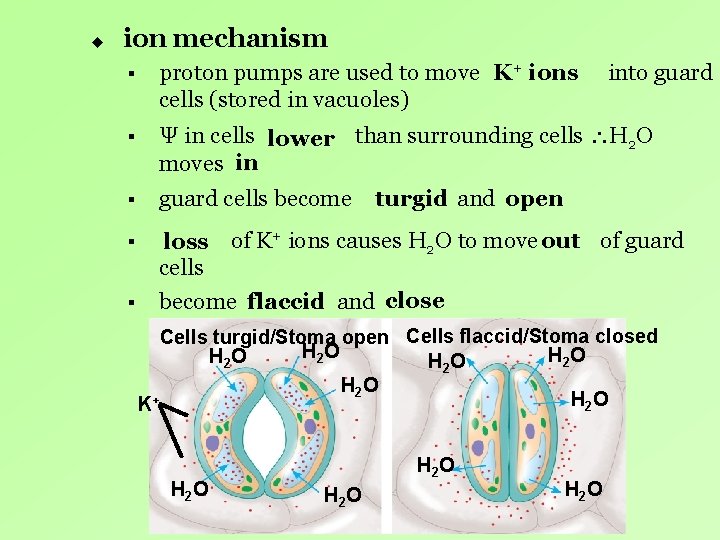
u ion mechanism § proton pumps are used to move K+ ions cells (stored in vacuoles) § Ψ in cells lower than surrounding cells H 2 O moves in § guard cells become § loss of K+ ions causes H 2 O to move out of guard cells become flaccid and close § into guard turgid and open Cells turgid/Stoma open Cells flaccid/Stoma closed H 2 O H 2 O K+ H 2 O
u other cues § light § § § blue-light receptors in plasma membrane triggers ATP-powered proton pumps causing K+ uptake stomata open depletion of CO 2 § CO 2 in air spaces in mesophyll is used for photosynthesis § depletion causes stomata to open
§ circadian rhythm § automatic 24 -hour cycle § stomata open in day, close at night
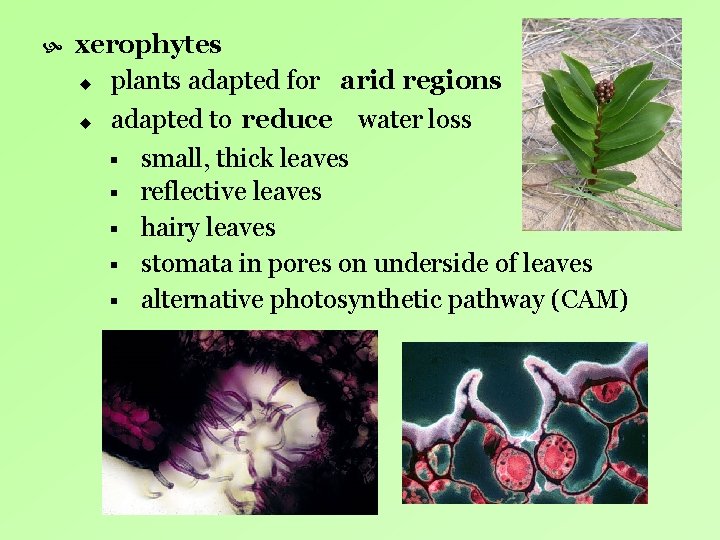
xerophytes u plants adapted for arid regions u adapted to reduce water loss § small, thick leaves § reflective leaves § hairy leaves § stomata in pores on underside of leaves § alternative photosynthetic pathway (CAM)
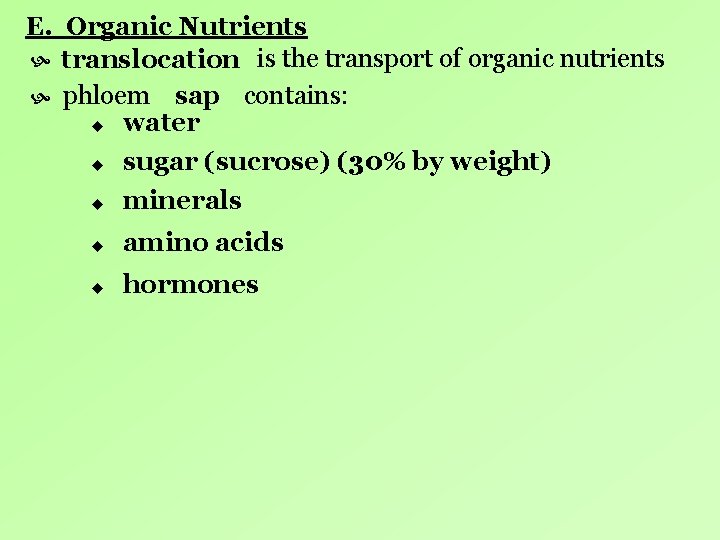
E. Organic Nutrients translocation is the transport of organic nutrients phloem sap contains: u water u sugar (sucrose) (30% by weight) minerals u amino acids u hormones u
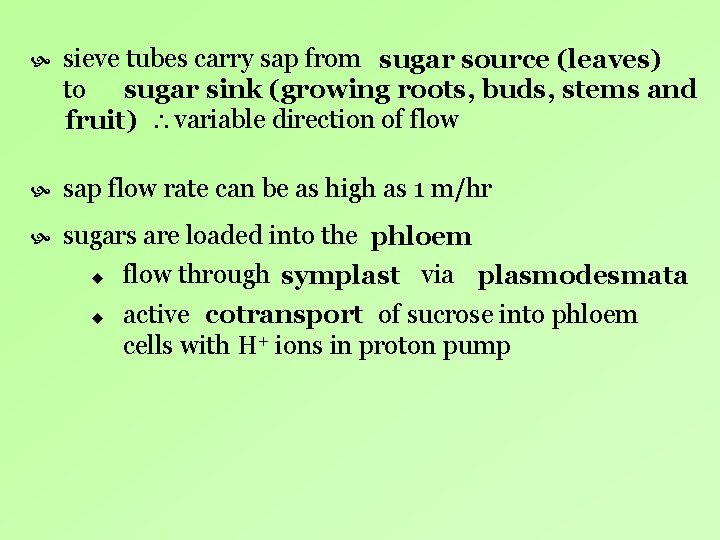
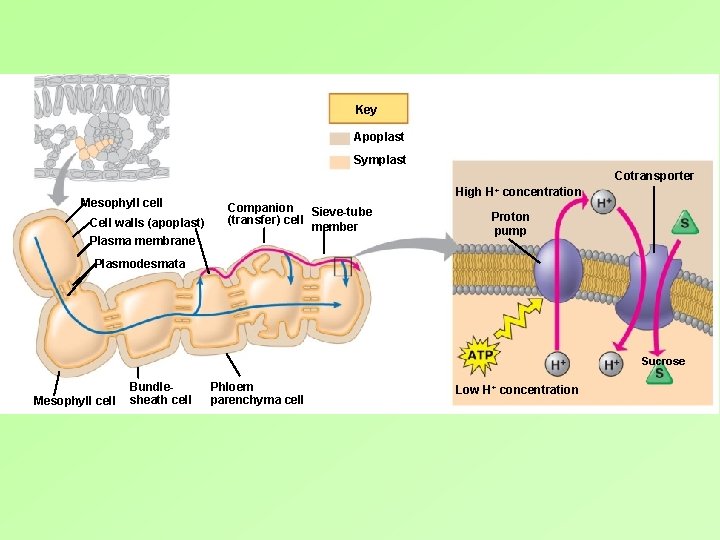
sieve tubes carry sap from sugar source (leaves) to sugar sink (growing roots, buds, stems and fruit) variable direction of flow sap flow rate can be as high as 1 m/hr sugars are loaded into the phloem u flow through symplast via plasmodesmata u active cotransport of sucrose into phloem cells with H+ ions in proton pump
Key Apoplast Symplast Cotransporter Mesophyll cell Cell walls (apoplast) Plasma membrane High H+ concentration Companion Sieve-tube (transfer) cell member Proton pump Plasmodesmata Sucrose Mesophyll cell Bundlesheath cell Phloem parenchyma cell Low H+ concentration
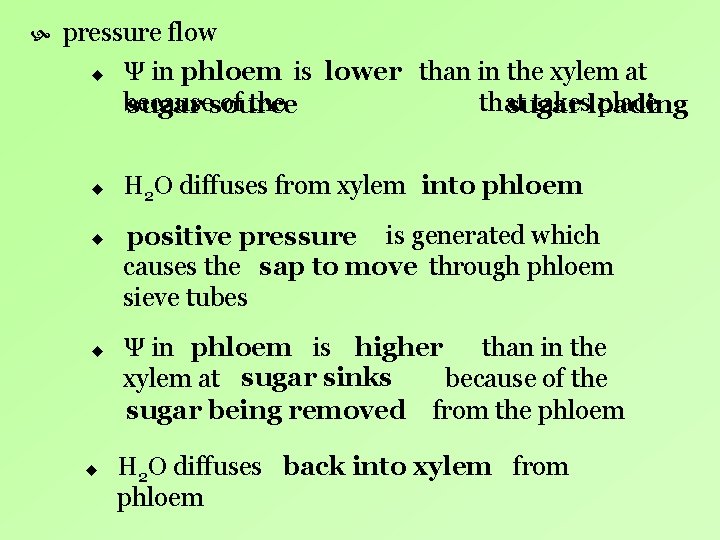
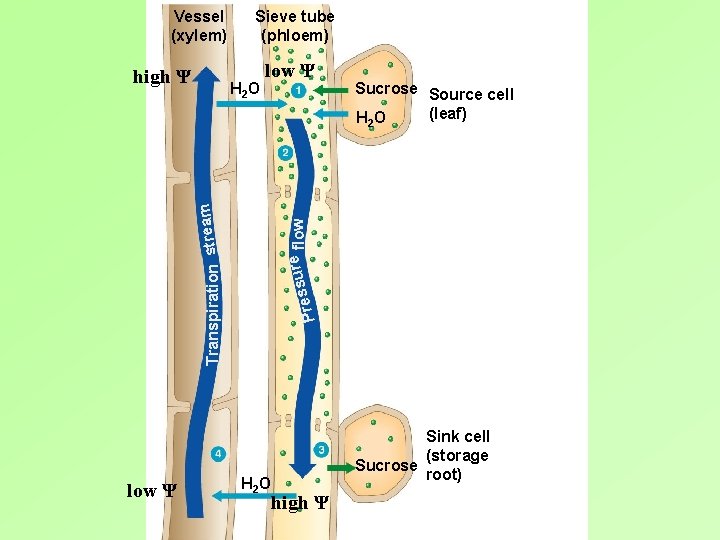
pressure flow u u u Ψ in phloem is lower than in the xylem at because of the that takesloading place sugar source sugar H 2 O diffuses from xylem into phloem positive pressure is generated which causes the sap to move through phloem sieve tubes Ψ in phloem is higher than in the xylem at sugar sinks because of the sugar being removed from the phloem H 2 O diffuses back into xylem from phloem
Vessel (xylem) high Ψ Sieve tube (phloem) low Ψ Sucrose Source cell (leaf) H 2 O su Pres re flow Transpiration stream H 2 O low Ψ H 2 O Sink cell (storage Sucrose root) high Ψ