
Chapter 36 The Cold War Begins Post War
Chapter 36 The Cold War Begins
Post War Anxiety • Americans were happy World War II was over (1945), but many worried that the U. S. would sink back into another Great Depression. – Inflation shot up with the release of price controls – Gross national product sank – Labor strikes swept the nation. • Congress passed the Taft-Hartley Act – Outlawed “closed” shops (closed to non-union members) – Made unions liable for damages that resulted from jurisdictional disputes among themselves – Required that union leaders take non-communist oaths – Opposite of the Wagner Act (New Deal) – a strike AGAINST labor unions
• “Operation Dixie” – Labor tried to organize in the South and West – Frustrating and unsuccessful • Government tried to keep the economy up – Sold war factories and other government installations to private businesses cheaply. – Congress passed the Employment Act of 1946 - made it government policy to “promote maximum employment, production, and purchasing power” – Created the Council of Economic Advisors to provide the president with data to make that policy a reality. – Servicemen’s Readjustment Act (1944) - GI Bill of Rights, which allowed all servicemen to have free college education once they returned from the war.
A Long Economic Boom • Late 1940 s and into the 1960 s, the economy began to boom tremendously – The middle class more than doubled while people now wanted two cars in every garage; over 90% of American families owned a television. • Women grew in the American work force while giving up their former roles as housewives. • New affluence did not touch everyone, but it did touch many.

Causes of the Boom • The war itself that forced America to produce more than it’d ever imagined • Colossal military projects – Korean War, defense spending, industries, aerospace, plastics, and electronics, and research and development all were such projects. – R and D (research and development) became an entirely new industry. • Cheap energy paralleled the popularity of automobiles, and spidery grids of electrical cables carried the power of oil, gas, coal, and falling water into homes and factories alike. • Workers upped their productivity tremendously • Farmers, due to new technology in fertilizers, etc. produced more than ever – Farming population shrank while production soared
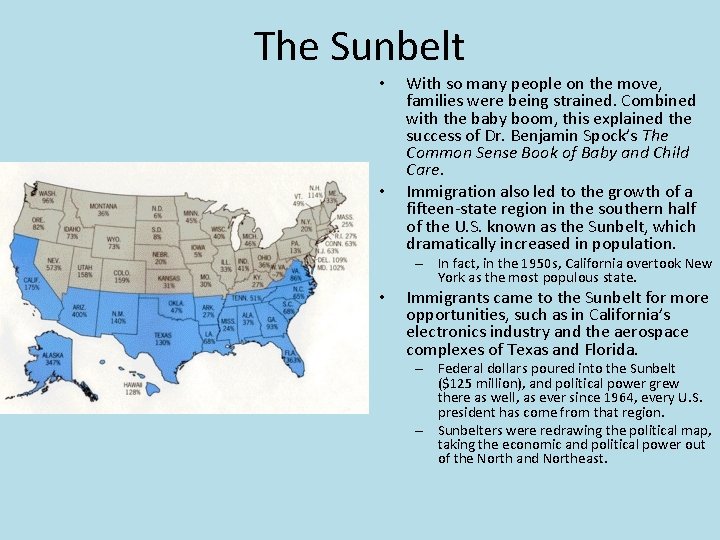
The Sunbelt • • With so many people on the move, families were being strained. Combined with the baby boom, this explained the success of Dr. Benjamin Spock’s The Common Sense Book of Baby and Child Care. Immigration also led to the growth of a fifteen-state region in the southern half of the U. S. known as the Sunbelt, which dramatically increased in population. – In fact, in the 1950 s, California overtook New York as the most populous state. • Immigrants came to the Sunbelt for more opportunities, such as in California’s electronics industry and the aerospace complexes of Texas and Florida. – Federal dollars poured into the Sunbelt ($125 million), and political power grew there as well, as ever since 1964, every U. S. president has come from that region. – Sunbelters were redrawing the political map, taking the economic and political power out of the North and Northeast.
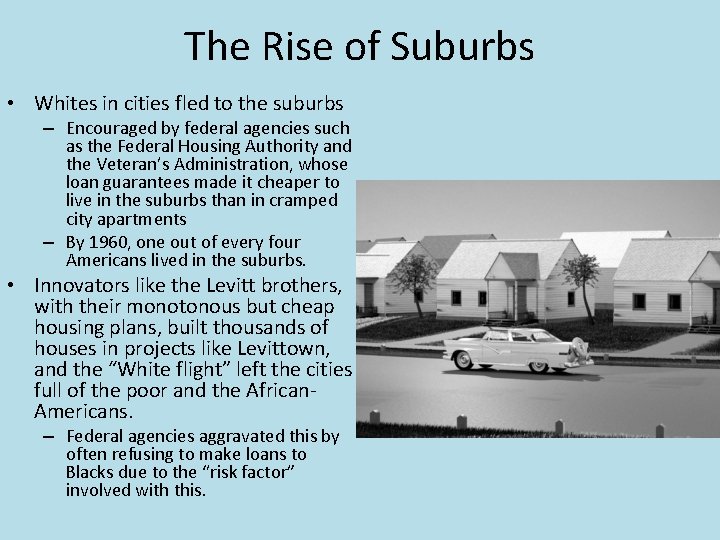
The Rise of Suburbs • Whites in cities fled to the suburbs – Encouraged by federal agencies such as the Federal Housing Authority and the Veteran’s Administration, whose loan guarantees made it cheaper to live in the suburbs than in cramped city apartments – By 1960, one out of every four Americans lived in the suburbs. • Innovators like the Levitt brothers, with their monotonous but cheap housing plans, built thousands of houses in projects like Levittown, and the “White flight” left the cities full of the poor and the African. Americans. – Federal agencies aggravated this by often refusing to make loans to Blacks due to the “risk factor” involved with this.
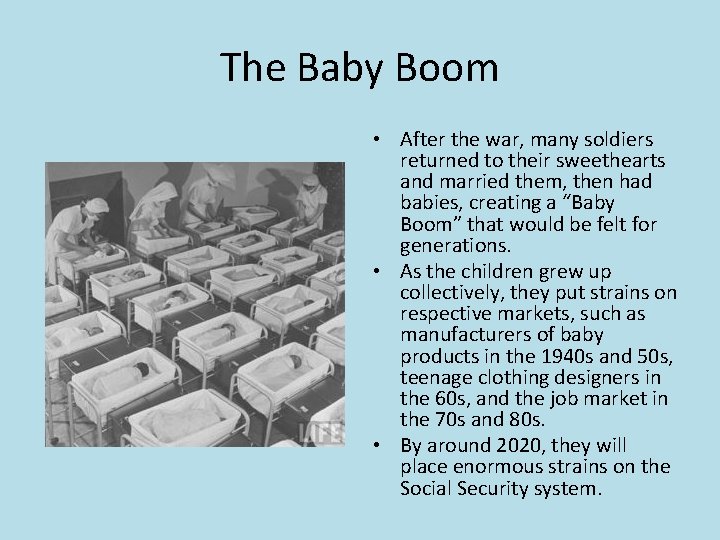
The Baby Boom • After the war, many soldiers returned to their sweethearts and married them, then had babies, creating a “Baby Boom” that would be felt for generations. • As the children grew up collectively, they put strains on respective markets, such as manufacturers of baby products in the 1940 s and 50 s, teenage clothing designers in the 60 s, and the job market in the 70 s and 80 s. • By around 2020, they will place enormous strains on the Social Security system.
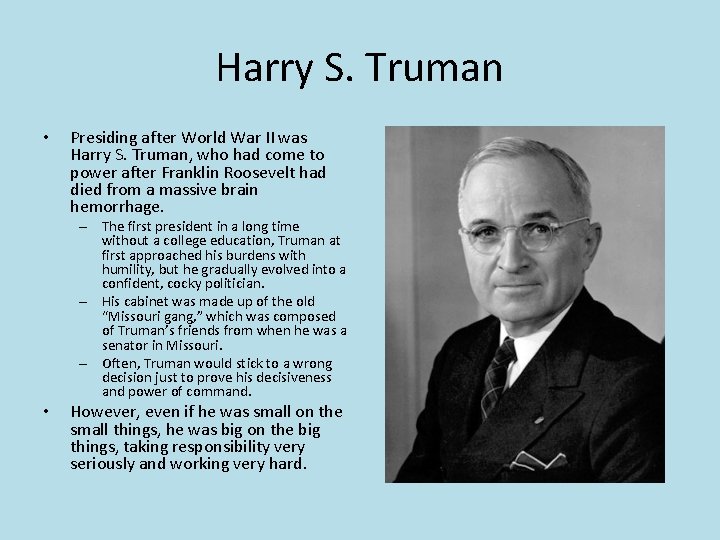
Harry S. Truman • Presiding after World War II was Harry S. Truman, who had come to power after Franklin Roosevelt had died from a massive brain hemorrhage. – The first president in a long time without a college education, Truman at first approached his burdens with humility, but he gradually evolved into a confident, cocky politician. – His cabinet was made up of the old “Missouri gang, ” which was composed of Truman’s friends from when he was a senator in Missouri. – Often, Truman would stick to a wrong decision just to prove his decisiveness and power of command. • However, even if he was small on the small things, he was big on the big things, taking responsibility very seriously and working very hard.
Yalta Conference • A final conference of the Big Three had taken place at Yalta in February 1945, where Soviet leader Joseph Stalin pledged that Poland should have a representative government with free elections, as would Bulgaria and Romania. But, Stalin broke those promises. • At Yalta, the Soviet Union had agreed to attack Japan three months after the fall of Germany, but by the time the Soviets entered the Pacific war, the U. S. was about to win anyway, and now, it seemed that the U. S. S. R. had entered for the sake of taking spoils. – The Soviet Union was also granted control of the Manchurian railroads and received special privileges to Dairen and Port Arthur. • Critics of FDR charged that he’d sold China’s Chiang Kai-shek down the river, while supporters claimed that the Soviets could have taken more of China had they wished, and that the Yalta agreements had actually limited the Soviet Union.
Two World Powers • With the U. S. A. and the U. S. S. R. as the only world superpowers after WWII, trouble seemed imminent – – U. S. had waited until 1933, to recognize the U. S. S. R. U. S. and Britain had delayed to open up a second front during World War II U. S. and Britain had frozen the Soviets out of developing nuclear arms U. S. had withdrawn its vital lend-lease program from the U. S. S. R. in 1945 and spurned Moscow’s plea for a $6 billion reconstructive loan while approving a similar $3. 75 billion loan to Berlin. • Stalin wanted a protective sphere around western Russian, for twice earlier in the century Russia had been attacked from that direction, and that meant taking nations like Poland under its control. • Even though both the U. S. A. and the U. S. S. R. were recent newcomers to the world stage, they were very advanced and had been isolationist before the 20 th century, now they found themselves in a political staredown that would turn into the Cold War and last for four and a half decades.
The Post-War World • U. S. did manage to establish structures that were part of FDR’s open world. – At a meeting at Bretton Woods, New Hampshire, in 1944, the Western Allies established the International Monetary Fund (IMF) to encourage world trade by regulating the currency exchange rates. • The United Nations opened on April 25, 1945. – The member nations drew up a charter similar to that of the old League of Nations, formed a Security Council to be headed by five permanent powers (China, U. S. S. R. , Britain, France, and U. S. A. ) that had total veto powers, and was headquartered in New York City. – The Senate overwhelmingly approved the U. N. by a vote of 89 to 2. • • The U. N. kept peace in Kashmir and other trouble spots, created the new Jewish state of Israel, formed such groups as UNESCO (U. N. Educational, Scientific, and Cultural Organization), FAO (Food and Agricultural Organization), and WHO (World Health Organization), bringing benefits to people all over the globe. However, when U. S. delegate Bernard Baruch called in 1946 for a U. N. agency free from the great power veto that could investigate all nuclear facilities and weapons, the U. S. S. R. rejected the proposal, since it didn’t want to give up its veto power and was opposed to “capitalist spies” snooping around in the Soviet Union. The small window of regulating nuclear weapons was lost.
What To Do With Germany? • The Nuremberg Trials of 1945 -46 severely punished 22 top culprits of the Holocaust. • America knew that an economically healthy Germany was indispensable to the recovery of all of Europe, but Russia, fearing another blitzkrieg, wanted huge reparations from Germany. • Germany, like Austria, was divided into four occupational zones controlled by the Allied Powers minus China, but as the U. S. began proposing the idea of a united Germany, and as the Western nations prevented Stalin from getting his reparations from their parts of Germany, it became obvious that Germany would remain indefinitely divided. – In 1948, when the U. S. S. R. choked off all air and railway access to Berlin, located deep in East Germany, they thought that such an act would starve the Allies out, since Berlin itself was divided into four zones as well. – However, the Allies organized the massive Berlin Airlift to feed the people of Berlin, and in May 1949, the Soviets stopped their blockade of Berlin.
The Truman Doctrine • When, in 1946, Stalin used his troops to aid a rebel movement in Iran, Truman protested, and the Soviets backed down. • Truman soon adopted the “containment policy, ” crafted by Soviet specialist George F. Kennan, which stated that firm containment of Soviet expansion would halt Communist power. • On March 12, 1947, Truman requested that the containment policy be put into action in what would come to be called the Truman Doctrine: $400 million to help Greece and Turkey from falling into communist power. – So basically, the doctrine said that the U. S. would aid any power fighting Communist aggression, an idea later criticized because the U. S. would often give money to dictators “fighting communism. ”
The Marshall Plan • In Western Europe, France, Italy, and Germany were still in terrible shape, so Truman, with the help of Secretary of State George C. Marshall, implemented the Marshall Plan, a miraculous recovery effort that had Western Europe up and prosperous in no time. – This helped in the forming of the European Community (EC). – The plan sent $12. 5 billion over four years to 16 cooperating nations to aid in recovery, and at first, Congress didn’t want to comply, especially when this sum was added to the $2 billion the U. S. was already giving to European relief as part of the United Nations Relief and Rehabilitation Administration (UNRRA). – A Soviet-sponsored coup that toppled the government of Czechoslovakia finally awakened the Congressmen to their senses, and they passed the plan. • Truman also recognized Israel on its birthday, May 14, 1948, despite heavy Arab opposition and despite the fact that those same Arabs controlled the oil supplies in the Middle East.
Re-Arming America • The 1947 National Security Act created the Department of Defense, which was housed in the Pentagon and headed by a new cabinet position, the Secretary of Defense, under which served civilian secretaries of the army, navy, and air force. • The National Security Act also formed the National Security Council (NSC) to advise the president on security matters and the Central Intelligence Agency (CIA) to coordinate the government’s foreign fact-gathering (spying). • The “Voice of America, ” a radio broadcast, began beaming in 1948, while Congress resurrected the military draft (Selective Service System), which redefined many young people’s career choices and persuaded them to go to college. • In 1948, the U. S. joined Britain, France, Belgium, the Netherlands, and Luxembourg to form the North Atlantic Treaty Organization (NATO), which considered an attack on one NATO member an attack on all, despite the U. S. ’s policy of traditionally not involving itself in entangling alliances. – In response, the U. S. S. R. formed the Warsaw Pact, its own alliance system. – NATO’s membership grew to fourteen with the 1952 admissions of Greece and Turkey, and then to 15 when West Germany joined in 1955.
Reconstruction and Revolution in Asia • General Douglas Mac. Arthur headed reconstruction in Japan and tried the top Japanese war criminals. He dictated a constitution that was adopted in 1946, and democratized Japan. • However, in China, the communist forces, led by Mao Zedong, defeated the nationalist forces, led by Chiang Kai-shek, who then fled to the island of Formosa (Taiwan) in 1949. – With this defeat, one-quarter of the world population (500, 000 people) plunged under the Communist flag. – Critics of Truman assailed that he did not support the nationalists enough, but Chiang Kai-shek never had the support of the people to begin with. • Then, in September of 1949, Truman announced that the Soviets had exploded their first atomic bomb—three years before experts thought it was possible, thus eliminating the U. S. monopoly on nuclear weapons. – The U. S. exploded the hydrogen bomb in 1952, and the Soviets followed suit a year later; thus began the dangerous arms race of the Cold War.
The Red Scare • An anti-red chase was in full force in the U. S. with the formation of the Loyalty Review Board, which investigated more than 3 million federal employees. – The attorney general also drew up a list of 90 organizations that were potentially not loyal to the U. S. , and none was given the opportunity to defend itself. • In 1949, 11 communists were brought to a New York jury for violating the Smith Act of 1940, which had been the first peacetime anti-sedition law since 1798. – They were convicted, sent to prison, and their conviction was upheld by the 1951 case Dennis v. United States. • The House of Representatives had, in 1938 established the Committee on Un-American Activities (“HUAC”) to investigate “subversion, ” and in 1948, committee member Richard M. Nixon prosecuted Alger Hiss.
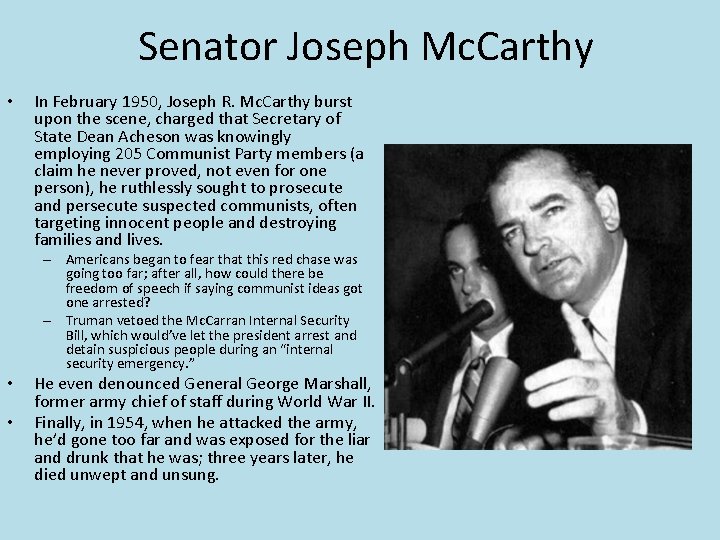
Senator Joseph Mc. Carthy • In February 1950, Joseph R. Mc. Carthy burst upon the scene, charged that Secretary of State Dean Acheson was knowingly employing 205 Communist Party members (a claim he never proved, not even for one person), he ruthlessly sought to prosecute and persecute suspected communists, often targeting innocent people and destroying families and lives. – Americans began to fear that this red chase was going too far; after all, how could there be freedom of speech if saying communist ideas got one arrested? – Truman vetoed the Mc. Carran Internal Security Bill, which would’ve let the president arrest and detain suspicious people during an “internal security emergency. ” • • He even denounced General George Marshall, former army chief of staff during World War II. Finally, in 1954, when he attacked the army, he’d gone too far and was exposed for the liar and drunk that he was; three years later, he died unwept and unsung.
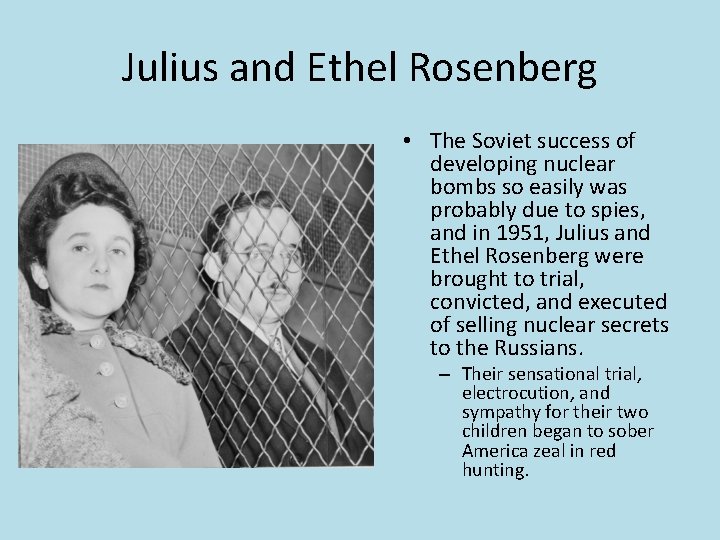
Julius and Ethel Rosenberg • The Soviet success of developing nuclear bombs so easily was probably due to spies, and in 1951, Julius and Ethel Rosenberg were brought to trial, convicted, and executed of selling nuclear secrets to the Russians. – Their sensational trial, electrocution, and sympathy for their two children began to sober America zeal in red hunting.
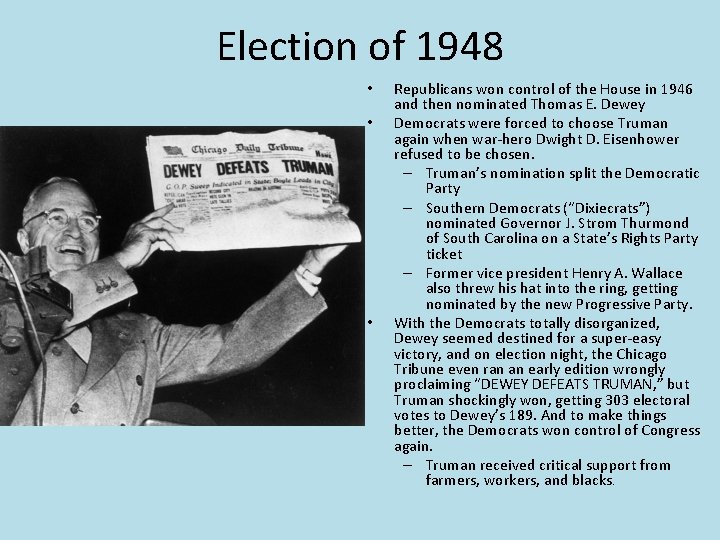
Election of 1948 • • • Republicans won control of the House in 1946 and then nominated Thomas E. Dewey Democrats were forced to choose Truman again when war-hero Dwight D. Eisenhower refused to be chosen. – Truman’s nomination split the Democratic Party – Southern Democrats (“Dixiecrats”) nominated Governor J. Strom Thurmond of South Carolina on a State’s Rights Party ticket – Former vice president Henry A. Wallace also threw his hat into the ring, getting nominated by the new Progressive Party. With the Democrats totally disorganized, Dewey seemed destined for a super-easy victory, and on election night, the Chicago Tribune even ran an early edition wrongly proclaiming “DEWEY DEFEATS TRUMAN, ” but Truman shockingly won, getting 303 electoral votes to Dewey’s 189. And to make things better, the Democrats won control of Congress again. – Truman received critical support from farmers, workers, and blacks.
Truman’s Second Term • Truman then called for a new program called “Point Four, ” which called for financial support of poor, underdeveloped lands in hopes of keeping underprivileged peoples from turning communist. • At home, Truman outlined a sweeping “Fair Deal” program, which called for improved housing, full employment, a higher minimum wage, better farm price supports, a new Tennessee Valley Authority, and an extension of Social Security. – However, the only successes came in raising the minimum wage, providing for public housing in the Housing Act of 1949, and extending old-age insurance to more beneficiaries with the Social Security Act of 1950.
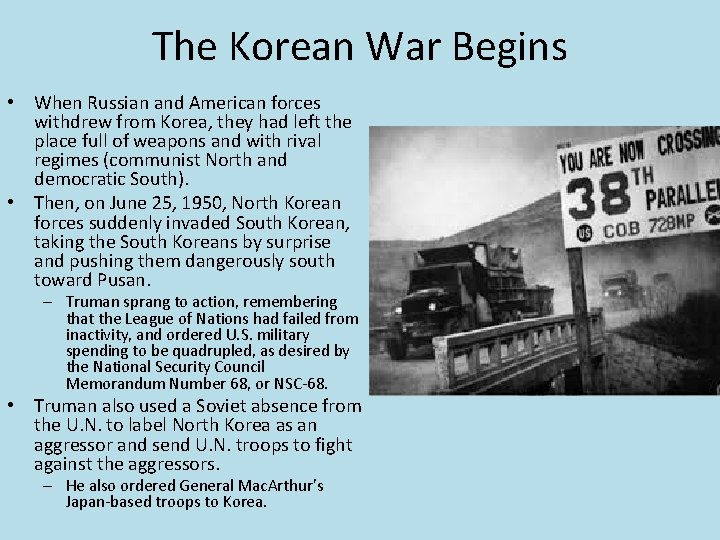
The Korean War Begins • When Russian and American forces withdrew from Korea, they had left the place full of weapons and with rival regimes (communist North and democratic South). • Then, on June 25, 1950, North Korean forces suddenly invaded South Korean, taking the South Koreans by surprise and pushing them dangerously south toward Pusan. – Truman sprang to action, remembering that the League of Nations had failed from inactivity, and ordered U. S. military spending to be quadrupled, as desired by the National Security Council Memorandum Number 68, or NSC-68. • Truman also used a Soviet absence from the U. N. to label North Korea as an aggressor and send U. N. troops to fight against the aggressors. – He also ordered General Mac. Arthur’s Japan-based troops to Korea.
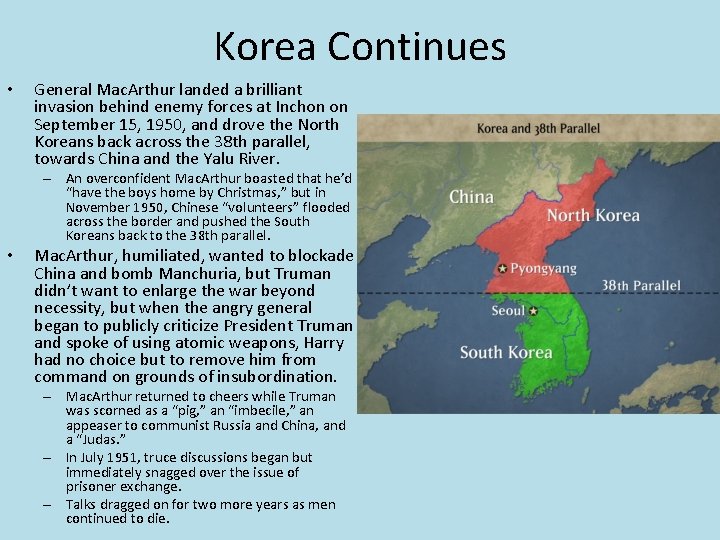
Korea Continues • General Mac. Arthur landed a brilliant invasion behind enemy forces at Inchon on September 15, 1950, and drove the North Koreans back across the 38 th parallel, towards China and the Yalu River. – An overconfident Mac. Arthur boasted that he’d “have the boys home by Christmas, ” but in November 1950, Chinese “volunteers” flooded across the border and pushed the South Koreans back to the 38 th parallel. • Mac. Arthur, humiliated, wanted to blockade China and bomb Manchuria, but Truman didn’t want to enlarge the war beyond necessity, but when the angry general began to publicly criticize President Truman and spoke of using atomic weapons, Harry had no choice but to remove him from command on grounds of insubordination. – Mac. Arthur returned to cheers while Truman was scorned as a “pig, ” an “imbecile, ” an appeaser to communist Russia and China, and a “Judas. ” – In July 1951, truce discussions began but immediately snagged over the issue of prisoner exchange. – Talks dragged on for two more years as men continued to die.
- Slides: 24