
Chapter 36 Skeletal and Muscular Systems Skeletal System
- Slides: 10
Chapter 36 Skeletal and Muscular Systems
Skeletal System: 4 Basic Functions �Supports body �Provides protection of internal organs EX: Brain encased by skull, heart and lungs encased by ribs �Site of blood cell formation Mostly red blood cells with a few white blood cell types and platelets �Stores minerals Ex: Calcium (Ca 2+, PO 43 -)
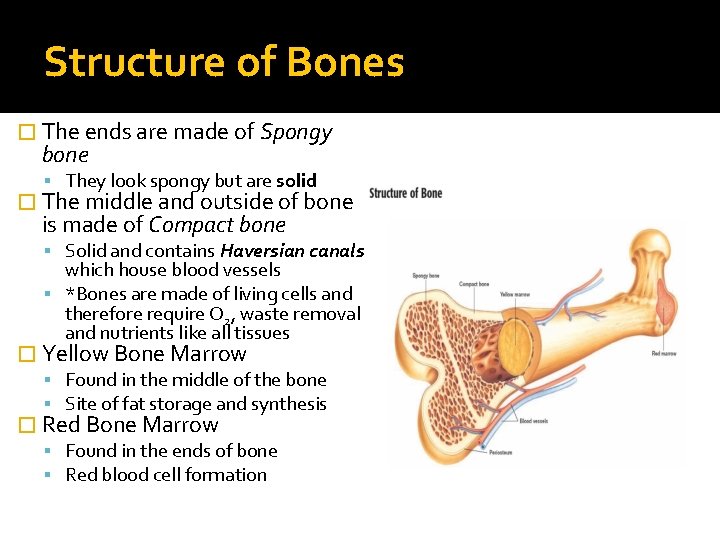
Structure of Bones � The ends are made of Spongy bone They look spongy but are solid � The middle and outside of bone is made of Compact bone Solid and contains Haversian canals which house blood vessels *Bones are made of living cells and therefore require O 2, waste removal and nutrients like all tissues � Yellow Bone Marrow Found in the middle of the bone Site of fat storage and synthesis � Red Bone Marrow Found in the ends of bone Red blood cell formation
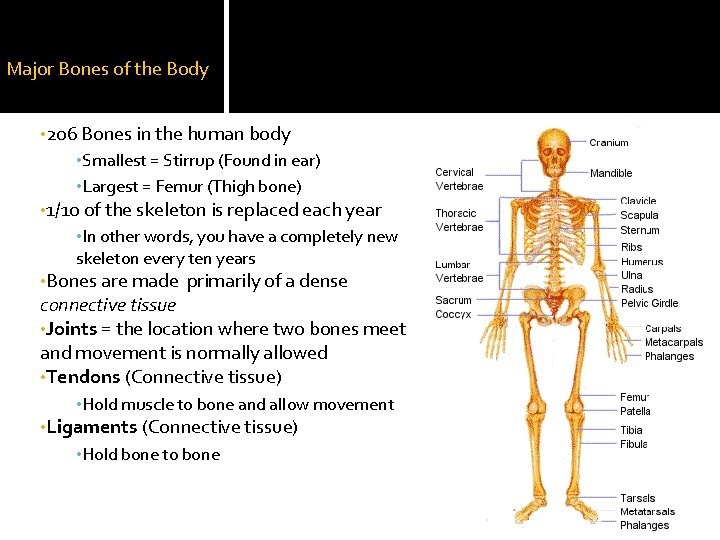
Major Bones of the Body • 206 Bones in the human body • Smallest = Stirrup (Found in ear) • Largest = Femur (Thigh bone) • 1/10 of the skeleton is replaced each year • In other words, you have a completely new skeleton every ten years • Bones are made primarily of a dense connective tissue • Joints = the location where two bones meet and movement is normally allowed • Tendons (Connective tissue) • Hold muscle to bone and allow movement • Ligaments (Connective tissue) • Hold bone to bone
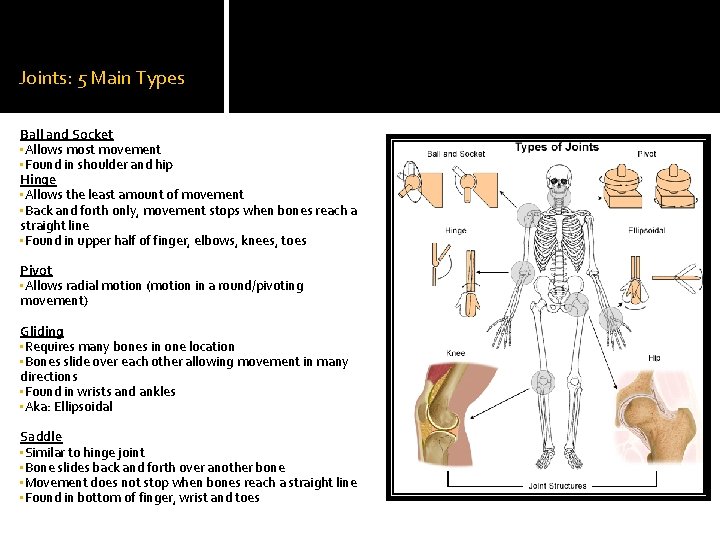
Joints: 5 Main Types Ball and Socket • Allows most movement • Found in shoulder and hip Hinge • Allows the least amount of movement • Back and forth only, movement stops when bones reach a straight line • Found in upper half of finger, elbows, knees, toes Pivot • Allows radial motion (motion in a round/pivoting movement) Gliding • Requires many bones in one location • Bones slide over each other allowing movement in many directions • Found in wrists and ankles • Aka: Ellipsoidal Saddle • Similar to hinge joint • Bone slides back and forth over another bone • Movement does not stop when bones reach a straight line • Found in bottom of finger, wrist and toes
Muscular System: 3 Types of Muscle �Skeletal Muscle A. k. a: Striated Muscle (striped muscle) Under voluntary control �Smooth Muscle A. k. a: Visceral Muscle Under involuntary control �Cardiac Muscle Under involuntary control
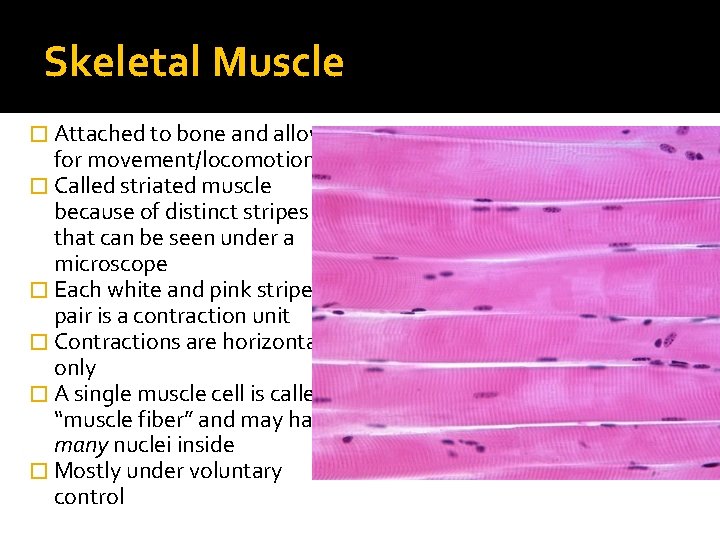
Skeletal Muscle � Attached to bone and allows for movement/locomotion � Called striated muscle because of distinct stripes that can be seen under a microscope � Each white and pink stripe pair is a contraction unit � Contractions are horizontal only � A single muscle cell is called a “muscle fiber” and may have many nuclei inside � Mostly under voluntary control
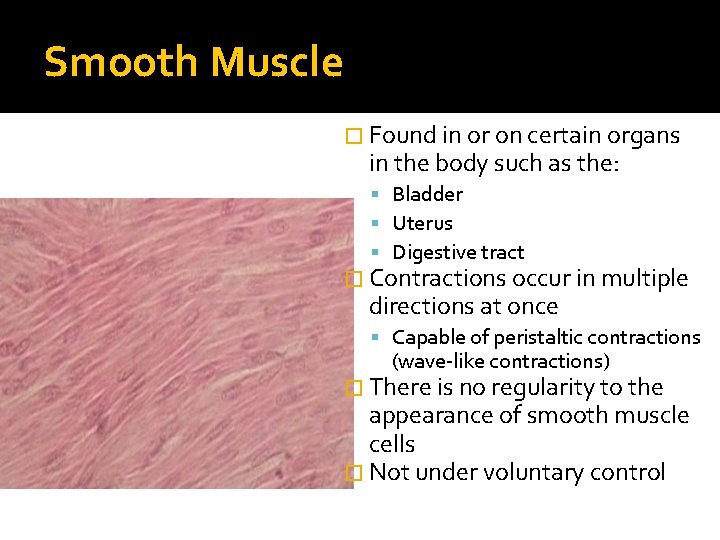
Smooth Muscle � Found in or on certain organs in the body such as the: Bladder Uterus Digestive tract � Contractions occur in multiple directions at once Capable of peristaltic contractions (wave-like contractions) � There is no regularity to the appearance of smooth muscle cells � Not under voluntary control
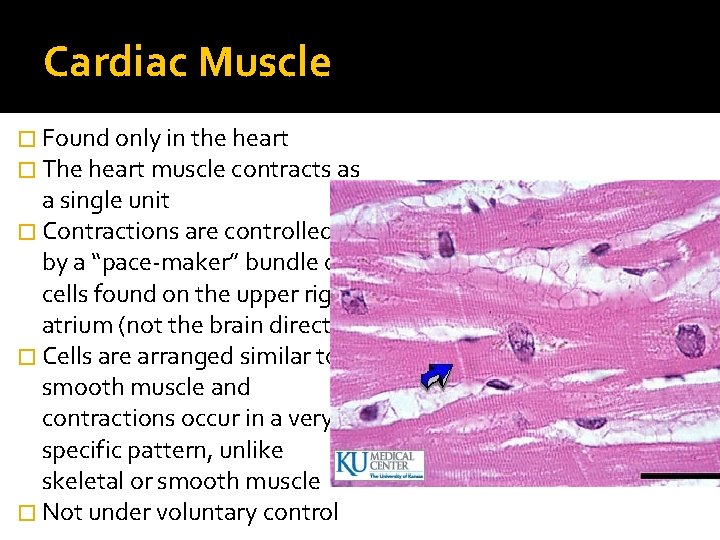
Cardiac Muscle � Found only in the heart � The heart muscle contracts as a single unit � Contractions are controlled by a “pace-maker” bundle of cells found on the upper right atrium (not the brain directly) � Cells are arranged similar to smooth muscle and contractions occur in a very specific pattern, unlike skeletal or smooth muscle � Not under voluntary control
Muscle Contractions �Contractions are triggered when a surge of calcium enters a muscle cell. After that… �ATP binds to the proteins in the muscle. As energy is release and ATP is turned into ADP (by breaking off a phosphate) the proteins in the muscle ratchet closer together �The muscle relaxes when the spent ADP molecules are released from the muscle proteins �In order for a muscle to contract, thousands of ATP molecules must be used at the same time in a single muscle fiber (cell)