
Chapter 36 Population Dynamics Power Point Lectures for

- Slides: 30
Chapter 36 Population Dynamics Power. Point Lectures for Biology: Concepts and Connections, Fifth Edition – Campbell, Reece, Taylor, and Simon Lectures by Chris Romero Copyright © 2005 Pearson Education, Inc. Publishing as Benjamin Cummings
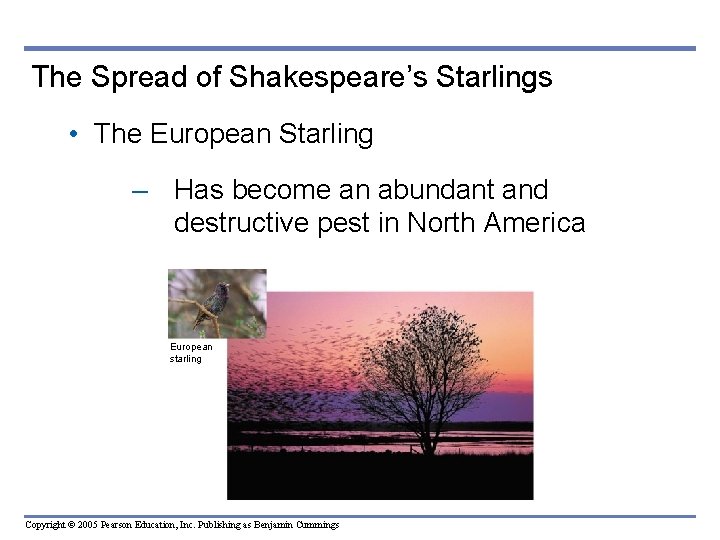
The Spread of Shakespeare’s Starlings • The European Starling – Has become an abundant and destructive pest in North America European starling Copyright © 2005 Pearson Education, Inc. Publishing as Benjamin Cummings
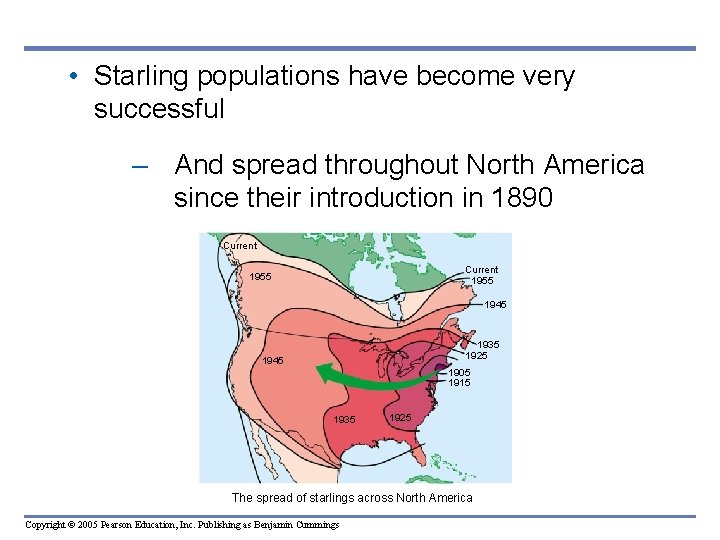
• Starling populations have become very successful – And spread throughout North America since their introduction in 1890 Current 1955 1945 1935 1925 1945 1905 1915 1935 1925 The spread of starlings across North America Copyright © 2005 Pearson Education, Inc. Publishing as Benjamin Cummings
• Population ecology – Is concerned with changes in population size and the factors that regulate populations over time Copyright © 2005 Pearson Education, Inc. Publishing as Benjamin Cummings
36. 1 Population ecology is the study of how and why populations change • A population – Is a group of individuals of a single species that occupy the same general area Copyright © 2005 Pearson Education, Inc. Publishing as Benjamin Cummings
POPULATION STRUCTURE AND DYNAMICS 36. 2 Density and dispersion patterns are important population variables • Population density – Is the number of individuals of a species per unit of area or volume Copyright © 2005 Pearson Education, Inc. Publishing as Benjamin Cummings
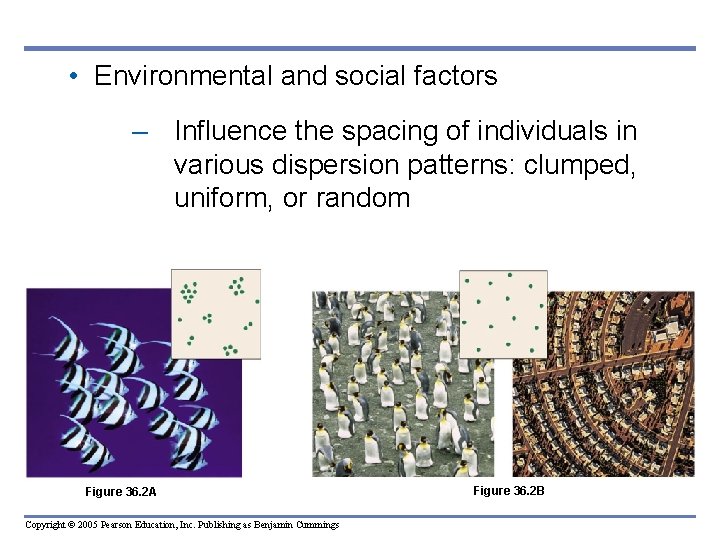
• Environmental and social factors – Influence the spacing of individuals in various dispersion patterns: clumped, uniform, or random Figure 36. 2 A Copyright © 2005 Pearson Education, Inc. Publishing as Benjamin Cummings Figure 36. 2 B
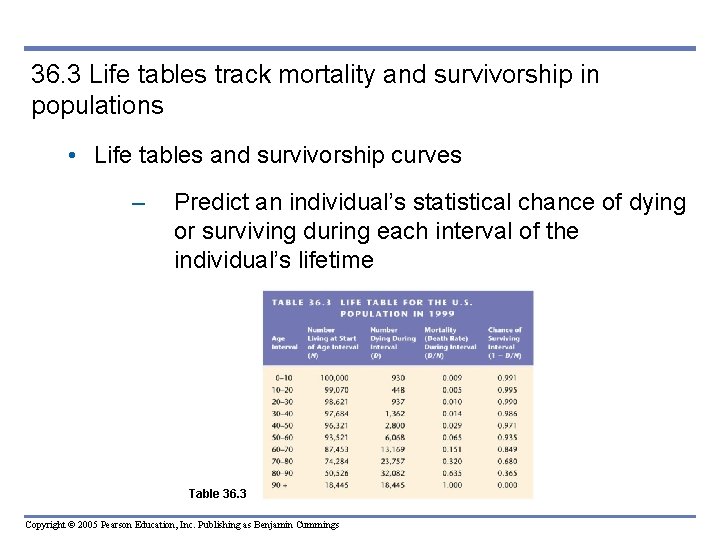
36. 3 Life tables track mortality and survivorship in populations • Life tables and survivorship curves – Predict an individual’s statistical chance of dying or surviving during each interval of the individual’s lifetime Table 36. 3 Copyright © 2005 Pearson Education, Inc. Publishing as Benjamin Cummings
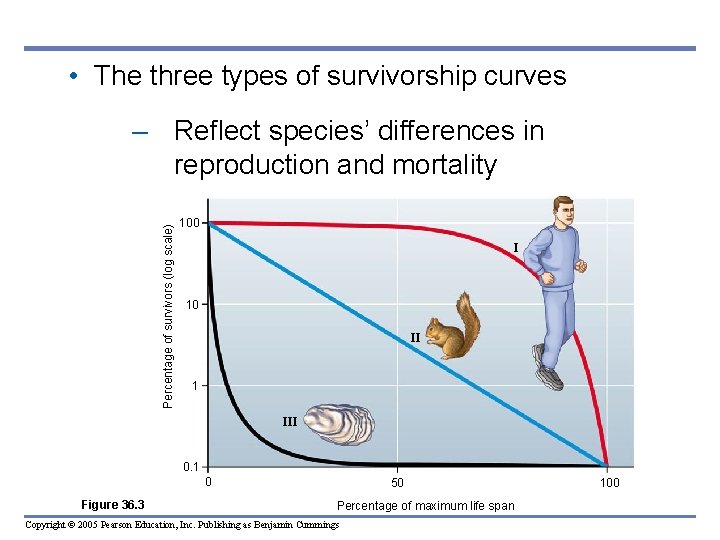
• The three types of survivorship curves Percentage of survivors (log scale) – Reflect species’ differences in reproduction and mortality 100 I 10 II 1 III 0. 1 0 Figure 36. 3 50 Percentage of maximum life span Copyright © 2005 Pearson Education, Inc. Publishing as Benjamin Cummings 100
36. 4 Idealized models help us understand population growth Copyright © 2005 Pearson Education, Inc. Publishing as Benjamin Cummings
The Exponential Growth Model • Exponential growth – Is the accelerating increase that occurs when growth is unlimited Copyright © 2005 Pearson Education, Inc. Publishing as Benjamin Cummings
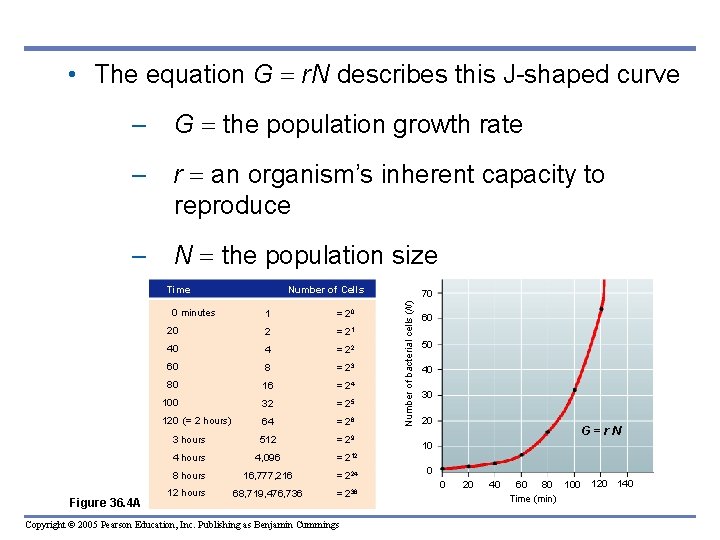
• The equation G r. N describes this J-shaped curve – G the population growth rate – r an organism’s inherent capacity to reproduce – N the population size 0 minutes Figure 36. 4 A Number of Cells 1 = 20 20 2 = 21 40 4 = 22 60 8 = 23 80 16 = 24 100 32 = 25 120 (= 2 hours) 64 = 26 3 hours 512 = 29 4 hours 4, 096 = 212 8 hours 16, 777, 216 = 224 12 hours 68, 719, 476, 736 = 236 Copyright © 2005 Pearson Education, Inc. Publishing as Benjamin Cummings 70 Number of bacterial cells (N) Time 60 50 40 30 20 G=r. N 10 0 0 20 40 60 80 100 Time (min) 120 140
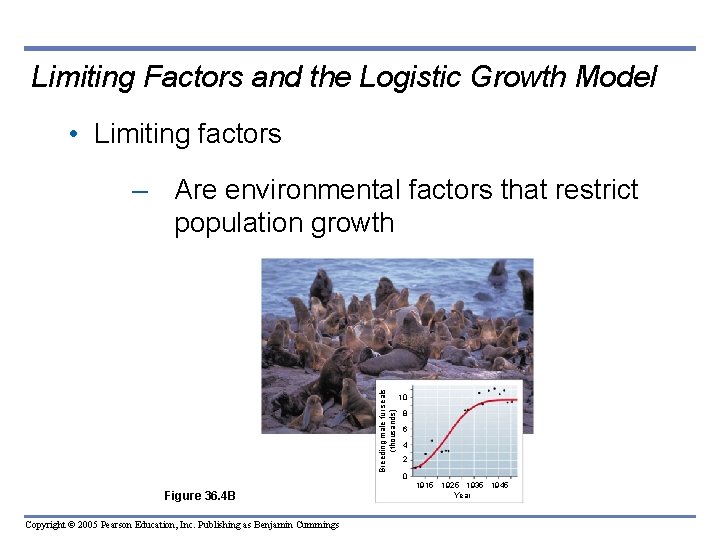
Limiting Factors and the Logistic Growth Model • Limiting factors Breeding male fur seals (thousands) – Are environmental factors that restrict population growth Figure 36. 4 B Copyright © 2005 Pearson Education, Inc. Publishing as Benjamin Cummings 10 8 6 4 2 0 1915 1925 1935 1945 Year
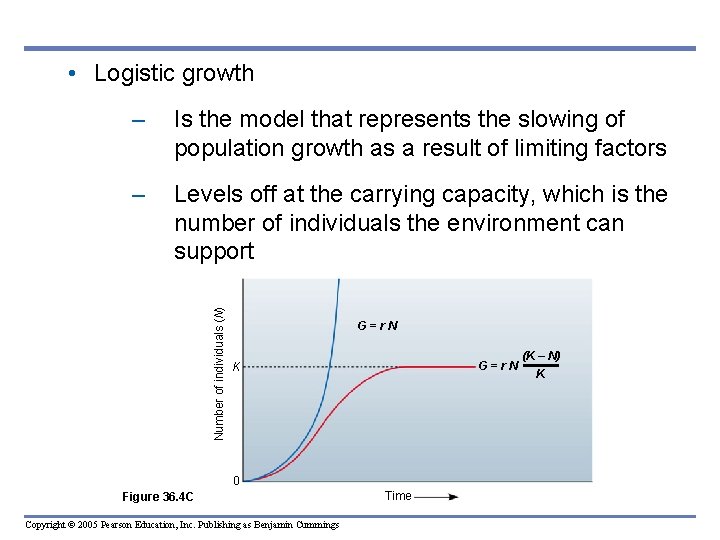
• Logistic growth Is the model that represents the slowing of population growth as a result of limiting factors – Levels off at the carrying capacity, which is the number of individuals the environment can support Number of individuals (N) – G=r. N K 0 Figure 36. 4 C Copyright © 2005 Pearson Education, Inc. Publishing as Benjamin Cummings Time (K – N) K
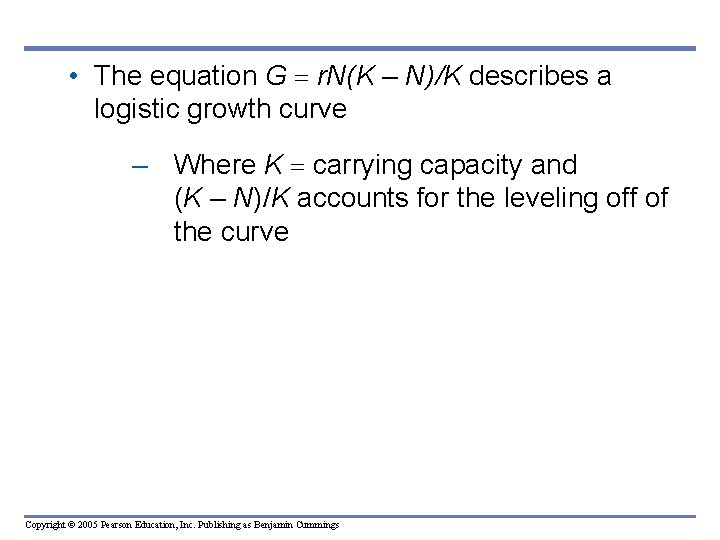
• The equation G r. N(K – N)/K describes a logistic growth curve – Where K carrying capacity and (K – N)/K accounts for the leveling off of the curve Copyright © 2005 Pearson Education, Inc. Publishing as Benjamin Cummings
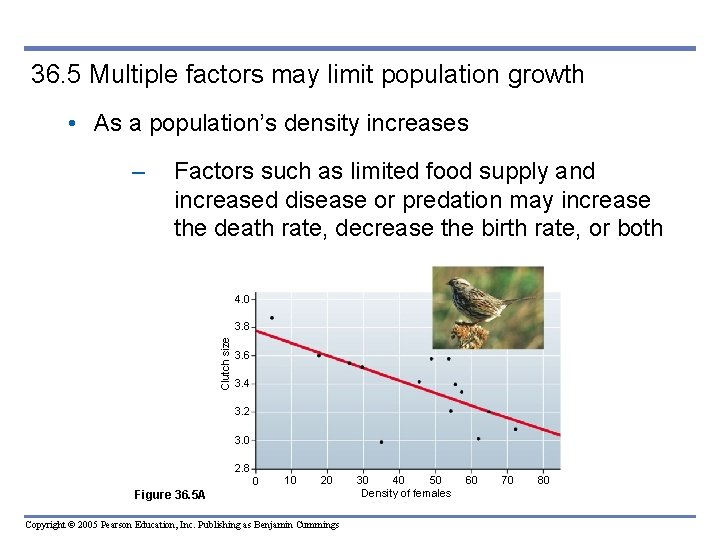
36. 5 Multiple factors may limit population growth • As a population’s density increases – Factors such as limited food supply and increased disease or predation may increase the death rate, decrease the birth rate, or both 4. 0 Clutch size 3. 8 3. 6 3. 4 3. 2 3. 0 2. 8 0 10 20 Figure 36. 5 A Copyright © 2005 Pearson Education, Inc. Publishing as Benjamin Cummings 30 40 50 Density of females 60 70 80
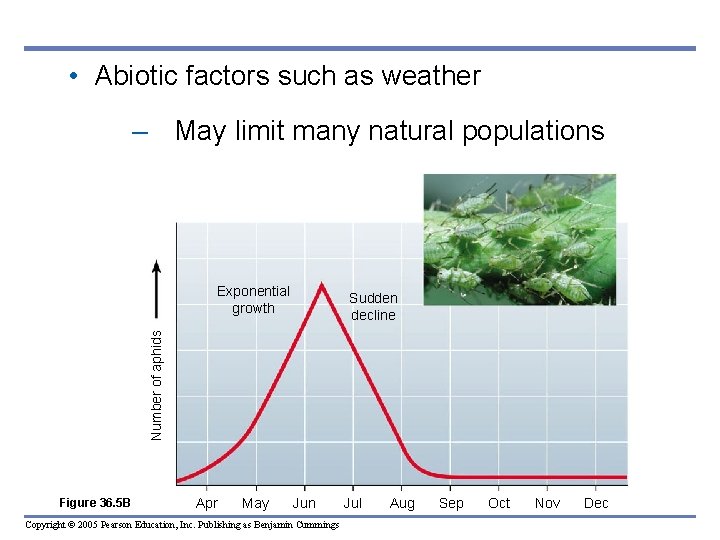
• Abiotic factors such as weather – May limit many natural populations Exponential growth Number of aphids Sudden decline Figure 36. 5 B Apr May Jun Copyright © 2005 Pearson Education, Inc. Publishing as Benjamin Cummings Jul Aug Sep Oct Nov Dec
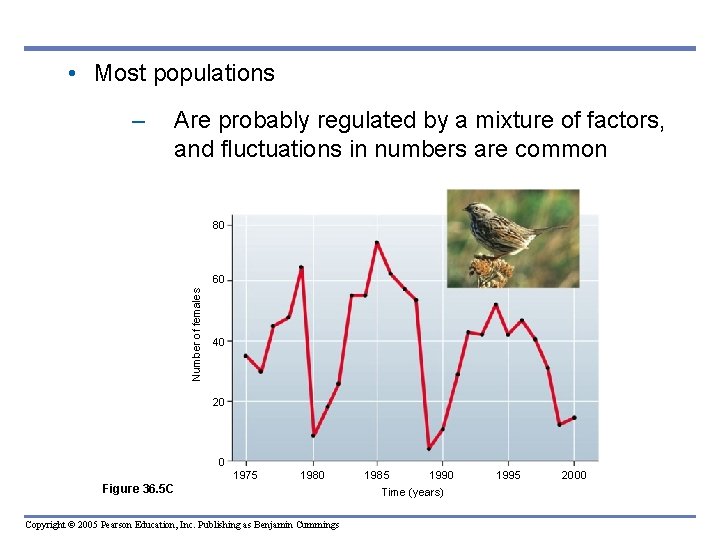
• Most populations – Are probably regulated by a mixture of factors, and fluctuations in numbers are common 80 Number of females 60 40 20 0 1975 1980 Figure 36. 5 C Copyright © 2005 Pearson Education, Inc. Publishing as Benjamin Cummings 1985 1990 Time (years) 1995 2000
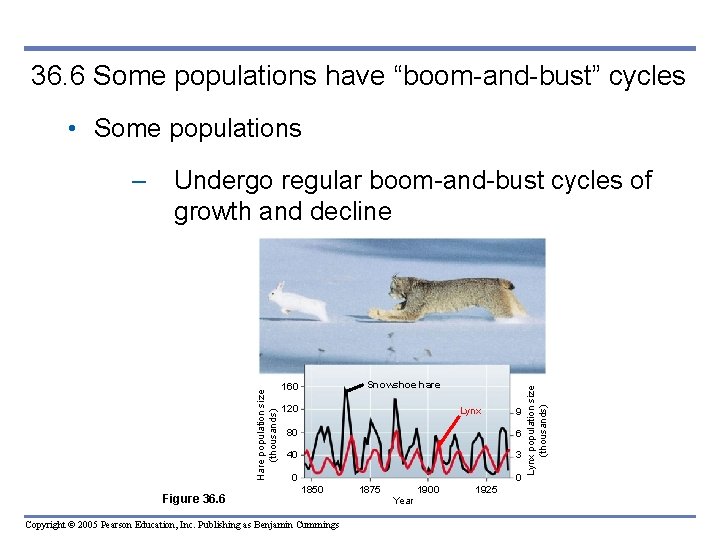
36. 6 Some populations have “boom-and-bust” cycles • Some populations Figure 36. 6 Snowshoe hare 160 120 Lynx 9 80 6 40 3 0 0 1850 Copyright © 2005 Pearson Education, Inc. Publishing as Benjamin Cummings 1875 1900 Year 1925 Lynx population size (thousands) Undergo regular boom-and-bust cycles of growth and decline Hare population size (thousands) –
LIFE HISTORIES AND THEIR EVOLUTION 36. 7 Evolution shapes life histories • An organism’s life history – Is the series of events from birth through reproduction to death Copyright © 2005 Pearson Education, Inc. Publishing as Benjamin Cummings
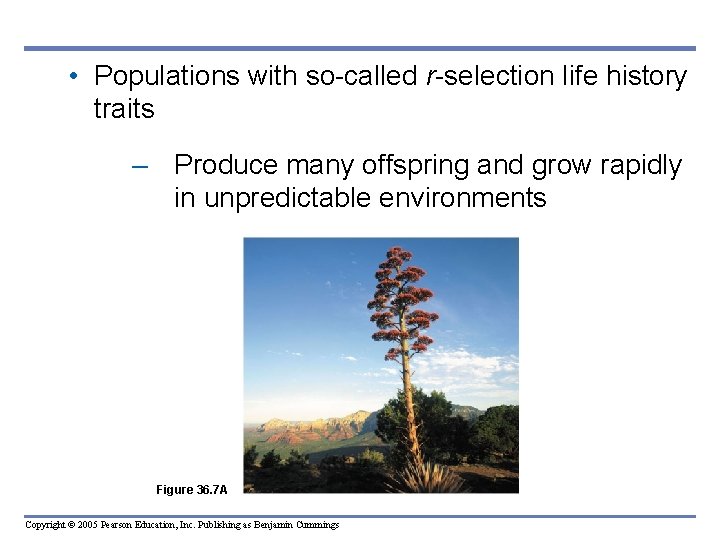
• Populations with so-called r-selection life history traits – Produce many offspring and grow rapidly in unpredictable environments Figure 36. 7 A Copyright © 2005 Pearson Education, Inc. Publishing as Benjamin Cummings
• Populations with K-selected traits – Raise few offspring and maintain relatively stable populations Copyright © 2005 Pearson Education, Inc. Publishing as Benjamin Cummings
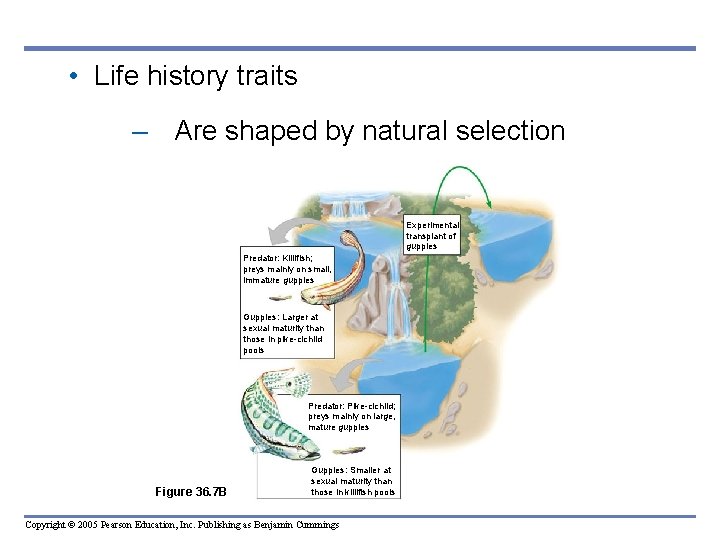
• Life history traits – Are shaped by natural selection Experimental transplant of guppies Predator: Killifish; preys mainly on small, immature guppies Guppies: Larger at sexual maturity than those in pike-cichlid pools Predator: Pike-cichlid; preys mainly on large, mature guppies Figure 36. 7 B Guppies: Smaller at sexual maturity than those in killifish pools Copyright © 2005 Pearson Education, Inc. Publishing as Benjamin Cummings
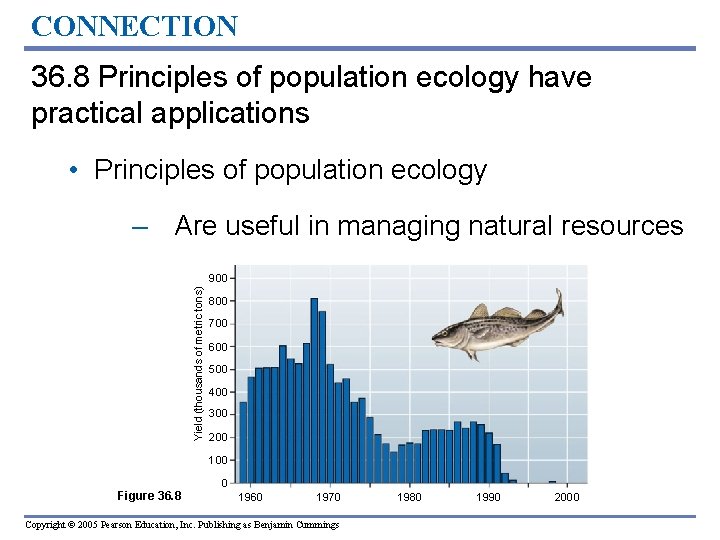
CONNECTION 36. 8 Principles of population ecology have practical applications • Principles of population ecology – Are useful in managing natural resources Yield (thousands of metric tons) 900 800 700 600 500 400 300 200 100 0 Figure 36. 8 1960 1970 Copyright © 2005 Pearson Education, Inc. Publishing as Benjamin Cummings 1980 1990 2000
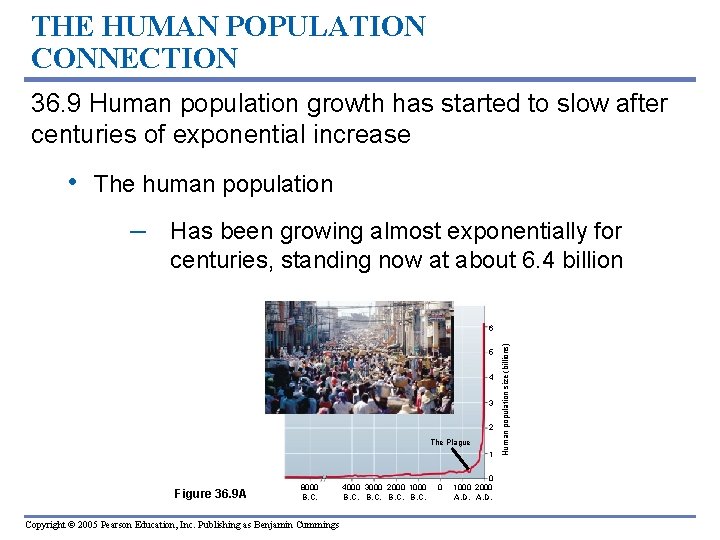
THE HUMAN POPULATION CONNECTION 36. 9 Human population growth has started to slow after centuries of exponential increase • The human population – Has been growing almost exponentially for centuries, standing now at about 6. 4 billion 5 4 3 2 The Plague 1 Figure 36. 9 A 8000 B. C. Copyright © 2005 Pearson Education, Inc. Publishing as Benjamin Cummings 4000 3000 2000 1000 B. C. 0 0 1000 2000 A. D. Human population size (billions) 6
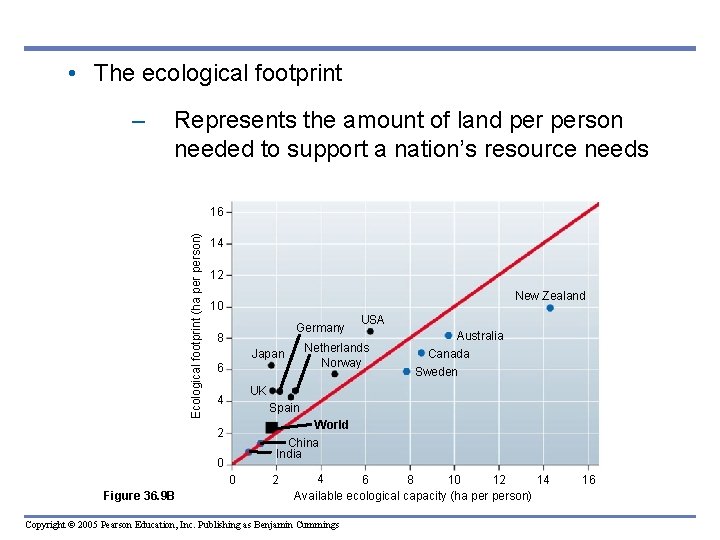
• The ecological footprint – Represents the amount of land person needed to support a nation’s resource needs Ecological footprint (ha person) 16 14 12 New Zealand 10 Germany 8 Netherlands Norway Japan 6 Australia Canada Sweden UK 4 Spain World China India 2 0 0 Figure 36. 9 B USA 2 4 6 8 10 12 14 Available ecological capacity (ha person) Copyright © 2005 Pearson Education, Inc. Publishing as Benjamin Cummings 16
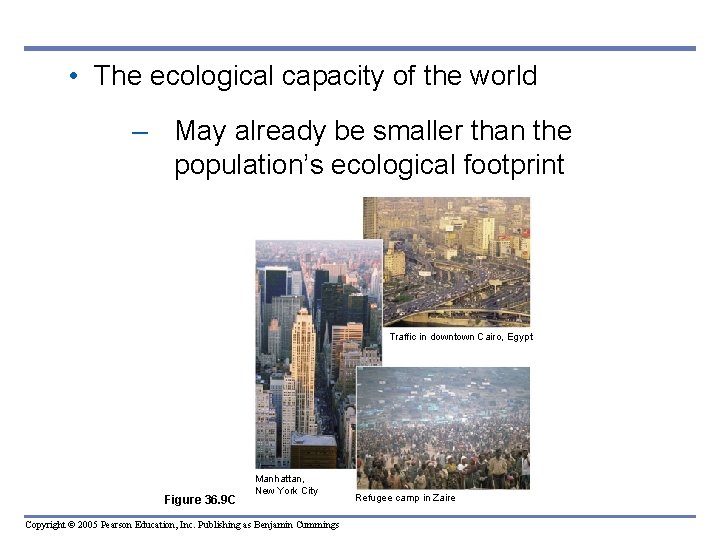
• The ecological capacity of the world – May already be smaller than the population’s ecological footprint Traffic in downtown Cairo, Egypt Figure 36. 9 C Manhattan, New York City Copyright © 2005 Pearson Education, Inc. Publishing as Benjamin Cummings Refugee camp in Zaire
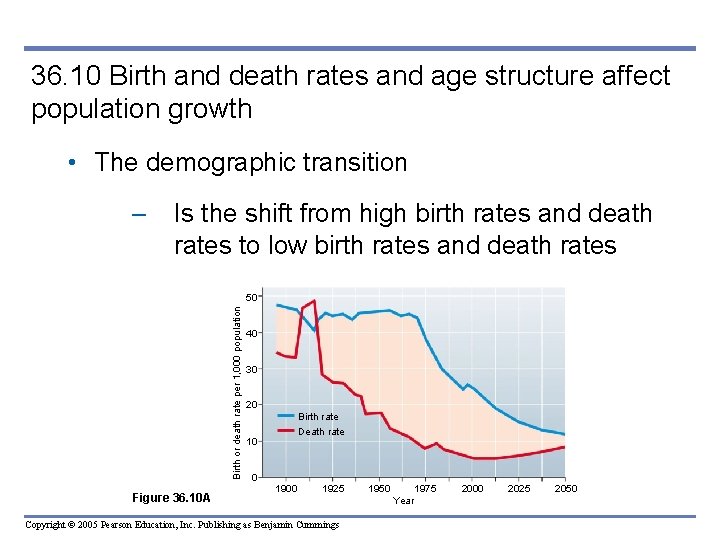
36. 10 Birth and death rates and age structure affect population growth • The demographic transition – Is the shift from high birth rates and death rates to low birth rates and death rates Birth or death rate per 1, 000 population 50 Figure 36. 10 A 40 30 20 Birth rate Death rate 10 0 1900 1925 Copyright © 2005 Pearson Education, Inc. Publishing as Benjamin Cummings 1950 1975 Year 2000 2025 2050
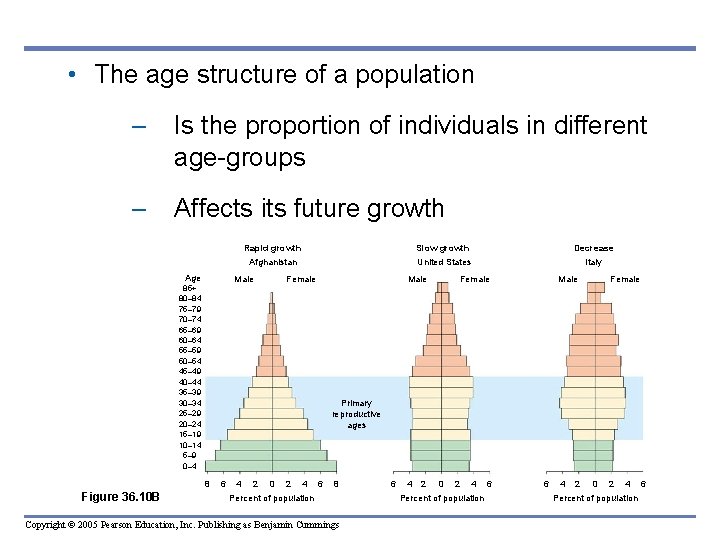
• The age structure of a population – Is the proportion of individuals in different age-groups – Affects its future growth Age Slow growth Decrease Afghanistan United States Italy Male 85+ 80– 84 75– 79 70– 74 65– 69 60– 64 55– 59 50– 54 45– 49 40– 44 35– 39 30– 34 25– 29 20– 24 15– 19 10– 14 5– 9 0– 4 Female Male Female Primary reproductive ages 8 Figure 36. 10 B Rapid growth 6 4 2 0 2 4 6 Percent of population 8 Copyright © 2005 Pearson Education, Inc. Publishing as Benjamin Cummings 6 4 2 0 2 4 6 Percent of population 6 4 2 0 2 4 Percent of population 6
• Increasing the status of women – May help to reduce family size Copyright © 2005 Pearson Education, Inc. Publishing as Benjamin Cummings