
Chapter 36 Introduction to the Bakeshop Objective Explain
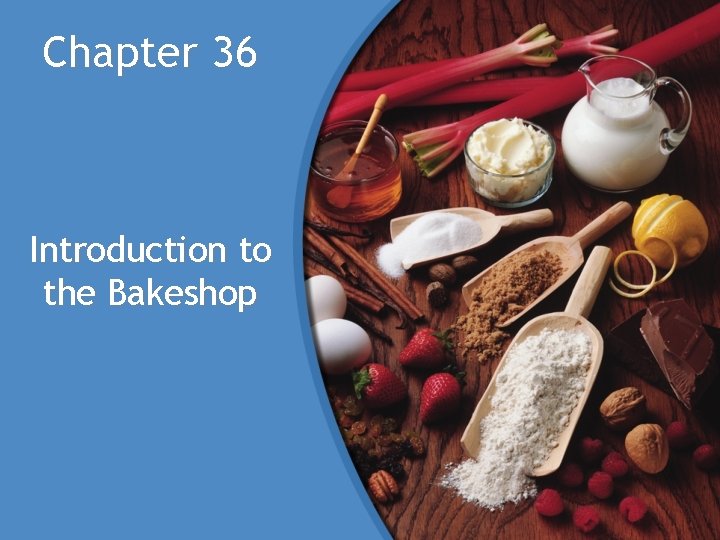
Chapter 36 Introduction to the Bakeshop
Objective • Explain various jobs in the bakeshop © Goodheart-Willcox Co. , Inc.
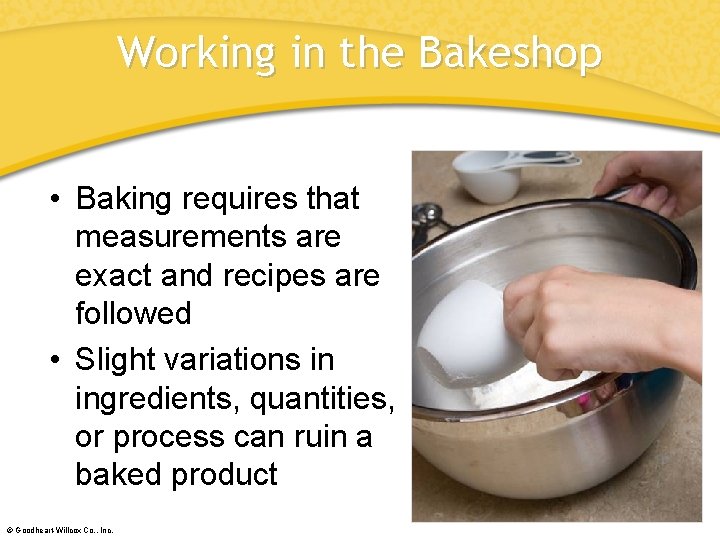
Working in the Bakeshop • Baking requires that measurements are exact and recipes are followed • Slight variations in ingredients, quantities, or process can ruin a baked product © Goodheart-Willcox Co. , Inc.
Working in the Bakeshop • Operations that prepare their own baked goods have a work area and schedule for bakeshop different from the rest of the kitchen • Pastry cooks and bakers work under the supervision of the pastry chef © Goodheart-Willcox Co. , Inc.
Working in the Bakeshop • Large pastry kitchens may have staff that specialize in particular tasks • All professional culinarians should have basic skills in baking and pastry techniques © Goodheart-Willcox Co. , Inc.

Objective • Recognize baking ingredients and understand their functions in baked goods © Goodheart-Willcox Co. , Inc.
Bakeshop Ingredients • The amount and type of ingredients is more important in baking and pastry work than other areas of the kitchen • Minor variations in ingredients can create noticeable differences in the finished product © Goodheart-Willcox Co. , Inc.
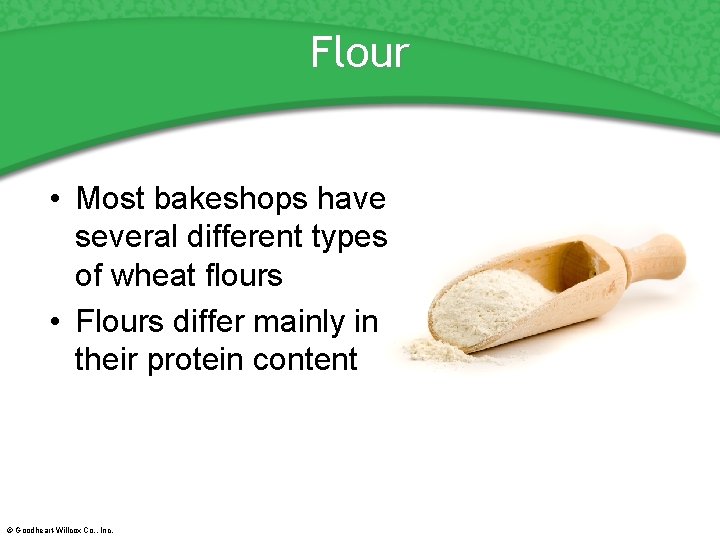
Flour • Most bakeshops have several different types of wheat flours • Flours differ mainly in their protein content © Goodheart-Willcox Co. , Inc.
Flour • When flour is mixed with water, the protein in the flour produces gluten • Strands of gluten stretch and trap gases that create the spongy texture of breads and cakes © Goodheart-Willcox Co. , Inc.
Flour • Wheat flours are categorized by their gluten potential – Hard flours: higher protein content – Soft flours: lower protein content • The amount of protein is directly related to gluten content © Goodheart-Willcox Co. , Inc.
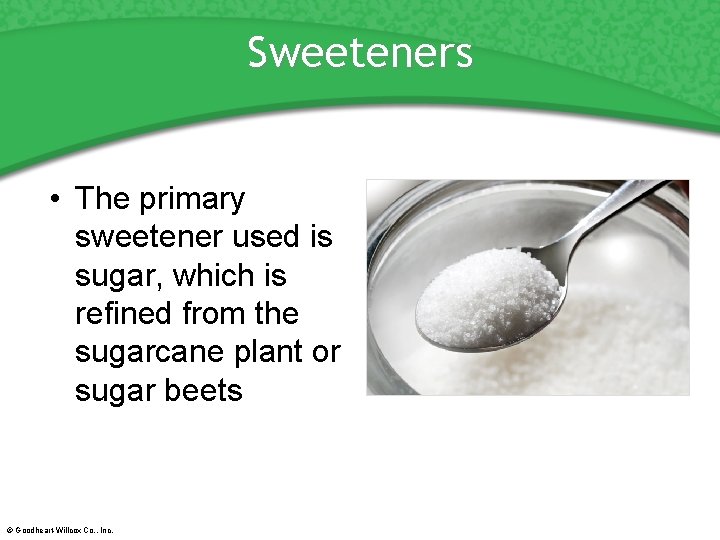
Sweeteners • The primary sweetener used is sugar, which is refined from the sugarcane plant or sugar beets © Goodheart-Willcox Co. , Inc.
Sweeteners • In addition to adding a sweet taste, sugar – helps maintain moistness in cakes – assists with the leavening process in breads – lends crispness to cookies and pastries – is key to browning and caramelization © Goodheart-Willcox Co. , Inc.
Sweeteners • Another sweetener often made in large batches in a pastry shop is simple syrup • It has many uses including moistening cakes and poaching fruits • Other sweeteners are used in the bakeshop such as molasses, honey, and corn syrup © Goodheart-Willcox Co. , Inc.
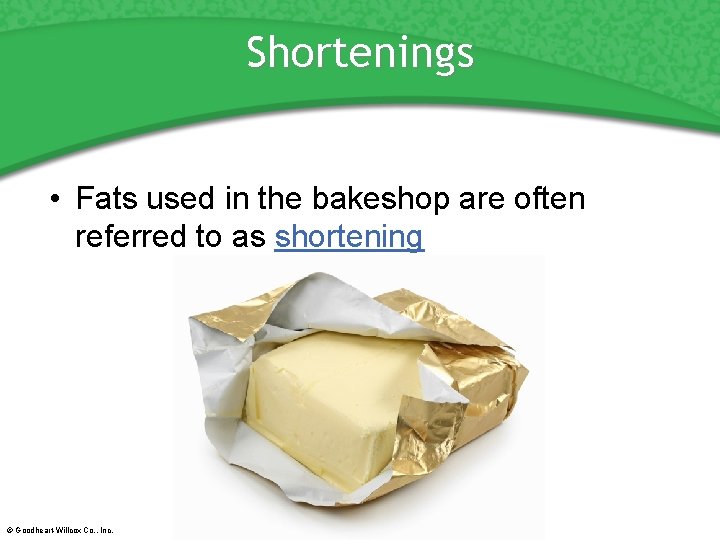
Shortenings • Fats used in the bakeshop are often referred to as shortening © Goodheart-Willcox Co. , Inc.
Shortenings • Add flavor, color, moisture, and richness to baked products • Some add flakiness to products and assist with leavening • Shortenings can be either solid or liquid © Goodheart-Willcox Co. , Inc.
Shortenings • The source for shortenings can be either animal or vegetable – Animal shortenings: butter, lard, and blends using rendered beef fat; are solid at room temperature – Vegetable-based shortenings: made from soybean, corn, coconut, and other refined vegetable oils; may be solid or liquid © Goodheart-Willcox Co. , Inc.

Shortenings • A shortening is chosen for a given application based on its melting point and nutritional content • Hydrogenation incorporates hydrogen into the oil making it solid © Goodheart-Willcox Co. , Inc.
Shortenings • Hydrogenated vegetable shortenings have a longer shelf life because of the hydrogenation process • Margarine is a hydrogenated vegetable shortening flavored to serve as a substitute for butter © Goodheart-Willcox Co. , Inc.
Leavening Agents • In order for leavening to happen, a leavening agent in the dough must cause a reaction, which creates a gas • Two types of leavening agents are used in baking – Chemical leaveners – Yeasts © Goodheart-Willcox Co. , Inc.
Chemical Leaveners • When baking soda is mixed with moisture and acid, it releases carbon dioxide gas, which becomes trapped in the dough • When the dough is heated, the carbon dioxide gas expands, causing the dough to rise © Goodheart-Willcox Co. , Inc.
Chemical Leaveners • Milk, buttermilk, cocoa, molasses, cream of tartar, and many other ingredients can provide the acid needed for baking soda to produce gas • Only moisture provided by dough ingredients is needed for baking powder to produce carbon dioxide gas © Goodheart-Willcox Co. , Inc.
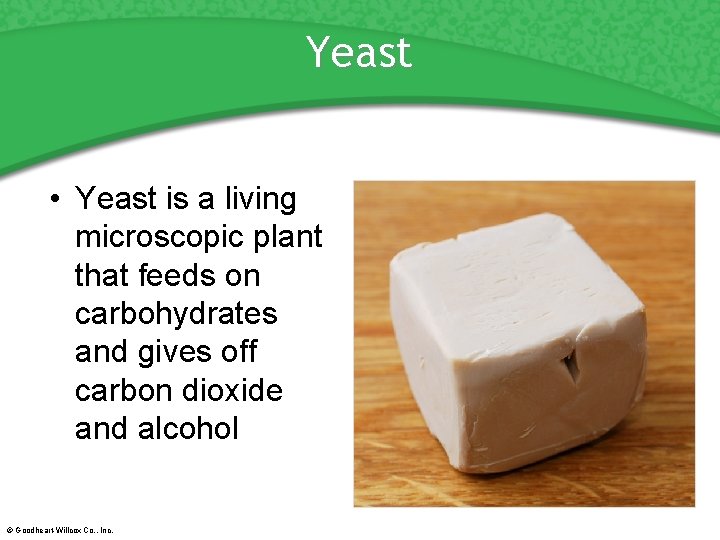
Yeast • Yeast is a living microscopic plant that feeds on carbohydrates and gives off carbon dioxide and alcohol © Goodheart-Willcox Co. , Inc.
Yeast • The fermentation process happens most quickly at 90 F– 110 F (32 C– 43 C) • Eventually the higher temperatures during baking kill the yeast © Goodheart-Willcox Co. , Inc.
Yeast • Two forms of yeast are common in the bakeshop – Compressed – Dry (active dry yeast or instant dry yeast) © Goodheart-Willcox Co. , Inc.
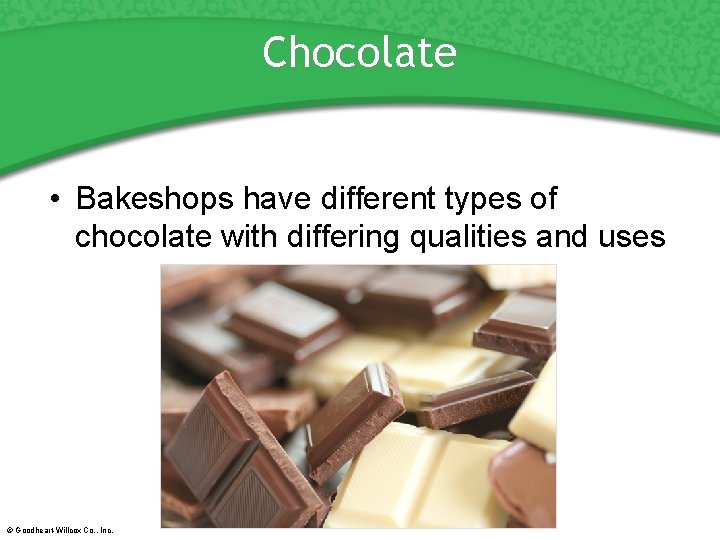
Chocolate • Bakeshops have different types of chocolate with differing qualities and uses © Goodheart-Willcox Co. , Inc.
Chocolate • Quality is measured by flavor, smell, appearance, texture, and melting point • Chocolate products are categorized and rated by the amount of chocolate liquor they contain • Chocolate liquor (nonalcoholic) is composed of cocoa solids and fat called cocoa butter © Goodheart-Willcox Co. , Inc.
Chocolate • Sugar, vanilla, milk solids, and other flavorings are commonly added to chocolate products • Chocolate should be stored covered or wrapped, in a cool dry place • Chocolate that is improperly stored can develop a white film on its surface © Goodheart-Willcox Co. , Inc.
Gelatin • Used to thicken various sweet and savory preparations • Pastry chefs use two types of gelatin— sheet and powdered © Goodheart-Willcox Co. , Inc.
Gelatin • The first step when using gelatin is blooming – To bloom sheet gelatin, cover sheets in cold water until they become soft, remove from water and squeeze to remove excess water – To bloom powdered gelatin, mix with roughly four times its weight in cold water and let sit until it loses its white appearance © Goodheart-Willcox Co. , Inc.
Gelatin • In the second step, the bloomed gelatin is melted or dissolved in a small amount of liquid and carefully added to the recipe © Goodheart-Willcox Co. , Inc.
Nuts and Seeds • Store nuts in tightly sealed containers in a cool dark place or freezer • Nuts can be purchased – whole in the shell, shelled whole nuts, halves, pieces, chopped, or ground – raw, roasted, blanched, or roasted and salted © Goodheart-Willcox Co. , Inc.
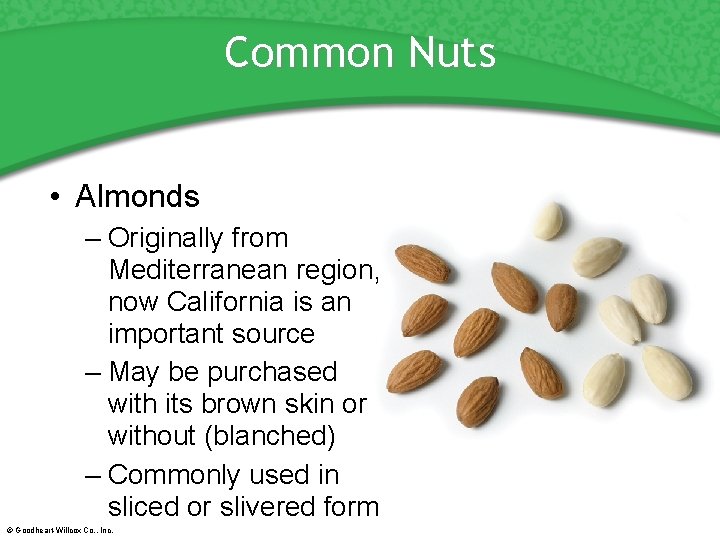
Common Nuts • Almonds – Originally from Mediterranean region, now California is an important source – May be purchased with its brown skin or without (blanched) – Commonly used in sliced or slivered form © Goodheart-Willcox Co. , Inc.
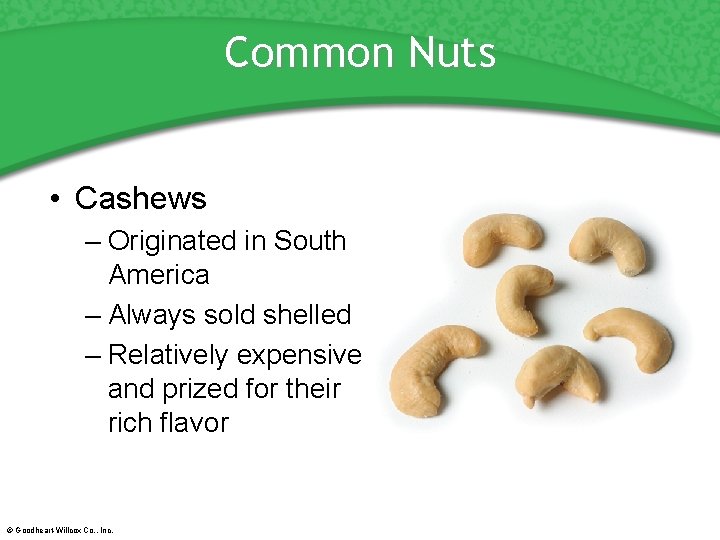
Common Nuts • Cashews – Originated in South America – Always sold shelled – Relatively expensive and prized for their rich flavor © Goodheart-Willcox Co. , Inc.
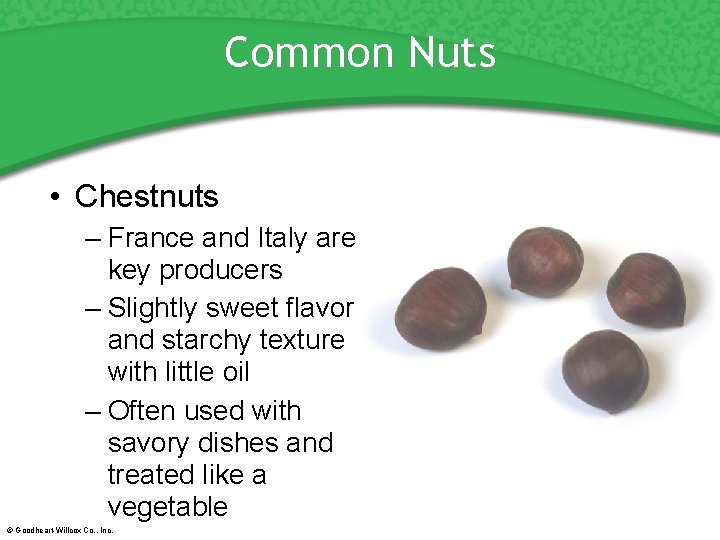
Common Nuts • Chestnuts – France and Italy are key producers – Slightly sweet flavor and starchy texture with little oil – Often used with savory dishes and treated like a vegetable © Goodheart-Willcox Co. , Inc.
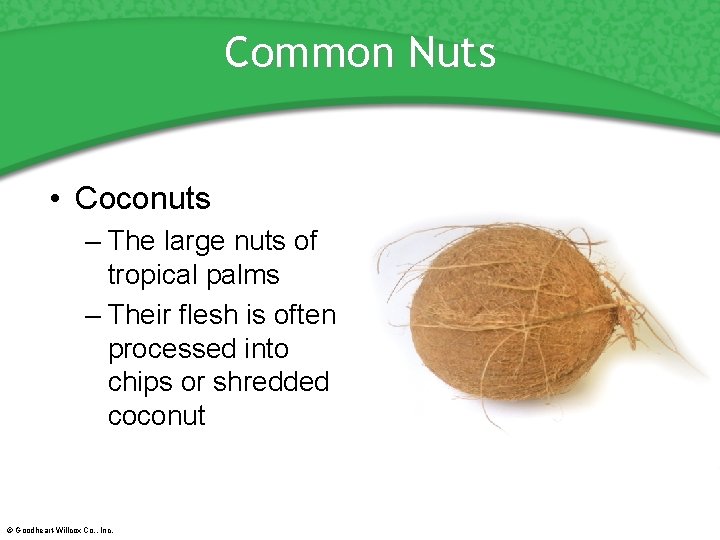
Common Nuts • Coconuts – The large nuts of tropical palms – Their flesh is often processed into chips or shredded coconut © Goodheart-Willcox Co. , Inc.
Common Nuts • Coconuts (continued) – The liquid found inside the nut is called coconut water – Coconut milk is made by extracting the oils and flavor from the flesh of the nut © Goodheart-Willcox Co. , Inc.
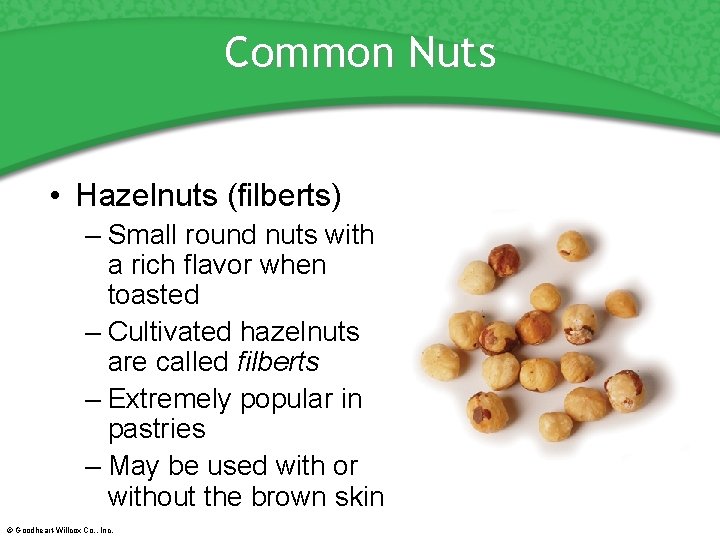
Common Nuts • Hazelnuts (filberts) – Small round nuts with a rich flavor when toasted – Cultivated hazelnuts are called filberts – Extremely popular in pastries – May be used with or without the brown skin © Goodheart-Willcox Co. , Inc.
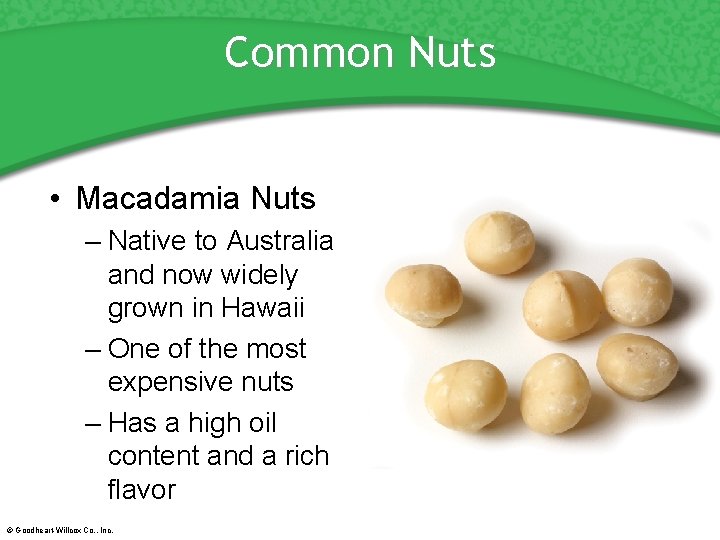
Common Nuts • Macadamia Nuts – Native to Australia and now widely grown in Hawaii – One of the most expensive nuts – Has a high oil content and a rich flavor © Goodheart-Willcox Co. , Inc.
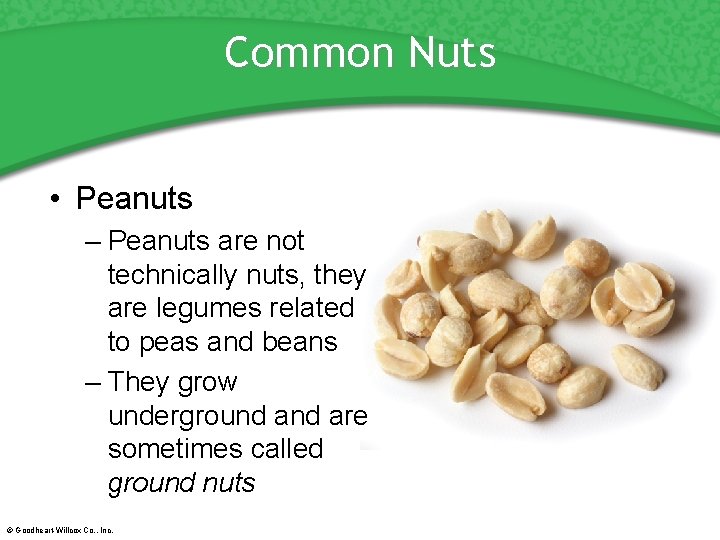
Common Nuts • Peanuts – Peanuts are not technically nuts, they are legumes related to peas and beans – They grow underground are sometimes called ground nuts © Goodheart-Willcox Co. , Inc.
Common Nuts • Peanuts (continued) – They are an important ingredient in American, Asian, and African cuisines – They are relatively inexpensive and are the source for peanut oil and peanut butter © Goodheart-Willcox Co. , Inc.
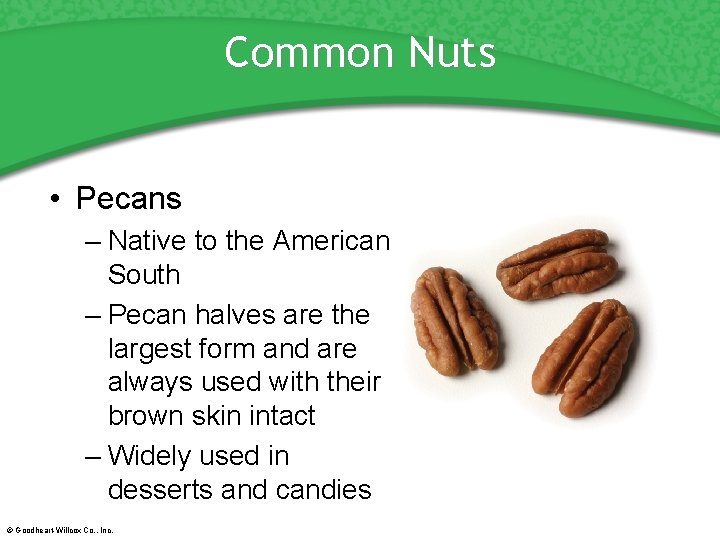
Common Nuts • Pecans – Native to the American South – Pecan halves are the largest form and are always used with their brown skin intact – Widely used in desserts and candies © Goodheart-Willcox Co. , Inc.
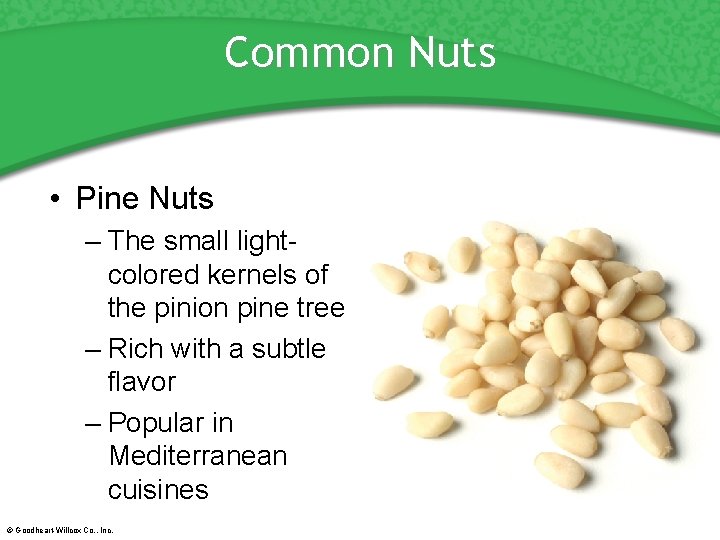
Common Nuts • Pine Nuts – The small lightcolored kernels of the pinion pine tree – Rich with a subtle flavor – Popular in Mediterranean cuisines © Goodheart-Willcox Co. , Inc.
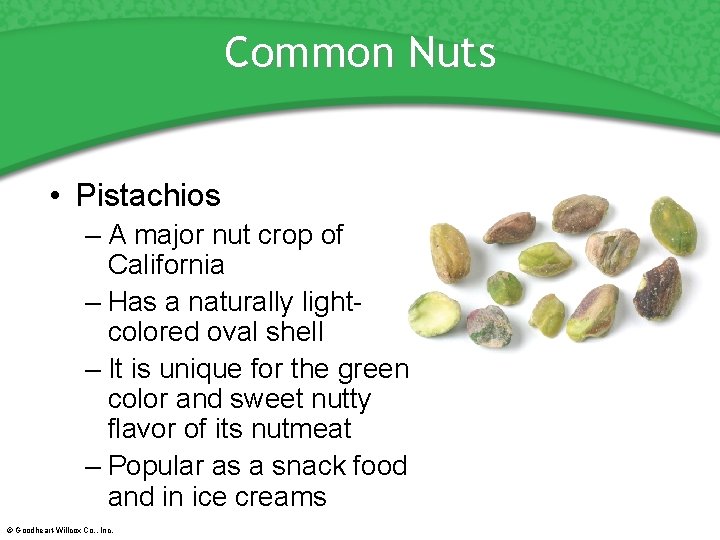
Common Nuts • Pistachios – A major nut crop of California – Has a naturally lightcolored oval shell – It is unique for the green color and sweet nutty flavor of its nutmeat – Popular as a snack food and in ice creams © Goodheart-Willcox Co. , Inc.

Common Nuts • Walnuts – One of the most popular nuts in commercial foodservice – English walnuts have light-colored flesh with a mild flavor – Black walnuts are darker and have an intense flavor © Goodheart-Willcox Co. , Inc.
Nuts and Seeds • Seeds are rich in fats and develop a richer flavor when toasted • They are often used as fillings and to decorate breads and pastries © Goodheart-Willcox Co. , Inc.
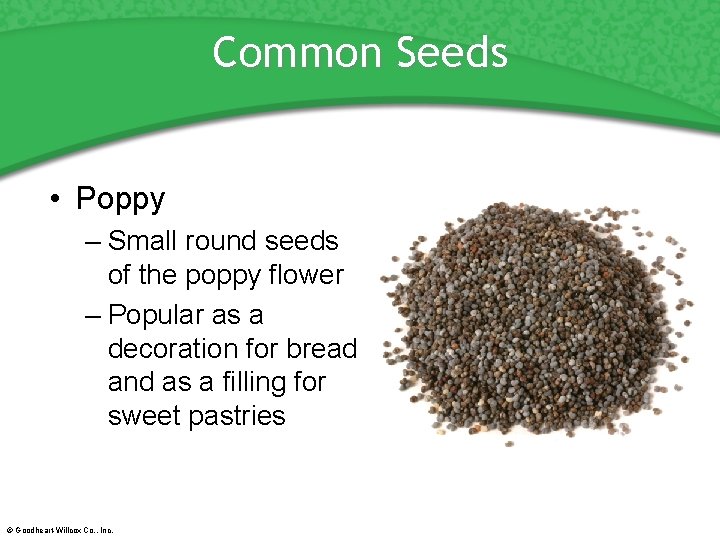
Common Seeds • Poppy – Small round seeds of the poppy flower – Popular as a decoration for bread and as a filling for sweet pastries © Goodheart-Willcox Co. , Inc.
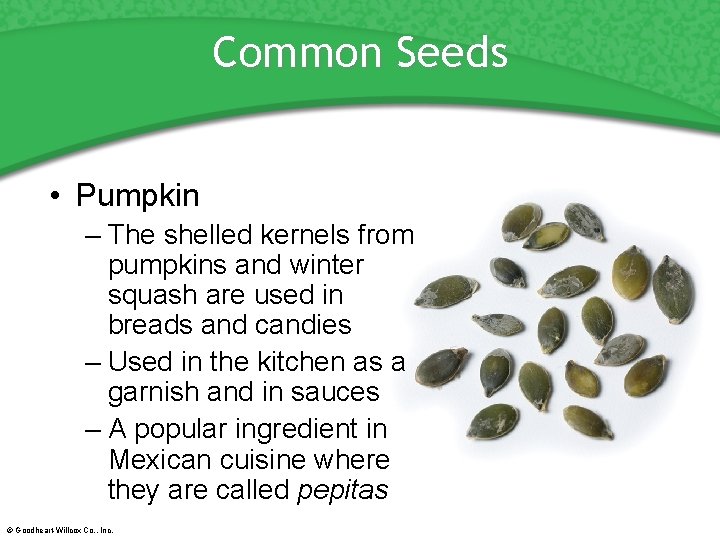
Common Seeds • Pumpkin – The shelled kernels from pumpkins and winter squash are used in breads and candies – Used in the kitchen as a garnish and in sauces – A popular ingredient in Mexican cuisine where they are called pepitas © Goodheart-Willcox Co. , Inc.
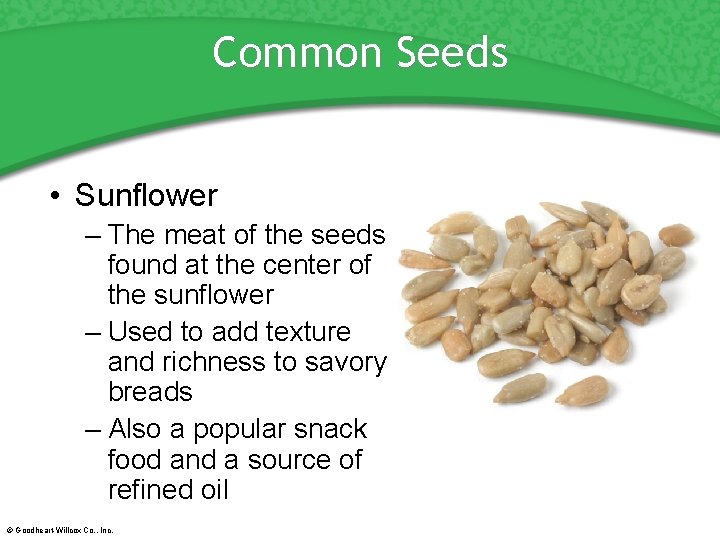
Common Seeds • Sunflower – The meat of the seeds found at the center of the sunflower – Used to add texture and richness to savory breads – Also a popular snack food and a source of refined oil © Goodheart-Willcox Co. , Inc.
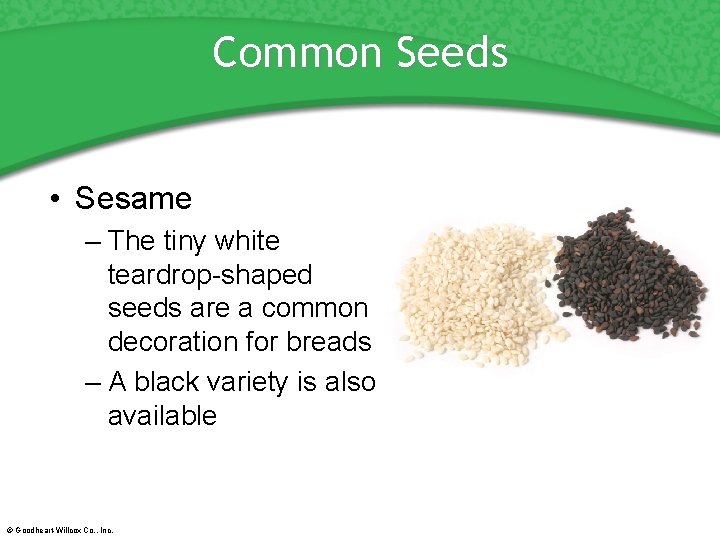
Common Seeds • Sesame – The tiny white teardrop-shaped seeds are a common decoration for breads – A black variety is also available © Goodheart-Willcox Co. , Inc.
Common Seeds • Sesame (continued) – Sesame seed paste, called tahini, is a popular Middle Eastern ingredient – Sesame seed oil is a common Asian ingredient © Goodheart-Willcox Co. , Inc.
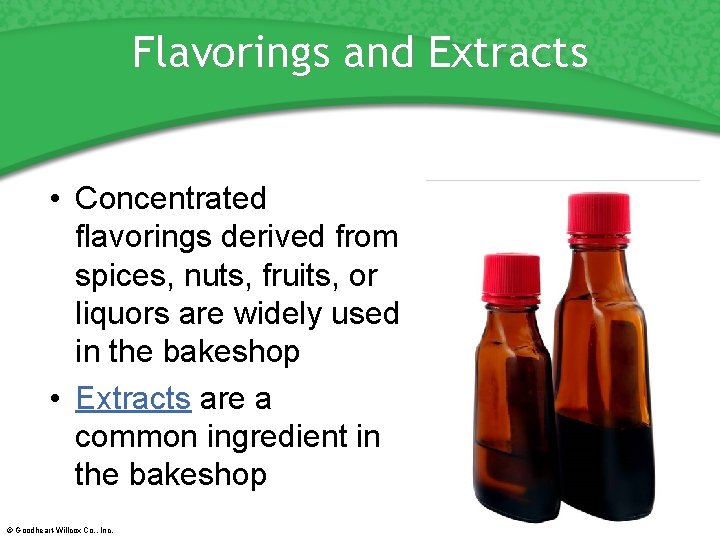
Flavorings and Extracts • Concentrated flavorings derived from spices, nuts, fruits, or liquors are widely used in the bakeshop • Extracts are a common ingredient in the bakeshop © Goodheart-Willcox Co. , Inc.
Flavorings and Extracts • Other flavorings may be referred to as concentrates or compounds and may be in liquid or paste form • When working with these ingredients, follow recipe quantities closely and measure carefully © Goodheart-Willcox Co. , Inc.
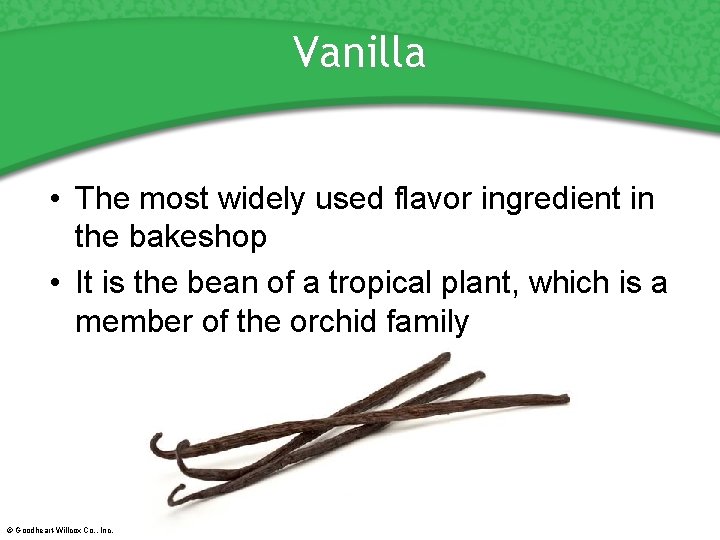
Vanilla • The most widely used flavor ingredient in the bakeshop • It is the bean of a tropical plant, which is a member of the orchid family © Goodheart-Willcox Co. , Inc.
Vanilla • Whole beans are typically simmered in liquid to extract their flavor • Vanilla extract is the more commonly used form • Since vanilla and pure vanilla extracts are expensive, some kitchens may use artificial vanilla extract © Goodheart-Willcox Co. , Inc.
Objective • Recognize smallwares, hand tools, and large equipment used in the bakeshop © Goodheart-Willcox Co. , Inc.
Bakeshop Equipment • Many pieces of equipment are unique to the bakeshop or pastry kitchen • This equipment makes producing baked goods and pastries easier and more efficient © Goodheart-Willcox Co. , Inc.
Smallwares and Hand Tools • A variety of smallwares and hand tools should be available for use in the bakeshop • These include the balance scale, rolling pin, palette knife, turntable, pastry comb, pastry bag, and various types of pans © Goodheart-Willcox Co. , Inc.
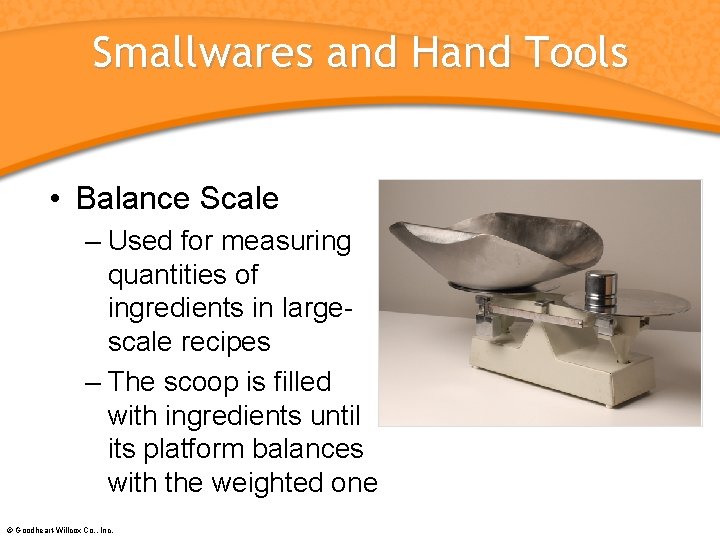
Smallwares and Hand Tools • Balance Scale – Used for measuring quantities of ingredients in largescale recipes – The scoop is filled with ingredients until its platform balances with the weighted one © Goodheart-Willcox Co. , Inc.
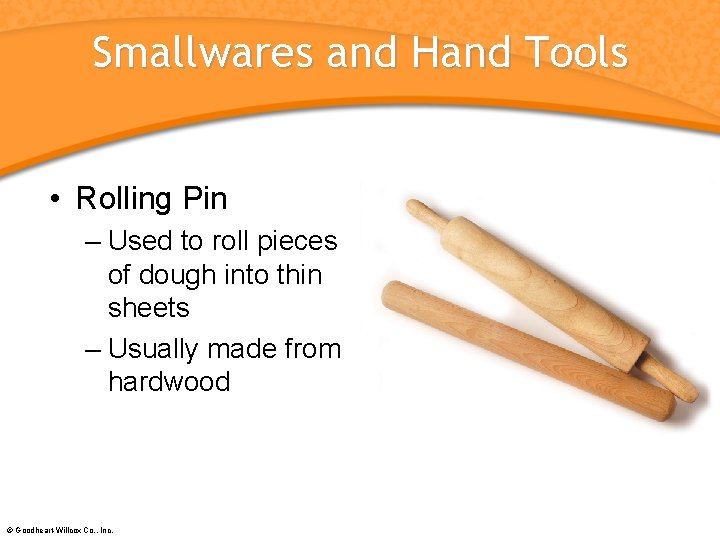
Smallwares and Hand Tools • Rolling Pin – Used to roll pieces of dough into thin sheets – Usually made from hardwood © Goodheart-Willcox Co. , Inc.
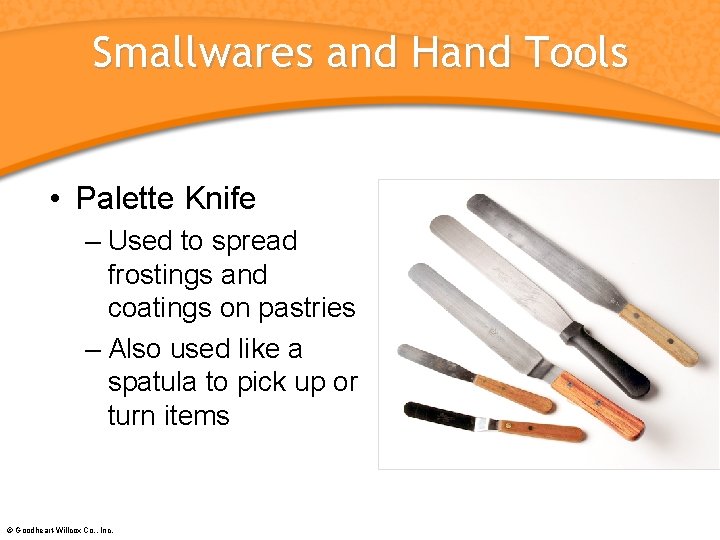
Smallwares and Hand Tools • Palette Knife – Used to spread frostings and coatings on pastries – Also used like a spatula to pick up or turn items © Goodheart-Willcox Co. , Inc.
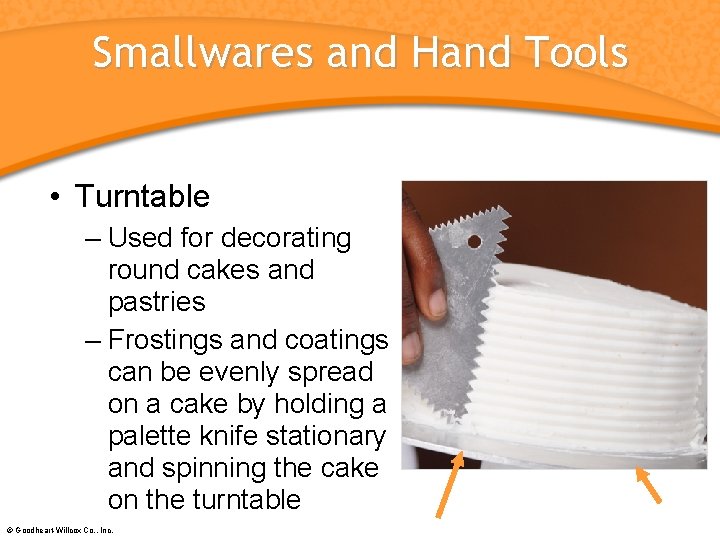
Smallwares and Hand Tools • Turntable – Used for decorating round cakes and pastries – Frostings and coatings can be evenly spread on a cake by holding a palette knife stationary and spinning the cake on the turntable © Goodheart-Willcox Co. , Inc.
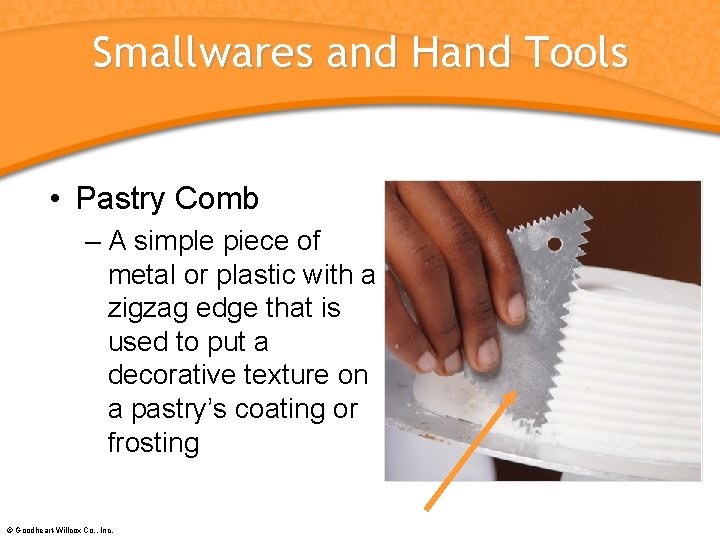
Smallwares and Hand Tools • Pastry Comb – A simple piece of metal or plastic with a zigzag edge that is used to put a decorative texture on a pastry’s coating or frosting © Goodheart-Willcox Co. , Inc.

Smallwares and Hand Tools • Pastry Bag – A cone-shaped bag made of cloth or plastic with a small opening at the point of the cone into which a metal tip is placed – It is filled with product that is squeezed through the tip to create a decorative effect © Goodheart-Willcox Co. , Inc.
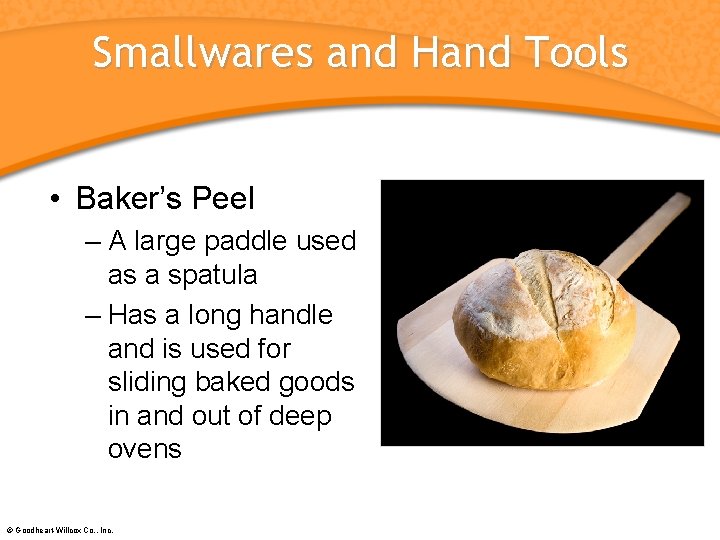
Smallwares and Hand Tools • Baker’s Peel – A large paddle used as a spatula – Has a long handle and is used for sliding baked goods in and out of deep ovens © Goodheart-Willcox Co. , Inc.
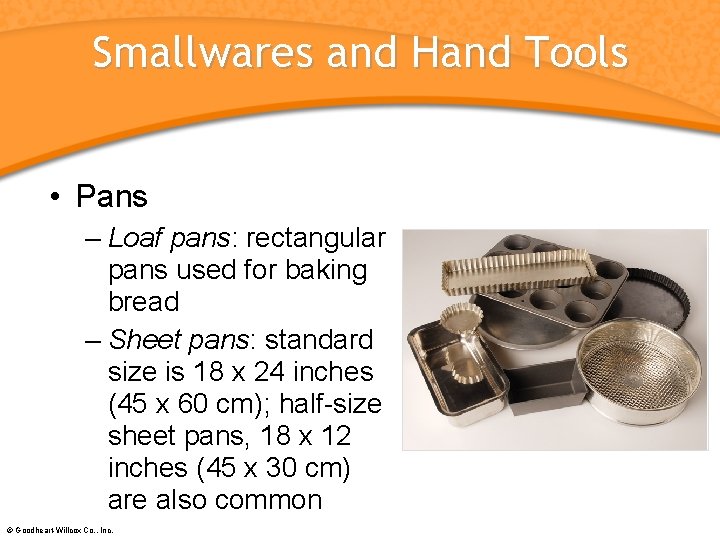
Smallwares and Hand Tools • Pans – Loaf pans: rectangular pans used for baking bread – Sheet pans: standard size is 18 x 24 inches (45 x 60 cm); half-size sheet pans, 18 x 12 inches (45 x 30 cm) are also common © Goodheart-Willcox Co. , Inc.
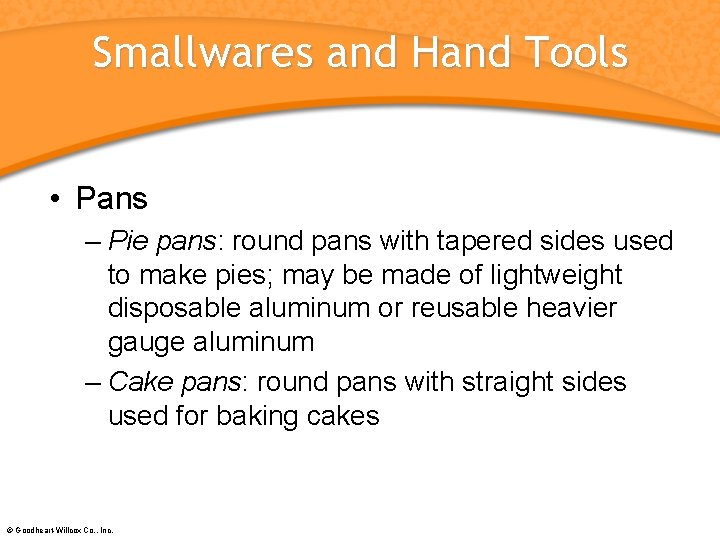
Smallwares and Hand Tools • Pans – Pie pans: round pans with tapered sides used to make pies; may be made of lightweight disposable aluminum or reusable heavier gauge aluminum – Cake pans: round pans with straight sides used for baking cakes © Goodheart-Willcox Co. , Inc.
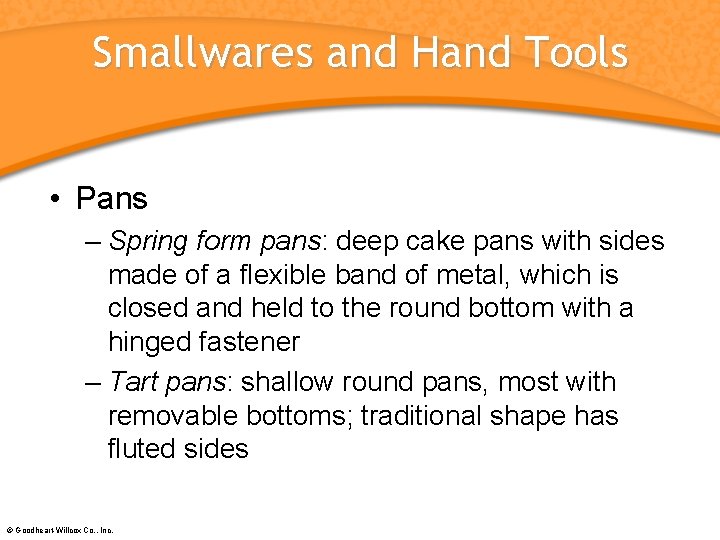
Smallwares and Hand Tools • Pans – Spring form pans: deep cake pans with sides made of a flexible band of metal, which is closed and held to the round bottom with a hinged fastener – Tart pans: shallow round pans, most with removable bottoms; traditional shape has fluted sides © Goodheart-Willcox Co. , Inc.
Smallwares and Hand Tools • Pans – Muffin pans: a set of small round pans pressed into a single sheet of metal; used for easier handling of individual muffins or cupcakes © Goodheart-Willcox Co. , Inc.
Large Equipment • The large equipment used in bakeshops produce large quantities of product efficiently • They give bakers and pastry chefs the ability to create a large variety of products with the same equipment © Goodheart-Willcox Co. , Inc.
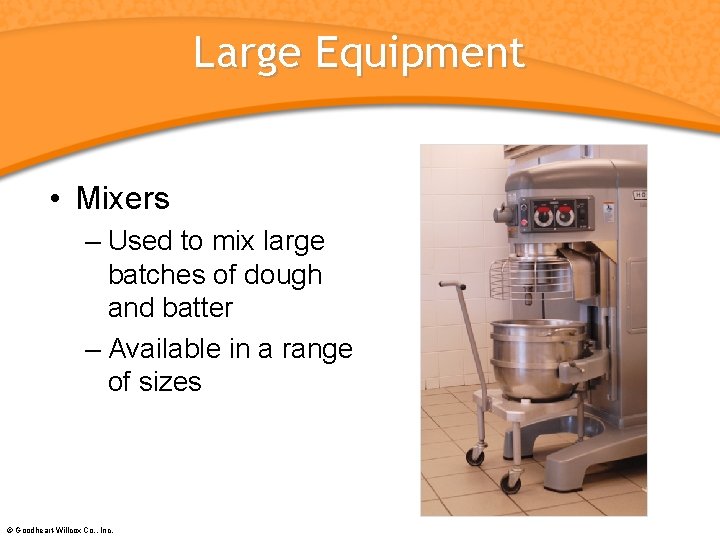
Large Equipment • Mixers – Used to mix large batches of dough and batter – Available in a range of sizes © Goodheart-Willcox Co. , Inc.
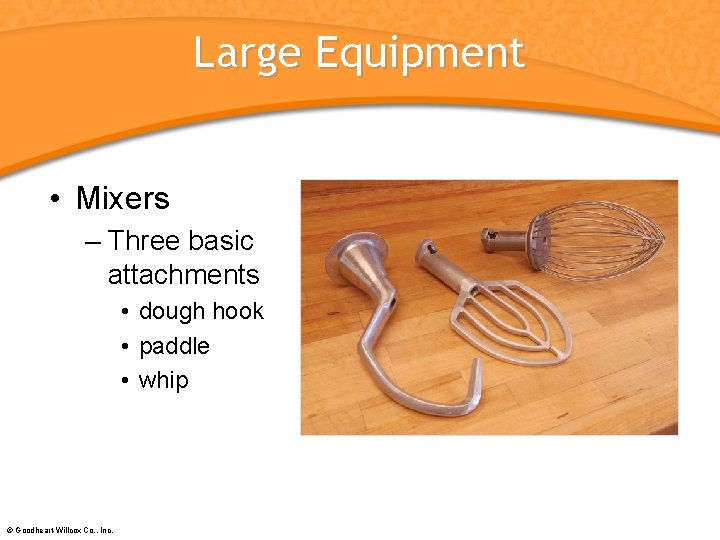
Large Equipment • Mixers – Three basic attachments • dough hook • paddle • whip © Goodheart-Willcox Co. , Inc.
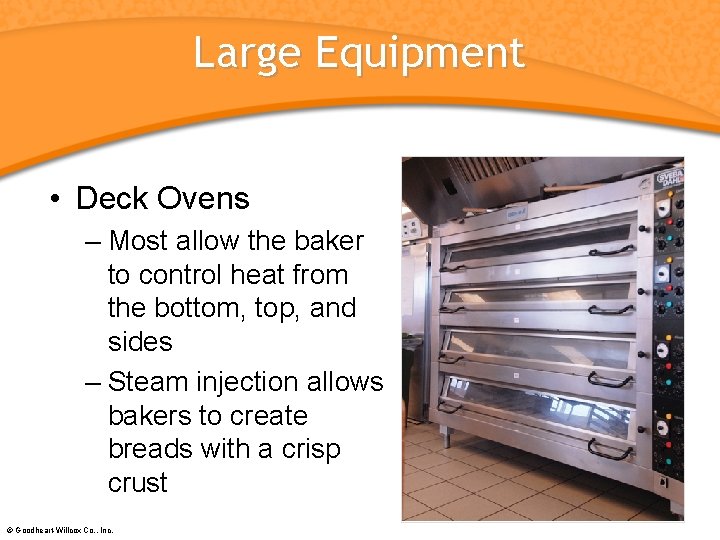
Large Equipment • Deck Ovens – Most allow the baker to control heat from the bottom, top, and sides – Steam injection allows bakers to create breads with a crisp crust © Goodheart-Willcox Co. , Inc.
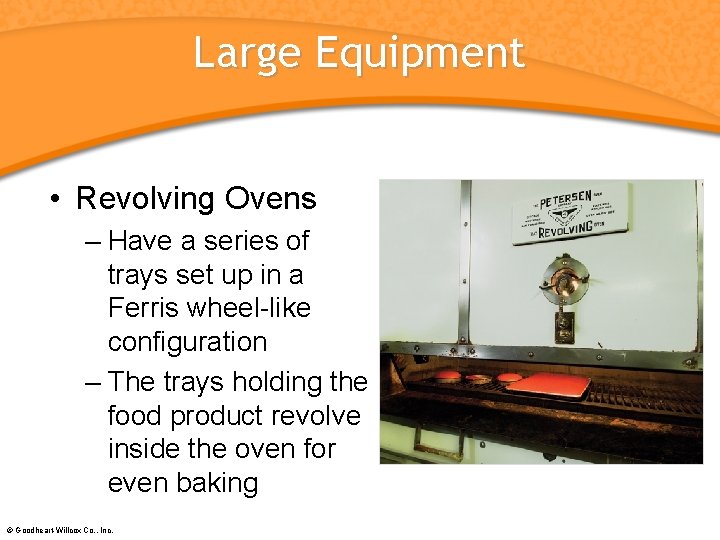
Large Equipment • Revolving Ovens – Have a series of trays set up in a Ferris wheel-like configuration – The trays holding the food product revolve inside the oven for even baking © Goodheart-Willcox Co. , Inc.
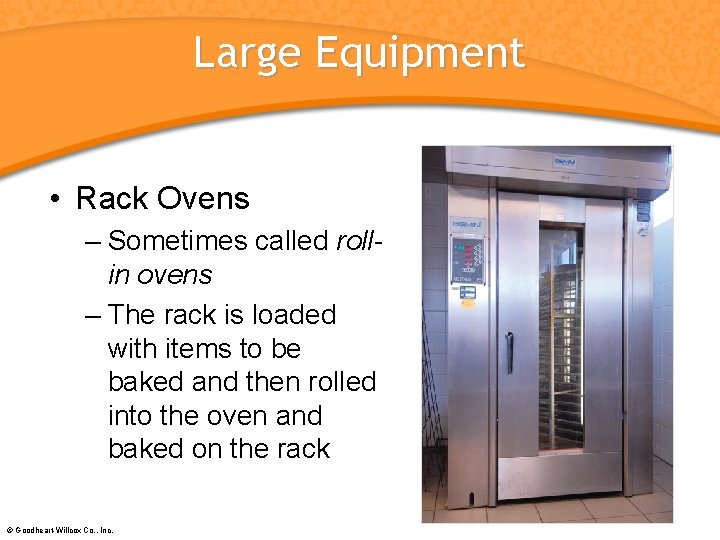
Large Equipment • Rack Ovens – Sometimes called rollin ovens – The rack is loaded with items to be baked and then rolled into the oven and baked on the rack © Goodheart-Willcox Co. , Inc.
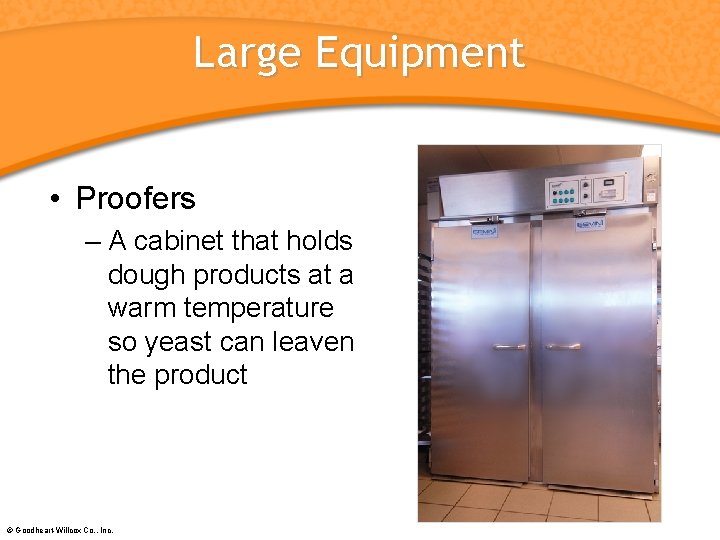
Large Equipment • Proofers – A cabinet that holds dough products at a warm temperature so yeast can leaven the product © Goodheart-Willcox Co. , Inc.
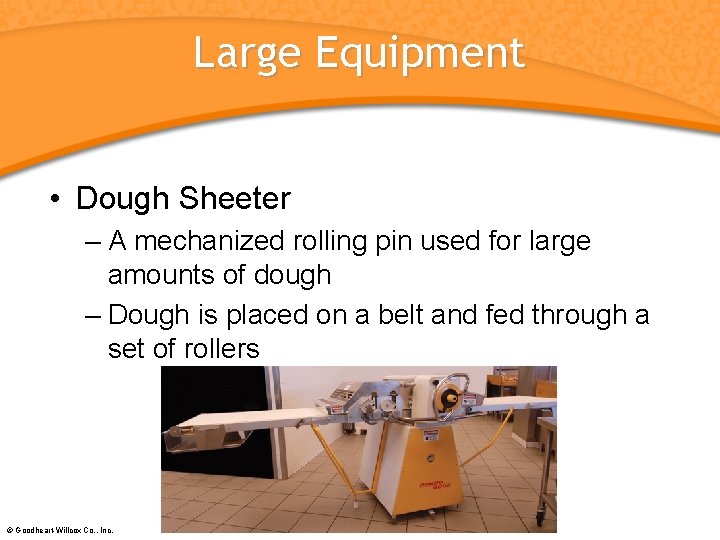
Large Equipment • Dough Sheeter – A mechanized rolling pin used for large amounts of dough – Dough is placed on a belt and fed through a set of rollers © Goodheart-Willcox Co. , Inc.
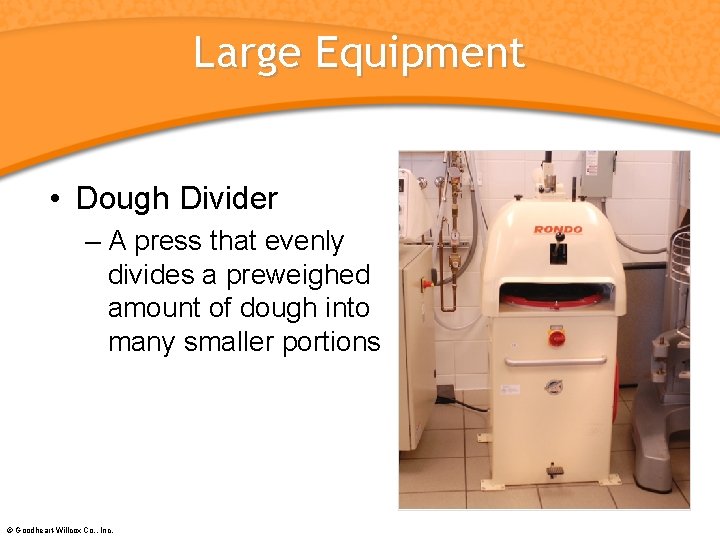
Large Equipment • Dough Divider – A press that evenly divides a preweighed amount of dough into many smaller portions © Goodheart-Willcox Co. , Inc.
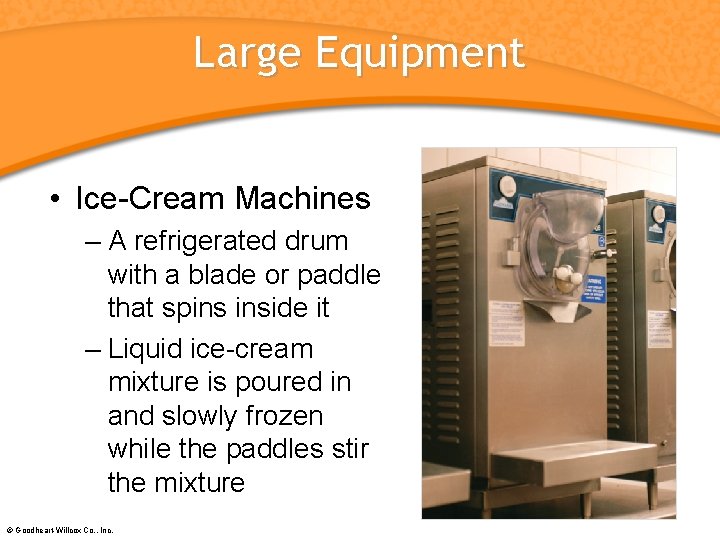
Large Equipment • Ice-Cream Machines – A refrigerated drum with a blade or paddle that spins inside it – Liquid ice-cream mixture is poured in and slowly frozen while the paddles stir the mixture © Goodheart-Willcox Co. , Inc.

Review • Describe the difference between a pastry chef, pastry cook, and baker – The pastry chef is the head of the baking and pastry department and is responsible for supervising the preparation of all breads, cakes, pies, pastries, ice creams, and candies – A pastry cook is responsible for preparing sweet dessert items – A baker works preparing and baking breads © Goodheart-Willcox Co. , Inc.
Review • Name ingredients commonly used in the bakeshop – Flour – Sweeteners – Shortenings – Leavening agents – Chocolate – Gelatin – Nuts and seeds – Flavorings and extracts © Goodheart-Willcox Co. , Inc.
Review • What function does the gluten in flour perform as an ingredient in baked goods? – It provides structure to the product © Goodheart-Willcox Co. , Inc.
Review • What function do shortenings perform as an ingredient in baked goods? – They give baked goods a soft texture and richness © Goodheart-Willcox Co. , Inc.
Review • What function do leavening agents perform as an ingredient in baked goods? – They make baked goods light and airy © Goodheart-Willcox Co. , Inc.
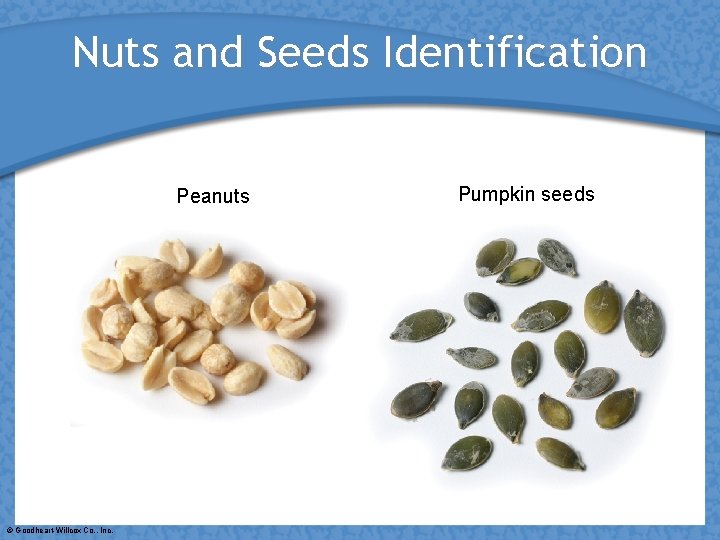
Nuts and Seeds Identification Peanuts © Goodheart-Willcox Co. , Inc. Pumpkin seeds
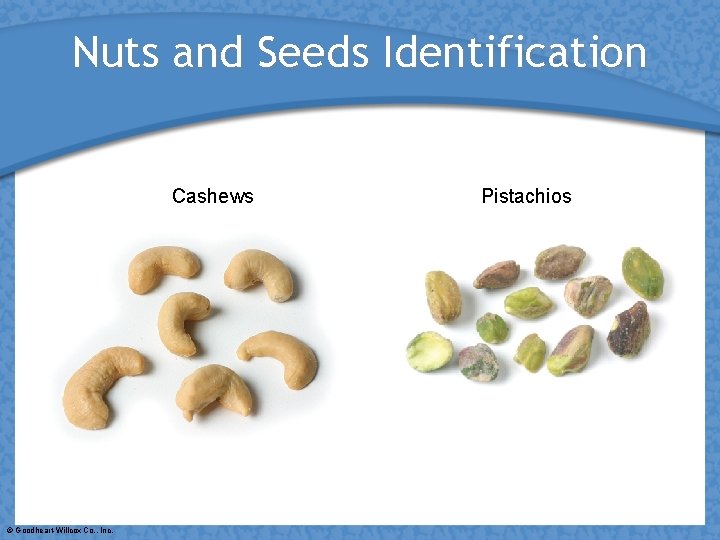
Nuts and Seeds Identification Cashews © Goodheart-Willcox Co. , Inc. Pistachios
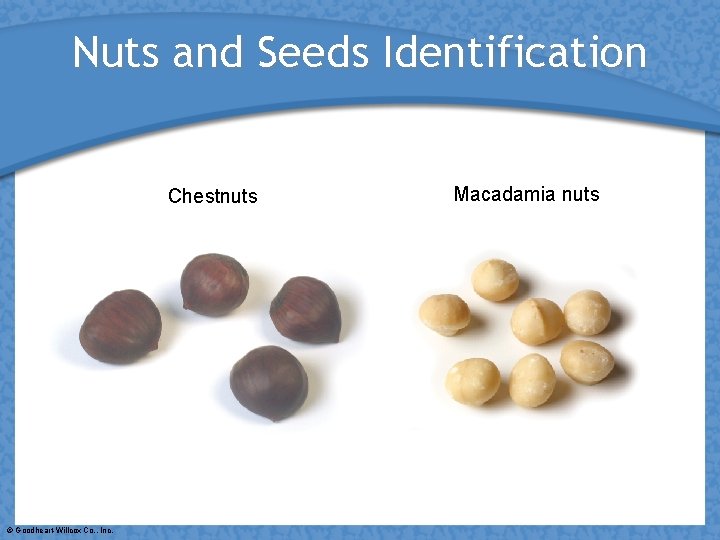
Nuts and Seeds Identification Chestnuts © Goodheart-Willcox Co. , Inc. Macadamia nuts
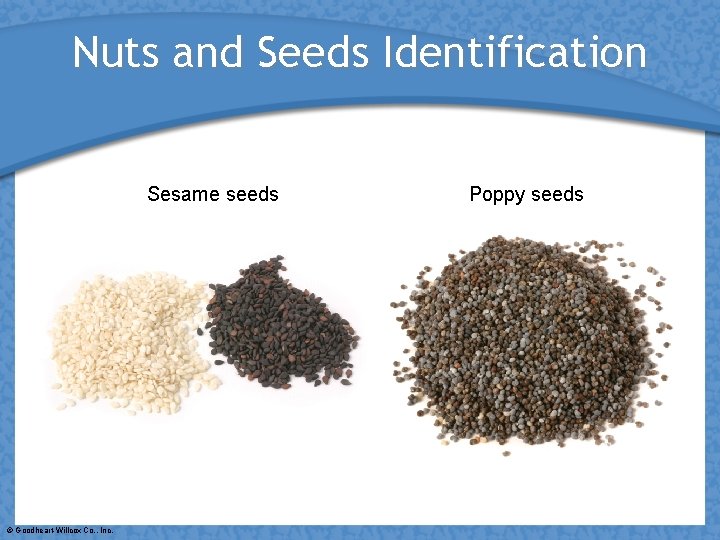
Nuts and Seeds Identification Sesame seeds © Goodheart-Willcox Co. , Inc. Poppy seeds
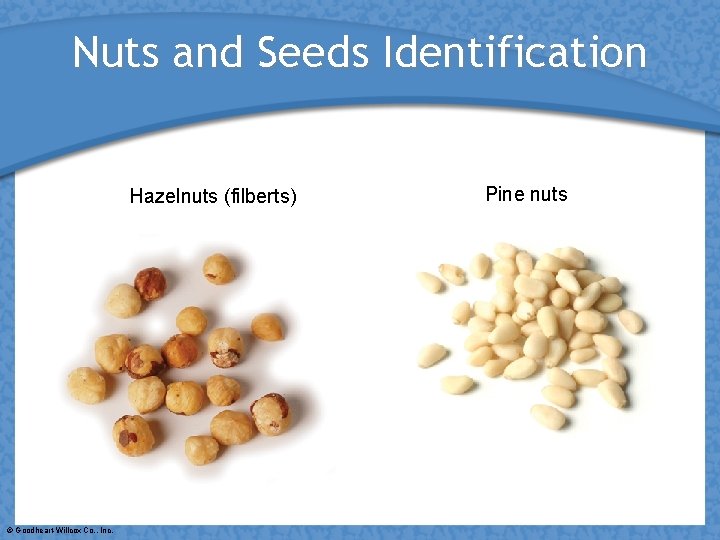
Nuts and Seeds Identification Hazelnuts (filberts) © Goodheart-Willcox Co. , Inc. Pine nuts
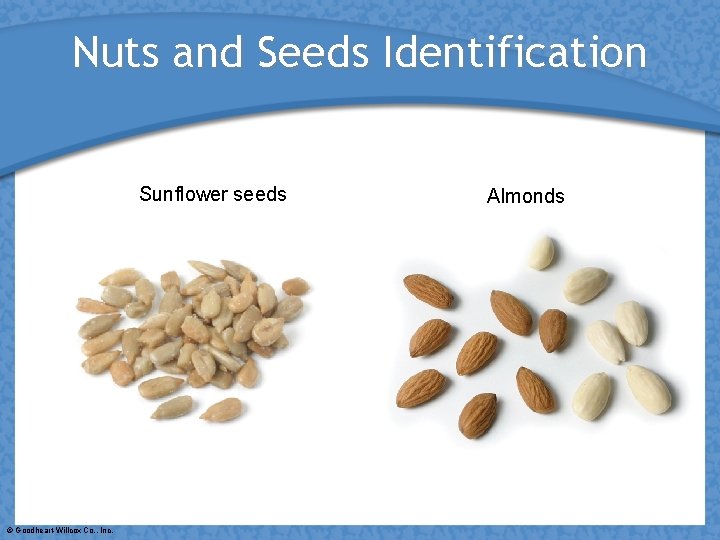
Nuts and Seeds Identification Sunflower seeds © Goodheart-Willcox Co. , Inc. Almonds
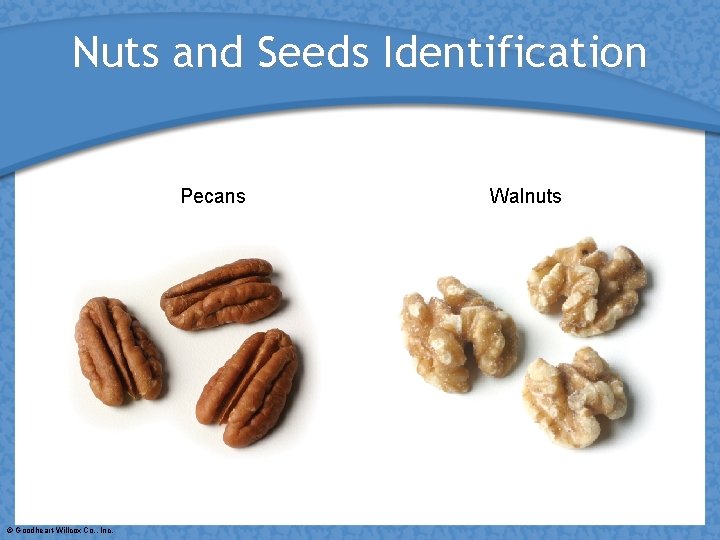
Nuts and Seeds Identification Pecans © Goodheart-Willcox Co. , Inc. Walnuts

Nuts and Seeds Identification Coconut © Goodheart-Willcox Co. , Inc.
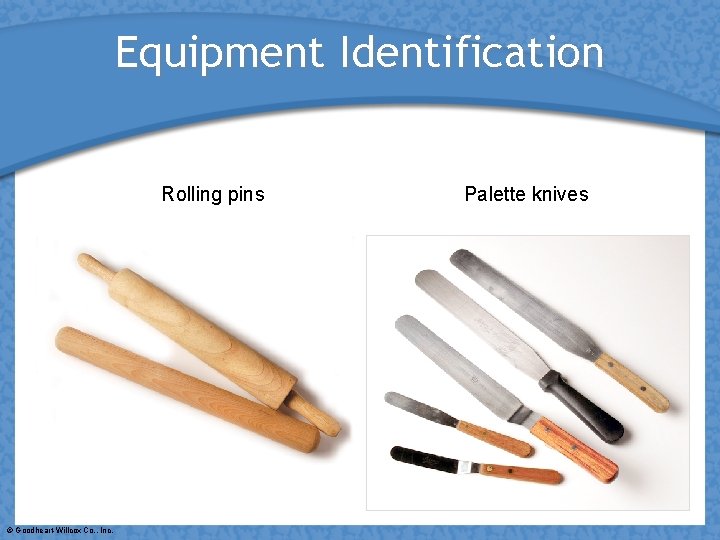
Equipment Identification Rolling pins © Goodheart-Willcox Co. , Inc. Palette knives
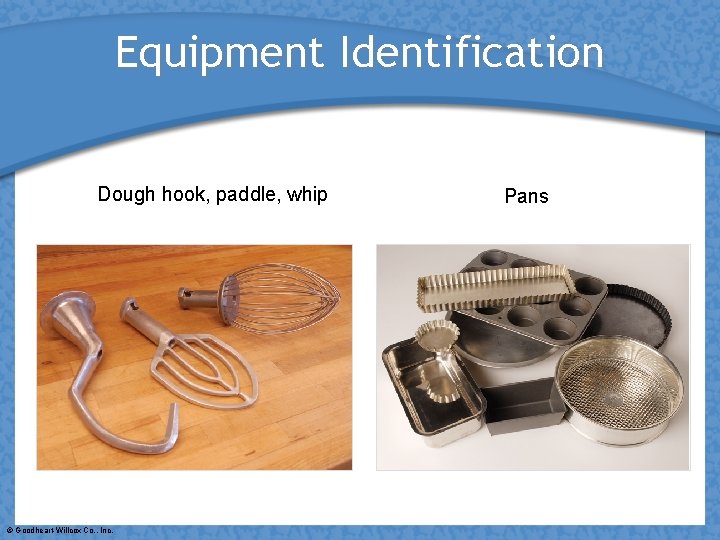
Equipment Identification Dough hook, paddle, whip © Goodheart-Willcox Co. , Inc. Pans
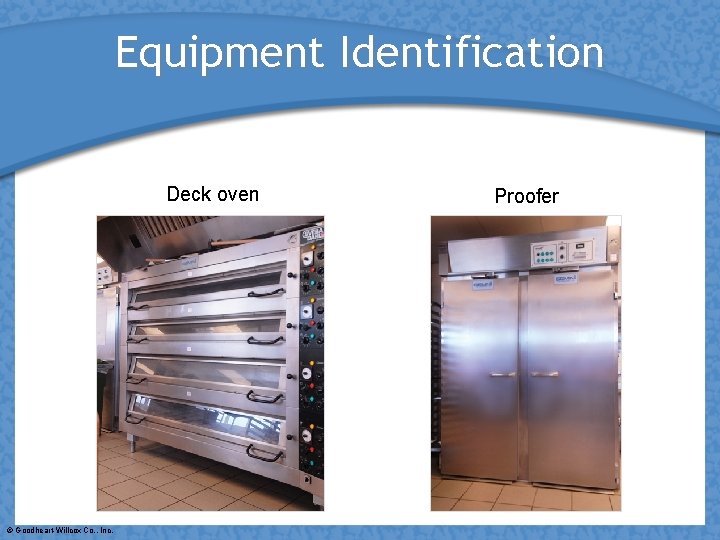
Equipment Identification Deck oven © Goodheart-Willcox Co. , Inc. Proofer
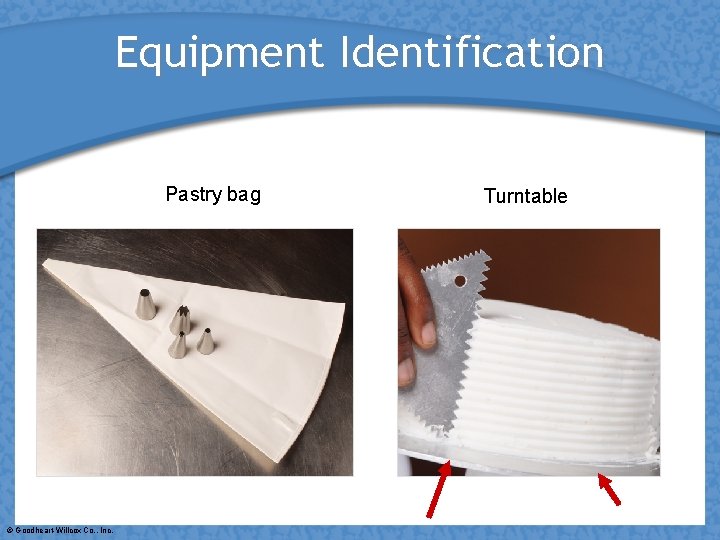
Equipment Identification Pastry bag © Goodheart-Willcox Co. , Inc. Turntable
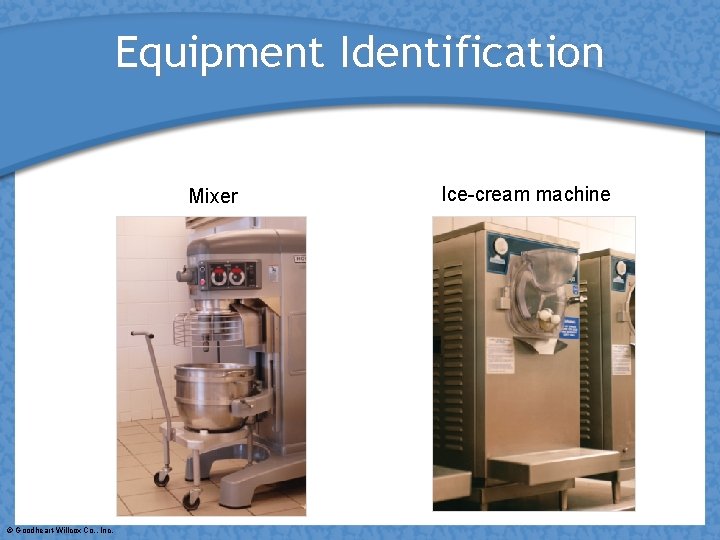
Equipment Identification Mixer © Goodheart-Willcox Co. , Inc. Ice-cream machine
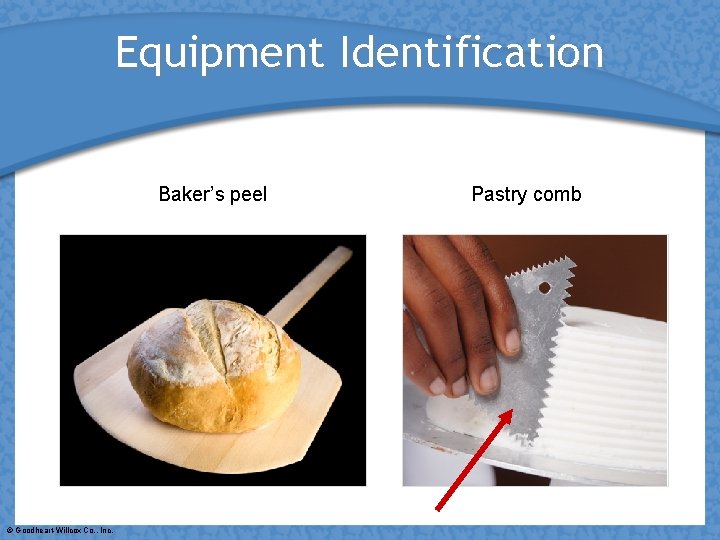
Equipment Identification Baker’s peel © Goodheart-Willcox Co. , Inc. Pastry comb
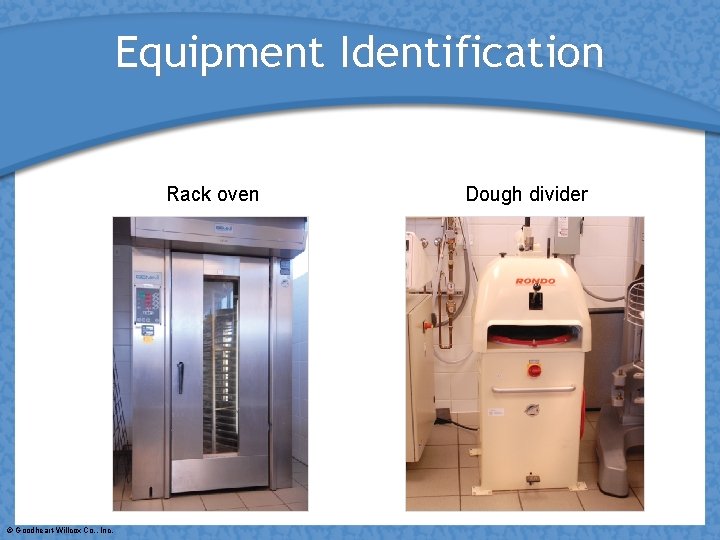
Equipment Identification Rack oven © Goodheart-Willcox Co. , Inc. Dough divider
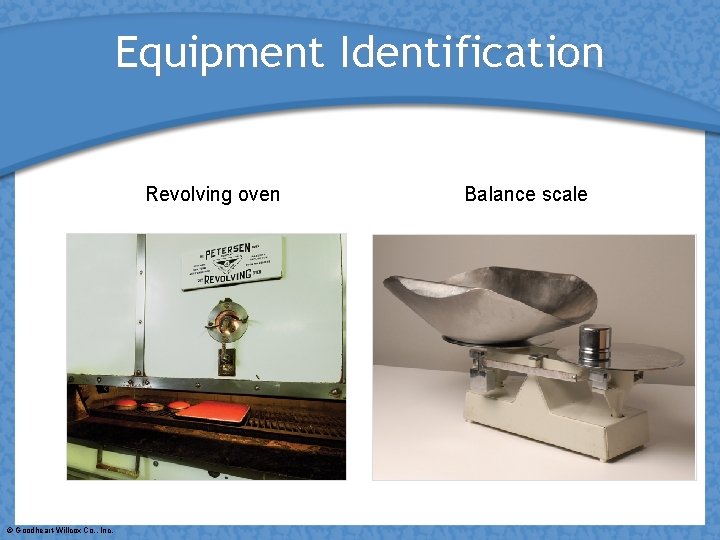
Equipment Identification Revolving oven © Goodheart-Willcox Co. , Inc. Balance scale
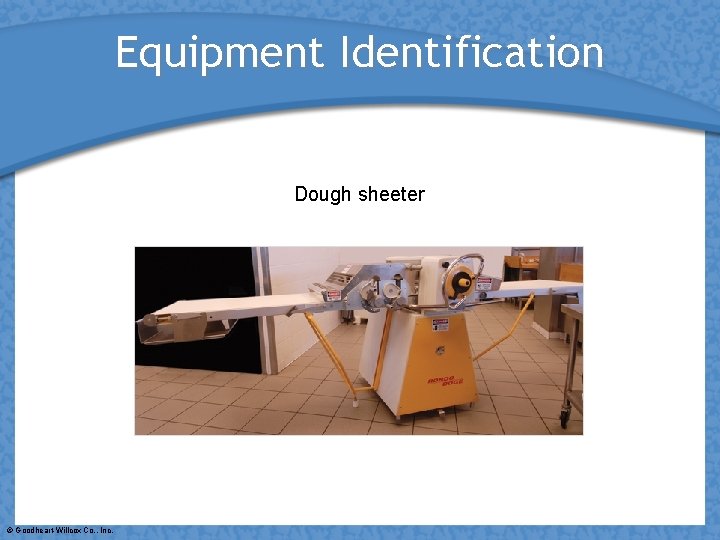
Equipment Identification Dough sheeter © Goodheart-Willcox Co. , Inc.
- Slides: 101