
Chapter 36 Agents Used to Treat Hyperglycemia and
- Slides: 22
Chapter 36 Agents Used to Treat Hyperglycemia and Hypoglycemia
Diabetes Mellitus Disorder of the pancreas l £ Results in hyperglycemia Treatment l £ £ 2 Insulin Oral hypoglycemics (continues) Copyright 2007 Thomson Delmar Learning, a division of Thomson Learning Inc. All rights reserved.
(continued) Diabetes Mellitus Pancreatic beta cells l £ £ Excrete an insufficient amount of insulin, or no insulin at all Flawed carbohydrate, fat, and protein metabolism 3 Copyright 2007 Thomson Delmar Learning, a division of Thomson Learning Inc. All rights reserved.
Insulin Promotes: l £ £ Glucose transport across cell membranes Conversion of glycogen into glucose Utilizes fatty acids and inhibits lipolysis Enhances protein synthesis and inhibits protein breakdown l l 4 Copyright 2007 Thomson Delmar Learning, a division of Thomson Learning Inc. All rights reserved.
Symptoms of Diabetes Mellitus Polyuria (increased urine output) Polydipsia (excessive thirst) Polyphagia (excessive hunger) l l l 5 Copyright 2007 Thomson Delmar Learning, a division of Thomson Learning Inc. All rights reserved.
Diabetes Mellitus Two types: l 1. 2. 6 Type 1 (formerly known as insulindependent diabetes mellitus, IDDM) Type 2 (formerly known as noninsulindependent diabetes mellitus, NIDDM) (continues) Copyright 2007 Thomson Delmar Learning, a division of Thomson Learning Inc. All rights reserved.
(continued) Diabetes Mellitus Type 1 diabetes mellitus l £ Treated with insulin subcutaneous injections Type 2 diabetes mellitus l £ Treated with oral hypoglycemic agents 7 Copyright 2007 Thomson Delmar Learning, a division of Thomson Learning Inc. All rights reserved.
Insulin Synthetic human insulin l £ Produced either by: u u Recombinant DNA synthesis of human insulin Conversion of pig to human insulin Human in origin l £ Humulin, Novolin, and Lispro Older versions l £ Pig or cow in origin 8 Copyright 2007 Thomson Delmar Learning, a division of Thomson Learning Inc. All rights reserved.
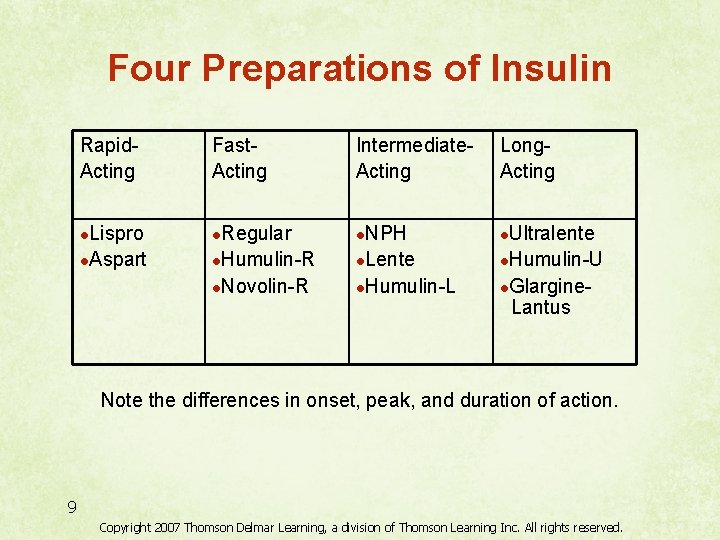
Four Preparations of Insulin Rapid. Acting Lispro l. Aspart l Fast. Acting Regular l. Humulin-R l. Novolin-R l Intermediate. Acting NPH l. Lente l. Humulin-L l Long. Acting Ultralente l. Humulin-U l. Glargine. Lantus l Note the differences in onset, peak, and duration of action. 9 Copyright 2007 Thomson Delmar Learning, a division of Thomson Learning Inc. All rights reserved.
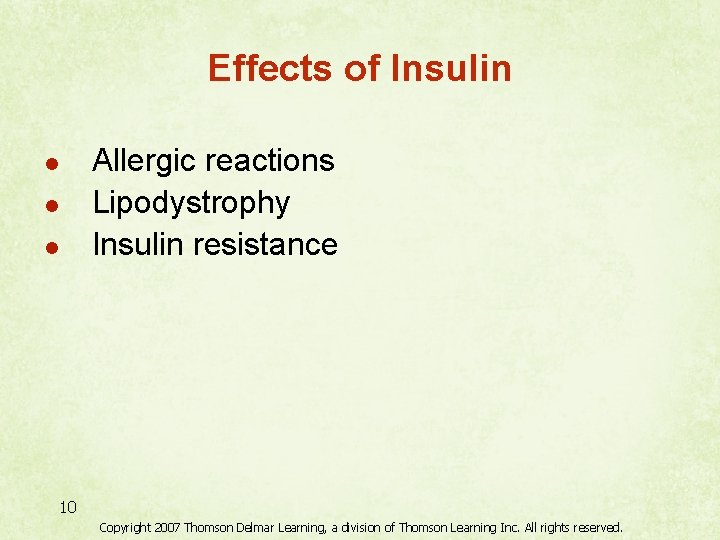
Effects of Insulin Allergic reactions Lipodystrophy Insulin resistance l l l 10 Copyright 2007 Thomson Delmar Learning, a division of Thomson Learning Inc. All rights reserved.
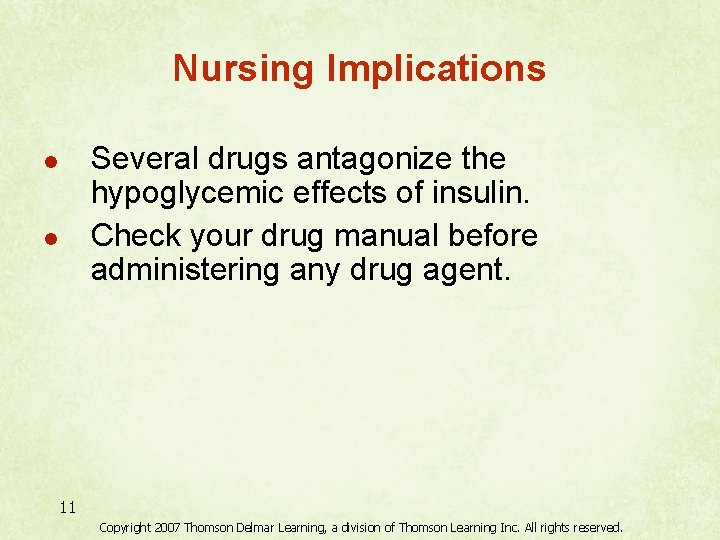
Nursing Implications Several drugs antagonize the hypoglycemic effects of insulin. Check your drug manual before administering any drug agent. l l 11 Copyright 2007 Thomson Delmar Learning, a division of Thomson Learning Inc. All rights reserved.
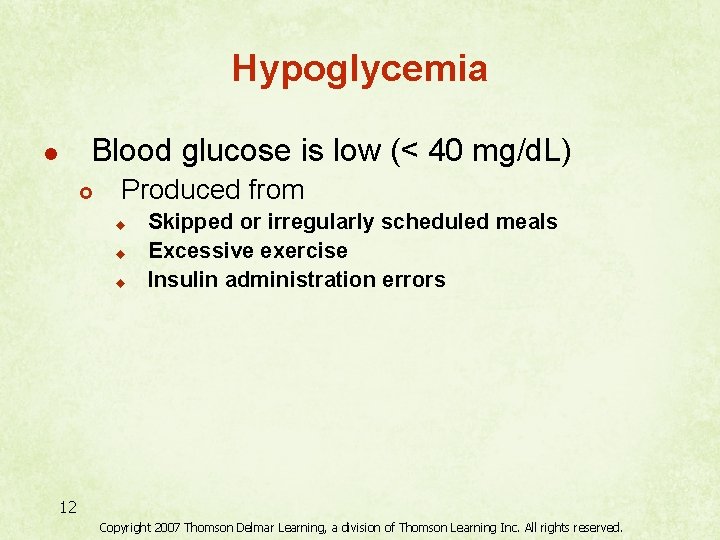
Hypoglycemia Blood glucose is low (< 40 mg/d. L) l £ Produced from u u u Skipped or irregularly scheduled meals Excessive exercise Insulin administration errors 12 Copyright 2007 Thomson Delmar Learning, a division of Thomson Learning Inc. All rights reserved.
Signs and Symptoms of Hypoglycemia Sweating Confusion Tachycardia Headache Hunger l l l l l Weakness Poor muscle control Emotional instability Coma and death 13 Copyright 2007 Thomson Delmar Learning, a division of Thomson Learning Inc. All rights reserved.
Hypoglycemia Treatment Glucagon (intramuscular, intravenous, or subcutaneous) IV dextrose 50%, also known as D 50 W l l 14 Copyright 2007 Thomson Delmar Learning, a division of Thomson Learning Inc. All rights reserved.
Treatment for Type 2 Diabetes Oral antidiabetic agents l £ Five classes 1. Sulfonylureas (oldest category) • • 2. 3. 4. 5. First generation Second generation Biguanides Meglitinides Alpha-glucosidases Thiazolidinediones 15 Copyright 2007 Thomson Delmar Learning, a division of Thomson Learning Inc. All rights reserved.
Sulfonylureas Action: stimulate the beta cells of the pancreas to secrete more insulin l 16 Copyright 2007 Thomson Delmar Learning, a division of Thomson Learning Inc. All rights reserved.
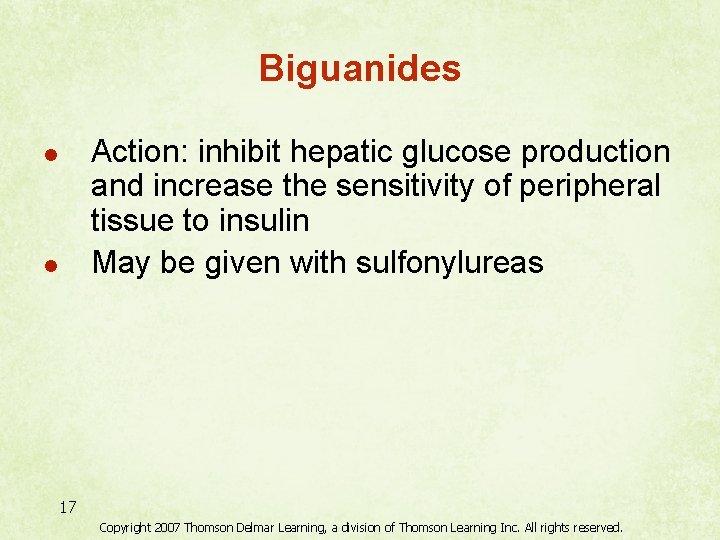
Biguanides Action: inhibit hepatic glucose production and increase the sensitivity of peripheral tissue to insulin May be given with sulfonylureas l l 17 Copyright 2007 Thomson Delmar Learning, a division of Thomson Learning Inc. All rights reserved.
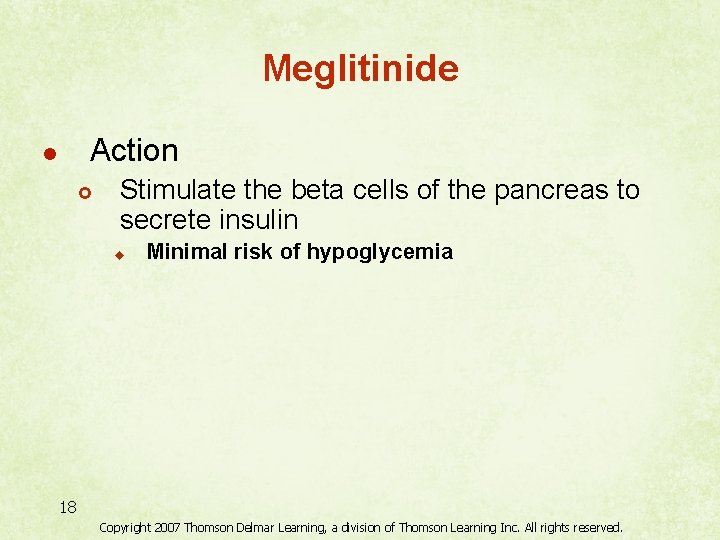
Meglitinide Action l £ Stimulate the beta cells of the pancreas to secrete insulin u Minimal risk of hypoglycemia 18 Copyright 2007 Thomson Delmar Learning, a division of Thomson Learning Inc. All rights reserved.
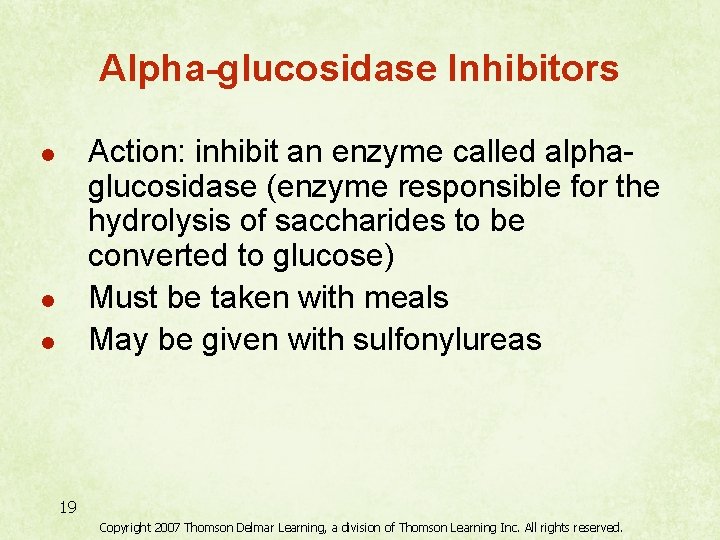
Alpha-glucosidase Inhibitors Action: inhibit an enzyme called alphaglucosidase (enzyme responsible for the hydrolysis of saccharides to be converted to glucose) Must be taken with meals May be given with sulfonylureas l l l 19 Copyright 2007 Thomson Delmar Learning, a division of Thomson Learning Inc. All rights reserved.
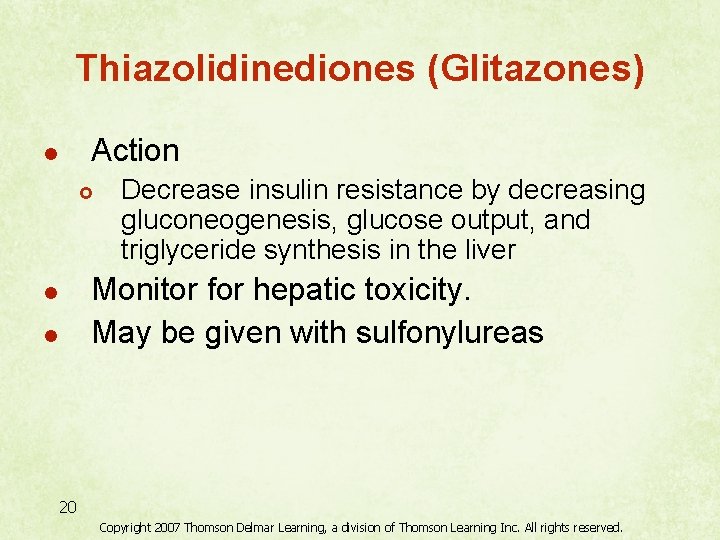
Thiazolidinediones (Glitazones) Action l £ Decrease insulin resistance by decreasing gluconeogenesis, glucose output, and triglyceride synthesis in the liver Monitor for hepatic toxicity. May be given with sulfonylureas l l 20 Copyright 2007 Thomson Delmar Learning, a division of Thomson Learning Inc. All rights reserved.
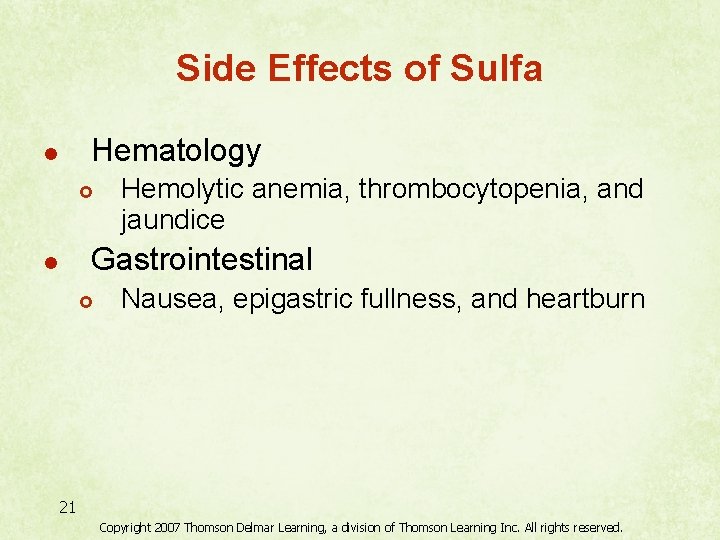
Side Effects of Sulfa Hematology l £ Hemolytic anemia, thrombocytopenia, and jaundice Gastrointestinal l £ Nausea, epigastric fullness, and heartburn 21 Copyright 2007 Thomson Delmar Learning, a division of Thomson Learning Inc. All rights reserved.
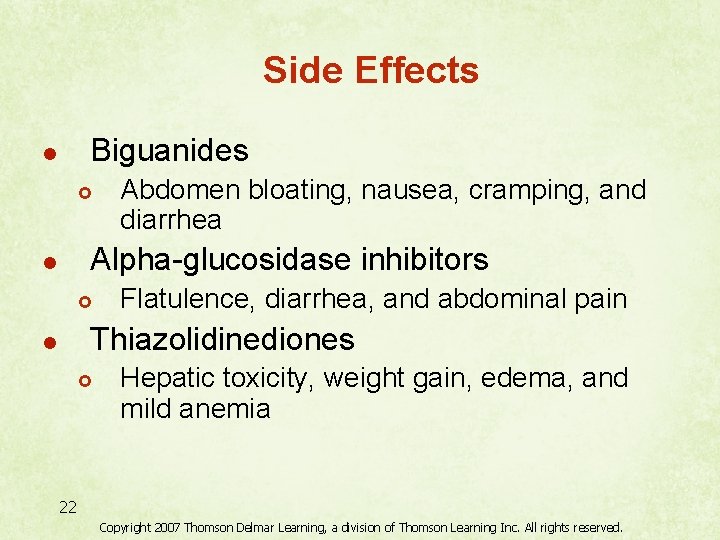
Side Effects Biguanides l £ Abdomen bloating, nausea, cramping, and diarrhea Alpha-glucosidase inhibitors l £ Flatulence, diarrhea, and abdominal pain Thiazolidinediones l £ Hepatic toxicity, weight gain, edema, and mild anemia 22 Copyright 2007 Thomson Delmar Learning, a division of Thomson Learning Inc. All rights reserved.