
Chapter 35 Plant Structure Growth Development 1 What
- Slides: 31
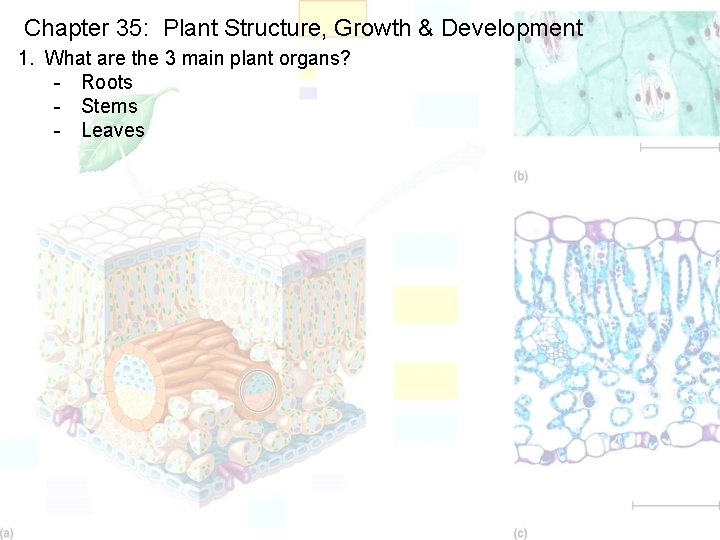
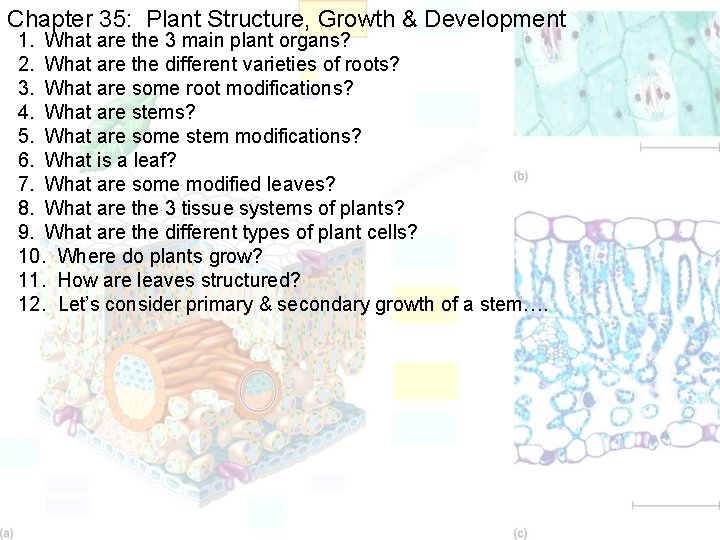
Chapter 35: Plant Structure, Growth & Development 1. What are the 3 main plant organs? - Roots - Stems - Leaves
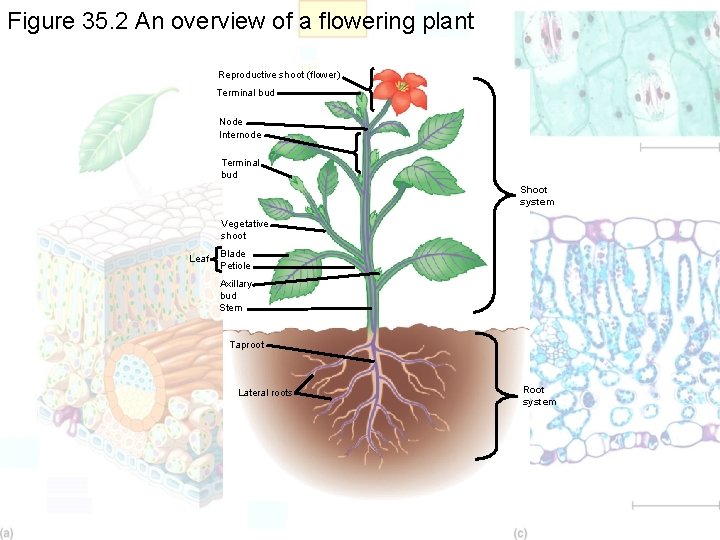
Figure 35. 2 An overview of a flowering plant Reproductive shoot (flower) Terminal bud Node Internode Terminal bud Shoot system Vegetative shoot Leaf Blade Petiole Axillary bud Stem Taproot Lateral roots Root system
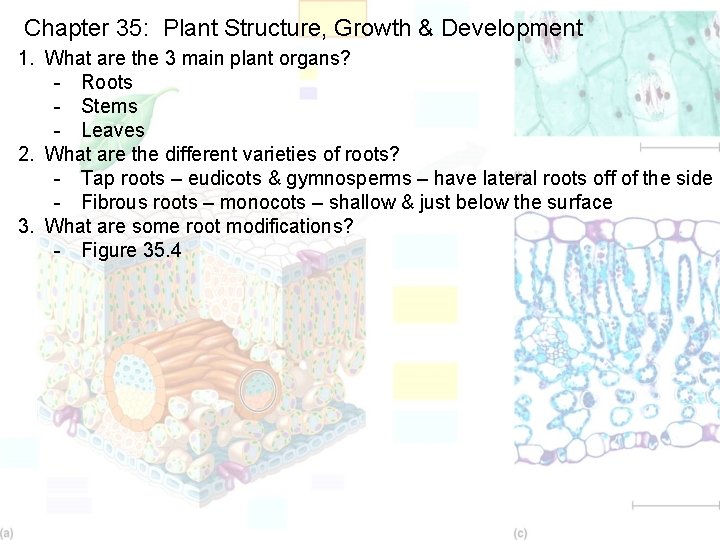
Chapter 35: Plant Structure, Growth & Development 1. What are the 3 main plant organs? - Roots - Stems - Leaves 2. What are the different varieties of roots? - Tap roots – eudicots & gymnosperms – have lateral roots off of the side - Fibrous roots – monocots – shallow & just below the surface 3. What are some root modifications? - Figure 35. 4
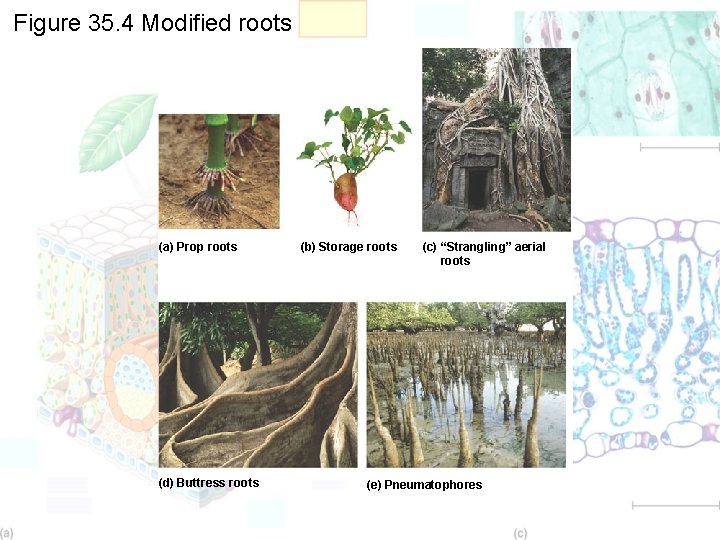
Figure 35. 4 Modified roots (a) Prop roots (d) Buttress roots (b) Storage roots (c) “Strangling” aerial roots (e) Pneumatophores
Students Pre-lab for Lab 4 Part II – due tomorrow Essays on-line – bring tomorrow Test Friday
Chapter 35: Plant Structure, Growth & Development 1. What are the 3 main plant organs? - Roots - Stems - Leaves 2. What are the different varieties of roots? - Tap roots – eudicots & gymnosperms – have lateral roots off of the side - Fibrous roots – monocots – shallow & just below the surface 3. What are some root modifications? - Figure 35. 4 4. What are stems? - Above ground organ with an alternating system of nodes (where the leaves attach) & internodes (stem segments between nodes) - Axillary bud – structure at each node that may form a lateral shoot (branch) 5. What are some stem modifications? - Figure 35. 5
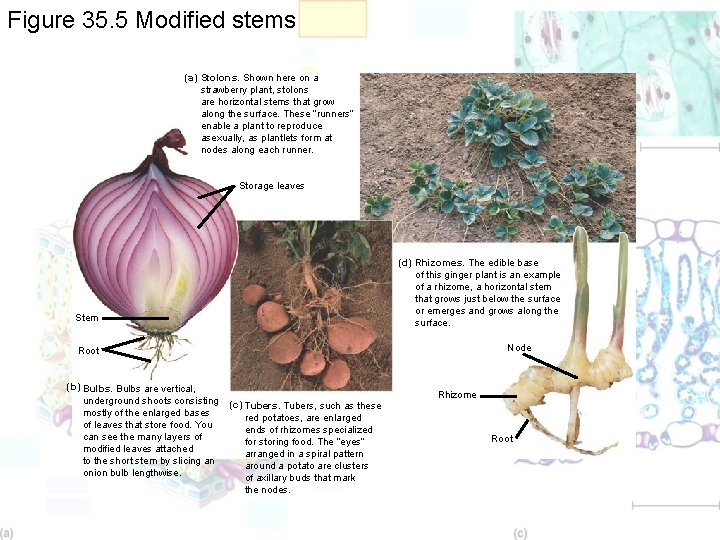
Figure 35. 5 Modified stems (a) Stolons. Shown here on a strawberry plant, stolons are horizontal stems that grow along the surface. These “runners” enable a plant to reproduce asexually, as plantlets form at nodes along each runner. Storage leaves (d) Rhizomes. The edible base of this ginger plant is an example of a rhizome, a horizontal stem that grows just below the surface or emerges and grows along the surface. Stem Node Root (b) Bulbs are vertical, underground shoots consisting mostly of the enlarged bases of leaves that store food. You can see the many layers of modified leaves attached to the short stem by slicing an onion bulb lengthwise. (c) Tubers, such as these red potatoes, are enlarged ends of rhizomes specialized for storing food. The “eyes” arranged in a spiral pattern around a potato are clusters of axillary buds that mark the nodes. Rhizome Root
Chapter 35: Plant Structure, Growth & Development 1. 2. 3. 4. 5. 6. What are the 3 main plant organs? What are the different varieties of roots? What are some root modifications? What are stems? What are some stem modifications? What is a leaf? - Main photosynthetic organ of a plant
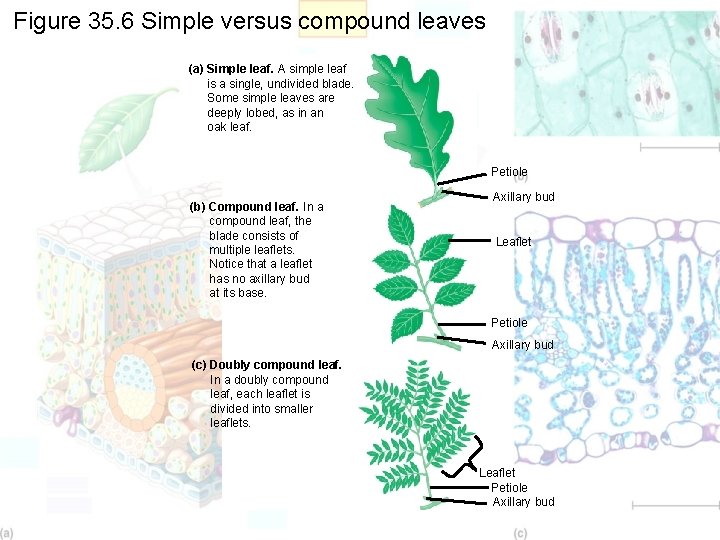
Figure 35. 6 Simple versus compound leaves (a) Simple leaf. A simple leaf is a single, undivided blade. Some simple leaves are deeply lobed, as in an oak leaf. Petiole (b) Compound leaf. In a compound leaf, the blade consists of multiple leaflets. Notice that a leaflet has no axillary bud at its base. Axillary bud Leaflet Petiole Axillary bud (c) Doubly compound leaf. In a doubly compound leaf, each leaflet is divided into smaller leaflets. Leaflet Petiole Axillary bud
Chapter 35: Plant Structure, Growth & Development 1. 2. 3. 4. 5. 6. What are the 3 main plant organs? What are the different varieties of roots? What are some root modifications? What are stems? What are some stem modifications? What is a leaf? - Main photosynthetic organ of a plant 7. What are some modified leaves? - Figure 35. 7
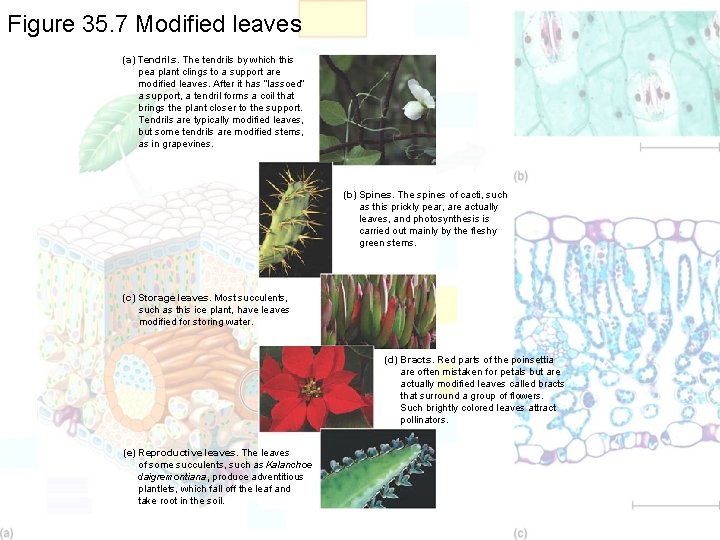
Figure 35. 7 Modified leaves (a) Tendrils. The tendrils by which this pea plant clings to a support are modified leaves. After it has “lassoed” a support, a tendril forms a coil that brings the plant closer to the support. Tendrils are typically modified leaves, but some tendrils are modified stems, as in grapevines. (b) Spines. The spines of cacti, such as this prickly pear, are actually leaves, and photosynthesis is carried out mainly by the fleshy green stems. (c) Storage leaves. Most succulents, such as this ice plant, have leaves modified for storing water. (d) Bracts. Red parts of the poinsettia are often mistaken for petals but are actually modified leaves called bracts that surround a group of flowers. Such brightly colored leaves attract pollinators. (e) Reproductive leaves. The leaves of some succulents, such as Kalanchoe daigremontiana, produce adventitious plantlets, which fall off the leaf and take root in the soil.
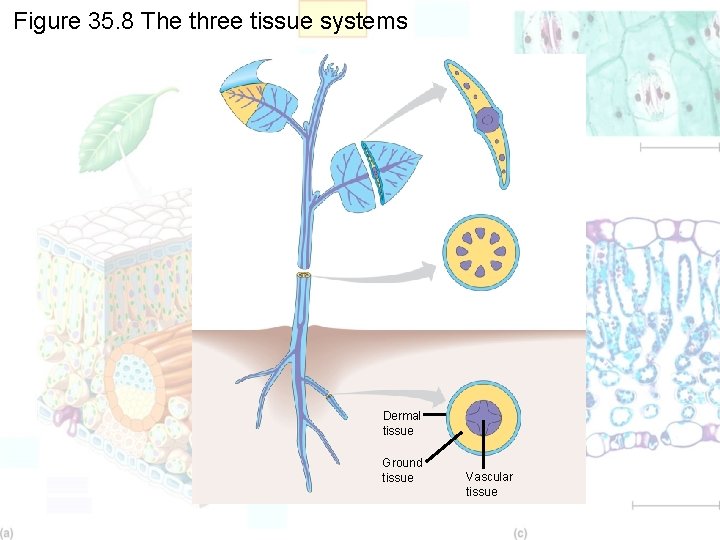
Chapter 35: Plant Structure, Growth & Development 1. 2. 3. 4. 5. 6. 7. 8. What are the 3 main plant organs? What are the different varieties of roots? What are some root modifications? What are stems? What are some stem modifications? What is a leaf? What are some modified leaves? What are the 3 tissue systems of plants? - Dermal – outer protective covering - Vascular – long distance transport between roots & shoots - Ground – tissue between vascular & dermal
Figure 35. 8 The three tissue systems Dermal tissue Ground tissue Vascular tissue
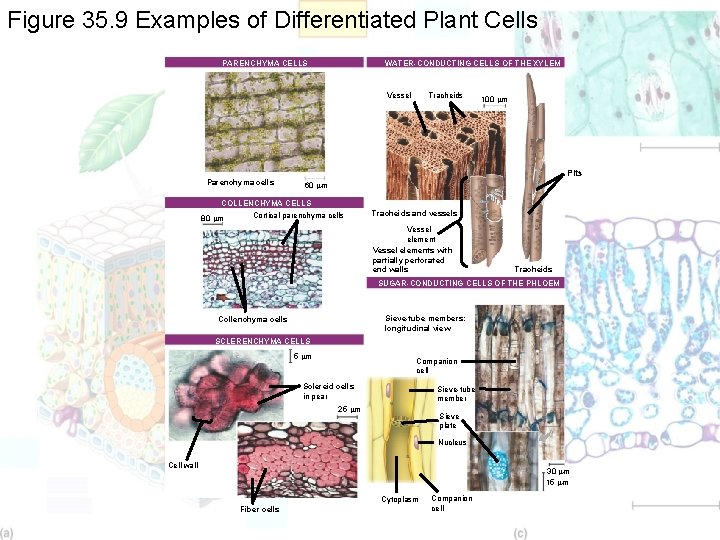
Chapter 35: Plant Structure, Growth & Development 1. 2. 3. 4. 5. 6. 7. 8. 9. What are the 3 main plant organs? What are the different varieties of roots? What are some root modifications? What are stems? What are some stem modifications? What is a leaf? What are some modified leaves? What are the 3 tissue systems of plants? What are the different types of plant cells? - Parenchyma - Least specialized, typical plant cell - Thin, flexible primary walls - Do most of metabolic work - Photosynthesis - Storage - All other cells derived from parenchyma
Chapter 35: Plant Structure, Growth & Development 1. 2. 3. 4. 5. 6. 7. 8. 9. What are the 3 main plant organs? What are the different varieties of roots? What are some root modifications? What are stems? What are some stem modifications? What is a leaf? What are some modified leaves? What are the 3 tissue systems of plants? What are the different types of plant cells? - Parenchyma - Collenchyma - Uneven & thicker primary walls than parenchyma - Grouped in strands or cylinders for support of young plant - Provide support without restricting growth - No secondary walls & no lignin
Chapter 35: Plant Structure, Growth & Development 1. 2. 3. 4. 5. 6. 7. 8. 9. What are the 3 main plant organs? What are the different varieties of roots? What are some root modifications? What are stems? What are some stem modifications? What is a leaf? What are some modified leaves? What are the 3 tissue systems of plants? What are the different types of plant cells? - Parenchyma - Collenchyma - Sclerenchyma - Thicker secondary walls with lignin for rigid support - Mature sclerenchyma cannot elongate & are usually dead lacking a protoplast - 2 forms - Fibers – long, slender, tapered & usually in bundles – rope & flax fibers for linen - Sclerids – short & irregular shaped that provide hardness to nut shells, seed coats & the gritty texture of pears
Chapter 35: Plant Structure, Growth & Development 1. 2. 3. 4. 5. 6. 7. 8. 9. What are the 3 main plant organs? What are the different varieties of roots? What are some root modifications? What are stems? What are some stem modifications? What is a leaf? What are some modified leaves? What are the 3 tissue systems of plants? What are the different types of plant cells? - Parenchyma - Collenchyma - Sclerenchyma - Tracheids & vessels elements - H 2 O conducting cells - Tracheids - All vascular plants - Long, thin cells with tapered ends - Vessel elements (angiosperms) - Wider, shorter & less tapered - Perforated ends & sometimes sides
Chapter 35: Plant Structure, Growth & Development 1. 2. 3. 4. 5. 6. 7. 8. 9. What are the 3 main plant organs? What are the different varieties of roots? What are some root modifications? What are stems? What are some stem modifications? What is a leaf? What are some modified leaves? What are the 3 tissue systems of plants? What are the different types of plant cells? - Parenchyma - Collenchyma - Sclerenchyma - Tracheids & vessels elements - Sieve-tube members - Sugar-conducting cells of phloem - Alive but lack nucleus, ribosomes, & vacuole - Companion cells help load sugar
Figure 35. 9 Examples of Differentiated Plant Cells PARENCHYMA CELLS WATER-CONDUCTING CELLS OF THE XYLEM Tracheids Vessel Parenchyma cells 100 m Pits 60 m COLLENCHYMA CELLS Cortical parenchyma cells 80 m Tracheids and vessels Vessel elements with partially perforated end walls Tracheids SUGAR-CONDUCTING CELLS OF THE PHLOEM Sieve-tube members: longitudinal view Collenchyma cells SCLERENCHYMA CELLS 5 m Companion cell Sclereid cells in pear Sieve-tube member 25 m Sieve plate Nucleus Cell wall 30 m 15 m Cytoplasm Fiber cells Companion cell
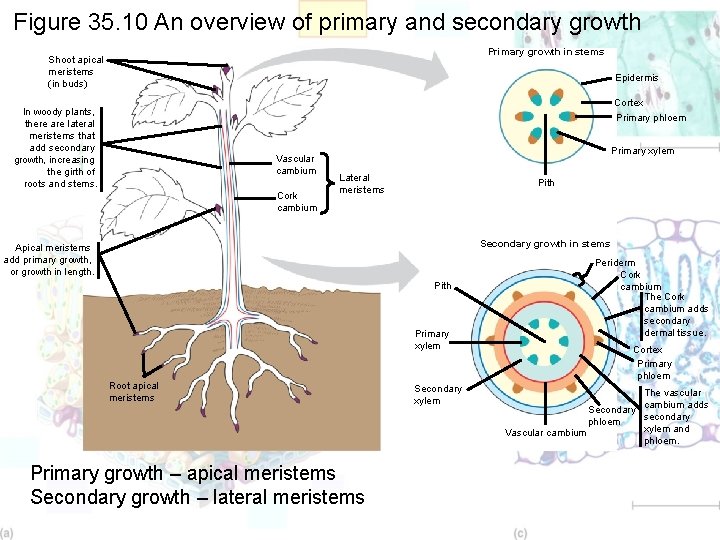
Chapter 35: Plant Structure, Growth & Development 1. What are the 3 main plant organs? 2. What are the different varieties of roots? 3. What are some root modifications? 4. What are stems? 5. What are some stem modifications? 6. What is a leaf? 7. What are some modified leaves? 8. What are the 3 tissue systems of plants? 9. What are the different types of plant cells? 10. Where do plants grow? - Meristems
Figure 35. 10 An overview of primary and secondary growth Primary growth in stems Shoot apical meristems (in buds) Epidermis Cortex In woody plants, there are lateral meristems that add secondary growth, increasing the girth of roots and stems. Primary phloem Vascular cambium Cork cambium Primary xylem Lateral meristems Pith Secondary growth in stems Apical meristems add primary growth, or growth in length. Pith Primary xylem Root apical meristems Primary growth – apical meristems Secondary growth – lateral meristems Secondary xylem Periderm Cork cambium The Cork cambium adds secondary dermal tissue. Cortex Primary phloem The vascular cambium adds Secondary secondary phloem xylem and Vascular cambium phloem.
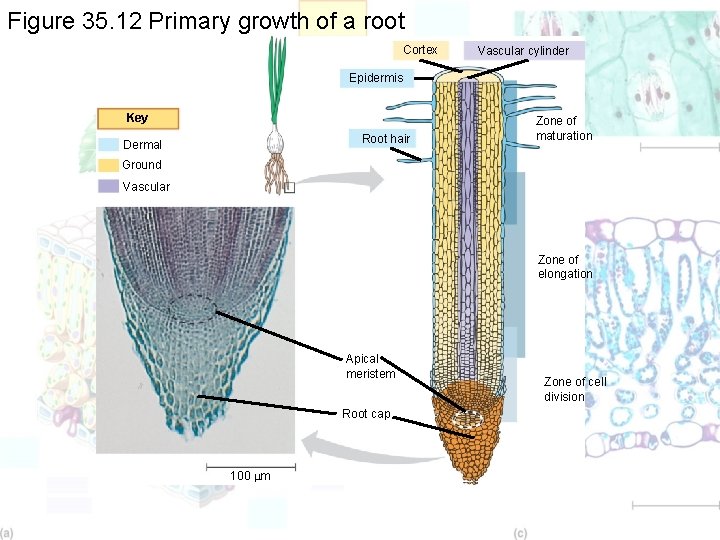
Figure 35. 12 Primary growth of a root Cortex Vascular cylinder Epidermis Key Root hair Dermal Zone of maturation Ground Vascular Zone of elongation Apical meristem Root cap 100 m Zone of cell division
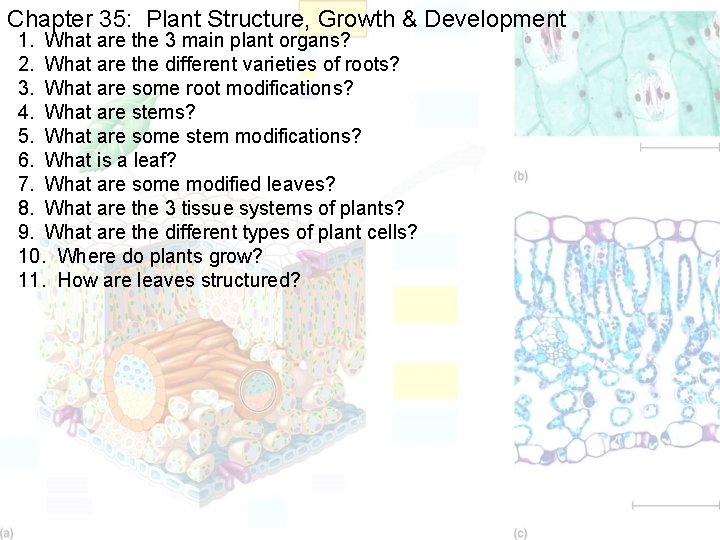
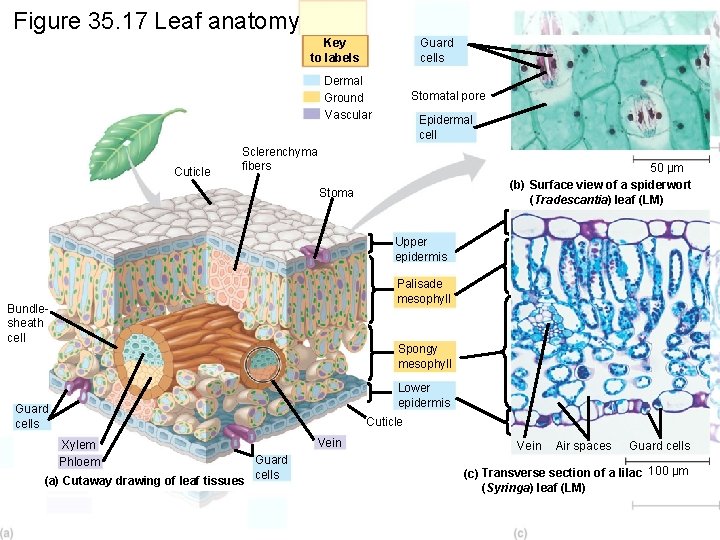
Chapter 35: Plant Structure, Growth & Development 1. What are the 3 main plant organs? 2. What are the different varieties of roots? 3. What are some root modifications? 4. What are stems? 5. What are some stem modifications? 6. What is a leaf? 7. What are some modified leaves? 8. What are the 3 tissue systems of plants? 9. What are the different types of plant cells? 10. Where do plants grow? 11. How are leaves structured?
Figure 35. 17 Leaf anatomy Key to labels Guard cells Dermal Ground Vascular Cuticle Stomatal pore Epidermal cell Sclerenchyma fibers 50 µm (b) Surface view of a spiderwort (Tradescantia) leaf (LM) Stoma Upper epidermis Palisade mesophyll Bundlesheath cell Spongy mesophyll Lower epidermis Guard cells Cuticle Xylem Phloem Guard (a) Cutaway drawing of leaf tissues cells Vein Air spaces Guard cells (c) Transverse section of a lilac 100 µm (Syringa) leaf (LM)
Chapter 35: Plant Structure, Growth & Development 1. What are the 3 main plant organs? 2. What are the different varieties of roots? 3. What are some root modifications? 4. What are stems? 5. What are some stem modifications? 6. What is a leaf? 7. What are some modified leaves? 8. What are the 3 tissue systems of plants? 9. What are the different types of plant cells? 10. Where do plants grow? 11. How are leaves structured? 12. Let’s consider primary & secondary growth of a stem….
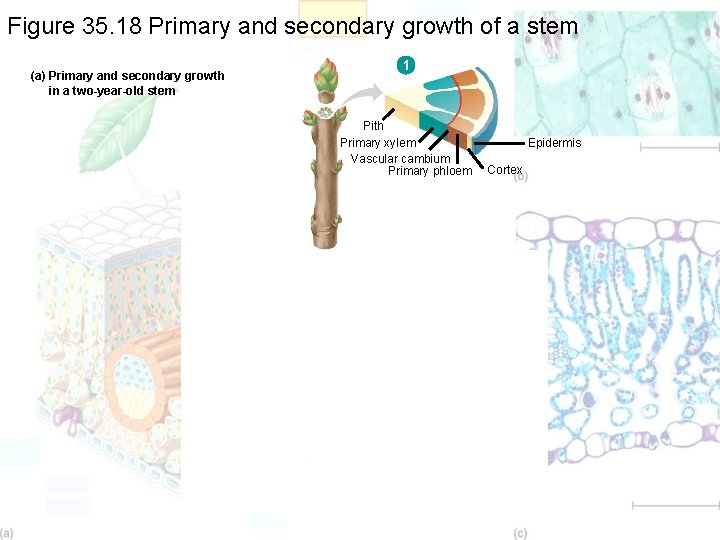
Figure 35. 18 Primary and secondary growth of a stem (a) Primary and secondary growth in a two-year-old stem 1 Pith Primary xylem Vascular cambium Primary phloem Epidermis Cortex
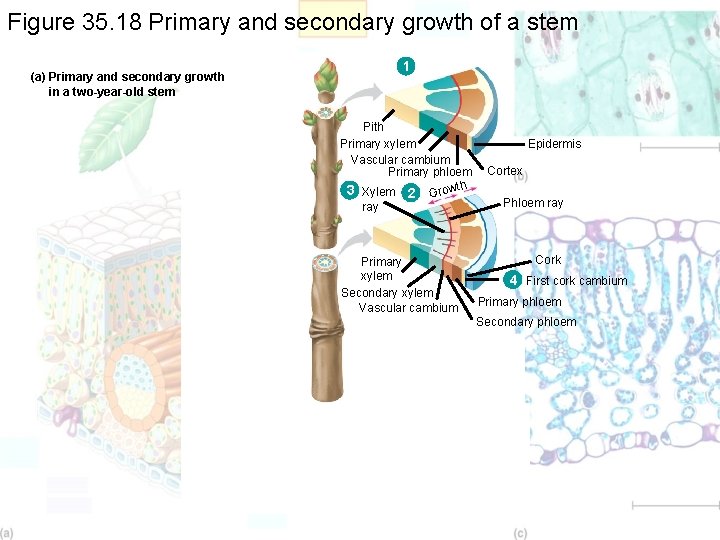
Figure 35. 18 Primary and secondary growth of a stem (a) Primary and secondary growth in a two-year-old stem 1 Pith Primary xylem Vascular cambium Primary phloem 3 Xylem 2 Growth ray Primary xylem Secondary xylem Vascular cambium Epidermis Cortex Phloem ray Cork 4 First cork cambium Primary phloem Secondary phloem
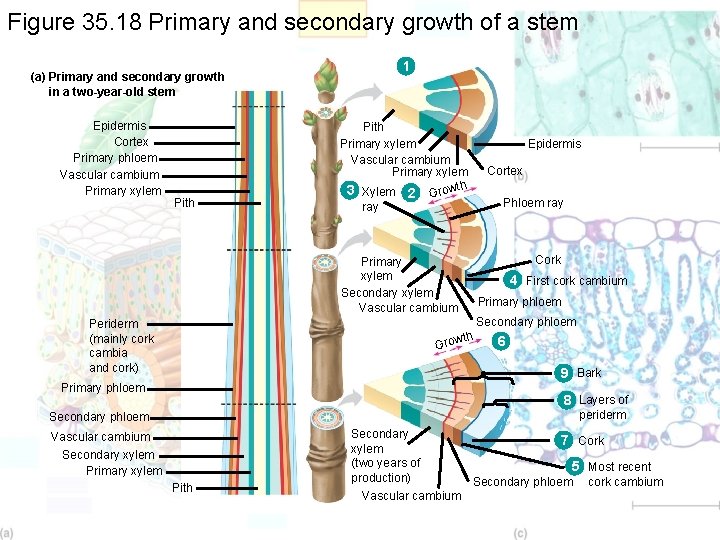
Figure 35. 18 Primary and secondary growth of a stem (a) Primary and secondary growth in a two-year-old stem Epidermis Cortex Primary phloem Vascular cambium Primary xylem Pith 1 Pith Primary xylem Vascular cambium Primary xylem 3 Xylem 2 Growth ray Primary xylem Secondary xylem Vascular cambium Epidermis Cortex Phloem ray Cork 4 First cork cambium Primary phloem Secondary phloem Periderm (mainly cork cambia and cork) th Grow 6 9 Bark Primary phloem 8 Layers of periderm Secondary phloem Vascular cambium Secondary xylem Primary xylem Pith Secondary 7 Cork xylem (two years of 5 Most recent production) Secondary phloem cork cambium Vascular cambium
Chapter 35: Plant Structure, Growth & Development 1. What are the 3 main plant organs? 2. What are the different varieties of roots? 3. What are some root modifications? 4. What are stems? 5. What are some stem modifications? 6. What is a leaf? 7. What are some modified leaves? 8. What are the 3 tissue systems of plants? 9. What are the different types of plant cells? 10. Where do plants grow? 11. How are leaves structured? 12. Let’s consider primary & secondary growth of a stem…. 13. Where does secondary occur? - Vascular cambium
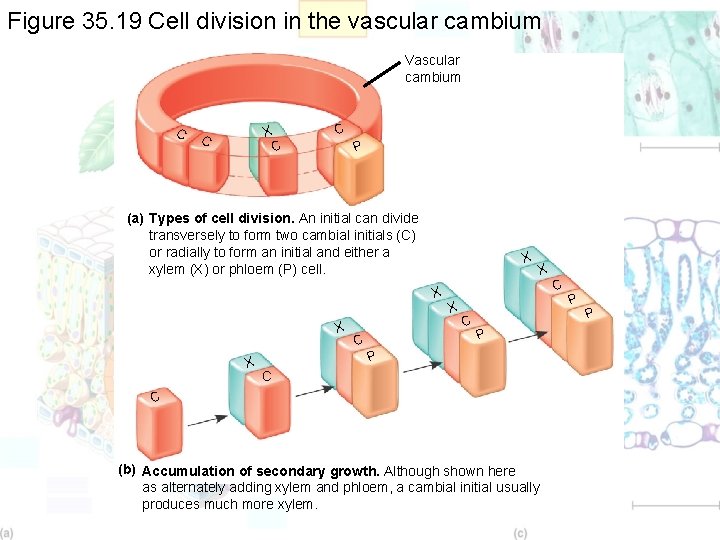
Figure 35. 19 Cell division in the vascular cambium Vascular cambium C X C C C P (a) Types of cell division. An initial can divide transversely to form two cambial initials (C) or radially to form an initial and either a xylem (X) or phloem (P) cell. X X C X C P P C C (b) Accumulation of secondary growth. Although shown here as alternately adding xylem and phloem, a cambial initial usually produces much more xylem. P P
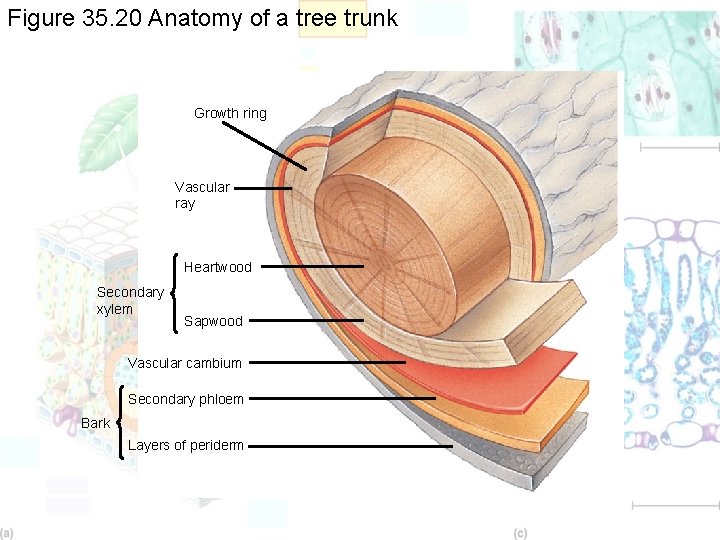
Figure 35. 20 Anatomy of a tree trunk Growth ring Vascular ray Heartwood Secondary xylem Sapwood Vascular cambium Secondary phloem Bark Layers of periderm