
Chapter 34 The Laws of Electromagnetism Maxwells Equations
- Slides: 23
Chapter 34 The Laws of Electromagnetism Maxwell’s Equations Displacement Current Electromagnetic Radiation
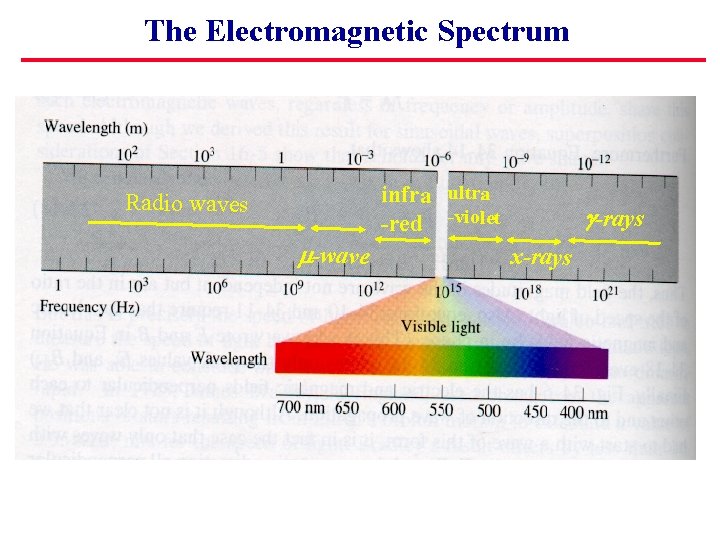
The Electromagnetic Spectrum infra ultra -red -violet Radio waves m-wave g-rays x-rays
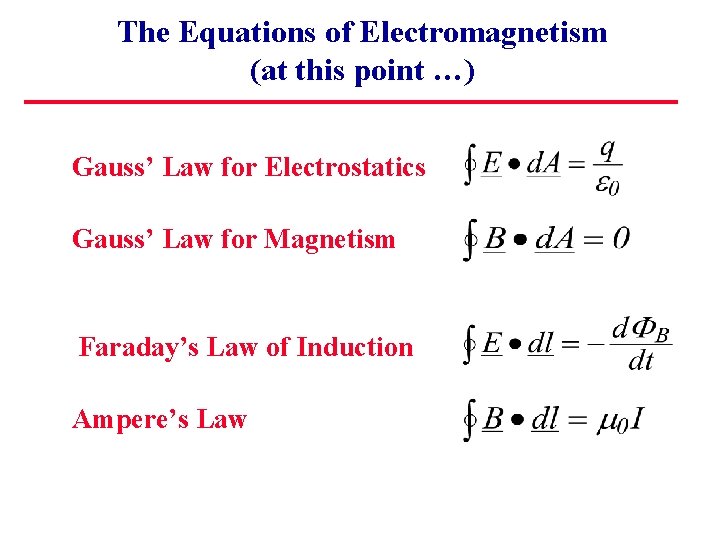
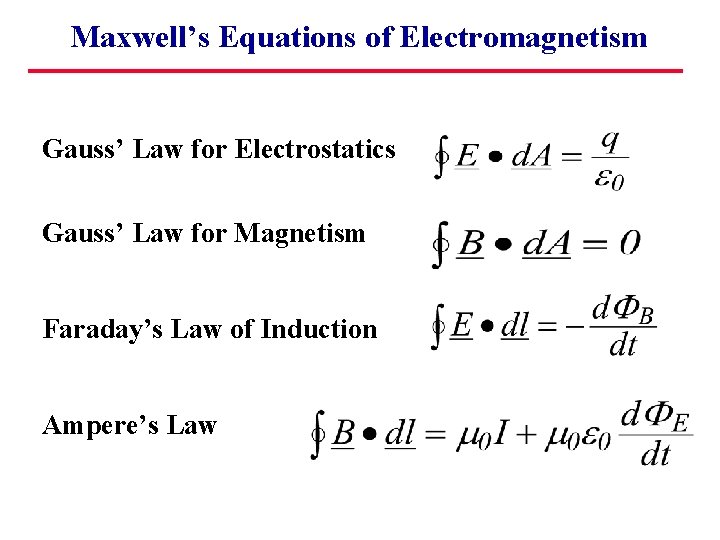
The Equations of Electromagnetism (at this point …) Gauss’ Law for Electrostatics Gauss’ Law for Magnetism Faraday’s Law of Induction Ampere’s Law
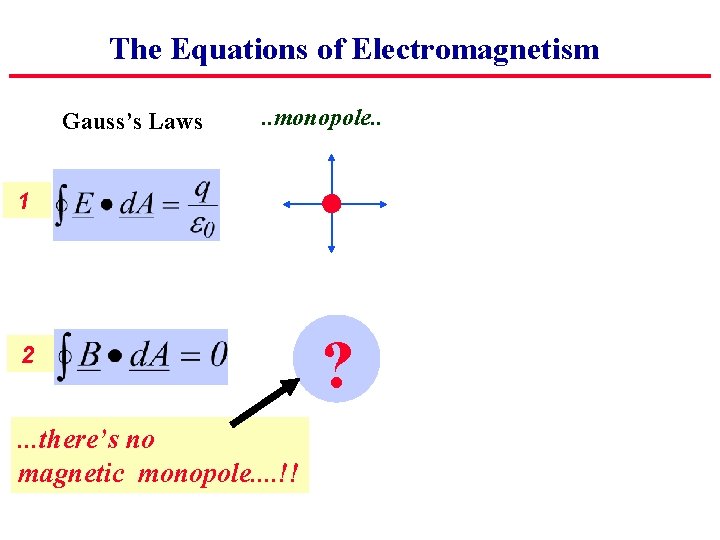
The Equations of Electromagnetism Gauss’s Laws . . monopole. . 1 2 . . . there’s no magnetic monopole. . !! ?
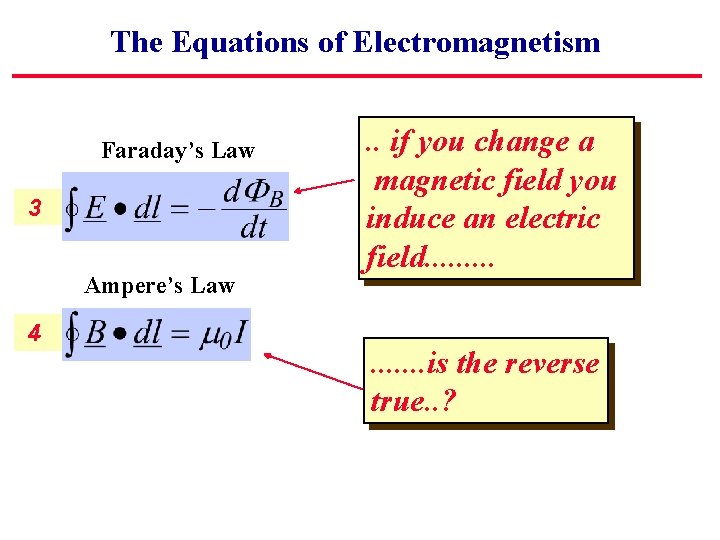
The Equations of Electromagnetism Faraday’s Law 3 Ampere’s Law 4 . . if you change a magnetic field you induce an electric field. . . . is the reverse true. . ?
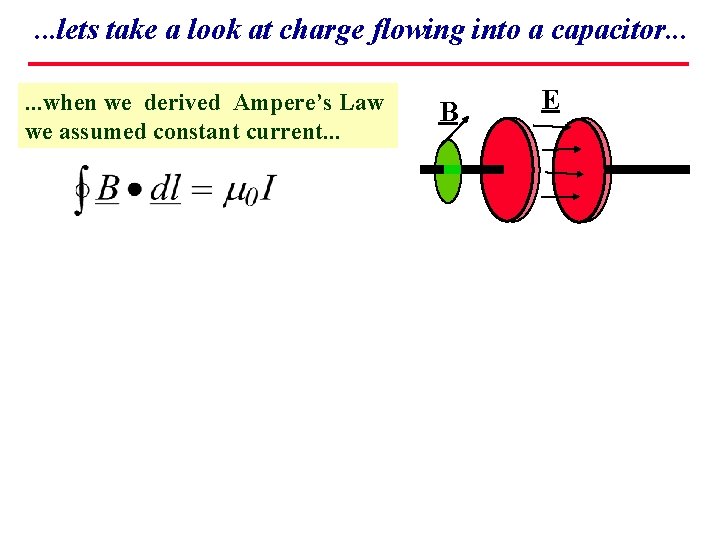
. . . lets take a look at charge flowing into a capacitor. . . when we derived Ampere’s Law we assumed constant current. . . B E
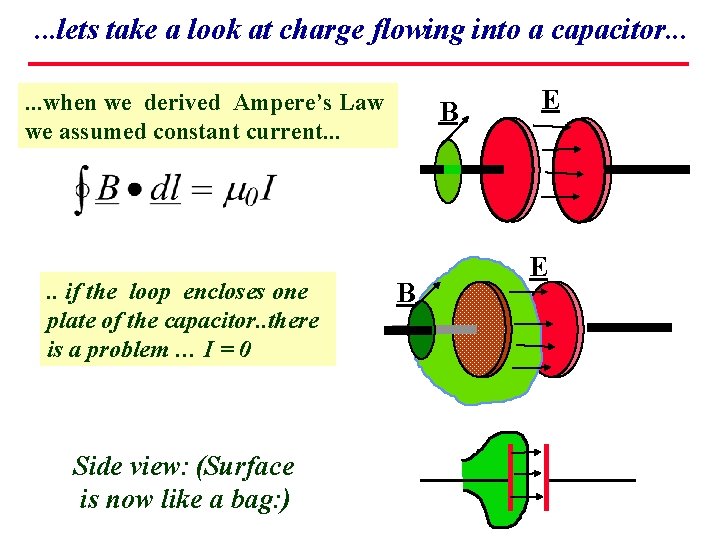
. . . lets take a look at charge flowing into a capacitor. . . when we derived Ampere’s Law we assumed constant current. . . if the loop encloses one plate of the capacitor. . there is a problem … I = 0 Side view: (Surface is now like a bag: ) B B E E
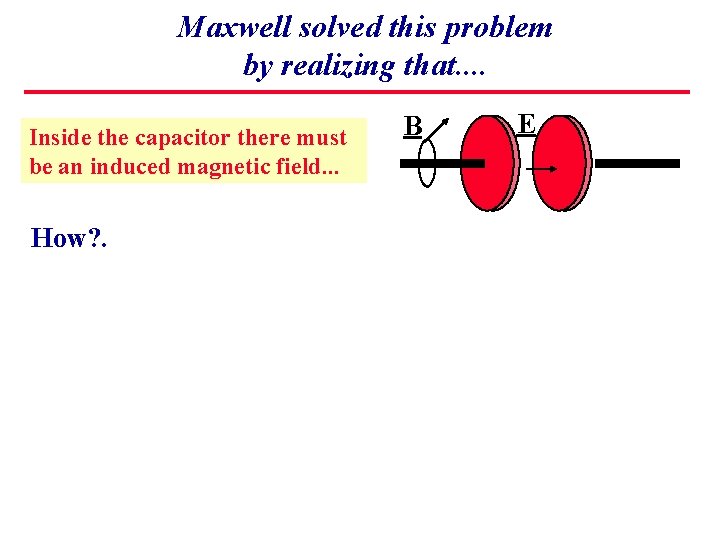
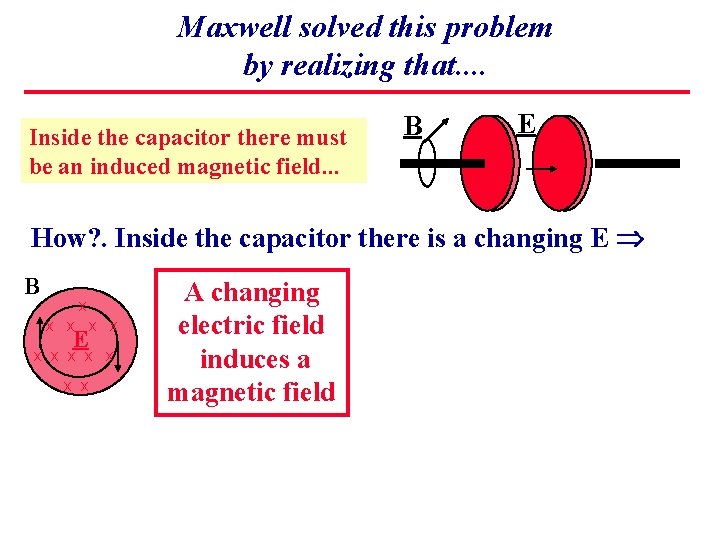
Maxwell solved this problem by realizing that. . Inside the capacitor there must be an induced magnetic field. . . How? . B E
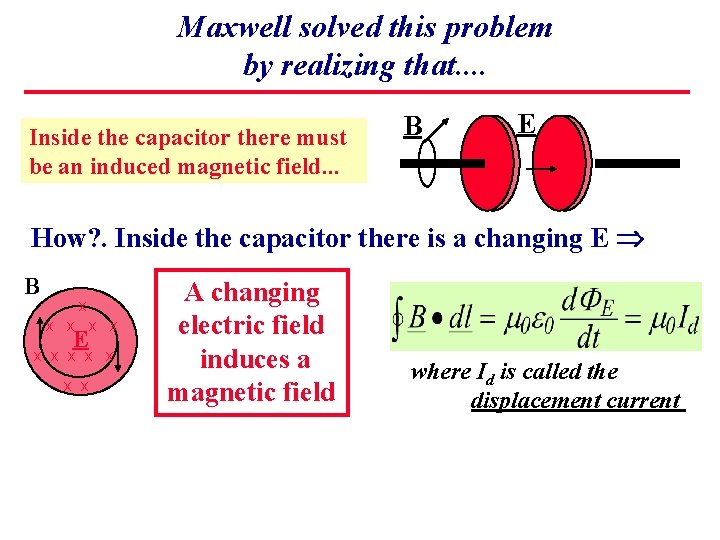
Maxwell solved this problem by realizing that. . Inside the capacitor there must be an induced magnetic field. . . B E How? . Inside the capacitor there is a changing E B x x x E x x x x A changing electric field induces a magnetic field
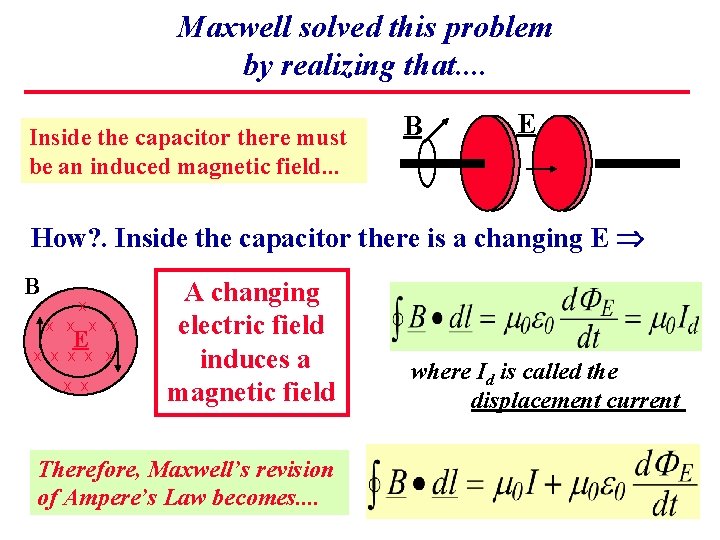
Maxwell solved this problem by realizing that. . Inside the capacitor there must be an induced magnetic field. . . B E How? . Inside the capacitor there is a changing E B x x x E x x x x A changing electric field induces a magnetic field where Id is called the displacement current
Maxwell solved this problem by realizing that. . Inside the capacitor there must be an induced magnetic field. . . B E How? . Inside the capacitor there is a changing E B x x x E x x x x A changing electric field induces a magnetic field Therefore, Maxwell’s revision of Ampere’s Law becomes. . where Id is called the displacement current
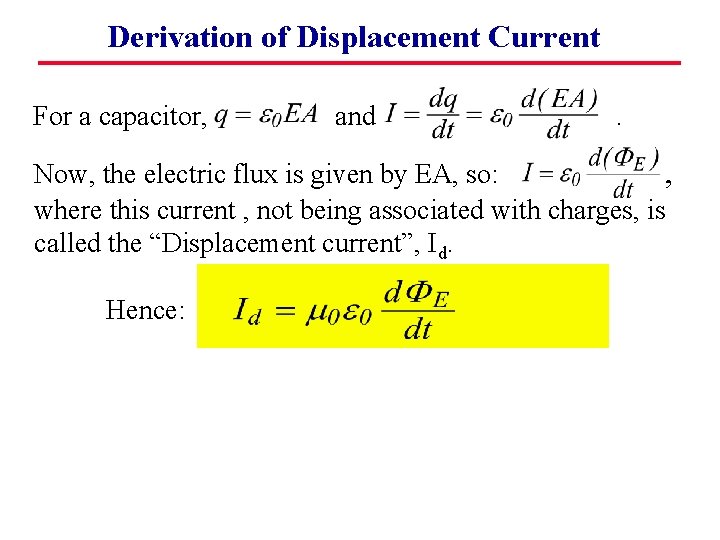
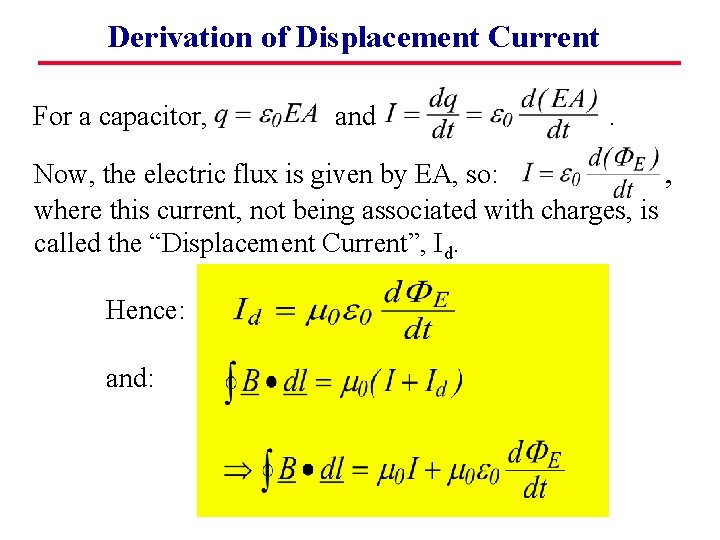
Derivation of Displacement Current For a capacitor, and . Now, the electric flux is given by EA, so: , where this current , not being associated with charges, is called the “Displacement current”, Id. Hence: and:
Derivation of Displacement Current For a capacitor, and . Now, the electric flux is given by EA, so: , where this current, not being associated with charges, is called the “Displacement Current”, Id. Hence: and:
Maxwell’s Equations of Electromagnetism Gauss’ Law for Electrostatics Gauss’ Law for Magnetism Faraday’s Law of Induction Ampere’s Law
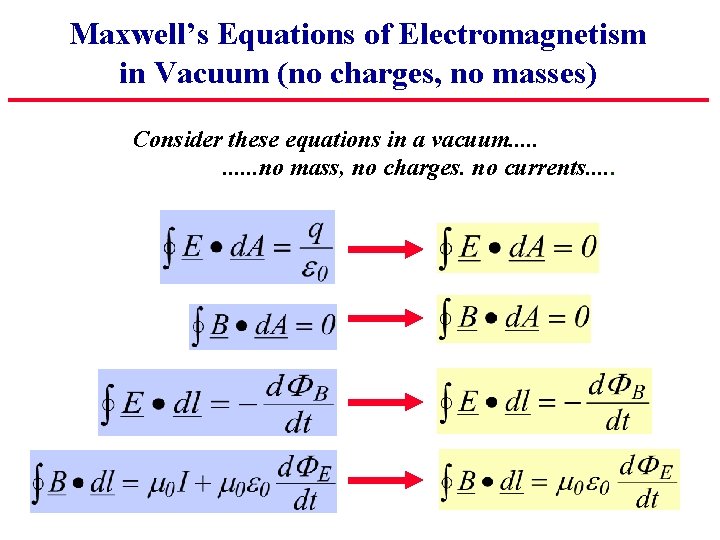
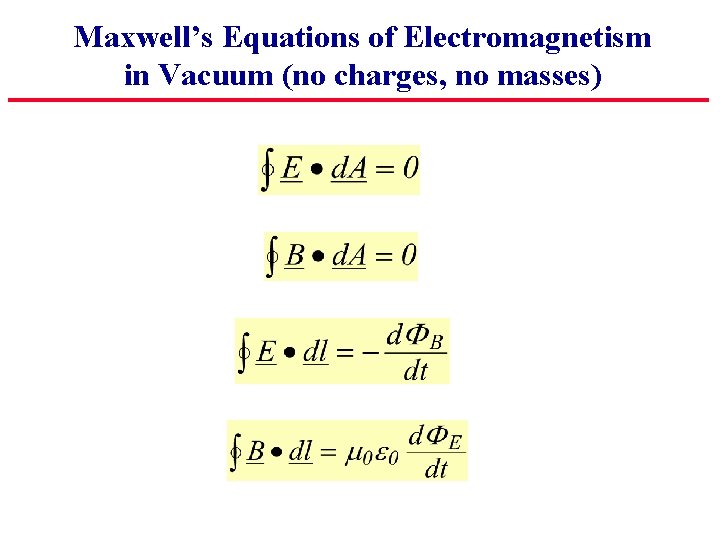
Maxwell’s Equations of Electromagnetism in Vacuum (no charges, no masses) Consider these equations in a vacuum. . . no mass, no charges. no currents. . .
Maxwell’s Equations of Electromagnetism in Vacuum (no charges, no masses)
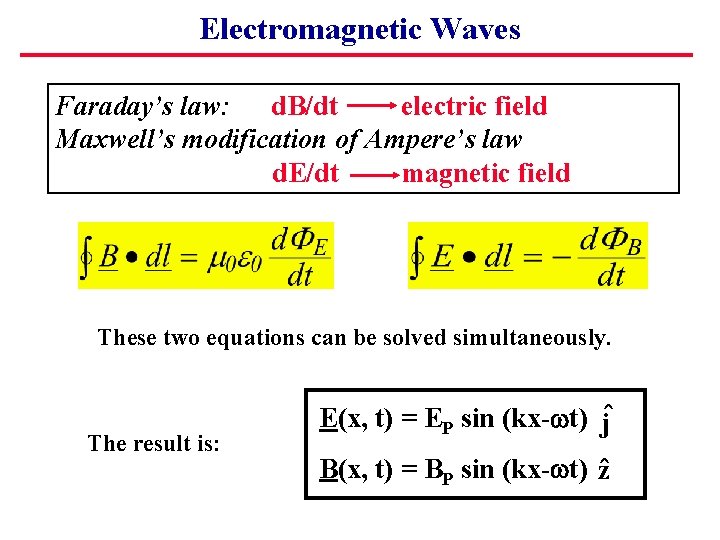
Electromagnetic Waves Faraday’s law: d. B/dt electric field Maxwell’s modification of Ampere’s law d. E/dt magnetic field These two equations can be solved simultaneously. The result is: E(x, t) = EP sin (kx- t) jˆ B(x, t) = BP sin (kx- t) zˆ
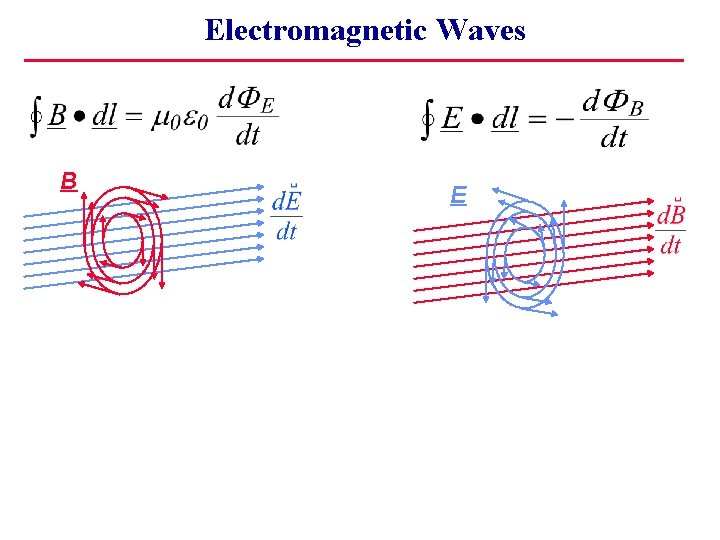
Electromagnetic Waves B E
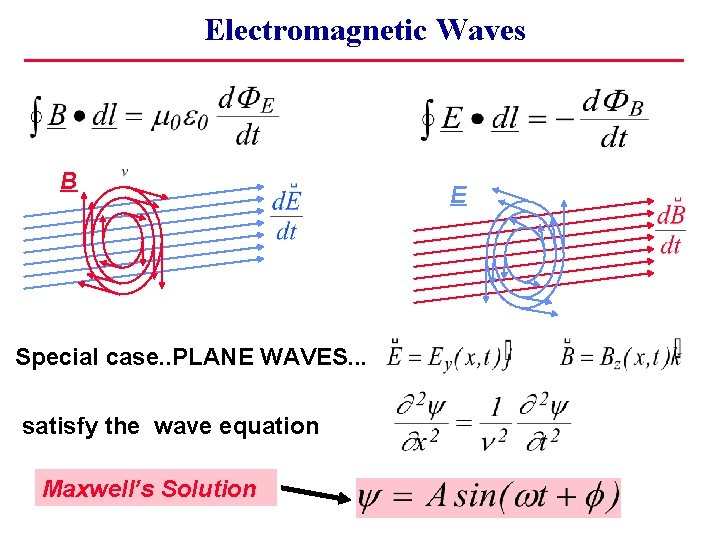
Electromagnetic Waves B Special case. . PLANE WAVES. . . satisfy the wave equation Maxwell’s Solution E
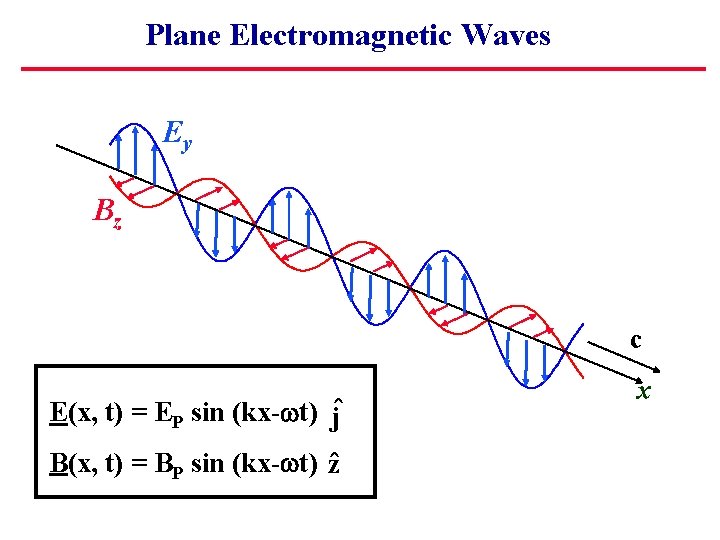
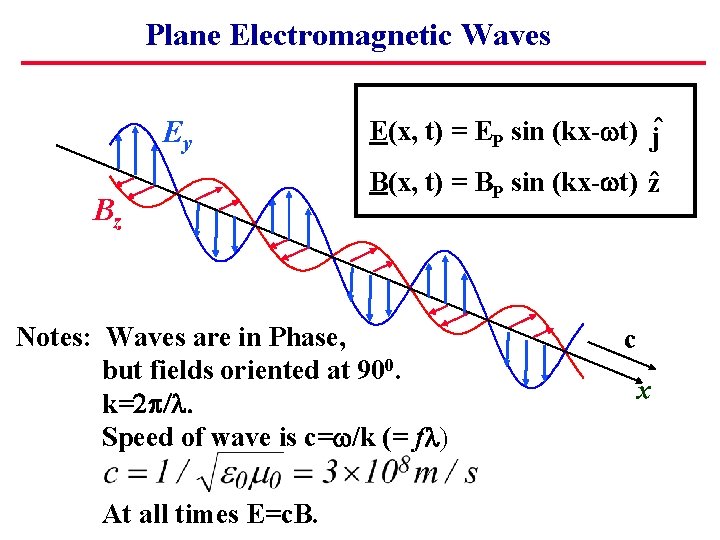
Plane Electromagnetic Waves Ey Bz c E(x, t) = EP sin (kx- t) jˆ B(x, t) = BP sin (kx- t) zˆ x
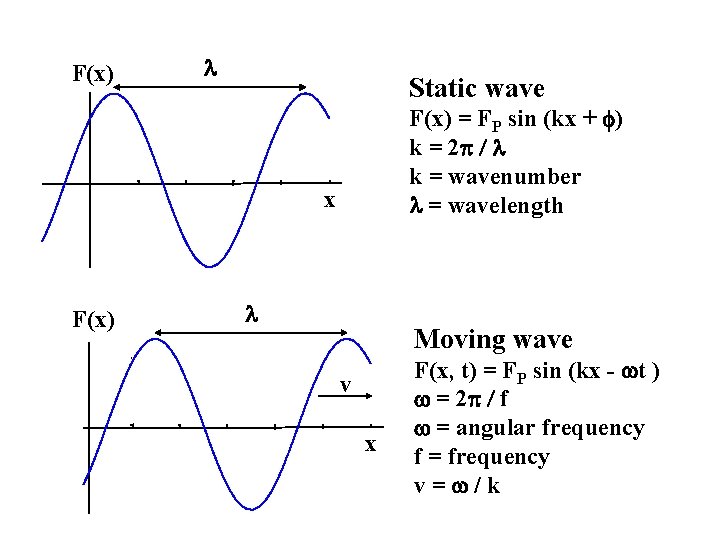
F(x) Static wave F(x) = FP sin (kx + ) k = 2 k = wavenumber = wavelength x F(x) Moving wave v x F(x, t) = FP sin (kx - t ) = 2 f = angular frequency f = frequency v= /k
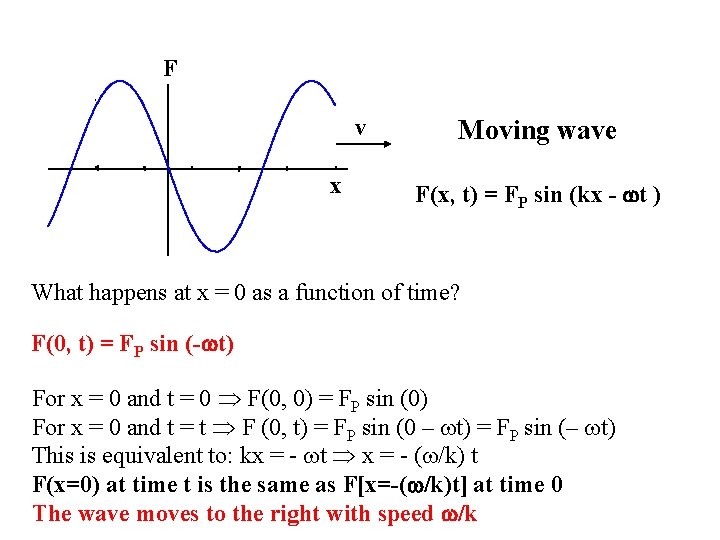
F v x Moving wave F(x, t) = FP sin (kx - t ) What happens at x = 0 as a function of time? F(0, t) = FP sin (- t) For x = 0 and t = 0 F(0, 0) = FP sin (0) For x = 0 and t = t F (0, t) = FP sin (0 – t) = FP sin (– t) This is equivalent to: kx = - t x = - ( /k) t F(x=0) at time t is the same as F[x=-( /k)t] at time 0 The wave moves to the right with speed /k
Plane Electromagnetic Waves Ey Bz E(x, t) = EP sin (kx- t) jˆ B(x, t) = BP sin (kx- t) zˆ Notes: Waves are in Phase, but fields oriented at 900. k=2 . Speed of wave is c= /k (= f ) At all times E=c. B. c x