
CHAPTER 34 SMALL BUSINESSES ENTREPRENEURS AND GENERAL PARTNERSHIPS
CHAPTER 34 SMALL BUSINESSES, ENTREPRENEURS, AND GENERAL PARTNERSHIPS © 2010 Pearson Education, Inc. , publishing as Prentice-Hall 1
Entrepreneur A person who forms and operates a new business either by him- or herself or with others. © 2010 Pearson Education, Inc. , publishing as Prentice-Hall 2
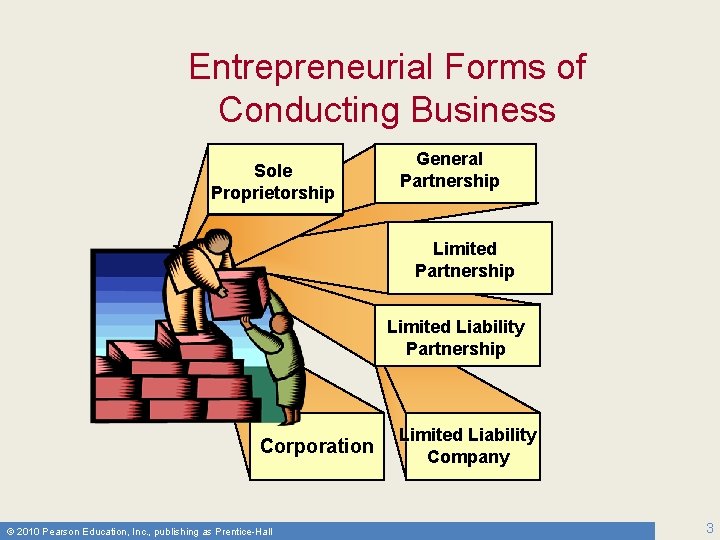
Entrepreneurial Forms of Conducting Business Sole Proprietorship General Partnership Limited Liability Partnership Corporation © 2010 Pearson Education, Inc. , publishing as Prentice-Hall Limited Liability Company 3
Sole Proprietorship • Owner is actually the business. • Business is not a separate legal entity. • Most common form of business organization in the United States. © 2010 Pearson Education, Inc. , publishing as Prentice-Hall 4
Advantages of Sole Proprietorship • Ease and low cost of formation. • Proprietor can make all management decisions. – E. g. , hiring and firing employees. – No other approvals required. • Proprietor owns entire business. • Has the right to receive all profits. • Easily transferred or sold. © 2010 Pearson Education, Inc. , publishing as Prentice-Hall 5
Disadvantages of Sole Proprietorship • Access to capital is limited to: – personal funds plus – any loans owner can obtain • Proprietor legally responsible for business’s contracts. • Proprietor responsible for torts committed in course of employment. © 2010 Pearson Education, Inc. , publishing as Prentice-Hall 6
Creation of a Sole Proprietorship • No formalities. • No federal or state government approval is required. • Some local governments require a license to do business within the city. • Can operate under name of the proprietor or trade name. – E. g. , Henry Cheeseman, d. b. a. “The Big Cheese. ” © 2010 Pearson Education, Inc. , publishing as Prentice-Hall 7
Personal Liability of Sole Proprietor • Proprietor bears the risk of loss of the business. – Will lose entire capital contribution if the business fails. • Proprietor has unlimited personal liability. • Creditors may recover claims against the business from proprietor’s personal assets. © 2010 Pearson Education, Inc. , publishing as Prentice-Hall 8
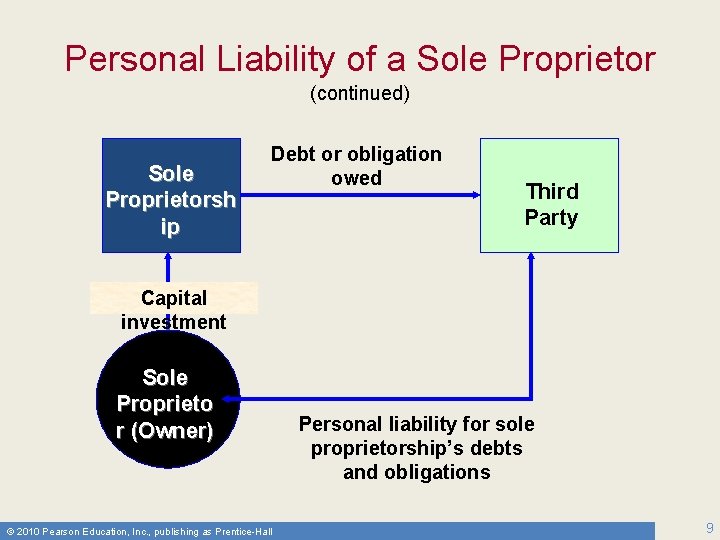
Personal Liability of a Sole Proprietor (continued) Sole Proprietorsh ip Debt or obligation owed Third Party Capital investment Sole Proprieto r (Owner) © 2010 Pearson Education, Inc. , publishing as Prentice-Hall Personal liability for sole proprietorship’s debts and obligations 9
Taxation of Sole Proprietorship • Does not pay taxes at business level. • Earnings and losses reported on proprietor’s personal income tax return. – Form 1040. – Schedule SE Self Employment Tax attached. © 2010 Pearson Education, Inc. , publishing as Prentice-Hall 10
General Partnership • Voluntary association of two or more people as co-owners of business. • Rights and duties between partners and with third parties defined by partnership agreement and by law. • Partners personally liable for debts and obligations of the partnership. © 2010 Pearson Education, Inc. , publishing as Prentice-Hall 11
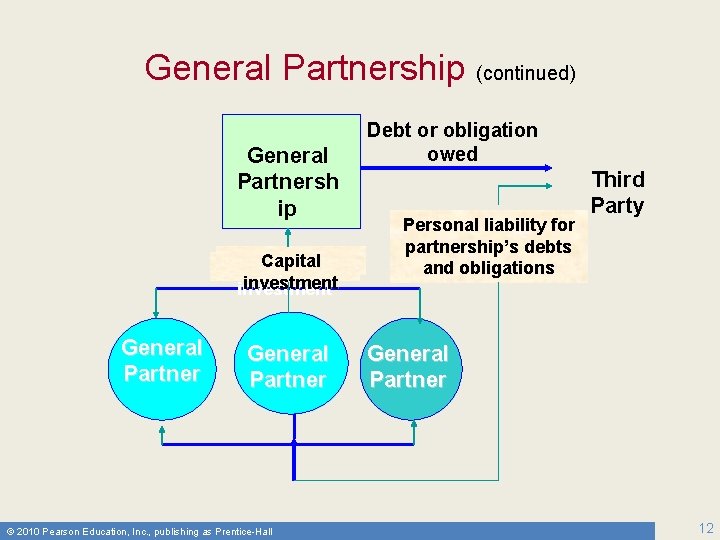
General Partnership (continued) General Partnersh ip Capital investment General Partner © 2010 Pearson Education, Inc. , publishing as Prentice-Hall Debt or obligation owed Personal liability for partnership’s debts and obligations Third Party General Partner 12
Uniform Partnership Act (UPA) • • Model act. Codifies partnership law. Most states have adopted. Covers most problems that arise in the formation, operation, and dissolution of ordinary partnerships. © 2010 Pearson Education, Inc. , publishing as Prentice-Hall 13
General Partnership Name • Can operate under name of any one or all of partners, or • May use fictitious name. – Must file fictitious business name certificate. – Publish notice. – Cannot be similar to name used by another business. © 2010 Pearson Education, Inc. , publishing as Prentice-Hall 14
Requirements for a General Partnership under UPA Four requirements: 1. Voluntary association of two or more persons Includes natural persons, partnerships, corporations. 2. Carrying on a business 3. As co-owners All partners must agree to participation. 4. For profit. © 2010 Pearson Education, Inc. , publishing as Prentice-Hall 15
Evidence of Partnership • Prima facie evidence: – Receipt of a share of business profits • Compelling evidence: – Agreement to share in profits and losses – Right to participate in management © 2010 Pearson Education, Inc. , publishing as Prentice-Hall 16
Partnership Agreement • May be written, oral, or implied from conduct. – Partnerships that exist for >1 year or deal in real estate must be in writing under Statute of Frauds. – Written agreement recommended. • No formalities generally required. – A few states require filing of certificate of partnership. © 2010 Pearson Education, Inc. , publishing as Prentice-Hall 17
Partnership Agreement (continued) • Partners free to determine terms, except illegal terms. • If agreement fails to specify an essential term, UPA will fill gaps. © 2010 Pearson Education, Inc. , publishing as Prentice-Hall 18
Taxation of Partnerships • Partnership does not pay federal income taxes. – Partnership files information return. • Income and losses reported on individual partners’ personal income tax returns. – “Flow through” taxation. © 2010 Pearson Education, Inc. , publishing as Prentice-Hall 19
Rights of General Partners • Unless otherwise agreed, each partner: – Has a right to participate in management, and – Has an equal vote on partnership matters. • Under UPA, a simple majority decides most ordinary partnership matters. © 2010 Pearson Education, Inc. , publishing as Prentice-Hall 20
Rights of General Partners (continued) • Unless otherwise agreed, partners share equally in profits and losses. • Unless otherwise agreed, partners not entitled to a salary. • Partners entitled to indemnification for expenditures on behalf of partnership. • Partners who make loans to partnership entitled to repayment. – After payment of other creditors. © 2010 Pearson Education, Inc. , publishing as Prentice-Hall 21
Rights of General Partners (continued) • Partners entitled to return of capital contributions upon termination of partnership. – After creditors paid. • Each partner has right to full information from other partners. – Right to inspect and copy records. © 2010 Pearson Education, Inc. , publishing as Prentice-Hall 22
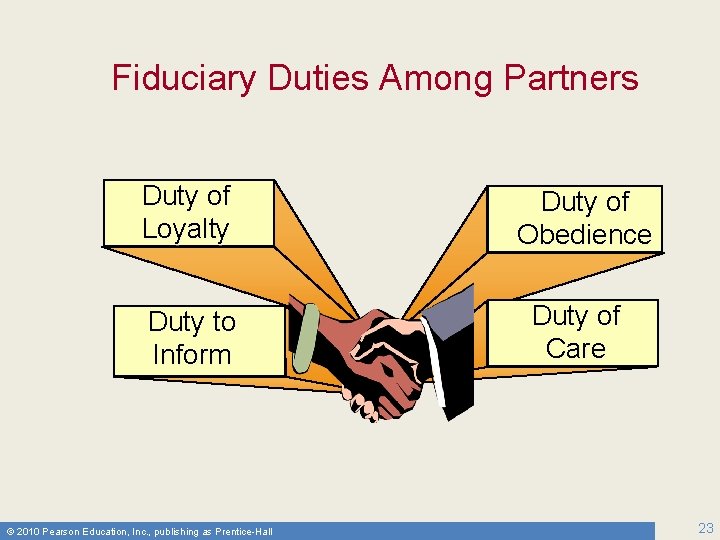
Fiduciary Duties Among Partners Duty of Loyalty Duty to Inform © 2010 Pearson Education, Inc. , publishing as Prentice-Hall Duty of Obedience Duty of Care 23
Duty of Loyalty • Duty imposed by law • Cannot be waived. • In case of conflict between partnership interests and personal interests, partner must choose the interest of the partnership. © 2010 Pearson Education, Inc. , publishing as Prentice-Hall 24
Breaches of Duty of Loyalty • Self-dealing without disclosure and consent of partnership • Usurping partnership opportunity • Competing with partnership © 2010 Pearson Education, Inc. , publishing as Prentice-Hall • Secret profits • E. g. , taking kickbacks. • Breach of confidentiality • Making personal use of partnership property 25
Duty of Care • Partners must use level of care and skill that reasonable person would use in the same circumstances. • Breach of this duty is negligence. • Partner is liable to the partnership for any damages caused by his or her negligence. • Partners not liable for honest errors in judgment. © 2010 Pearson Education, Inc. , publishing as Prentice-Hall 26
Duty to Inform • Partner must inform co-partners of all information he or she possesses that is relevant to the affairs of the partnership. • Knowledge is imputed to other partners. © 2010 Pearson Education, Inc. , publishing as Prentice-Hall 27
Duty of Obedience • Partners must adhere to provisions of partnership agreement and decisions of the partnership. • Partner who breaches this duty is liable to the partnership for any damages caused by the breach. © 2010 Pearson Education, Inc. , publishing as Prentice-Hall 28
Right to an Accounting • Partners cannot sue partnership. • Partners may bring action for an accounting. – Formal judicial proceeding in which the court is authorized to: • Review the partnership and the partners’ transactions, and • Award each partner his or her share of the partnership assets. © 2010 Pearson Education, Inc. , publishing as Prentice-Hall 29
Tort Liability of General Partners • Partnership is liable for tortious act of a partner, employee, or agent committed while the person is acting within the ordinary course of partnership business or with the authority of his or her co-partners. • Partners jointly and severally liable for torts and breaches of trust. © 2010 Pearson Education, Inc. , publishing as Prentice-Hall 30
Joint and Several Liability • Plaintiff can sue one or more of the partners separately and recover the entire amount of judgment from any or all of the defendantpartners. • Release of one partner does not discharge the others. • Partners who thus paid may seek indemnification from partner who committed wrongful act. © 2010 Pearson Education, Inc. , publishing as Prentice-Hall 31
Contract Liability • Partners are jointly liable for contracts and debts of partnership. • Third party must name all partners in suit. – If suit does not list all, judgment cannot be collected. – If one is released, all are released. • Successful third party may collect judgment against any or all partners. – Partners may seek indemnification if they pay more than their share. © 2010 Pearson Education, Inc. , publishing as Prentice-Hall 32
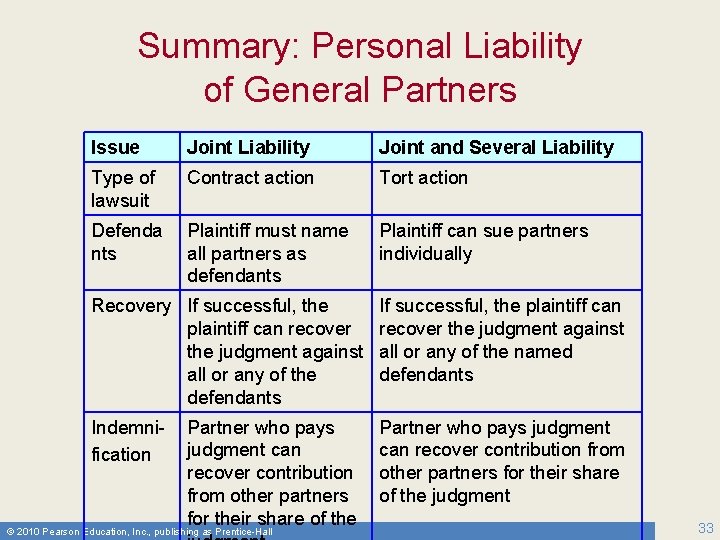
Summary: Personal Liability of General Partners Issue Joint Liability Joint and Several Liability Type of lawsuit Contract action Tort action Defenda nts Plaintiff must name all partners as defendants Plaintiff can sue partners individually Recovery If successful, the plaintiff can recover the judgment against all or any of the defendants If successful, the plaintiff can recover the judgment against all or any of the named defendants Indemnification Partner who pays judgment can recover contribution from other partners for their share of the judgment Partner who pays judgment can recover contribution from other partners for their share of the © 2010 Pearson Education, Inc. , publishing as Prentice-Hall 33
Liability of Incoming Partners • New partner who is admitted to the partnership is liable for the existing debts and obligations (antecedent debts) of the partnership only to the extent of his or her capital contribution. • The new partner is personally liable for debts and obligations incurred by the partnership after becoming a partner. © 2010 Pearson Education, Inc. , publishing as Prentice-Hall 34
Dissolution of General Partnership • Dissolution is “change in the relation of the partners caused by any partner ceasing to be associated in the carrying on of the business. ” • Duration of partnership may be: – A fixed term. – Until event occurs – At will. © 2010 Pearson Education, Inc. , publishing as Prentice-Hall 35
Wrongful Dissolution • A partner has the power to withdraw and dissolve the partnership at any time. – If is at-will partnership, partner has right to do so. – If is partnership for a term not yet expired, dissolution is wrongful, and that partner may owe damages to remaining partners. © 2010 Pearson Education, Inc. , publishing as Prentice-Hall 36
Winding-Up • Follows dissolution (unless partnership is to continue). • Process of liquidating the partnership’s assets and distributing the proceeds to satisfy claims against the partnership. © 2010 Pearson Education, Inc. , publishing as Prentice-Hall 37
Notice of Dissolution • Dissolution terminates partners’ actual authority to enter into contracts or act on behalf of partnership. • Notice must be given to certain third parties. – Third parties who dealt with partnership must be given actual notice. – Third parties who had knowledge of partnership must be given actual or constructive notice. – Third parties who had no knowledge owed no notice. • If no notice given, apparent authority to bind partnership continues. © 2010 Pearson Education, Inc. , publishing as Prentice-Hall 38
Distribution of Assets • Upon the winding-up of a dissolved partnership, debts are satisfied in the following order: 1. 2. 3. 4. • Creditors (except creditor-partners) Creditor-partners Capital contributions Profits If partnership cannot satisfy claims, partners personally liable. © 2010 Pearson Education, Inc. , publishing as Prentice-Hall 39
Continuation of Partnership after Dissolution • Continuation agreement – Sets forth events that allow for continuation, amount paid to out-going partners, and other details. • Old partnership dissolved and new partnership created – Creditors of old partnership become creditors of new partnership. – Have equal status with creditors of new partnership. © 2010 Pearson Education, Inc. , publishing as Prentice-Hall 40
Liability of Outgoing Partners • Dissolution of partnership does not discharge liability of outgoing partner for existing partnership debts and obligations. • Outgoing partner not liable for new debts incurred after dissolution, assuming proper notification of withdrawal was given to creditors. © 2010 Pearson Education, Inc. , publishing as Prentice-Hall 41
Right of Survivorship • Partners are tenants in partnership. – Upon the death of a partner, deceased partner’s right in specific partnership property vests in the remaining partner or partners. – Does not pass to deceased partner’s heirs or next of kin. They obtain value of partnership interest. – Upon death of last partner, rights in specific partnership property vest in the deceased partner’s legal representative. © 2010 Pearson Education, Inc. , publishing as Prentice-Hall 42
- Slides: 42