
Chapter 34 NPCompleteness Slide Sources CLRS Intro To
![The complexity class NP [nondeterministic polynomial time] • Henceforth, suppose binary inputs. • A](https://slidetodoc.com/presentation_image_h2/bb4784977202262d32542be0bd390bbf/image-10.jpg "The complexity class NP [nondeterministic polynomial time] • Henceforth, suppose binary inputs. • A")
![If the cycle enters through vertex [u, v, 1] it must exist through [u,](https://slidetodoc.com/presentation_image_h2/bb4784977202262d32542be0bd390bbf/image-33.jpg "If the cycle enters through vertex [u, v, 1] it must exist through [u,")
- Slides: 40
Chapter 34: NP-Completeness Slide Sources: CLRS “Intro. To Algorithms” book website (copyright Mc. Graw Hill) adapted and supplemented
Chapter 34: NP-Completeness • So far: we have seen pretty efficient algorithm for a variety of problems. • Given a problem A. Is it always possible to provide an efficient algorithm for A? • Theory translation: Is there a polynomial time algorithm for? Or, is A in the class P? • State-of-the-art. For many problems the answer is “yes”. For many problem the answer is “probably not”. We will study in this chapter: • What does “probably” mean? Belongs to the set NPComplete, but what does this mean? • Given a problem A, we know to prove that it is in P. How to prove that it is (in the set) NP-Complete?
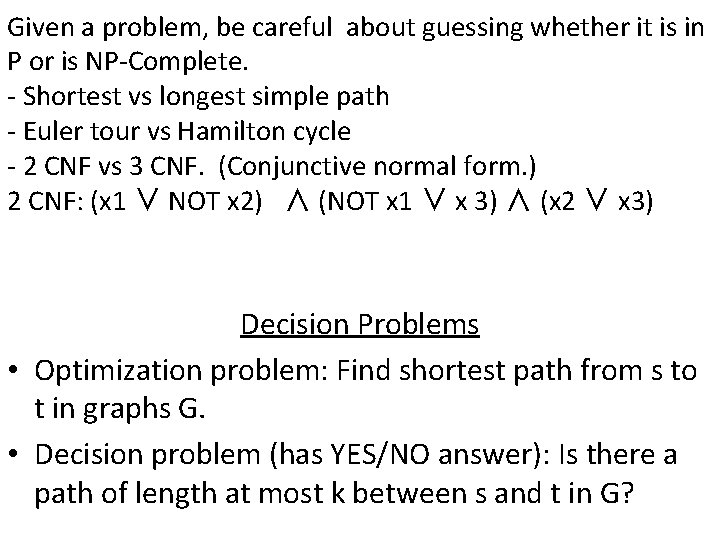
Given a problem, be careful about guessing whether it is in P or is NP-Complete. - Shortest vs longest simple path - Euler tour vs Hamilton cycle - 2 CNF vs 3 CNF. (Conjunctive normal form. ) 2 CNF: (x 1 ∨ NOT x 2) ∧ (NOT x 1 ∨ x 3) ∧ (x 2 ∨ x 3) Decision Problems • Optimization problem: Find shortest path from s to t in graphs G. • Decision problem (has YES/NO answer): Is there a path of length at most k between s and t in G?
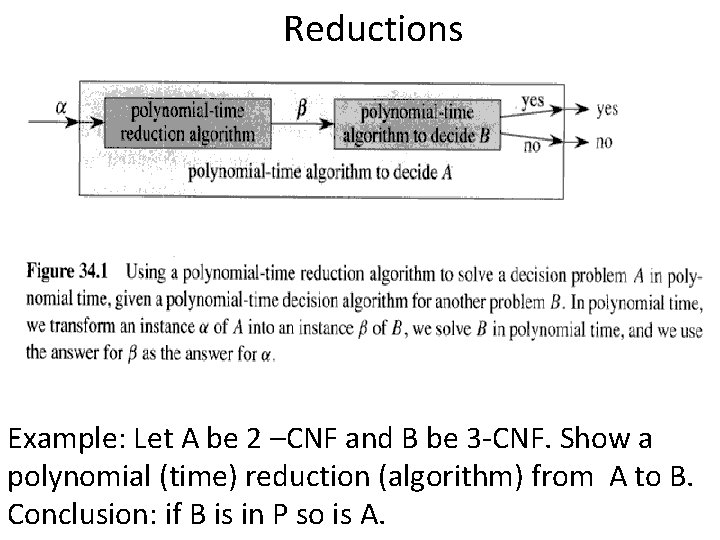
Reductions Example: Let A be 2 –CNF and B be 3 -CNF. Show a polynomial (time) reduction (algorithm) from A to B. Conclusion: if B is in P so is A.
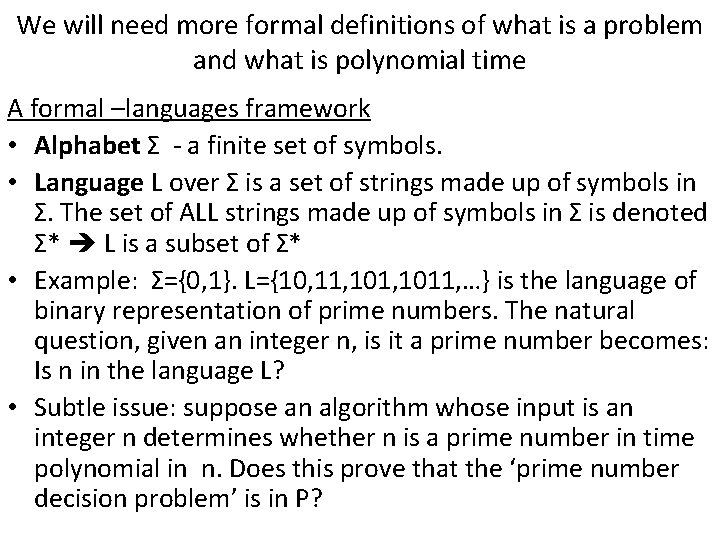
We will need more formal definitions of what is a problem and what is polynomial time A formal –languages framework • Alphabet Σ - a finite set of symbols. • Language L over Σ is a set of strings made up of symbols in Σ. The set of ALL strings made up of symbols in Σ is denoted Σ* L is a subset of Σ* • Example: Σ={0, 1}. L={10, 11, 1011, …} is the language of binary representation of prime numbers. The natural question, given an integer n, is it a prime number becomes: Is n in the language L? • Subtle issue: suppose an algorithm whose input is an integer n determines whether n is a prime number in time polynomial in n. Does this prove that the ‘prime number decision problem’ is in P?
Hint • The answer is NO
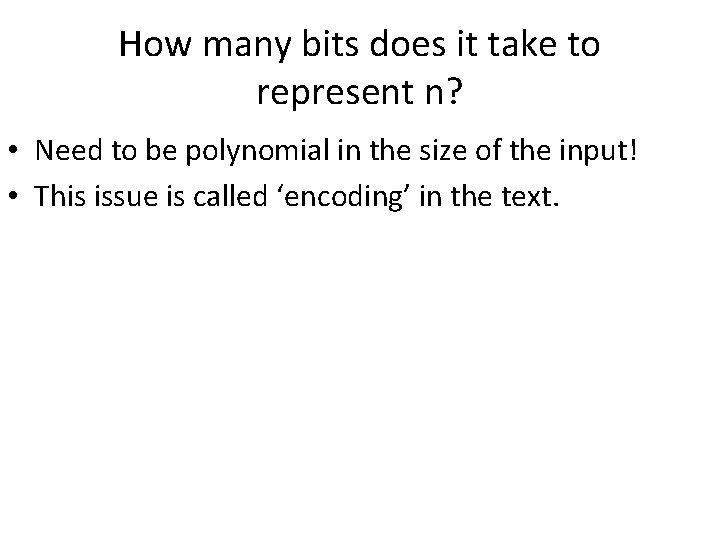
How many bits does it take to represent n? • Need to be polynomial in the size of the input! • This issue is called ‘encoding’ in the text.
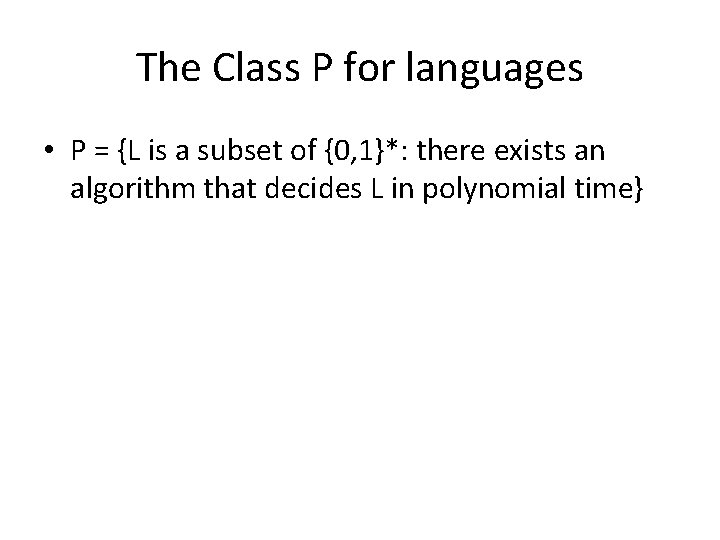
The Class P for languages • P = {L is a subset of {0, 1}*: there exists an algorithm that decides L in polynomial time}
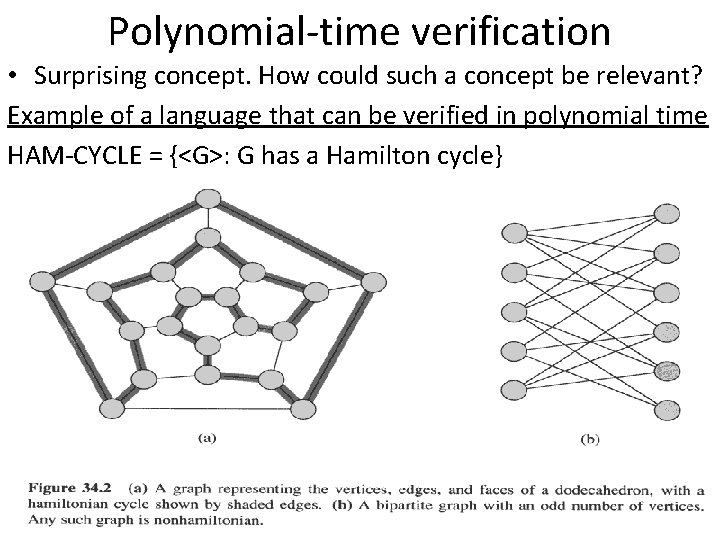
Polynomial-time verification • Surprising concept. How could such a concept be relevant? Example of a language that can be verified in polynomial time HAM-CYCLE = {<G>: G has a Hamilton cycle}
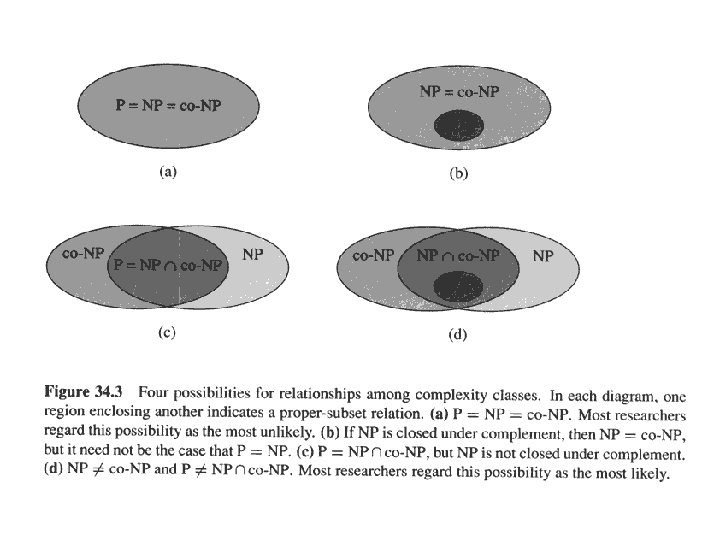
The complexity class NP [nondeterministic polynomial time] • Henceforth, suppose binary inputs. • A verification algorithm is defined as a 2 -argument algorithm A. One argument: ordinary input string x. The other: a (binary) string y, called certificate. A verifies an input x if there exists a certificate y such that A(x, y)=1. The language verified by verification algorithm A is L={x is in {0, 1}*: there exists y in {0, 1}* such that A(x, y)=1} • The complexity class NP: the class of languages that can be verified by a polynomial-time algorithm. L is in NP if and only if there exists a 2 -input polynomial-time algorithm A and a constant c such that L={x in {0, 1}*: there exists certificate y with |y|=O(|x|c ) such that A(x, y)=1} co-NP is the class of languages whose complement is in NP.
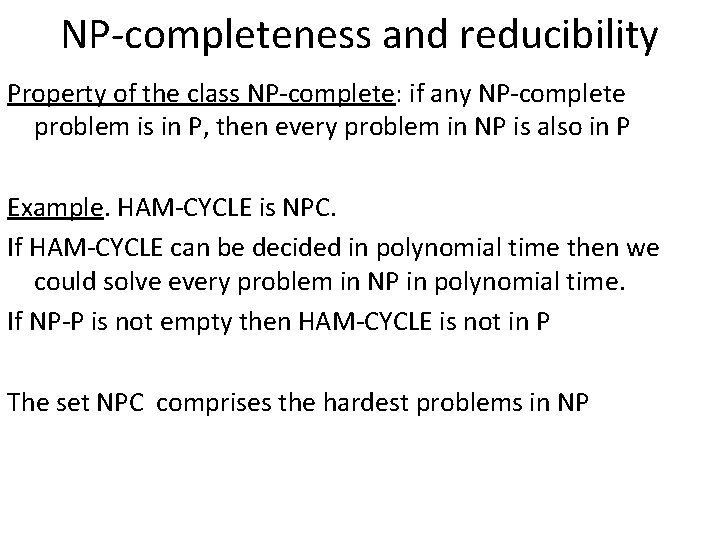
NP-completeness and reducibility Property of the class NP-complete: if any NP-complete problem is in P, then every problem in NP is also in P Example. HAM-CYCLE is NPC. If HAM-CYCLE can be decided in polynomial time then we could solve every problem in NP in polynomial time. If NP-P is not empty then HAM-CYCLE is not in P The set NPC comprises the hardest problems in NP
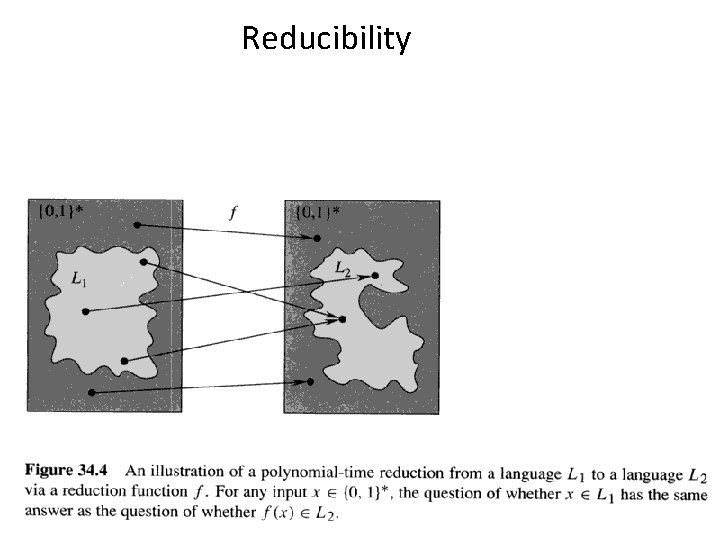
Reducibility
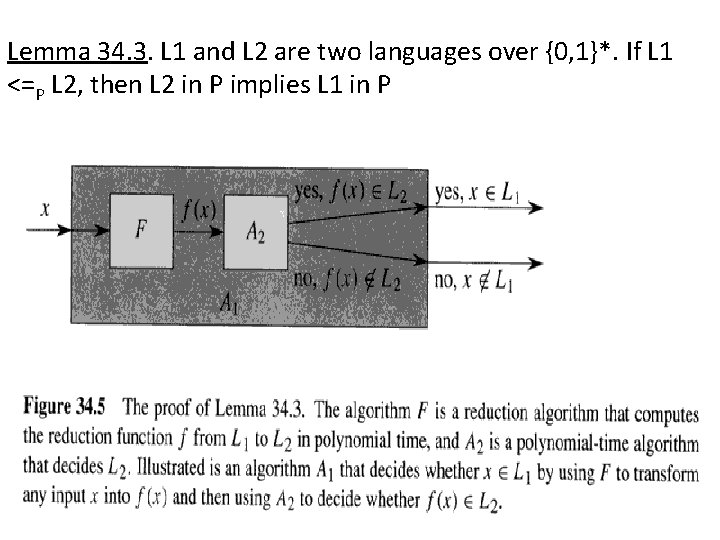
Lemma 34. 3. L 1 and L 2 are two languages over {0, 1}*. If L 1 <=P L 2, then L 2 in P implies L 1 in P
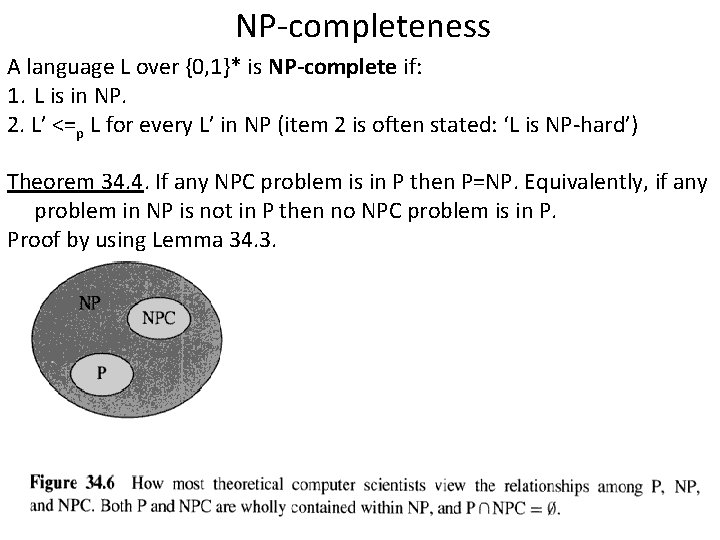
NP-completeness A language L over {0, 1}* is NP-complete if: 1. L is in NP. 2. L’ <=p L for every L’ in NP (item 2 is often stated: ‘L is NP-hard’) Theorem 34. 4. If any NPC problem is in P then P=NP. Equivalently, if any problem in NP is not in P then no NPC problem is in P. Proof by using Lemma 34. 3.
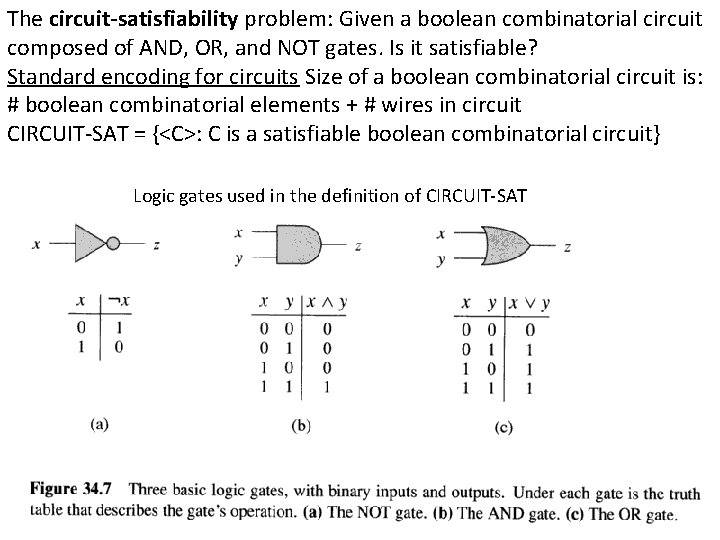
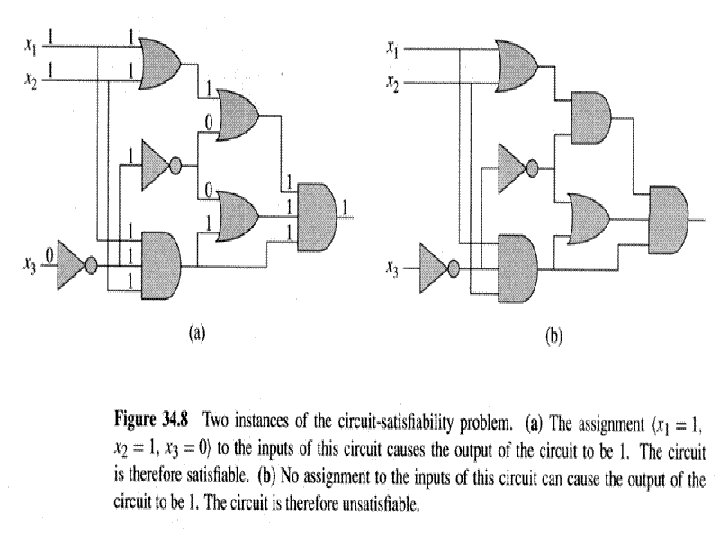
The circuit-satisfiability problem: Given a boolean combinatorial circuit composed of AND, OR, and NOT gates. Is it satisfiable? Standard encoding for circuits Size of a boolean combinatorial circuit is: # boolean combinatorial elements + # wires in circuit CIRCUIT-SAT = {<C>: C is a satisfiable boolean combinatorial circuit} Logic gates used in the definition of CIRCUIT-SAT
Lemma 34. 5. CIRCUIT-SAT is in NP Proof. We provide a 2 -input, polynomial-time algorithms A that verifies CIRCUIT-SAT. One input: a standard encoding of a (boolean combinatorial) circuit C. The other input: a certificate corresponding to an assignment of boolean values to the wire in C. Algorithm A simply checks whether the input for each gate in C produce its claimed output and whether the final output is 1. If yes, the verification algorithm outputs 1. Else, it outputs 0. Whenever a satisfiable circuit C is input to algorithm A, there exists a certificate whose length is polynomial in the size of C that cause A to output 1. But, whenever an unsatisfiable circuit is input, no certificate can fool A into ‘believing’ that C is satisfiable. Algorithm A runs in polynomial time. [How to implement algorithm A in linear time? ] CIRCUIT-SAT can be verified in polynomial time CIRCUIT-SAT is in NP.
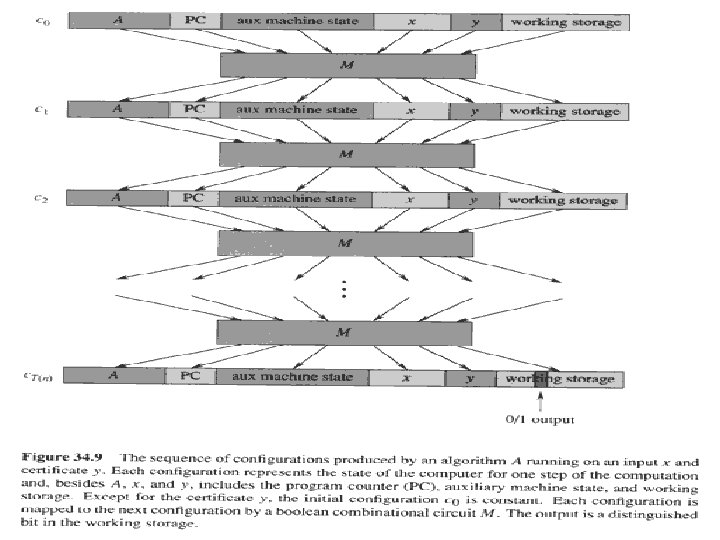
Lemma 34. 6. CIRCUIT-SAT is NP-hard Proof. Fig 34. 9. The reduction algorithms F constructs a single combinational circuit that computes all configurations produced by a given initial configuration. The idea is to paste together T(n) copies of the circuit M, where T(n) is the worst case number of steps of the verification algorithms A, and M is a circuit representing the logic of the computer executing A. The output is one of the bit in the last configuration CT(n) Theorem 34. 7. CIRCUIT-SAT is NPC.
NP-completeness proofs Lemma 34. 8 Suppose that L is a language such that L’ <=P L, and L’ is NP-complete. Then L is NP-Hard. If L is in NP, then L is NP-complete. MAIN recipe for proving that a language L is NP-complete 1. Prove L is in NP 2. Select a known NP-complete problem L’ 3. Describe an algorithm that computes a function f that maps every instance x in {0, 1}* of L’ to an instance f(x) of L 4. Prove that x is in L’ if and only if f(x) is in L 5. Prove that the algorithm computing f runs in polynomial time
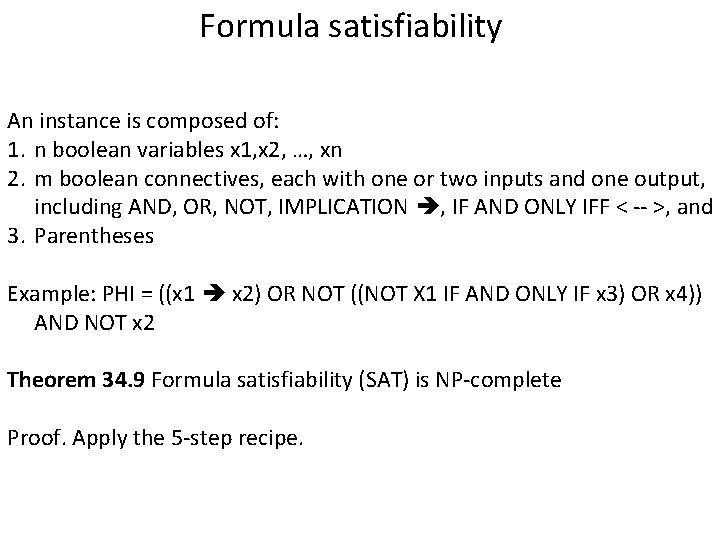
Formula satisfiability An instance is composed of: 1. n boolean variables x 1, x 2, …, xn 2. m boolean connectives, each with one or two inputs and one output, including AND, OR, NOT, IMPLICATION , IF AND ONLY IFF < -- >, and 3. Parentheses Example: PHI = ((x 1 x 2) OR NOT ((NOT X 1 IF AND ONLY IF x 3) OR x 4)) AND NOT x 2 Theorem 34. 9 Formula satisfiability (SAT) is NP-complete Proof. Apply the 5 -step recipe.
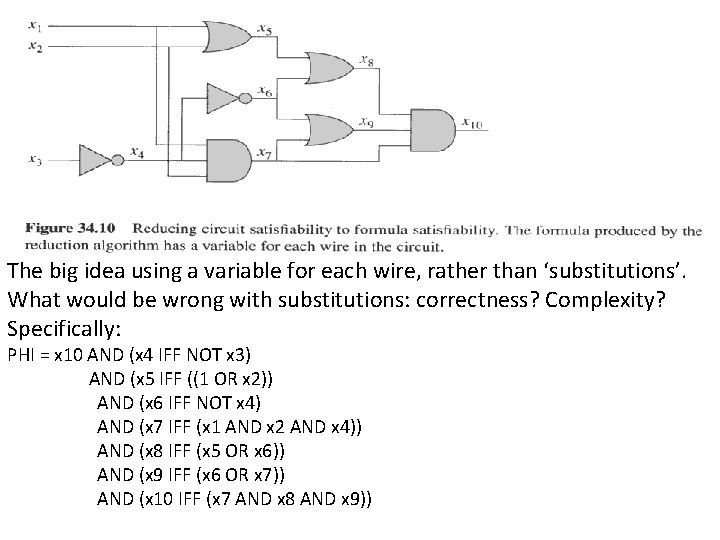
The big idea using a variable for each wire, rather than ‘substitutions’. What would be wrong with substitutions: correctness? Complexity? Specifically: PHI = x 10 AND (x 4 IFF NOT x 3) AND (x 5 IFF ((1 OR x 2)) AND (x 6 IFF NOT x 4) AND (x 7 IFF (x 1 AND x 2 AND x 4)) AND (x 8 IFF (x 5 OR x 6)) AND (x 9 IFF (x 6 OR x 7)) AND (x 10 IFF (x 7 AND x 8 AND x 9))
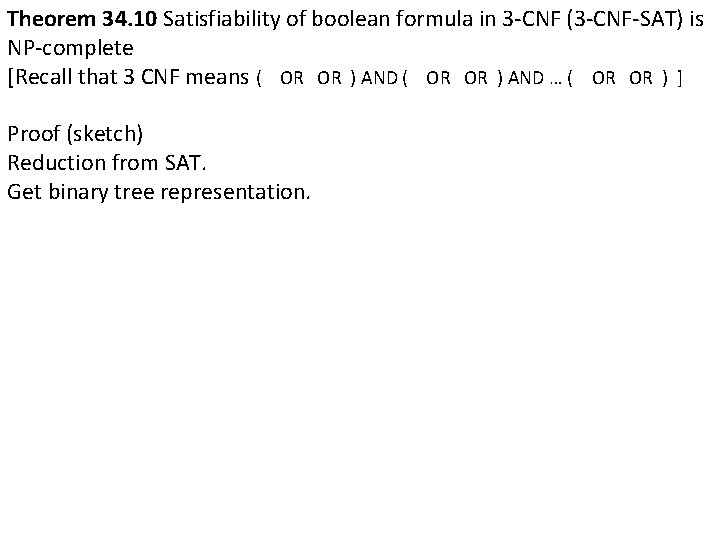
Theorem 34. 10 Satisfiability of boolean formula in 3 -CNF (3 -CNF-SAT) is NP-complete [Recall that 3 CNF means ( OR OR ) AND … ( OR OR ) ] Proof (sketch) Reduction from SAT. Get binary tree representation.
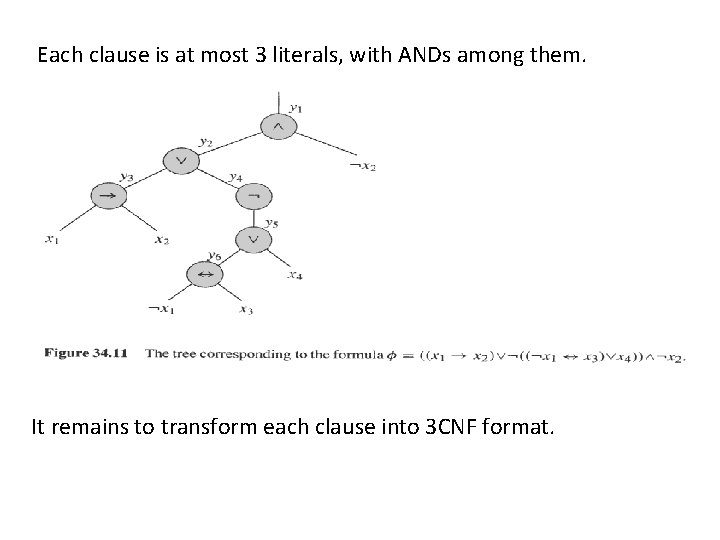
Each clause is at most 3 literals, with ANDs among them. It remains to transform each clause into 3 CNF format.
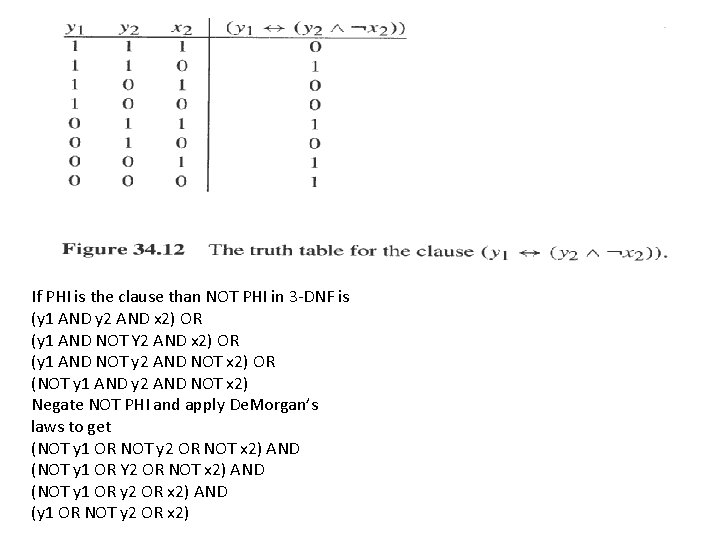
If PHI is the clause than NOT PHI in 3 -DNF is (y 1 AND y 2 AND x 2) OR (y 1 AND NOT Y 2 AND x 2) OR (y 1 AND NOT y 2 AND NOT x 2) OR (NOT y 1 AND y 2 AND NOT x 2) Negate NOT PHI and apply De. Morgan’s laws to get (NOT y 1 OR NOT y 2 OR NOT x 2) AND (NOT y 1 OR Y 2 OR NOT x 2) AND (NOT y 1 OR y 2 OR x 2) AND (y 1 OR NOT y 2 OR x 2)
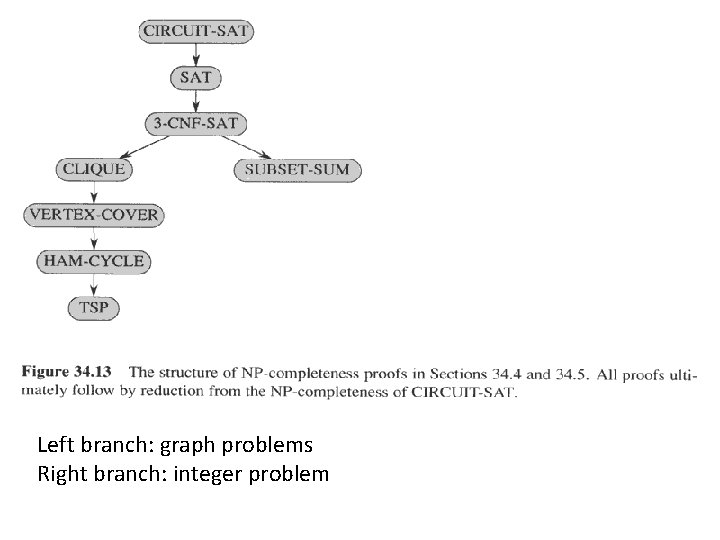
Left branch: graph problems Right branch: integer problem
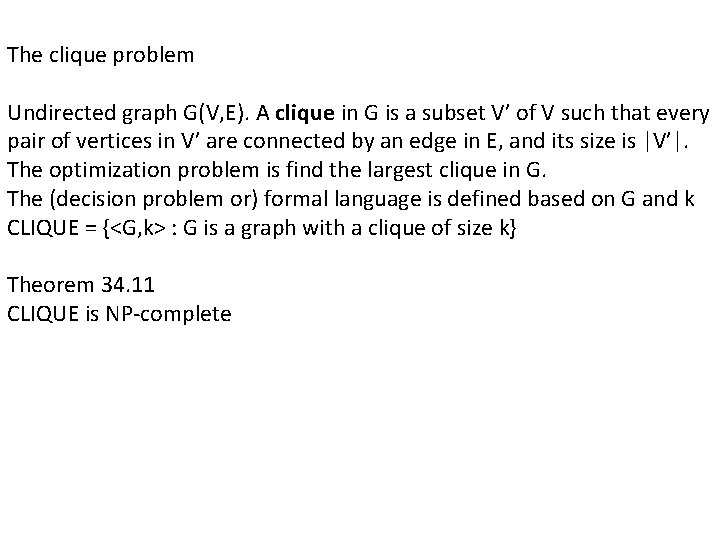
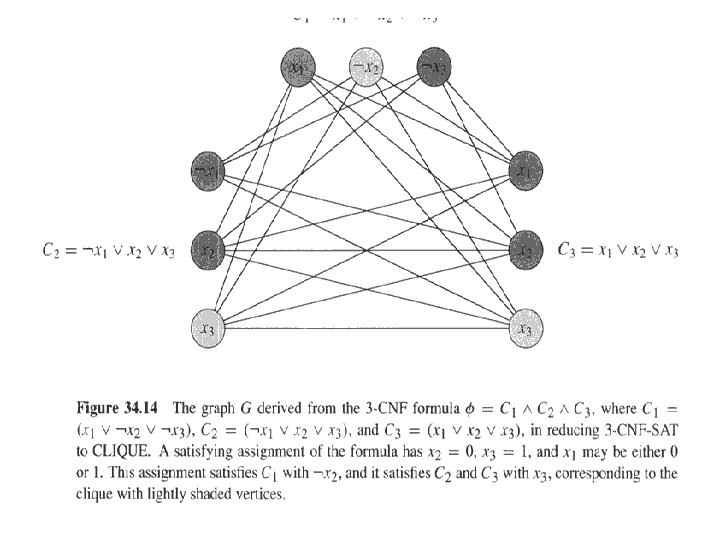
The clique problem Undirected graph G(V, E). A clique in G is a subset V’ of V such that every pair of vertices in V’ are connected by an edge in E, and its size is |V’|. The optimization problem is find the largest clique in G. The (decision problem or) formal language is defined based on G and k CLIQUE = {<G, k> : G is a graph with a clique of size k} Theorem 34. 11 CLIQUE is NP-complete
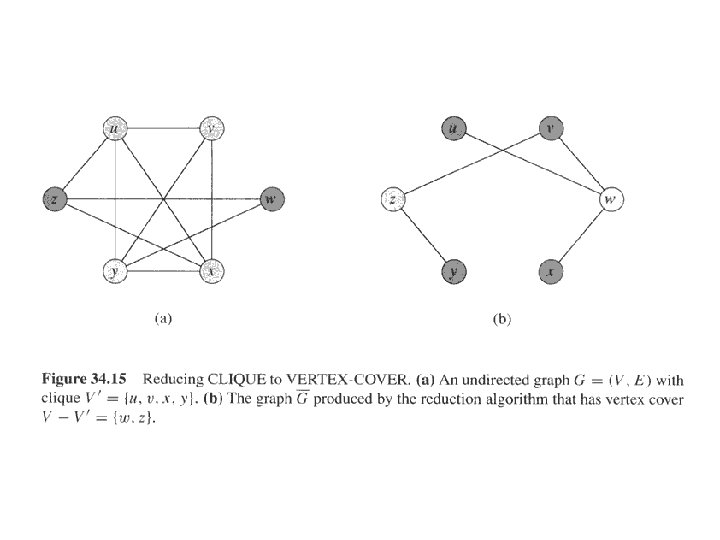
The vertex cover problem G(V, E) is an undirected graph. A vertex cover V’ is a subset of V that for every edge (u, v) in E at least one of its points (u or v) is in V’. The optimization problem is find the smallest vertex cover in G. The (decision problem or) formal language is defined based on G and k VERTEX-COVER = {<G, k> : G is a graph with a vertex cover of size k} Theorem 34. 12 VERTEX-COVER is NP-complete
Theorem Hamilton-cycle is NP-complete
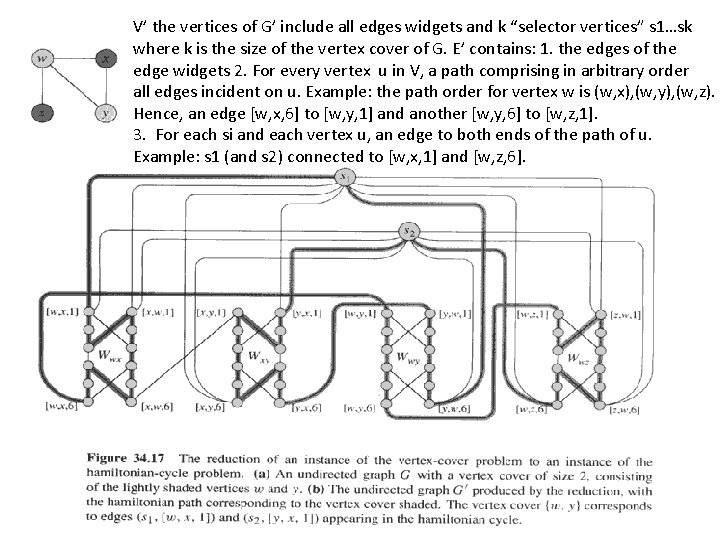
If the cycle enters through vertex [u, v, 1] it must exist through [u, v, 6] and include either: 1. All 12 vertices - if u is in the vertex cover but v is not, or 2. The 6 vertices [u, v, 1. . 6] - if v is also in the vertex cover. If v is in the vertex cover, but not u, the cycle enters through vertex [v, u, 1] and exists through [v, u, 6]
V’ the vertices of G’ include all edges widgets and k “selector vertices” s 1…sk where k is the size of the vertex cover of G. E’ contains: 1. the edges of the edge widgets 2. For every vertex u in V, a path comprising in arbitrary order all edges incident on u. Example: the path order for vertex w is (w, x), (w, y), (w, z). Hence, an edge [w, x, 6] to [w, y, 1] and another [w, y, 6] to [w, z, 1]. 3. For each si and each vertex u, an edge to both ends of the path of u. Example: s 1 (and s 2) connected to [w, x, 1] and [w, z, 6].
G has vertex cover of size k if and only if G’ has Hamilton cycle.
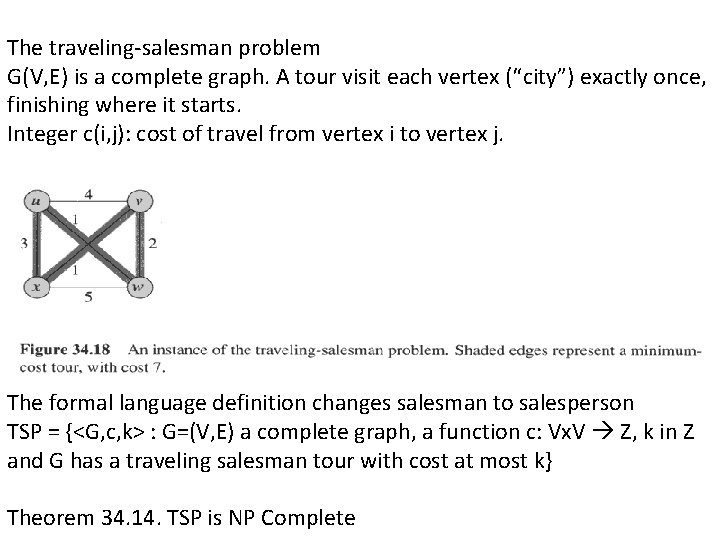
The traveling-salesman problem G(V, E) is a complete graph. A tour visit each vertex (“city”) exactly once, finishing where it starts. Integer c(i, j): cost of travel from vertex i to vertex j. The formal language definition changes salesman to salesperson TSP = {<G, c, k> : G=(V, E) a complete graph, a function c: Vx. V Z, k in Z and G has a traveling salesman tour with cost at most k} Theorem 34. 14. TSP is NP Complete
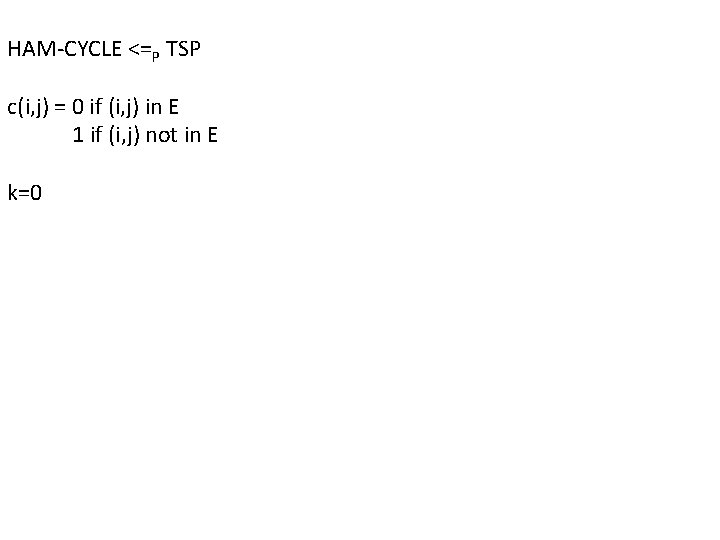
HAM-CYCLE <=P TSP c(i, j) = 0 if (i, j) in E 1 if (i, j) not in E k=0
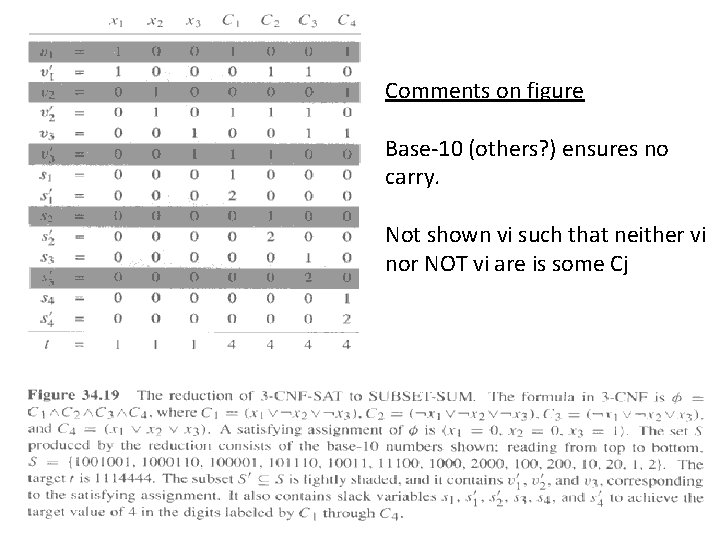
The subset-sum problem Finite set S of natural numbers and target t a natural number. Is there a subset S’ of S such that the sum of the elements of S’ is t? Theorem 34. 14 SUBSET-SUM is NP-Complete
Comments on figure Base-10 (others? ) ensures no carry. Not shown vi such that neither vi nor NOT vi are is some Cj