
Chapter 33 The Economic Problems of LessDeveloped Economies

Chapter 33 The Economic Problems of Less-Developed Economies © 2005
Economic Principles Poverty in the less-developed countries (LDCs) Economic dualism The big-push strategy for economic development © 2005 Gottheil - Principles of Economics, 4 e 2
Economic Principles The unbalanced growth strategy for economic development Foreign investment in the LDCs. Economic aid to the LDCs. © 2005 Gottheil - Principles of Economics, 4 e 3

Confronting National Poverty Beginning in the 1950 s economists began seeing the economies of Asia, Africa, and Latin America as something more than trading posts for our raw materials. © 2005 Gottheil - Principles of Economics, 4 e 4

Confronting National Poverty Complete the sentence: In the 1960 s economists dropped the terms _____ and _____ in favor of newly developing countries or less-developed countries. © 2005 Gottheil - Principles of Economics, 4 e 5
Confronting National Poverty Complete the sentence: In the 1960 s economists dropped the terms backwardness and underdevelopment in favor of newly developing countries or less -developed countries. © 2005 Gottheil - Principles of Economics, 4 e 6

Confronting National Poverty “Backwardness” and “underdevelopment” were seen as being much too prejudicial. © 2005 Gottheil - Principles of Economics, 4 e 7
Less-Developed Countries (LDCs) Less-developed countries (LDCs) • The economies of Asia, Africa, and Latin America. © 2005 Gottheil - Principles of Economics, 4 e 8
Less-Developed Countries (LDCs) True or false: Decade after decade, the economies of LDCs have been stalled, generating at best only subsistence-level incomes. • False. The economies of some LDCs have grown and modernized, while others have languished. © 2005 Gottheil - Principles of Economics, 4 e 9
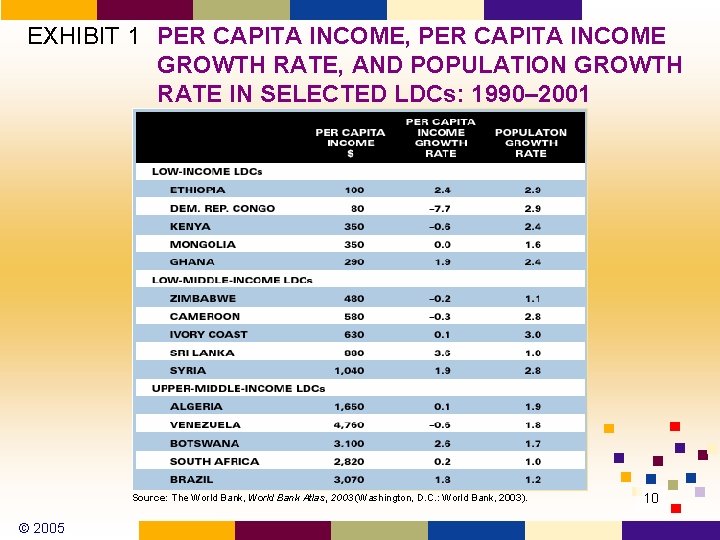
EXHIBIT 1 PER CAPITA INCOME, PER CAPITA INCOME GROWTH RATE, AND POPULATION GROWTH RATE IN SELECTED LDCs: 1990– 2001 Source: The World Bank, World Bank Atlas, 2003 (Washington, D. C. : World Bank, 2003). © 2005 10
Exhibit 1: Per Capita Income, Per Capita Income Growth Rate, and Population Growth Rate in Selected LDCs: 1990 -2001 1. Which of the following upper-middleincome LDCs has experienced the most rapid growth in per capita income between 1990 and 2001? a. Algeria b. Venezuela c. Brazil © 2005 Gottheil - Principles of Economics, 4 e 11
Exhibit 1: Per Capita Income, Per Capita Income Growth Rate, and Population Growth Rate in Selected LDCs: 1990 -2001 1. Which of the following upper-middleincome LDCs has experienced the most rapid growth in per capita income between 1990 and 2001? a. Algeria b. Venezuela c. Brazil © 2005 Gottheil - Principles of Economics, 4 e 12
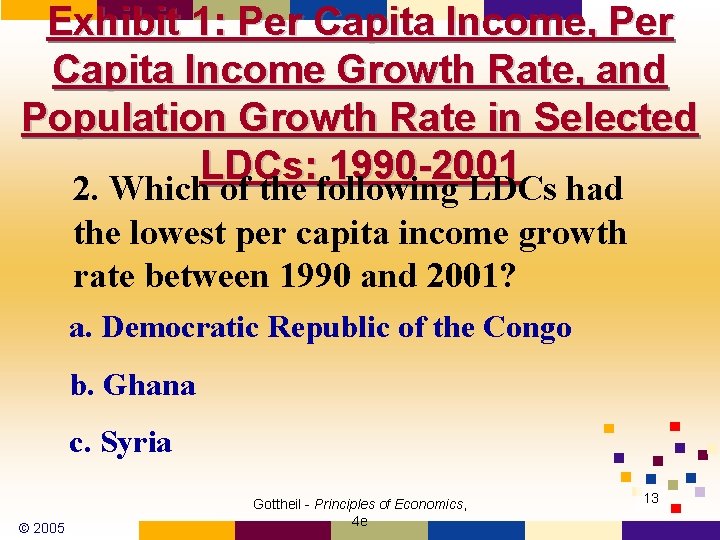
Exhibit 1: Per Capita Income, Per Capita Income Growth Rate, and Population Growth Rate in Selected LDCs: 1990 -2001 2. Which of the following LDCs had the lowest per capita income growth rate between 1990 and 2001? a. Democratic Republic of the Congo b. Ghana c. Syria © 2005 Gottheil - Principles of Economics, 4 e 13
Exhibit 1: Per Capita Income, Per Capita Income Growth Rate, and Population Growth Rate in Selected LDCs: 1990 -98 2. Which of the following LDCs had the lowest per capita income growth rate between 1990 and 2001? a. Democratic Republic of the Congo b. Ghana c. Syria © 2005 Gottheil - Principles of Economics, 4 e 14
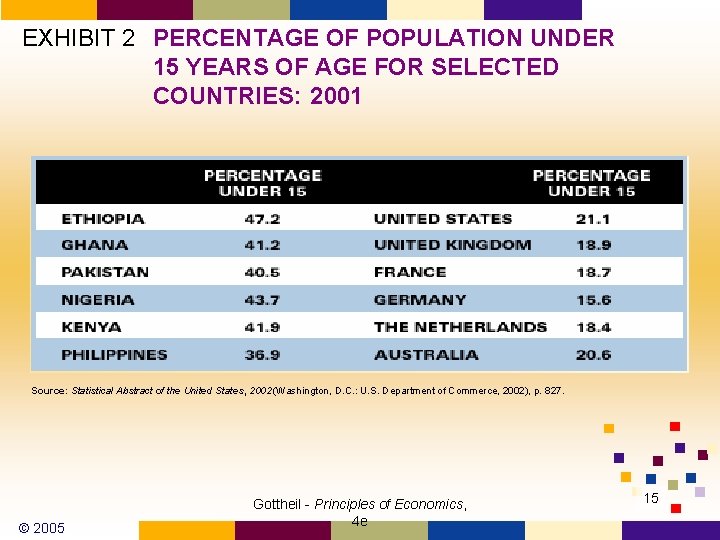
EXHIBIT 2 PERCENTAGE OF POPULATION UNDER 15 YEARS OF AGE FOR SELECTED COUNTRIES: 2001 Source: Statistical Abstract of the United States, 2002 (Washington, D. C. : U. S. Department of Commerce, 2002), p. 827. © 2005 Gottheil - Principles of Economics, 4 e 15
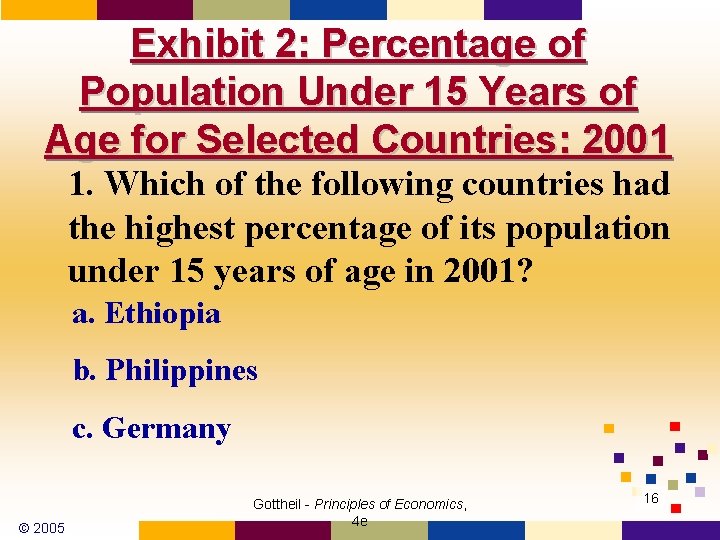
Exhibit 2: Percentage of Population Under 15 Years of Age for Selected Countries: 2001 1. Which of the following countries had the highest percentage of its population under 15 years of age in 2001? a. Ethiopia b. Philippines c. Germany © 2005 Gottheil - Principles of Economics, 4 e 16

Exhibit 2: Percentage of Population Under 15 Years of Age for Selected Countries: 2001 1. Which of the following countries had the highest percentage of its population under 15 years of age in 2001? a. Ethiopia b. Philippines c. Germany © 2005 Gottheil - Principles of Economics, 4 e 17

Exhibit 2: Percentage of Population Under 15 Years of Age for Selected Countries: 2001 2. Do countries with low population growth rates tend to have a high percentage of their population under 15 years of age? • No. © 2005 Gottheil - Principles of Economics, 4 e 18

Exhibit 2: Percentage of Population Under 15 Years of Age for Selected Countries: 2001 2. Do countries with low population growth rates tend to have a high percentage of their population under 15 years of age? • In countries with low population growth rates, such as Germany, France, and the Netherlands, typically less than 25 percent of the population is under 15 years of age. © 2005 Gottheil - Principles of Economics, 4 e 19
Exhibit 2: Percentage of Population Under 15 Years of Age for Selected Countries: 1997 2. Do countries with low population growth rates tend to have a high percentage of their population under 15 years of age? • In contrast, in countries with high population growth rates, such as Nigeria and Kenya, typically more than 40 percent of the population is under 15 years of age. © 2005 Gottheil - Principles of Economics, 4 e 20
LDC Per Capita Incomes 1. How is per capita income growth related to income growth and population growth? • Per capita income growth is equal to income growth divided by population growth. © 2005 Gottheil - Principles of Economics, 4 e 21
LDC Per Capita Incomes 2. What happens to per capita income if population grows faster than income? • Since per capita income growth is equal to income growth divided by population growth, if population grows faster than income, then per capita income must fall. © 2005 Gottheil - Principles of Economics, 4 e 22
LDC Per Capita Incomes 3. What is the vicious cycle of poverty? • People are poor because they can’t invest in capital goods, and they can’t invest in capital goods because they are poor. © 2005 Gottheil - Principles of Economics, 4 e 23
LDC Per Capita Incomes 4. Why is the vicious cycle of poverty more likely to occur in countries that have a large percentage of their population under 15 years of age? • Most people under age 15, and particularly those under 10, are unable to produce enough to meet their own consumption needs. © 2005 Gottheil - Principles of Economics, 4 e 24
LDC Per Capita Incomes 4. Why is the vicious cycle of poverty more likely to occur in countries that have a large percentage of their population under 15 years of age? • If almost one-half of a country’s population consumes more than it produces, there are few resources that can be shifted from producing consumer goods to producing capital goods. 25 Gottheil - Principles of Economics, © 2005 4 e
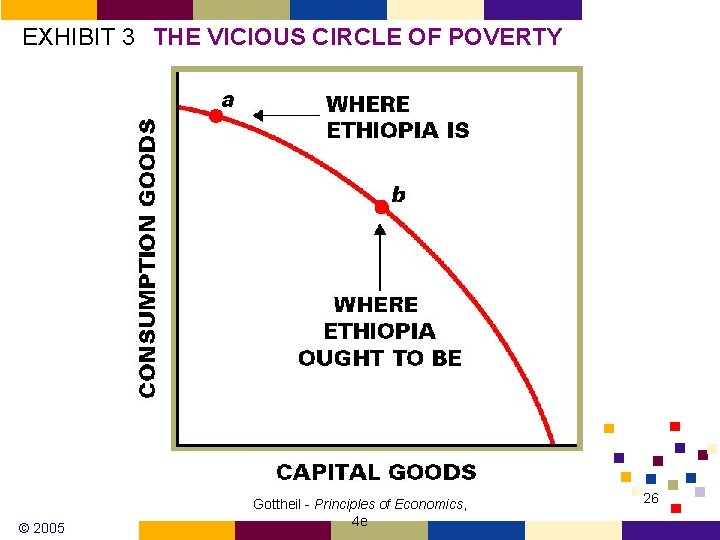
EXHIBIT 3 THE VICIOUS CIRCLE OF POVERTY © 2005 Gottheil - Principles of Economics, 4 e 26
Exhibit 3: The Vicious Cycle of Poverty What is the consequence of Ethiopia producing at point a rather than point b in Exhibit 3? • Slower economic growth rates and lower per-capita incomes in the future. © 2005 Gottheil - Principles of Economics, 4 e 27

Human Capital Human capital • The investment in workers’ health and knowledge, acquired through education, training, and/or experience that enhances their productivity. © 2005 Gottheil - Principles of Economics, 4 e 28

Other Indicators of the LDCs’ Lack of Economic Well-Being 1. True or false: The capital investments that yield the highest payoffs in an economy are those made in machinery and factories. • False © 2005 Gottheil - Principles of Economics, 4 e 29

Other Indicators of the LDCs’ Lack of Economic Well-Being 1. True or false: The capital investments that yield the highest payoffs in an economy are those made in machinery and factories. • Investments in human capital—in the form of education and health care—rank among the most important of the capital goods contributing to national economic growth. © 2005 Gottheil - Principles of Economics, 4 e 30
Other Indicators of the LDCs’ Lack of Economic Well-Being 2. Which of the following best describes the timeframe between investment in human capital and the realization of payoffs in the form of improvements in a person’s working efficiency? a. Immediate b. Brief c. Relatively long © 2005 Gottheil - Principles of Economics, 4 e 31
Other Indicators of the LDCs’ Lack of Economic Well-Being 2. Which of the following best describes the timeframe between investment in human capital and the realization of payoffs in the form of improvements in a person’s working efficiency? a. Immediate b. Brief c. Relatively long © 2005 Gottheil - Principles of Economics, 4 e 32
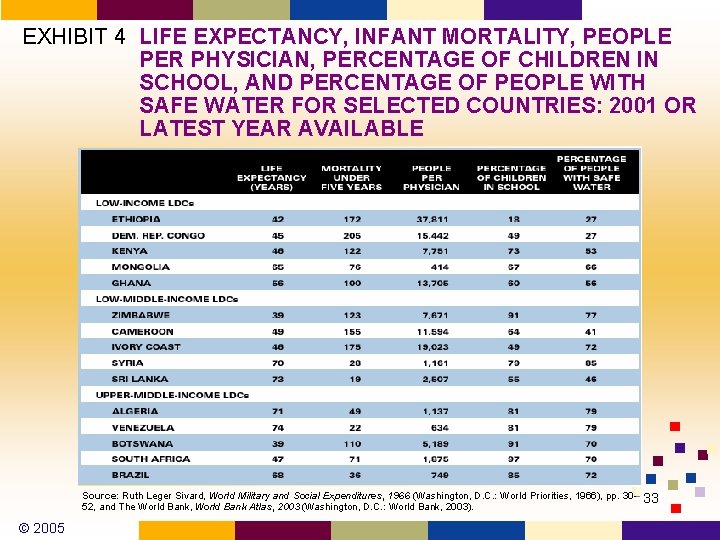
EXHIBIT 4 LIFE EXPECTANCY, INFANT MORTALITY, PEOPLE PER PHYSICIAN, PERCENTAGE OF CHILDREN IN SCHOOL, AND PERCENTAGE OF PEOPLE WITH SAFE WATER FOR SELECTED COUNTRIES: 2001 OR LATEST YEAR AVAILABLE Source: Ruth Leger Sivard, World Military and Social Expenditures, 1966 (Washington, D. C. : World Priorities, 1966), pp. 30– 52, and The World Bank, World Bank Atlas, 2003 (Washington, D. C. : World Bank, 2003). © 2005 33
Exhibit 4: Life Expectancy, Infant Mortality, People Per Physician. . . 1. What is the relationship between per capita income and life expectancy? • Life expectancy tends to be directly related to per capita income. © 2005 Gottheil - Principles of Economics, 4 e 34
Exhibit 4: Life Expectancy, Infant Mortality, People Per Physician, . . . 2. Do low-income LDCs tend to have more people per physician than higher-income LDCs? • Yes. With a few exceptions, there are usually many thousands of people per physician in low-income LDCs. © 2005 Gottheil - Principles of Economics, 4 e 35
Exhibit 4: Life Expectancy, Infant Mortality, People Per Physician, . . . 3. Based on the percentage of children in school, how well is Ethiopia doing at investing in human capital when compared to Botswana and South Africa? • Very poorly. © 2005 Gottheil - Principles of Economics, 4 e 36
Exhibit 4: Life Expectancy, Infant Mortality, People Per Physician, . . . 3. Based on the percentage of children in school, how well is Ethiopia doing at investing in human capital when compared to Botswana and South Africa? • Fewer than one-half of the children in Ethiopia is receiving a school education, while this figure exceeds 90 percent in Botswana and South Africa. © 2005 Gottheil - Principles of Economics, 4 e 37
Exhibit 4: Life Expectancy, Infant Mortality, People Per Physician, . . . 4. Are people in low-income LDCs very much more likely to risk exposure to waterborne diseases such as dysentery and cholera than in higher-income LDCs? • In general as per capita income rises, the percentage of people with access to safe water also rises. © 2005 Gottheil - Principles of Economics, 4 e 38
Economic Dualism True or false: While conditions in lowincome LDCs are poor, there is a high degree of equality in these societies, and all people bear a roughly equal share of the burden of poor living conditions. • False. © 2005 Gottheil - Principles of Economics, 4 e 39
Economic Dualism True or false: While conditions in lowincome LDCs are poor, there is a high degree of equality in these societies, and all people bear a roughly equal share of the burden of poor living conditions. • Many LDC doctors, lawyers, merchants, accountants, and exporters and importers, among others, have access to safe water, hospitals, education, and decent housing. © 2005 Gottheil - Principles of Economics, 4 e 40
Economic Dualism Economic dualism • The coexistence of two separate and distinct economies within an LDC; one modern, primarily urban, and exportdriven, the other traditional, agricultural, and self-sustaining. © 2005 Gottheil - Principles of Economics, 4 e 41
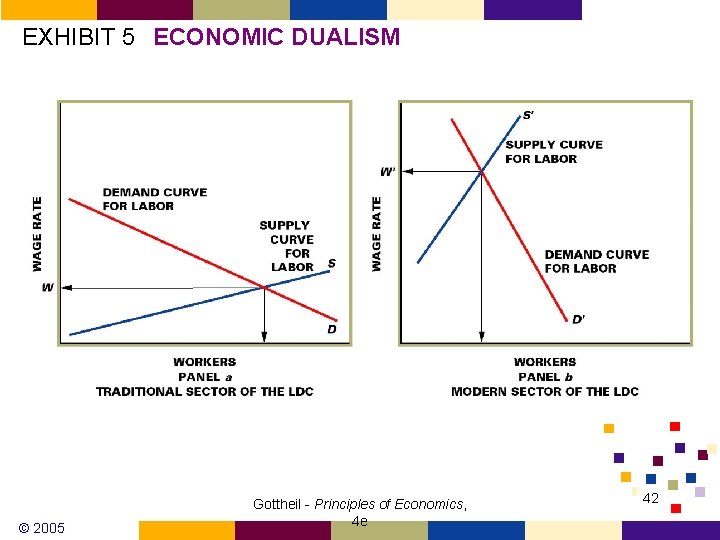
EXHIBIT 5 ECONOMIC DUALISM © 2005 Gottheil - Principles of Economics, 4 e 42
Exhibit 5: Economic Dualism 1. What are the characteristics of the labor market in the traditional sector of an LDC economy? • The labor market for the traditional sector is shown in panel a. © 2005 Gottheil - Principles of Economics, 4 e 43
Exhibit 5: Economic Dualism 1. What are the characteristics of the labor market in the traditional sector of an LDC economy? • The labor market in the traditional sector features a relatively low and flat demand curve. © 2005 Gottheil - Principles of Economics, 4 e 44
Exhibit 5: Economic Dualism 1. What are the characteristics of the labor market in the traditional sector of an LDC economy? • The relatively low opportunity costs associated with traditional labor produce a relatively flat supply curve for labor. © 2005 Gottheil - Principles of Economics, 4 e 45
Exhibit 5: Economic Dualism 1. What are the characteristics of the labor market in the traditional sector of an LDC economy? • As a result, the labor market in the traditional sector of an LDC economy yields low wages. © 2005 Gottheil - Principles of Economics, 4 e 46
Exhibit 5: Economic Dualism 2. What are the characteristics of the labor market in the modern sector of an LDC economy? • The labor market for the modern sector is shown in panel b. © 2005 Gottheil - Principles of Economics, 4 e 47
Exhibit 5: Economic Dualism 2. What are the characteristics of the labor market in the modern sector of an LDC economy? • The labor market in the modern sector features a higher and steeper demand. © 2005 Gottheil - Principles of Economics, 4 e 48
Exhibit 5: Economic Dualism 2. What are the characteristics of the labor market in the modern sector of an LDC economy? • The higher opportunity costs associated with skilled workers in this sector generates a steeper supply curve. © 2005 Gottheil - Principles of Economics, 4 e 49

Exhibit 5: Economic Dualism 2. What are the characteristics of the labor market in the modern sector of an LDC economy? • As a result, the equilibrium wage rate in the modern sector is considerably higher than in the traditional sector. © 2005 Gottheil - Principles of Economics, 4 e 50

Exhibit 5: Economic Dualism 3. What factors might cause economic dualism to persist? • The vicious cycle of poverty prevents the parents of children living in poverty from investing in their children’s human capital. These children forego an education and begin working at an early age. © 2005 Gottheil - Principles of Economics, 4 e 51

Exhibit 5: Economic Dualism 3. What factors might cause economic dualism to persist? • In contrast, people earning a high income in the modern sector can afford tutors, private education, health care, and adequate food for their children. © 2005 Gottheil - Principles of Economics, 4 e 52

Exhibit 5: Economic Dualism 3. What factors might cause economic dualism to persist? • When they become adults, the children of the elite can prosper and succeed in the modern sector. The children of workers in the traditional sector may never get the education necessary to enter the labor force in the modern sector. © 2005 Gottheil - Principles of Economics, 4 e 53

The Absence of Basic Prerequisites 1. In what way is political stability important to the proper functioning of an economy? • Laws become meaningless when governments that displace each other too frequently and by force are inclined to set aside past government commitments and, at times, even basic property rights. © 2005 Gottheil - Principles of Economics, 4 e 54

The Absence of Basic Prerequisites 1. In what way is political stability important to the proper functioning of an economy? • Such political discontinuities interfere with routine economic decision making. For example, businesses will be more hesitant to make new capital investments. © 2005 Gottheil - Principles of Economics, 4 e 55

The Absence of Basic Prerequisites 2. How might economic development be inhibited by the psychological, religious, and cultural character of LDCs? • Cultural traditionalism can inhibit economic development by promoting large families, inhibiting the use of new technologies, and denying women access to education and work outside the home. © 2005 Gottheil - Principles of Economics, 4 e 56
The Absence of Basic Prerequisites 3. Are there difficulties transplanting modern production technologies and facilities in an LDC? • Modern production requires an extensive support system. © 2005 Gottheil - Principles of Economics, 4 e 57
The Absence of Basic Prerequisites 3. Are there difficulties transplanting modern production technologies and facilities in an LDC? • This support system includes workforce training, sources of credit, and networks of telecommunications, power, and transportation. © 2005 Gottheil - Principles of Economics, 4 e 58

Infrastructure • The basic institutions and public facilities upon which an economy’s development depends. © 2005 Gottheil - Principles of Economics, 4 e 59

The Big Push Strategy Big push • The development strategy that relies on an integrated network of governmentsponsored and financed investments introduced into the economy all at once. © 2005 Gottheil - Principles of Economics, 4 e 60

The Big Push Strategy 1. What is the argument in favor of the big push strategy? • Each potential investment’s success depends upon there being a market for its output. © 2005 Gottheil - Principles of Economics, 4 e 61

The Big Push Strategy 1. What is the argument in favor of the big push strategy? • For example, in order for an automobile plant to succeed, there must be input producers, a road system, and gasoline stations, as well as people with sufficient income to purchase the cars. © 2005 Gottheil - Principles of Economics, 4 e 62

The Big Push Strategy 1. What is the argument in favor of the big push strategy? • Therefore the big push strategy builds everything at once so that all necessary infrastructure and markets are in place. © 2005 Gottheil - Principles of Economics, 4 e 63

The Big Push Strategy 2. What are some possible problems with the big push strategy? • Skills and materials may get spread too thinly, and the tax burden needed to finance the big push may be destabilizing. © 2005 Gottheil - Principles of Economics, 4 e 64

The Unbalanced Development Strategy What is the basic idea underlying the unbalanced development strategy? • Government triggers the process by funding and putting into place key infrastructure investments. © 2005 Gottheil - Principles of Economics, 4 e 65

The Unbalanced Development Strategy What is the basic idea underlying the unbalanced development strategy? • Private entrepreneurs initiate investments that are funded from the entrepreneur’s own savings or from the private banking system. © 2005 Gottheil - Principles of Economics, 4 e 66

Forward Linkages Forward linkages • Investments in one industry that create opportunities for profitable investments in other industries, using the goods produced in the first as inputs. © 2005 Gottheil - Principles of Economics, 4 e 67

Backward Linkages Backward linkages • Investments in one industry that create demands for inputs, inducing investment in other industries to produce those inputs. © 2005 Gottheil - Principles of Economics, 4 e 68
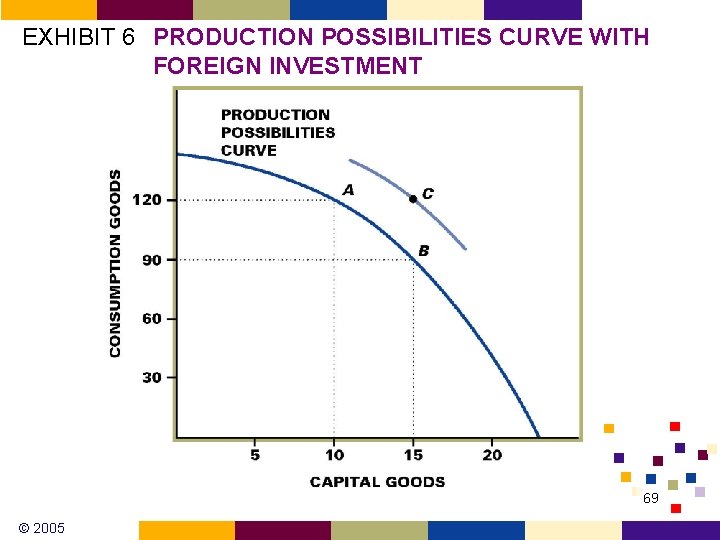
EXHIBIT 6 PRODUCTION POSSIBILITIES CURVE WITH FOREIGN INVESTMENT 69 © 2005

Exhibit 6: Production Possibilities Curve with Foreign Investment How does foreign investment affect the production possibilities curve for consumption and capital goods? • It shifts out the production possibilities curve. © 2005 Gottheil - Principles of Economics, 4 e 70
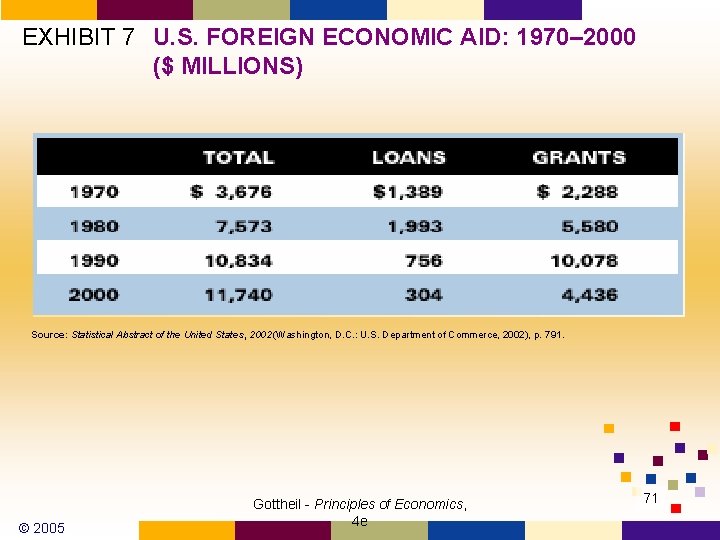
EXHIBIT 7 U. S. FOREIGN ECONOMIC AID: 1970– 2000 ($ MILLIONS) Source: Statistical Abstract of the United States, 2002 (Washington, D. C. : U. S. Department of Commerce, 2002), p. 791. © 2005 Gottheil - Principles of Economics, 4 e 71
Exhibit 7: U. S. Foreign Economic Aid: 1970 -2000 ($ millions) What accounts for the increase in total U. S. foreign economic aid? • Most of the increase can be attributed to an increase in grants. © 2005 Gottheil - Principles of Economics, 4 e 72
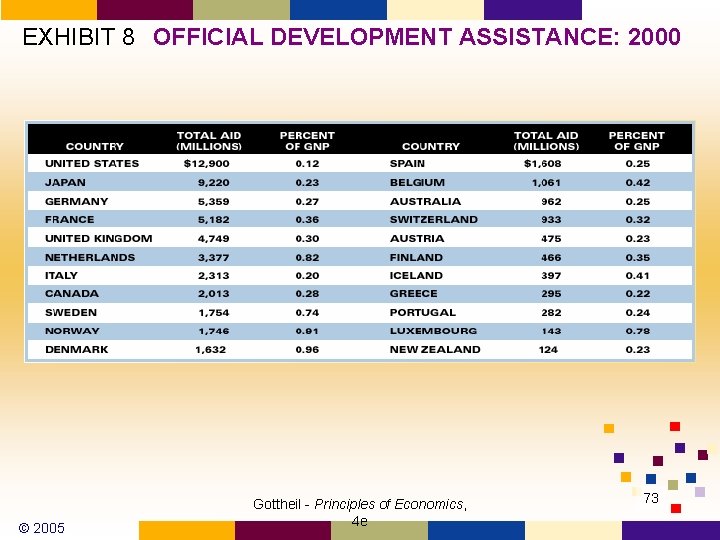
EXHIBIT 8 OFFICIAL DEVELOPMENT ASSISTANCE: 2000 © 2005 Gottheil - Principles of Economics, 4 e 73
Exhibit 8: Official Development Assistance: 2000 Although the U. S. gives the most aid, what is the other story that donor nations tell? • Given as a percent of GNP, other countries could be said to be more generous. © 2005 Gottheil - Principles of Economics, 4 e 74
- Slides: 74