
Chapter 33 Plant Responses Objectives Explain the term
Chapter 33: Plant Responses Objectives Explain the term: growth regulation. Define the following terms: tropisms, phototropism, geotropism, thigmotropism, hydrotropism, chemotropism. Name examples of phototropism & geotropism. Define the term: growth regulator. Outline the transport of regulators via the vascular system.
Explain the term: Combined Effect Explain the term: Growth Promoter. Explain the term: Growth Inhibitor Name 4 methods of anatomical/chemical adaptations that protect plants. State 2 examples of the use of plant regulators. Mandatory Activity : Effects of I. A. A. Growth Regulators on Plants
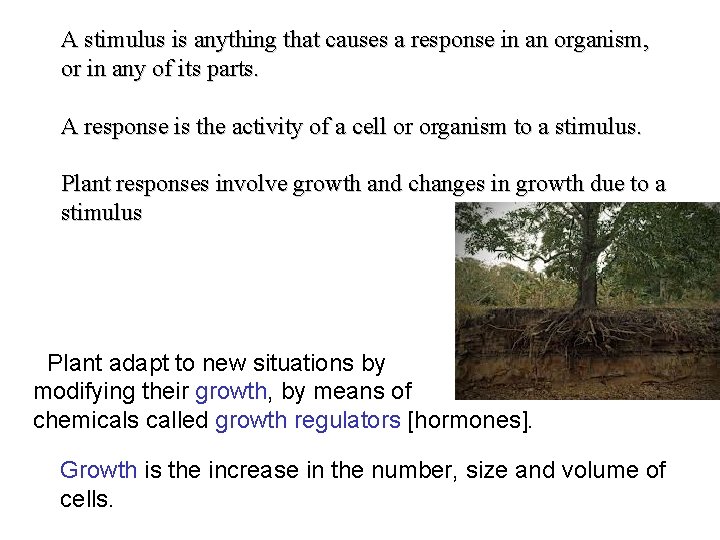
A stimulus is anything that causes a response in an organism, or in any of its parts. A response is the activity of a cell or organism to a stimulus. Plant responses involve growth and changes in growth due to a stimulus Plant adapt to new situations by modifying their growth, by means of chemicals called growth regulators [hormones]. Growth is the increase in the number, size and volume of cells.
Ø A hormone is a chemical produced in one part of an organism, transported to other tissues where it has its effect. Ø External factors that regulate the growth of plants are light intensity, day length, gravity, temperature.

Ø Plant growth regulators [hormones] are chemicals that interact with one another to control a particular development or response. Ø Plants only grow at their tips, in small regions of active cell division called meristems— the tips of shoots, roots and side buds. Ø Plant growth regulators are produced in the meristems and transported through the vascular system of the plant.
Plant Growth Regulators • They are active in very small amounts • They are produced in the meristems • They are transported in the xylem and phloem • Their effects are dependent on concentration • A small amount of growth regulator can have great effect on growth
Quiz • What is the difference between growth and development? • What is a growth regulator? • List the properties of plant growth regulators • What is a meristem?
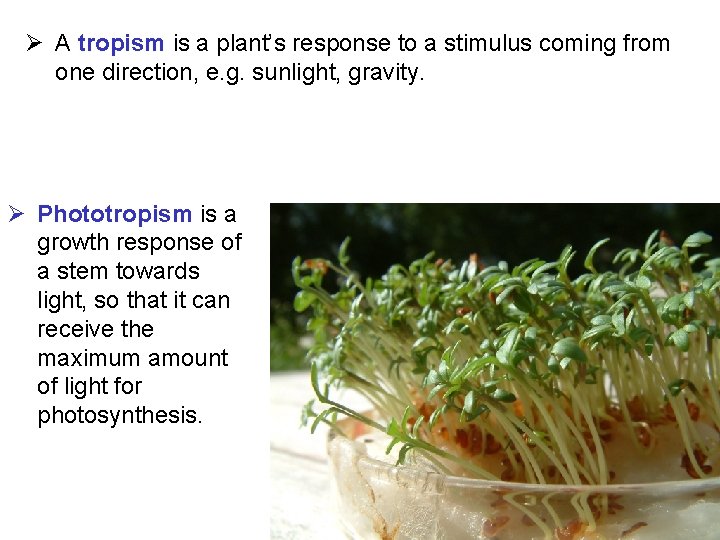
Ø A tropism is a plant’s response to a stimulus coming from one direction, e. g. sunlight, gravity. Ø Phototropism is a growth response of a stem towards light, so that it can receive the maximum amount of light for photosynthesis.

Ø Geotropism is the growth of a plant in response to gravity—it allows the root to get the water and nutrients it needs from the soil, and raises the leaves up into the light for photosynthesis. Ø Thigmotropism is the growth of a plant in response to contact, e. g. vines wrap around objects which help support the plant.
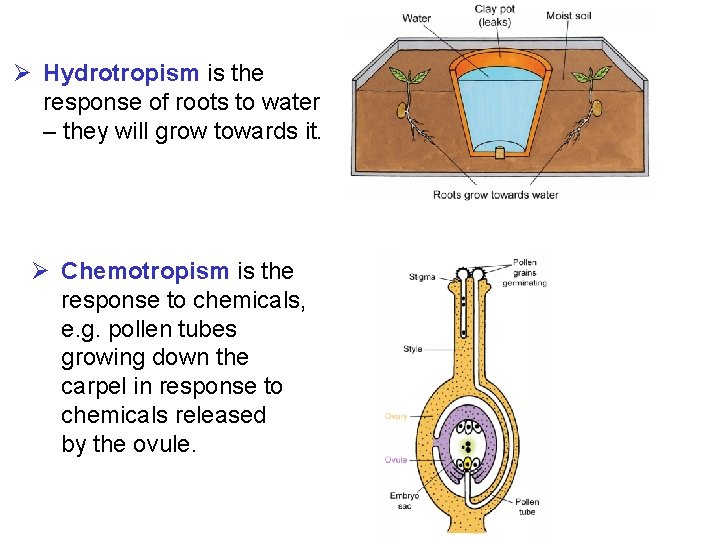
Ø Hydrotropism is the response of roots to water – they will grow towards it. Ø Chemotropism is the response to chemicals, e. g. pollen tubes growing down the carpel in response to chemicals released by the ovule.
Quiz • What is meant by the term “tropism”. • What is a stimulus. • Name 5 different tropisms and the stimulus involved in each case. • List the advantage to the plant of each tropism.
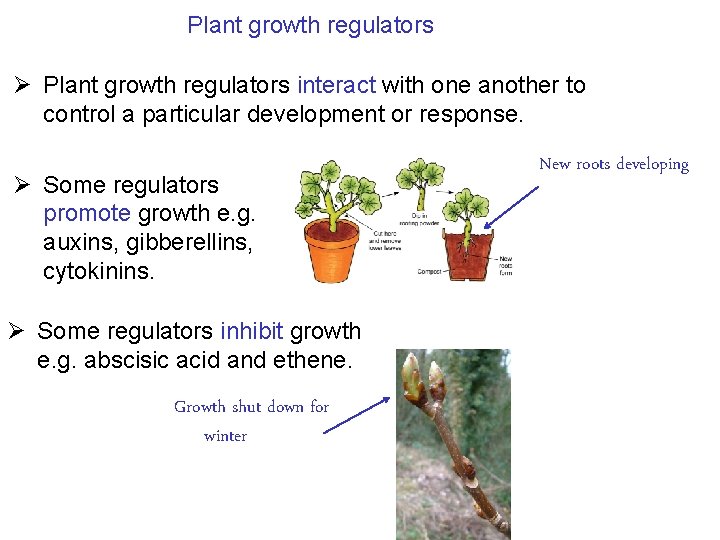
Plant growth regulators Ø Plant growth regulators interact with one another to control a particular development or response. Ø Some regulators promote growth e. g. auxins, gibberellins, cytokinins. Ø Some regulators inhibit growth e. g. abscisic acid and ethene. Growth shut down for winter New roots developing
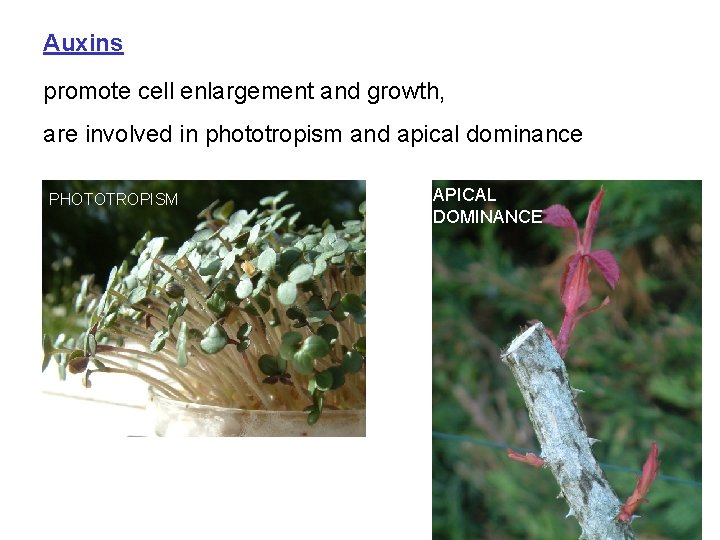
Auxins promote cell enlargement and growth, are involved in phototropism and apical dominance PHOTOTROPISM APICAL DOMINANCE
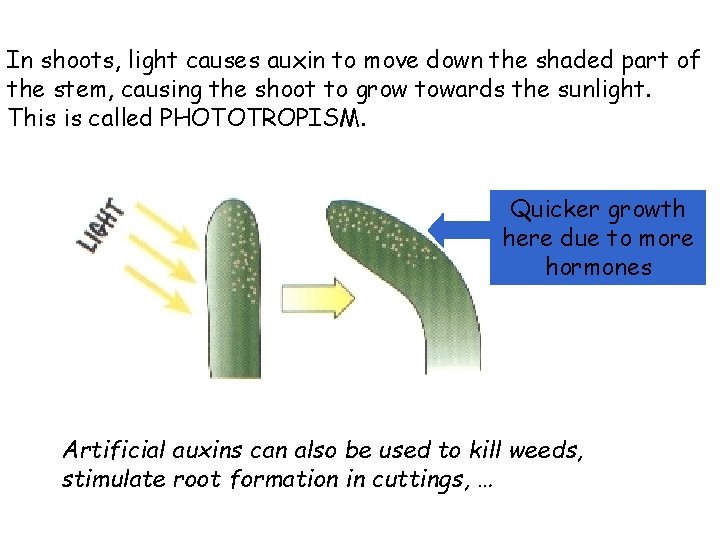
In shoots, light causes auxin to move down the shaded part of the stem, causing the shoot to grow towards the sunlight. This is called PHOTOTROPISM. Quicker growth here due to more hormones Artificial auxins can also be used to kill weeds, stimulate root formation in cuttings, …
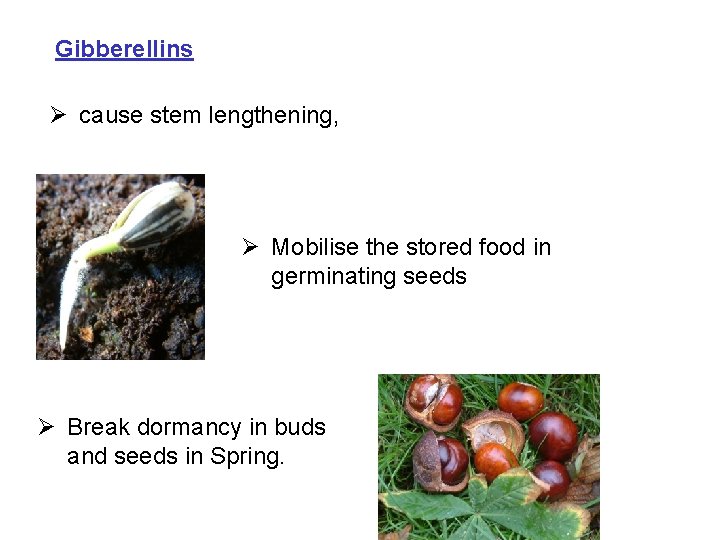
Gibberellins Ø cause stem lengthening, Ø Mobilise the stored food in germinating seeds Ø Break dormancy in buds and seeds in Spring.
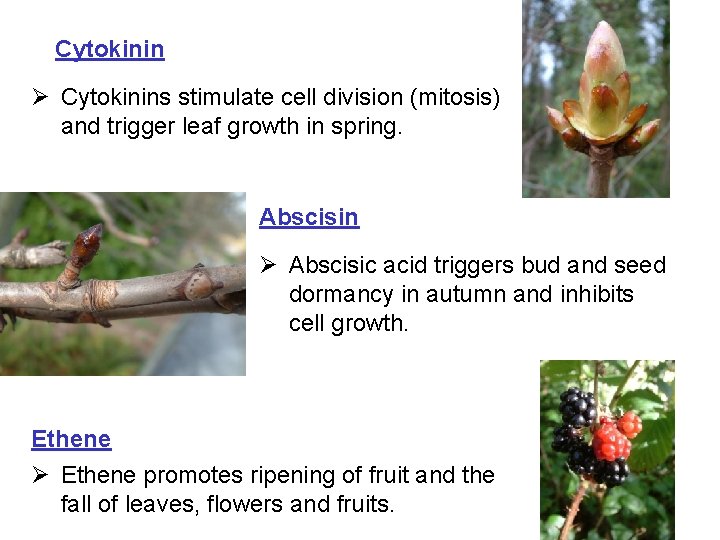
Cytokinin Ø Cytokinins stimulate cell division (mitosis) and trigger leaf growth in spring. Abscisin Ø Abscisic acid triggers bud and seed dormancy in autumn and inhibits cell growth. Ethene Ø Ethene promotes ripening of fruit and the fall of leaves, flowers and fruits.
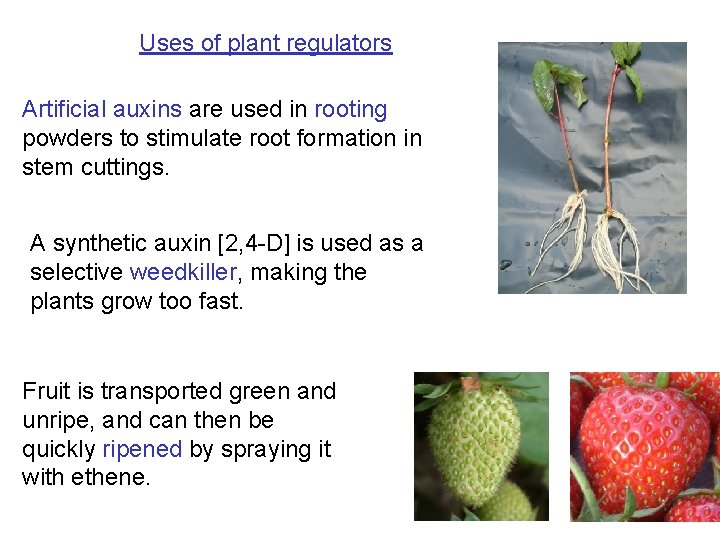
Uses of plant regulators Artificial auxins are used in rooting powders to stimulate root formation in stem cuttings. A synthetic auxin [2, 4 -D] is used as a selective weedkiller, making the plants grow too fast. Fruit is transported green and unripe, and can then be quickly ripened by spraying it with ethene.
Quiz • What is a plant growth regulator? • Explain the terms “promote” and “inhibit”. • Name 5 growth regulators and a function of each. • Give 3 examples of how we make use of plants growth regulators [natural or artificial]
Plant Defences Ø The growth and development responses described so far are a form of defence that allows a plant to survive difficult conditions [environmental stress] in its habitat. Ø Plants can’t move and so need to defend themselves against being eaten or damaged.
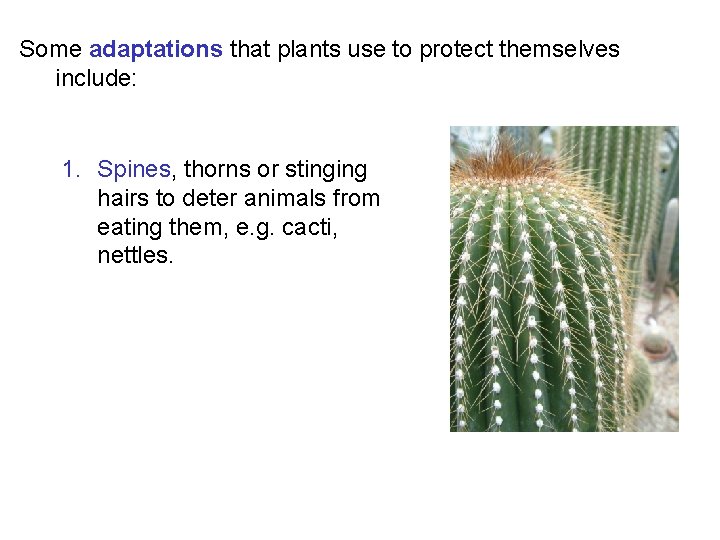
Some adaptations that plants use to protect themselves include: 1. Spines, thorns or stinging hairs to deter animals from eating them, e. g. cacti, nettles.
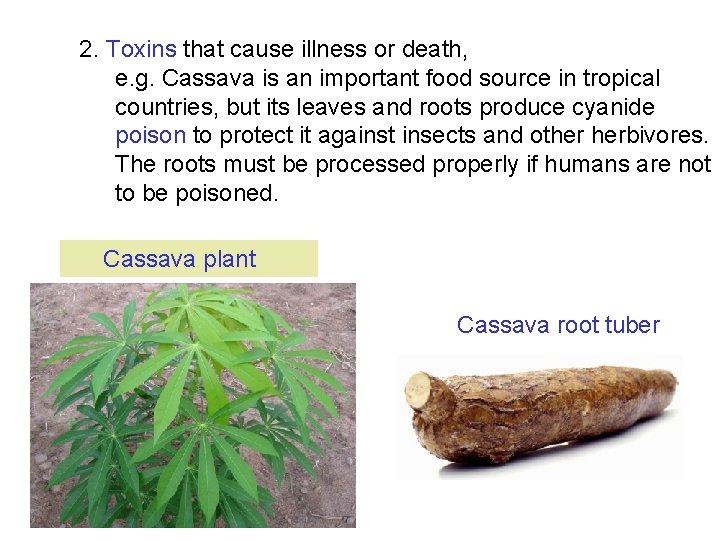
2. Toxins that cause illness or death, e. g. Cassava is an important food source in tropical countries, but its leaves and roots produce cyanide poison to protect it against insects and other herbivores. The roots must be processed properly if humans are not to be poisoned. Cassava plant Cassava root tuber
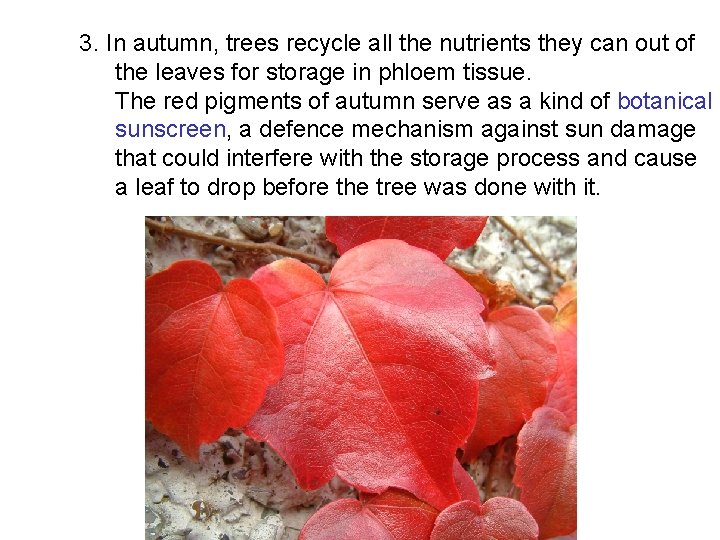
3. In autumn, trees recycle all the nutrients they can out of the leaves for storage in phloem tissue. The red pigments of autumn serve as a kind of botanical sunscreen, a defence mechanism against sun damage that could interfere with the storage process and cause a leaf to drop before the tree was done with it.
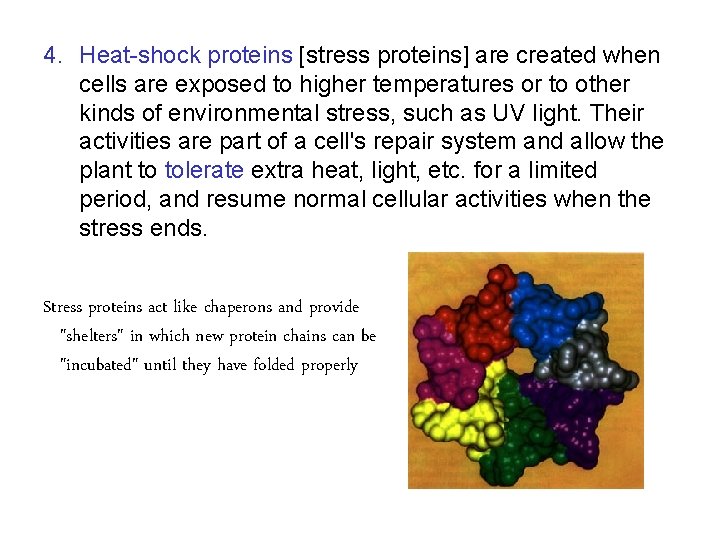
4. Heat-shock proteins [stress proteins] are created when cells are exposed to higher temperatures or to other kinds of environmental stress, such as UV light. Their activities are part of a cell's repair system and allow the plant to tolerate extra heat, light, etc. for a limited period, and resume normal cellular activities when the stress ends. Stress proteins act like chaperons and provide "shelters" in which new protein chains can be "incubated" until they have folded properly
Plant protection Ø Plants need to protect themselves from their environment They protect themselves against: • Loss of water • Overheating • Infection from micro organisms • Being eaten by herbivores
Adaptations for Protection in Plants can adapt themselves for protection in two ways: 1. Structural or anatomical adaptations 2. Chemical adaptations
Structural Adaptations • Bark/epidermis prevents entry of microbes and reduces loss of water • Thick cuticle on stem or leaves in plants that live in dry places • Thorns prevent plants from being eaten by herbivores • Stinging cell in epidermis prevent plants been eaten • Guard cells change shape when they lose water which causes stomata to close and this reduces water loss
Chemical Adaptations • Production of Tannins to make the plant indigestible • Production of toxic chemicals to prevent growth of insect larvae • Production of strychnine and nicotine in legumes that damage nerves and muscles • Production of heat shock proteins to protect enzymes when temperatures are high
Most important adaptation Plants can grow and regenerate throughout their life. They can produce new roots, stems, leaves.
Quiz • Why is defence important to plants? • List four methods used by plants to defend themselves. • Explain the term “structural adaptation”. • What is a toxin? • What advantage is it to a plant that it grows throughout its life [from meristems]?
IAA Experiment To investigate the effect of IAA concentration on plant tissues. 1. Different concentrations of IAA are prepared. 2. Seeds are grown in petri dishes with different concentrations of IAA. 3. Changes in length of seedlings shoots and roots are recorded.
Results At low concentrations the roots grow larger and shoots stay short. At higher concentrations the shoots grow larger and roots stay short.
- Slides: 31