
Chapter 32 The Building of Global Empires Copyright
Chapter 32 The Building of Global Empires Copyright © 2015 Mc. Graw-Hill Education. All rights reserved. No reproduction or distribution without the prior written consent of Mc. Graw-Hill Education. 1
Warmup Essay Outline/Preparation n Compare differing responses to industrialization in two of the following: q q q Japan China Russia Copyright © 2015 Mc. Graw-Hill Education. All rights reserved. No reproduction or distribution without the prior written consent of Mc. Graw-Hill Education. 2
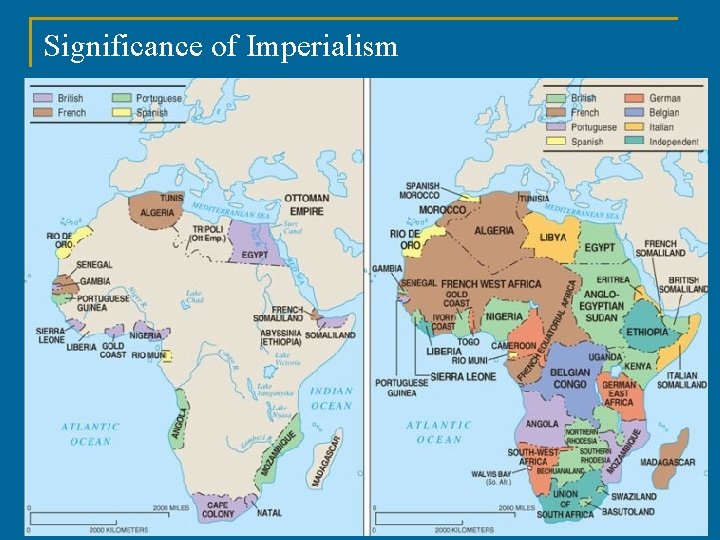
Significance of Imperialism Copyright © 2015 Mc. Graw-Hill Education. All rights reserved. No reproduction or distribution without the prior written consent of Mc. Graw-Hill Education. 3
The Idea of Imperialism n n Imperialism: The policy of extending a country's power and influence through diplomacy or military force. Colonies: Foreign territories conquered and ruled by Europeans, the US and Japan using technology and military dominance. Copyright © 2015 Mc. Graw-Hill Education. All rights reserved. No reproduction or distribution without the prior written consent of Mc. Graw-Hill Education. 4
Types of Imperialism n Three types of Imperialism q q q Military imperialism: Using military force and technology to conquer a foreign country. Economic imperialism: Dominating the resources and jobs of people in a foreign country. Cultural imperialism: Expanding usage of language, religion, and education by the conquering nation in a foreign country. Copyright © 2015 Mc. Graw-Hill Education. All rights reserved. No reproduction or distribution without the prior written consent of Mc. Graw-Hill Education. 5
Motivations for Imperialism n Military q n Political q n European capitalism, markets for goods, exploit resources Religious: q n Distract the unhappy citizens, stoke nationalism Economic q n Use new weaponry, acquire new territories Convert new peoples to faith Demographic q Criminal populations, dissident populations 6
CFU n Define Imperialism. Explain its impact and spread. Copyright © 2015 Mc. Graw-Hill Education. All rights reserved. No reproduction or distribution without the prior written consent of Mc. Graw-Hill Education. 7
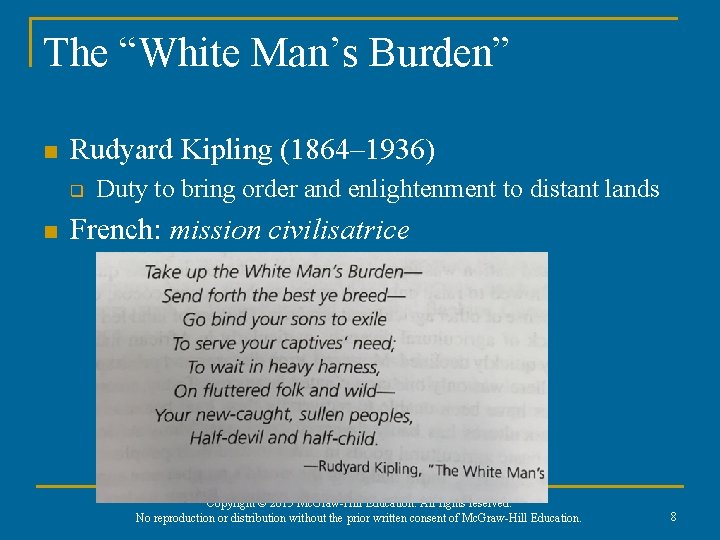
The “White Man’s Burden” n Rudyard Kipling (1864– 1936) q n Duty to bring order and enlightenment to distant lands French: mission civilisatrice Copyright © 2015 Mc. Graw-Hill Education. All rights reserved. No reproduction or distribution without the prior written consent of Mc. Graw-Hill Education. 8
Domestic Political Considerations n Crises of industrialism q n n Industrial discontent, resistance to economic changes Pressure from nascent socialism Imperial policies distract proletariat from domestic politics q Cecil Rhodes: imperialism alternative to civil war Copyright © 2015 Mc. Graw-Hill Education. All rights reserved. No reproduction or distribution without the prior written consent of Mc. Graw-Hill Education. 9
Technology and Imperialism n n This level of imperialism would not have been possible without technological advances. Medicine q n Quinine (Helped to treat Malaria) Transportation q Steamships, and Railroads Copyright © 2015 Mc. Graw-Hill Education. All rights reserved. No reproduction or distribution without the prior written consent of Mc. Graw-Hill Education. 10
Technology and Imperialism n Communication q n The telegraph Infrastructure q Suez Canal (1859– 1869) n n q Performed at the direction of Great Britain Connected the Red Sea (Indian Ocean) to the Mediterranean Sea (Atlantic Ocean) Panama Canal (1904– 1914) n n Performed at the direction of the United states Connected the Atlantic Ocean to the Pacific Ocean Copyright © 2015 Mc. Graw-Hill Education. All rights reserved. No reproduction or distribution without the prior written consent of Mc. Graw-Hill Education. 11
CFU n n Describe the “moral” reasons behind the spread of imperialism. What were some of the societal goals of imperialism. Copyright © 2015 Mc. Graw-Hill Education. All rights reserved. No reproduction or distribution without the prior written consent of Mc. Graw-Hill Education. 12
New Weapons Technology n Mass production of new weaponry gave European soldiers massive military advantage: q Repeating rifles n n n q Reduced reloading time More accurate Carried by all soldiers Maxim gun n n First machine gun 11 rounds per second Copyright © 2015 Mc. Graw-Hill Education. All rights reserved. No reproduction or distribution without the prior written consent of Mc. Graw-Hill Education. 13
The Military Advantage n Battle of Omdurman (near Khartoum on Nile), 1898 q q n n Five hours of fighting British Army fought the Sudanese Army British: six gunboats, twenty machine guns British force lost a few hundred men; close to 20, 000 Sudanese killed Copyright © 2015 Mc. Graw-Hill Education. All rights reserved. No reproduction or distribution without the prior written consent of Mc. Graw-Hill Education. 14
Technology: Communications n Correspondence q q n 1830 s, Britain–India: as long as 2 years After Suez Canal, 2 weeks Telegraph q q 1870 s, development of submarine cables Britain–India: 5 hours Copyright © 2015 Mc. Graw-Hill Education. All rights reserved. No reproduction or distribution without the prior written consent of Mc. Graw-Hill Education. 15
CFU n n Identify three technological advantages that Europeans used during Imperialism. Explain how they were used. Copyright © 2015 Mc. Graw-Hill Education. All rights reserved. No reproduction or distribution without the prior written consent of Mc. Graw-Hill Education. 16
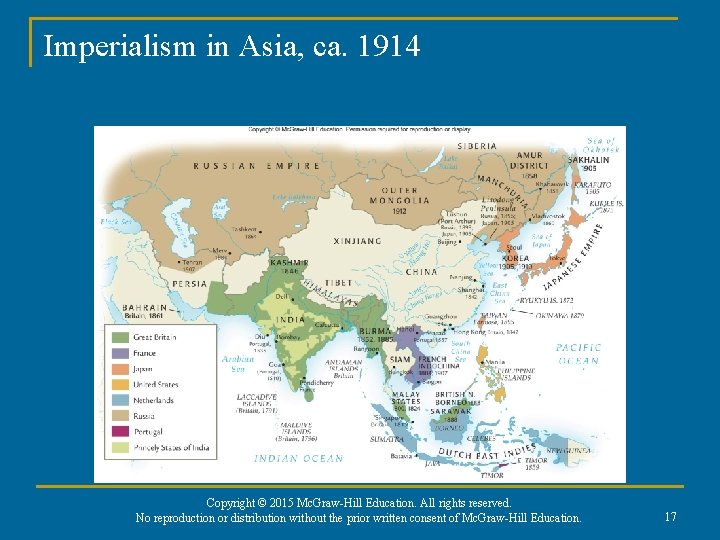
Imperialism in Asia, ca. 1914 Copyright © 2015 Mc. Graw-Hill Education. All rights reserved. No reproduction or distribution without the prior written consent of Mc. Graw-Hill Education. 17
British Empire in India n British East India Company q n Monopoly on India trade Original permission from Mughal emperors q q Decline of Mughal empire after death of Aurangzeb, 1707 British East India Company controlled Indian government through the Mughal Empire Copyright © 2015 Mc. Graw-Hill Education. All rights reserved. No reproduction or distribution without the prior written consent of Mc. Graw-Hill Education. 18
British Conquest n n n Protection of economic interests through political conquest “Doctrine of lapse” British and Indian troops (sepoys) q British officers controlled Indian soldiers Copyright © 2015 Mc. Graw-Hill Education. All rights reserved. No reproduction or distribution without the prior written consent of Mc. Graw-Hill Education. 19
Indian Rebellion, 1857 n Newly issued rifles had cartridges in wax paper greased with animal fat q q n n Problem for Hindus: beef Problem for Muslims: pork Small-scale sepoy rebellion ignited general anti-British revolution British gained upper hand in late 1857 Copyright © 2015 Mc. Graw-Hill Education. All rights reserved. No reproduction or distribution without the prior written consent of Mc. Graw-Hill Education. 20
British Imperial Rule n In response to the rebellion, Britain: q q Abolished Mughal empire Exiled emperor to Burma Abolished East India Company Established direct rule of India by British government n Organization of agriculture q n Crops: tea, coffee, opium Stamp of British culture on Indian environment Copyright © 2015 Mc. Graw-Hill Education. All rights reserved. No reproduction or distribution without the prior written consent of Mc. Graw-Hill Education. 21
CFU n Summarize the steps taken by the British to consolidate their rule in India, and the resistance to their attempts. Copyright © 2015 Mc. Graw-Hill Education. All rights reserved. No reproduction or distribution without the prior written consent of Mc. Graw-Hill Education. 22
Imperialism in Central Asia n British, French, Russians in competition for central Asia q q n France dropped out after Napoleon Russia active after 1860 s in Tashkent, Bokhara, Samarkand; and approached India The “Great Game”: Russian vs. British intrigue in Afghanistan q q Preparation for imperialist war Russian revolution of 1917 forestalled war Copyright © 2015 Mc. Graw-Hill Education. All rights reserved. No reproduction or distribution without the prior written consent of Mc. Graw-Hill Education. 23
Imperialism in Southeast Asia n n n Spanish: Philippines Dutch: Indonesia (Dutch East Indies) British established presence from 1820 s q q Conflict with kings of Burma (Myanmar) 1820 s; established colonial authority by 1880 s Thomas Stamford Raffles founded port of Singapore for trade in Strait of Melaka n n Base of British colonization in Malaysia, 1870 s– 1880 s French: Vietnam, Cambodia, Laos, 1859– 1893 q Encouraged conversion to Christianity Copyright © 2015 Mc. Graw-Hill Education. All rights reserved. No reproduction or distribution without the prior written consent of Mc. Graw-Hill Education. 24
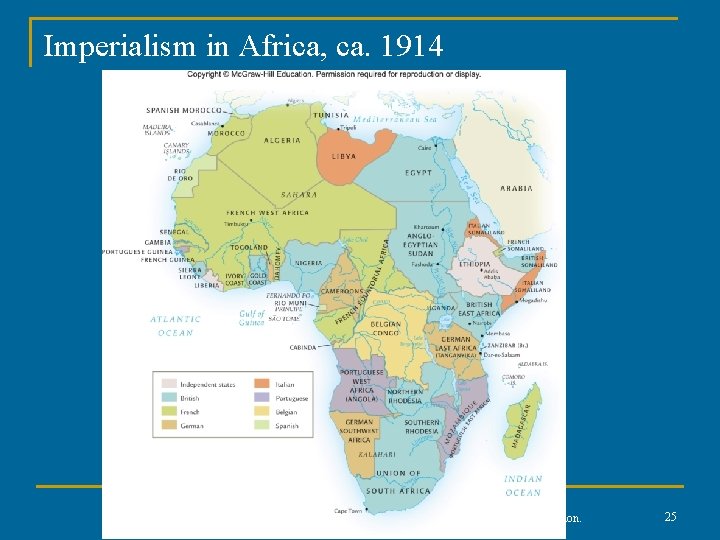
Imperialism in Africa, ca. 1914 Copyright © 2015 Mc. Graw-Hill Education. All rights reserved. No reproduction or distribution without the prior written consent of Mc. Graw-Hill Education. 25
European Explorers in Africa n n Implications for justification of imperialist rule Exploration of rivers (Nile, Niger, Congo, Zambesi) Information on interior of Africa Congo Free State established by King Leopold II of Belgium q q Personal property of King Leopold Belgians committed horrific atrocities against the Congolese people (Genocide) Copyright © 2015 Mc. Graw-Hill Education. All rights reserved. No reproduction or distribution without the prior written consent of Mc. Graw-Hill Education. 26
Firewrite n Compare differing responses to industrialization in two of the following: q q q Japan China Russia Copyright © 2015 Mc. Graw-Hill Education. All rights reserved. No reproduction or distribution without the prior written consent of Mc. Graw-Hill Education. 27
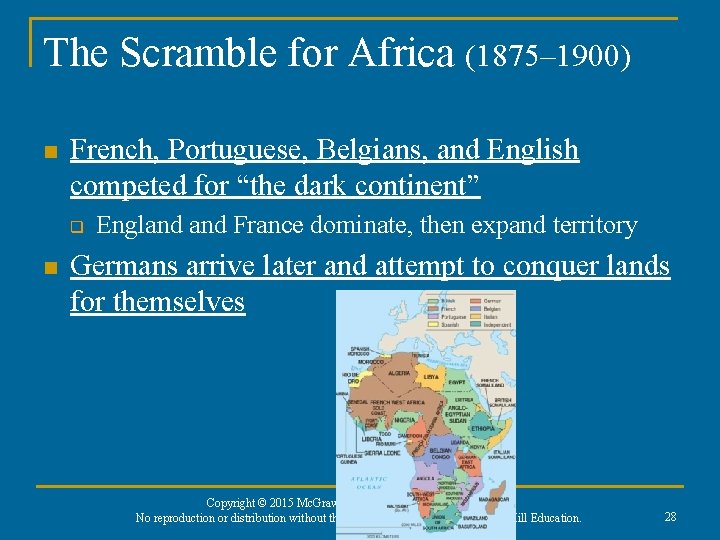
The Scramble for Africa (1875– 1900) n French, Portuguese, Belgians, and English competed for “the dark continent” q n England France dominate, then expand territory Germans arrive later and attempt to conquer lands for themselves Copyright © 2015 Mc. Graw-Hill Education. All rights reserved. No reproduction or distribution without the prior written consent of Mc. Graw-Hill Education. 28
The Berlin West Africa Conference (1884– 1885) n Fourteen European states, United States q q No African states present Established Rules of colonization: any European state can take “unoccupied” territory after informing other European powers Copyright © 2015 Mc. Graw-Hill Education. All rights reserved. No reproduction or distribution without the prior written consent of Mc. Graw-Hill Education. 29
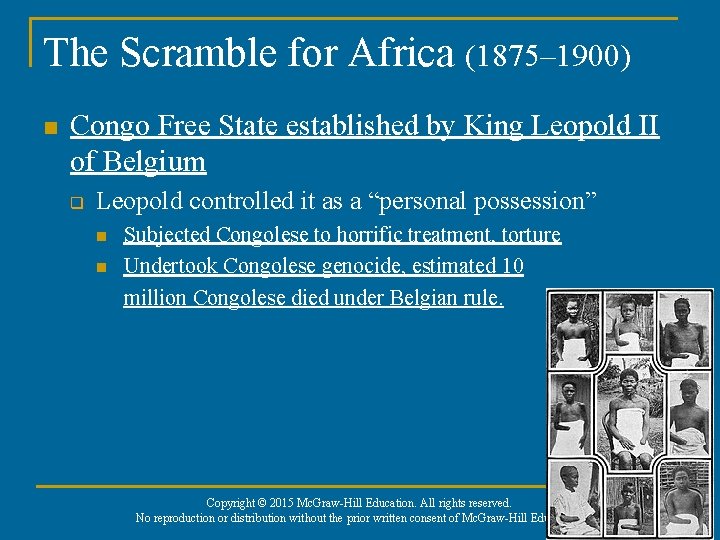
The Scramble for Africa (1875– 1900) n Congo Free State established by King Leopold II of Belgium q Leopold controlled it as a “personal possession” n n Subjected Congolese to horrific treatment, torture Undertook Congolese genocide, estimated 10 million Congolese died under Belgian rule. Copyright © 2015 Mc. Graw-Hill Education. All rights reserved. No reproduction or distribution without the prior written consent of Mc. Graw-Hill Education. 30
South Africa n Cape Town established by Dutch East India, 1652 q q n Farmers (Boers, later known as Afrikaners) followed to settle territory Competition and conflict with indigenous peoples British takeover country in 1806 Copyright © 2015 Mc. Graw-Hill Education. All rights reserved. No reproduction or distribution without the prior written consent of Mc. Graw-Hill Education. 31
South African War (1899– 1902) n n n Also known as the Boer War White–white conflict, black soldiers and laborers Afrikaners conceded in 1902 q n 1910, integrated into Union of South Africa Created an incredibly racist state based off of racial segregation known as Apartheid. Copyright © 2015 Mc. Graw-Hill Education. All rights reserved. No reproduction or distribution without the prior written consent of Mc. Graw-Hill Education. 32
CFU n n Describe the impact of the Berlin conference on Europe and Africa. Explain the scramble for Africa. Copyright © 2015 Mc. Graw-Hill Education. All rights reserved. No reproduction or distribution without the prior written consent of Mc. Graw-Hill Education. 33
Systems of Colonial Rule n Large Private companies q q q British East India Company Private companies obtained large tracts of land to exploit natural resources Freedom to tax, recruit labor: horrible abuses Copyright © 2015 Mc. Graw-Hill Education. All rights reserved. No reproduction or distribution without the prior written consent of Mc. Graw-Hill Education. 34
Systems of Colonial Rule (continued) n Direct rule: France q Using French Officials to be the center of government n n n Chronic shortage of European personnel; language and cultural barriers French west Africa: 3, 600 Europeans ruled 9 million Africans Indirect rule: Britain q Use of pre-existing governments, favoring synpatetic indigenous peoples with weapons/technology n Difficulty in establishing tribal categories; imposed arbitrary boundaries Copyright © 2015 Mc. Graw-Hill Education. All rights reserved. No reproduction or distribution without the prior written consent of Mc. Graw-Hill Education. 35
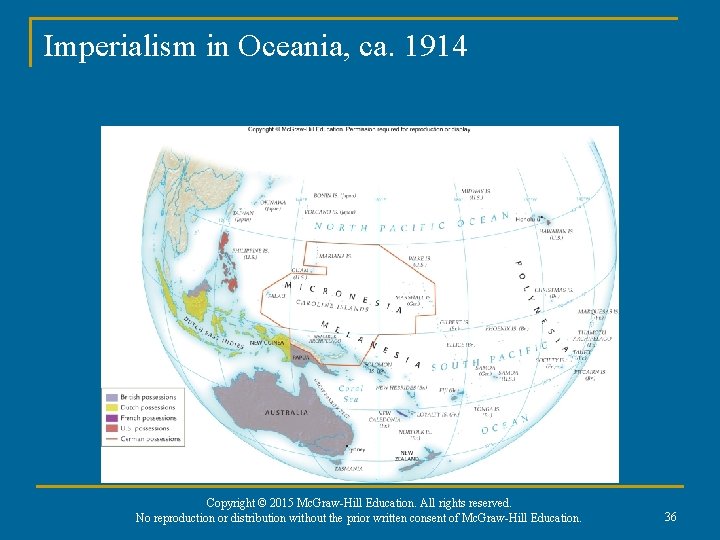
Imperialism in Oceania, ca. 1914 Copyright © 2015 Mc. Graw-Hill Education. All rights reserved. No reproduction or distribution without the prior written consent of Mc. Graw-Hill Education. 36
European Imperialism in the Pacific n English used Australia as penal colony from 1788 q q Voluntary migrants followed Gold discovered, 1851 n n n Smallpox, measles devastated natives Territory called terra nullius: “land belonging to no one” New Zealand: natives forced to sign Treaty of Waitangi (1840) q placing New Zealand under British “protection” Copyright © 2015 Mc. Graw-Hill Education. All rights reserved. No reproduction or distribution without the prior written consent of Mc. Graw-Hill Education. 37
Imperialists in Paradise n Pacific islands: commercial outposts q q q n Whalers seeking port Merchants seeking sandalwood, sea slugs for sale in China Missionaries seeking souls British, French, German, American powers carved islands up q Tonga remained independent, but relied on Britain Copyright © 2015 Mc. Graw-Hill Education. All rights reserved. No reproduction or distribution without the prior written consent of Mc. Graw-Hill Education. 38
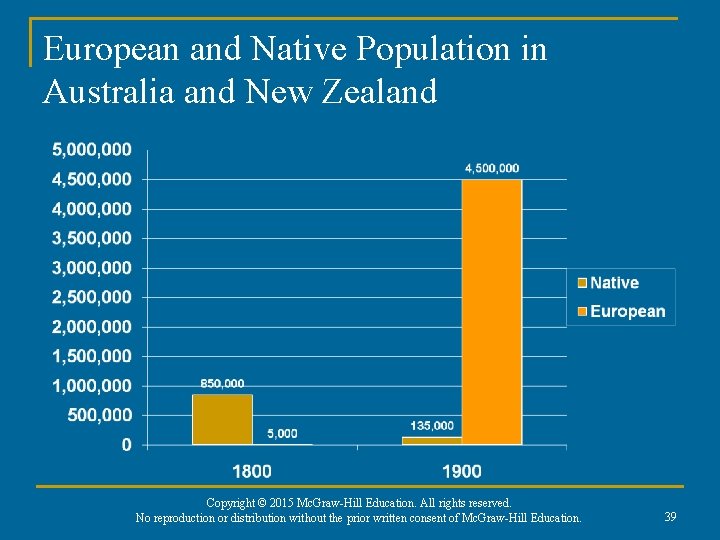
European and Native Population in Australia and New Zealand Copyright © 2015 Mc. Graw-Hill Education. All rights reserved. No reproduction or distribution without the prior written consent of Mc. Graw-Hill Education. 39
CFU n n Describe the different styles of Colonial Rule. Identify the purpose of European conquest in the Pacific. Copyright © 2015 Mc. Graw-Hill Education. All rights reserved. No reproduction or distribution without the prior written consent of Mc. Graw-Hill Education. 40
U. S. Imperialism n The Monroe Doctrine: President James Monroe warned Europeans not to engage in imperialism in western hemisphere (1823) q n n All Americas a U. S. protectorate 1867: purchased Alaska from Russia 1875: established protectorate over Hawai`i q Locals overthrew queen in 1893, persuaded U. S. to acquire islands in 1898 Copyright © 2015 Mc. Graw-Hill Education. All rights reserved. No reproduction or distribution without the prior written consent of Mc. Graw-Hill Education. 41
The Spanish-American-Filipino War (1898– 1899) n U. S. declared war on Spain after battleship Maine sunk in Havana harbor, 1898 q q n Took possession of Cuba, Puerto Rico, Guam, Philippines U. S. intervened in other Caribbean, Central American lands Filipinos revolted against Spanish rule, later against U. S. rule q American troops used to conquer the Phillipines 42
The Panama Canal n President Theodore Roosevelt put support behind insurrection against Colombia q n n Rebels won, established state of Panama U. S. gained territory to build canal, Panama Canal Zone Roosevelt Corollary of Monroe Doctrine q U. S. right to intervene in domestic affairs of other nations if U. S. investments threatened Copyright © 2015 Mc. Graw-Hill Education. All rights reserved. No reproduction or distribution without the prior written consent of Mc. Graw-Hill Education. 43
CFU n Identify significant areas imperialized by the United States, and explain the policies used to promote this expansion. Copyright © 2015 Mc. Graw-Hill Education. All rights reserved. No reproduction or distribution without the prior written consent of Mc. Graw-Hill Education. 44
Early Japanese Expansion n Resentment over unequal treaties of 1860 s q n 1870 s, colonized northern region: Hokkaido, Kurile Islands, southern Okinawa, and Ryukyu Islands 1876, Japanese purchase of warships from Britain, moved to dominate Korea Copyright © 2015 Mc. Graw-Hill Education. All rights reserved. No reproduction or distribution without the prior written consent of Mc. Graw-Hill Education. 45
Early Japanese Expansion n Sino-Japanese War (1894– 1895) over Korea a Japanese victory q n Japan colonized and occupied Korea Russo-Japanese War (1904– 1905) also ended in Japanese victory q Demonstrated the military power of Japan and Weakness of Russia Copyright © 2015 Mc. Graw-Hill Education. All rights reserved. No reproduction or distribution without the prior written consent of Mc. Graw-Hill Education. 46
Economic Legacies of Imperialism n n Colonized states encouraged to exploit natural resources rather than build manufacturing centers Encouraged dependency on imperial power for manufactured goods made from native raw product q n Indian cotton Introduction of new crops q Tea in Ceylon Copyright © 2015 Mc. Graw-Hill Education. All rights reserved. No reproduction or distribution without the prior written consent of Mc. Graw-Hill Education. 47
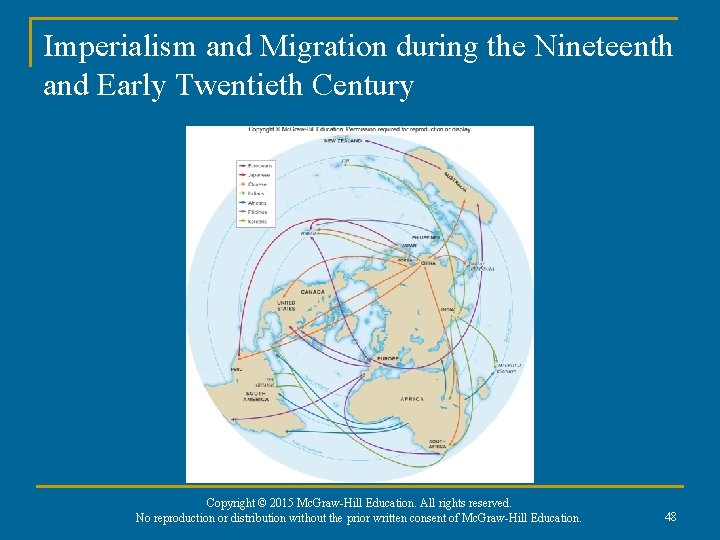
Imperialism and Migration during the Nineteenth and Early Twentieth Century Copyright © 2015 Mc. Graw-Hill Education. All rights reserved. No reproduction or distribution without the prior written consent of Mc. Graw-Hill Education. 48
Labor Migrations n Europeans moved to more temperate lands q n Worked as free cultivators, industrial laborers Africans, Asians, and Pacific islanders moved to tropical/subtropical lands q q Indentured laborers, manual laborers, slavery expanded 2. 5 million between 1820 and 1914 Copyright © 2015 Mc. Graw-Hill Education. All rights reserved. No reproduction or distribution without the prior written consent of Mc. Graw-Hill Education. 49
CFU n n Describe the motivations and actions taken by the Japanese Empire. Explain the Long term impact of Imperialism economically and socially. Copyright © 2015 Mc. Graw-Hill Education. All rights reserved. No reproduction or distribution without the prior written consent of Mc. Graw-Hill Education. 50
Colonial Conflict n Thousands of insurrections against colonial rule q q n In German East Africa, Maji rebellion against Germans (1905– 1906) Rebels sprinkled selves with magic water (maji-maji) as protection against modern weapons; 75, 000 killed “Scientific” racism developed q q Count Joseph Arthur de Gobineau (1816– 1882) Combined with theories of Charles Darwin (1809– 1882) to form pernicious doctrine of “social Darwinism” Copyright © 2015 Mc. Graw-Hill Education. All rights reserved. No reproduction or distribution without the prior written consent of Mc. Graw-Hill Education. 51
Nationalism and Anticolonial Movements n Ram Mohan Roy (1772– 1883), Bengali called “father of modern India” q q n Reformers called for self-government, adoption of selected British practices (e. g. ban on sati) Influence of Enlightenment thought, often obtained in European universities Indian National Congress formed, 1885 q 1916, joined with All-India Muslim League Copyright © 2015 Mc. Graw-Hill Education. All rights reserved. No reproduction or distribution without the prior written consent of Mc. Graw-Hill Education. 52
- Slides: 52