
Chapter 32 Light Reflection and Refraction Copyright 2009
- Slides: 38
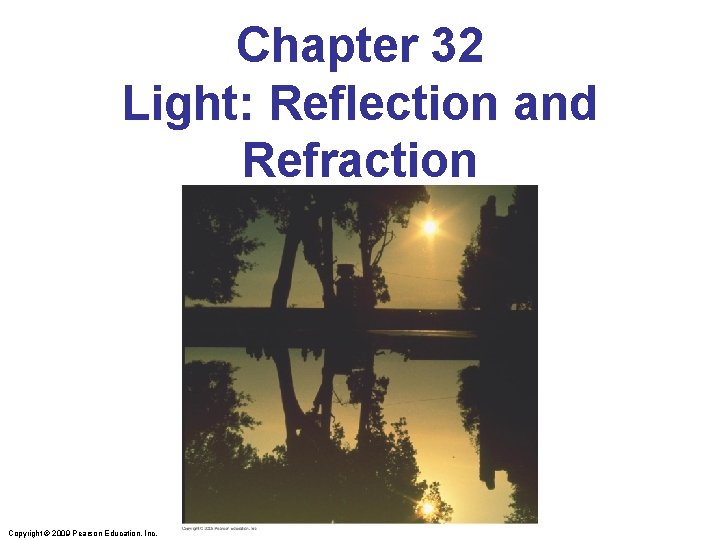
Chapter 32 Light: Reflection and Refraction Copyright © 2009 Pearson Education, Inc.
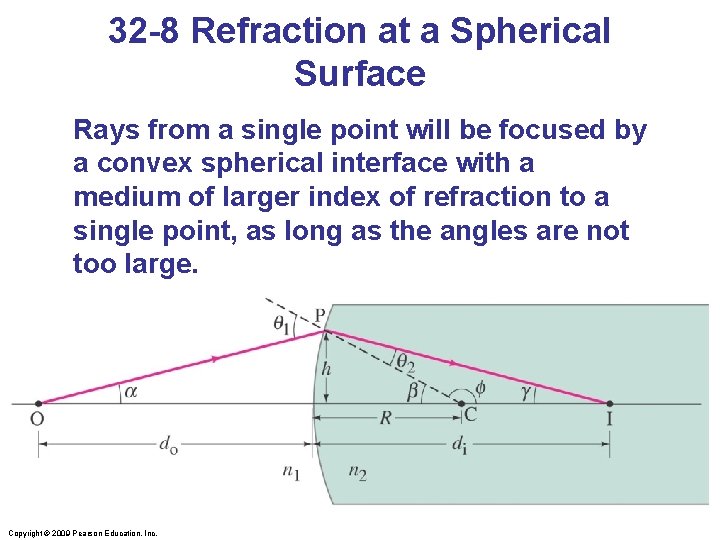
32 -8 Refraction at a Spherical Surface Rays from a single point will be focused by a convex spherical interface with a medium of larger index of refraction to a single point, as long as the angles are not too large. Copyright © 2009 Pearson Education, Inc.
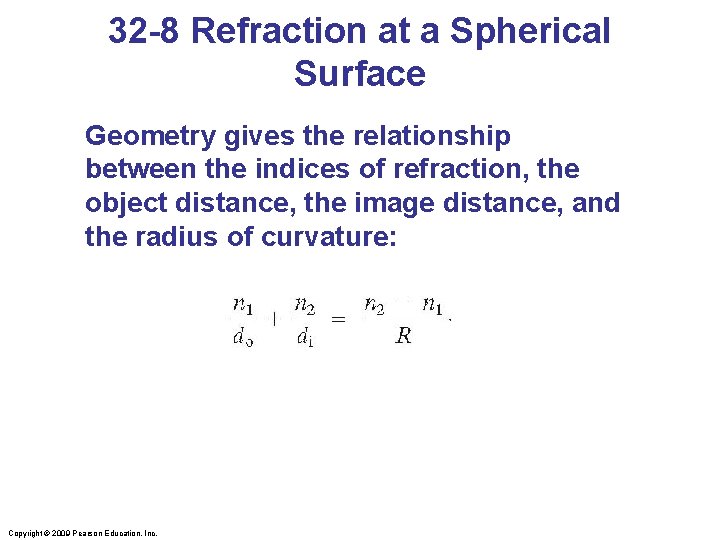
32 -8 Refraction at a Spherical Surface Geometry gives the relationship between the indices of refraction, the object distance, the image distance, and the radius of curvature: Copyright © 2009 Pearson Education, Inc.
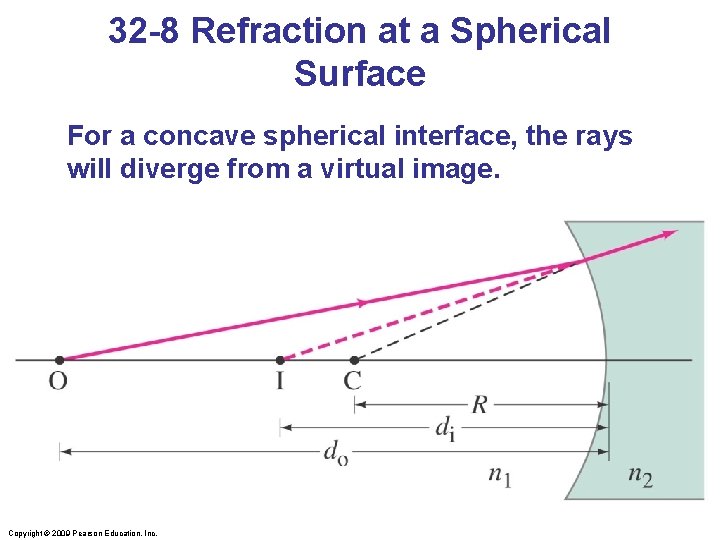
32 -8 Refraction at a Spherical Surface For a concave spherical interface, the rays will diverge from a virtual image. Copyright © 2009 Pearson Education, Inc.
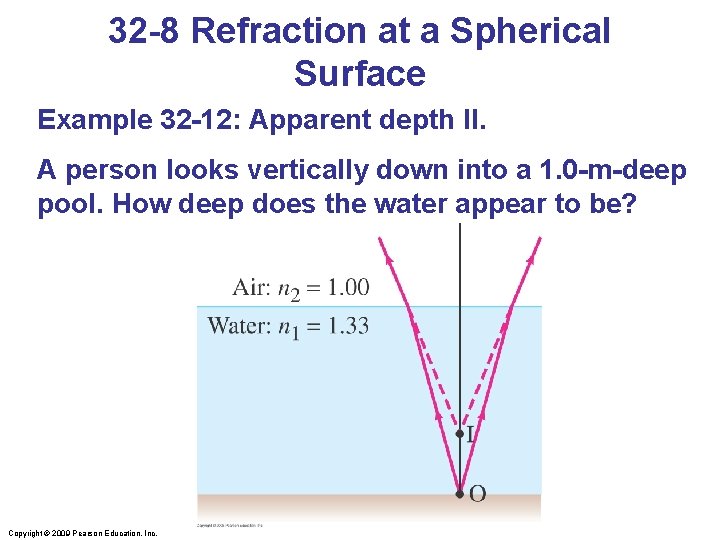
32 -8 Refraction at a Spherical Surface Example 32 -12: Apparent depth II. A person looks vertically down into a 1. 0 -m-deep pool. How deep does the water appear to be? Copyright © 2009 Pearson Education, Inc.
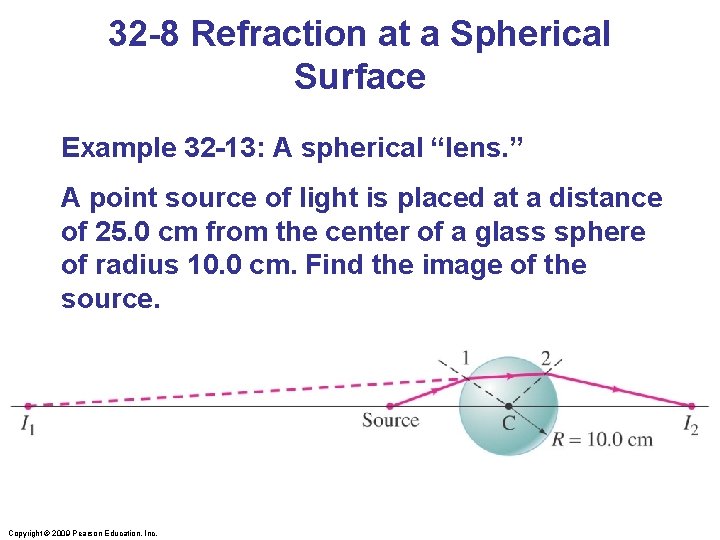
32 -8 Refraction at a Spherical Surface Example 32 -13: A spherical “lens. ” A point source of light is placed at a distance of 25. 0 cm from the center of a glass sphere of radius 10. 0 cm. Find the image of the source. Copyright © 2009 Pearson Education, Inc.
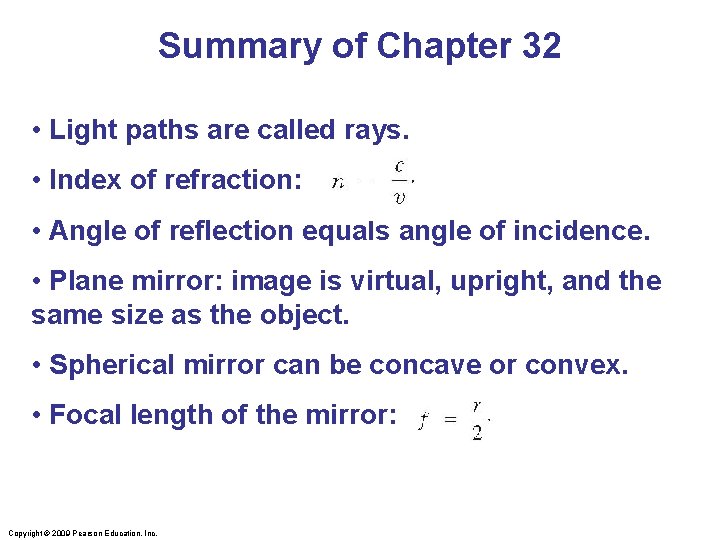
Summary of Chapter 32 • Light paths are called rays. • Index of refraction: • Angle of reflection equals angle of incidence. • Plane mirror: image is virtual, upright, and the same size as the object. • Spherical mirror can be concave or convex. • Focal length of the mirror: Copyright © 2009 Pearson Education, Inc.
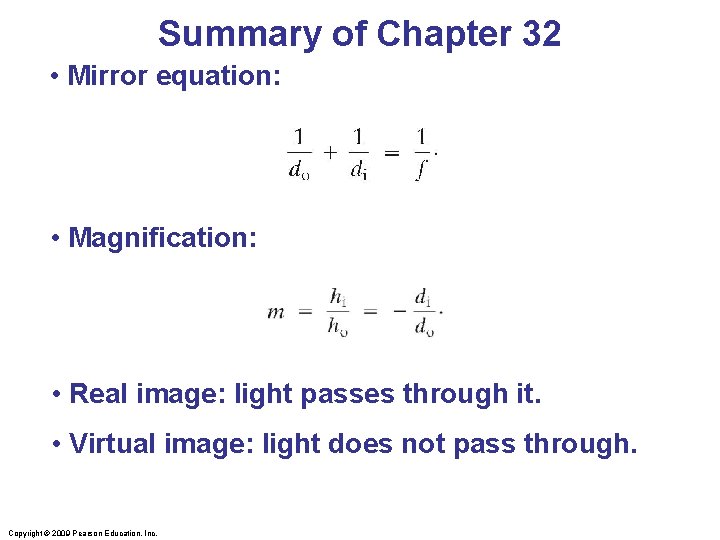
Summary of Chapter 32 • Mirror equation: • Magnification: • Real image: light passes through it. • Virtual image: light does not pass through. Copyright © 2009 Pearson Education, Inc.
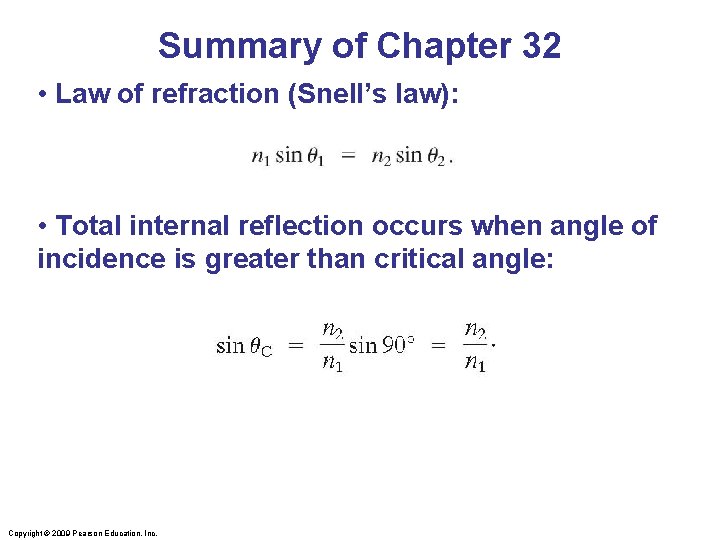
Summary of Chapter 32 • Law of refraction (Snell’s law): • Total internal reflection occurs when angle of incidence is greater than critical angle: Copyright © 2009 Pearson Education, Inc.
Chapter 33 Lenses and Optical Instruments Copyright © 2009 Pearson Education, Inc.
Units of Chapter 33 • Thin Lenses; Ray Tracing • The Thin Lens Equation; Magnification • Combinations of Lenses • Lensmaker’s Equation • Magnifying Glass Copyright © 2009 Pearson Education, Inc.
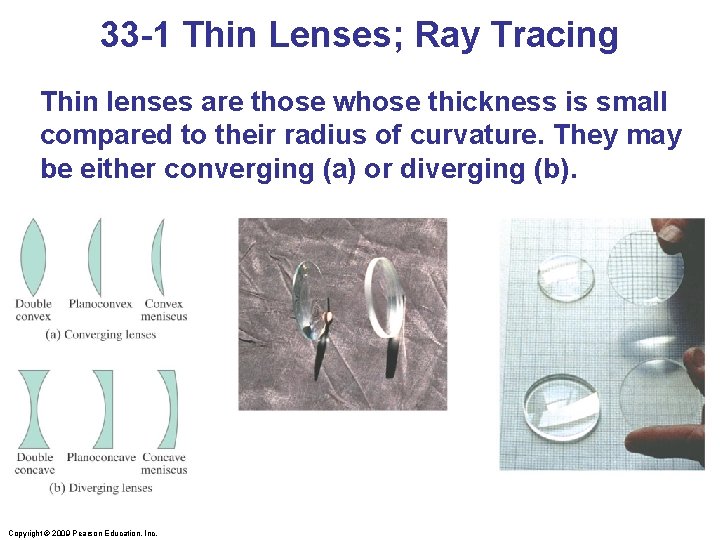
33 -1 Thin Lenses; Ray Tracing Thin lenses are those whose thickness is small compared to their radius of curvature. They may be either converging (a) or diverging (b). Copyright © 2009 Pearson Education, Inc.
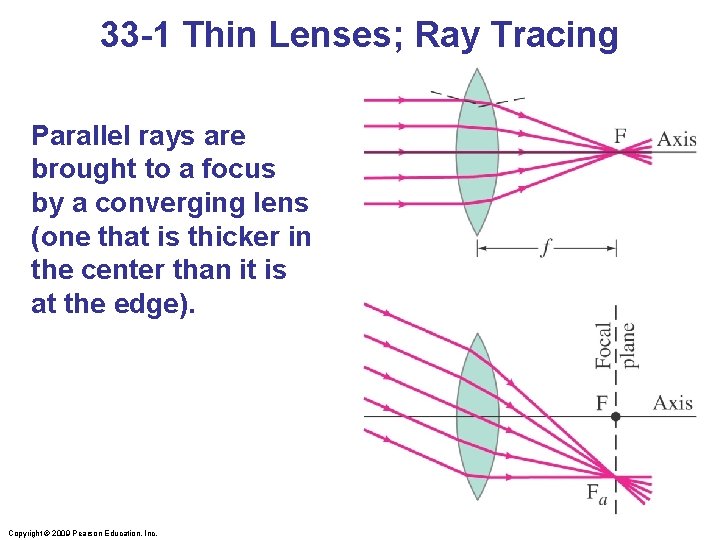
33 -1 Thin Lenses; Ray Tracing Parallel rays are brought to a focus by a converging lens (one that is thicker in the center than it is at the edge). Copyright © 2009 Pearson Education, Inc.
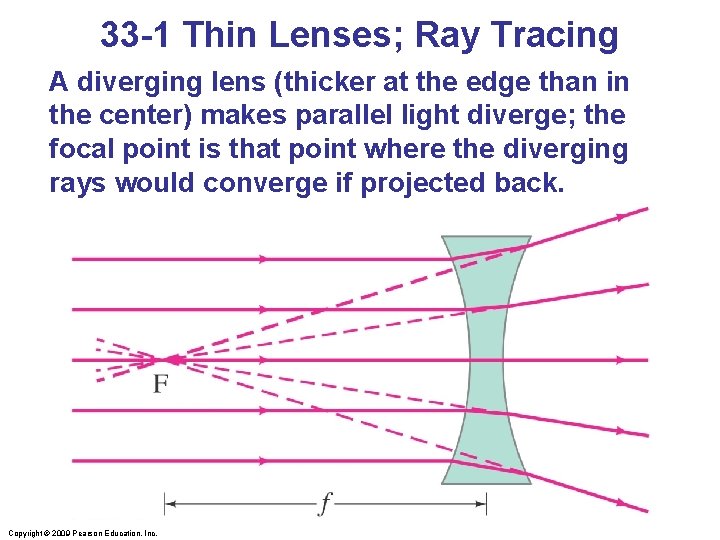
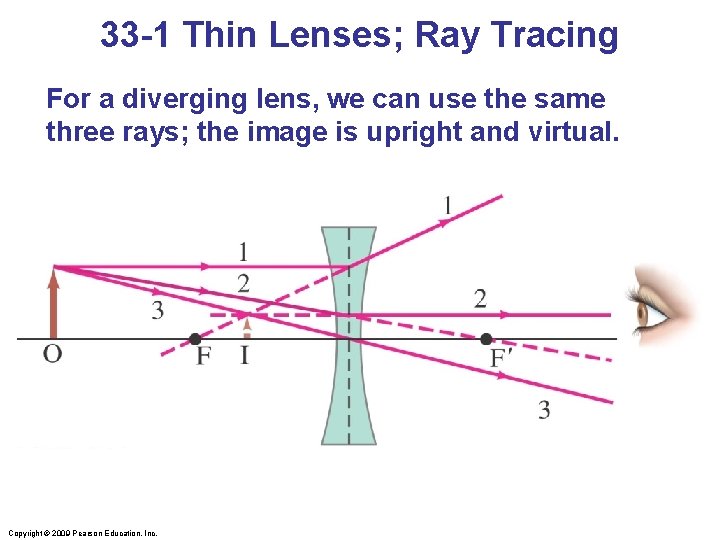
33 -1 Thin Lenses; Ray Tracing A diverging lens (thicker at the edge than in the center) makes parallel light diverge; the focal point is that point where the diverging rays would converge if projected back. Copyright © 2009 Pearson Education, Inc.
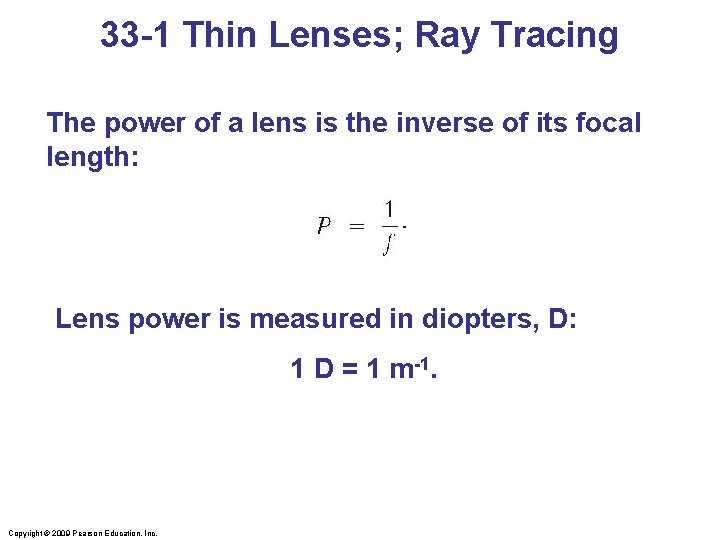
33 -1 Thin Lenses; Ray Tracing The power of a lens is the inverse of its focal length: Lens power is measured in diopters, D: 1 D = 1 m-1. Copyright © 2009 Pearson Education, Inc.
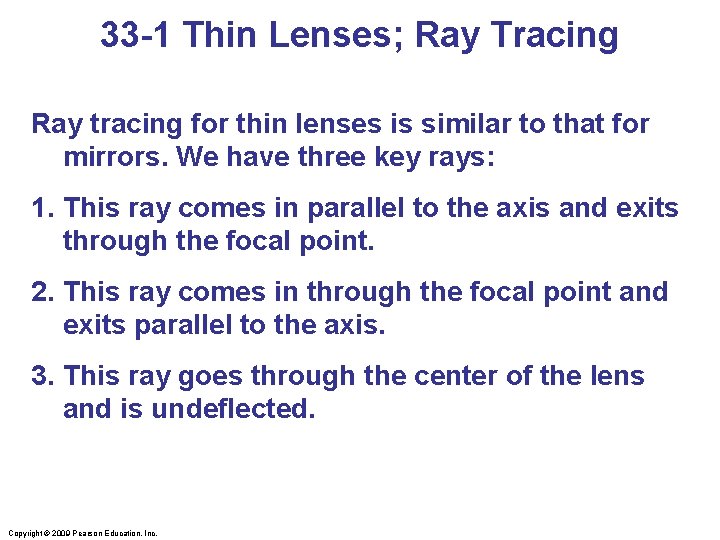
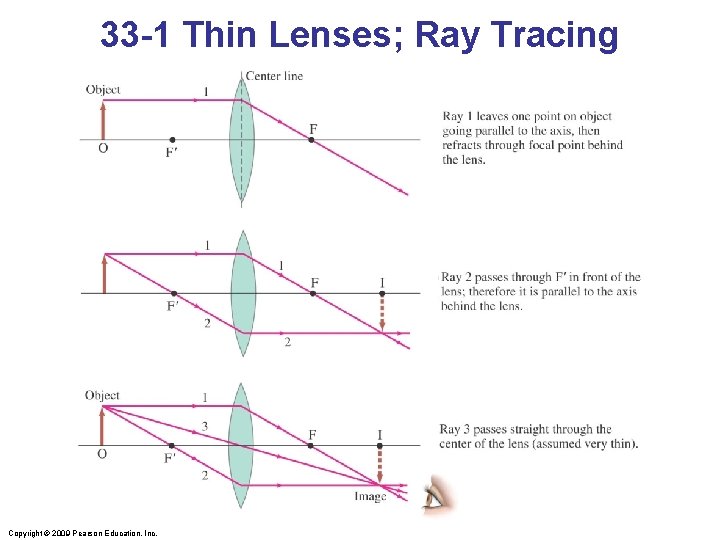
33 -1 Thin Lenses; Ray Tracing Ray tracing for thin lenses is similar to that for mirrors. We have three key rays: 1. This ray comes in parallel to the axis and exits through the focal point. 2. This ray comes in through the focal point and exits parallel to the axis. 3. This ray goes through the center of the lens and is undeflected. Copyright © 2009 Pearson Education, Inc.
33 -1 Thin Lenses; Ray Tracing Copyright © 2009 Pearson Education, Inc.
33 -1 Thin Lenses; Ray Tracing For a diverging lens, we can use the same three rays; the image is upright and virtual. Copyright © 2009 Pearson Education, Inc.
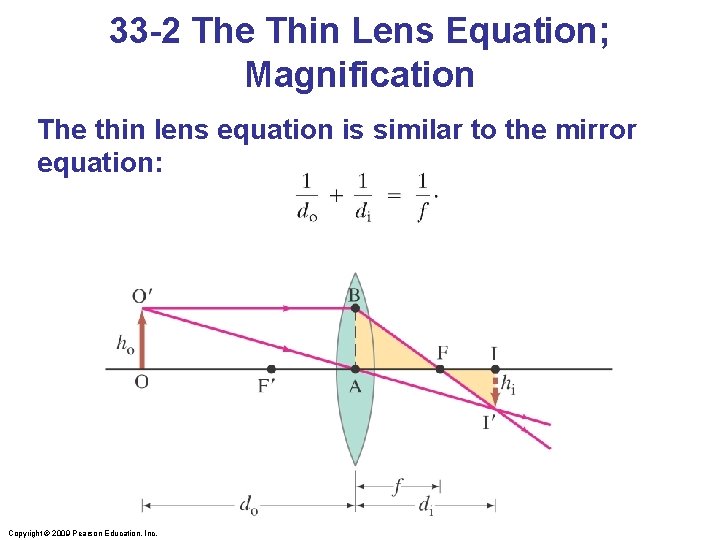
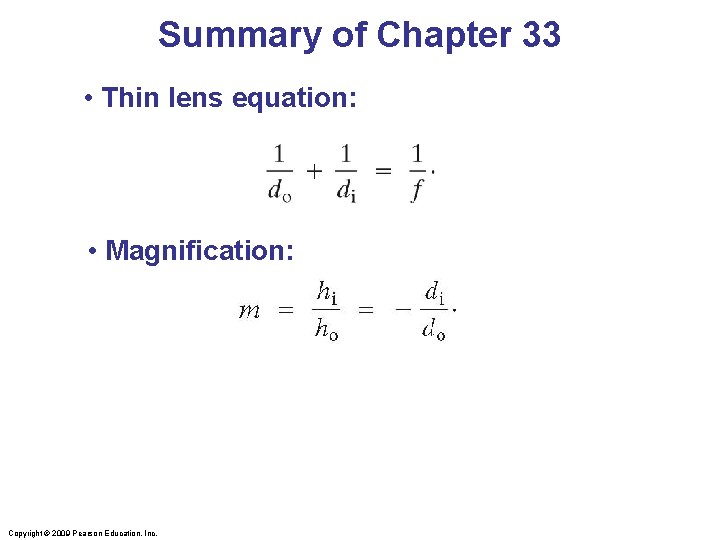
33 -2 The Thin Lens Equation; Magnification The thin lens equation is similar to the mirror equation: Copyright © 2009 Pearson Education, Inc.
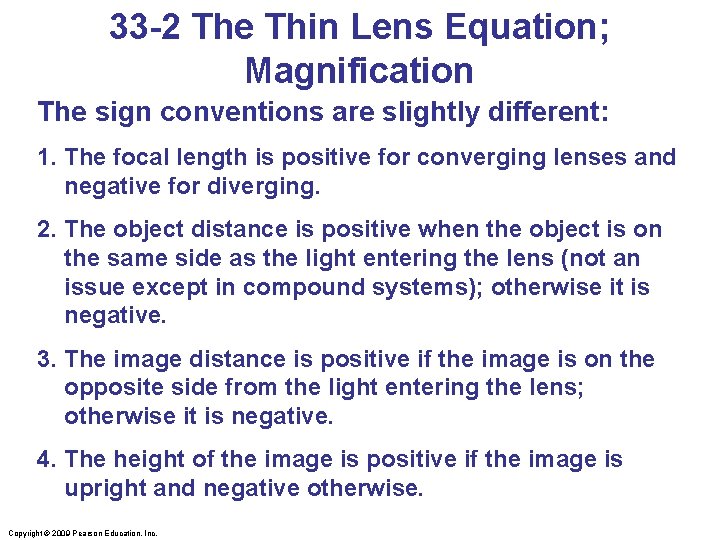
33 -2 The Thin Lens Equation; Magnification The sign conventions are slightly different: 1. The focal length is positive for converging lenses and negative for diverging. 2. The object distance is positive when the object is on the same side as the light entering the lens (not an issue except in compound systems); otherwise it is negative. 3. The image distance is positive if the image is on the opposite side from the light entering the lens; otherwise it is negative. 4. The height of the image is positive if the image is upright and negative otherwise. Copyright © 2009 Pearson Education, Inc.
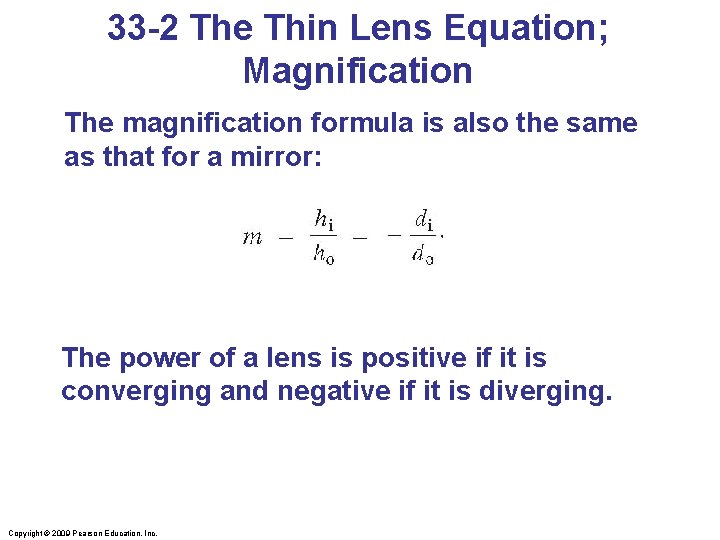
33 -2 The Thin Lens Equation; Magnification The magnification formula is also the same as that for a mirror: The power of a lens is positive if it is converging and negative if it is diverging. Copyright © 2009 Pearson Education, Inc.
33 -2 The Thin Lens Equation; Magnification Problem Solving: Thin Lenses 1. Draw a ray diagram. The image is located where the key rays intersect. 2. Solve for unknowns. 3. Follow the sign conventions. 4. Check that your answers are consistent with the ray diagram. Copyright © 2009 Pearson Education, Inc.
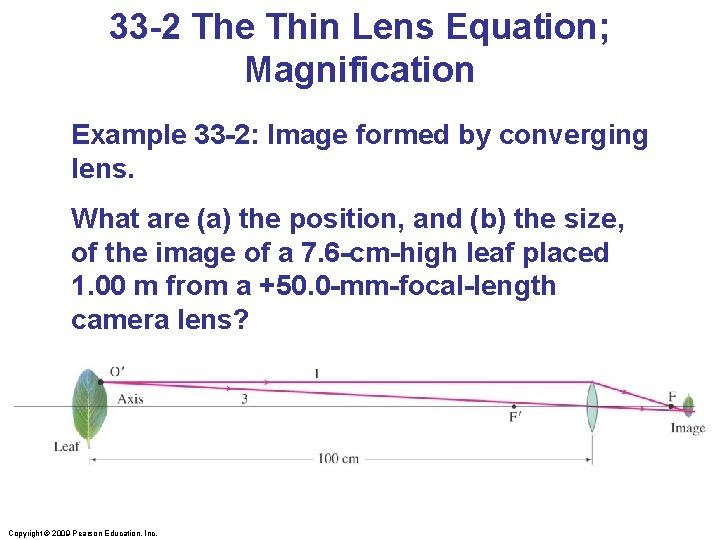
33 -2 The Thin Lens Equation; Magnification Example 33 -2: Image formed by converging lens. What are (a) the position, and (b) the size, of the image of a 7. 6 -cm-high leaf placed 1. 00 m from a +50. 0 -mm-focal-length camera lens? Copyright © 2009 Pearson Education, Inc.
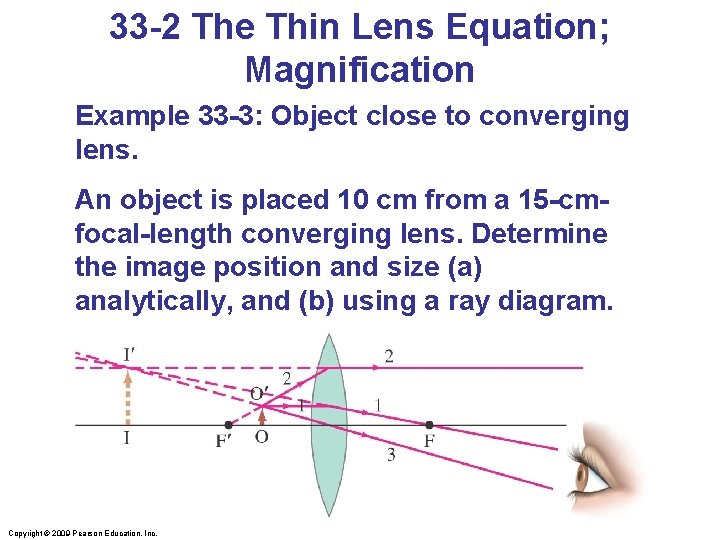
33 -2 The Thin Lens Equation; Magnification Example 33 -3: Object close to converging lens. An object is placed 10 cm from a 15 -cmfocal-length converging lens. Determine the image position and size (a) analytically, and (b) using a ray diagram. Copyright © 2009 Pearson Education, Inc.
33 -2 The Thin Lens Equation; Magnification Example 33 -4: Diverging lens. Where must a small insect be placed if a 25 -cm-focal-length diverging lens is to form a virtual image 20 cm from the lens, on the same side as the object? Copyright © 2009 Pearson Education, Inc.
33 -3 Combinations of Lenses In lens combinations, the image formed by the first lens becomes the object for the second lens (this is where object distances may be negative). The total magnification is the product of the magnification of each lens. Copyright © 2009 Pearson Education, Inc.
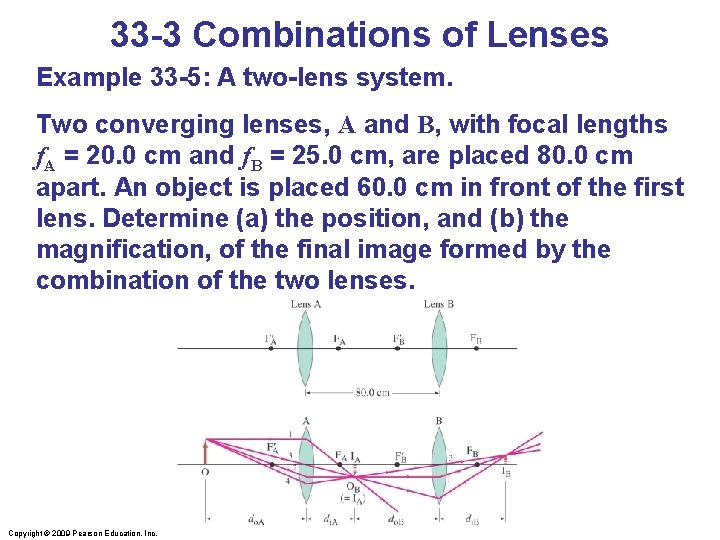
33 -3 Combinations of Lenses Example 33 -5: A two-lens system. Two converging lenses, A and B, with focal lengths f. A = 20. 0 cm and f. B = 25. 0 cm, are placed 80. 0 cm apart. An object is placed 60. 0 cm in front of the first lens. Determine (a) the position, and (b) the magnification, of the final image formed by the combination of the two lenses. Copyright © 2009 Pearson Education, Inc.
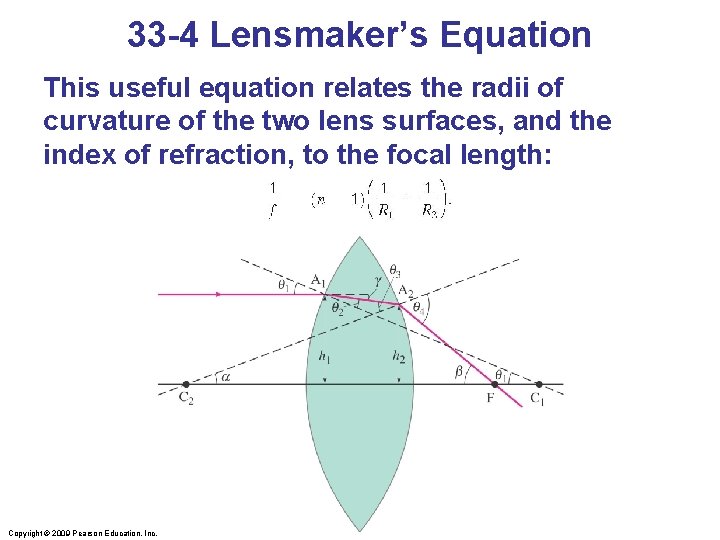
33 -4 Lensmaker’s Equation This useful equation relates the radii of curvature of the two lens surfaces, and the index of refraction, to the focal length: Copyright © 2009 Pearson Education, Inc.
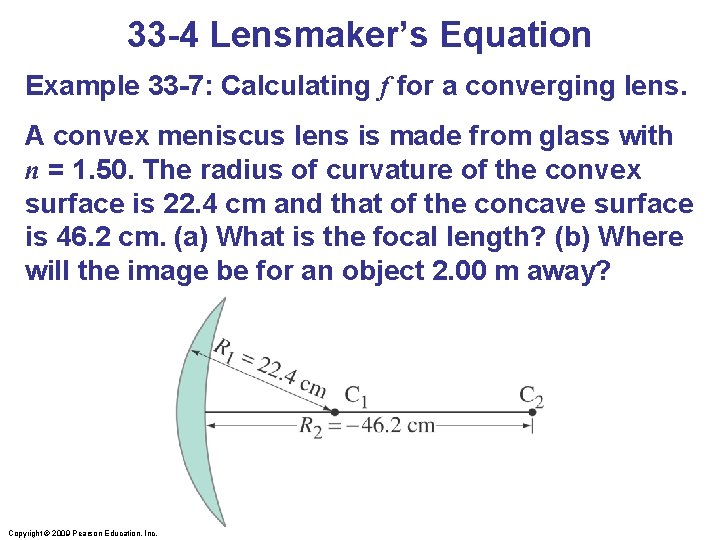
33 -4 Lensmaker’s Equation Example 33 -7: Calculating f for a converging lens. A convex meniscus lens is made from glass with n = 1. 50. The radius of curvature of the convex surface is 22. 4 cm and that of the concave surface is 46. 2 cm. (a) What is the focal length? (b) Where will the image be for an object 2. 00 m away? Copyright © 2009 Pearson Education, Inc.
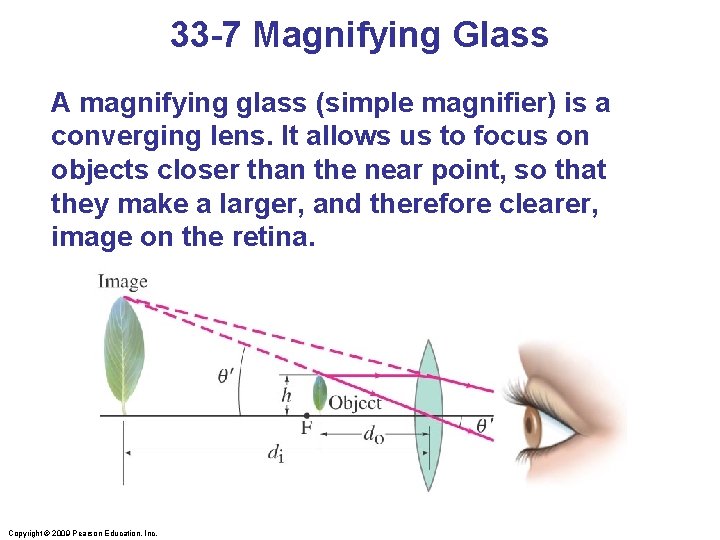
33 -7 Magnifying Glass A magnifying glass (simple magnifier) is a converging lens. It allows us to focus on objects closer than the near point, so that they make a larger, and therefore clearer, image on the retina. Copyright © 2009 Pearson Education, Inc.
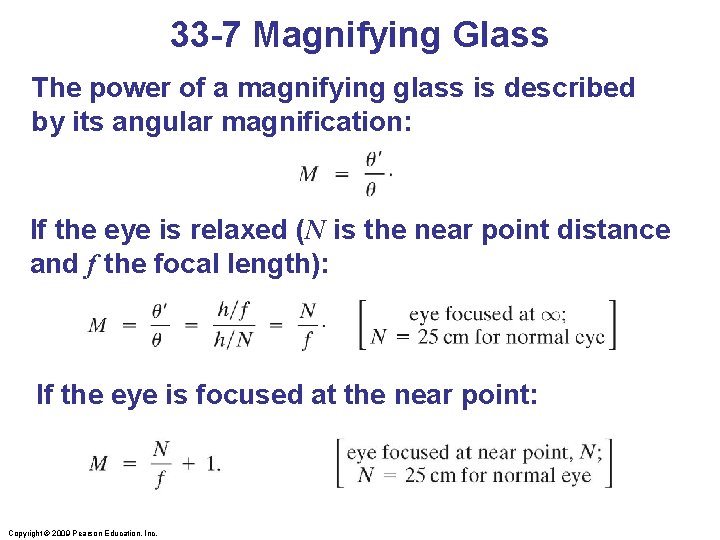
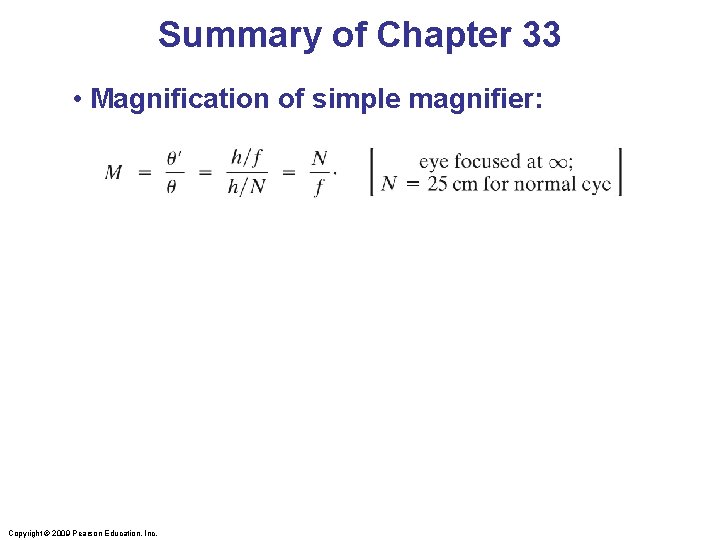
33 -7 Magnifying Glass The power of a magnifying glass is described by its angular magnification: If the eye is relaxed (N is the near point distance and f the focal length): If the eye is focused at the near point: Copyright © 2009 Pearson Education, Inc.
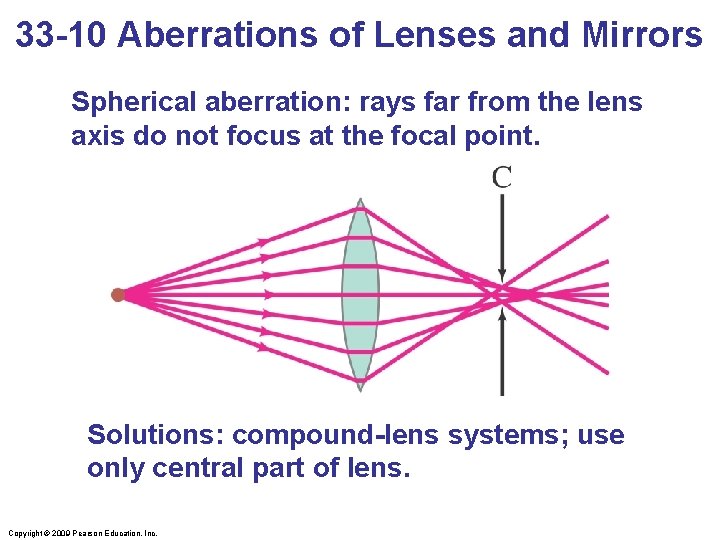
33 -10 Aberrations of Lenses and Mirrors Spherical aberration: rays far from the lens axis do not focus at the focal point. Solutions: compound-lens systems; use only central part of lens. Copyright © 2009 Pearson Education, Inc.
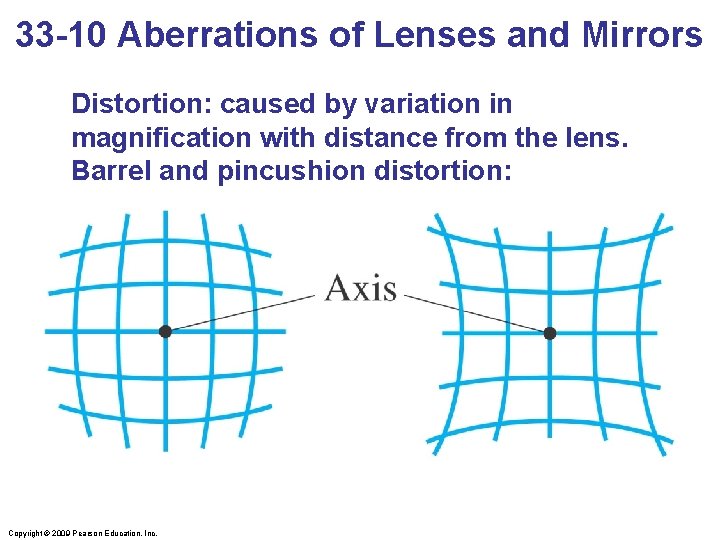
33 -10 Aberrations of Lenses and Mirrors Distortion: caused by variation in magnification with distance from the lens. Barrel and pincushion distortion: Copyright © 2009 Pearson Education, Inc.
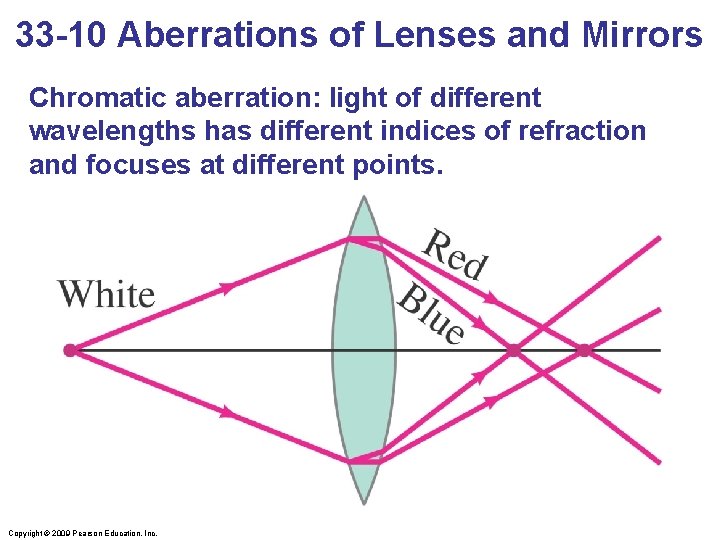
33 -10 Aberrations of Lenses and Mirrors Chromatic aberration: light of different wavelengths has different indices of refraction and focuses at different points. Copyright © 2009 Pearson Education, Inc.
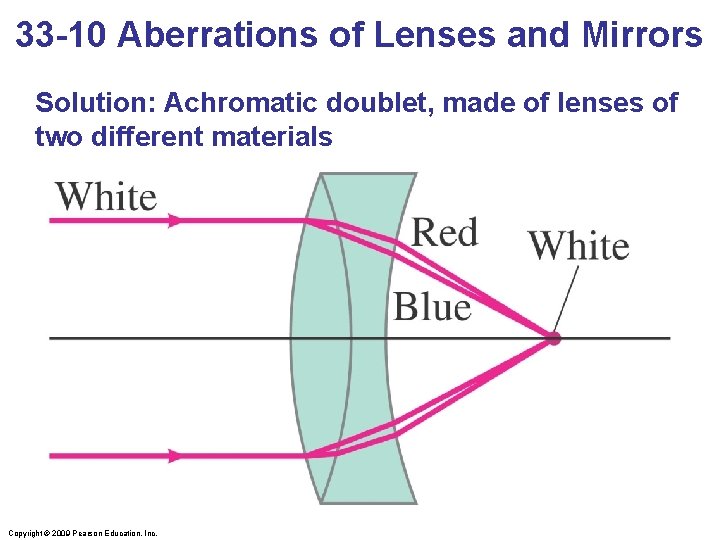
33 -10 Aberrations of Lenses and Mirrors Solution: Achromatic doublet, made of lenses of two different materials Copyright © 2009 Pearson Education, Inc.
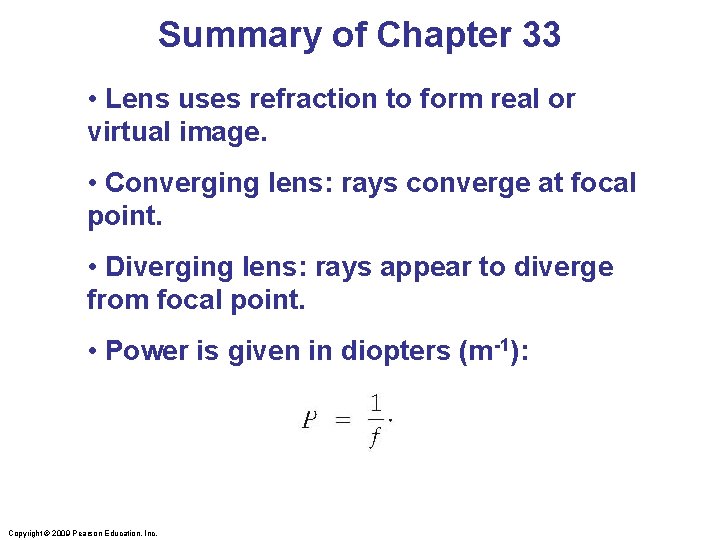
Summary of Chapter 33 • Lens uses refraction to form real or virtual image. • Converging lens: rays converge at focal point. • Diverging lens: rays appear to diverge from focal point. • Power is given in diopters (m-1): Copyright © 2009 Pearson Education, Inc.
Summary of Chapter 33 • Thin lens equation: • Magnification: Copyright © 2009 Pearson Education, Inc.
Summary of Chapter 33 • Magnification of simple magnifier: Copyright © 2009 Pearson Education, Inc.