
Chapter 32 Charging System Technology Objectives After studying
Chapter 32 Charging System Technology
Objectives After studying this chapter, you will be able to: • Describe the construction of major 12 -volt charging system components. • Explain charging system indicators and instrumentation. • Explain the construction and operation of hybrid charging systems. © Goodheart-Willcox Co. , Inc. Permission granted to reproduce for educational use only.
Objectives • Compare the operation of a 12 -volt charging system to that of a hybrid charging system. • Correctly answer ASE certification test questions that require a knowledge of charging system fundamentals. © Goodheart-Willcox Co. , Inc. Permission granted to reproduce for educational use only.
12 -Volt Charging System Functions • Recharges battery after engine cranking or after electrical accessory use with engine shut off • Supplies all 12 -volt electricity when engine is running • Provides 13 -15 volt output, slightly higher than fully -charged battery at 12. 6 volts © Goodheart-Willcox Co. , Inc. Permission granted to reproduce for educational use only.
12 -Volt Charging System Functions (Cont. ) • Changes current and voltage output to meet different electrical loads • Provides smooth dc for proper function of all vehicle’s electronic circuits © Goodheart-Willcox Co. , Inc. Permission granted to reproduce for educational use only.
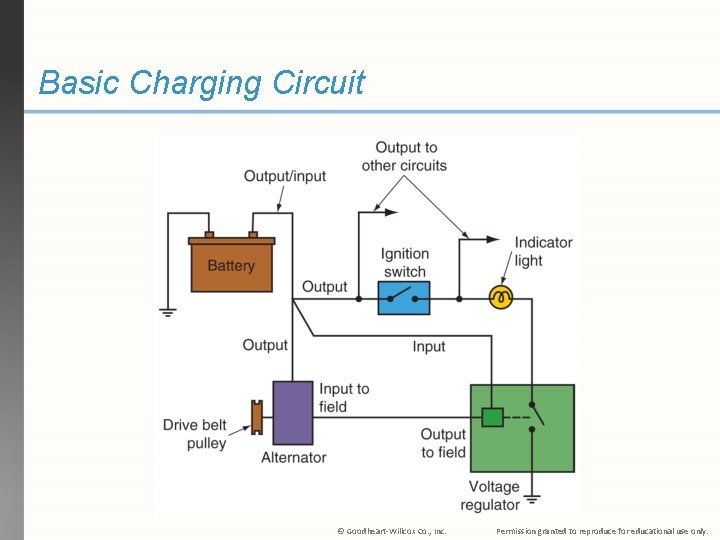
Basic Charging Circuit © Goodheart-Willcox Co. , Inc. Permission granted to reproduce for educational use only.
12 -Volt Charging System Parts • • Alternator (ac generator) Voltage regulator Drive belt Charge indicator Charging system harness Battery ECM © Goodheart-Willcox Co. , Inc. Permission granted to reproduce for educational use only.
12 -Volt Charging System • During engine cranking, battery supplies all electricity for use • When engine starts running, charging system takes over • Voltage regulator keeps alternator output at preset charging voltage (13– 15 volts) – Since this is higher than battery voltage (12. 6 volts), current flows back into battery © Goodheart-Willcox Co. , Inc. Permission granted to reproduce for educational use only.
Alternator • Simplified alternator has two main parts – Rotor • Located in alternator housing center • Creates rotating magnetic field – Stator • Stationary set of windings surrounds rotor • Output winding in alternator © Goodheart-Willcox Co. , Inc. Permission granted to reproduce for educational use only.
Alternator (Cont. ) • Produces alternating current (ac) output • Automobile electrical systems designed to use direct current (dc) – Cannot use ac as it comes out of alternator’s stator • Alternator current must be rectified before entering electrical system – Changed into direct current © Goodheart-Willcox Co. , Inc. Permission granted to reproduce for educational use only.
Alternator Components • • Rotor Brush assembly Rectifier Stator Alternator housing Fan and pulley Voltage regulator © Goodheart-Willcox Co. , Inc. Permission granted to reproduce for educational use only.
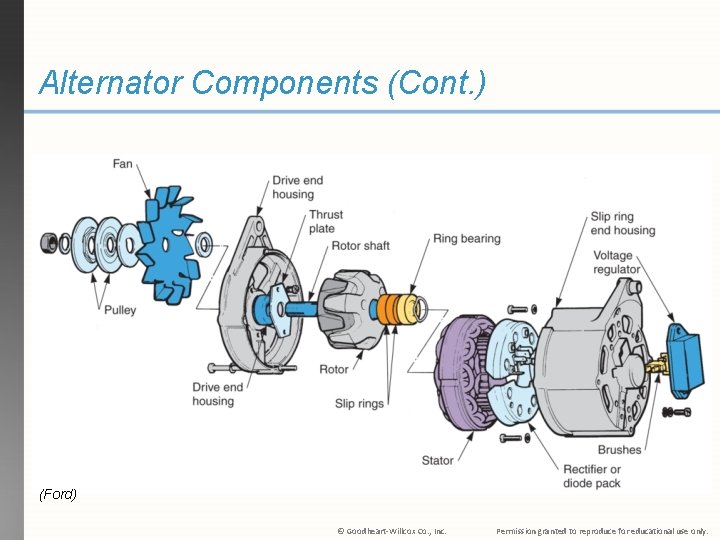
Alternator Components (Cont. ) (Ford) © Goodheart-Willcox Co. , Inc. Permission granted to reproduce for educational use only.
Alternator Components (Cont. ) • Alternator rotor assembly – Consists of field windings mounted on shaft • Alternator bearings – Used to produce low-friction surface for rotor shaft – Needle or ball types © Goodheart-Willcox Co. , Inc. Permission granted to reproduce for educational use only.
Alternator Components (Cont. ) • Alternator slip rings – Mounted on rotor shaft to provide dc current to field windings – Each end of field windings connects to a slip ring • Alternator brushes – Ride on slip rings to make sliding electrical connection • Brush springs – Hold brushes in contact with slip rings © Goodheart-Willcox Co. , Inc. Permission granted to reproduce for educational use only.
Alternator Rectifier • Or diode assembly • Uses six diodes to convert stator current (ac) to direct current (dc) • Full-wave rectification – Changes both positive and negative polarities into direct current © Goodheart-Willcox Co. , Inc. Permission granted to reproduce for educational use only.
Alternator Rectifier (Cont. ) • Diode trio – Supply current to rotor field windings • Rectifier diodes mounted in diode frame or heat sink – Three positive diodes press-fit in insulated frame – Three negative diodes mounted in uninsulated or grounded frame © Goodheart-Willcox Co. , Inc. Permission granted to reproduce for educational use only.
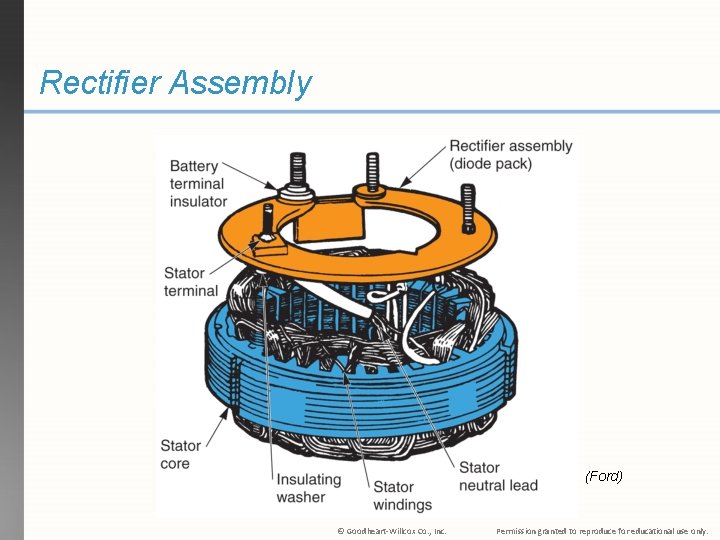
Rectifier Assembly (Ford) © Goodheart-Willcox Co. , Inc. Permission granted to reproduce for educational use only.
Alternator Components (Cont. ) • Alternator stator – Three sets of windings, each wrapped around laminated iron core • Alternator fan – Mounted on front of rotor shaft • Alternator pulley – Uses a belt to spin rotor © Goodheart-Willcox Co. , Inc. Permission granted to reproduce for educational use only.
Voltage Regulator • Control alternator output by changing current flowing through rotor’s field windings • Integral voltage regulator – Mounted inside or on alternator rear – Most common type used on today’s vehicles © Goodheart-Willcox Co. , Inc. Permission granted to reproduce for educational use only.
Voltage Regulator Operation • To increase alternator output – Allows more current into rotor’s field windings • To reduce alternator output – Places more resistance between battery and field windings • Alternator speed and electrical load determine whether regulator increases or decreases charging output © Goodheart-Willcox Co. , Inc. Permission granted to reproduce for educational use only.
ECM Charging System Monitoring and Control • Control module can monitor charging system output and react to changing operating conditions • Computer controls duty cycle of alternator’s field – Duty cycle is percentage of time current feeds to alternator’s field windings • 50% duty cycle is normal © Goodheart-Willcox Co. , Inc. Permission granted to reproduce for educational use only.
Battery Thermistor/Fail-Safe Circuit • Battery thermistor – Measures battery temperature so charging system can alter charging output as needed • Fail-safe circuits – Disconnect alternator output if voltage levels become too high © Goodheart-Willcox Co. , Inc. Permission granted to reproduce for educational use only.
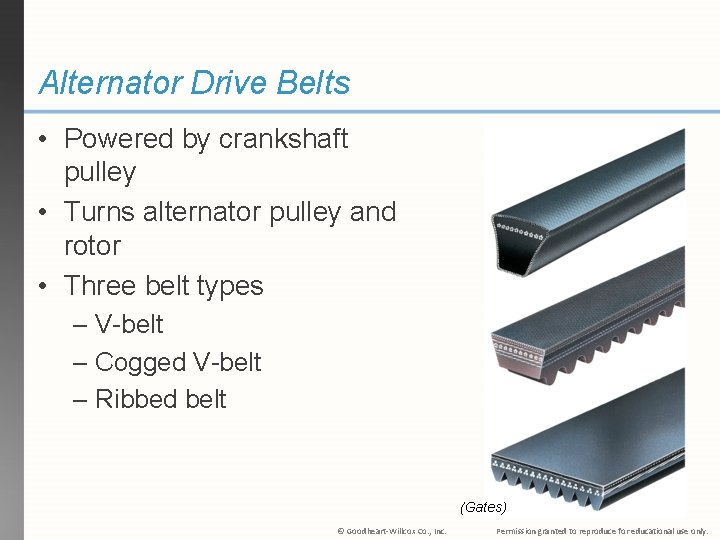
Alternator Drive Belts • Powered by crankshaft pulley • Turns alternator pulley and rotor • Three belt types – V-belt – Cogged V-belt – Ribbed belt (Gates) © Goodheart-Willcox Co. , Inc. Permission granted to reproduce for educational use only.
Charge Indicators • Informs driver of operating condition or output of charging system • Three basic types – Warning light – Voltmeter indicator – Ammeter indicator © Goodheart-Willcox Co. , Inc. Permission granted to reproduce for educational use only.
Alternator Warning Light • Wired into charging system – Will glow when alternator output drops to specified level • In good charging systems, current flow through field will be too low to light bulb © Goodheart-Willcox Co. , Inc. Permission granted to reproduce for educational use only.
Voltmeter Indicator • Warns driver of charging system problems • Simply shows voltage • Indicator of current output and charging system condition • If reading is too high, overcharging can occur – When excess current is forced through battery © Goodheart-Willcox Co. , Inc. Permission granted to reproduce for educational use only.
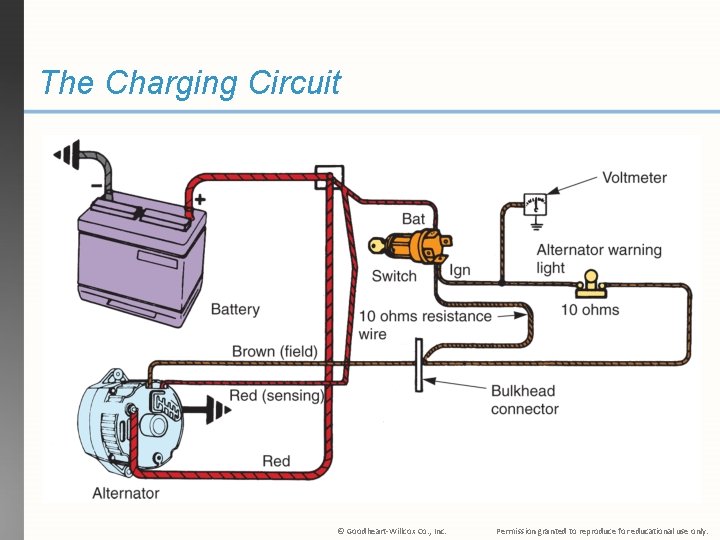
The Charging Circuit © Goodheart-Willcox Co. , Inc. Permission granted to reproduce for educational use only.
Hybrid Charging Systems • Many hybrid vehicles do not have conventional alternators • Motor-generator recharges high-voltage battery or conventional 12 -volt battery © Goodheart-Willcox Co. , Inc. Permission granted to reproduce for educational use only.
Hybrid Charging System Parts Major parts of hybrid charging system • Motor-generator • Hybrid instrumentation • HV power control module • HV battery • Hybrid control module © Goodheart-Willcox Co. , Inc. Permission granted to reproduce for educational use only.
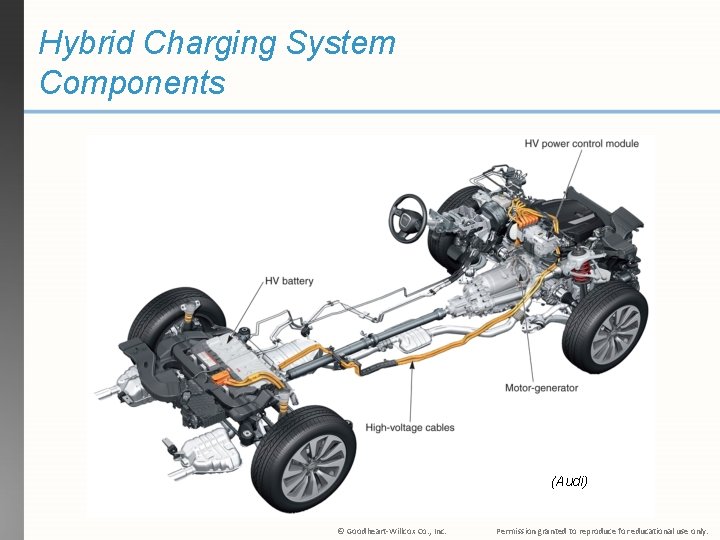
Hybrid Charging System Components (Audi) © Goodheart-Willcox Co. , Inc. Permission granted to reproduce for educational use only.
- Slides: 31