
Chapter 32 An Introduction to Animal Diversity Power
- Slides: 46
Chapter 32 An Introduction to Animal Diversity Power. Point® Lecture Presentations for Biology Eighth Edition Neil Campbell and Jane Reece Lectures by Chris Romero, updated by Erin Barley with contributions from Joan Sharp Copyright © 2008 Pearson Education, Inc. , publishing as Pearson Benjamin Cummings
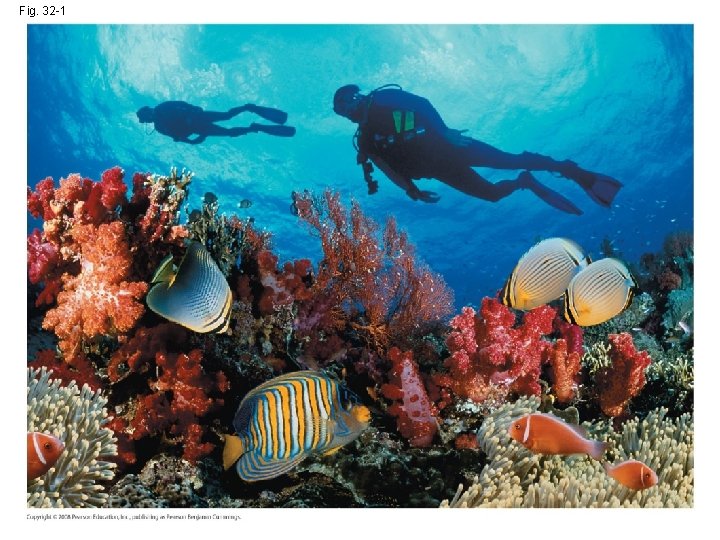
Overview: Welcome to Your Kingdom • The animal kingdom: – Extends far beyond humans & other animals we may encounter • Living animals that have been identified: – 1. 3 million living species Video: Coral Reef Copyright © 2008 Pearson Education, Inc. , publishing as Pearson Benjamin Cummings
Fig. 32 -1
Animal are: • Animals are eukaryotes that are: – Multicellular – Heterotrophic – With tissues that developed from embryonic layers • Several characteristics, taken together, sufficiently define the group Copyright © 2008 Pearson Education, Inc. , publishing as Pearson Benjamin Cummings
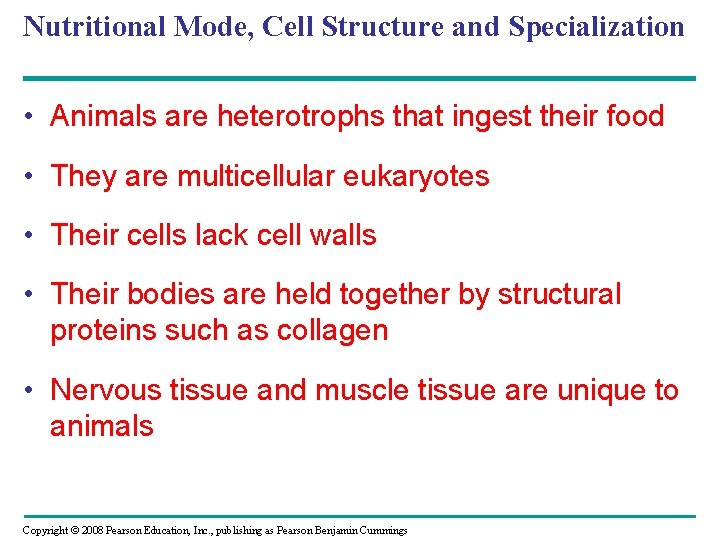
Nutritional Mode, Cell Structure and Specialization • Animals are heterotrophs that ingest their food • They are multicellular eukaryotes • Their cells lack cell walls • Their bodies are held together by structural proteins such as collagen • Nervous tissue and muscle tissue are unique to animals Copyright © 2008 Pearson Education, Inc. , publishing as Pearson Benjamin Cummings
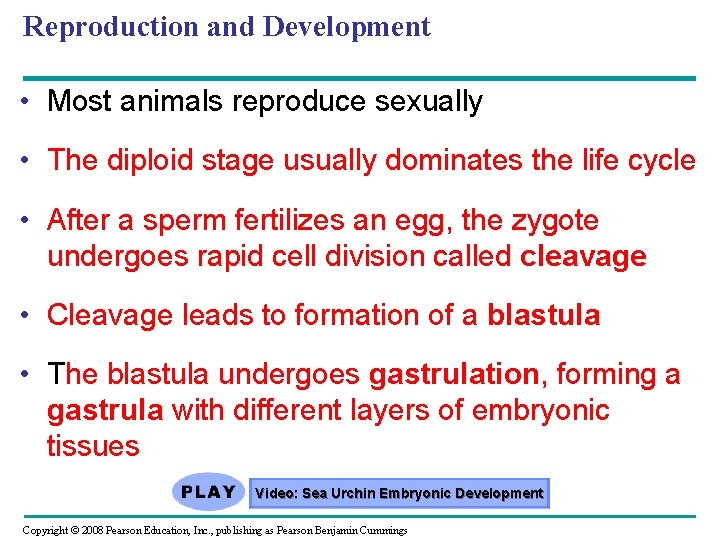
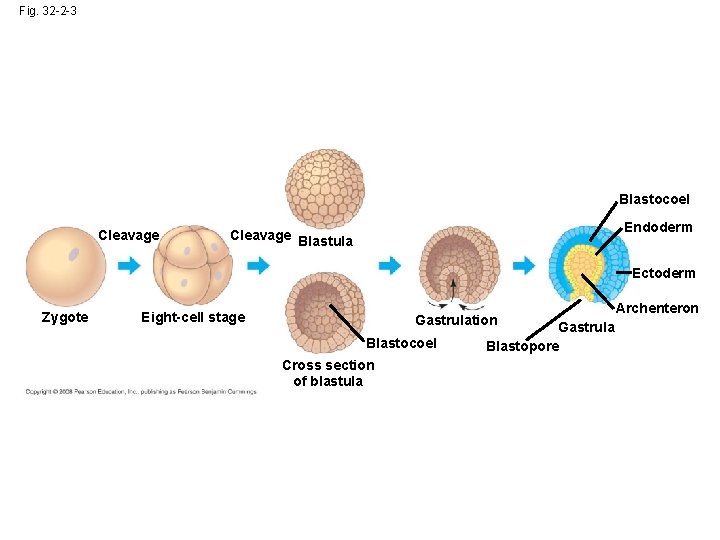
Reproduction and Development • Most animals reproduce sexually • The diploid stage usually dominates the life cycle • After a sperm fertilizes an egg, the zygote undergoes rapid cell division called cleavage • Cleavage leads to formation of a blastula • The blastula undergoes gastrulation, forming a gastrula with different layers of embryonic tissues Video: Sea Urchin Embryonic Development Copyright © 2008 Pearson Education, Inc. , publishing as Pearson Benjamin Cummings
Fig. 32 -2 -3 Blastocoel Cleavage Endoderm Cleavage Blastula Ectoderm Zygote Eight-cell stage Gastrulation Blastocoel Cross section of blastula Gastrula Blastopore Archenteron
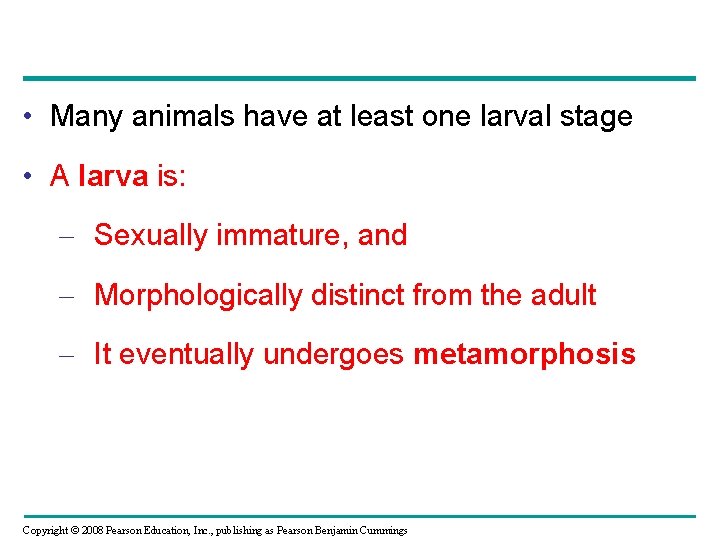
• Many animals have at least one larval stage • A larva is: – Sexually immature, and – Morphologically distinct from the adult – It eventually undergoes metamorphosis Copyright © 2008 Pearson Education, Inc. , publishing as Pearson Benjamin Cummings
• All animals, and only animals, have: – A family of genes called Hox genes – They regulate the development of body form – This Hox family of genes is highly conserved – Yet, it can produce a wide diversity of animal morphology Copyright © 2008 Pearson Education, Inc. , publishing as Pearson Benjamin Cummings
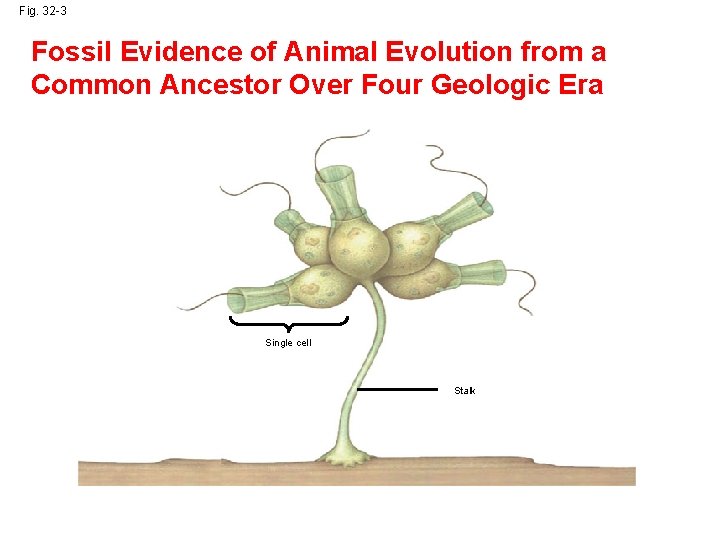
The history of animals spans more than half a billion years • The animal kingdom includes: – A great diversity of living species – An even greater diversity of extinct species • The common ancestor of living animals: – May have lived between 675 and 875 million years ago – May have resembled: • Modern choanoflagellates (protists that are the closest living relatives of animals) Copyright © 2008 Pearson Education, Inc. , publishing as Pearson Benjamin Cummings
Fig. 32 -3 Fossil Evidence of Animal Evolution from a Common Ancestor Over Four Geologic Era Single cell Stalk
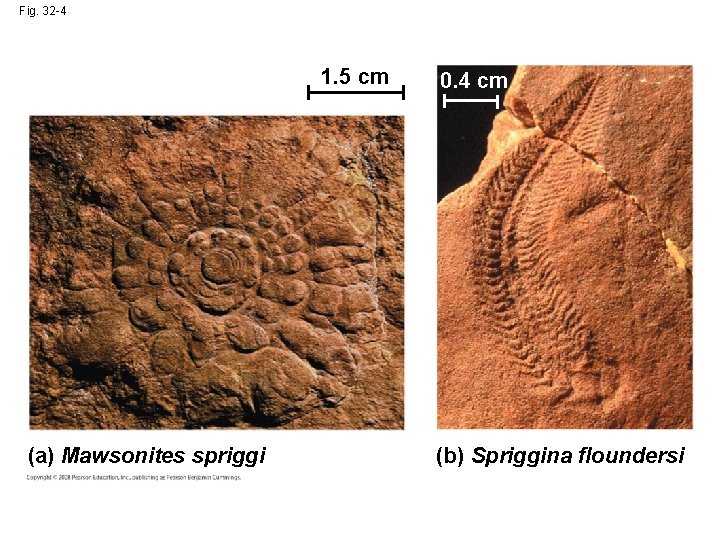
Neoproterozoic Era (1 Billion– 524 Million Years Ago) • Early members of the animal fossil record include: – The Ediacaran biota, which dates from 565 to 550 million years ago Copyright © 2008 Pearson Education, Inc. , publishing as Pearson Benjamin Cummings
Fig. 32 -4 1. 5 cm (a) Mawsonites spriggi 0. 4 cm (b) Spriggina floundersi
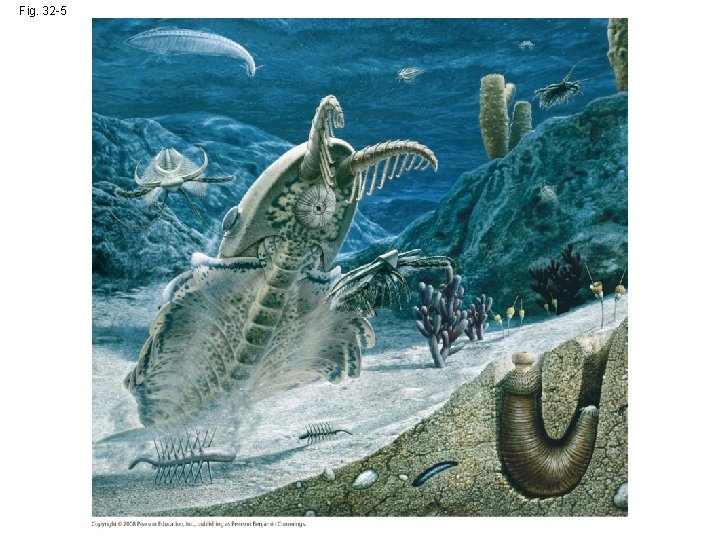
Paleozoic Era (542– 251 Million Years Ago) • The Cambrian explosion (535 to 525 million years ago): – Marks the earliest fossil appearance of many major groups of living animals • Several hypotheses explain the increase in diversity of animal phyla during the Cambrian explosion period: – New predator-prey relationships – A rise in atmospheric oxygen – The evolution of the Hox gene complex Copyright © 2008 Pearson Education, Inc. , publishing as Pearson Benjamin Cummings
Fig. 32 -5
Mesozoic Era (251– 65. 5 Million Years Ago) • Coral reefs emerged, becoming important marine ecological niches for other organisms • Dinosaurs were the dominant terrestrial vertebrates during this era • The first mammals emerged Copyright © 2008 Pearson Education, Inc. , publishing as Pearson Benjamin Cummings
Cenozoic Era (65. 5 Million Years Ago to the Present) • The Cenozoic era begins : • After mass extinctions of both terrestrial & marine animals • These extinctions included: • The large, non-flying dinosaurs • The marine reptiles • Modern mammal orders and insects diversified during the Cenozoic Copyright © 2008 Pearson Education, Inc. , publishing as Pearson Benjamin Cummings
Animals can be characterized by “body plans” • Zoologists sometimes categorize animals according to: • A body plan is a set of: • Morphological & developmental traits • A grade: • Is a group of animal species whose members share key biological features • It is not necessarily a clade, or monophyletic group Copyright © 2008 Pearson Education, Inc. , publishing as Pearson Benjamin Cummings
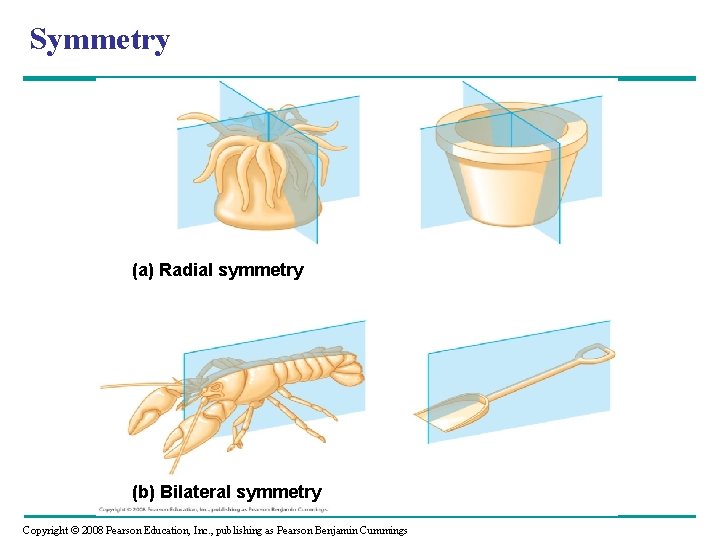
Symmetry • Animals can be categorized according to the symmetry of their bodies, or lack of it • Some animals have radial symmetry • Others have two-sided symmetry called bilateral symmetry • Bilaterally symmetrical animals have: – A dorsal (top) side and a ventral (bottom) side – A right and left side – Anterior (head) and posterior (tail) ends – Cephalization, the development of a head Copyright © 2008 Pearson Education, Inc. , publishing as Pearson Benjamin Cummings
Symmetry (a) Radial symmetry (b) Bilateral symmetry Copyright © 2008 Pearson Education, Inc. , publishing as Pearson Benjamin Cummings
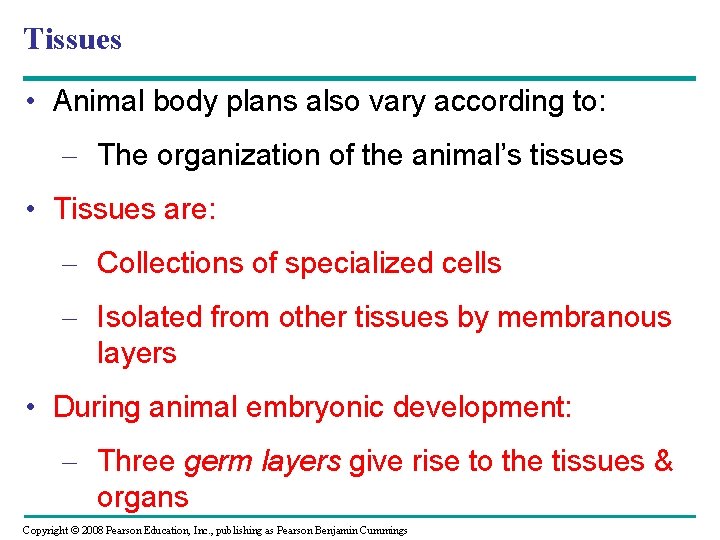
Tissues • Animal body plans also vary according to: – The organization of the animal’s tissues • Tissues are: – Collections of specialized cells – Isolated from other tissues by membranous layers • During animal embryonic development: – Three germ layers give rise to the tissues & organs Copyright © 2008 Pearson Education, Inc. , publishing as Pearson Benjamin Cummings
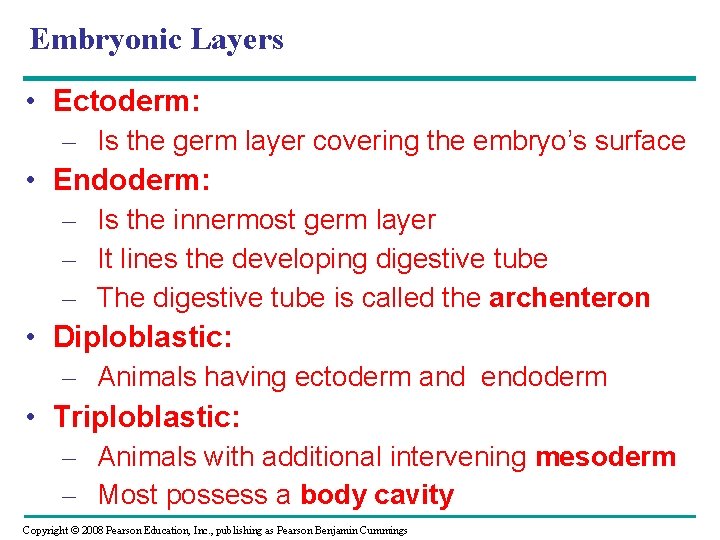
Embryonic Layers • Ectoderm: – Is the germ layer covering the embryo’s surface • Endoderm: – Is the innermost germ layer – It lines the developing digestive tube – The digestive tube is called the archenteron • Diploblastic: – Animals having ectoderm and endoderm • Triploblastic: – Animals with additional intervening mesoderm – Most possess a body cavity Copyright © 2008 Pearson Education, Inc. , publishing as Pearson Benjamin Cummings
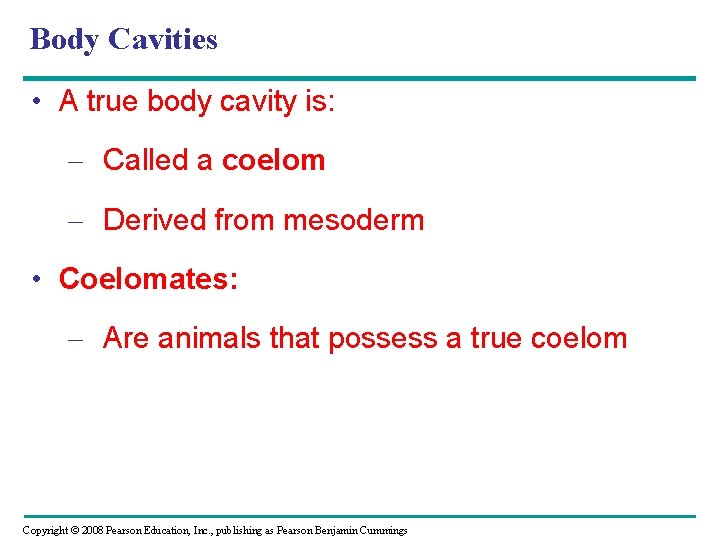
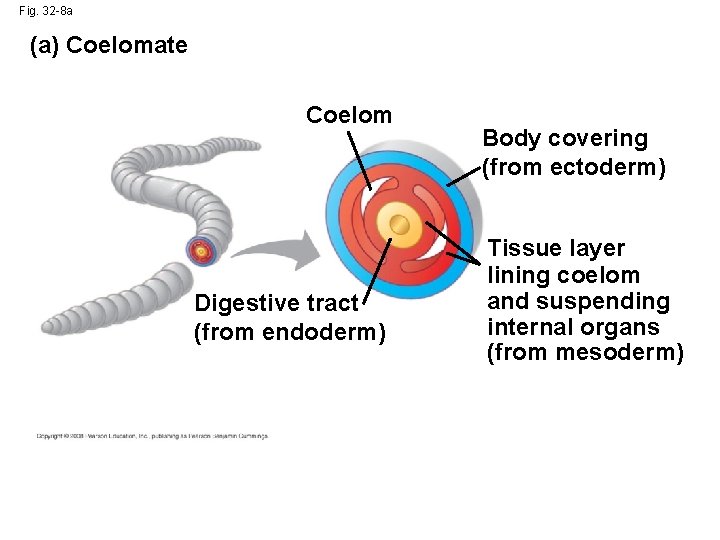
Body Cavities • A true body cavity is: – Called a coelom – Derived from mesoderm • Coelomates: – Are animals that possess a true coelom Copyright © 2008 Pearson Education, Inc. , publishing as Pearson Benjamin Cummings
Fig. 32 -8 a (a) Coelomate Coelom Digestive tract (from endoderm) Body covering (from ectoderm) Tissue layer lining coelom and suspending internal organs (from mesoderm)
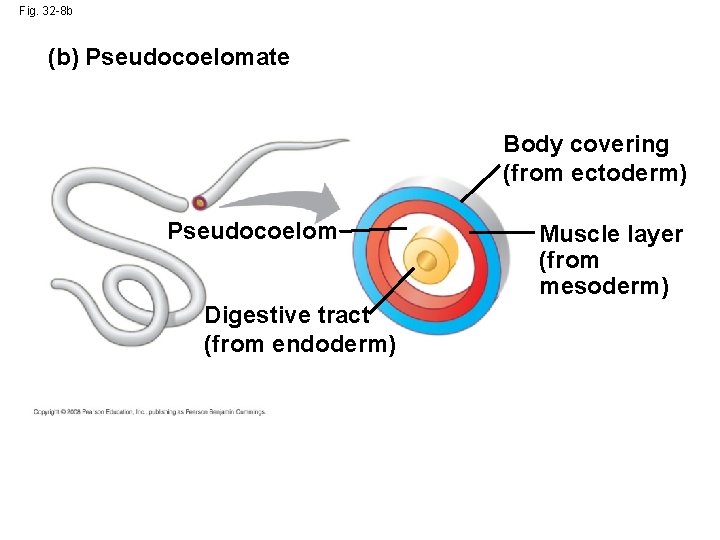
• A pseudocoelom: – Is a body cavity derived from the mesoderm and endoderm • Pseudocoelomates: – Triploblastic animals that possess a pseudocoelom Copyright © 2008 Pearson Education, Inc. , publishing as Pearson Benjamin Cummings
Fig. 32 -8 b (b) Pseudocoelomate Body covering (from ectoderm) Pseudocoelom Digestive tract (from endoderm) Muscle layer (from mesoderm)
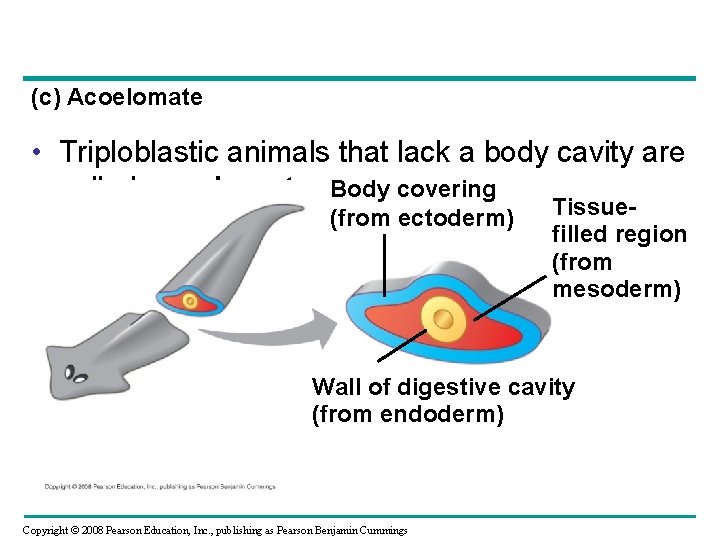
(c) Acoelomate • Triploblastic animals that lack a body cavity are called acoelomates Body covering (from ectoderm) Tissuefilled region (from mesoderm) Wall of digestive cavity (from endoderm) Copyright © 2008 Pearson Education, Inc. , publishing as Pearson Benjamin Cummings
Protostome and Deuterostome Development • Based on early development, many animals can be categorized as having one of two developmental modes: – Protostome development, or – Deuterostome development Copyright © 2008 Pearson Education, Inc. , publishing as Pearson Benjamin Cummings
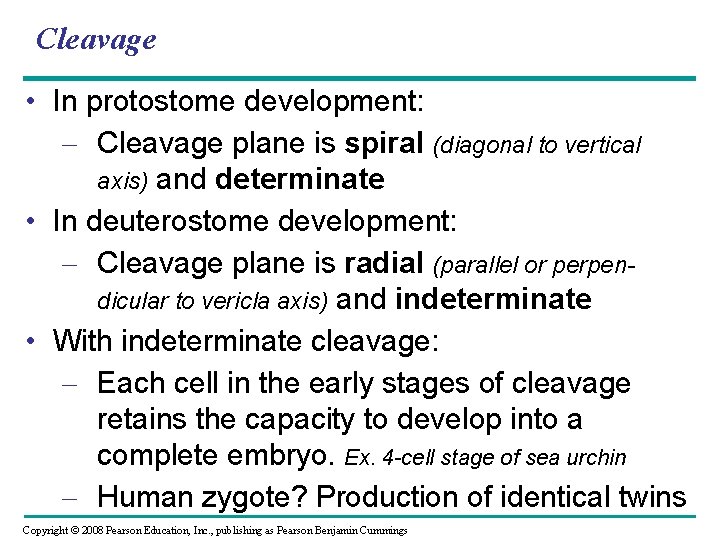
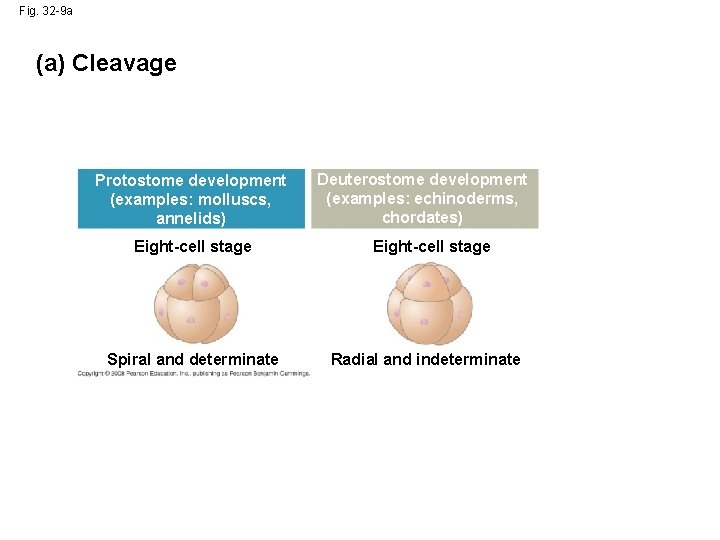
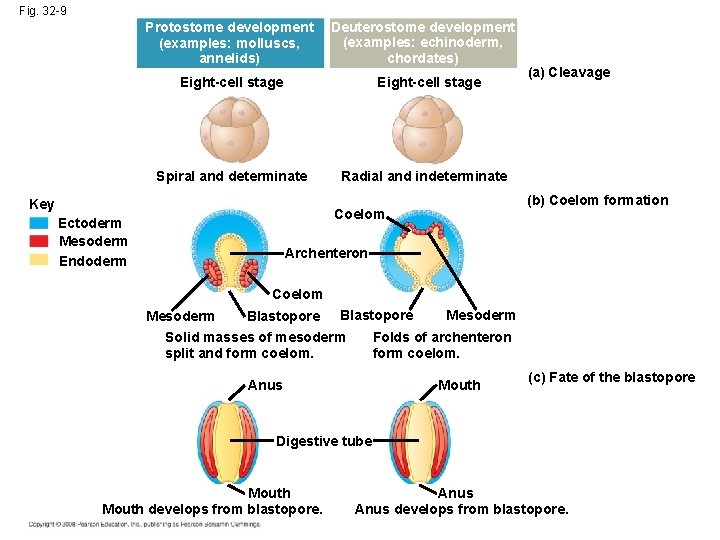
Cleavage • In protostome development: – Cleavage plane is spiral (diagonal to vertical axis) and determinate • In deuterostome development: – Cleavage plane is radial (parallel or perpendicular to vericla axis) and indeterminate • With indeterminate cleavage: – Each cell in the early stages of cleavage retains the capacity to develop into a complete embryo. Ex. 4 -cell stage of sea urchin – Human zygote? Production of identical twins Copyright © 2008 Pearson Education, Inc. , publishing as Pearson Benjamin Cummings
Fig. 32 -9 a (a) Cleavage Protostome development (examples: molluscs, annelids) Eight-cell stage Spiral and determinate Deuterostome development (examples: echinoderms, chordates) Eight-cell stage Radial and indeterminate
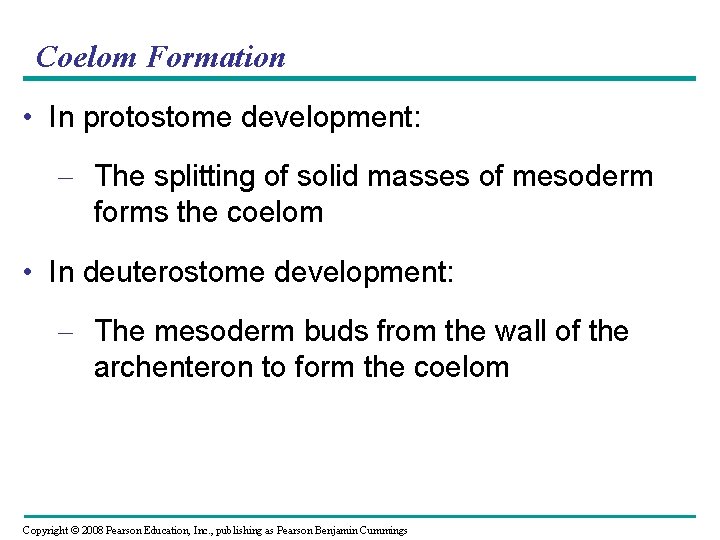
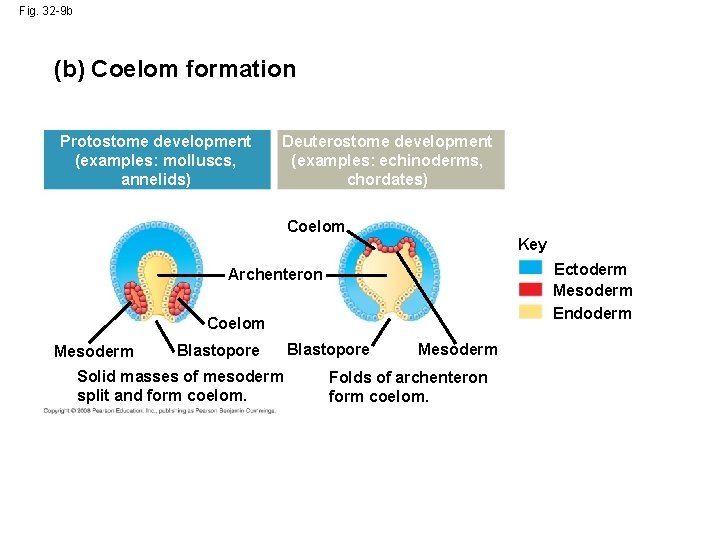
Coelom Formation • In protostome development: – The splitting of solid masses of mesoderm forms the coelom • In deuterostome development: – The mesoderm buds from the wall of the archenteron to form the coelom Copyright © 2008 Pearson Education, Inc. , publishing as Pearson Benjamin Cummings
Fig. 32 -9 b (b) Coelom formation Protostome development (examples: molluscs, annelids) Deuterostome development (examples: echinoderms, chordates) Coelom Key Ectoderm Mesoderm Endoderm Archenteron Coelom Mesoderm Blastopore Solid masses of mesoderm split and form coelom. Blastopore Mesoderm Folds of archenteron form coelom.
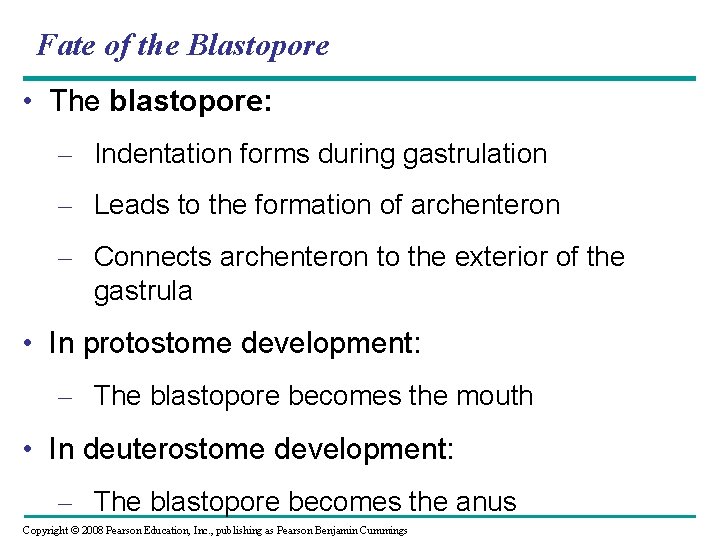
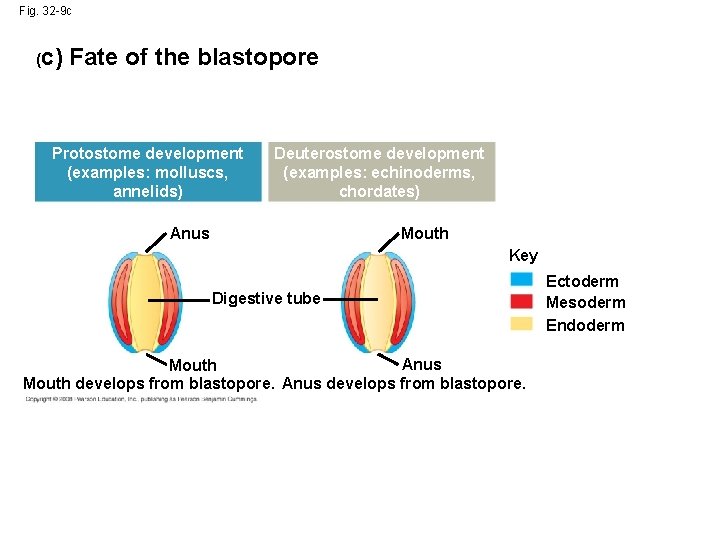
Fate of the Blastopore • The blastopore: – Indentation forms during gastrulation – Leads to the formation of archenteron – Connects archenteron to the exterior of the gastrula • In protostome development: – The blastopore becomes the mouth • In deuterostome development: – The blastopore becomes the anus Copyright © 2008 Pearson Education, Inc. , publishing as Pearson Benjamin Cummings
Fig. 32 -9 c (c) Fate of the blastopore Protostome development (examples: molluscs, annelids) Deuterostome development (examples: echinoderms, chordates) Anus Mouth Key Digestive tube Anus Mouth develops from blastopore. Anus develops from blastopore. Ectoderm Mesoderm Endoderm
Fig. 32 -9 Protostome development (examples: molluscs, annelids) Deuterostome development (examples: echinoderm, chordates) Eight-cell stage Spiral and determinate Key Radial and indeterminate (b) Coelom formation Coelom Ectoderm Mesoderm Endoderm (a) Cleavage Archenteron Coelom Mesoderm Blastopore Solid masses of mesoderm split and form coelom. Mesoderm Folds of archenteron form coelom. Anus Mouth (c) Fate of the blastopore Digestive tube Mouth develops from blastopore. Anus develops from blastopore.
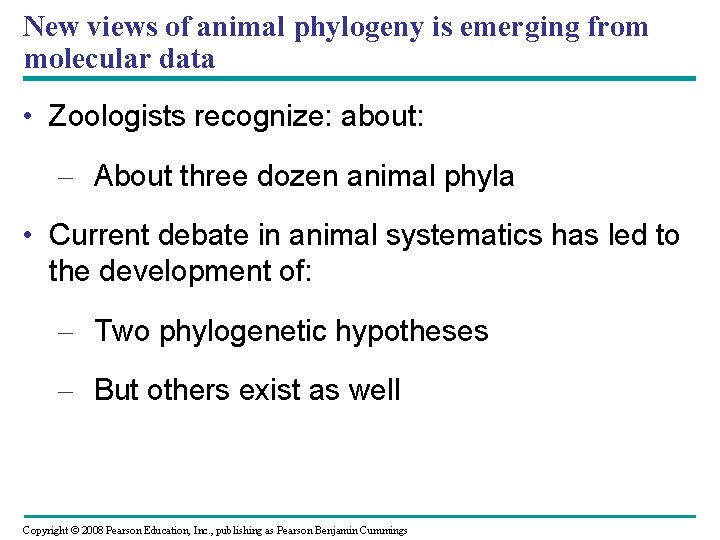
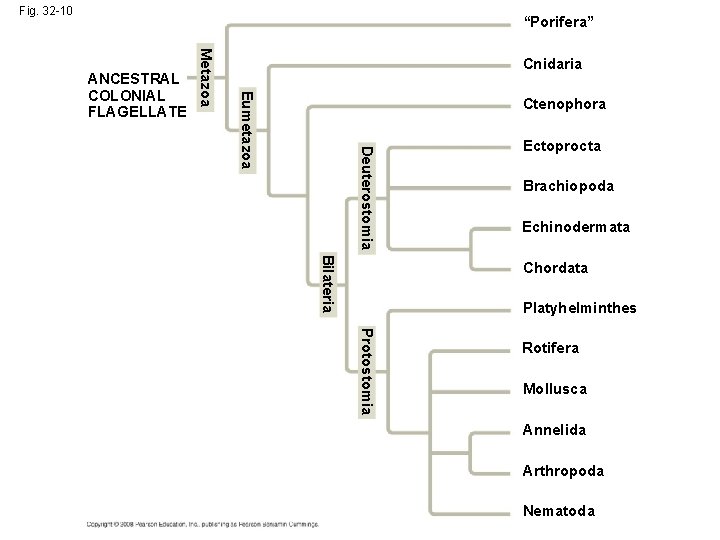
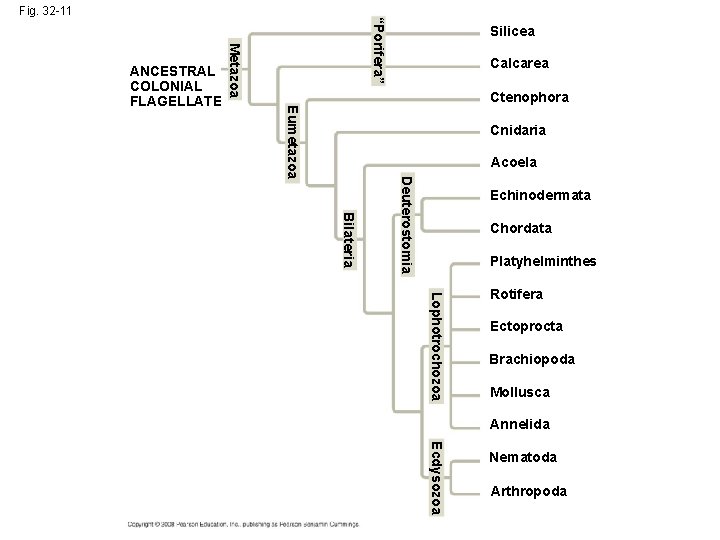
New views of animal phylogeny is emerging from molecular data • Zoologists recognize: about: – About three dozen animal phyla • Current debate in animal systematics has led to the development of: – Two phylogenetic hypotheses – But others exist as well Copyright © 2008 Pearson Education, Inc. , publishing as Pearson Benjamin Cummings
• One hypothesis of animal phylogeny is based mainly on comparisons between: – Morphological features, & – Developmental features Copyright © 2008 Pearson Education, Inc. , publishing as Pearson Benjamin Cummings
Fig. 32 -10 “Porifera” Eumetazoa Metazoa ANCESTRAL COLONIAL FLAGELLATE Cnidaria Ctenophora Deuterostomia Ectoprocta Brachiopoda Echinodermata Bilateria Chordata Platyhelminthes Protostomia Rotifera Mollusca Annelida Arthropoda Nematoda
• Another hypothesis of animal phylogeny is based mainly on: – Molecular data Copyright © 2008 Pearson Education, Inc. , publishing as Pearson Benjamin Cummings
Metazoa Silicea Calcarea Ctenophora Eumetazoa ANCESTRAL COLONIAL FLAGELLATE “Porifera” Fig. 32 -11 Cnidaria Acoela Bilateria Deuterostomia Echinodermata Chordata Platyhelminthes Lophotrochozoa Rotifera Ectoprocta Brachiopoda Mollusca Annelida Ecdysozoa Nematoda Arthropoda
Points of Agreement • All animals share a common ancestor • Sponges are basal animals • Eumetazoa is a clade of animals (eumetazoans) with true tissues • Most animal phyla belong to the clade Bilateria, and are called bilaterians • Chordates and some other phyla belong to the clade Deuterostomia Copyright © 2008 Pearson Education, Inc. , publishing as Pearson Benjamin Cummings
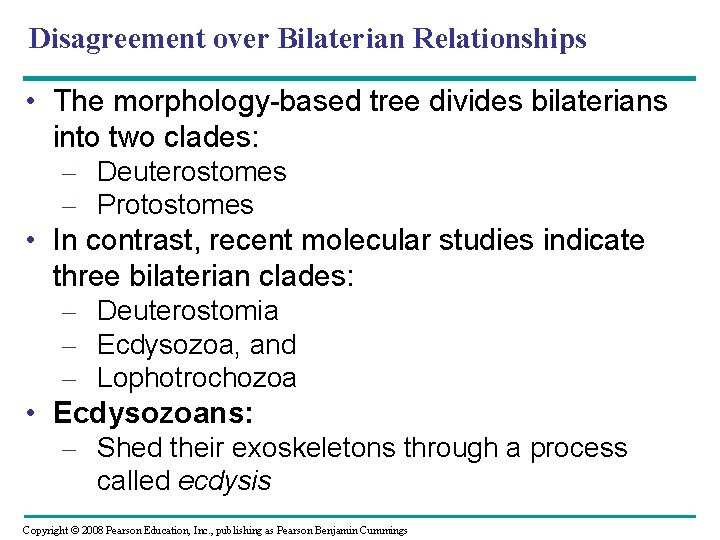
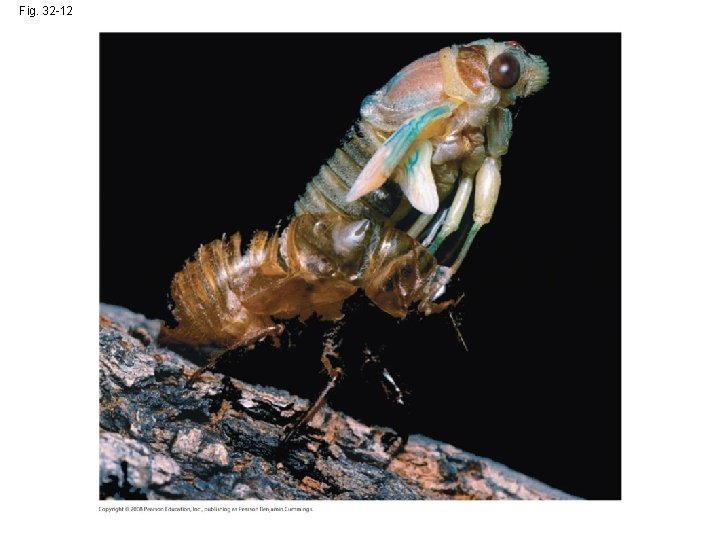
Disagreement over Bilaterian Relationships • The morphology-based tree divides bilaterians into two clades: – Deuterostomes – Protostomes • In contrast, recent molecular studies indicate three bilaterian clades: – Deuterostomia – Ecdysozoa, and – Lophotrochozoa • Ecdysozoans: – Shed their exoskeletons through a process called ecdysis Copyright © 2008 Pearson Education, Inc. , publishing as Pearson Benjamin Cummings
Fig. 32 -12
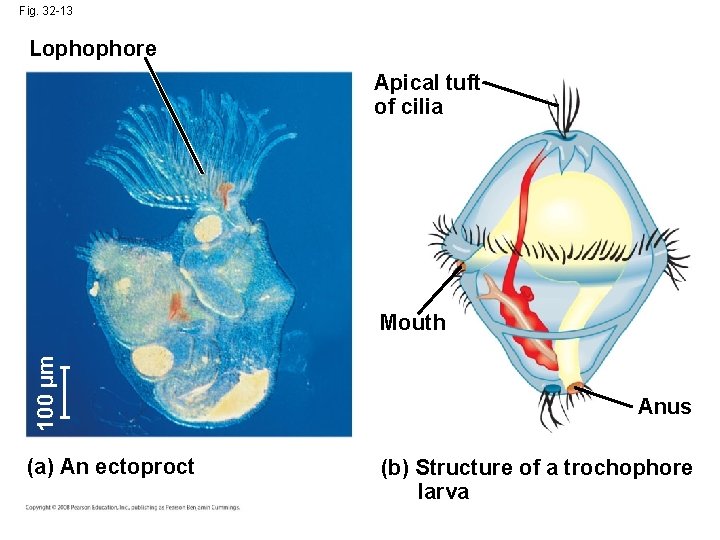
• Some lophotrochozoans have a feeding structure called a lophophore • Other phyla go through a distinct developmental stage called the trochophore larva Copyright © 2008 Pearson Education, Inc. , publishing as Pearson Benjamin Cummings
Fig. 32 -13 Lophophore Apical tuft of cilia 100 µm Mouth (a) An ectoproct Anus (b) Structure of a trochophore larva
Future Directions in Animal Systematics • Phylogenetic studies based on larger databases will likely provide further insights into animal evolutionary history Copyright © 2008 Pearson Education, Inc. , publishing as Pearson Benjamin Cummings