
Chapter 31 Plant Structure Reproduction and Development Power

- Slides: 44
Chapter 31 Plant Structure, Reproduction, and Development Power. Point Lectures for Biology: Concepts and Connections, Fifth Edition – Campbell, Reece, Taylor, and Simon Lectures by Chris Romero Copyright © 2005 Pearson Education, Inc. Publishing as Benjamin Cummings
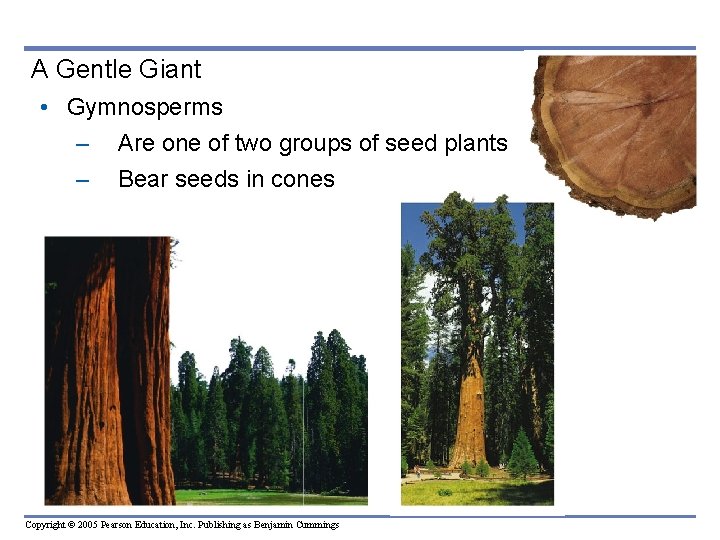
A Gentle Giant • Gymnosperms – Are one of two groups of seed plants – Bear seeds in cones Copyright © 2005 Pearson Education, Inc. Publishing as Benjamin Cummings
• Angiosperms, or flowering plants – Are the most familiar and diverse group of plants Copyright © 2005 Pearson Education, Inc. Publishing as Benjamin Cummings
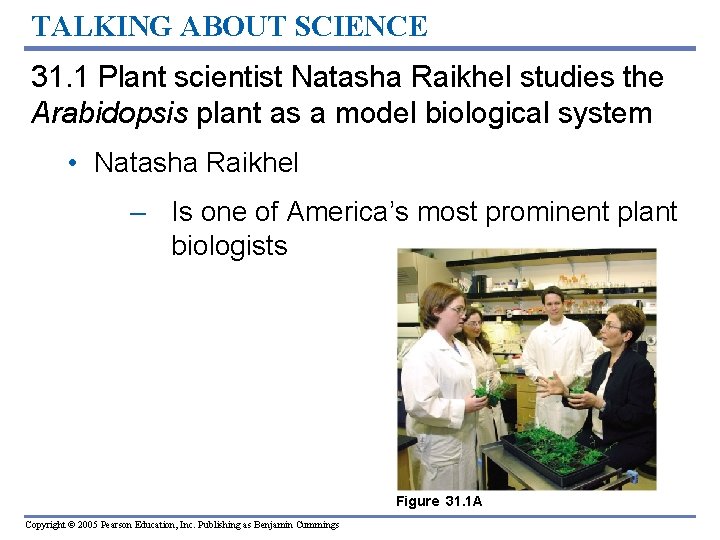
TALKING ABOUT SCIENCE 31. 1 Plant scientist Natasha Raikhel studies the Arabidopsis plant as a model biological system • Natasha Raikhel – Is one of America’s most prominent plant biologists Figure 31. 1 A Copyright © 2005 Pearson Education, Inc. Publishing as Benjamin Cummings
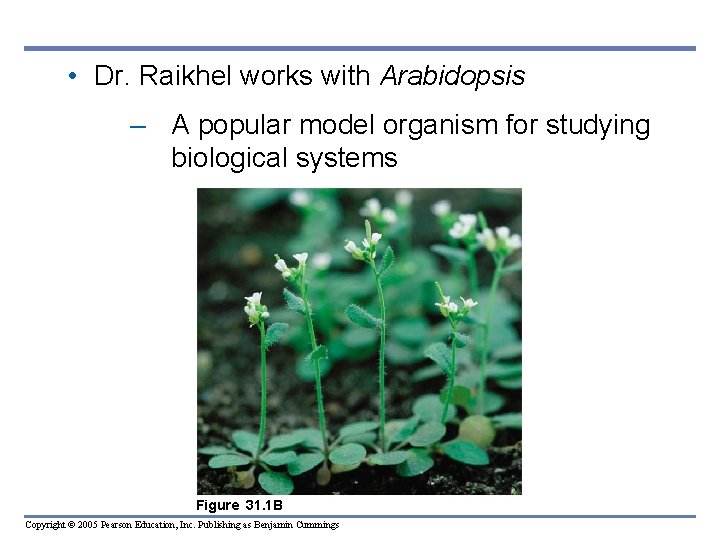
• Dr. Raikhel works with Arabidopsis – A popular model organism for studying biological systems Figure 31. 1 B Copyright © 2005 Pearson Education, Inc. Publishing as Benjamin Cummings
PLANT STRUCTURE AND FUNCTION 31. 2 The two main groups of angiosperms are the monocots and the dicots • Monocots and dicots differ in – The number of seed leaves and in the structure of roots, stems, leaves, and flowers Seed leaves Leaf veins Stems Flowers Roots MONOCOTS One cotyledon Main veins usually parallel Vascular bundles in complex arrangement Floral parts usually in multiples of three Fibrous root system Floral parts usually in multiples of four or five Taproot usually present DICOTS Figure 31. 2 Two cotyledons Main veins usually branched Copyright © 2005 Pearson Education, Inc. Publishing as Benjamin Cummings Vascular bundles arranged in ring
31. 3 A typical plant body consists of roots and shoots • A plant’s root system – Anchors it in the soil – Absorbs and transports minerals and water and stores food Copyright © 2005 Pearson Education, Inc. Publishing as Benjamin Cummings
• The shoot system of a plant – Is made up of stems, leaves, and adaptations for reproduction, flowers Copyright © 2005 Pearson Education, Inc. Publishing as Benjamin Cummings
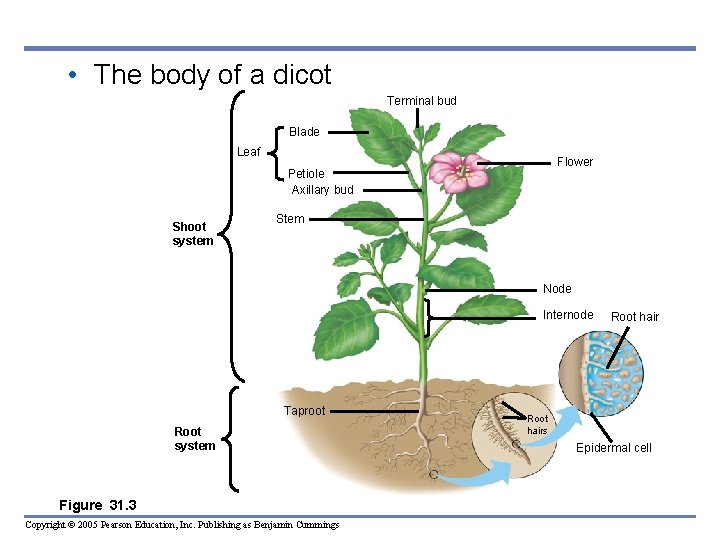
• The body of a dicot Terminal bud Blade Leaf Flower Petiole Axillary bud Shoot system Stem Node Internode Taproot Root system Figure 31. 3 Copyright © 2005 Pearson Education, Inc. Publishing as Benjamin Cummings Root hairs Epidermal cell
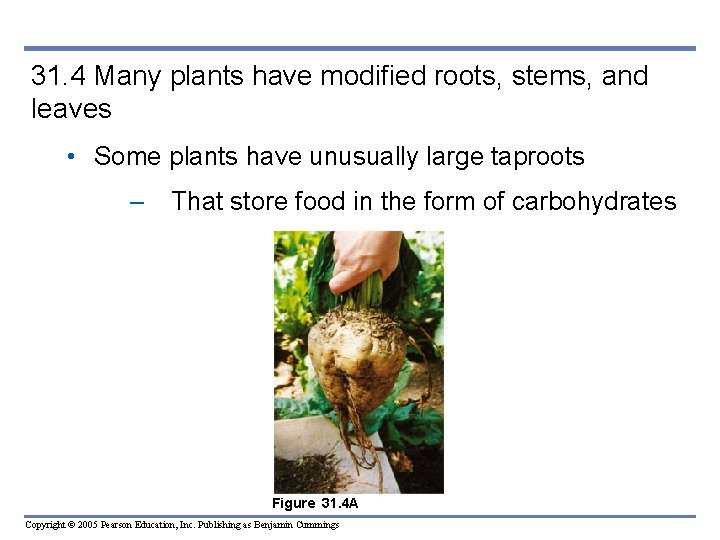
31. 4 Many plants have modified roots, stems, and leaves • Some plants have unusually large taproots – That store food in the form of carbohydrates Figure 31. 4 A Copyright © 2005 Pearson Education, Inc. Publishing as Benjamin Cummings
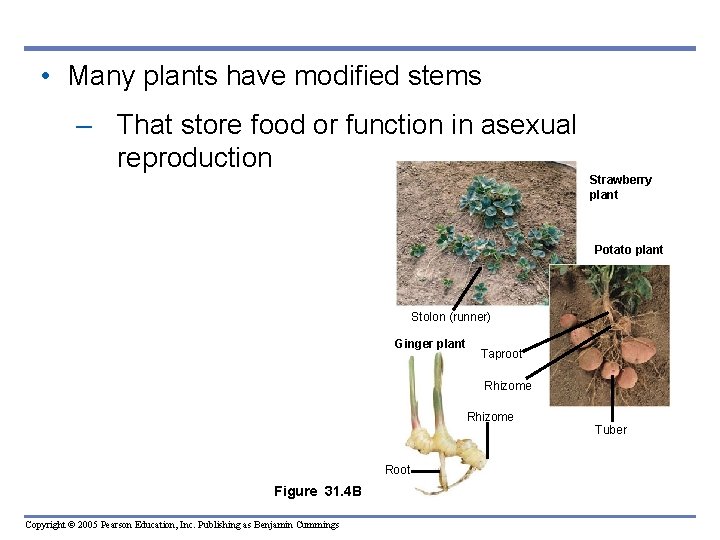
• Many plants have modified stems – That store food or function in asexual reproduction Strawberry plant Potato plant Stolon (runner) Ginger plant Taproot Rhizome Tuber Root Figure 31. 4 B Copyright © 2005 Pearson Education, Inc. Publishing as Benjamin Cummings
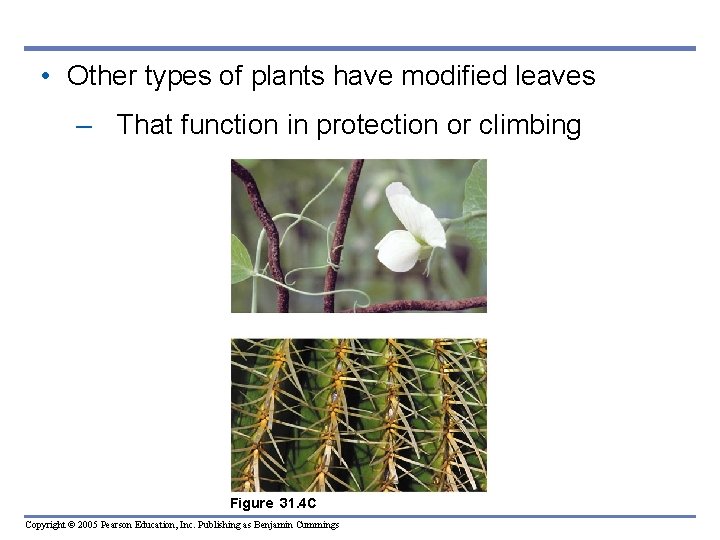
• Other types of plants have modified leaves – That function in protection or climbing Figure 31. 4 C Copyright © 2005 Pearson Education, Inc. Publishing as Benjamin Cummings
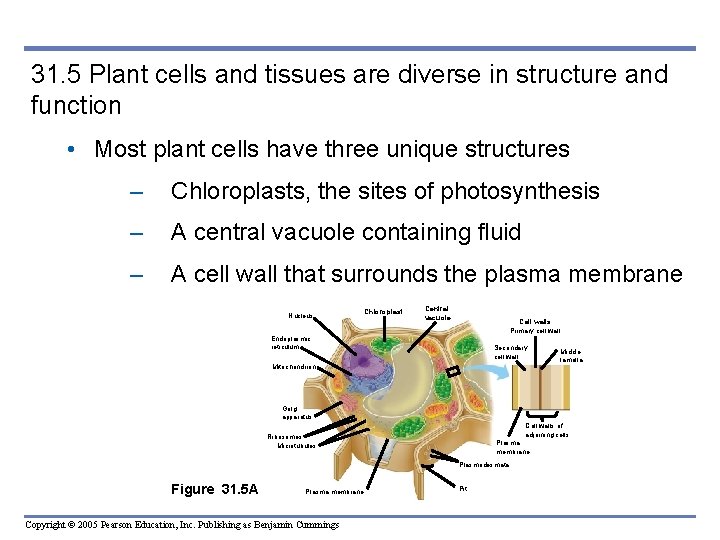
31. 5 Plant cells and tissues are diverse in structure and function • Most plant cells have three unique structures – Chloroplasts, the sites of photosynthesis – A central vacuole containing fluid – A cell wall that surrounds the plasma membrane Nucleus Chloroplast Central vacuole Cell walls Primary cell wall Endoplasmic reticulum Secondary cell wall Mitochondrion Middle lamella Golgi apparatus Cell walls of adjoining cells Ribosomes Microtubules Plasma membrane Plasmodesmata Figure 31. 5 A Plasma membrane Copyright © 2005 Pearson Education, Inc. Publishing as Benjamin Cummings Pit
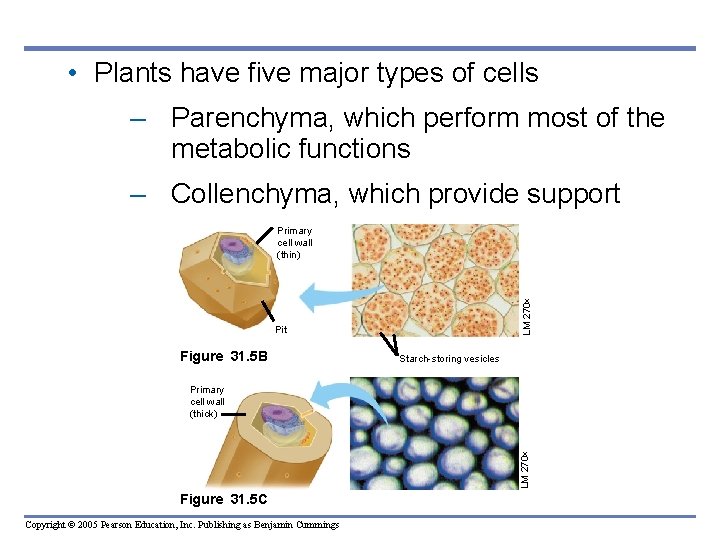
• Plants have five major types of cells – Parenchyma, which perform most of the metabolic functions – Collenchyma, which provide support LM 270 Primary cell wall (thin) Pit Figure 31. 5 B Starch-storing vesicles LM 270 Primary cell wall (thick) Figure 31. 5 C Copyright © 2005 Pearson Education, Inc. Publishing as Benjamin Cummings
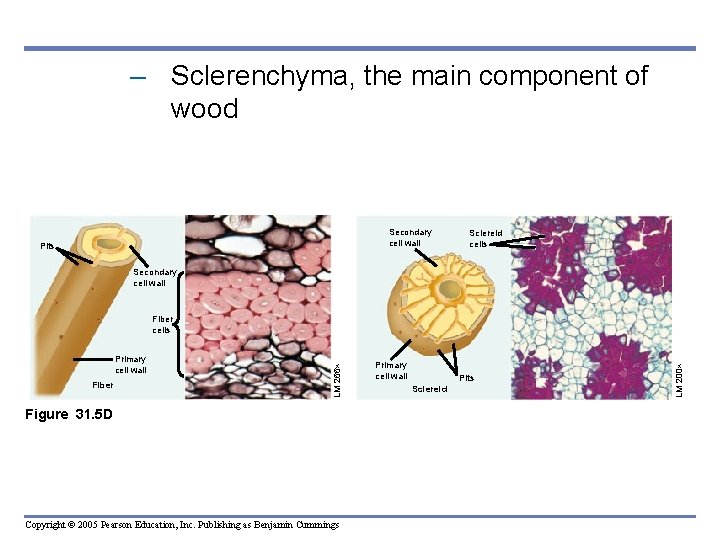
– Sclerenchyma, the main component of wood Secondary cell wall Pits Sclereid cells Secondary cell wall Fiber Figure 31. 5 D Copyright © 2005 Pearson Education, Inc. Publishing as Benjamin Cummings Primary cell wall Pits Sclereid LM 200 Primary cell wall LM 266 Fiber cells
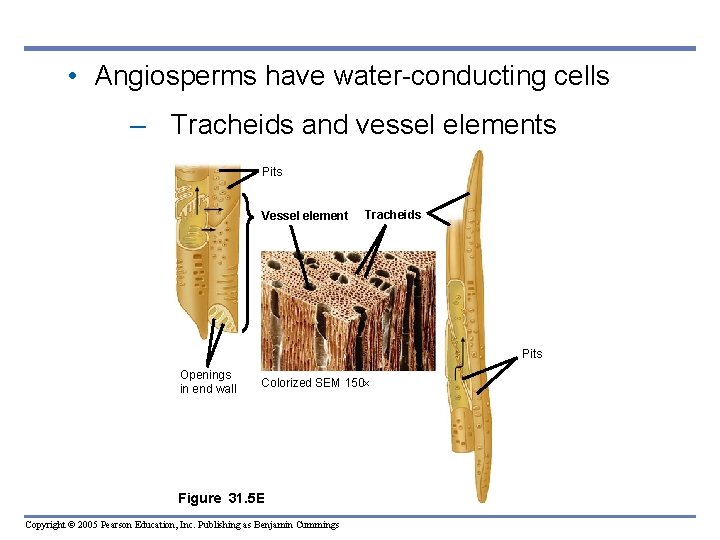
• Angiosperms have water-conducting cells – Tracheids and vessel elements Pits Vessel element Tracheids Pits Openings in end wall Colorized SEM 150 Figure 31. 5 E Copyright © 2005 Pearson Education, Inc. Publishing as Benjamin Cummings
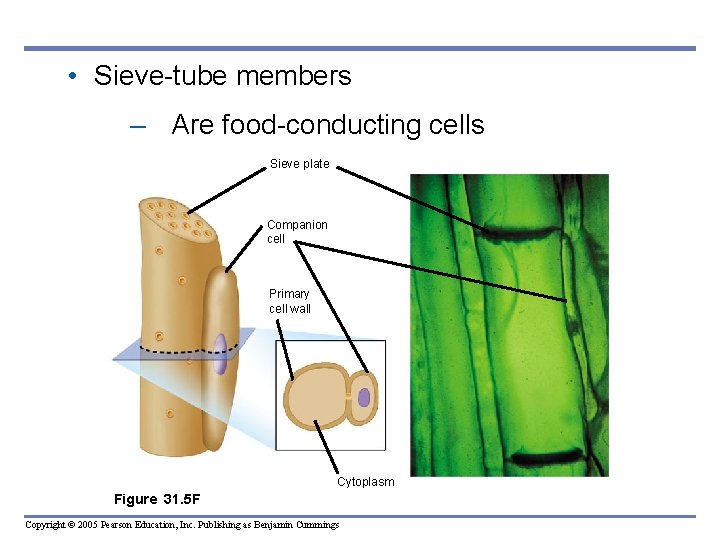
• Sieve-tube members – Are food-conducting cells Sieve plate Companion cell Primary cell wall Cytoplasm Figure 31. 5 F Copyright © 2005 Pearson Education, Inc. Publishing as Benjamin Cummings
• Two kinds of vascular tissue are – Xylem, which conveys water and minerals – Phloem, which transports sugars Copyright © 2005 Pearson Education, Inc. Publishing as Benjamin Cummings
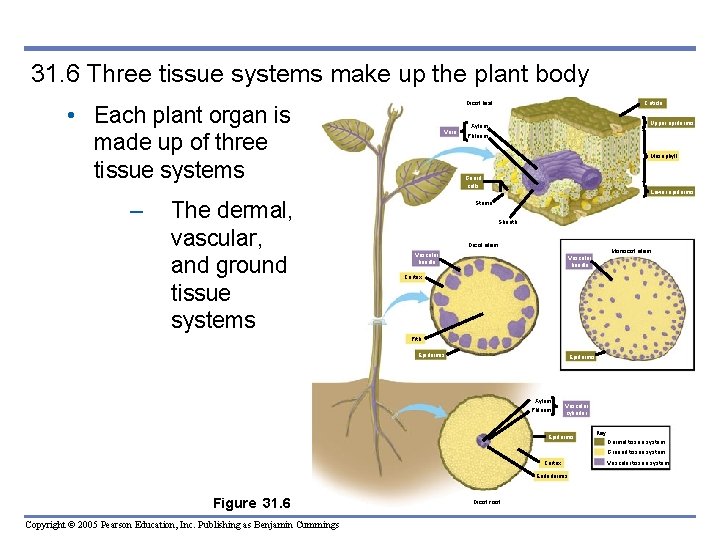
31. 6 Three tissue systems make up the plant body Dicot leaf • Each plant organ is made up of three tissue systems – The dermal, vascular, and ground tissue systems Vein Cuticle Upper epidermis Xylem Phloem Mesophyll Guard cells Lower epidermis Stoma Sheath Dicot stem Vascular bundle Monocot stem Vascular bundle Cortex Pith Epidermis Xylem Phloem Vascular cylinder Epidermis Key Dermal tissue system Ground tissue system Cortex Endodermis Figure 31. 6 Copyright © 2005 Pearson Education, Inc. Publishing as Benjamin Cummings Dicot root Vascular tissue system
• The dermal tissue system – Covers and protects the plant • The vascular tissue system – Contains xylem and phloem and provides long -distance transport and support • The ground tissue system – Consists of parenchyma cells and supportive collenchyma and sclerenchyma cells Copyright © 2005 Pearson Education, Inc. Publishing as Benjamin Cummings
PLANT GROWTH 31. 7 Primary growth lengthens roots and shoots • Meristems, areas of unspecialized, dividing cells – Are where plant growth originates Copyright © 2005 Pearson Education, Inc. Publishing as Benjamin Cummings
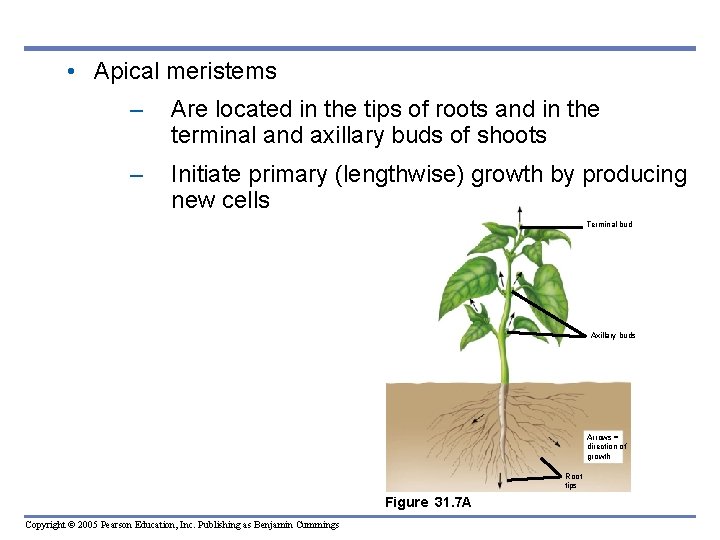
• Apical meristems – Are located in the tips of roots and in the terminal and axillary buds of shoots – Initiate primary (lengthwise) growth by producing new cells Terminal bud Axillary buds Arrows = direction of growth Root tips Figure 31. 7 A Copyright © 2005 Pearson Education, Inc. Publishing as Benjamin Cummings
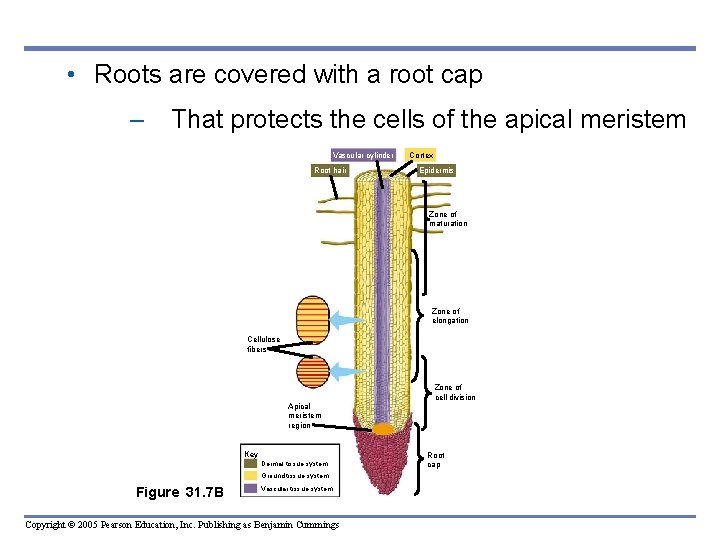
• Roots are covered with a root cap – That protects the cells of the apical meristem Vascular cylinder Root hair Cortex Epidermis Zone of maturation Zone of elongation Cellulose fibers Apical meristem region Key Dermal tissue system Ground tissue system Figure 31. 7 B Vascular tissue system Copyright © 2005 Pearson Education, Inc. Publishing as Benjamin Cummings Zone of cell division Root cap
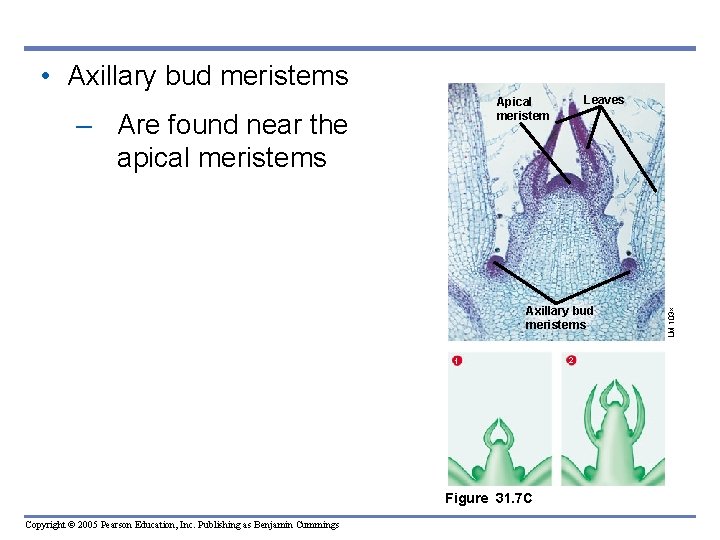
• Axillary bud meristems – Are found near the apical meristems Axillary bud meristems 1 Figure 31. 7 C Copyright © 2005 Pearson Education, Inc. Publishing as Benjamin Cummings 2 LM 103 Leaves Apical meristem
31. 8 Secondary growth increases the girth of woody plants • Secondary growth arises from cell division – In a cylindrical meristem called the vascular cambium Copyright © 2005 Pearson Education, Inc. Publishing as Benjamin Cummings
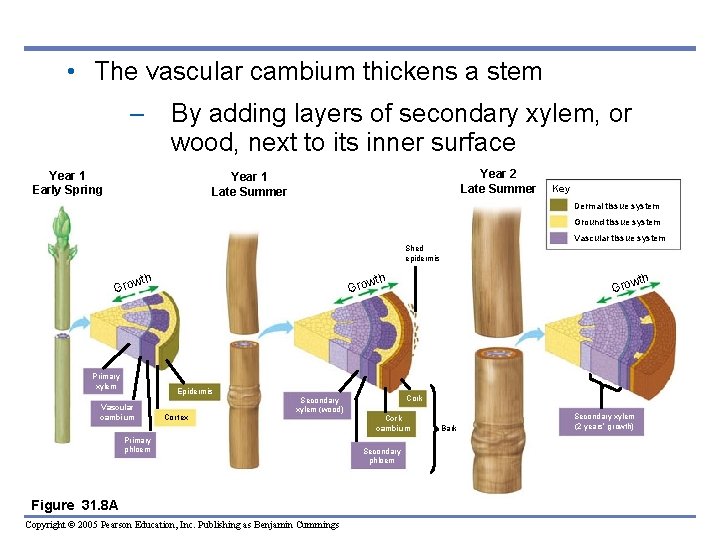
• The vascular cambium thickens a stem – By adding layers of secondary xylem, or wood, next to its inner surface Year 1 Early Spring Year 2 Late Summer Year 1 Late Summer Key Dermal tissue system Ground tissue system Vascular tissue system Shed epidermis wth Gro Primary xylem Epidermis Vascular cambium h wt Gro Cor tex Secondary xylem (wood) Primary phloem Figure 31. 8 A Copyright © 2005 Pearson Education, Inc. Publishing as Benjamin Cummings Cork cambium Secondary phloem Bark Secondary xylem (2 years’ growth)
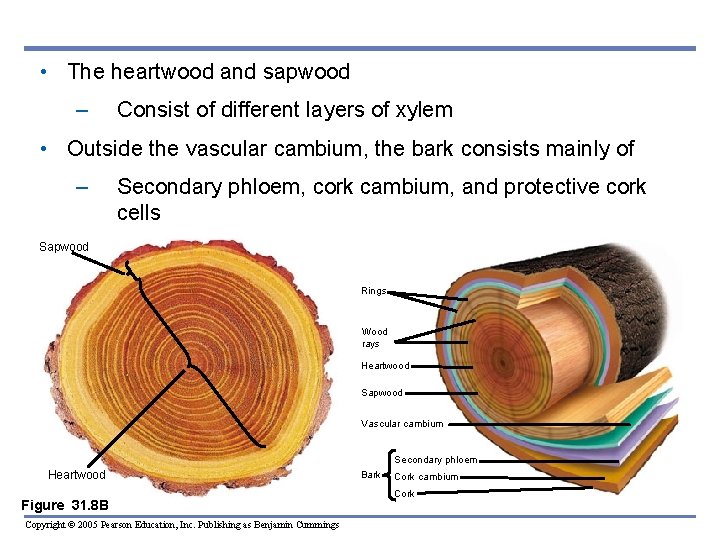
• The heartwood and sapwood – Consist of different layers of xylem • Outside the vascular cambium, the bark consists mainly of – Secondary phloem, cork cambium, and protective cork cells Sapwood Rings Wood rays Heartwood Sapwood Vascular cambium Secondary phloem Heartwood Figure 31. 8 B Copyright © 2005 Pearson Education, Inc. Publishing as Benjamin Cummings Bark Cork cambium Cork
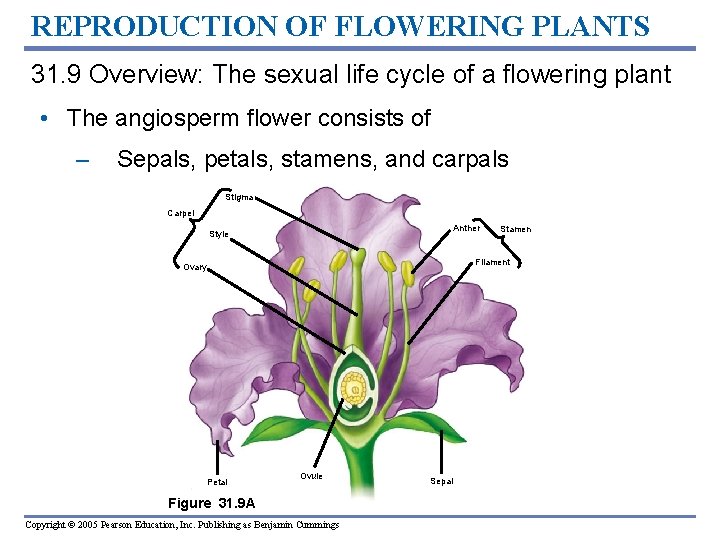
REPRODUCTION OF FLOWERING PLANTS 31. 9 Overview: The sexual life cycle of a flowering plant • The angiosperm flower consists of – Sepals, petals, stamens, and carpals Stigma Carpel Anther Style Stamen Filament Ovary Petal Ovule Figure 31. 9 A Copyright © 2005 Pearson Education, Inc. Publishing as Benjamin Cummings Sepal
• Pollen grains develop in anthers – At the tip of stamens Copyright © 2005 Pearson Education, Inc. Publishing as Benjamin Cummings
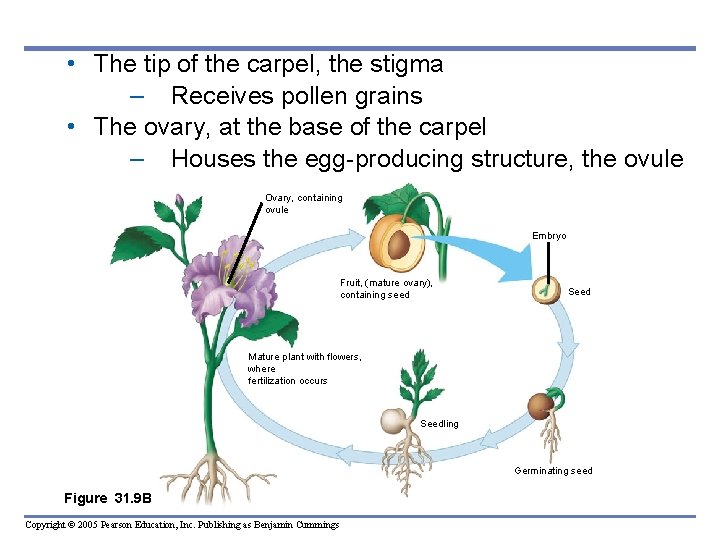
• The tip of the carpel, the stigma – Receives pollen grains • The ovary, at the base of the carpel – Houses the egg-producing structure, the ovule Ovary, containing ovule Embryo Fruit, (mature ovary), containing seed Seed Mature plant with flowers, where fertilization occurs Seedling Germinating seed Figure 31. 9 B Copyright © 2005 Pearson Education, Inc. Publishing as Benjamin Cummings
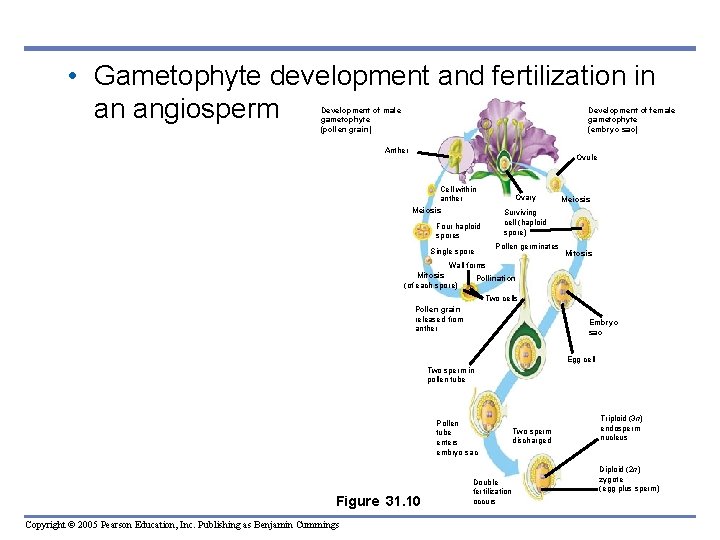
31. 10 The development of pollen and ovules culminates in fer tilization • In the diploid sporophyte of an angiosperm – Haploid spores are formed within ovules and anthers Copyright © 2005 Pearson Education, Inc. Publishing as Benjamin Cummings
• The spores in the anthers – Give rise to male gametophytes, pollen grains, which produce sperm • A spore in an ovule – Produces the embryo sac, the female gametophyte, which contains an egg cell Copyright © 2005 Pearson Education, Inc. Publishing as Benjamin Cummings
• Pollination – Is the arrival of pollen grains onto a stigma • A pollen tube grows into the ovule – And sperm pass through it and fer tilize both the egg and a second cell in a process called double fer tilization Copyright © 2005 Pearson Education, Inc. Publishing as Benjamin Cummings
• Gametophyte development and fertilization in an angiosperm Development of male gametophyte (pollen grain) Development of female gametophyte (embryo sac) Anther Ovule Cell within anther Meiosis Ovary Meiosis Surviving cell (haploid spore) Four haploid spores Pollen germinates Single spore Mitosis Wall forms Mitosis (of each spore) Pollination Two cells Pollen grain released from anther Embryo sac Egg cell Two sperm in pollen tube Pollen tube enters embryo sac Figure 31. 10 Copyright © 2005 Pearson Education, Inc. Publishing as Benjamin Cummings Double fer tilization occurs Two sperm discharged Triploid (3 n) endosperm nucleus Diploid (2 n) zygote (egg plus sperm)
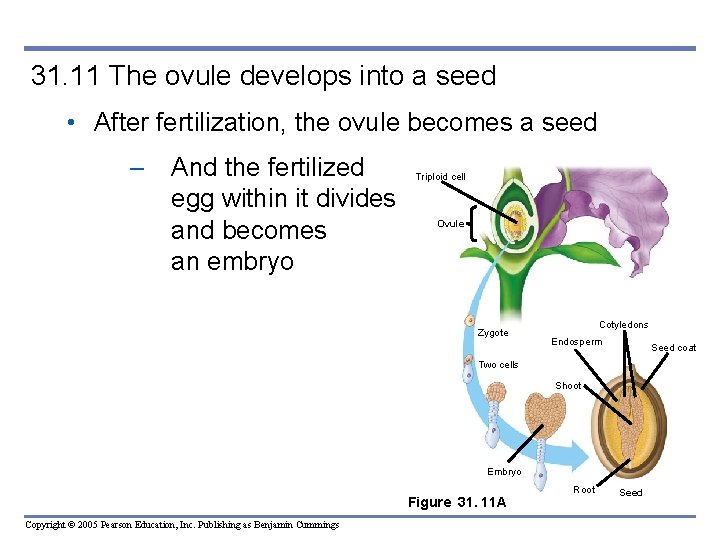
31. 11 The ovule develops into a seed • After fertilization, the ovule becomes a seed – And the fertilized egg within it divides and becomes an embryo Triploid cell Ovule Shed epider mis wth Gro Cotyledons Zygote Endosperm Seed coat Two cells Co Second Shoot ary Cork rk xylem cambi (wood) um Second ary phloem Embryo Figure 31. 11 A Copyright © 2005 Pearson Education, Inc. Publishing as Benjamin Cummings Root Seed
• The other fertilized cell – Develops into the endosperm, which stores food for the embryo Copyright © 2005 Pearson Education, Inc. Publishing as Benjamin Cummings
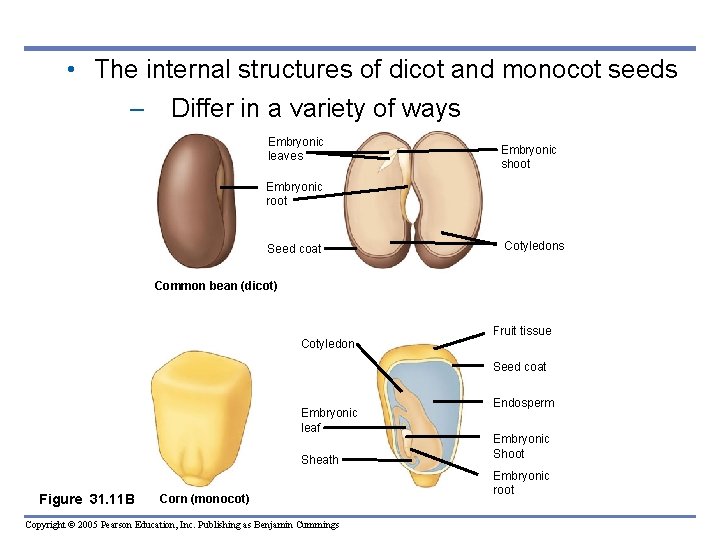
• The internal structures of dicot and monocot seeds – Differ in a variety of ways Embryonic leaves Embryonic shoot Embryonic root Seed coat Cotyledons Common bean (dicot) Fruit tissue Cotyledon Seed coat Embryonic leaf Sheath Figure 31. 11 B Corn (monocot) Copyright © 2005 Pearson Education, Inc. Publishing as Benjamin Cummings Endosperm Embryonic Shoot Embryonic root
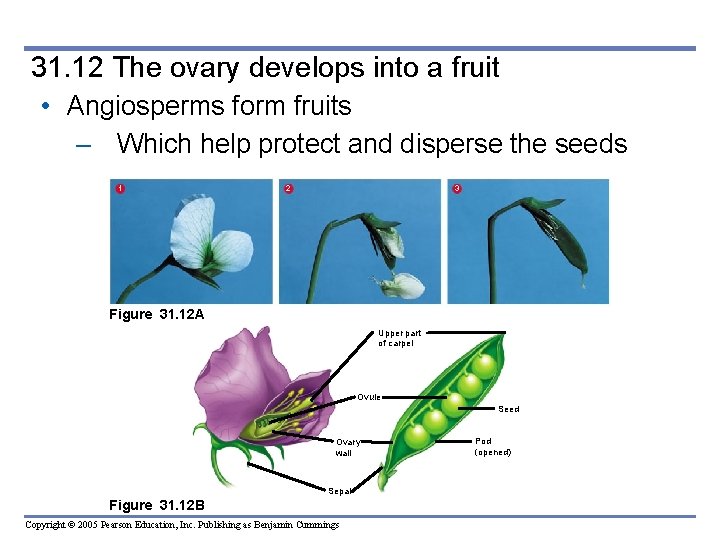
31. 12 The ovary develops into a fruit • Angiosperms form fruits – Which help protect and disperse the seeds 1 3 2 Figure 31. 12 A Upper part of carpel Ovule Seed Ovar y wall Sepal Figure 31. 12 B Copyright © 2005 Pearson Education, Inc. Publishing as Benjamin Cummings Pod (opened)
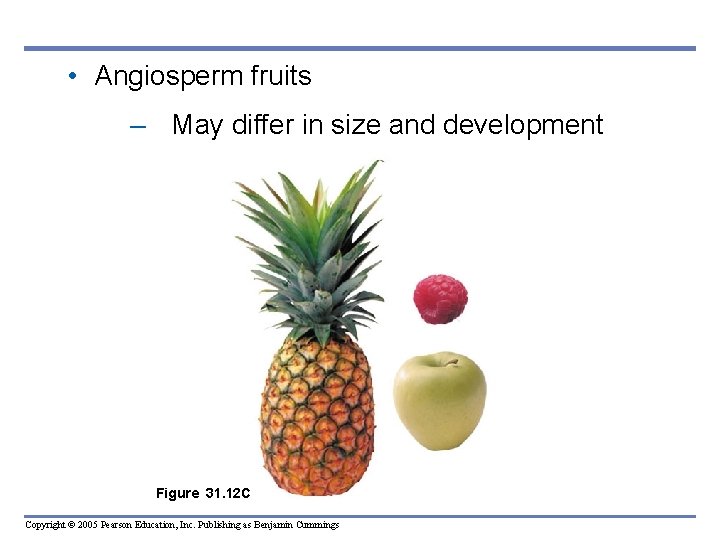
• Angiosperm fruits – May differ in size and development Figure 31. 12 C Copyright © 2005 Pearson Education, Inc. Publishing as Benjamin Cummings
31. 13 Seed germination continues the life cycle • A seed starts to germinate – When it takes up water and star ts to expand • The embryo resumes growth – And absorbs nutrients from the endosperm • An embryonic root emerges – And a shoot pushes upward and expands its leaves Copyright © 2005 Pearson Education, Inc. Publishing as Benjamin Cummings
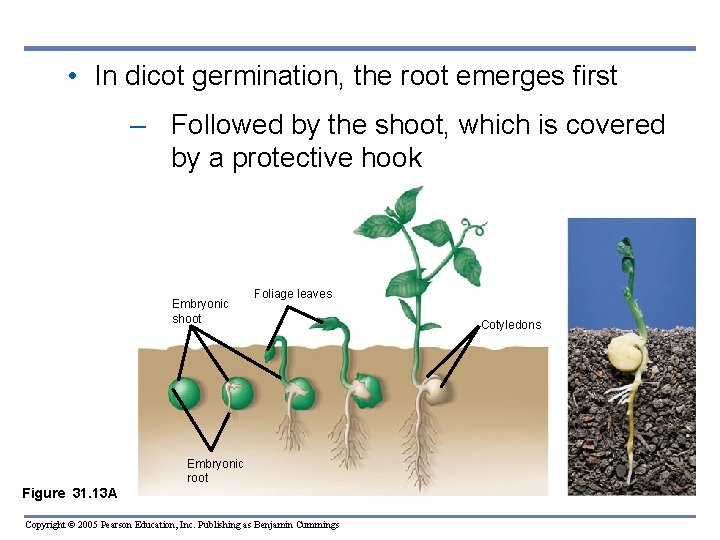
• In dicot germination, the root emerges first – Followed by the shoot, which is covered by a protective hook Embryonic shoot Foliage leaves Embryonic root Figure 31. 13 A Copyright © 2005 Pearson Education, Inc. Publishing as Benjamin Cummings Cotyledons
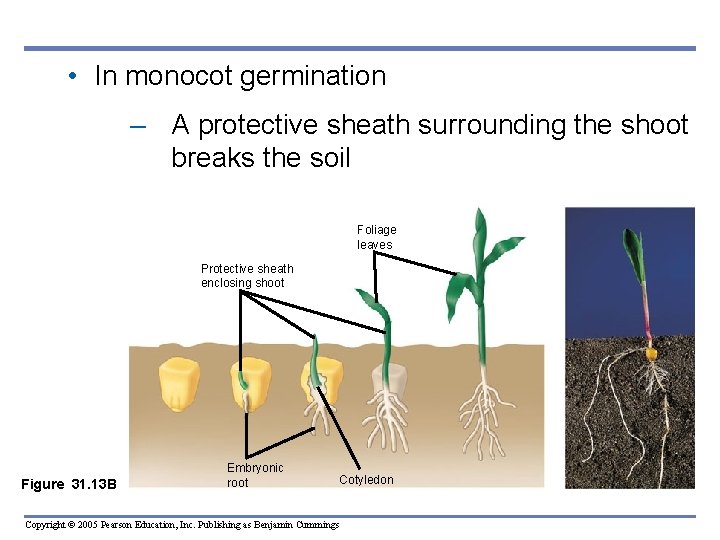
• In monocot germination – A protective sheath surrounding the shoot breaks the soil Foliage leaves Protective sheath enclosing shoot Figure 31. 13 B Embryonic root Cotyledon Copyright © 2005 Pearson Education, Inc. Publishing as Benjamin Cummings
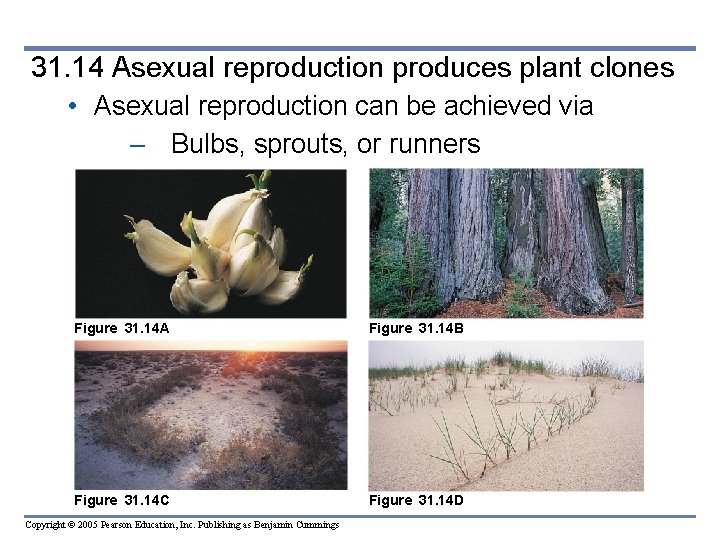
31. 14 Asexual reproduction produces plant clones • Asexual reproduction can be achieved via – Bulbs, sprouts, or runners Figure 31. 14 A Figure 31. 14 B Figure 31. 14 C Figure 31. 14 D Copyright © 2005 Pearson Education, Inc. Publishing as Benjamin Cummings
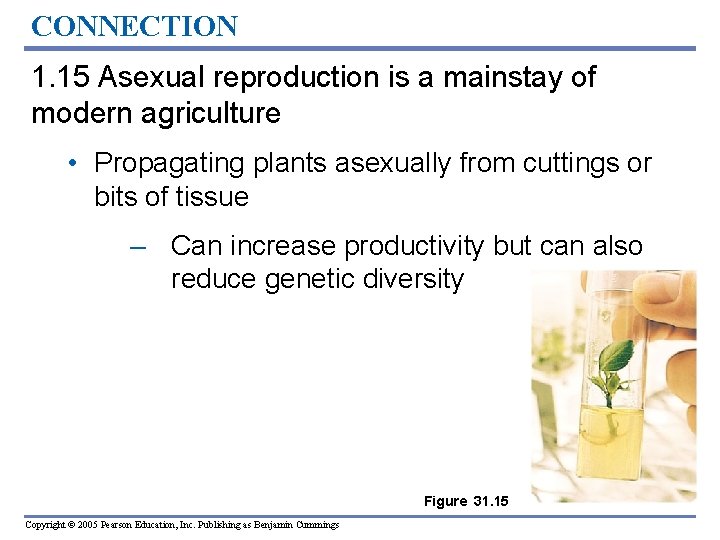
CONNECTION 1. 15 Asexual reproduction is a mainstay of modern agriculture • Propagating plants asexually from cuttings or bits of tissue – Can increase productivity but can also reduce genetic diversity Figure 31. 15 Copyright © 2005 Pearson Education, Inc. Publishing as Benjamin Cummings