
Chapter 30 XML Database System Concepts 7 th
Chapter 30: XML Database System Concepts, 7 th Ed. ©Silberschatz, Korth and Sudarshan See www. db-book. com for conditions on re-use
Outline § § § Structure of XML Data XML Document Schema Querying and Transformation Application Program Interfaces to XML Storage of XML Data XML Applications Database System Concepts - 7 th Edition 30. 2 ©Silberschatz, Korth and Sudarshan
Introduction § XML: Extensible Markup Language § Defined by the WWW Consortium (W 3 C) § Derived from SGML (Standard Generalized Markup Language), but simpler to use than SGML § Documents have tags giving extra information about sections of the document • E. g. , <title> XML </title> <slide> Introduction …</slide> § Extensible, unlike HTML • Users can add new tags, and separately specify how the tag should be handled for display Database System Concepts - 7 th Edition 30. 3 ©Silberschatz, Korth and Sudarshan
XML Introduction (Cont. ) § The ability to specify new tags, and to create nested tag structures make XML a great way to exchange data, not just documents. • Much of the use of XML has been in data exchange applications, not as a replacement for HTML § Tags make data (relatively) self-documenting • E. g. , <university> <department> <dept_name> Comp. Sci. </dept_name> <building> Taylor </building> <budget> 100000 </budget> </department> <course_id> CS-101 </course_id> <title> Intro. to Computer Science </title> <dept_name> Comp. Sci </dept_name> <credits> 4 </credits> </course> </university> Database System Concepts - 7 th Edition 30. 4 ©Silberschatz, Korth and Sudarshan

XML: Motivation § Data interchange is critical in today’s networked world • Examples: § Banking: funds transfer § Order processing (especially inter-company orders) § Scientific data • Chemistry: Chem. ML, … • Genetics: BSML (Bio-Sequence Markup Language), … • Paper flow of information between organizations is being replaced by electronic flow of information § Each application area has its own set of standards for representing information § XML has become the basis for all new generation data interchange formats Database System Concepts - 7 th Edition 30. 5 ©Silberschatz, Korth and Sudarshan
XML Motivation (Cont. ) § Earlier generation formats were based on plain text with line headers indicating the meaning of fields • Similar in concept to email headers • Does not allow for nested structures, no standard “type” language • Tied too closely to low level document structure (lines, spaces, etc) § Each XML based standard defines what are valid elements, using • XML type specification languages to specify the syntax § DTD (Document Type Descriptors) § XML Schema • Plus textual descriptions of the semantics § XML allows new tags to be defined as required • However, this may be constrained by DTDs § A wide variety of tools is available for parsing, browsing and querying XML documents/data Database System Concepts - 7 th Edition 30. 6 ©Silberschatz, Korth and Sudarshan
Comparison with Relational Data § Inefficient: tags, which in effect represent schema information, are repeated § Better than relational tuples as a data-exchange format • Unlike relational tuples, XML data is self-documenting due to presence of tags • Non-rigid format: tags can be added • Allows nested structures • Wide acceptance, not only in database systems, but also in browsers, tools, and applications Database System Concepts - 7 th Edition 30. 7 ©Silberschatz, Korth and Sudarshan
Structure of XML Data § Tag: label for a section of data § Element: section of data beginning with <tagname> and ending with matching </tagname> § Elements must be properly nested • Proper nesting § <course> … <title> …. </title> </course> • Improper nesting § <course> … <title> …. </course> </title> • Formally: every start tag must have a unique matching end tag, that is in the context of the same parent element. § Every document must have a single top-level element Database System Concepts - 7 th Edition 30. 8 ©Silberschatz, Korth and Sudarshan
Example of Nested Elements <purchase_order> <identifier> P-101 </identifier> <purchaser> …. </purchaser> <itemlist> <item> <identifier> RS 1 </identifier> <description> Atom powered rocket sled </description> <quantity> 2 </quantity> <price> 199. 95 </price> </item> <identifier> SG 2 </identifier> <description> Superb glue </description> <quantity> 1 </quantity> <unit-of-measure> liter </unit-of-measure> <price> 29. 95 </price> </itemlist> </purchase_order> Database System Concepts - 7 th Edition 30. 9 ©Silberschatz, Korth and Sudarshan
Motivation for Nesting § Nesting of data is useful in data transfer • Example: elements representing item nested within an itemlist element § Nesting is not supported, or discouraged, in relational databases • With multiple orders, customer name and address are stored redundantly • normalization replaces nested structures in each order by foreign key into table storing customer name and address information • Nesting is supported in object-relational databases § But nesting is appropriate when transferring data • External application does not have direct access to data referenced by a foreign key Database System Concepts - 7 th Edition 30. 10 ©Silberschatz, Korth and Sudarshan
Structure of XML Data (Cont. ) § Mixture of text with sub-elements is legal in XML. • Example: <course> This course is being offered for the first time in 2009. <course id> BIO-399 </course id> <title> Computational Biology </title> <dept name> Biology </dept name> <credits> 3 </credits> </course> • Useful for document markup, but discouraged for data representation Database System Concepts - 7 th Edition 30. 11 ©Silberschatz, Korth and Sudarshan
Attributes § Elements can have attributes <course_id= “CS-101”> <title> Intro. to Computer Science</title> <dept name> Comp. Sci. </dept name> <credits> 4 </credits> </course> § Attributes are specified by name=value pairs inside the starting tag of an element § An element may have several attributes, but each attribute name can only occur once <course_id = “CS-101” credits=“ 4”> Database System Concepts - 7 th Edition 30. 12 ©Silberschatz, Korth and Sudarshan
Attributes vs. Subelements § Distinction between subelement and attribute • In the context of documents, attributes are part of markup, while subelement contents are part of the basic document contents • In the context of data representation, the difference is unclear and may be confusing § Same information can be represented in two ways • <course_id= “CS-101”> … </course> • <course> <course_id>CS-101</course_id> … </course> • Suggestion: use attributes for identifiers of elements, and use subelements for contents Database System Concepts - 7 th Edition 30. 13 ©Silberschatz, Korth and Sudarshan
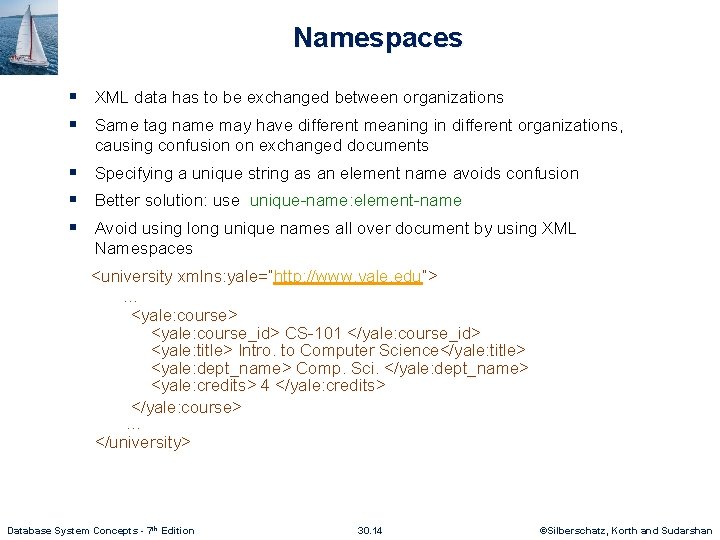
Namespaces § XML data has to be exchanged between organizations § Same tag name may have different meaning in different organizations, causing confusion on exchanged documents § Specifying a unique string as an element name avoids confusion § Better solution: use unique-name: element-name § Avoid using long unique names all over document by using XML Namespaces <university xmlns: yale=“http: //www. yale. edu”> … <yale: course> <yale: course_id> CS-101 </yale: course_id> <yale: title> Intro. to Computer Science</yale: title> <yale: dept_name> Comp. Sci. </yale: dept_name> <yale: credits> 4 </yale: credits> </yale: course> … </university> Database System Concepts - 7 th Edition 30. 14 ©Silberschatz, Korth and Sudarshan
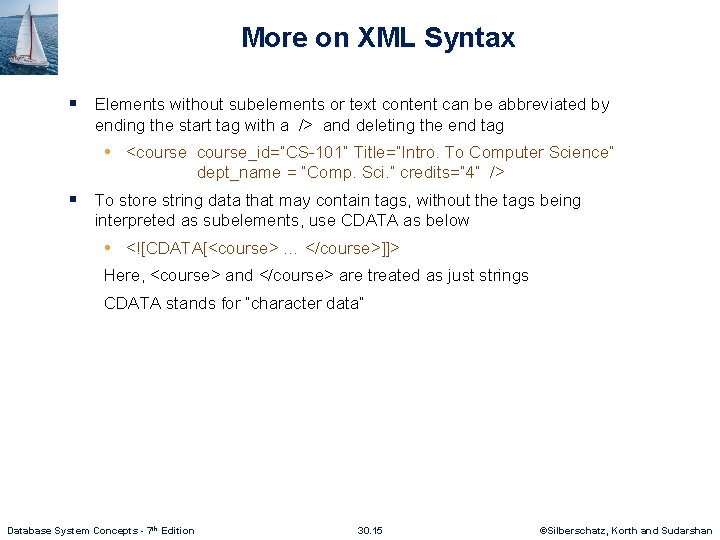
More on XML Syntax § Elements without subelements or text content can be abbreviated by ending the start tag with a /> and deleting the end tag • <course_id=“CS-101” Title=“Intro. To Computer Science” dept_name = “Comp. Sci. ” credits=“ 4” /> § To store string data that may contain tags, without the tags being interpreted as subelements, use CDATA as below • <![CDATA[<course> … </course>]]> Here, <course> and </course> are treated as just strings CDATA stands for “character data” Database System Concepts - 7 th Edition 30. 15 ©Silberschatz, Korth and Sudarshan
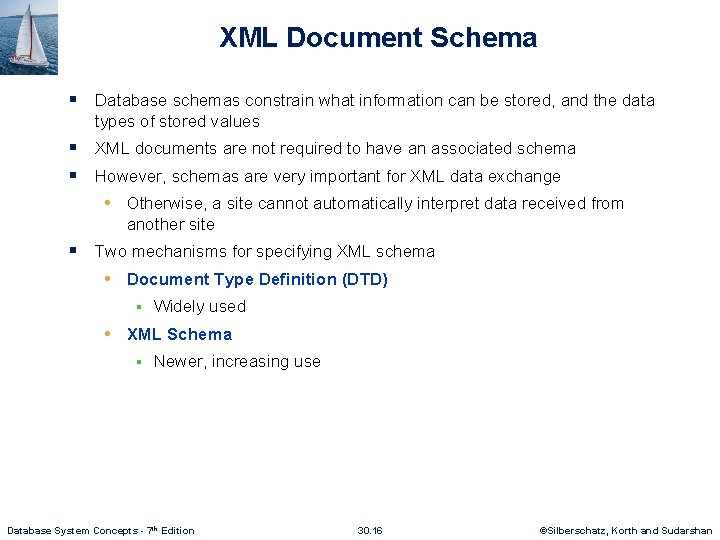
XML Document Schema § Database schemas constrain what information can be stored, and the data types of stored values § XML documents are not required to have an associated schema § However, schemas are very important for XML data exchange • Otherwise, a site cannot automatically interpret data received from another site § Two mechanisms for specifying XML schema • Document Type Definition (DTD) § Widely used • XML Schema § Newer, increasing use Database System Concepts - 7 th Edition 30. 16 ©Silberschatz, Korth and Sudarshan
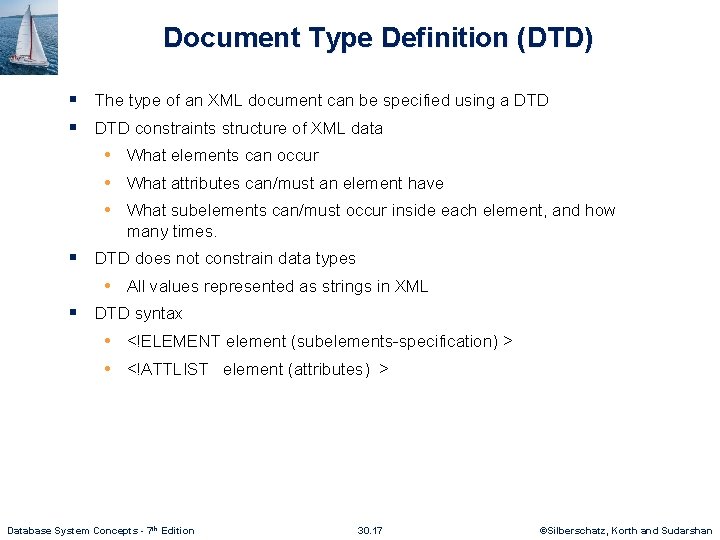
Document Type Definition (DTD) § The type of an XML document can be specified using a DTD § DTD constraints structure of XML data • What elements can occur • What attributes can/must an element have • What subelements can/must occur inside each element, and how many times. § DTD does not constrain data types • All values represented as strings in XML § DTD syntax • <!ELEMENT element (subelements-specification) > • <!ATTLIST element (attributes) > Database System Concepts - 7 th Edition 30. 17 ©Silberschatz, Korth and Sudarshan
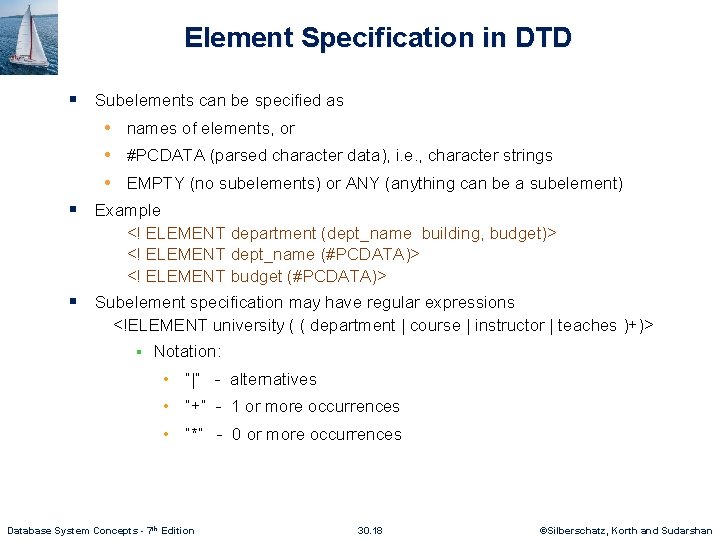
Element Specification in DTD § Subelements can be specified as • names of elements, or • #PCDATA (parsed character data), i. e. , character strings • EMPTY (no subelements) or ANY (anything can be a subelement) § Example <! ELEMENT department (dept_name building, budget)> <! ELEMENT dept_name (#PCDATA)> <! ELEMENT budget (#PCDATA)> § Subelement specification may have regular expressions <!ELEMENT university ( ( department | course | instructor | teaches )+)> § Notation: • “|” - alternatives • “+” - 1 or more occurrences • “*” - 0 or more occurrences Database System Concepts - 7 th Edition 30. 18 ©Silberschatz, Korth and Sudarshan
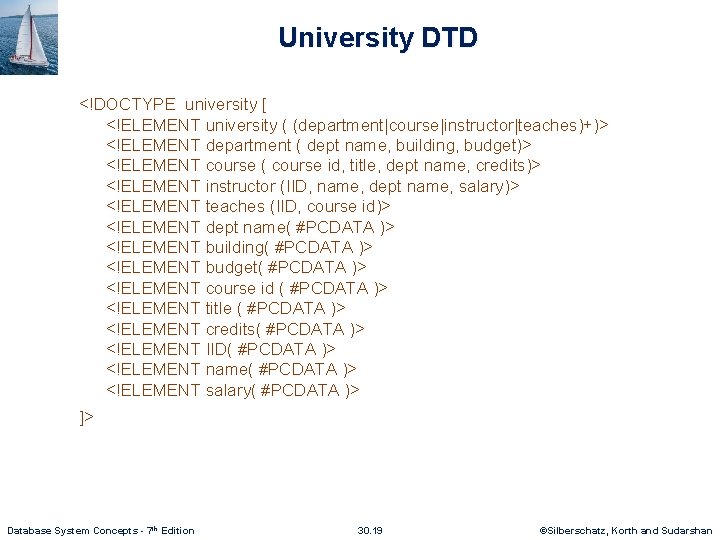
University DTD <!DOCTYPE university [ <!ELEMENT university ( (department|course|instructor|teaches)+)> <!ELEMENT department ( dept name, building, budget)> <!ELEMENT course ( course id, title, dept name, credits)> <!ELEMENT instructor (IID, name, dept name, salary)> <!ELEMENT teaches (IID, course id)> <!ELEMENT dept name( #PCDATA )> <!ELEMENT building( #PCDATA )> <!ELEMENT budget( #PCDATA )> <!ELEMENT course id ( #PCDATA )> <!ELEMENT title ( #PCDATA )> <!ELEMENT credits( #PCDATA )> <!ELEMENT IID( #PCDATA )> <!ELEMENT name( #PCDATA )> <!ELEMENT salary( #PCDATA )> ]> Database System Concepts - 7 th Edition 30. 19 ©Silberschatz, Korth and Sudarshan
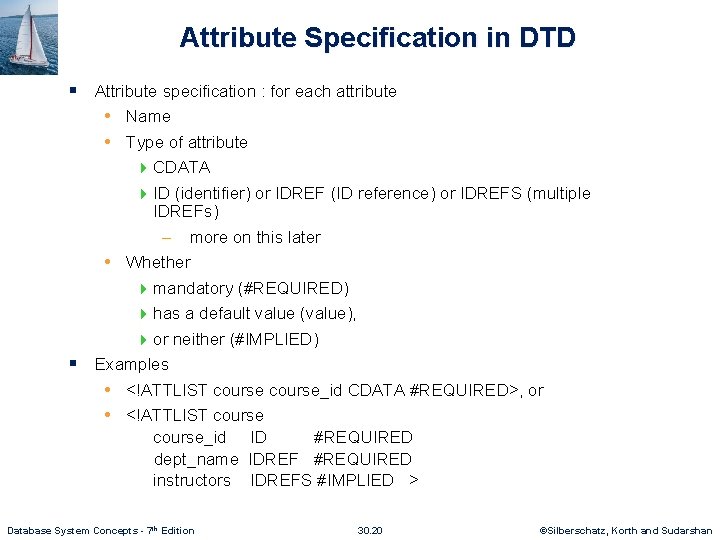
Attribute Specification in DTD § Attribute specification : for each attribute • Name • Type of attribute 4 CDATA 4 ID (identifier) or IDREF (ID reference) or IDREFS (multiple IDREFs) – more on this later • Whether 4 mandatory (#REQUIRED) 4 has a default value (value), 4 or neither (#IMPLIED) § Examples • <!ATTLIST course_id CDATA #REQUIRED>, or • <!ATTLIST course_id ID #REQUIRED dept_name IDREF #REQUIRED instructors IDREFS #IMPLIED > Database System Concepts - 7 th Edition 30. 20 ©Silberschatz, Korth and Sudarshan
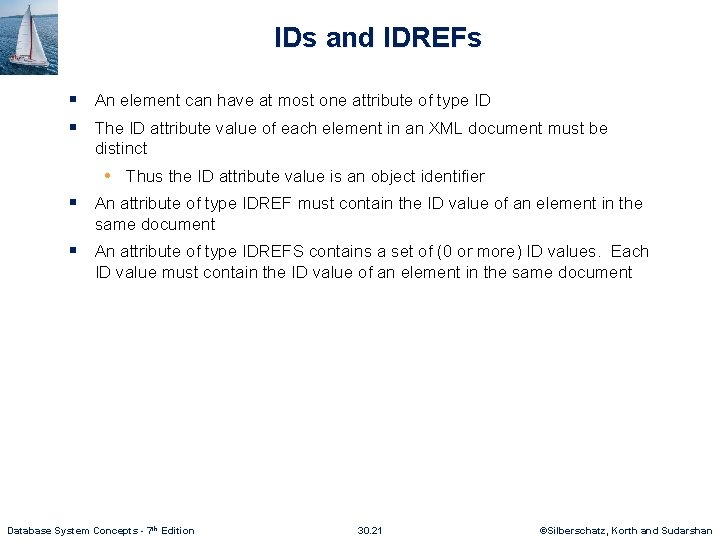
IDs and IDREFs § An element can have at most one attribute of type ID § The ID attribute value of each element in an XML document must be distinct • Thus the ID attribute value is an object identifier § An attribute of type IDREF must contain the ID value of an element in the same document § An attribute of type IDREFS contains a set of (0 or more) ID values. Each ID value must contain the ID value of an element in the same document Database System Concepts - 7 th Edition 30. 21 ©Silberschatz, Korth and Sudarshan
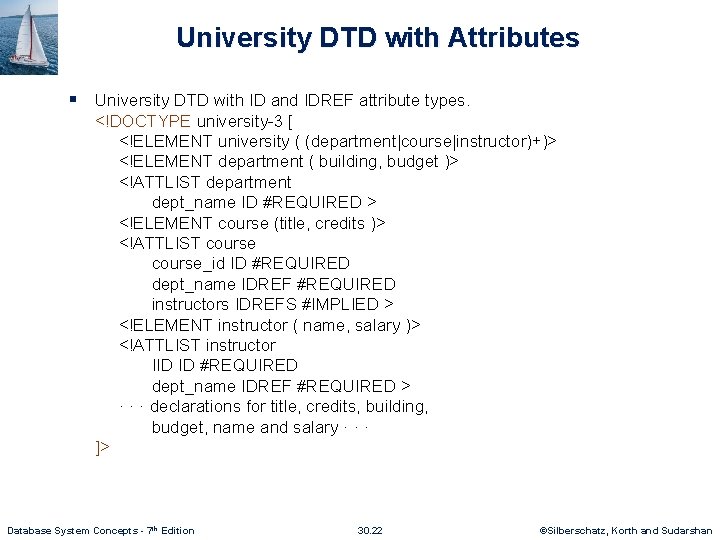
University DTD with Attributes § University DTD with ID and IDREF attribute types. <!DOCTYPE university-3 [ <!ELEMENT university ( (department|course|instructor)+)> <!ELEMENT department ( building, budget )> <!ATTLIST department dept_name ID #REQUIRED > <!ELEMENT course (title, credits )> <!ATTLIST course_id ID #REQUIRED dept_name IDREF #REQUIRED instructors IDREFS #IMPLIED > <!ELEMENT instructor ( name, salary )> <!ATTLIST instructor IID ID #REQUIRED dept_name IDREF #REQUIRED > · · · declarations for title, credits, building, budget, name and salary · · · ]> Database System Concepts - 7 th Edition 30. 22 ©Silberschatz, Korth and Sudarshan
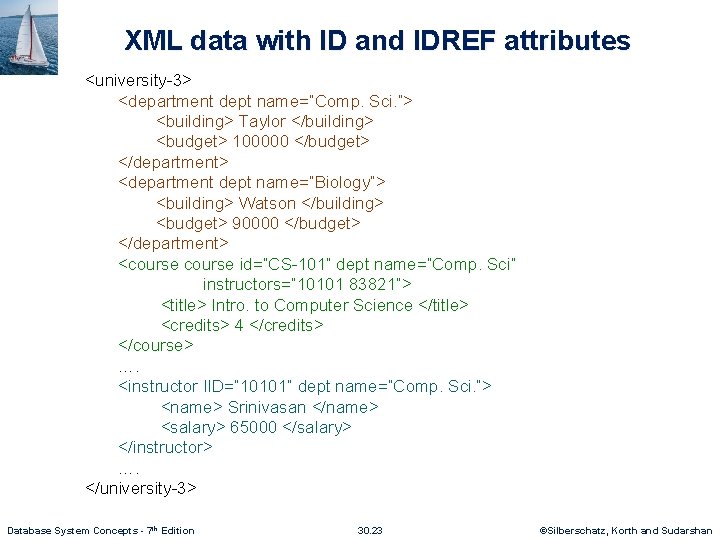
XML data with ID and IDREF attributes <university-3> <department dept name=“Comp. Sci. ”> <building> Taylor </building> <budget> 100000 </budget> </department> <department dept name=“Biology”> <building> Watson </building> <budget> 90000 </budget> </department> <course id=“CS-101” dept name=“Comp. Sci” instructors=“ 10101 83821”> <title> Intro. to Computer Science </title> <credits> 4 </credits> </course> …. <instructor IID=“ 10101” dept name=“Comp. Sci. ”> <name> Srinivasan </name> <salary> 65000 </salary> </instructor> …. </university-3> Database System Concepts - 7 th Edition 30. 23 ©Silberschatz, Korth and Sudarshan
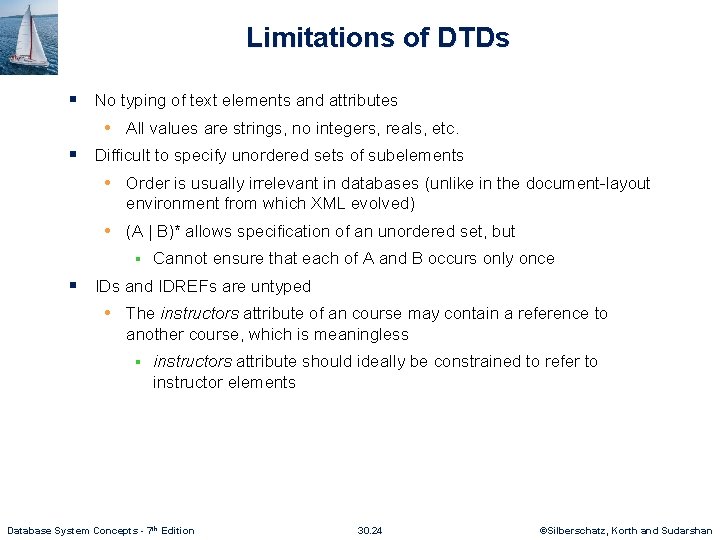
Limitations of DTDs § No typing of text elements and attributes • All values are strings, no integers, reals, etc. § Difficult to specify unordered sets of subelements • Order is usually irrelevant in databases (unlike in the document-layout environment from which XML evolved) • (A | B)* allows specification of an unordered set, but § Cannot ensure that each of A and B occurs only once § IDs and IDREFs are untyped • The instructors attribute of an course may contain a reference to another course, which is meaningless § instructors attribute should ideally be constrained to refer to instructor elements Database System Concepts - 7 th Edition 30. 24 ©Silberschatz, Korth and Sudarshan
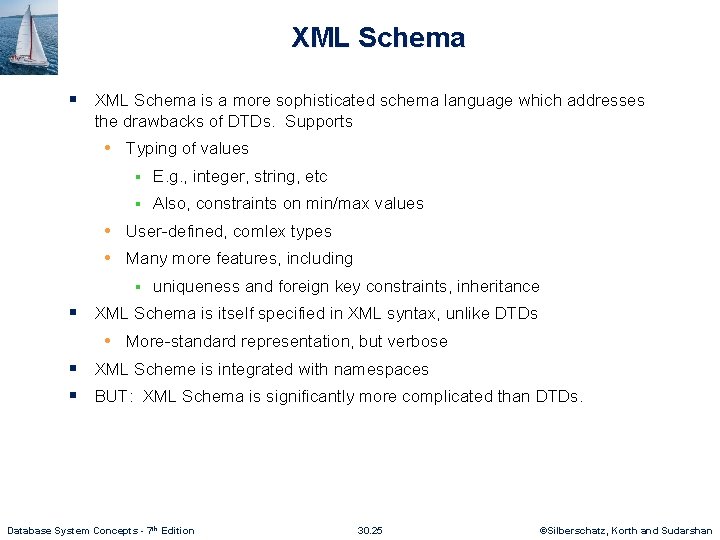
XML Schema § XML Schema is a more sophisticated schema language which addresses the drawbacks of DTDs. Supports • Typing of values § E. g. , integer, string, etc § Also, constraints on min/max values • User-defined, comlex types • Many more features, including § uniqueness and foreign key constraints, inheritance § XML Schema is itself specified in XML syntax, unlike DTDs • More-standard representation, but verbose § XML Scheme is integrated with namespaces § BUT: XML Schema is significantly more complicated than DTDs. Database System Concepts - 7 th Edition 30. 25 ©Silberschatz, Korth and Sudarshan
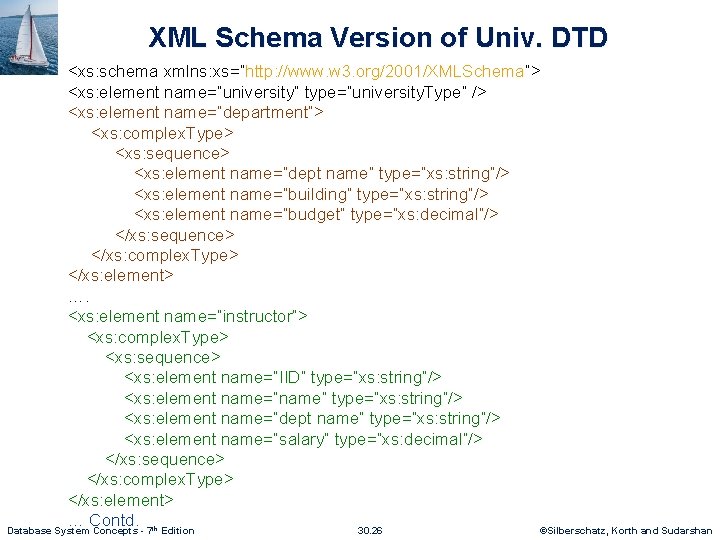
XML Schema Version of Univ. DTD <xs: schema xmlns: xs=“http: //www. w 3. org/2001/XMLSchema”> <xs: element name=“university” type=“university. Type” /> <xs: element name=“department”> <xs: complex. Type> <xs: sequence> <xs: element name=“dept name” type=“xs: string”/> <xs: element name=“building” type=“xs: string”/> <xs: element name=“budget” type=“xs: decimal”/> </xs: sequence> </xs: complex. Type> </xs: element> …. <xs: element name=“instructor”> <xs: complex. Type> <xs: sequence> <xs: element name=“IID” type=“xs: string”/> <xs: element name=“name” type=“xs: string”/> <xs: element name=“dept name” type=“xs: string”/> <xs: element name=“salary” type=“xs: decimal”/> </xs: sequence> </xs: complex. Type> </xs: element> … Contd. Database System Concepts - 7 Edition 30. 26 ©Silberschatz, Korth and Sudarshan th
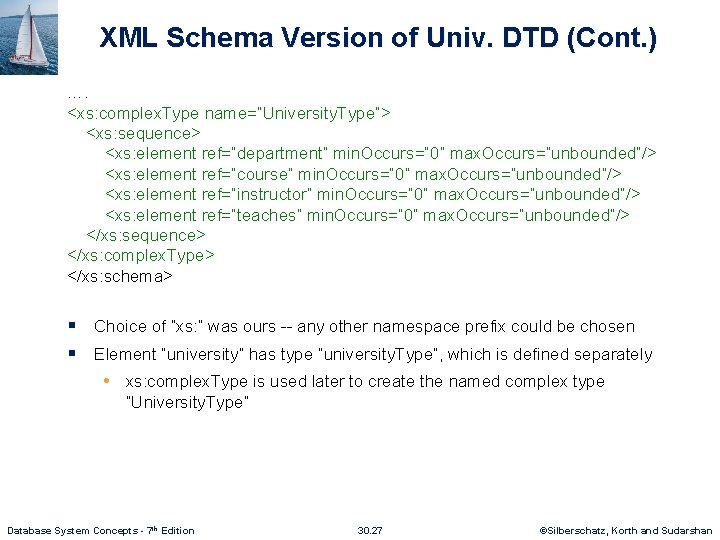
XML Schema Version of Univ. DTD (Cont. ) …. <xs: complex. Type name=“University. Type”> <xs: sequence> <xs: element ref=“department” min. Occurs=“ 0” max. Occurs=“unbounded”/> <xs: element ref=“course” min. Occurs=“ 0” max. Occurs=“unbounded”/> <xs: element ref=“instructor” min. Occurs=“ 0” max. Occurs=“unbounded”/> <xs: element ref=“teaches” min. Occurs=“ 0” max. Occurs=“unbounded”/> </xs: sequence> </xs: complex. Type> </xs: schema> § Choice of “xs: ” was ours -- any other namespace prefix could be chosen § Element “university” has type “university. Type”, which is defined separately • xs: complex. Type is used later to create the named complex type “University. Type” Database System Concepts - 7 th Edition 30. 27 ©Silberschatz, Korth and Sudarshan
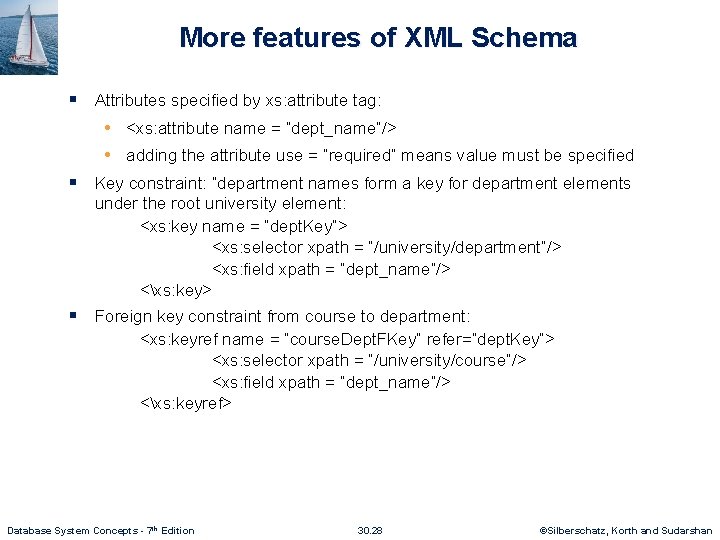
More features of XML Schema § Attributes specified by xs: attribute tag: • <xs: attribute name = “dept_name”/> • adding the attribute use = “required” means value must be specified § Key constraint: “department names form a key for department elements under the root university element: <xs: key name = “dept. Key”> <xs: selector xpath = “/university/department”/> <xs: field xpath = “dept_name”/> <xs: key> § Foreign key constraint from course to department: <xs: keyref name = “course. Dept. FKey” refer=“dept. Key”> <xs: selector xpath = “/university/course”/> <xs: field xpath = “dept_name”/> <xs: keyref> Database System Concepts - 7 th Edition 30. 28 ©Silberschatz, Korth and Sudarshan
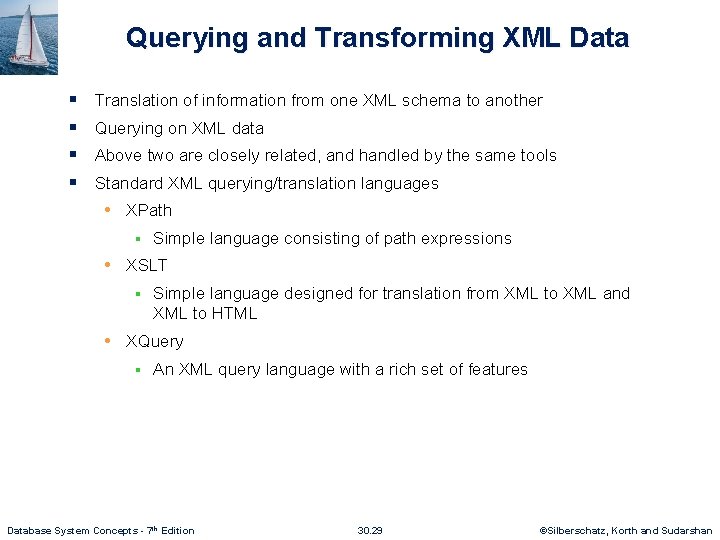
Querying and Transforming XML Data § § Translation of information from one XML schema to another Querying on XML data Above two are closely related, and handled by the same tools Standard XML querying/translation languages • XPath § Simple language consisting of path expressions • XSLT § Simple language designed for translation from XML to XML and XML to HTML • XQuery § An XML query language with a rich set of features Database System Concepts - 7 th Edition 30. 29 ©Silberschatz, Korth and Sudarshan
Tree Model of XML Data § Query and transformation languages are based on a tree model of XML data § An XML document is modeled as a tree, with nodes corresponding to elements and attributes • Element nodes have child nodes, which can be attributes or subelements • Text in an element is modeled as a text node child of the element • Children of a node are ordered according to their order in the XML document • Element and attribute nodes (except for the root node) have a single parent, which is an element node • The root node has a single child, which is the root element of the document Database System Concepts - 7 th Edition 30. 30 ©Silberschatz, Korth and Sudarshan
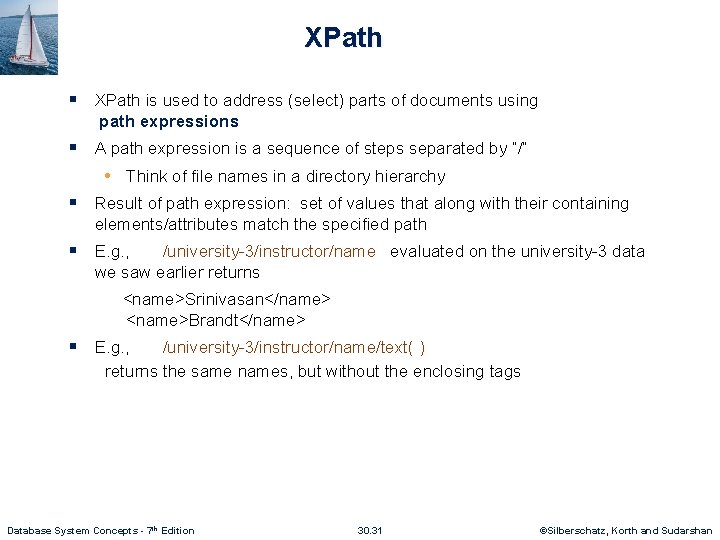
XPath § XPath is used to address (select) parts of documents using path expressions § A path expression is a sequence of steps separated by “/” • Think of file names in a directory hierarchy § Result of path expression: set of values that along with their containing elements/attributes match the specified path § E. g. , /university-3/instructor/name evaluated on the university-3 data we saw earlier returns <name>Srinivasan</name> <name>Brandt</name> § E. g. , /university-3/instructor/name/text( ) returns the same names, but without the enclosing tags Database System Concepts - 7 th Edition 30. 31 ©Silberschatz, Korth and Sudarshan
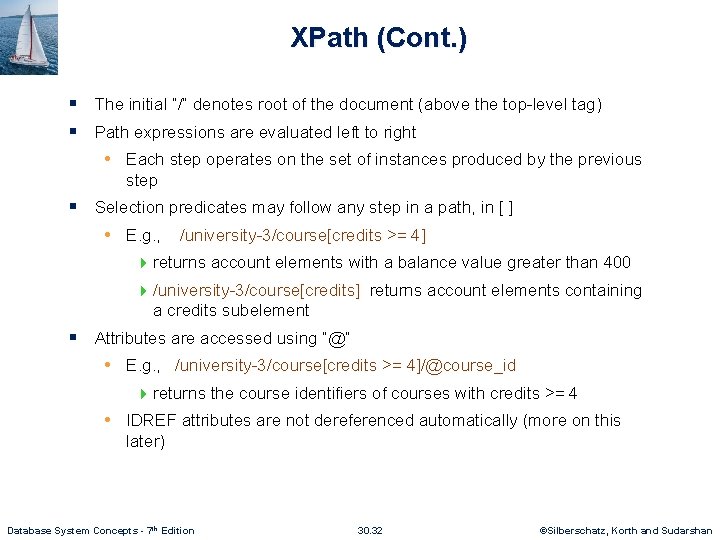
XPath (Cont. ) § The initial “/” denotes root of the document (above the top-level tag) § Path expressions are evaluated left to right • Each step operates on the set of instances produced by the previous step § Selection predicates may follow any step in a path, in [ ] • E. g. , /university-3/course[credits >= 4] 4 returns account elements with a balance value greater than 400 4 /university-3/course[credits] returns account elements containing a credits subelement § Attributes are accessed using “@” • E. g. , /university-3/course[credits >= 4]/@course_id 4 returns the course identifiers of courses with credits >= 4 • IDREF attributes are not dereferenced automatically (more on this later) Database System Concepts - 7 th Edition 30. 32 ©Silberschatz, Korth and Sudarshan
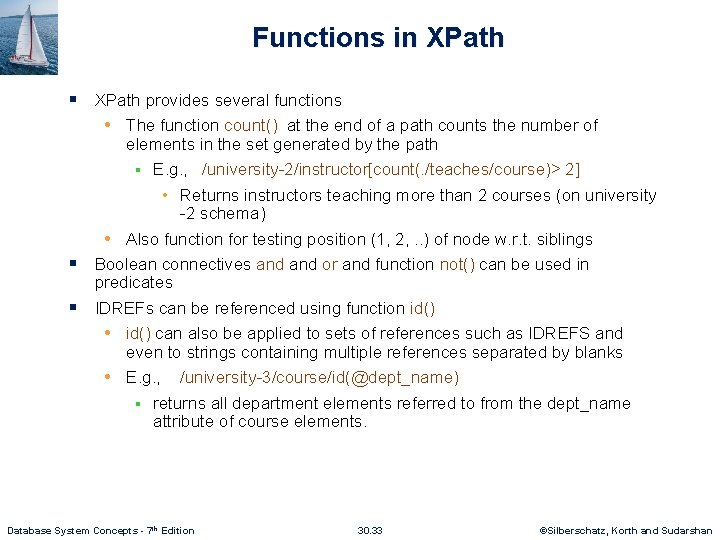
Functions in XPath § XPath provides several functions • The function count() at the end of a path counts the number of § § elements in the set generated by the path § E. g. , /university-2/instructor[count(. /teaches/course)> 2] • Returns instructors teaching more than 2 courses (on university -2 schema) • Also function for testing position (1, 2, . . ) of node w. r. t. siblings Boolean connectives and or and function not() can be used in predicates IDREFs can be referenced using function id() • id() can also be applied to sets of references such as IDREFS and even to strings containing multiple references separated by blanks • E. g. , /university-3/course/id(@dept_name) § returns all department elements referred to from the dept_name attribute of course elements. Database System Concepts - 7 th Edition 30. 33 ©Silberschatz, Korth and Sudarshan
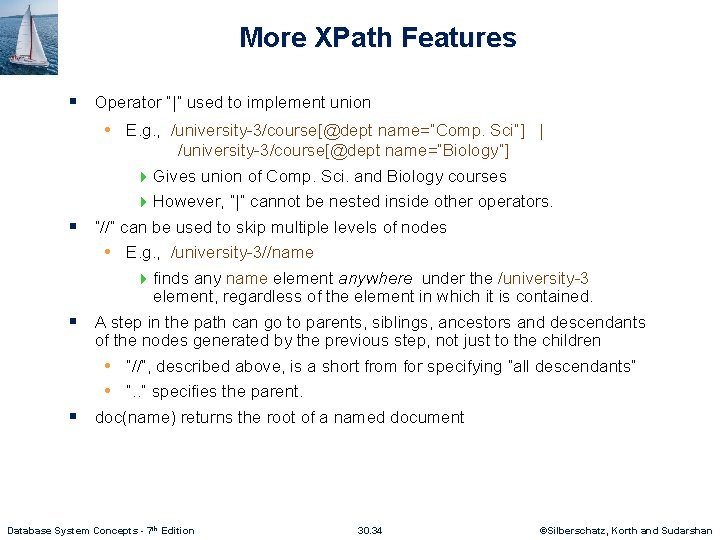
More XPath Features § Operator “|” used to implement union • E. g. , /university-3/course[@dept name=“Comp. Sci”] | /university-3/course[@dept name=“Biology”] 4 Gives union of Comp. Sci. and Biology courses 4 However, “|” cannot be nested inside other operators. § “//” can be used to skip multiple levels of nodes • E. g. , /university-3//name 4 finds any name element anywhere under the /university-3 § element, regardless of the element in which it is contained. A step in the path can go to parents, siblings, ancestors and descendants of the nodes generated by the previous step, not just to the children • “//”, described above, is a short from for specifying “all descendants” • “. . ” specifies the parent. § doc(name) returns the root of a named document Database System Concepts - 7 th Edition 30. 34 ©Silberschatz, Korth and Sudarshan
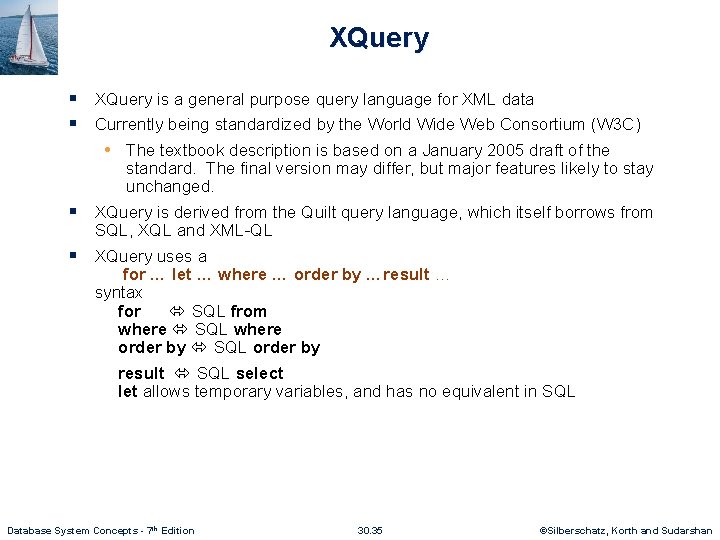
XQuery § XQuery is a general purpose query language for XML data § Currently being standardized by the World Wide Web Consortium (W 3 C) • The textbook description is based on a January 2005 draft of the § § standard. The final version may differ, but major features likely to stay unchanged. XQuery is derived from the Quilt query language, which itself borrows from SQL, XQL and XML-QL XQuery uses a for … let … where … order by …result … syntax for SQL from where SQL where order by SQL order by result SQL select let allows temporary variables, and has no equivalent in SQL Database System Concepts - 7 th Edition 30. 35 ©Silberschatz, Korth and Sudarshan
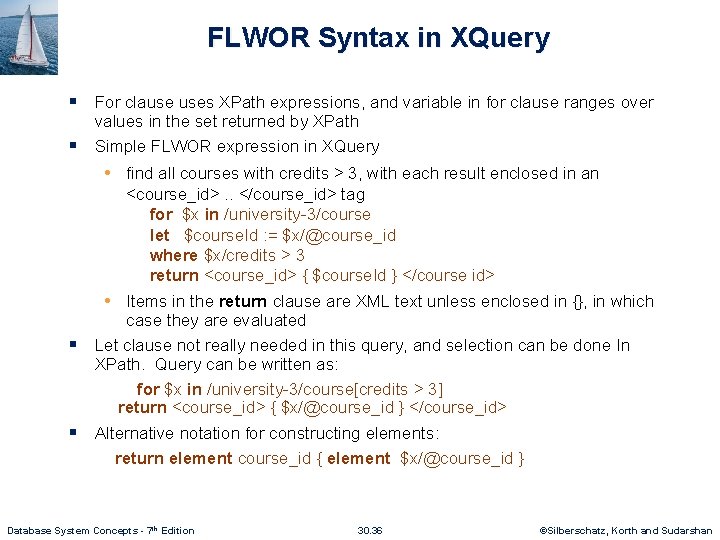
FLWOR Syntax in XQuery § For clause uses XPath expressions, and variable in for clause ranges over § values in the set returned by XPath Simple FLWOR expression in XQuery • find all courses with credits > 3, with each result enclosed in an <course_id>. . </course_id> tag for $x in /university-3/course let $course. Id : = $x/@course_id where $x/credits > 3 return <course_id> { $course. Id } </course id> • Items in the return clause are XML text unless enclosed in {}, in which case they are evaluated § Let clause not really needed in this query, and selection can be done In XPath. Query can be written as: for $x in /university-3/course[credits > 3] return <course_id> { $x/@course_id } </course_id> § Alternative notation for constructing elements: return element course_id { element $x/@course_id } Database System Concepts - 7 th Edition 30. 36 ©Silberschatz, Korth and Sudarshan
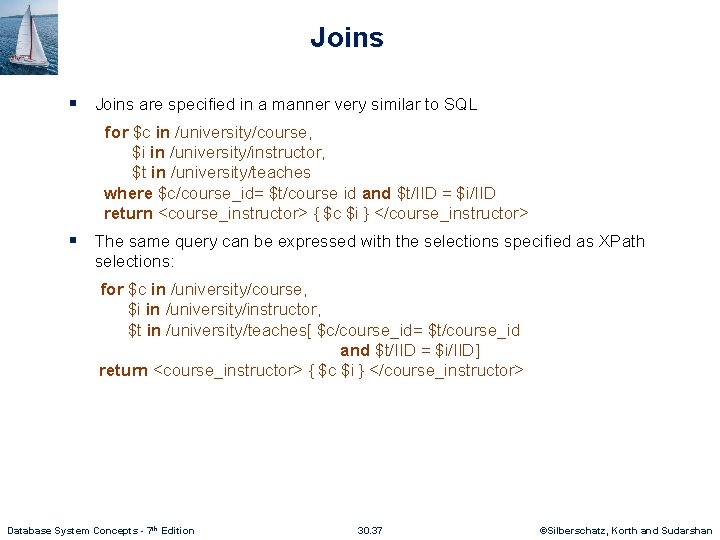
Joins § Joins are specified in a manner very similar to SQL for $c in /university/course, $i in /university/instructor, $t in /university/teaches where $c/course_id= $t/course id and $t/IID = $i/IID return <course_instructor> { $c $i } </course_instructor> § The same query can be expressed with the selections specified as XPath selections: for $c in /university/course, $i in /university/instructor, $t in /university/teaches[ $c/course_id= $t/course_id and $t/IID = $i/IID] return <course_instructor> { $c $i } </course_instructor> Database System Concepts - 7 th Edition 30. 37 ©Silberschatz, Korth and Sudarshan
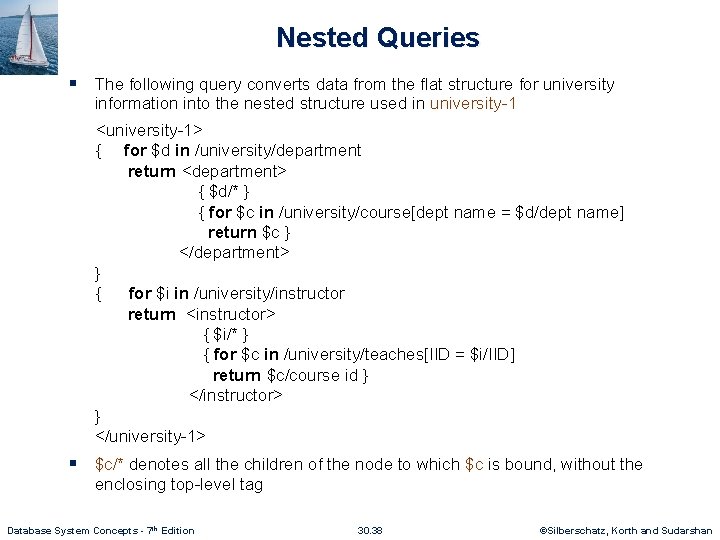
Nested Queries § The following query converts data from the flat structure for university information into the nested structure used in university-1 <university-1> { for $d in /university/department return <department> { $d/* } { for $c in /university/course[dept name = $d/dept name] return $c } </department> } { for $i in /university/instructor return <instructor> { $i/* } { for $c in /university/teaches[IID = $i/IID] return $c/course id } </instructor> } </university-1> § $c/* denotes all the children of the node to which $c is bound, without the enclosing top-level tag Database System Concepts - 7 th Edition 30. 38 ©Silberschatz, Korth and Sudarshan
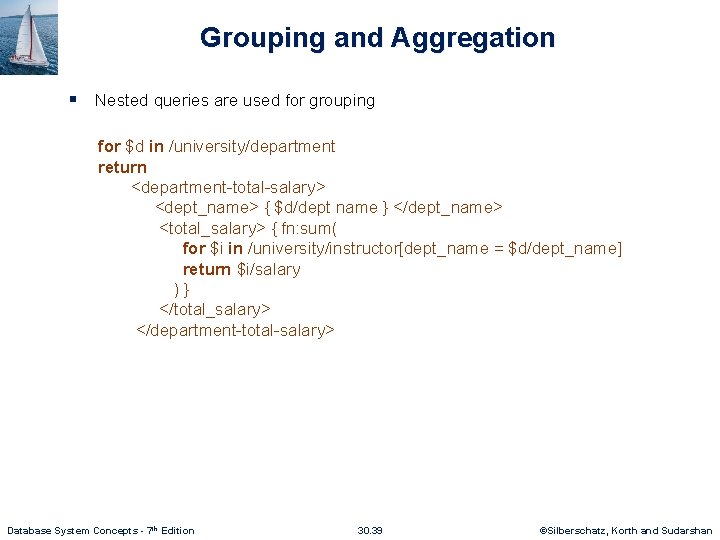
Grouping and Aggregation § Nested queries are used for grouping for $d in /university/department return <department-total-salary> <dept_name> { $d/dept name } </dept_name> <total_salary> { fn: sum( for $i in /university/instructor[dept_name = $d/dept_name] return $i/salary )} </total_salary> </department-total-salary> Database System Concepts - 7 th Edition 30. 39 ©Silberschatz, Korth and Sudarshan
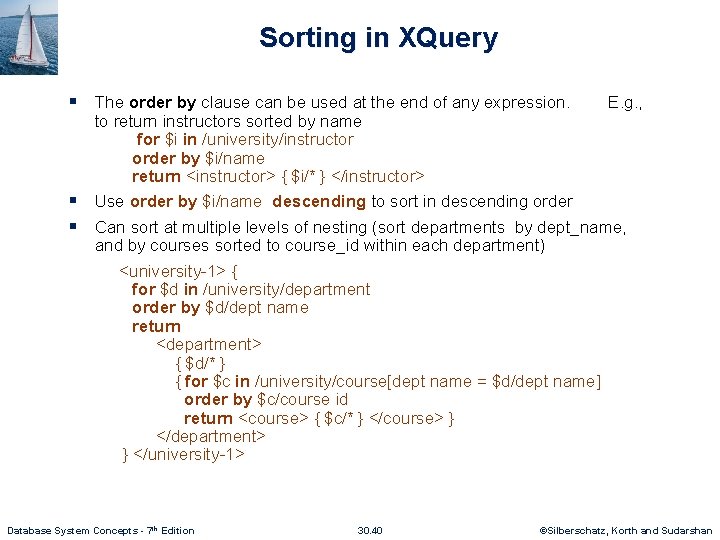
Sorting in XQuery § The order by clause can be used at the end of any expression. § § E. g. , to return instructors sorted by name for $i in /university/instructor order by $i/name return <instructor> { $i/* } </instructor> Use order by $i/name descending to sort in descending order Can sort at multiple levels of nesting (sort departments by dept_name, and by courses sorted to course_id within each department) <university-1> { for $d in /university/department order by $d/dept name return <department> { $d/* } { for $c in /university/course[dept name = $d/dept name] order by $c/course id return <course> { $c/* } </course> } </department> } </university-1> Database System Concepts - 7 th Edition 30. 40 ©Silberschatz, Korth and Sudarshan
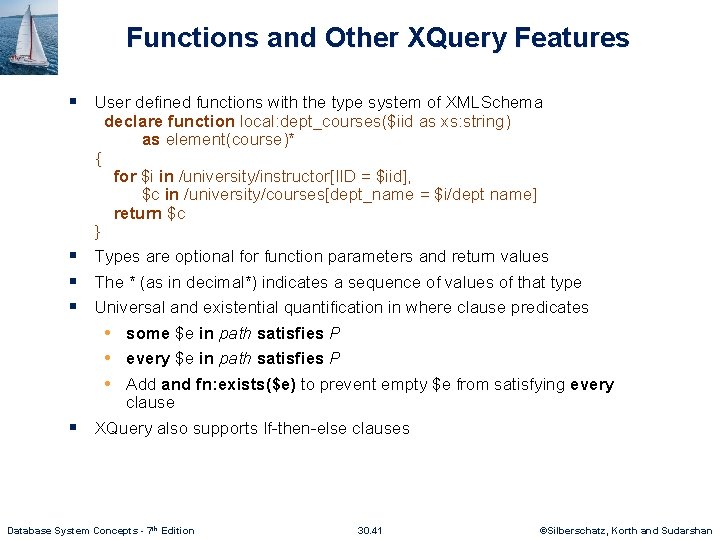
Functions and Other XQuery Features § User defined functions with the type system of XMLSchema { § § § declare function local: dept_courses($iid as xs: string) as element(course)* for $i in /university/instructor[IID = $iid], $c in /university/courses[dept_name = $i/dept name] return $c } Types are optional for function parameters and return values The * (as in decimal*) indicates a sequence of values of that type Universal and existential quantification in where clause predicates • some $e in path satisfies P • every $e in path satisfies P • Add and fn: exists($e) to prevent empty $e from satisfying every clause § XQuery also supports If-then-else clauses Database System Concepts - 7 th Edition 30. 41 ©Silberschatz, Korth and Sudarshan
XSLT § A stylesheet stores formatting options for a document, usually separately from document • E. g. an HTML style sheet may specify font colors and sizes for headings, etc. § The XML Stylesheet Language (XSL) was originally designed for generating HTML from XML § XSLT is a general-purpose transformation language • Can translate XML to XML, and XML to HTML § XSLT transformations are expressed using rules called templates • Templates combine selection using XPath with construction of results Database System Concepts - 7 th Edition 30. 42 ©Silberschatz, Korth and Sudarshan
Application Program Interface § There are two standard application program interfaces to XML data: • SAX (Simple API for XML) § Based on parser model, user provides event handlers for parsing events • E. g. , start of element, end of element • DOM (Document Object Model) § XML data is parsed into a tree representation § Variety of functions provided for traversing the DOM tree § E. g. : Java DOM API provides Node class with methods get. Parent. Node( ), get. First. Child( ), get. Next. Sibling( ) get. Attribute( ), get. Data( ) (for text node) get. Elements. By. Tag. Name( ), … § Also provides functions for updating DOM tree Database System Concepts - 7 th Edition 30. 43 ©Silberschatz, Korth and Sudarshan
Storage of XML Data § XML data can be stored in • Non-relational data stores § Flat files • Natural for storing XML • But has all problems discussed in Chapter 1 (no concurrency, no recovery, …) § XML database • Database built specifically for storing XML data, supporting DOM model and declarative querying • Currently no commercial-grade systems • Relational databases § Data must be translated into relational form § Advantage: mature database systems § Disadvantages: overhead of translating data and queries Database System Concepts - 7 th Edition 30. 44 ©Silberschatz, Korth and Sudarshan
Storage of XML in Relational Databases § Alternatives: • String Representation • Tree Representation • Map to relations Database System Concepts - 7 th Edition 30. 45 ©Silberschatz, Korth and Sudarshan
String Representation § Store each top level element as a string field of a tuple in a relational database • Use a single relation to store all elements, or • Use a separate relation for each top-level element type § E. g. , account, customer, depositor relations • Each with a string-valued attribute to store the element § Indexing: • Store values of subelements/attributes to be indexed as extra fields of the relation, and build indices on these fields § E. g. , customer_name or account_number • Some database systems support function indices, which use the result of a function as the key value. § The function should return the value of the required subelement/attribute Database System Concepts - 7 th Edition 30. 46 ©Silberschatz, Korth and Sudarshan
String Representation (Cont. ) § Benefits: • Can store any XML data even without DTD • As long as there are many top-level elements in a document, strings are small compared to full document § Allows fast access to individual elements. § Drawback: Need to parse strings to access values inside the elements • Parsing is slow. Database System Concepts - 7 th Edition 30. 47 ©Silberschatz, Korth and Sudarshan
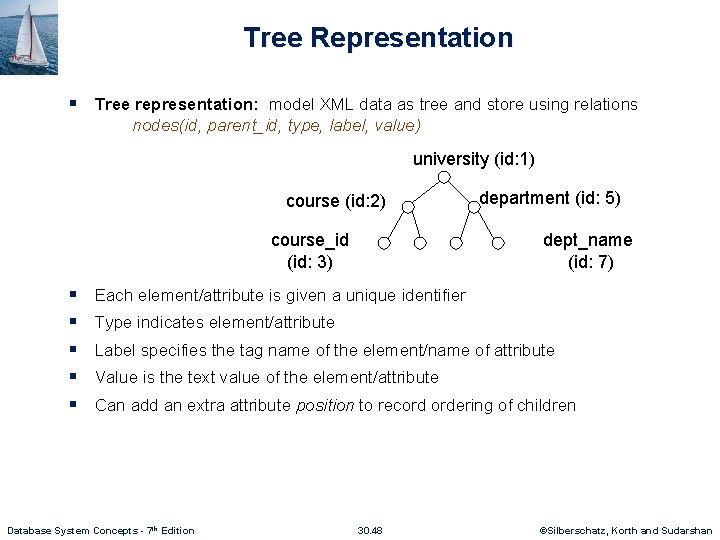
Tree Representation § Tree representation: model XML data as tree and store using relations nodes(id, parent_id, type, label, value) university (id: 1) course (id: 2) course_id (id: 3) § § § department (id: 5) dept_name (id: 7) Each element/attribute is given a unique identifier Type indicates element/attribute Label specifies the tag name of the element/name of attribute Value is the text value of the element/attribute Can add an extra attribute position to record ordering of children Database System Concepts - 7 th Edition 30. 48 ©Silberschatz, Korth and Sudarshan
Tree Representation (Cont. ) § Benefit: Can store any XML data, even without DTD § Drawbacks: • Data is broken up into too many pieces, increasing space overheads • Even simple queries require a large number of joins, which can be slow Database System Concepts - 7 th Edition 30. 49 ©Silberschatz, Korth and Sudarshan
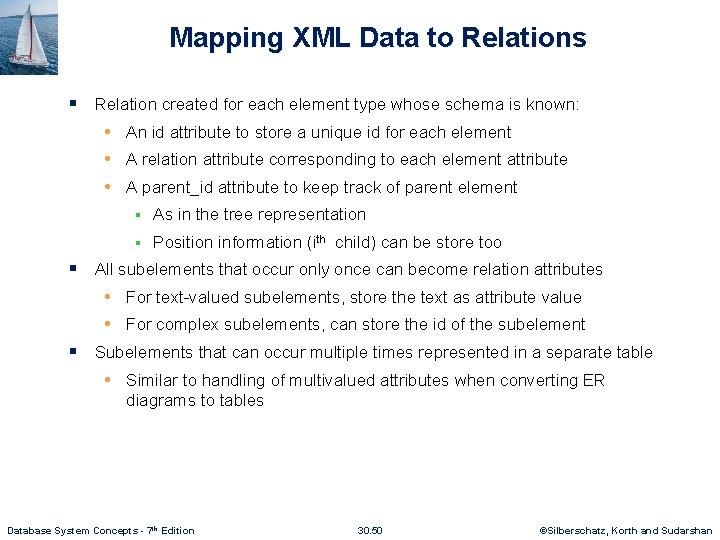
Mapping XML Data to Relations § Relation created for each element type whose schema is known: • An id attribute to store a unique id for each element • A relation attribute corresponding to each element attribute • A parent_id attribute to keep track of parent element § As in the tree representation § Position information (ith child) can be store too § All subelements that occur only once can become relation attributes • For text-valued subelements, store the text as attribute value • For complex subelements, can store the id of the subelement § Subelements that can occur multiple times represented in a separate table • Similar to handling of multivalued attributes when converting ER diagrams to tables Database System Concepts - 7 th Edition 30. 50 ©Silberschatz, Korth and Sudarshan
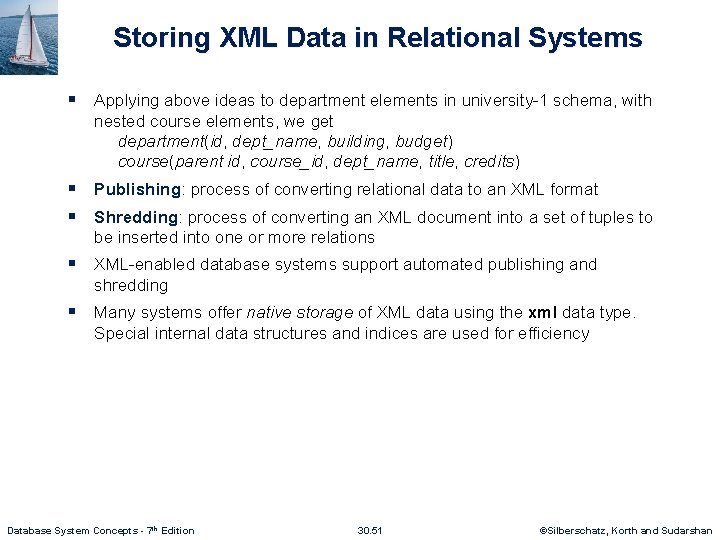
Storing XML Data in Relational Systems § Applying above ideas to department elements in university-1 schema, with nested course elements, we get department(id, dept_name, building, budget) course(parent id, course_id, dept_name, title, credits) § Publishing: process of converting relational data to an XML format § Shredding: process of converting an XML document into a set of tuples to be inserted into one or more relations § XML-enabled database systems support automated publishing and shredding § Many systems offer native storage of XML data using the xml data type. Special internal data structures and indices are used for efficiency Database System Concepts - 7 th Edition 30. 51 ©Silberschatz, Korth and Sudarshan
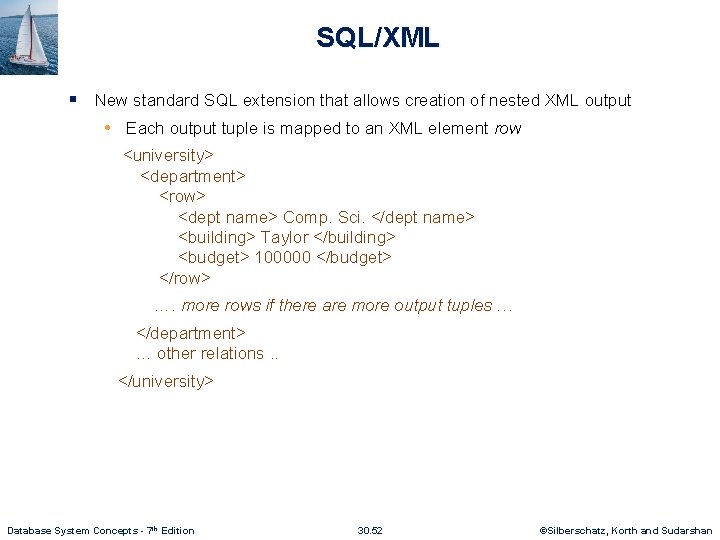
SQL/XML § New standard SQL extension that allows creation of nested XML output • Each output tuple is mapped to an XML element row <university> <department> <row> <dept name> Comp. Sci. </dept name> <building> Taylor </building> <budget> 100000 </budget> </row> …. more rows if there are more output tuples … </department> … other relations. . </university> Database System Concepts - 7 th Edition 30. 52 ©Silberschatz, Korth and Sudarshan
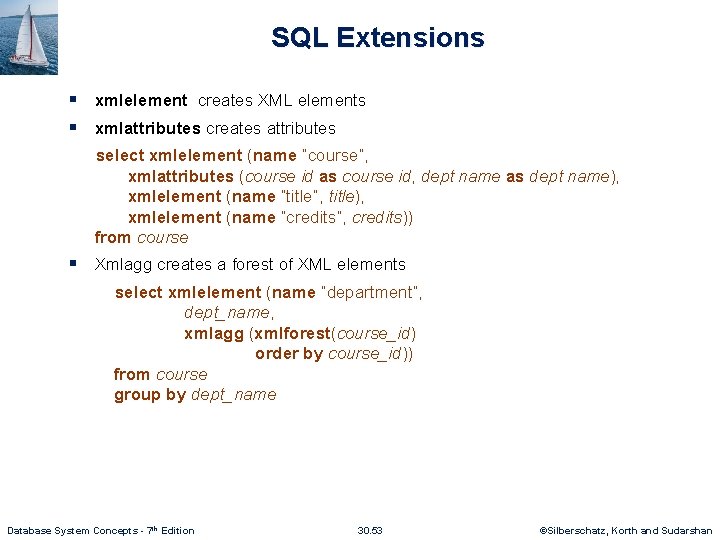
SQL Extensions § xmlelement creates XML elements § xmlattributes creates attributes select xmlelement (name “course”, xmlattributes (course id as course id, dept name as dept name), xmlelement (name “title”, title), xmlelement (name “credits”, credits)) from course § Xmlagg creates a forest of XML elements select xmlelement (name “department”, dept_name, xmlagg (xmlforest(course_id) order by course_id)) from course group by dept_name Database System Concepts - 7 th Edition 30. 53 ©Silberschatz, Korth and Sudarshan
XML Applications § Storing and exchanging data with complex structures • E. g. , Open Document Format (ODF) format standard for storing Open Office and Office Open XML (OOXML) format standard for storing Microsoft Office documents • Numerous other standards for a variety of applications § Chem. ML, Math. ML § Standard for data exchange for Web services • remote method invocation over HTTP protocol • More in next slide § Data mediation • Common data representation format to bridge different systems Database System Concepts - 7 th Edition 30. 54 ©Silberschatz, Korth and Sudarshan
Web Services § The Simple Object Access Protocol (SOAP) standard: • Invocation of procedures across applications with distinct databases • XML used to represent procedure input and output § A Web service is a site providing a collection of SOAP procedures • Described using the Web Services Description Language (WSDL) • Directories of Web services are described using the Universal Description, Discovery, and Integration (UDDI) standard Database System Concepts - 7 th Edition 30. 55 ©Silberschatz, Korth and Sudarshan
End of Chapter 30 Database System Concepts - 7 th Edition 30. 56 ©Silberschatz, Korth and Sudarshan
- Slides: 56