
Chapter 30 section 1 characteristics of stars pages






- Slides: 10
Chapter 30 section 1 characteristics of stars pages 775 -780 By: Kaylah Thomas
Characteristics of stars • A star is a ball of gases that give off a tremendous amount of electromagnetic energy. • Stars in the night sky appear to be tiny specks of white light. • If you look closely at the stars in the sky, they are vary in color.
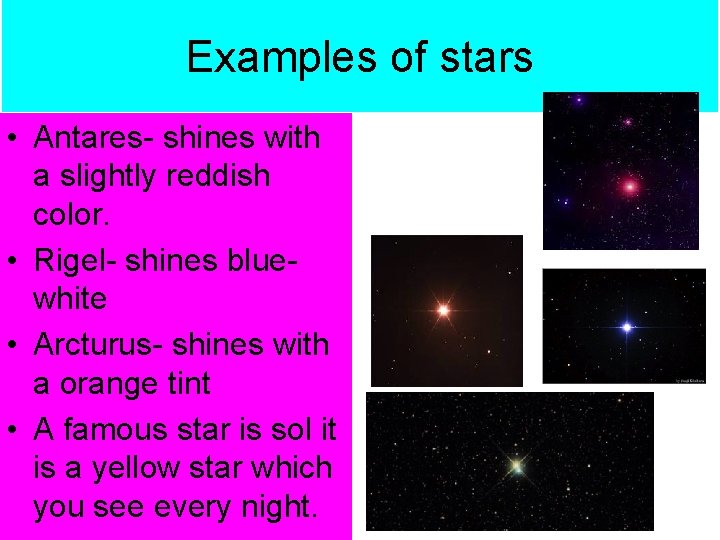
Examples of stars • Antares- shines with a slightly reddish color. • Rigel- shines bluewhite • Arcturus- shines with a orange tint • A famous star is sol it is a yellow star which you see every night.
Analyzing starlight • Astronomers direct starlight through spectrographs which are devices that separate light into different colors or wavelengths. • Spectrum- starlight passing through a spectrograph produces a display of colors and lines called spectrum. • There are three type of spectra; emission, or bright line, absorption or dark line: and continuous.
Continue analyzing starlight • All stars have dark line spectra bands of color crossed by dark lines where the color is diminished. • Stars are made up of different elements in forms of gases. • The inner layers of stars are very hot • The outer layers are somewhat cooler • Elements in the outer layers absorb some of the light radiating from within the star. Because different elements absorb different wavelengths of light.
The compositions of stars • Every chemical element has a characteristic spectrum in a given range of temperatures. • The colors and lines in the spectrum of a star indicate the elements that make up the star. • The most common element in stars is hydrogen • The most second common element is helium • Elements such as carbon, oxygen, and nitrogen, usually in small quantities, make up most of the remaining mass of stars.
The temperatures of the stars • The surface temperature of a star is indicated by the star's color. • The temperature of most stars range from 2, 800 c to 24, 000 c, but some are hotter. • Mostly a star that shines with blue light has about the average surface temperature of 35, 000 c.
The sizes and masses of stars • Stars also vary in size and mass • A medium- sized star has a diameter of about 1, 390, 000 km. • Some giant stars have a diameters that are 1, 000 times the suns diameter. • Many stars also have about the same mass as the sun, through some stars may be significantly more or less massive.
Distances to stars • A light year- is the distance that light travels in one year. • Parallax- an apparent shift in the position of the object when viewed from different locations. • The stars and earth are measured in light years.
Stellar brightness • Apparent magnitude- the brightness of a star seen from the earth • Absolute magnitude- the brightness that a star would have at a distance of 32. 6 lightyears from earth.