
Chapter 30 Money Growth and Inflation Inflation Inflation
- Slides: 37
Chapter 30 Money Growth and Inflation
Inflation • Inflation – Increase in the overall level of prices • Deflation – Decrease in the overall level of prices • Hyperinflation – Extraordinarily high rate of inflation 2
The Classical Theory of Inflation • The level of prices and the value of money • Inflation – Economy-wide phenomenon • Concerns the value of economy’s medium of exchange • Inflation - rise in the price level – Lower value of money – Each dollar - buys a smaller quantity of goods and services 3
The Classical Theory of Inflation • Money demand – Reflects how much wealth people want to hold in liquid form – Depends on • Credit cards; ATM machines; Interest rate • Average level of prices in economy – Demand curve – downward sloping 4
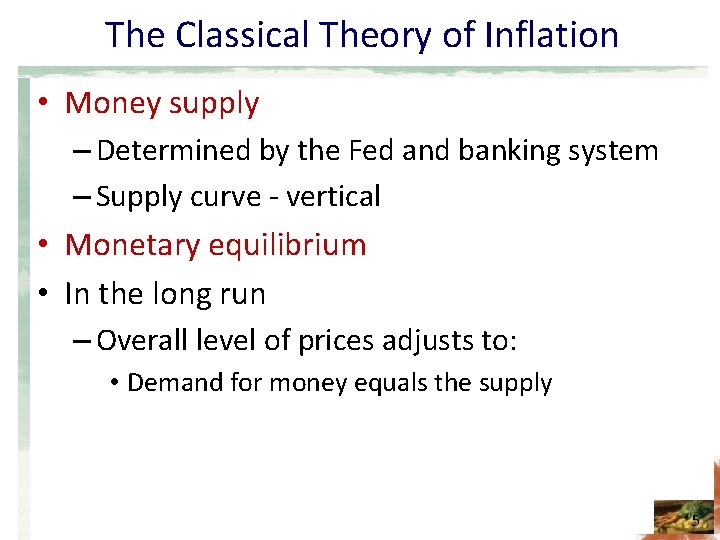
The Classical Theory of Inflation • Money supply – Determined by the Fed and banking system – Supply curve - vertical • Monetary equilibrium • In the long run – Overall level of prices adjusts to: • Demand for money equals the supply 5
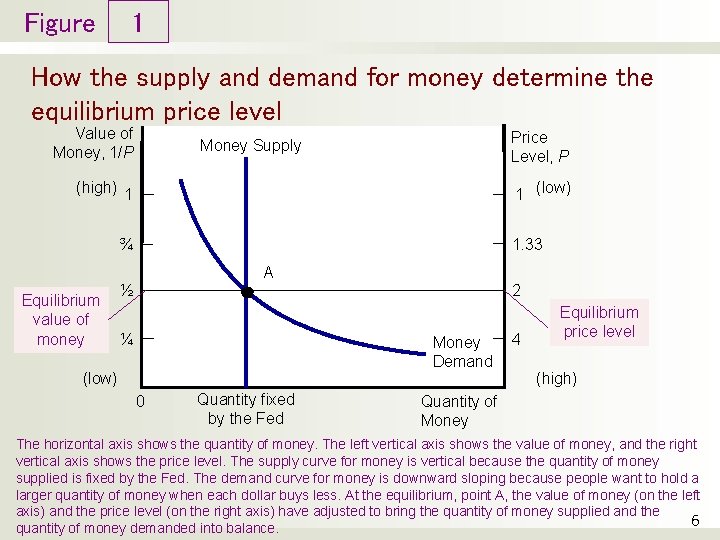
Figure 1 How the supply and demand for money determine the equilibrium price level Value of Money, 1/P Price Level, P Money Supply (high) 1 1 (low) 1. 33 ¾ A Equilibrium value of money 2 ½ ¼ Money Demand (low) 0 Quantity fixed by the Fed 4 Equilibrium price level (high) Quantity of Money The horizontal axis shows the quantity of money. The left vertical axis shows the value of money, and the right vertical axis shows the price level. The supply curve for money is vertical because the quantity of money supplied is fixed by the Fed. The demand curve for money is downward sloping because people want to hold a larger quantity of money when each dollar buys less. At the equilibrium, point A, the value of money (on the left axis) and the price level (on the right axis) have adjusted to bring the quantity of money supplied and the 6 quantity of money demanded into balance.
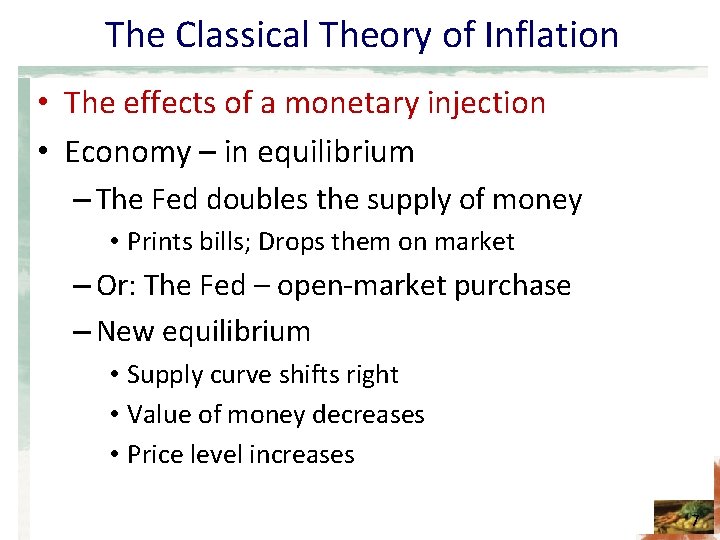
The Classical Theory of Inflation • The effects of a monetary injection • Economy – in equilibrium – The Fed doubles the supply of money • Prints bills; Drops them on market – Or: The Fed – open-market purchase – New equilibrium • Supply curve shifts right • Value of money decreases • Price level increases 7
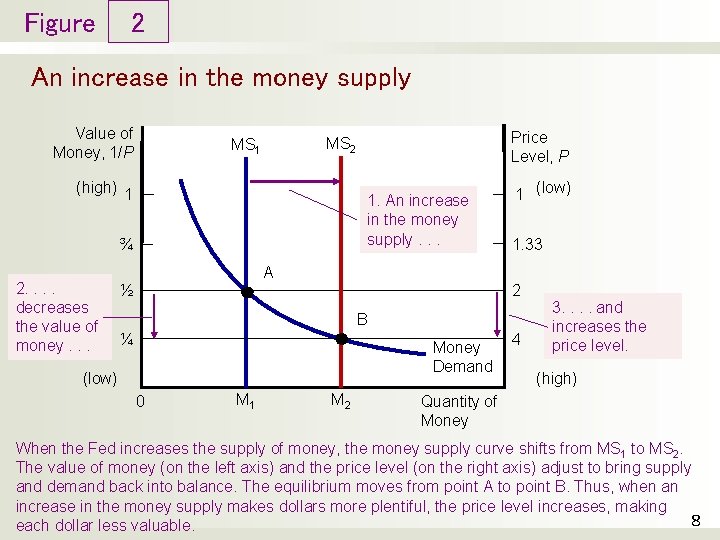
Figure 2 An increase in the money supply Value of Money, 1/P (high) 1 1. An increase in the money supply. . . ¾ 2. . decreases the value of money. . . Price Level, P MS 2 MS 1 1 (low) 1. 33 A 2 ½ B ¼ Money Demand (low) 0 M 1 M 2 4 3. . and increases the price level. (high) Quantity of Money When the Fed increases the supply of money, the money supply curve shifts from MS 1 to MS 2. The value of money (on the left axis) and the price level (on the right axis) adjust to bring supply and demand back into balance. The equilibrium moves from point A to point B. Thus, when an increase in the money supply makes dollars more plentiful, the price level increases, making 8 each dollar less valuable.
The Classical Theory of Inflation • Quantity theory of money – Quantity of money available – Determines the price level – Growth rate in quantity of money available – Determines the inflation rate 9
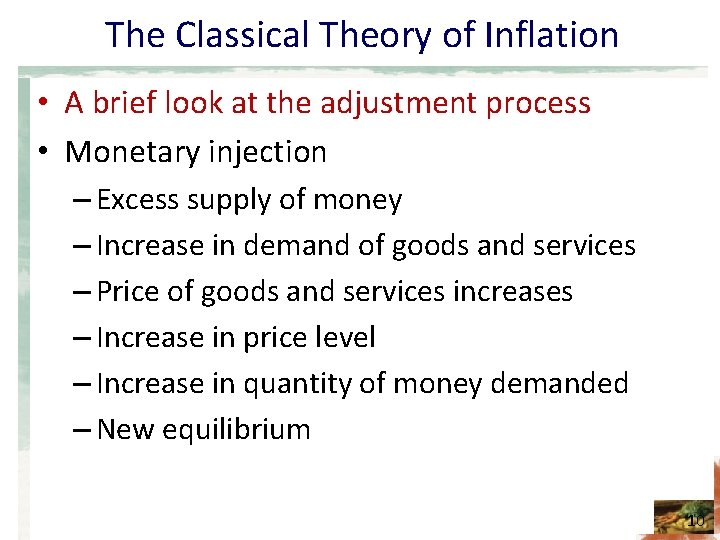
The Classical Theory of Inflation • A brief look at the adjustment process • Monetary injection – Excess supply of money – Increase in demand of goods and services – Price of goods and services increases – Increase in price level – Increase in quantity of money demanded – New equilibrium 10
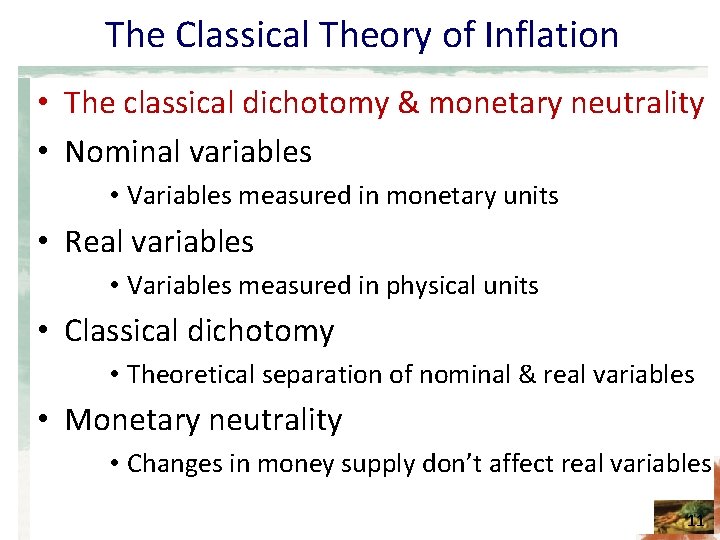
The Classical Theory of Inflation • The classical dichotomy & monetary neutrality • Nominal variables • Variables measured in monetary units • Real variables • Variables measured in physical units • Classical dichotomy • Theoretical separation of nominal & real variables • Monetary neutrality • Changes in money supply don’t affect real variables 11
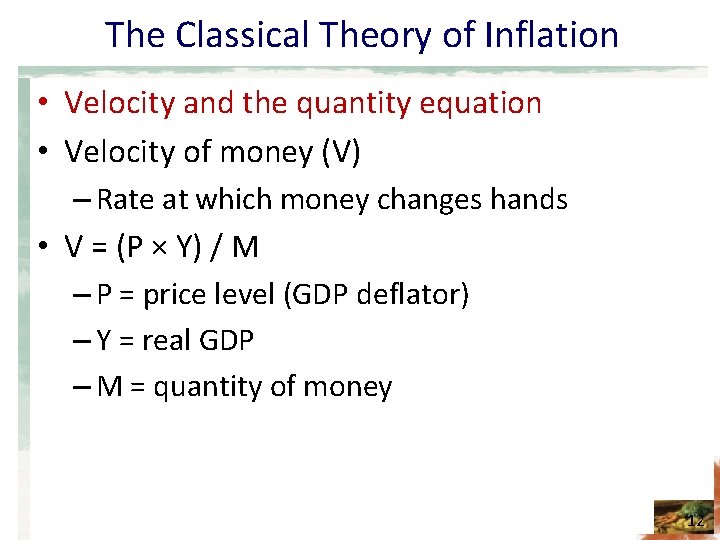
The Classical Theory of Inflation • Velocity and the quantity equation • Velocity of money (V) – Rate at which money changes hands • V = (P × Y) / M – P = price level (GDP deflator) – Y = real GDP – M = quantity of money 12
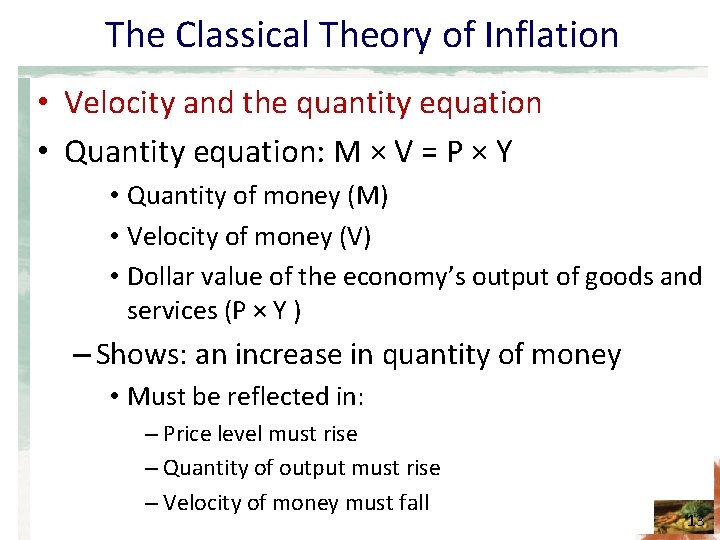
The Classical Theory of Inflation • Velocity and the quantity equation • Quantity equation: M × V = P × Y • Quantity of money (M) • Velocity of money (V) • Dollar value of the economy’s output of goods and services (P × Y ) – Shows: an increase in quantity of money • Must be reflected in: – Price level must rise – Quantity of output must rise – Velocity of money must fall 13
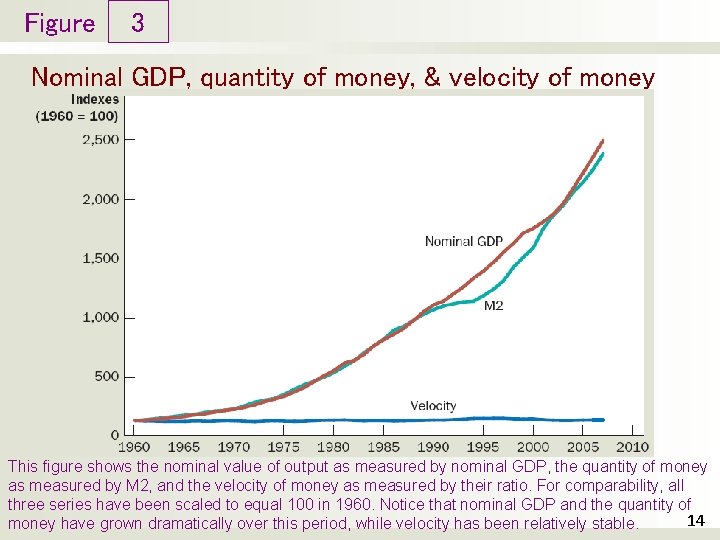
Figure 3 Nominal GDP, quantity of money, & velocity of money This figure shows the nominal value of output as measured by nominal GDP, the quantity of money as measured by M 2, and the velocity of money as measured by their ratio. For comparability, all three series have been scaled to equal 100 in 1960. Notice that nominal GDP and the quantity of 14 money have grown dramatically over this period, while velocity has been relatively stable.
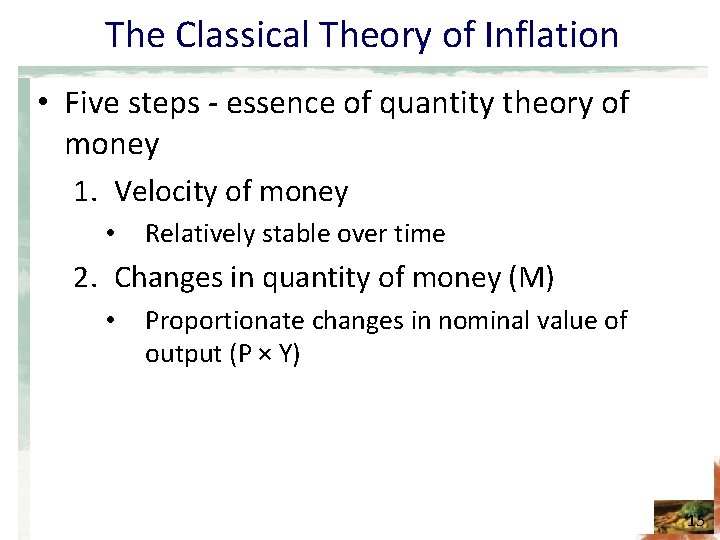
The Classical Theory of Inflation • Five steps - essence of quantity theory of money 1. Velocity of money • Relatively stable over time 2. Changes in quantity of money (M) • Proportionate changes in nominal value of output (P × Y) 15
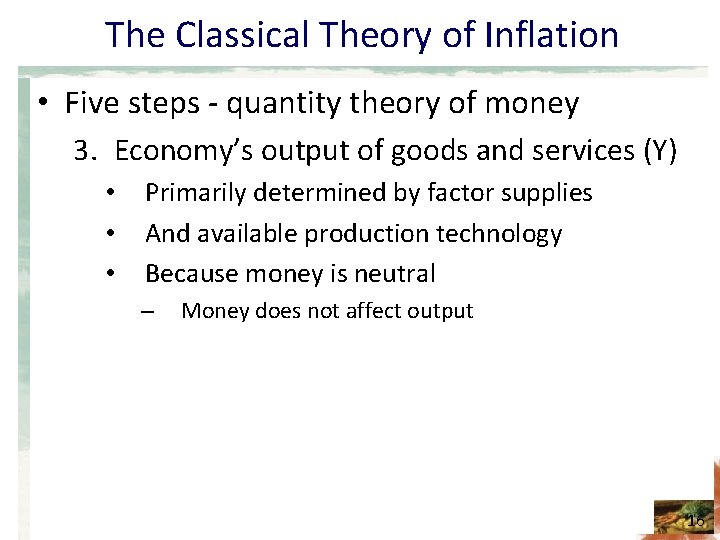
The Classical Theory of Inflation • Five steps - quantity theory of money 3. Economy’s output of goods and services (Y) • • • Primarily determined by factor supplies And available production technology Because money is neutral – Money does not affect output 16
The Classical Theory of Inflation • Five steps - quantity theory of money 4. Change in money supply (M) • Induces proportional changes in the nominal value of output (P × Y) – Reflected in changes in the price level (P) 5. Central bank - increases the money supply rapidly • High rate of inflation. 17
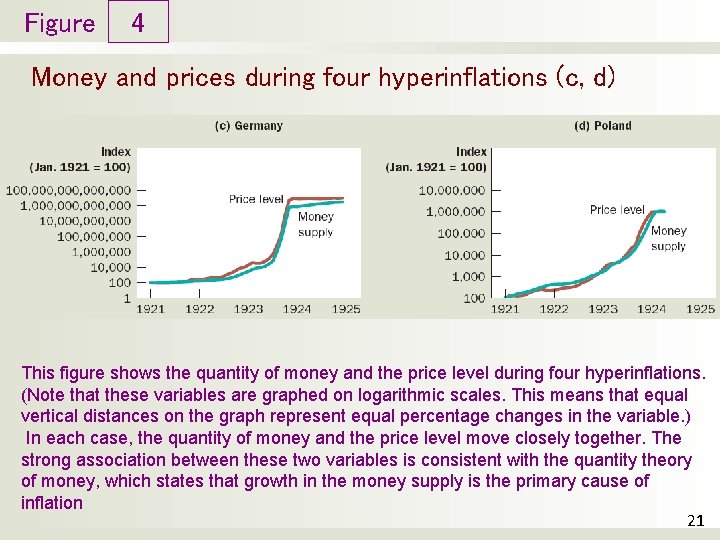
Money and prices during four hyperinflations • Hyperinflation – Inflation that exceeds 50% per month – Price level - increases more than a hundredfold over the course of a year • Data on hyperinflation – Clear link between • Quantity of money • And the price level 18
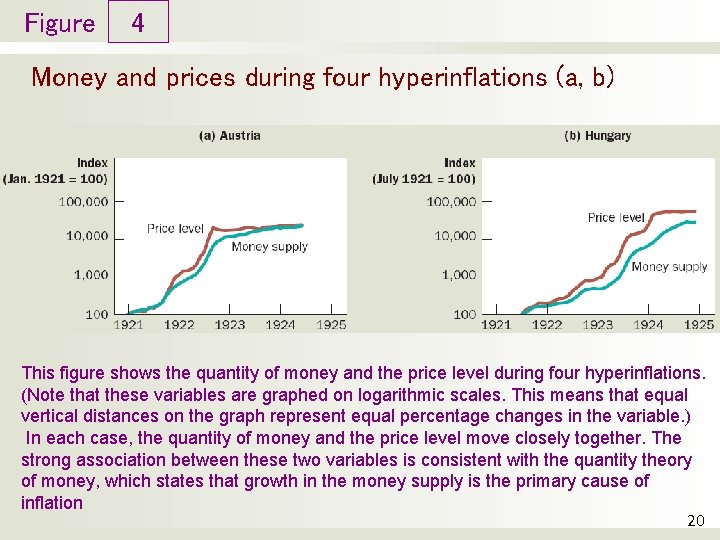
Money and prices during four hyperinflations • Four classic hyperinflation, 1920 s – Austria, Hungary, Germany, and Poland – Slope of the money line • Rate at which the quantity of money was growing – Slope of the price line • Inflation rate – The steeper the lines • The higher the rates of money growth or inflation • Prices rise when the government prints too much money 19
Figure 4 Money and prices during four hyperinflations (a, b) This figure shows the quantity of money and the price level during four hyperinflations. (Note that these variables are graphed on logarithmic scales. This means that equal vertical distances on the graph represent equal percentage changes in the variable. ) In each case, the quantity of money and the price level move closely together. The strong association between these two variables is consistent with the quantity theory of money, which states that growth in the money supply is the primary cause of inflation 20
Figure 4 Money and prices during four hyperinflations (c, d) This figure shows the quantity of money and the price level during four hyperinflations. (Note that these variables are graphed on logarithmic scales. This means that equal vertical distances on the graph represent equal percentage changes in the variable. ) In each case, the quantity of money and the price level move closely together. The strong association between these two variables is consistent with the quantity theory of money, which states that growth in the money supply is the primary cause of inflation 21
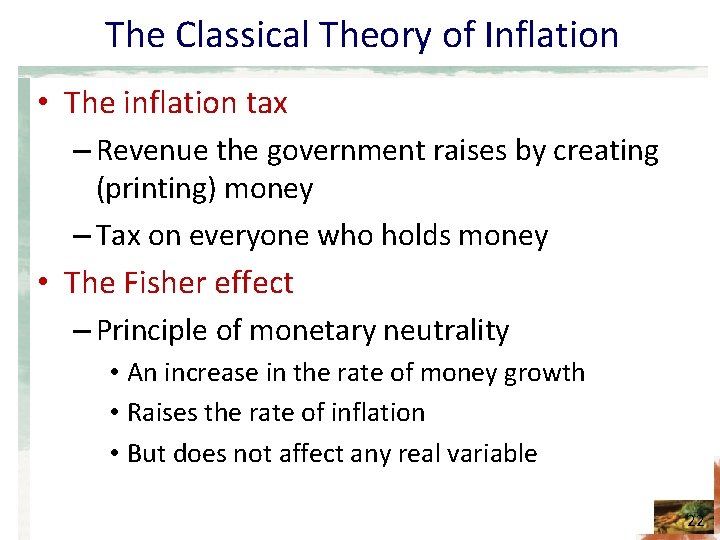
The Classical Theory of Inflation • The inflation tax – Revenue the government raises by creating (printing) money – Tax on everyone who holds money • The Fisher effect – Principle of monetary neutrality • An increase in the rate of money growth • Raises the rate of inflation • But does not affect any real variable 22
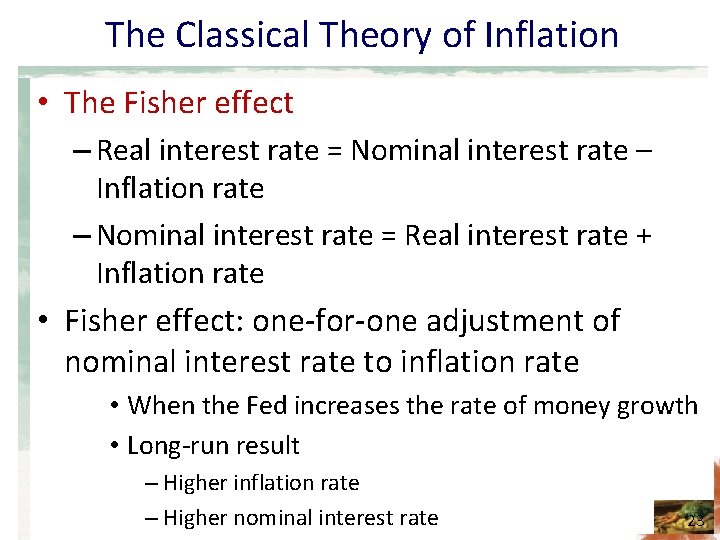
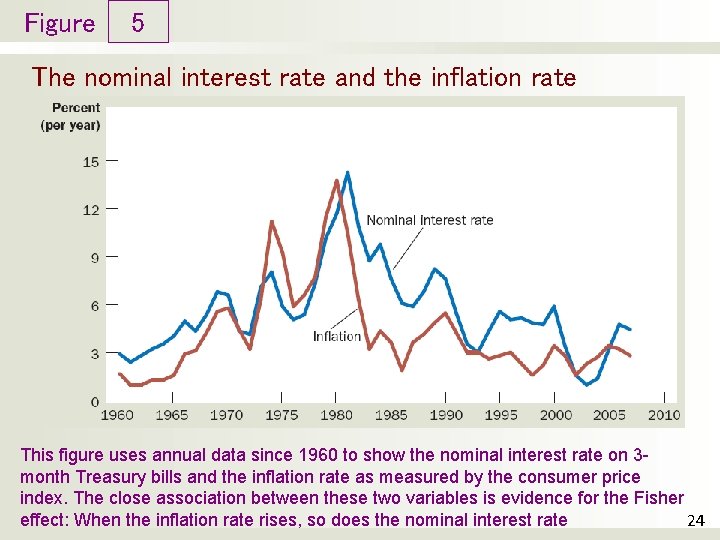
The Classical Theory of Inflation • The Fisher effect – Real interest rate = Nominal interest rate – Inflation rate – Nominal interest rate = Real interest rate + Inflation rate • Fisher effect: one-for-one adjustment of nominal interest rate to inflation rate • When the Fed increases the rate of money growth • Long-run result – Higher inflation rate – Higher nominal interest rate 23
Figure 5 The nominal interest rate and the inflation rate This figure uses annual data since 1960 to show the nominal interest rate on 3 month Treasury bills and the inflation rate as measured by the consumer price index. The close association between these two variables is evidence for the Fisher 24 effect: When the inflation rate rises, so does the nominal interest rate
The Costs of Inflation • A fall in purchasing power? Inflation fallacy • “Inflation robs people of the purchasing power of his hard-earned dollars” • When prices rise – Buyers – pay more – Sellers – get more – Inflation in incomes - goes hand in hand with inflation in prices • Inflation does not in itself reduce people’s real purchasing power 25
The Costs of Inflation • Shoeleather costs – Resources wasted when inflation encourages people to reduce their money holdings – Can be substantial • Menu costs – Costs of changing prices – Inflation – increases menu costs that firms must bear 26
The Costs of Inflation • Relative-price variability & misallocation of resources • Market economies • Rely on relative prices to allocate scarce resources – Consumers - compare – Quality and prices of various goods and services – Determine allocation of scarce factors of production • Inflation - distorts relative prices • Consumer decisions – distorted • Markets - less able to allocate resources to their best use 27
The Costs of Inflation • Inflation-induced tax distortions • Taxes – distort incentives – Many taxes • More problematic in the presence of inflation • Tax treatment of capital gains – Capital gains – Profits: • Sell an asset for more than its purchase price – Inflation discourages saving • Exaggerates the size of capital gains • Increases the tax burden 28
The Costs of Inflation • Inflation-induced tax distortions • Tax treatment of interest income – Nominal interest earned on savings • Treated as income • Even though part of the nominal interest rate compensates for inflation • Higher inflation – Tends to discourage people from saving 29
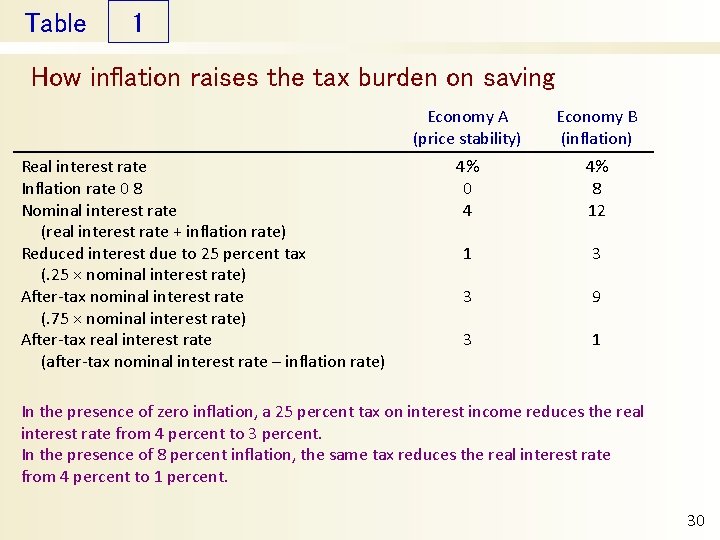
Table 1 How inflation raises the tax burden on saving Real interest rate Inflation rate 0 8 Nominal interest rate (real interest rate + inflation rate) Reduced interest due to 25 percent tax (. 25 × nominal interest rate) After-tax nominal interest rate (. 75 × nominal interest rate) After-tax real interest rate (after-tax nominal interest rate – inflation rate) Economy A (price stability) Economy B (inflation) 4% 0 4 4% 8 12 1 3 3 9 3 1 In the presence of zero inflation, a 25 percent tax on interest income reduces the real interest rate from 4 percent to 3 percent. In the presence of 8 percent inflation, the same tax reduces the real interest rate from 4 percent to 1 percent. 30
The Costs of Inflation • Confusion and inconvenience • Money – Yardstick with which we measure economic transactions • The Fed’s job – Ensure the reliability of money • When the Fed increases the money supply – Creates inflation – Erodes the real value of the unit of account 31
The Costs of Inflation • A special cost of unexpected inflation: arbitrary redistributions of wealth • Unexpected inflation – Redistributes wealth among the population • Not by merit • Not by need – Redistribute wealth among debtors and creditors • Inflation - volatile & uncertain – When the average rate of inflation is high 32
The wizard of Oz and the free-silver debate • Movie The Wizard of Oz – Based on a children’s book – 1900 – Allegory about U. S. monetary policy in the late 19 th century • 1880 – 1896 – Price level fell by 23%; unanticipated – Major redistribution of wealth • Farmers in west – debtors • Bankers in east – creditors • Real value of debts increased – Enriched the banks at the expense of the farmers 33
The wizard of Oz and the free-silver debate • Possible solution to the farmers’ problem – Free coinage of silver – During the gold standard • Quantity of gold determined – Money supply & Price level • Free-silver advocates – Silver and gold - to be used as money – Increase money supply – Pushed up the price level – Reduced the real burden of the farmers’ debts 34
The wizard of Oz and the free-silver debate • L. Frank Baum – Author of the book The Wonderful Wizard of Oz – Midwestern journalist – Characters - protagonists in the major political battle of his time • • • Dorothy: Traditional American values Toto: Prohibitionist party, also called the Teetotalers Scarecrow: Farmers Tin Woodsman: Industrial workers Cowardly Lion: William Jennings Bryan Munchkins: Citizens of the East 35
The wizard of Oz and the free-silver debate • L. Frank Baum – Characters • Wicked Witch of the East: Grover Cleveland • Wicked Witch of the West: William Mc. Kinley • Wizard: Marcus Alonzo Hanna, chairman of the Republican Party • Oz: Abbreviation for ounce of gold • Yellow Brick Road: Gold standard – In the end of the story – Dorothy find her way home • Not by just following the yellow brick road • Magical power of her silver slippers 36
The wizard of Oz and the free-silver debate • Populists – Lost the debate over the free coinage of silver – Get the monetary expansion and inflation that they wanted • Increased supply of gold – New discoveries - Klondike River in the Canadian Yukon – Mines of South Africa – Money supply & price level started to rise 37