
Chapter 3 Vectors 1 Coordinate Systems n n
- Slides: 36
Chapter 3 Vectors 1
Coordinate Systems n n Used to describe the position of a point in space Common coordinate systems are: n n Cartesian Polar 2
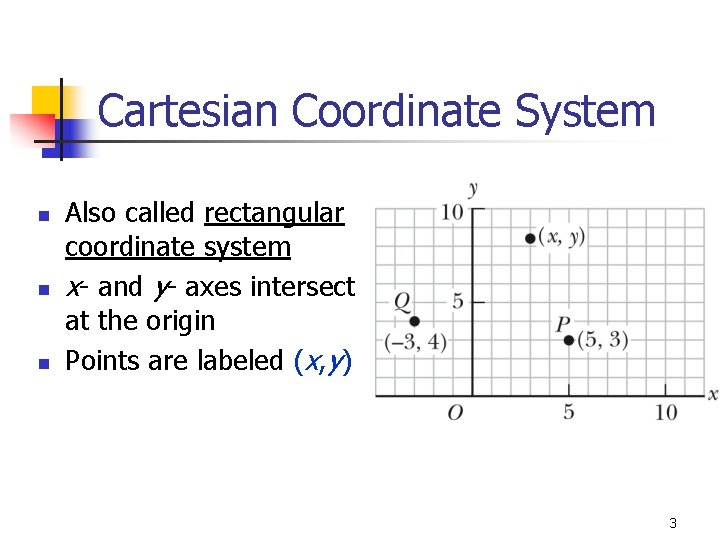
Cartesian Coordinate System n n n Also called rectangular coordinate system x- and y- axes intersect at the origin Points are labeled (x, y) 3
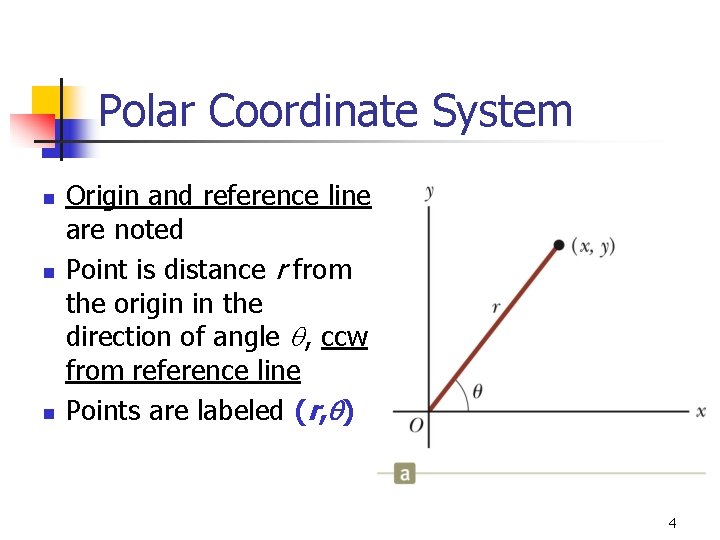
Polar Coordinate System n n n Origin and reference line are noted Point is distance r from the origin in the direction of angle , ccw from reference line Points are labeled (r, ) 4
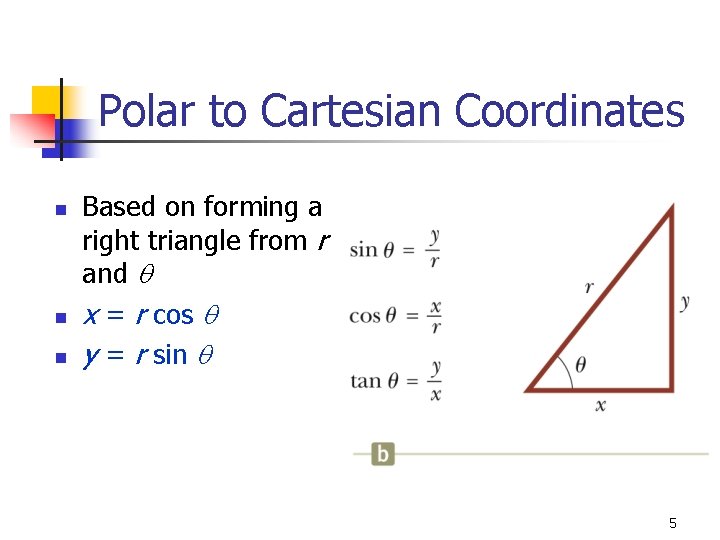
Polar to Cartesian Coordinates n n n Based on forming a right triangle from r and x = r cos y = r sin 5
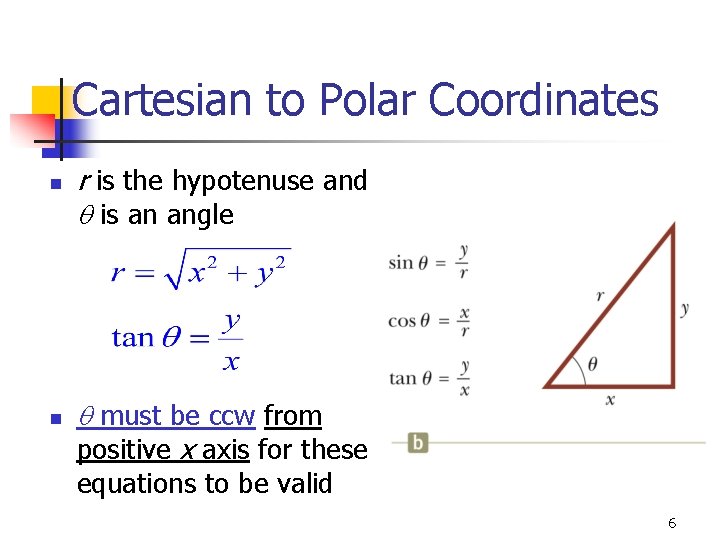
Cartesian to Polar Coordinates n n r is the hypotenuse and is an angle must be ccw from positive x axis for these equations to be valid 6
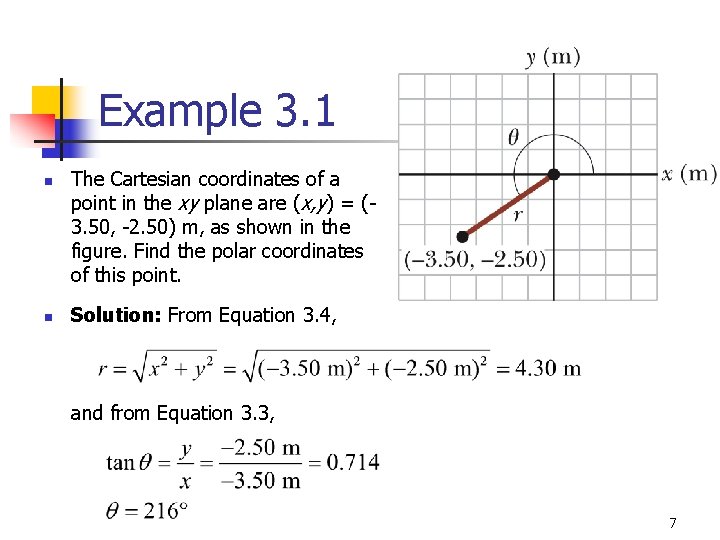
Example 3. 1 n n The Cartesian coordinates of a point in the xy plane are (x, y) = (3. 50, -2. 50) m, as shown in the figure. Find the polar coordinates of this point. Solution: From Equation 3. 4, and from Equation 3. 3, 7
Vectors and Scalars n n A scalar quantity is completely specified by a single value with an appropriate unit and has no direction. A vector quantity is completely described by a number and appropriate units plus a direction. 8
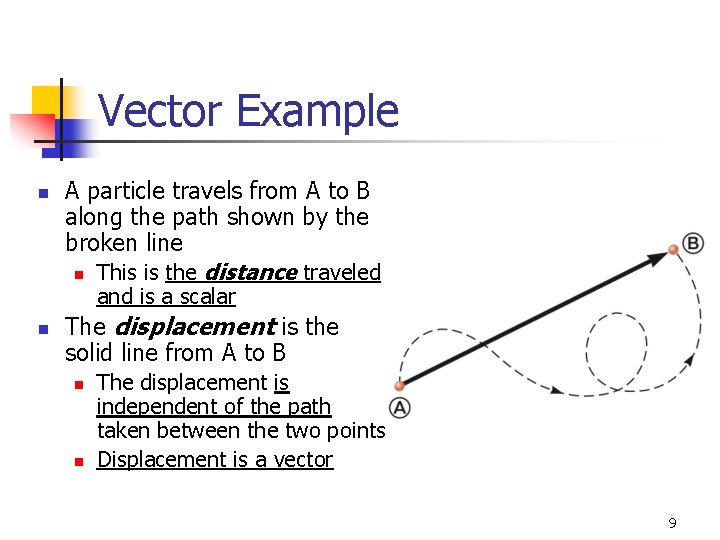
Vector Example n A particle travels from A to B along the path shown by the broken line n This is the distance traveled and is a scalar n The displacement is the solid line from A to B n n The displacement is independent of the path taken between the two points Displacement is a vector 9
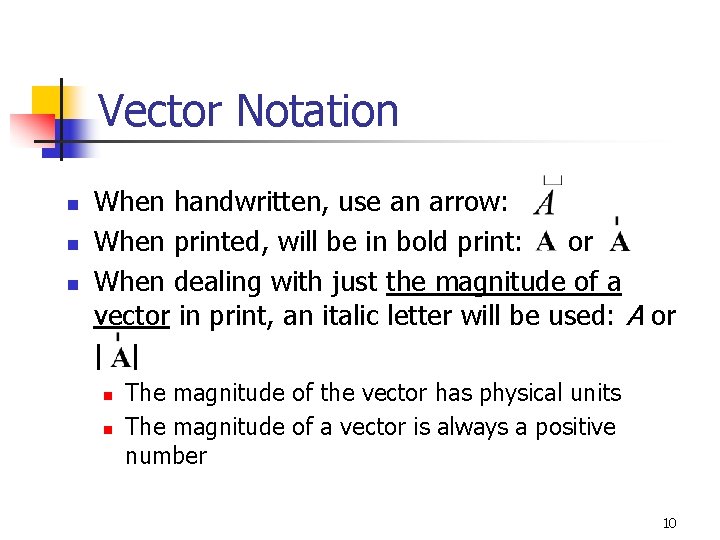
Vector Notation n When handwritten, use an arrow: When printed, will be in bold print: or When dealing with just the magnitude of a vector in print, an italic letter will be used: A or | | n n The magnitude of the vector has physical units The magnitude of a vector is always a positive number 10
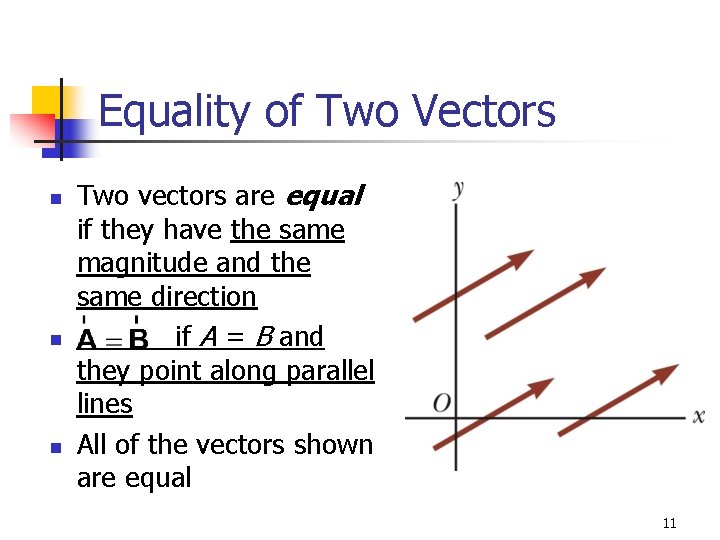
Equality of Two Vectors n n n Two vectors are equal if they have the same magnitude and the same direction if A = B and they point along parallel lines All of the vectors shown are equal 11
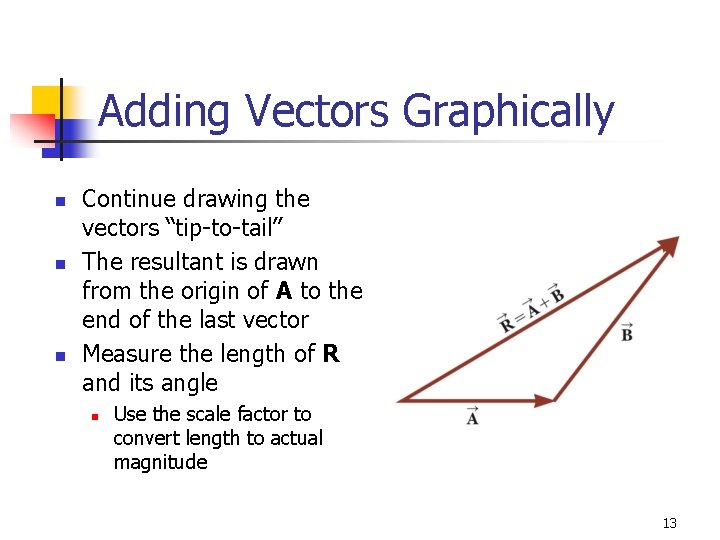
Adding Vectors n n n When adding vectors, their directions must be taken into account Units must be the same Graphical Methods n n Use scale drawings Algebraic Methods n More convenient 12
Adding Vectors Graphically n n n Continue drawing the vectors “tip-to-tail” The resultant is drawn from the origin of A to the end of the last vector Measure the length of R and its angle n Use the scale factor to convert length to actual magnitude 13
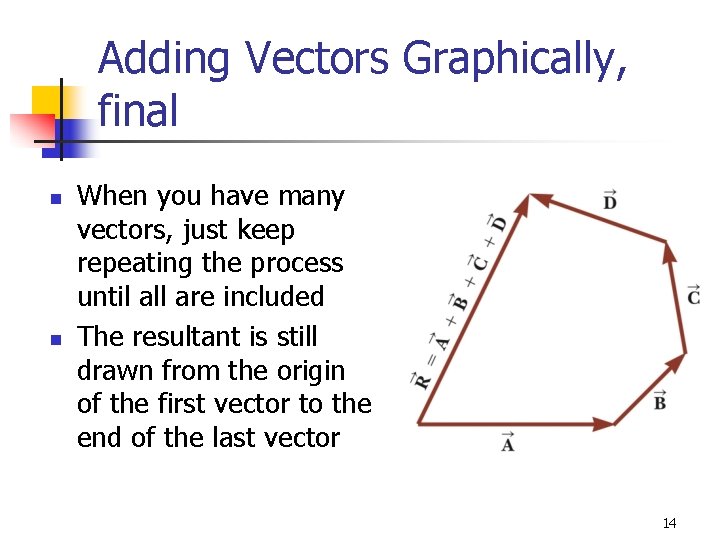
Adding Vectors Graphically, final n n When you have many vectors, just keep repeating the process until all are included The resultant is still drawn from the origin of the first vector to the end of the last vector 14
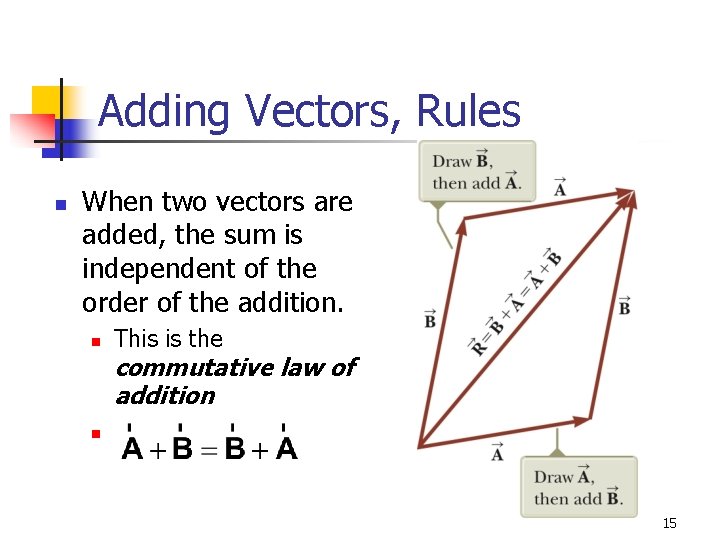
Adding Vectors, Rules n When two vectors are added, the sum is independent of the order of the addition. n This is the commutative law of addition n 15
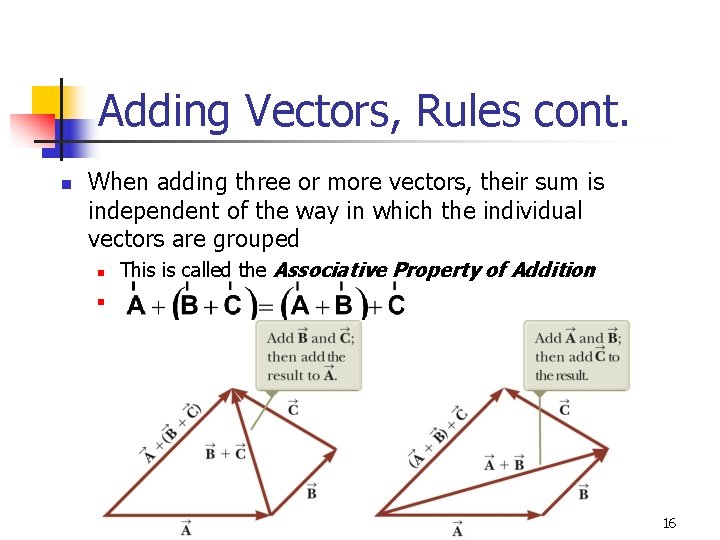
Adding Vectors, Rules cont. n When adding three or more vectors, their sum is independent of the way in which the individual vectors are grouped n This is called the Associative Property of Addition n 16
Adding Vectors, Rules final n n When adding vectors, all of the vectors must have the same units All of the vectors must be of the same type of quantity n For example, you cannot add a displacement to a velocity 17
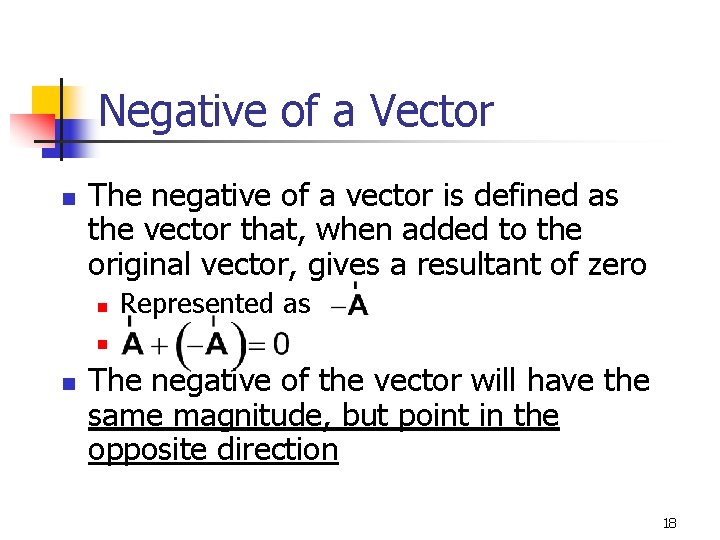
Negative of a Vector n The negative of a vector is defined as the vector that, when added to the original vector, gives a resultant of zero n Represented as n n The negative of the vector will have the same magnitude, but point in the opposite direction 18
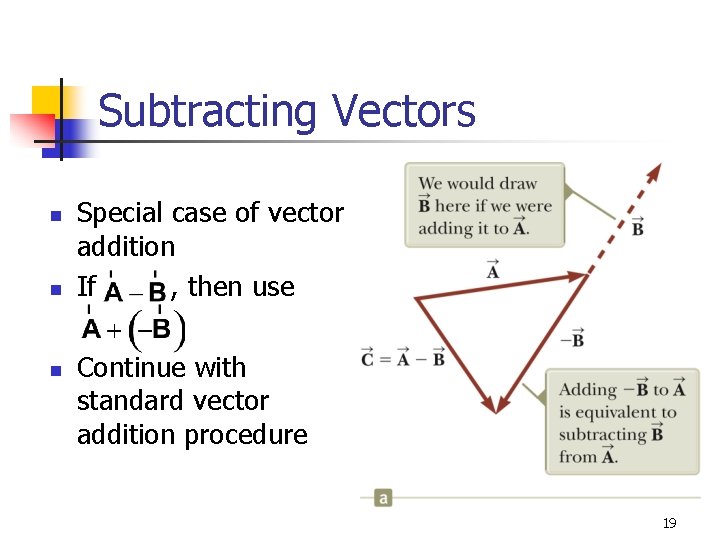
Subtracting Vectors n n n Special case of vector addition If , then use Continue with standard vector addition procedure 19
Multiplying or Dividing a Vector by a Scalar n n The result of the multiplication or division is a vector The magnitude of the vector is multiplied or divided by the scalar If the scalar is positive, the direction of the result is the same as of the original vector If the scalar is negative, the direction of the result is opposite that of the original vector 20
Component Method of Adding Vectors n Graphical addition is not recommended when n High accuracy is required If you have a three-dimensional problem Component method is an alternative method n It uses projections of vectors along coordinate axes 21
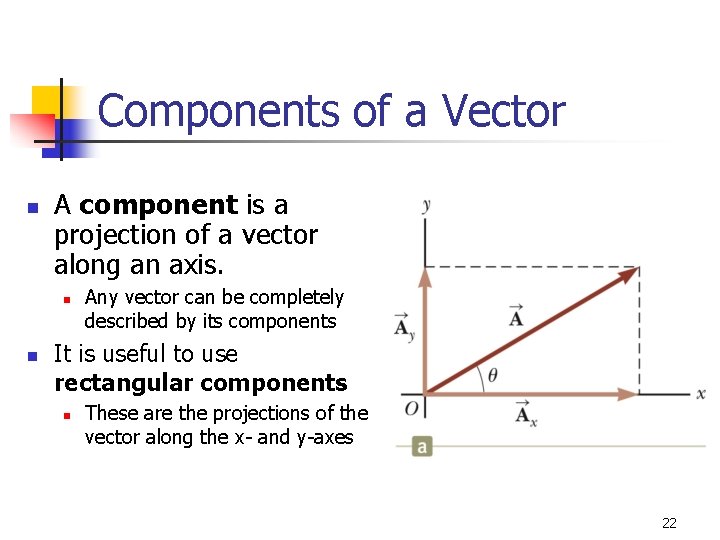
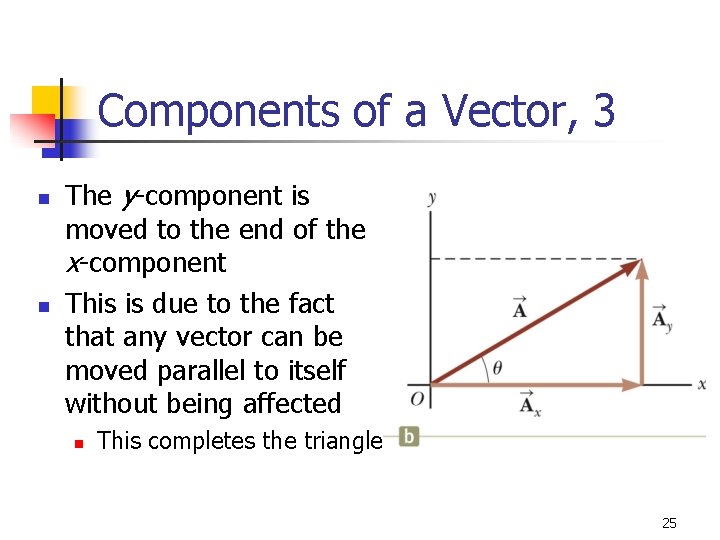
Components of a Vector n A component is a projection of a vector along an axis. n n Any vector can be completely described by its components It is useful to use rectangular components n These are the projections of the vector along the x- and y-axes 22
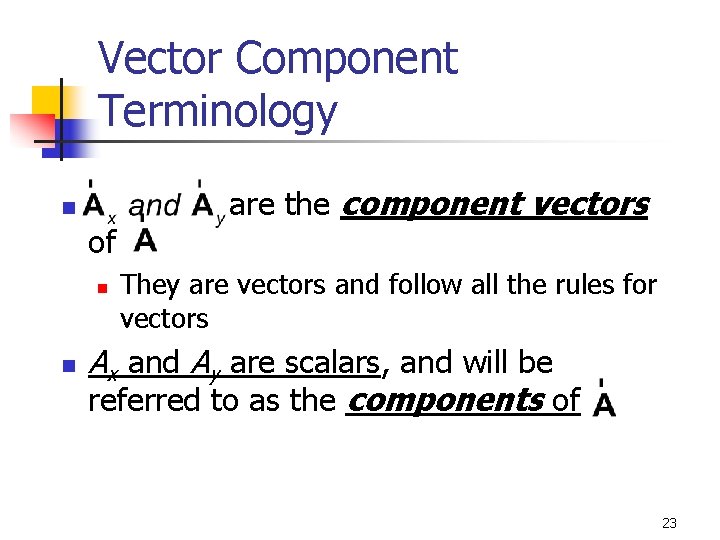
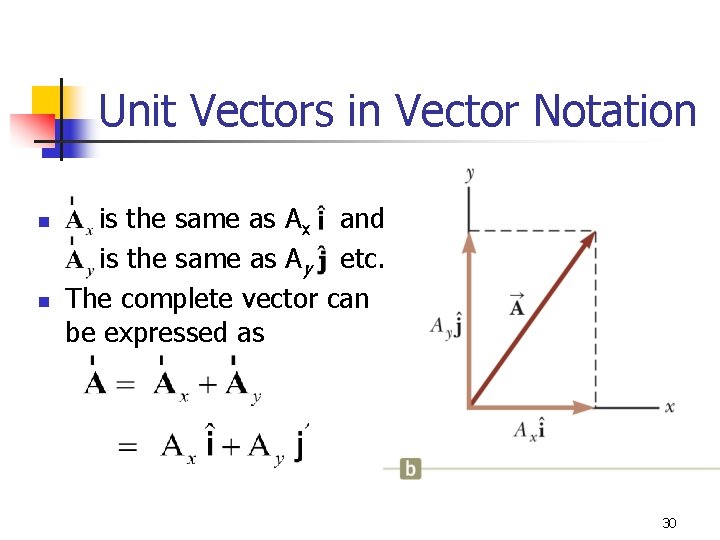
Vector Component Terminology n of n n are the component vectors They are vectors and follow all the rules for vectors Ax and Ay are scalars, and will be referred to as the components of 23
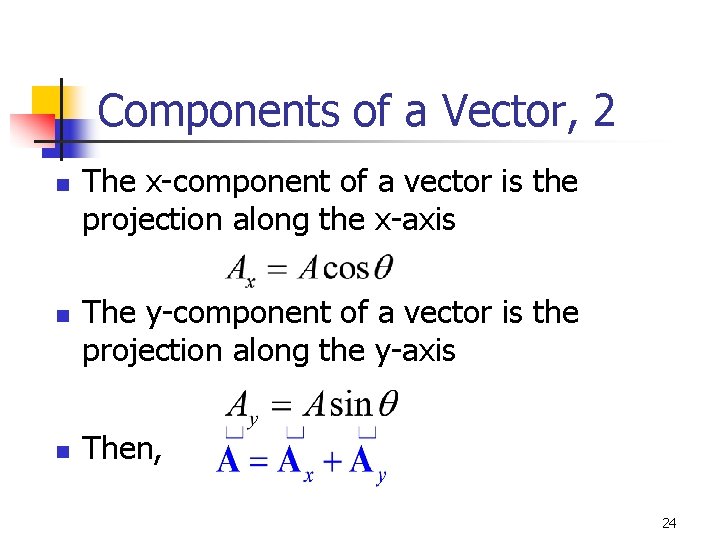
Components of a Vector, 2 n n n The x-component of a vector is the projection along the x-axis The y-component of a vector is the projection along the y-axis Then, 24
Components of a Vector, 3 n n The y-component is moved to the end of the x-component This is due to the fact that any vector can be moved parallel to itself without being affected n This completes the triangle 25
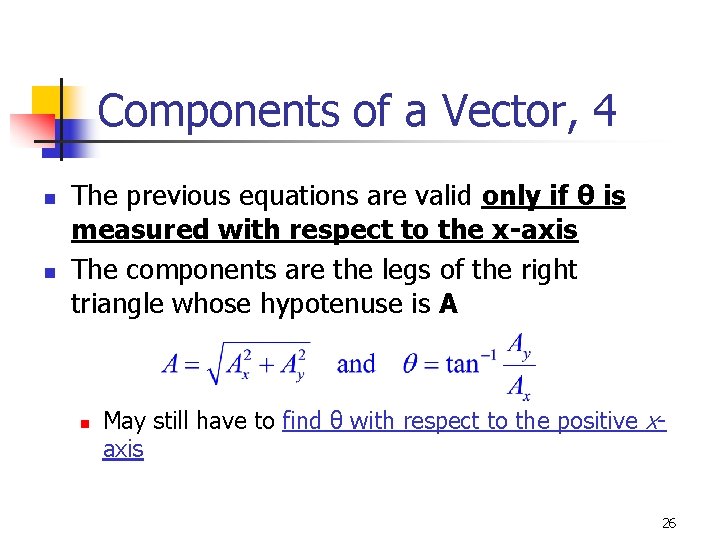
Components of a Vector, 4 n n The previous equations are valid only if θ is measured with respect to the x-axis The components are the legs of the right triangle whose hypotenuse is A n May still have to find θ with respect to the positive xaxis 26
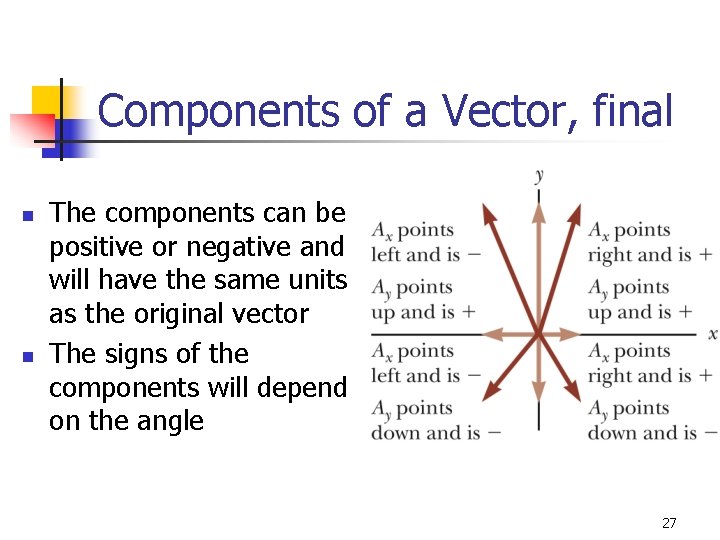
Components of a Vector, final n n The components can be positive or negative and will have the same units as the original vector The signs of the components will depend on the angle 27
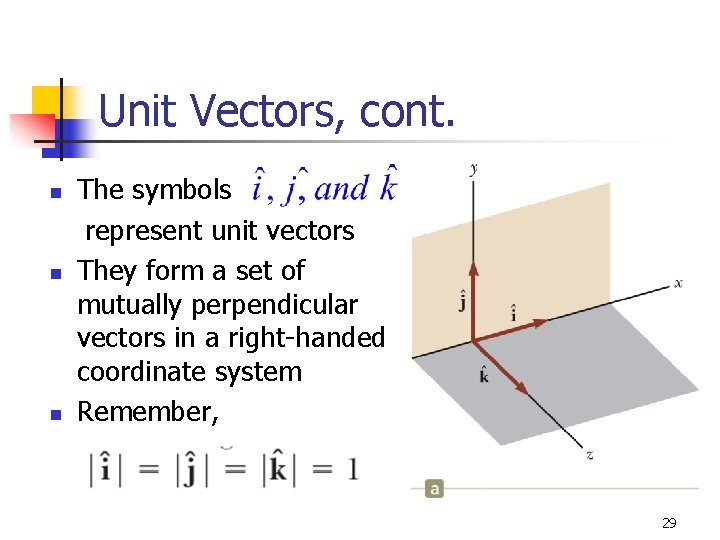
Unit Vectors n n A unit vector is a dimensionless vector with a magnitude of exactly 1. Unit vectors are used to specify a direction and have no other physical significance 28
Unit Vectors, cont. n n n The symbols represent unit vectors They form a set of mutually perpendicular vectors in a right-handed coordinate system Remember, 29
Unit Vectors in Vector Notation n n is the same as Ax and is the same as Ay etc. The complete vector can be expressed as 30
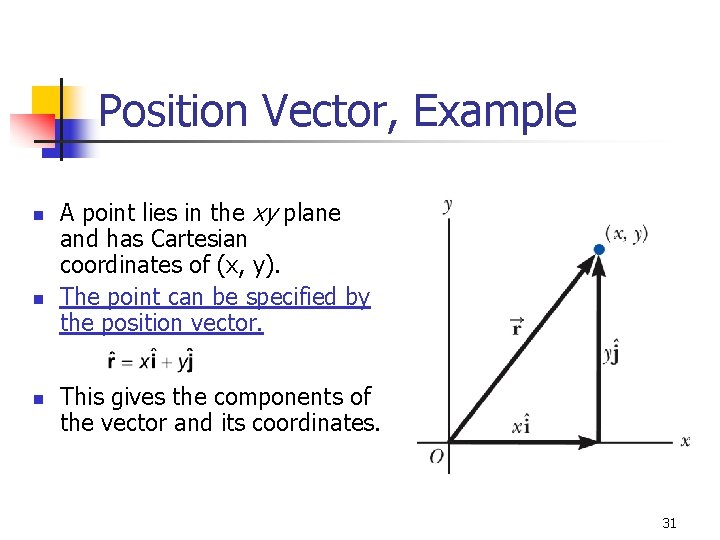
Position Vector, Example n n n A point lies in the xy plane and has Cartesian coordinates of (x, y). The point can be specified by the position vector. This gives the components of the vector and its coordinates. 31
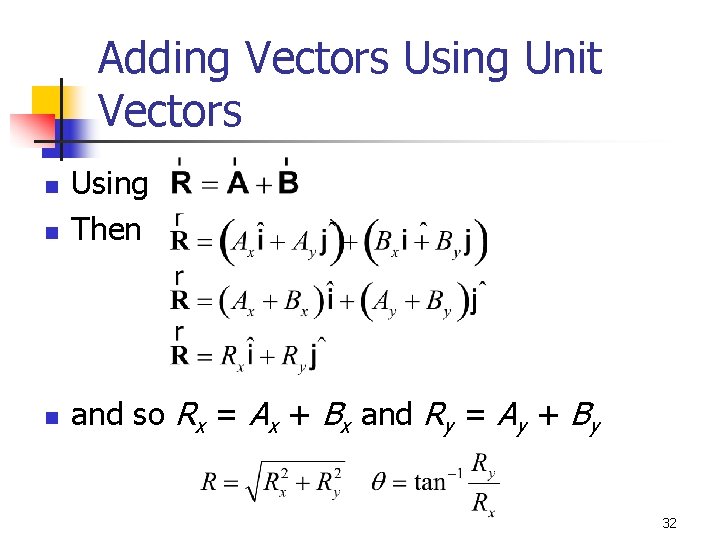
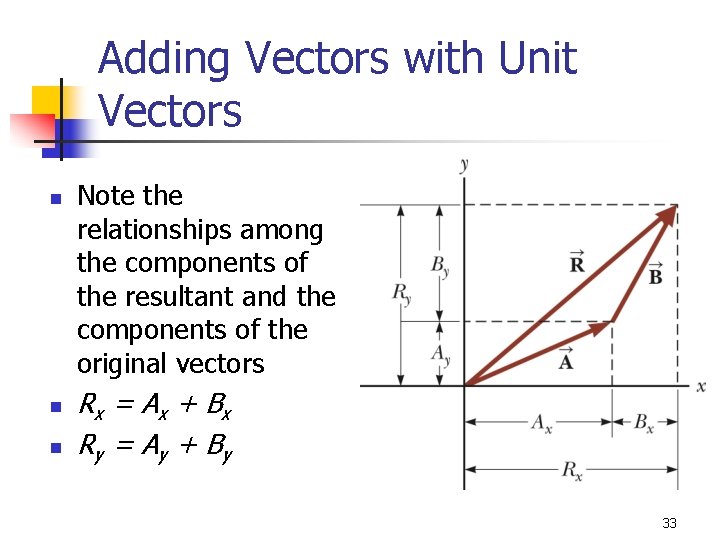
Adding Vectors Using Unit Vectors n Using Then n and so Rx = Ax + Bx and Ry = Ay + By n 32
Adding Vectors with Unit Vectors n n n Note the relationships among the components of the resultant and the components of the original vectors Rx = A x + B x Ry = A y + B y 33
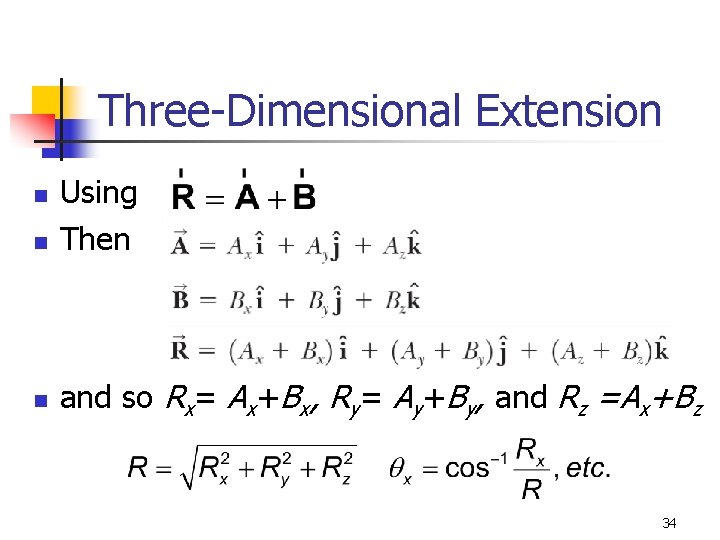
Three-Dimensional Extension n Using Then n and so Rx= Ax+Bx, Ry= Ay+By, and Rz =Ax+Bz n 34
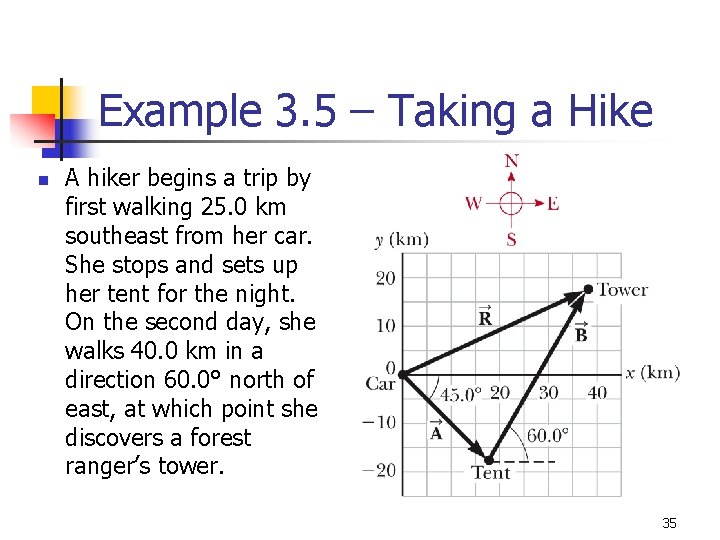
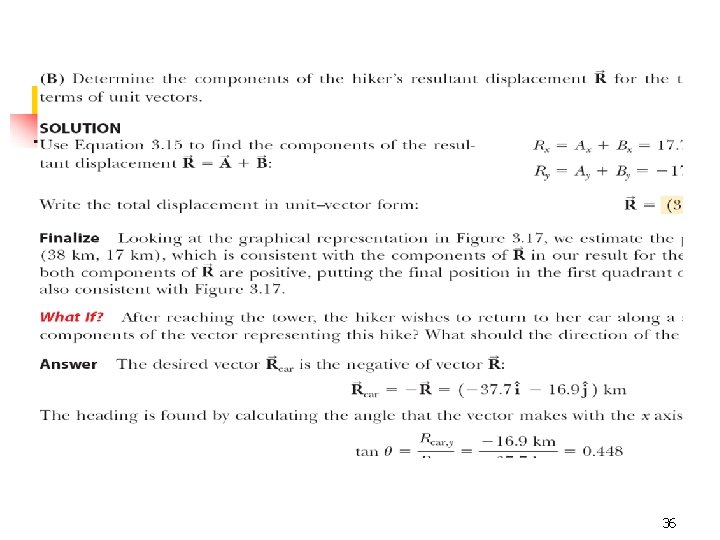
Example 3. 5 – Taking a Hike n A hiker begins a trip by first walking 25. 0 km southeast from her car. She stops and sets up her tent for the night. On the second day, she walks 40. 0 km in a direction 60. 0° north of east, at which point she discovers a forest ranger’s tower. 35
36