
CHAPTER 3 UNDERSTANDING INTERNAL EXTERNAL ENVIRONMENTS 2003 Mc
- Slides: 25
CHAPTER 3 UNDERSTANDING INTERNAL & EXTERNAL ENVIRONMENTS © 2003 Mc. Graw-Hill Australia Pty Ltd. Power. Point Slides t/a Management: A Pacific Rim Focus Enhanced Edition. Slides prepared by David Meacheam & George 1
Lecture outline External environment • Types of external environment • Analysing the environment • Managing the environment Internal environment (culture) • Nature of organisational. culture • Manifestations of culture • Promoting innovation • Changing organisational. culture • Leadership & cultural change © 2003 Mc. Graw-Hill Australia Pty Ltd. Power. Point Slides t/a Management: A Pacific 2 Rim Focus Enhanced Edition. Slides prepared by David Meacheam & George
External environment ‘Major forces outside the organisation with potential to influence significantly a product or service’s likely success. ’ © 2003 Mc. Graw-Hill Australia Pty Ltd. Power. Point Slides t/a Management: A Pacific Rim Focus Enhanced Edition. Slides prepared by David Meacheam & George 3
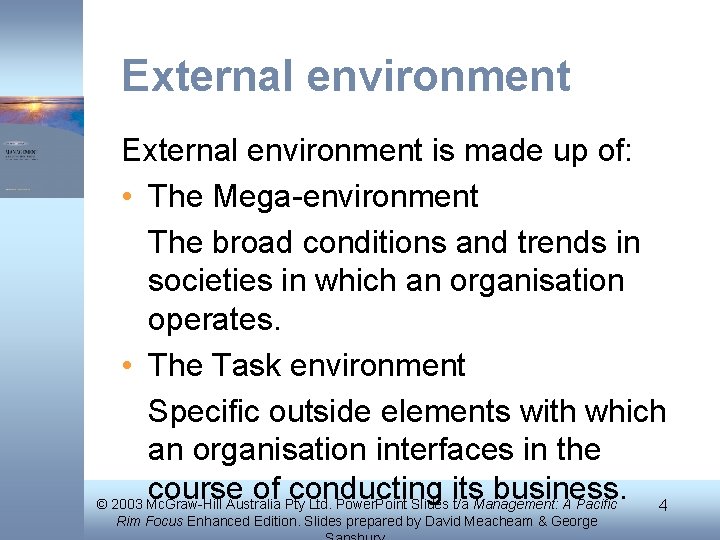
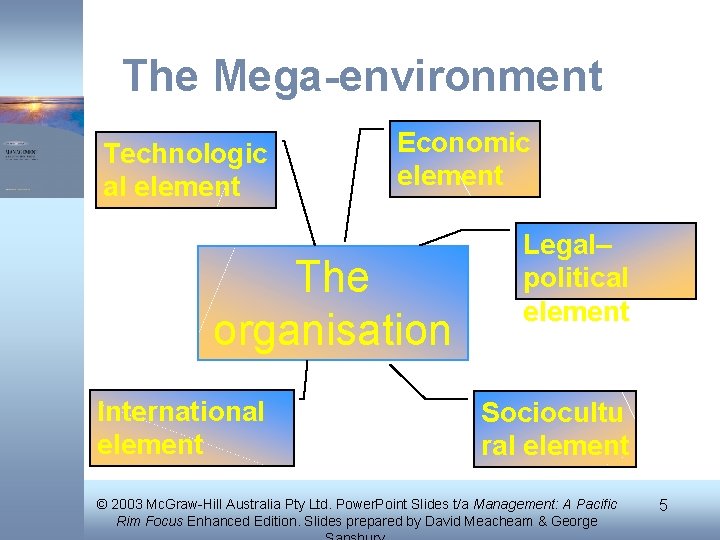
External environment is made up of: • The Mega-environment The broad conditions and trends in societies in which an organisation operates. • The Task environment Specific outside elements with which an organisation interfaces in the course of conducting its business. 4 © 2003 Mc. Graw-Hill Australia Pty Ltd. Power. Point Slides t/a Management: A Pacific Rim Focus Enhanced Edition. Slides prepared by David Meacheam & George
The Mega-environment Technologic al element Economic element The organisation International element Legal– political element Sociocultu ral element © 2003 Mc. Graw-Hill Australia Pty Ltd. Power. Point Slides t/a Management: A Pacific Rim Focus Enhanced Edition. Slides prepared by David Meacheam & George 5
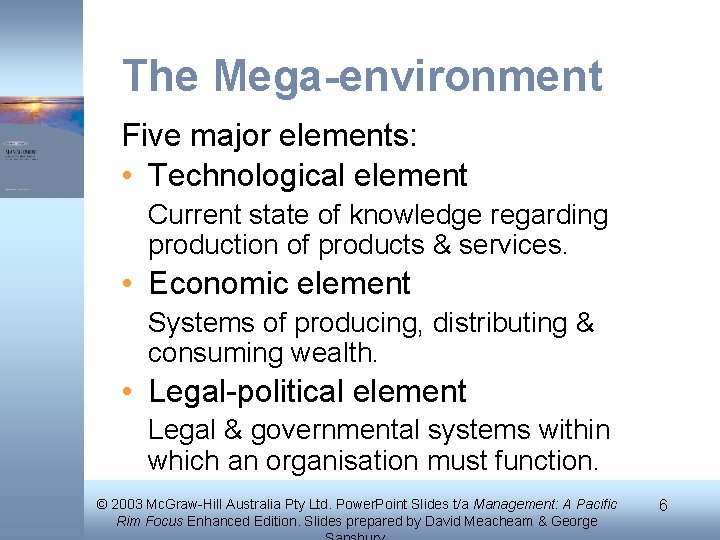
The Mega-environment Five major elements: • Technological element Current state of knowledge regarding production of products & services. • Economic element Systems of producing, distributing & consuming wealth. • Legal-political element Legal & governmental systems within which an organisation must function. © 2003 Mc. Graw-Hill Australia Pty Ltd. Power. Point Slides t/a Management: A Pacific Rim Focus Enhanced Edition. Slides prepared by David Meacheam & George 6
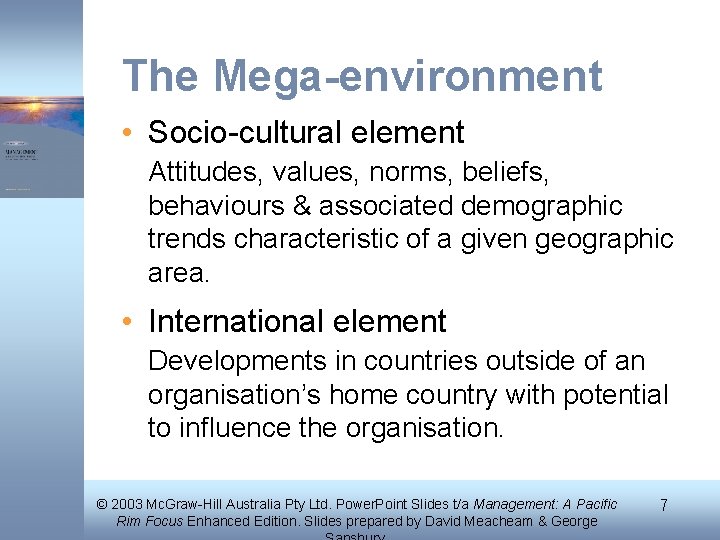
The Mega-environment • Socio-cultural element Attitudes, values, norms, beliefs, behaviours & associated demographic trends characteristic of a given geographic area. • International element Developments in countries outside of an organisation’s home country with potential to influence the organisation. © 2003 Mc. Graw-Hill Australia Pty Ltd. Power. Point Slides t/a Management: A Pacific Rim Focus Enhanced Edition. Slides prepared by David Meacheam & George 7
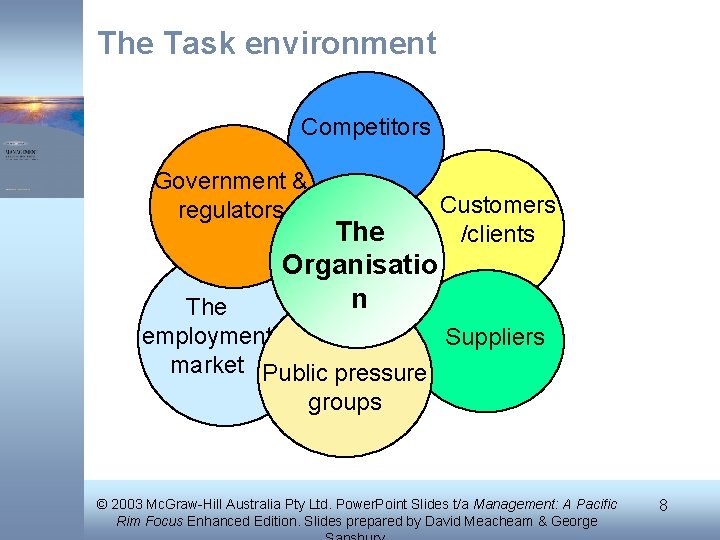
The Task environment Competitors Government & regulators The Organisatio n Customers /clients The employment Suppliers market Public pressure groups © 2003 Mc. Graw-Hill Australia Pty Ltd. Power. Point Slides t/a Management: A Pacific Rim Focus Enhanced Edition. Slides prepared by David Meacheam & George 8
The Task environment Five elements: • Customers and clients Individuals and organisations purchasing products/services. • Competitors Other organisations either offering (or a high potential of offering) rival products/services. • Suppliers Organisations and individuals supplying resources an organisation needs to © 2003 Mc. Graw-Hill Australia Pty Ltd. Power. Point Slides t/a Management: A Pacific conduct its operations. Rim Focus Enhanced Edition. Slides prepared by David Meacheam & George 9
The Task environment • Labour supply Individuals potentially employable by an organisation. • Government agencies Agencies providing services and monitoring compliance with laws and regulations at local, State or regional and national levels. © 2003 Mc. Graw-Hill Australia Pty Ltd. Power. Point Slides t/a Management: A Pacific Rim Focus Enhanced Edition. Slides prepared by David Meacheam & George 10
Analysing the environment Perspectives on environment: • Population ecology model Argues that environmental factors cause organisations to survive or fail. • Resource dependence model Highlights the dependence of organisations on environment but attempt to manipulate the environment to reduce this dependence. © 2003 Mc. Graw-Hill Australia Pty Ltd. Power. Point Slides t/a Management: A Pacific Rim Focus Enhanced Edition. Slides prepared by David Meacheam & George 11
Analysing the environment Environment characteristics: • Uncertainty Condition in which future environmental circumstances affecting an organisation cannot be accurately assessed and predicted. • Complexity Number of elements in an organisation’s environment and their degree of similarity. © 2003 Mc. Graw-Hill Australia Pty Ltd. Power. Point Slides t/a Management: A Pacific Rim Focus Enhanced Edition. Slides prepared by David Meacheam & George 12
Analysing the environment • Dynamism Rate and predictability of change in the elements of an organisation’s environment. • Bounty Extent to which the environment can support sustained growth and stability. © 2003 Mc. Graw-Hill Australia Pty Ltd. Power. Point Slides t/a Management: A Pacific Rim Focus Enhanced Edition. Slides prepared by David Meacheam & George 13
Managing the environment Three approaches to managing the environment: • Adaptation Involves changing internal operations & activities to make the organisation and its environment more compatible. • Favourability influence Involves trying to alter environmental elements to make them more compatible with the organisation’s needs. • Domain shifting Changing product/service mix to create favourable 14 interface. © 2003 Mc. Graw-Hill Australia Pty Ltd. Power. Point Slides t/a Management: A Pacific Rim Focus Enhanced Edition. Slides prepared by David Meacheam & George
Adaptation • Buffering Stockpiling either inputs into or outputs from a production or service process to cope with environmental fluctuations. • Smoothing Taking actions aimed at reducing the impact of fluctuations, given the market. • Forecasting Predicting changing conditions & future events that significantly affect an organisation’s business. • Rationing Providing limited access to a product or service in high demand. © 2003 Mc. Graw-Hill Australia Pty Ltd. Power. Point Slides t/a Management: A Pacific Rim Focus Enhanced Edition. Slides prepared by David Meacheam & George 15
Favourability influence • • Advertising & public relations Boundary spanning Recruiting Negotiating contracts Co-opting Strategic alliances Trade associations Political activity © 2003 Mc. Graw-Hill Australia Pty Ltd. Power. Point Slides t/a Management: A Pacific Rim Focus Enhanced Edition. Slides prepared by David Meacheam & George 16
Domain shifting • Move out of a current product, service or geographic area into a more favourable domain • Expand current domains through diversification or expansion of products/services offered © 2003 Mc. Graw-Hill Australia Pty Ltd. Power. Point Slides t/a Management: A Pacific Rim Focus Enhanced Edition. Slides prepared by David Meacheam & George 17
Internal environment Nature of organisational culture: • ‘A system of shared values, assumption, beliefs and norms uniting organisational members’ (Smircich 1983; Kilman et al. 1986). • ‘The way we do things around here. ’ • The ‘glue’ binding the disparate parts (or the oil that keeps them moving). • The interpretive part of organisational behaviour: It explains, gives direction, sustains energy, commitment, and cohesion. © 2003 Mc. Graw-Hill Australia Pty Ltd. Power. Point Slides t/a Management: A Pacific Rim Focus Enhanced Edition. Slides prepared by David Meacheam & George 18
Manifestations of culture • Symbols Object, act, event or quality serving as a vehicle for conveying meaning. • Stories Narrative based on true events, which may be embellished to highlight intended value. • Rites Relatively elaborate, dramatic, planned set of activities intended to convey cultural values to participants and, usually, an audience. • Ceremonies System of rites performed in conjunction with a single occasion or event. © 2003 Mc. Graw-Hill Australia Pty Ltd. Power. Point Slides t/a Management: A Pacific Rim Focus Enhanced Edition. Slides prepared by David Meacheam & George 19
Promoting innovation • Strategic Focussed on identifying opportunities. • Committed to seizing opportunities Willing to make major, fast changes. • Commitment of resources Many stages with risk assessed for each stage. • Control of resources Rental or outsourcing of resources for flexibility. • Management structure Few levels with informal communication. © 2003 Mc. Graw-Hill Australia Pty Ltd. Power. Point Slides t/a Management: A Pacific Rim Focus Enhanced Edition. Slides prepared by David Meacheam & George 20
Changing organisational culture Because they involve fairly stable values, assumptions, beliefs & norms, organisations can be difficult to change. An approach to changing culture: • Surfacing actual norms • Articulating new directions • Establishing new norms • Identifying culture gaps • Closing culture gaps. © 2003 Mc. Graw-Hill Australia Pty Ltd. Power. Point Slides t/a Management: A Pacific Rim Focus Enhanced Edition. Slides prepared by David Meacheam & George 21
Leadership and cultural change • Crisis identification • Communication of a new vision • Motivation of key staff to lead cultural change by implementing the new vision and its corresponding strategy © 2003 Mc. Graw-Hill Australia Pty Ltd. Power. Point Slides t/a Management: A Pacific Rim Focus Enhanced Edition. Slides prepared by David Meacheam & George 22
Lecture summary External environment: • Types of external environment Mega environment; Task environment • Analysing the environment Models: Ecology & Resource dependence • Managing the environment Adaptation, Favourability influence & Domain shift © 2003 Mc. Graw-Hill Australia Pty Ltd. Power. Point Slides t/a Management: A Pacific Rim Focus Enhanced Edition. Slides prepared by David Meacheam & George 23
Lecture summary Internal environment (culture): • Nature of organisational culture System of shared values, assumption, beliefs and norms uniting organisational members. • Manifestations of culture Symbols, stories, rites and ceremonies. • Promoting innovation Requires strategically oriented organisations with ability to change quickly. © 2003 Mc. Graw-Hill Australia Pty Ltd. Power. Point Slides t/a Management: A Pacific Rim Focus Enhanced Edition. Slides prepared by David Meacheam & George 24
Lecture summary Internal environment (culture): • Changing organisational culture Difficult because of need to change values & behaviour. • Leadership & cultural change Leaders convey need for change, provide new vision & motivate key staff. © 2003 Mc. Graw-Hill Australia Pty Ltd. Power. Point Slides t/a Management: A Pacific Rim Focus Enhanced Edition. Slides prepared by David Meacheam & George 25