
Chapter 3 Tools of the Laboratory The Methods
Chapter 3 Tools of the Laboratory: The Methods for Studying Microorganisms Copyright © Mc. Graw-Hill Education. All rights reserved. No reproduction or distribution without the prior written consent of Mc. Graw-Hill Education.
2 Copyright © Mc. Graw-Hill Education. All rights reserved. No reproduction or distribution without the prior written consent of Mc. Graw-Hill Education.

The Microscope Key characteristics of a reliable microscope are: • Magnification – ability to enlarge objects • Resolving power – ability to show detail 3 Copyright © Mc. Graw-Hill Education. All rights reserved. No reproduction or distribution without the prior written consent of Mc. Graw-Hill Education.

Magnification in most microscopes results from an interaction between visible light waves and the curvature of a lens. – The extent of enlargement is the magnification. 4 Copyright © Mc. Graw-Hill Education. All rights reserved. No reproduction or distribution without the prior written consent of Mc. Graw-Hill Education.
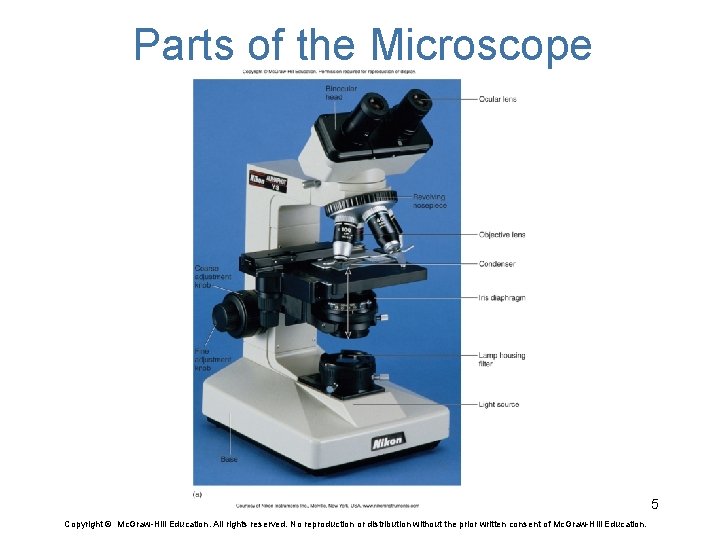
Parts of the Microscope 5 Copyright © Mc. Graw-Hill Education. All rights reserved. No reproduction or distribution without the prior written consent of Mc. Graw-Hill Education.

Magnification in Two Phases – The objective lens forms the magnified real image – The real image is projected to the ocular where it is magnified again to form the virtual image 6 Copyright © Mc. Graw-Hill Education. All rights reserved. No reproduction or distribution without the prior written consent of Mc. Graw-Hill Education.
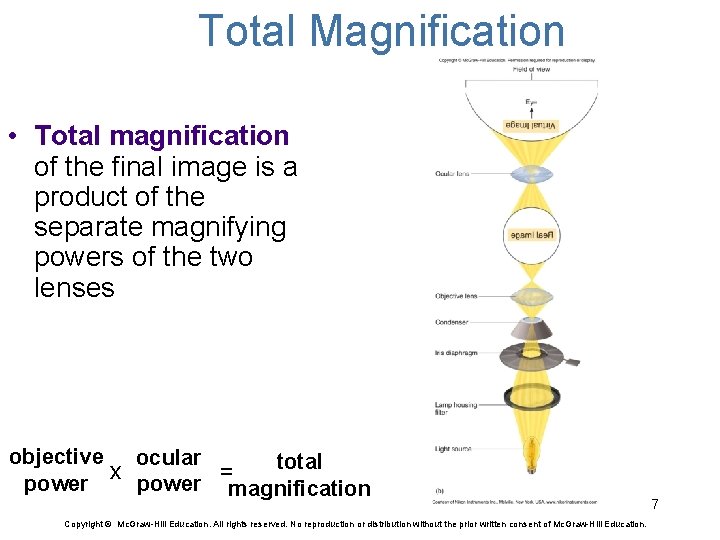
Total Magnification • Total magnification of the final image is a product of the separate magnifying powers of the two lenses objective ocular total x = power magnification Copyright © Mc. Graw-Hill Education. All rights reserved. No reproduction or distribution without the prior written consent of Mc. Graw-Hill Education. 7

Resolution The capacity to distinguish or separate two adjacent objects and depends on – The wavelength of light that forms the image along with characteristics of the objectives 8 Copyright © Mc. Graw-Hill Education. All rights reserved. No reproduction or distribution without the prior written consent of Mc. Graw-Hill Education.
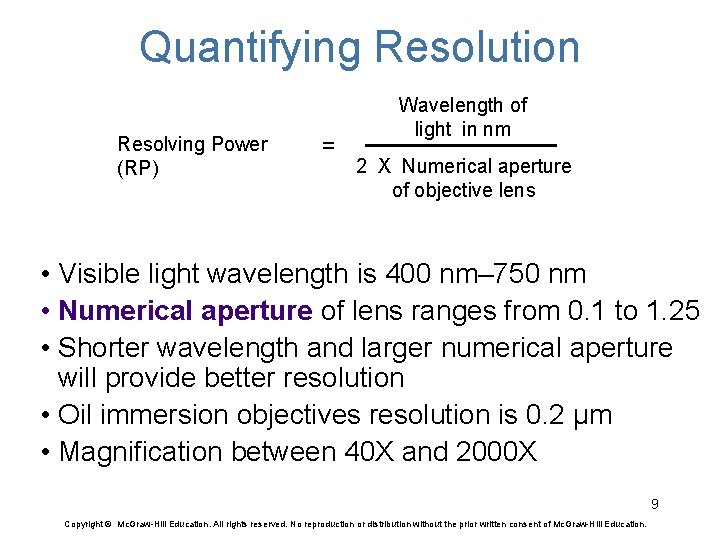
Quantifying Resolution Resolving Power (RP) = Wavelength of light in nm 2 X Numerical aperture of objective lens • Visible light wavelength is 400 nm– 750 nm • Numerical aperture of lens ranges from 0. 1 to 1. 25 • Shorter wavelength and larger numerical aperture will provide better resolution • Oil immersion objectives resolution is 0. 2 μm • Magnification between 40 X and 2000 X 9 Copyright © Mc. Graw-Hill Education. All rights reserved. No reproduction or distribution without the prior written consent of Mc. Graw-Hill Education.

The Purpose of Oil 10 Copyright © Mc. Graw-Hill Education. All rights reserved. No reproduction or distribution without the prior written consent of Mc. Graw-Hill Education.
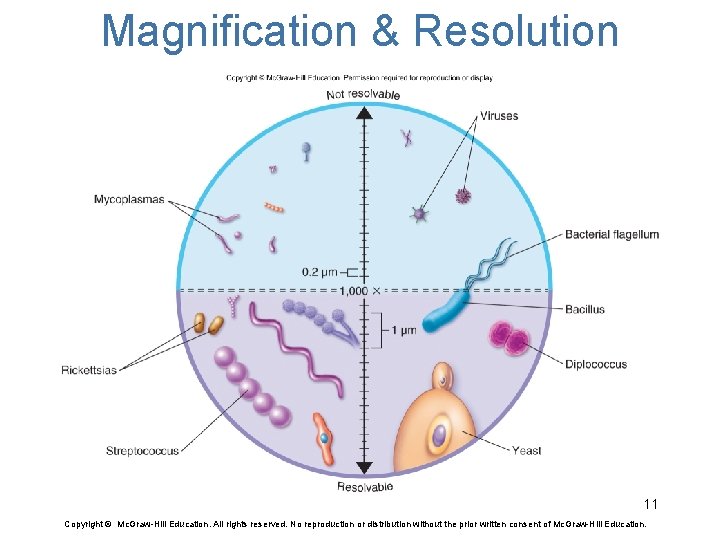
Magnification & Resolution 11 Copyright © Mc. Graw-Hill Education. All rights reserved. No reproduction or distribution without the prior written consent of Mc. Graw-Hill Education.
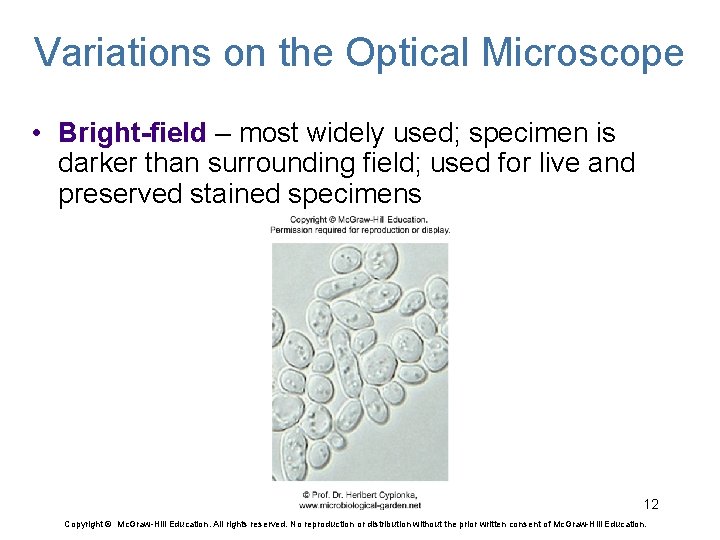
Variations on the Optical Microscope • Bright-field – most widely used; specimen is darker than surrounding field; used for live and preserved stained specimens 12 Copyright © Mc. Graw-Hill Education. All rights reserved. No reproduction or distribution without the prior written consent of Mc. Graw-Hill Education.

Variations on the Optical Microscope • Dark-field – brightly illuminated specimens surrounded by dark field; used for live and unstained specimens 13 Copyright © Mc. Graw-Hill Education. All rights reserved. No reproduction or distribution without the prior written consent of Mc. Graw-Hill Education.

Variations on the Optical Microscope • Phase-contrast – transforms subtle changes in light waves passing through the specimen into differences in light intensity, best for observing intracellular structures 14 Copyright © Mc. Graw-Hill Education. All rights reserved. No reproduction or distribution without the prior written consent of Mc. Graw-Hill Education.
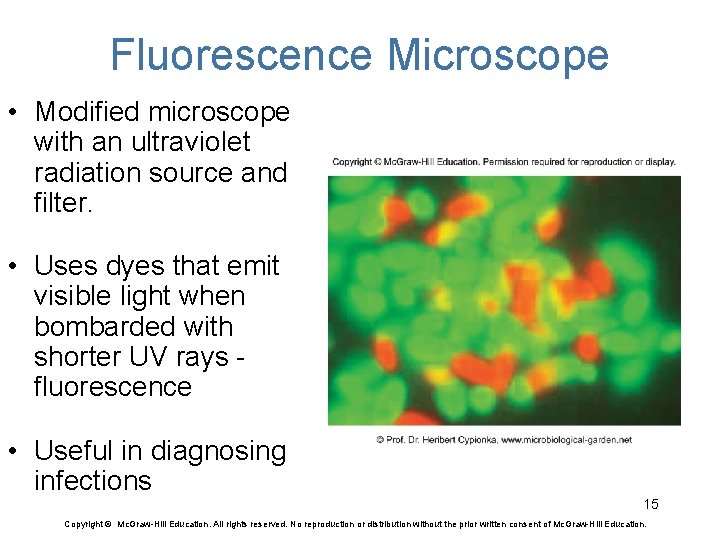
Fluorescence Microscope • Modified microscope with an ultraviolet radiation source and filter. • Uses dyes that emit visible light when bombarded with shorter UV rays fluorescence • Useful in diagnosing infections 15 Copyright © Mc. Graw-Hill Education. All rights reserved. No reproduction or distribution without the prior written consent of Mc. Graw-Hill Education.
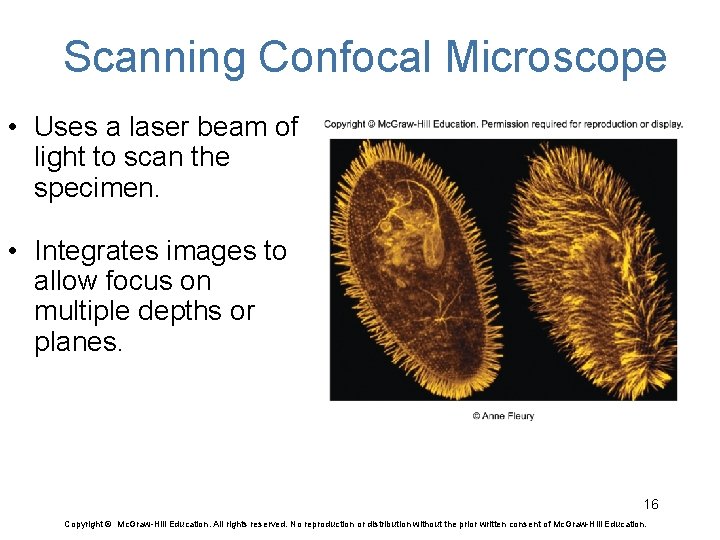
Scanning Confocal Microscope • Uses a laser beam of light to scan the specimen. • Integrates images to allow focus on multiple depths or planes. 16 Copyright © Mc. Graw-Hill Education. All rights reserved. No reproduction or distribution without the prior written consent of Mc. Graw-Hill Education.
Electron Microscopy • Forms an image with a beam of electrons that can be made to travel in wavelike patterns when accelerated to high speeds • Electron waves are 100, 000 times shorter than the waves of visible light • Electrons have tremendous power to resolve minute structures because resolving power is a function of wavelength • Magnification between 5, 000 X and 1, 000 X 17 Copyright © Mc. Graw-Hill Education. All rights reserved. No reproduction or distribution without the prior written consent of Mc. Graw-Hill Education.
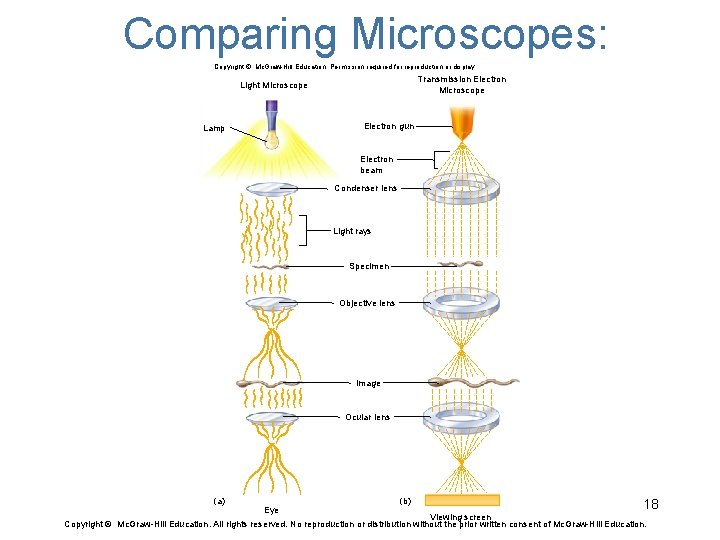
Comparing Microscopes: Copyright © Mc. Graw-Hill Education. Permission required for reproduction or display. Transmission Electron Microscope Light Microscope Lamp Electron gun Electron beam Condenser lens Light rays Specimen Objective lens Image Ocular lens (a) (b) 18 Eye Viewing screen Copyright © Mc. Graw-Hill Education. All rights reserved. No reproduction or distribution without the prior written consent of Mc. Graw-Hill Education.
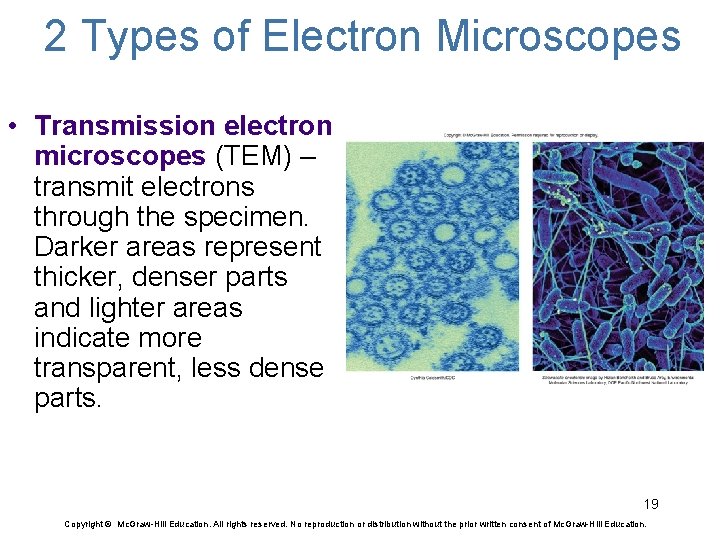
2 Types of Electron Microscopes • Transmission electron microscopes (TEM) – transmit electrons through the specimen. Darker areas represent thicker, denser parts and lighter areas indicate more transparent, less dense parts. 19 Copyright © Mc. Graw-Hill Education. All rights reserved. No reproduction or distribution without the prior written consent of Mc. Graw-Hill Education.
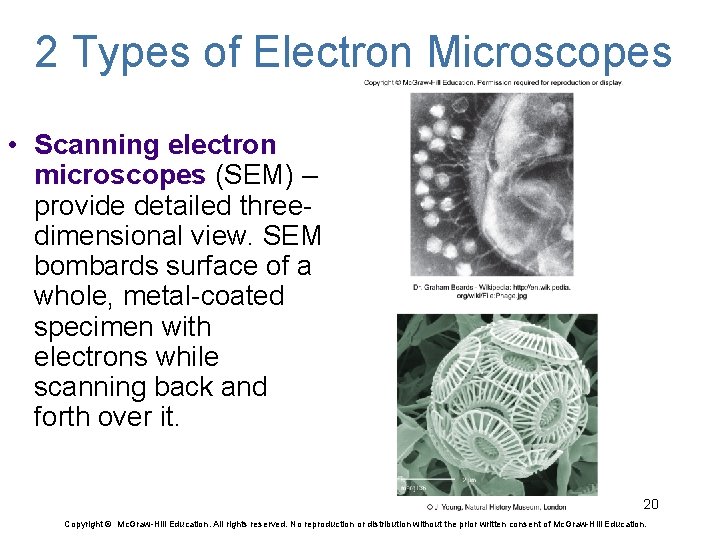
2 Types of Electron Microscopes • Scanning electron microscopes (SEM) – provide detailed threedimensional view. SEM bombards surface of a whole, metal-coated specimen with electrons while scanning back and forth over it. 20 Copyright © Mc. Graw-Hill Education. All rights reserved. No reproduction or distribution without the prior written consent of Mc. Graw-Hill Education.

Staining • Dyes are used to create contrast by imparting color Copyright © Mc. Graw-Hill Education. Permission required for reproduction or display. Positive-Type Staining • Basic dyes – cationic, positively charged chromophore • Positive staining – surfaces of microbes are negatively charged and attract basic dyes (a and b) Cell envelope (a) Basic Dye 21 Copyright © Mc. Graw-Hill Education. All rights reserved. No reproduction or distribution without the prior written consent of Mc. Graw-Hill Education.
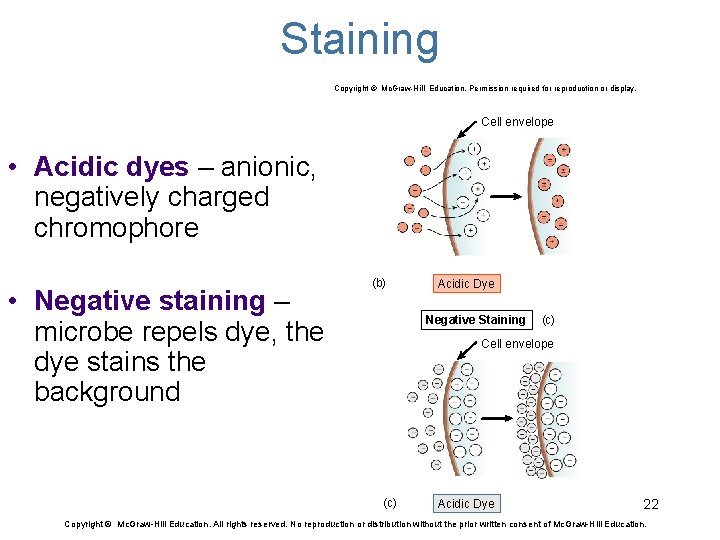
Staining Copyright © Mc. Graw-Hill Education. Permission required for reproduction or display. Cell envelope • Acidic dyes – anionic, negatively charged chromophore • Negative staining – microbe repels dye, the dye stains the background (b) Acidic Dye Negative Staining (c) Cell envelope (c) Acidic Dye 22 Copyright © Mc. Graw-Hill Education. All rights reserved. No reproduction or distribution without the prior written consent of Mc. Graw-Hill Education.
Staining • Simple stains – one dye is used; reveals shape, size, and arrangement • Differential stains – use a primary stain and a counterstain to distinguish cell types or parts (examples: Gram stain, acid-fast stain, and endospore stain) • Structural stains – reveal certain cell parts not revealed by conventional methods: capsule and flagellar stains 23 Copyright © Mc. Graw-Hill Education. All rights reserved. No reproduction or distribution without the prior written consent of Mc. Graw-Hill Education.
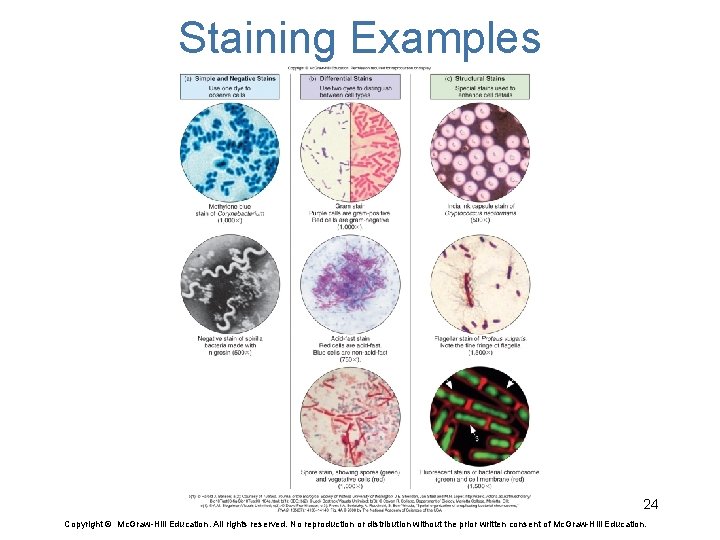
Staining Examples 24 Copyright © Mc. Graw-Hill Education. All rights reserved. No reproduction or distribution without the prior written consent of Mc. Graw-Hill Education.
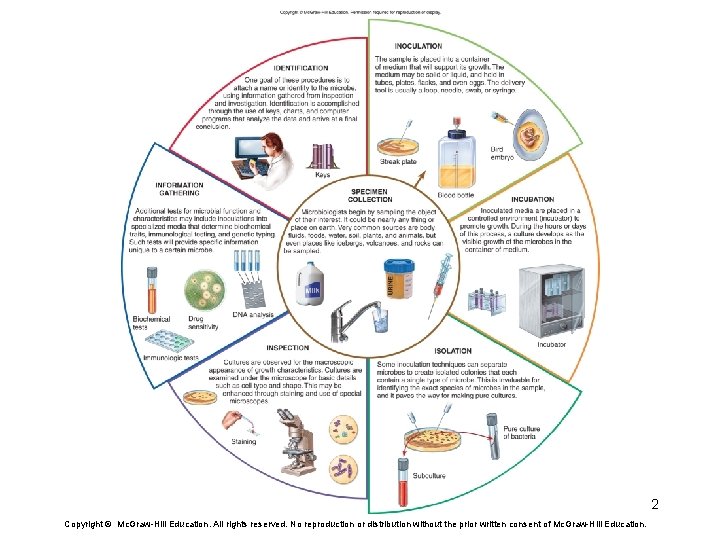
The 6 I’s of Culturing Microbes Inoculation – introduction of a sample into a container of media to produce a culture of observable growth Isolation – separating one species from another Incubation – under conditions that allow growth Inspection Information gathering Identification 25 Copyright © Mc. Graw-Hill Education. All rights reserved. No reproduction or distribution without the prior written consent of Mc. Graw-Hill Education.
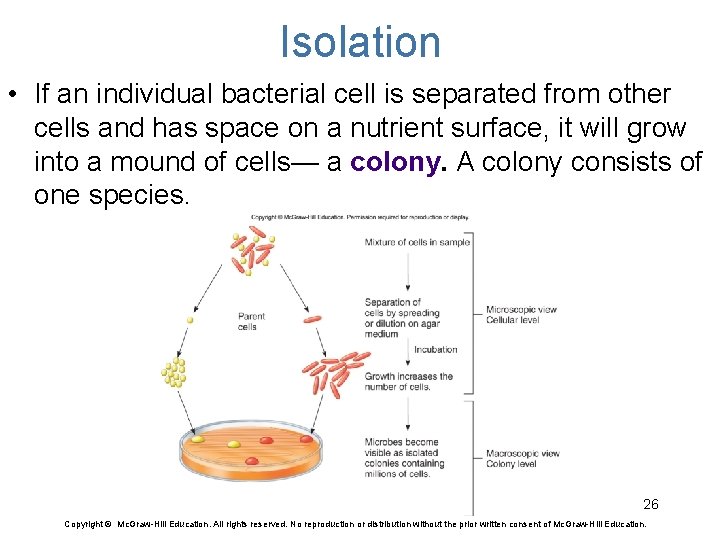
Isolation • If an individual bacterial cell is separated from other cells and has space on a nutrient surface, it will grow into a mound of cells— a colony. A colony consists of one species. 26 Copyright © Mc. Graw-Hill Education. All rights reserved. No reproduction or distribution without the prior written consent of Mc. Graw-Hill Education.
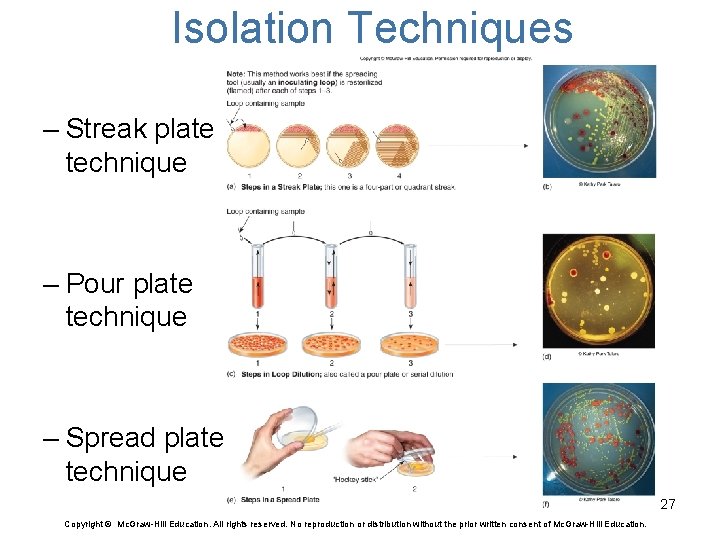
Isolation Techniques – Streak plate technique – Pour plate technique – Spread plate technique 27 Copyright © Mc. Graw-Hill Education. All rights reserved. No reproduction or distribution without the prior written consent of Mc. Graw-Hill Education.
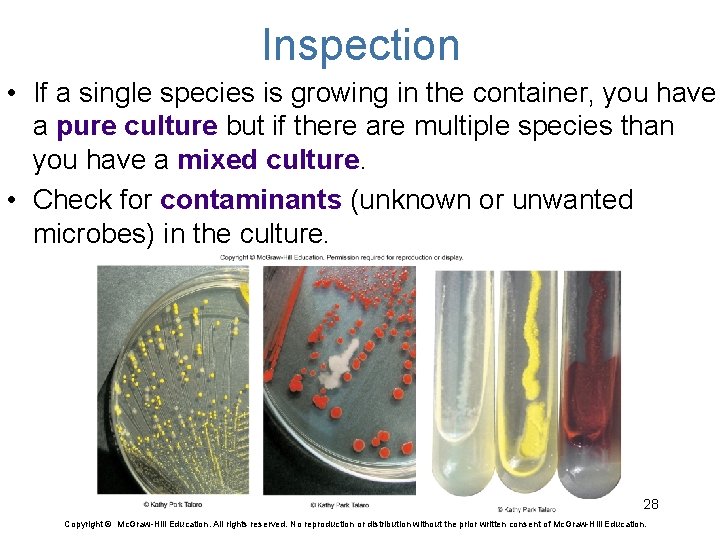
Inspection • If a single species is growing in the container, you have a pure culture but if there are multiple species than you have a mixed culture. • Check for contaminants (unknown or unwanted microbes) in the culture. 28 Copyright © Mc. Graw-Hill Education. All rights reserved. No reproduction or distribution without the prior written consent of Mc. Graw-Hill Education.
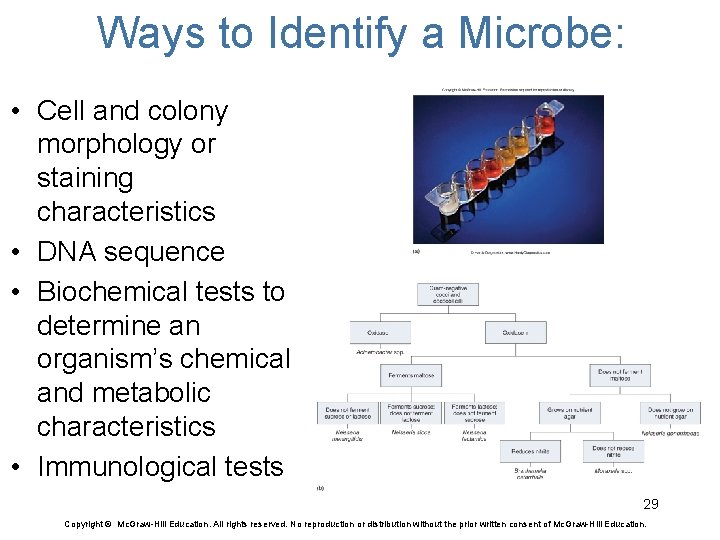
Ways to Identify a Microbe: • Cell and colony morphology or staining characteristics • DNA sequence • Biochemical tests to determine an organism’s chemical and metabolic characteristics • Immunological tests 29 Copyright © Mc. Graw-Hill Education. All rights reserved. No reproduction or distribution without the prior written consent of Mc. Graw-Hill Education.
Media: Providing Nutrients in the Laboratory Media can be classified according to three properties: 1. Physical state – liquid, semisolid, and solid 2. Chemical composition – synthetic (chemically defined) and complex 3. Functional type – general purpose, enriched, selective, differential, anaerobic, transport, assay, enumeration 30 Copyright © Mc. Graw-Hill Education. All rights reserved. No reproduction or distribution without the prior written consent of Mc. Graw-Hill Education.

Physical States of Media Liquid – broth; does not solidify Semisolid – contains solidifying agent Solid – firm surface for colony formation – Contains solidifying agent – Liquefiable and nonliquefiable 31 Copyright © Mc. Graw-Hill Education. All rights reserved. No reproduction or distribution without the prior written consent of Mc. Graw-Hill Education.
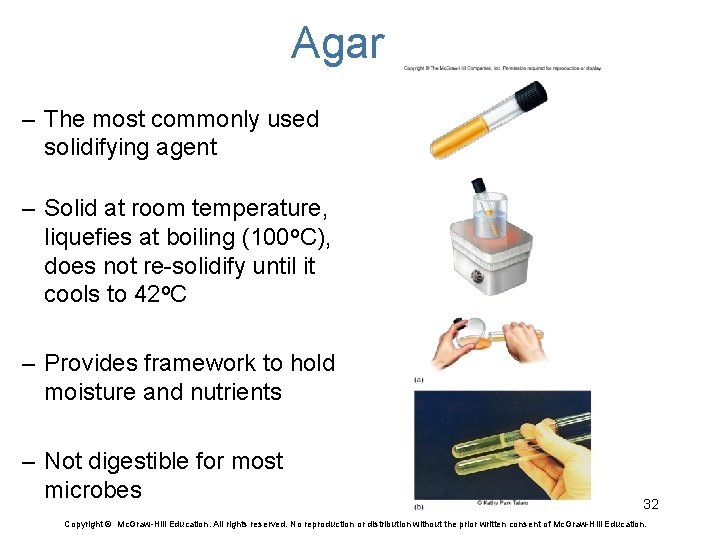
Agar – The most commonly used solidifying agent – Solid at room temperature, liquefies at boiling (100 o. C), does not re-solidify until it cools to 42 o. C – Provides framework to hold moisture and nutrients – Not digestible for most microbes 32 Copyright © Mc. Graw-Hill Education. All rights reserved. No reproduction or distribution without the prior written consent of Mc. Graw-Hill Education.
Chemical Content of Media • Synthetic – contains pure organic and inorganic compounds in an exact chemical formula • Complex or nonsynthetic – contains at least one ingredient that is not chemically definable • General purpose media – grows a broad range of microbes, usually nonsynthetic • Enriched media – contains complex organic substances such as blood, serum, hemoglobin, or special growth factors required by fastidious microbes 33 Copyright © Mc. Graw-Hill Education. All rights reserved. No reproduction or distribution without the prior written consent of Mc. Graw-Hill Education.

Examples of Enriched Media 34 Copyright © Mc. Graw-Hill Education. All rights reserved. No reproduction or distribution without the prior written consent of Mc. Graw-Hill Education.
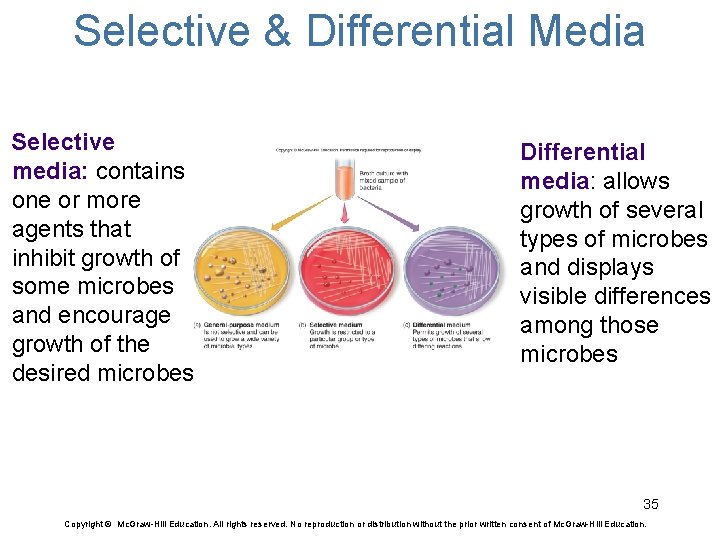
Selective & Differential Media Selective media: contains one or more agents that inhibit growth of some microbes and encourage growth of the desired microbes Differential media: allows growth of several types of microbes and displays visible differences among those microbes 35 Copyright © Mc. Graw-Hill Education. All rights reserved. No reproduction or distribution without the prior written consent of Mc. Graw-Hill Education.
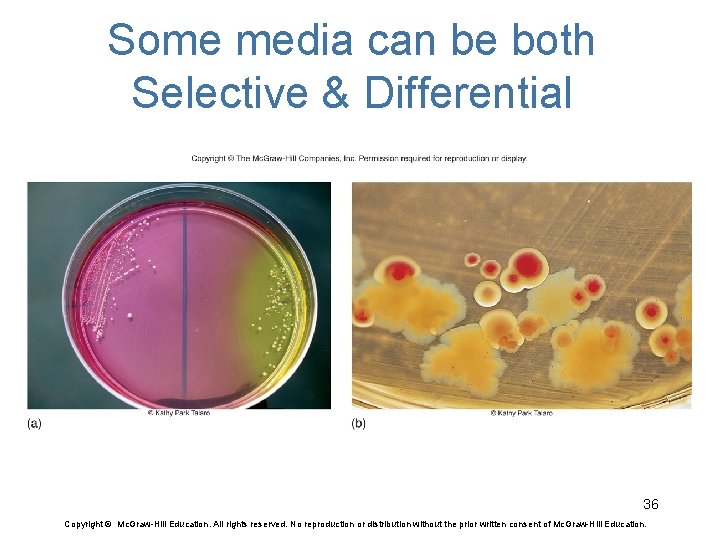
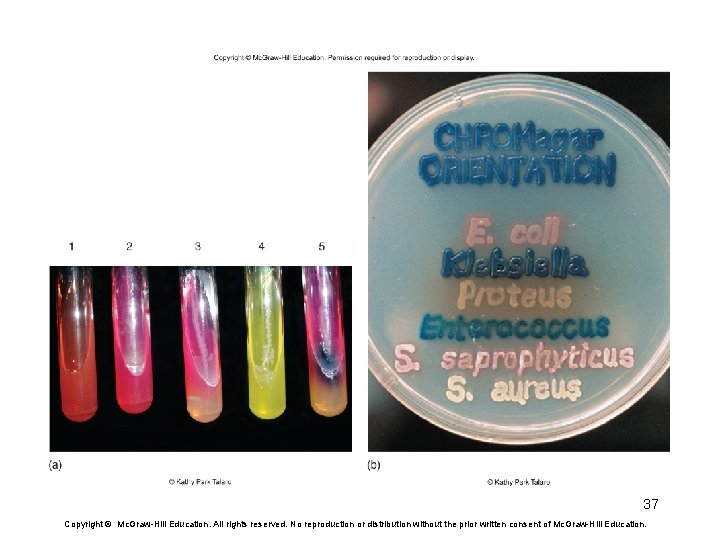
Some media can be both Selective & Differential 36 Copyright © Mc. Graw-Hill Education. All rights reserved. No reproduction or distribution without the prior written consent of Mc. Graw-Hill Education.
37 Copyright © Mc. Graw-Hill Education. All rights reserved. No reproduction or distribution without the prior written consent of Mc. Graw-Hill Education.
- Slides: 37