
Chapter 3 Tools and Equipment Copyright 2011 by
Chapter 3 Tools and Equipment Copyright © 2011 by John Wiley & Sons, Inc. All Rights Reserved
Tools and Equipment • A thorough knowledge of equipment is essential. • All kitchen personnel need to be orientated on the proper usage, cleaning, and safety of all equipment. • Modern cooking and food processing equipment has an extraordinary capacity to burn, cut, smash, mangle, and amputate parts of the tender human body. • Never use a piece of equipment until you are thoroughly familiar with its operation and all its features. • You must learn how to know when a machine is not operating correctly. 2
Tools and Equipment Not All Models Are Alike • It is important to study the operating manual supplied with each item or to be taught by someone who already knows that item well and has operated it. 3
Tools and Equipment Cleaning is part of the operating procedure! • Thorough, regular cleaning of ALL equipment is essential. • Most large equipment can be partially disassembled for cleaning. • Operating manuals should describe these procedures in detail. 4
Tools and Equipment Cleaning Look for equipment models that have been tested and certified by recognized agencies that certify products and write standards. 5
Tools and Equipment Conserve Energy • Know the preheating time for all your cooking equipment so you don’t need to turn it on before necessary. • Plan production so equipment that requires a lot of energy is not on for long periods when not in use. 6
Tools and Equipment Your Hands Are Your Best Tools • Machines are intended to be laborsaving devices. • The usefulness of specialized processing equipment depends on the volume of food it handles. • It takes less time for certain preparations to complete by hand, versus setting up, using, breaking down, and cleaning equipment. • This is why it is important to develop good manual skills. 7
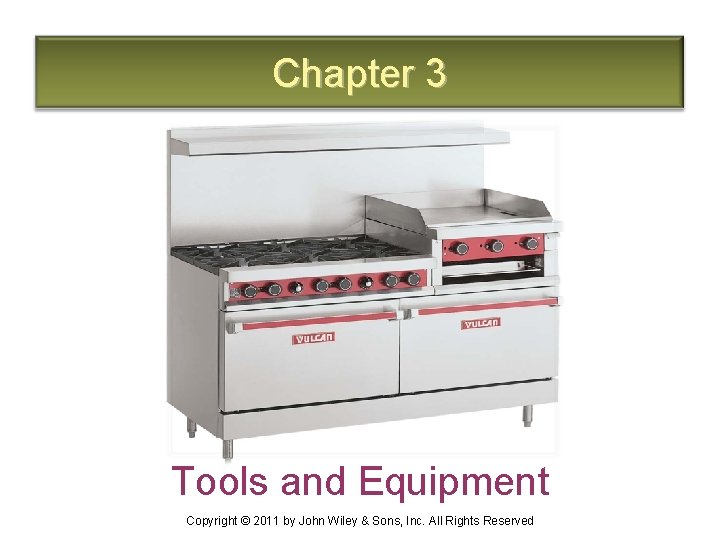
Cooking Equipment Rangetops • The range is still the most important piece of cooking equipment in the kitchen. • Many of its functions have been taken over by other tools such as steamers, steam kettles, tilting skillets, and ovens. 8
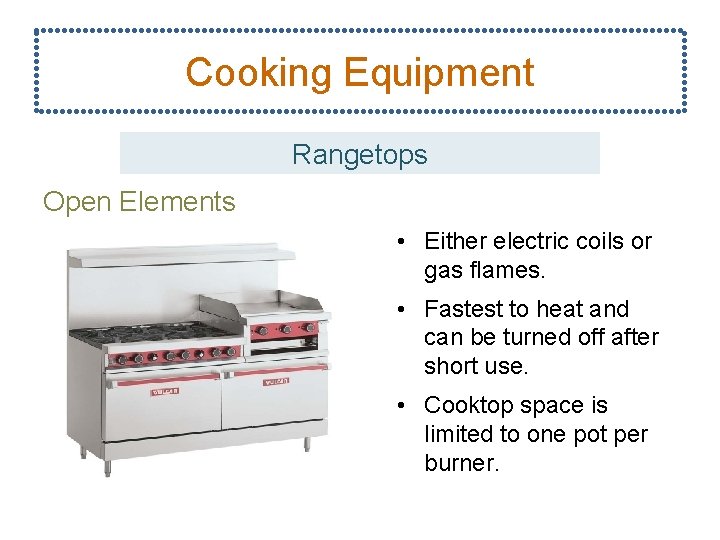
Cooking Equipment Rangetops Open Elements • Either electric coils or gas flames. • Fastest to heat and can be turned off after short use. • Cooktop space is limited to one pot per burner. 9
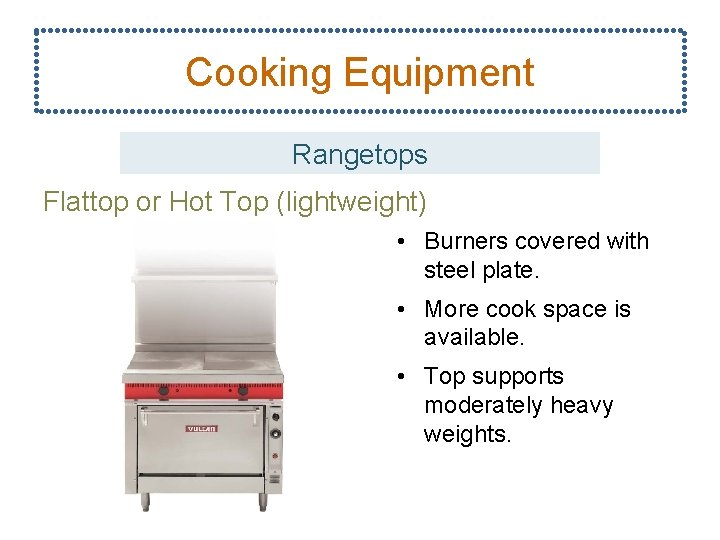
Cooking Equipment Rangetops Flattop or Hot Top (lightweight) • Burners covered with steel plate. • More cook space is available. • Top supports moderately heavy weights. 10
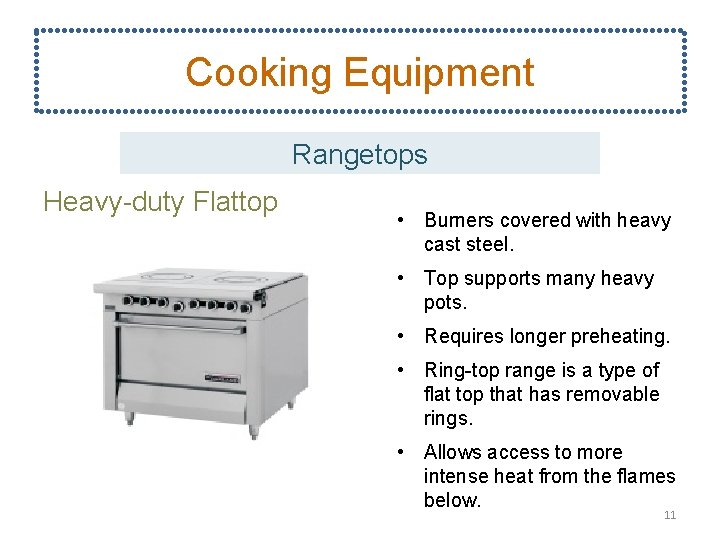
Cooking Equipment Rangetops Heavy-duty Flattop • Burners covered with heavy cast steel. • Top supports many heavy pots. • Requires longer preheating. • Ring-top range is a type of flat top that has removable rings. • Allows access to more intense heat from the flames below. 11
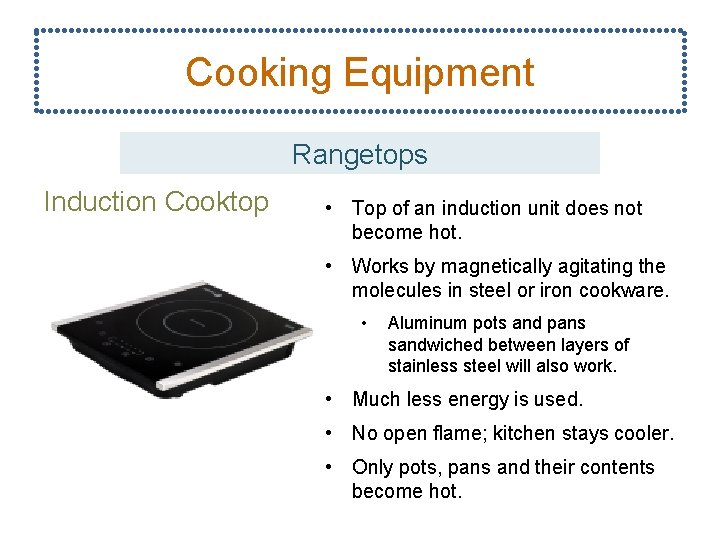
Cooking Equipment Rangetops Induction Cooktop • Top of an induction unit does not become hot. • Works by magnetically agitating the molecules in steel or iron cookware. • Aluminum pots and pans sandwiched between layers of stainless steel will also work. • Much less energy is used. • No open flame; kitchen stays cooler. • Only pots, pans and their contents become hot. 12
Cooking Equipment Ovens & Rangetops • The oven and the rangetop are the two workhorses of the traditional kitchen. • They are often found in the same unit. 13
Cooking Equipment Ovens • Enclosed spaces in which food is heated, usually by hot air. • Or, by microwaves or infrared radiation. • Used for roasting and baking. • Foods can also be simmered, stewed, braised, or poached in the oven. • This helps to free up the rangetop and the chef’s attention for other tasks. 14
Cooking Equipment Ovens for high volume or specialty use: • Conveyor oven: carries foods through the oven on a steel conveyor belt. • Holding oven or warmer: designed to hold foods at serving temperatures for extended periods without drying out or overcooking. • Roll-in oven: high-volume oven with large doors into which one can roll carts loaded with trays of food. 15
Cooking Equipment Ovens Conventional Ovens • Operate simply by heating air in an enclosed space. • Most common ovens are part of the range unit. • Separate oven units or ovens as part of a broiler unit are also available. 16
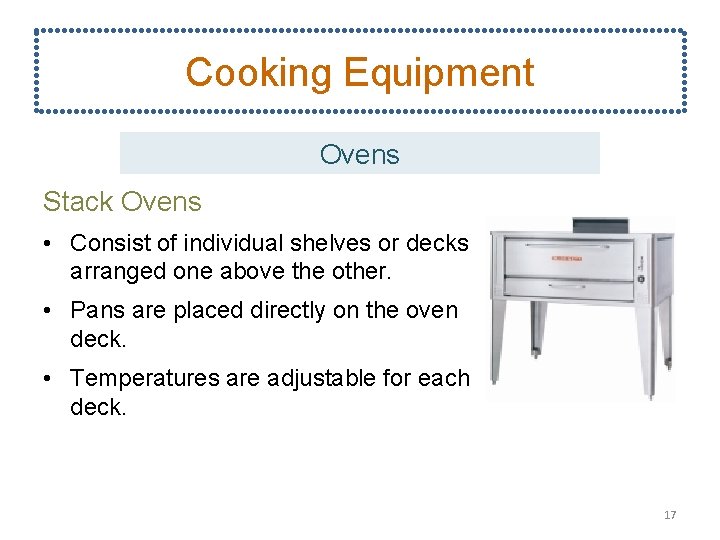
Cooking Equipment Ovens Stack Ovens • Consist of individual shelves or decks arranged one above the other. • Pans are placed directly on the oven deck. • Temperatures are adjustable for each deck. 17
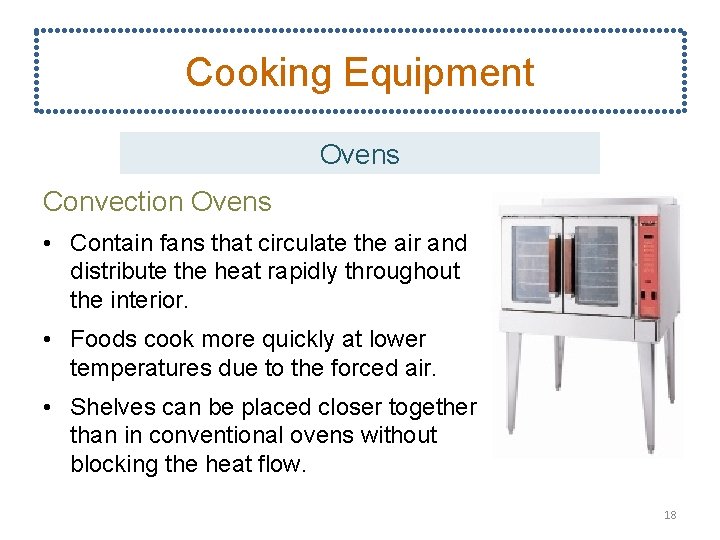
Cooking Equipment Ovens Convection Ovens • Contain fans that circulate the air and distribute the heat rapidly throughout the interior. • Foods cook more quickly at lower temperatures due to the forced air. • Shelves can be placed closer together than in conventional ovens without blocking the heat flow. 18
Cooking Equipment Ovens • Revolving Ovens • Large chambers containing many shelves or trays on an attachment like a Ferris wheel. • Also called reel ovens. • Slow-Cook-and-Hold Ovens • More sophisticated features. • Computerized electronic controls. • Special probes that sense when a roast is done and tell the oven to switch from cooking temperature to holding temperature. 19
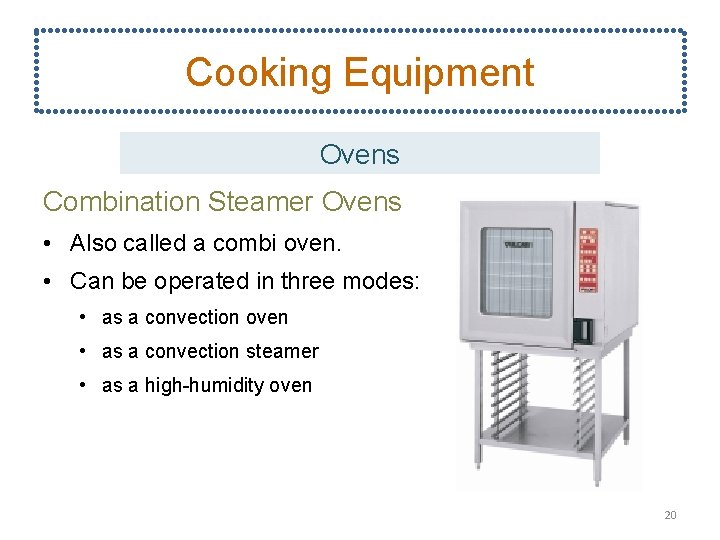
Cooking Equipment Ovens Combination Steamer Ovens • Also called a combi oven. • Can be operated in three modes: • as a convection oven • as a convection steamer • as a high-humidity oven 20
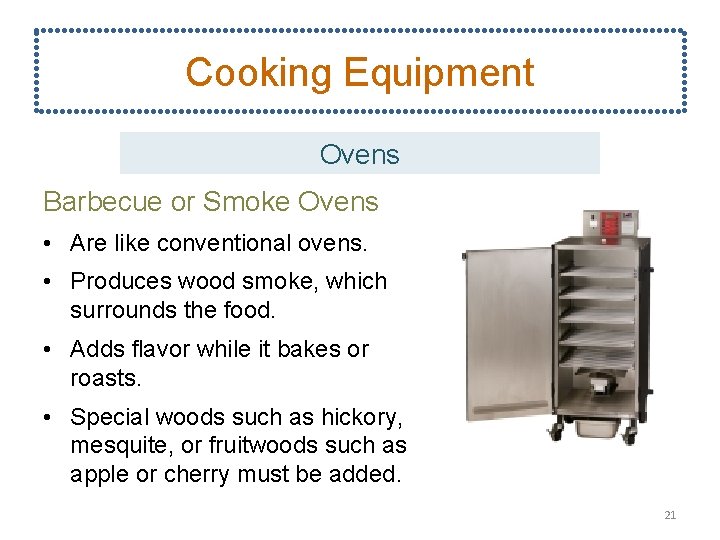
Cooking Equipment Ovens Barbecue or Smoke Ovens • Are like conventional ovens. • Produces wood smoke, which surrounds the food. • Adds flavor while it bakes or roasts. • Special woods such as hickory, mesquite, or fruitwoods such as apple or cherry must be added. 21
Cooking Equipment Ovens Infrared or Reconstituting Ovens • Contain quartz tubes or plates that generate intense infrared heat. • Used primarily for reconstituting frozen foods. • These ovens bring large quantities of foods to serving temperature in a short time. 22
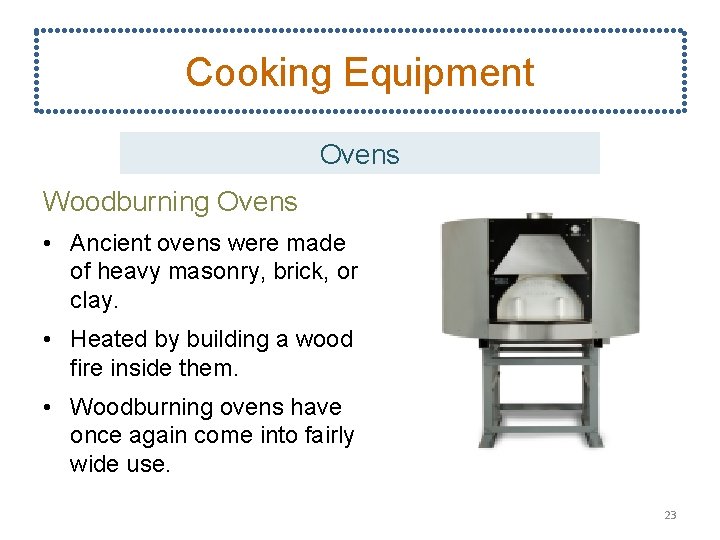
Cooking Equipment Ovens Woodburning Ovens • Ancient ovens were made of heavy masonry, brick, or clay. • Heated by building a wood fire inside them. • Woodburning ovens have once again come into fairly wide use. 23
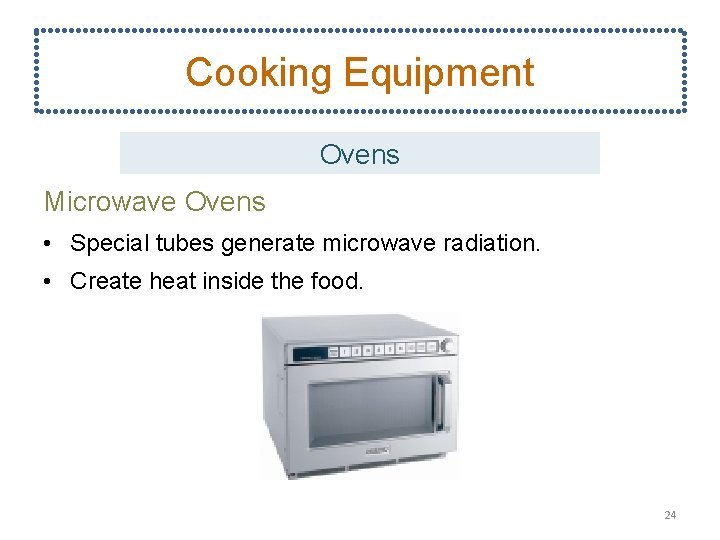
Cooking Equipment Ovens Microwave Ovens • Special tubes generate microwave radiation. • Create heat inside the food. 24
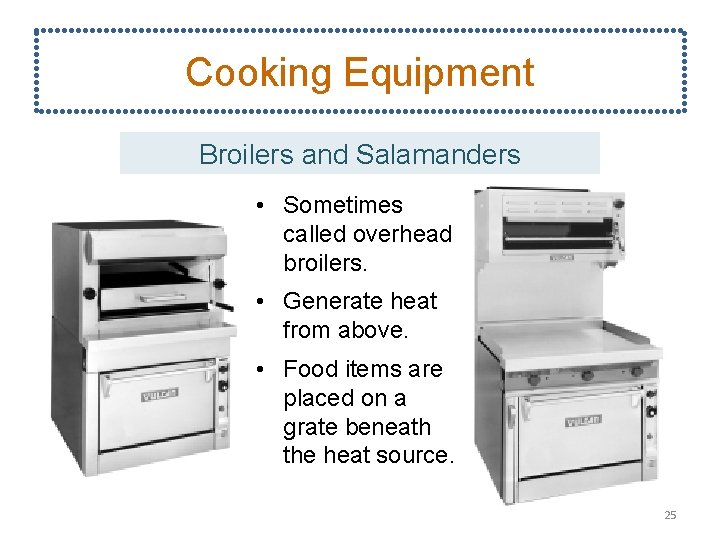
Cooking Equipment Broilers and Salamanders • Sometimes called overhead broilers. • Generate heat from above. • Food items are placed on a grate beneath the heat source. 25
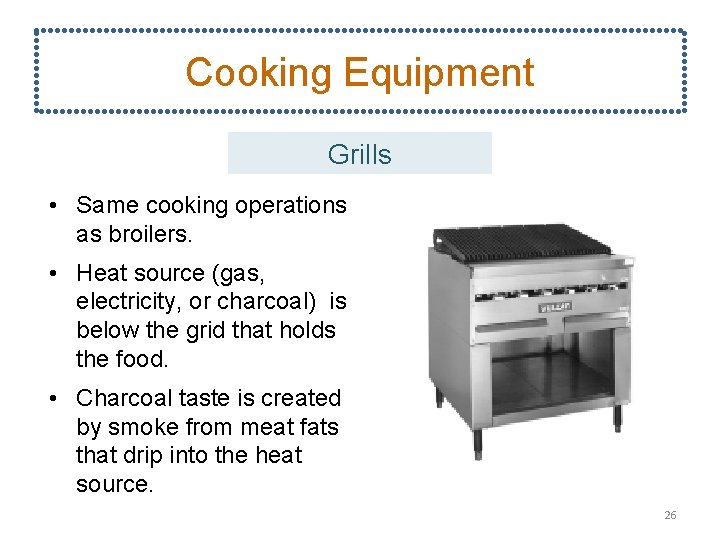
Cooking Equipment Grills • Same cooking operations as broilers. • Heat source (gas, electricity, or charcoal) is below the grid that holds the food. • Charcoal taste is created by smoke from meat fats that drip into the heat source. 26
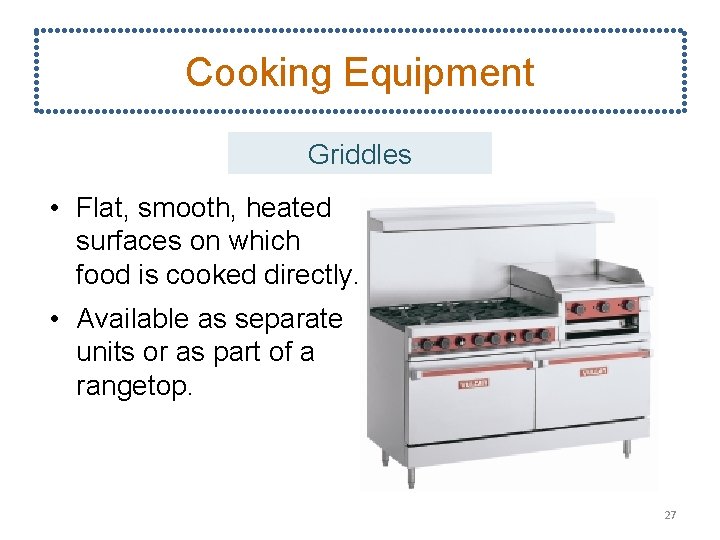
Cooking Equipment Griddles • Flat, smooth, heated surfaces on which food is cooked directly. • Available as separate units or as part of a rangetop. 27
Cooking Equipment Rotisseries • Cooks meats and other foods by turning them slowly in front of electric or gas-powered heating elements. • Especially suitable for chicken and other poultry. • Can be used to cook any meat or other food. • Drip pans catch juices, which can be used for basting or making gravy. 28
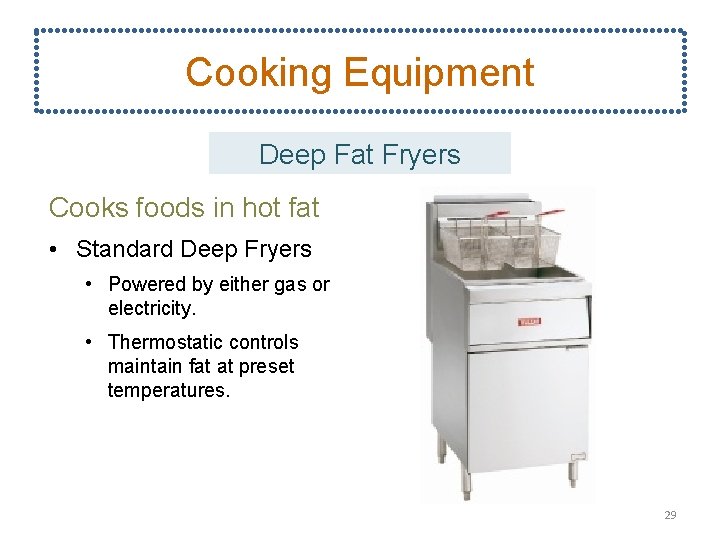
Cooking Equipment Deep Fat Fryers Cooks foods in hot fat • Standard Deep Fryers • Powered by either gas or electricity. • Thermostatic controls maintain fat at preset temperatures. 29
Cooking Equipment Deep Fat Fryers Automatic Fryers • Remove food from the fat automatically after a preset time. Pressure Fryers • Covered fry kettles that fry foods under pressure. • Foods cook faster. 30
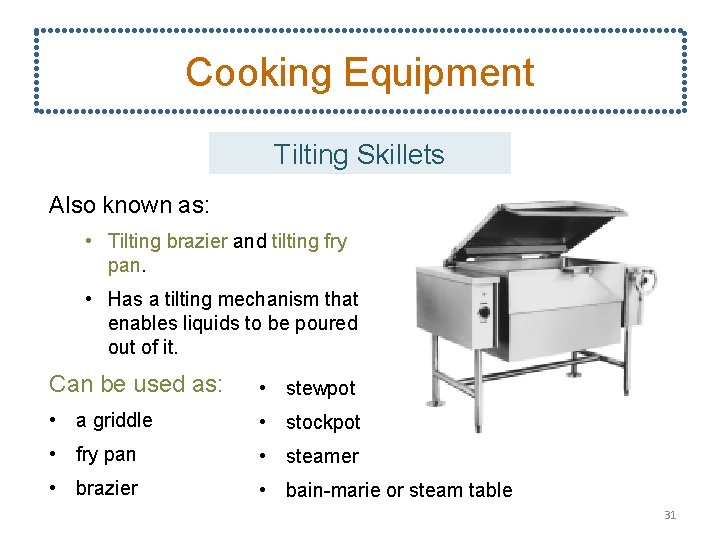
Cooking Equipment Tilting Skillets Also known as: • Tilting brazier and tilting fry pan. • Has a tilting mechanism that enables liquids to be poured out of it. Can be used as: • stewpot • a griddle • stockpot • fry pan • steamer • brazier • bain-marie or steam table 31
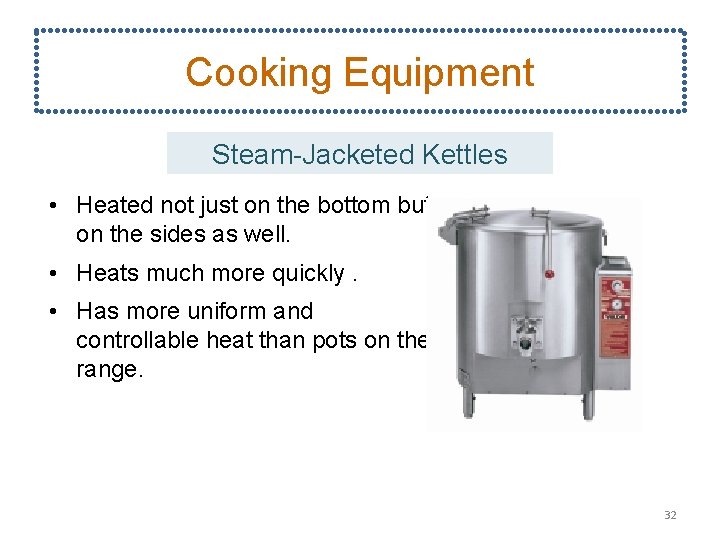
Cooking Equipment Steam-Jacketed Kettles • Heated not just on the bottom but on the sides as well. • Heats much more quickly. • Has more uniform and controllable heat than pots on the range. 32
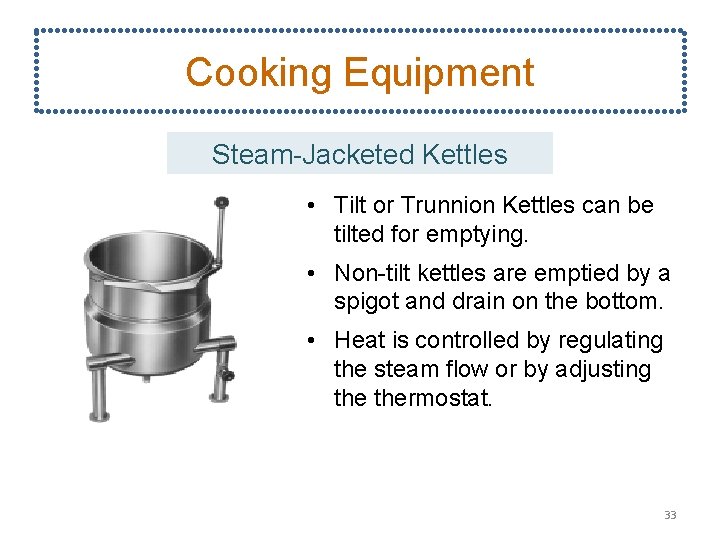
Cooking Equipment Steam-Jacketed Kettles • Tilt or Trunnion Kettles can be tilted for emptying. • Non-tilt kettles are emptied by a spigot and drain on the bottom. • Heat is controlled by regulating the steam flow or by adjusting thermostat. 33
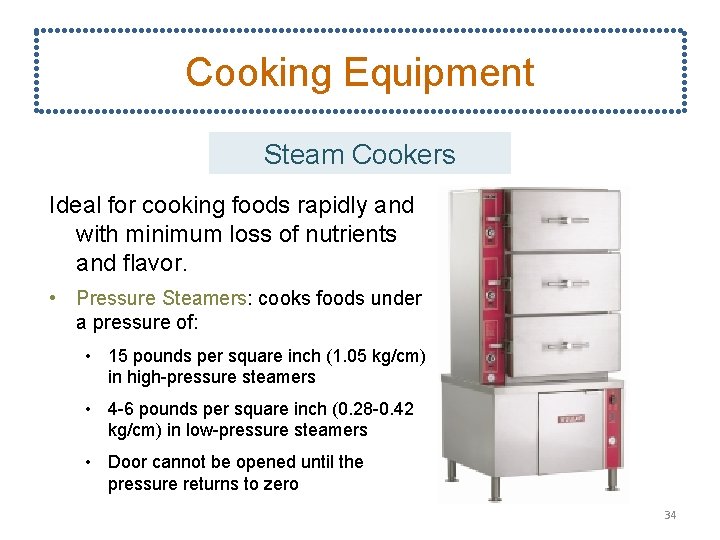
Cooking Equipment Steam Cookers Ideal for cooking foods rapidly and with minimum loss of nutrients and flavor. • Pressure Steamers: cooks foods under a pressure of: • 15 pounds per square inch (1. 05 kg/cm) in high-pressure steamers • 4 -6 pounds per square inch (0. 28 -0. 42 kg/cm) in low-pressure steamers • Door cannot be opened until the pressure returns to zero 34
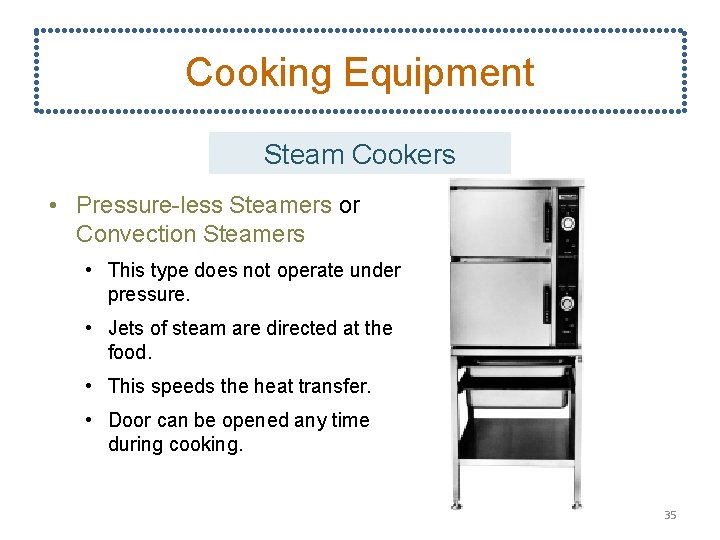
Cooking Equipment Steam Cookers • Pressure-less Steamers or Convection Steamers • This type does not operate under pressure. • Jets of steam are directed at the food. • This speeds the heat transfer. • Door can be opened any time during cooking. 35
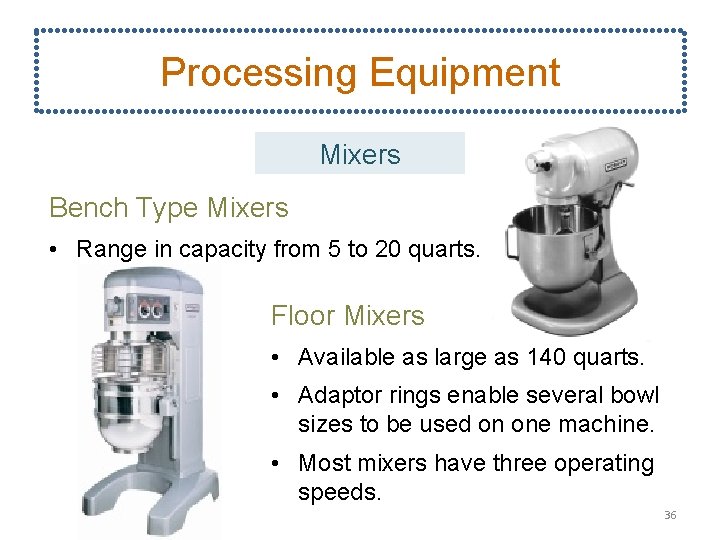
Processing Equipment Mixers Bench Type Mixers • Range in capacity from 5 to 20 quarts. Floor Mixers • Available as large as 140 quarts. • Adaptor rings enable several bowl sizes to be used on one machine. • Most mixers have three operating speeds. 36
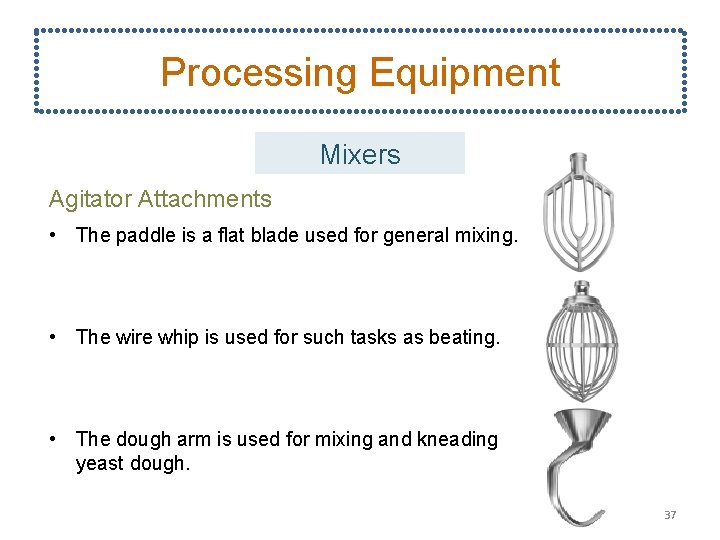
Processing Equipment Mixers Agitator Attachments • The paddle is a flat blade used for general mixing. • The wire whip is used for such tasks as beating. • The dough arm is used for mixing and kneading yeast dough. 37
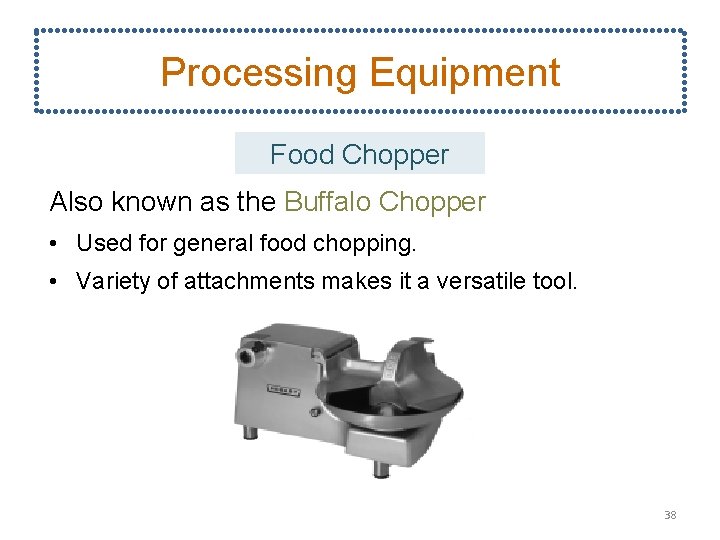
Processing Equipment Food Chopper Also known as the Buffalo Chopper • Used for general food chopping. • Variety of attachments makes it a versatile tool. 38
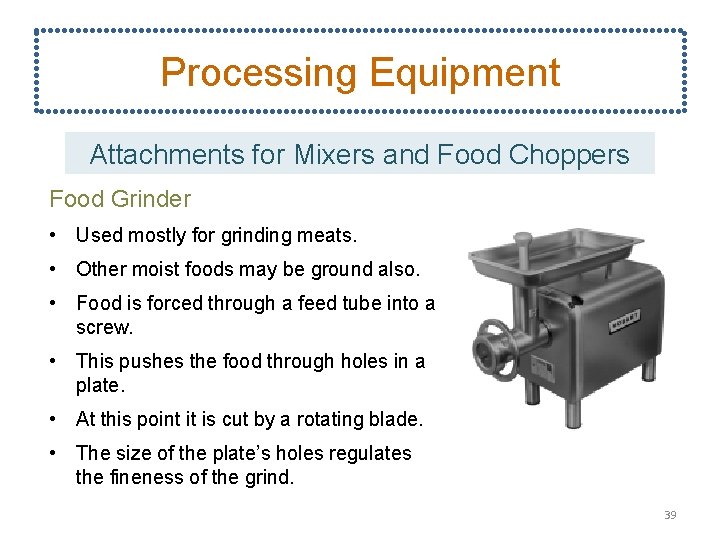
Processing Equipment Attachments for Mixers and Food Choppers Food Grinder • Used mostly for grinding meats. • Other moist foods may be ground also. • Food is forced through a feed tube into a screw. • This pushes the food through holes in a plate. • At this point it is cut by a rotating blade. • The size of the plate’s holes regulates the fineness of the grind. 39
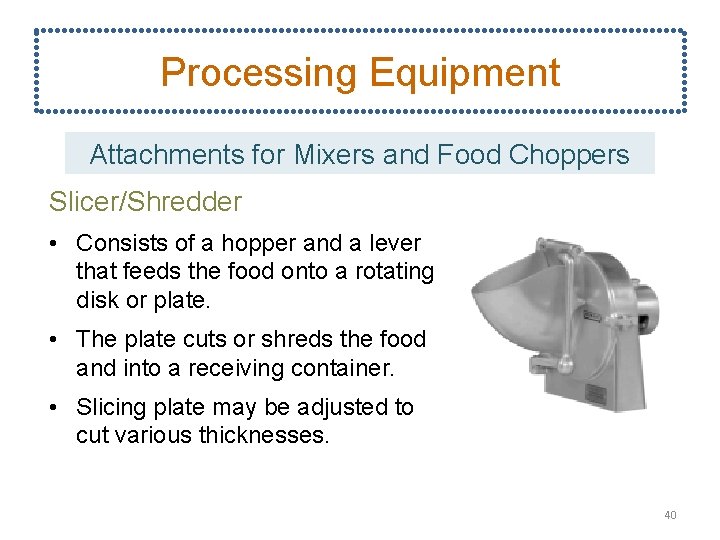
Processing Equipment Attachments for Mixers and Food Choppers Slicer/Shredder • Consists of a hopper and a lever that feeds the food onto a rotating disk or plate. • The plate cuts or shreds the food and into a receiving container. • Slicing plate may be adjusted to cut various thicknesses. 40
Processing Equipment Attachments for Mixers and Food Choppers Dicer • Attachment forces foods through a grid-type blade that cuts them into perfect dice. • Blades of different sizes may be used. 41
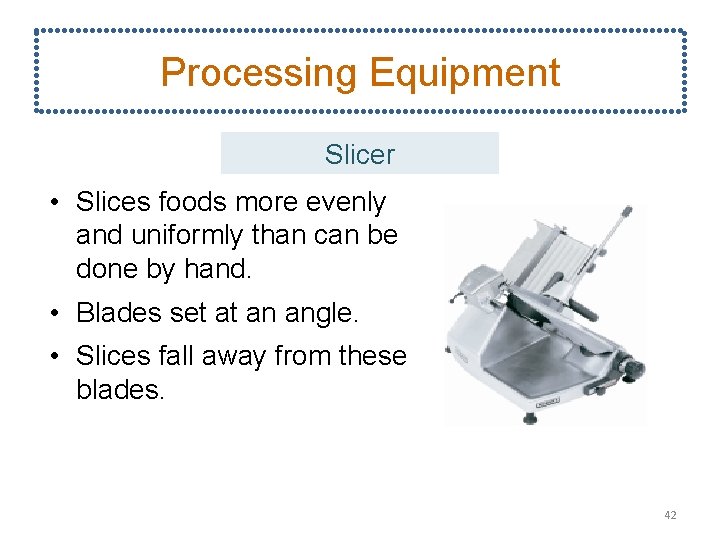
Processing Equipment Slicer • Slices foods more evenly and uniformly than can be done by hand. • Blades set at an angle. • Slices fall away from these blades. 42
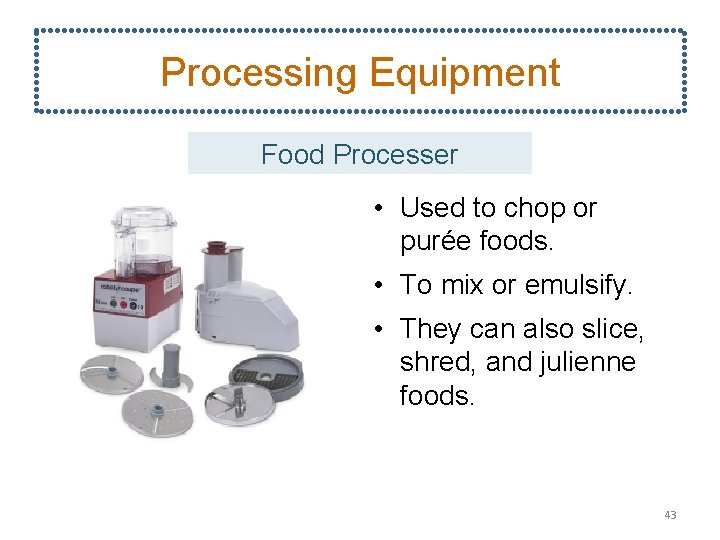
Processing Equipment Food Processer • Used to chop or purée foods. • To mix or emulsify. • They can also slice, shred, and julienne foods. 43
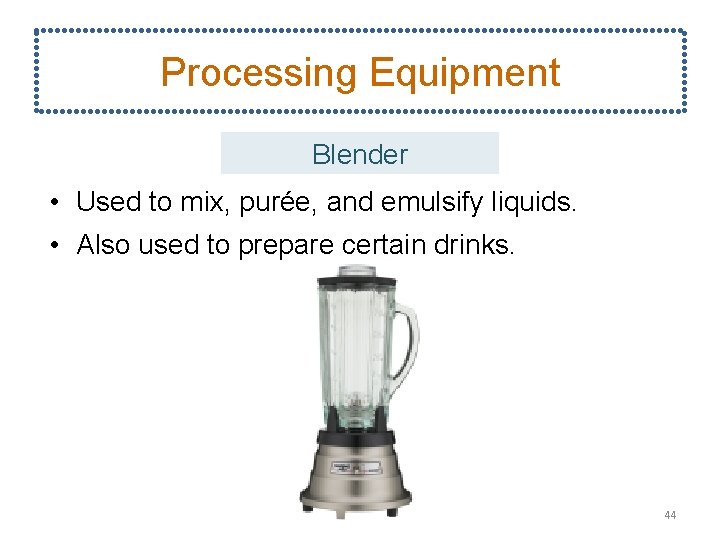
Processing Equipment Blender • Used to mix, purée, and emulsify liquids. • Also used to prepare certain drinks. 44
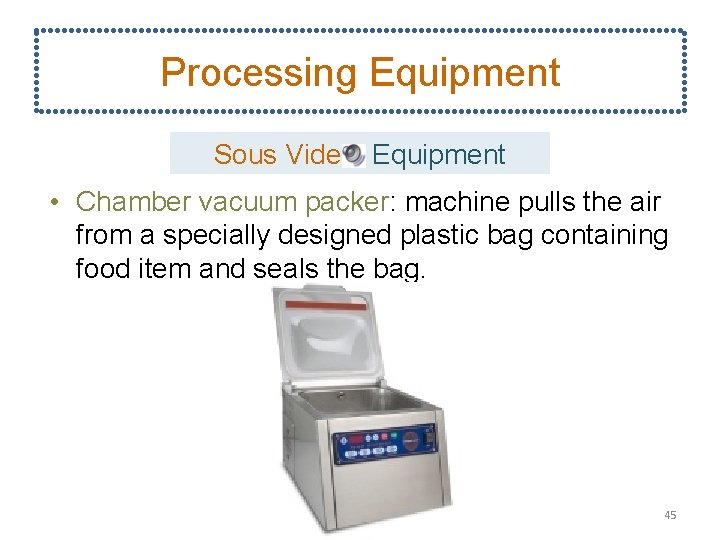
Processing Equipment Sous Vide Equipment • Chamber vacuum packer: machine pulls the air from a specially designed plastic bag containing food item and seals the bag. 45
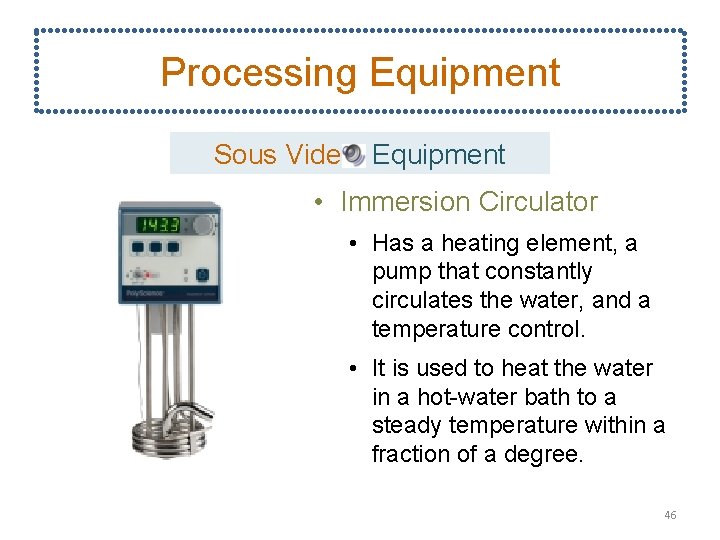
Processing Equipment Sous Vide Equipment • Immersion Circulator • Has a heating element, a pump that constantly circulates the water, and a temperature control. • It is used to heat the water in a hot-water bath to a steady temperature within a fraction of a degree. 46
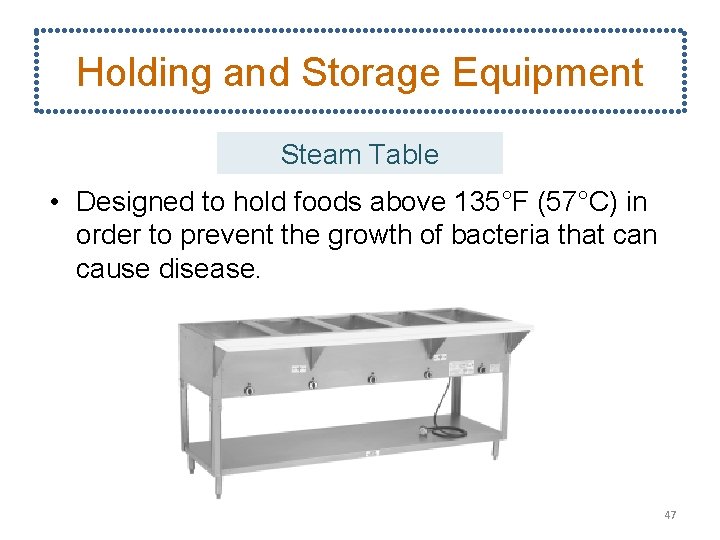
Holding and Storage Equipment Steam Table • Designed to hold foods above 135°F (57°C) in order to prevent the growth of bacteria that can cause disease. 47
Holding and Storage Equipment Cold Food Storage Equipment • The refrigerator (known in the trade as the cooler or the box) guards against spoilage and bacterial growth by keeping foods cold, usually, below 41°F (5°C). • The walk-in is a room-size refrigerator with built-in shelves on the walls. • The reach-in is a standard upright refrigerator that does not have freezer unit. 48
Holding and Storage Equipment Cold Food Storage Equipment • The freezer stores foods purchased in frozen form; used to hold foods for longer times. • The walk-in is a room-size freezer with built-in shelves on the walls. • The reach-in is a standard upright freezer. 49
- Slides: 49