
CHAPTER 3 THERAPEUTIC RANGE And ROUTES OF ADMINISTRATION
- Slides: 29
CHAPTER 3 THERAPEUTIC RANGE And ROUTES OF ADMINISTRATION Part 1
PROPER DRUG ADMINISTRATION u PROPER DRUG ADMINISTRATION is not simply calculating the correct amount of medication to prescribe to a patient. u There are many factors that play into making sure the patient is properly medicated u ALL DRUGS ARE POTENTIAL
PROPER DRUG ADMINISTRATION The CORRECT drug must be prescribed at the CORRECT dosage to be given in the CORRECT route at the CORRECT time to the CORRECT patient. It must be labeled CORRECTLY, explained to the client CORRECTLY and documented CORRECTLY.
u The goal of medicating is to deliver the desired drug concentration within the target area of the body to achieve the desired effect. u MORE drug is not better, LESS drug is not better. The more drug given, the more opportunities for organ damage to occur. The less amount of drug that is given, the less likely that the proper drug levels will be produced and the
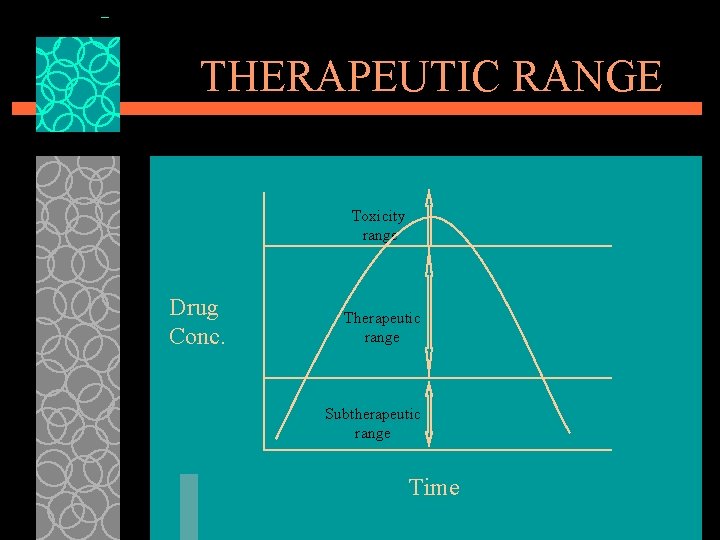
THERAPEUTIC RANGE Toxicity range Drug Conc. Therapeutic range Subtherapeutic range Time
THERAPEUTIC RANGE u THERAPEUTIC RANGE is the drug concentration in the body that produces the desired effect in the animal with minimal or no signs of toxicity. u The drug dosage is determined by laboratory and clinical testing to keep the drug levels in therapeutic range in the body.
What makes a drug get in and stay in the THERAPEUTIC RANGE? u Maintaining a balance between the rate of drug entry into the body, absorption, distribution, metabolism, and excretion of the drug. u Health of the animal u MAJOR FACTORS: – ROUTE OF ADMINISTRATION – DOSE – DOSAGE INTERVAL
ROUTE OF ADMINISTRATION How a drug is administered and how it enters into the body 2 MAJOR CATEGORIES t PARENTERAL: Route that does not involve the GI tract t NONPARENTERAL: Route that involves the GI tract
What determines the ROUTE? DRUG FACTORS u Different effects when given in different ways u An injectable has to be water soluble when administered IV u Stomach acid can inactivate some drugs, causing them to not be given orally
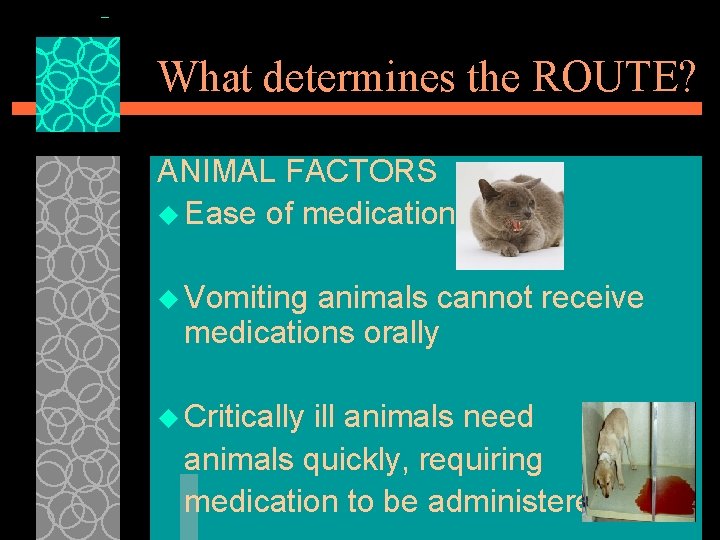
What determines the ROUTE? ANIMAL FACTORS u Ease of medication u Vomiting animals cannot receive medications orally u Critically ill animals need animals quickly, requiring medication to be administered IV
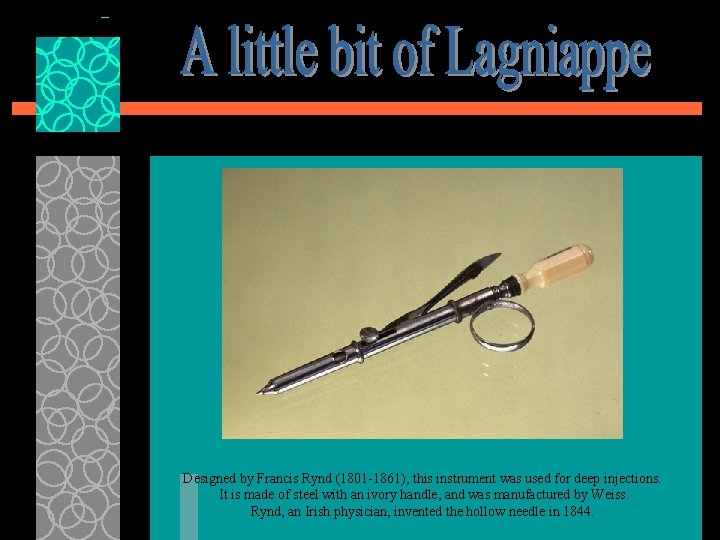
Designed by Francis Rynd (1801 -1861), this instrument was used for deep injections. It is made of steel with an ivory handle, and was manufactured by Weiss. Rynd, an Irish physician, invented the hollow needle in 1844.
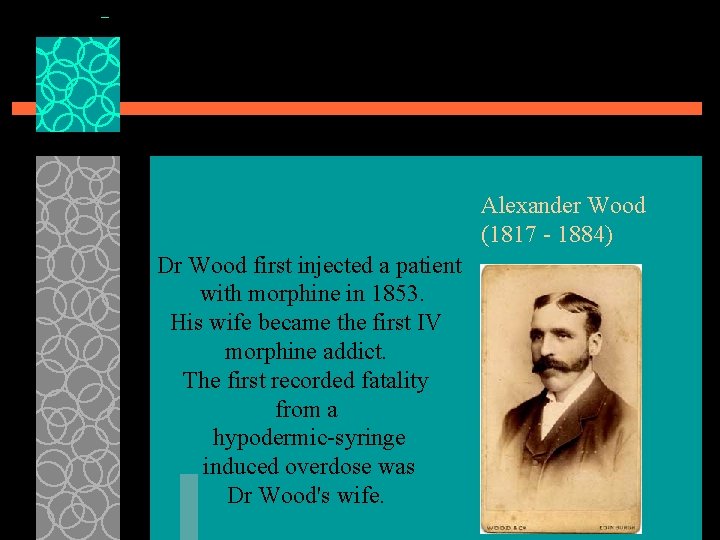
Alexander Wood (1817 - 1884) Dr Wood first injected a patient with morphine in 1853. His wife became the first IV morphine addict. The first recorded fatality from a hypodermic-syringe induced overdose was Dr Wood's wife.
TRYPANOPHOBIA u TRYPANOPHOBIA is the extreme and irrational fear of medical procedures involving injections or hypodermic needles. u It is occasionally referred to as aichmophobia, belonephobia, or enetophobia, names that are technically incorrect because they simply denote a “fear of pins/needles”. u The name that is in common usage is
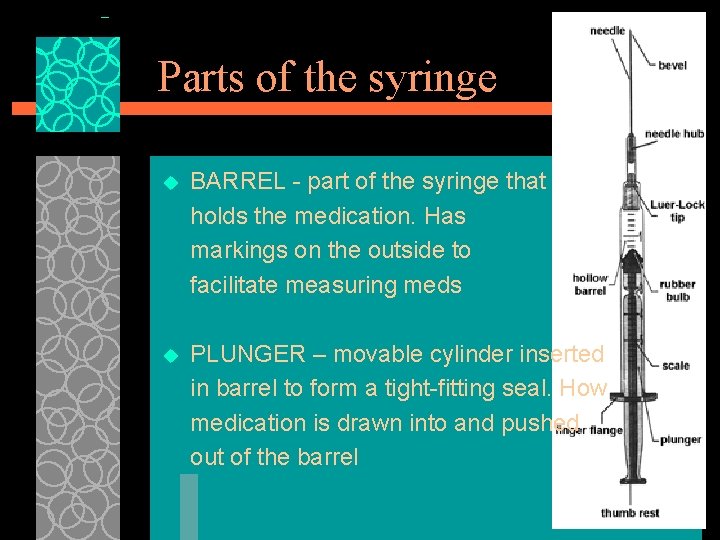
Parts of the syringe u BARREL - part of the syringe that holds the medication. Has markings on the outside to facilitate measuring meds u PLUNGER – movable cylinder inserted in barrel to form a tight-fitting seal. How medication is drawn into and pushed out of the barrel
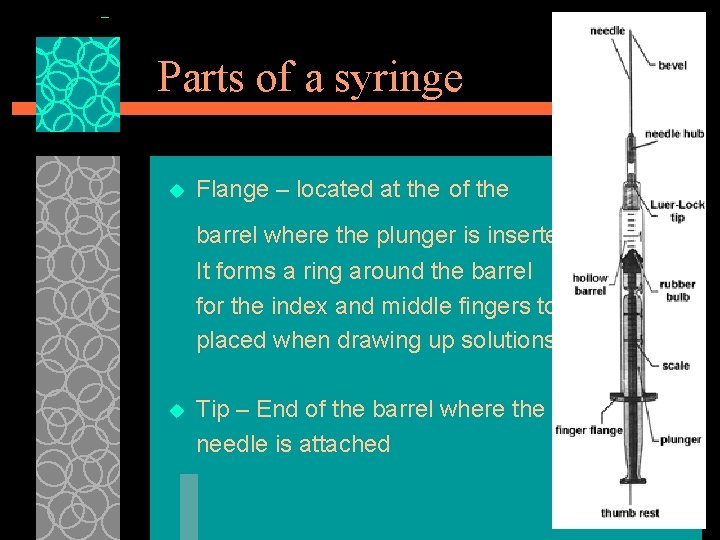
Parts of a syringe u Flange – located at the of the barrel where the plunger is inserted. It forms a ring around the barrel for the index and middle fingers to be placed when drawing up solutions. u Tip – End of the barrel where the needle is attached
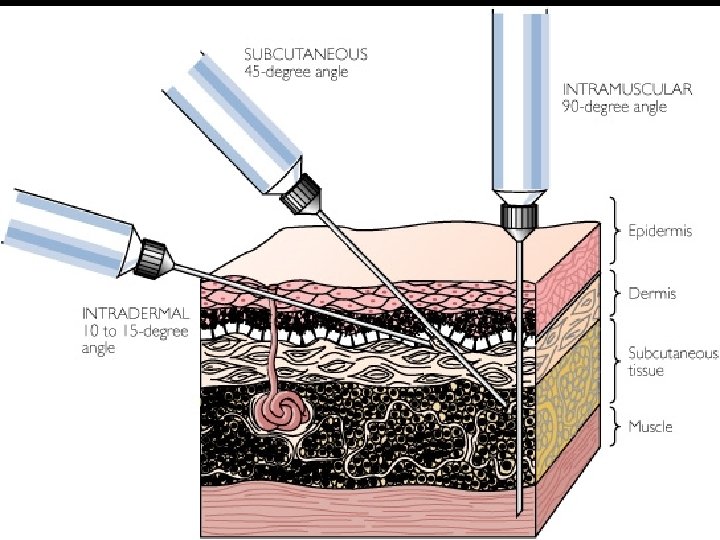
3 Most Common Routes of Injections u. Intravenous (IV) u. Intramuscular (IM) u. Subcutaneuous SQ) (SC,
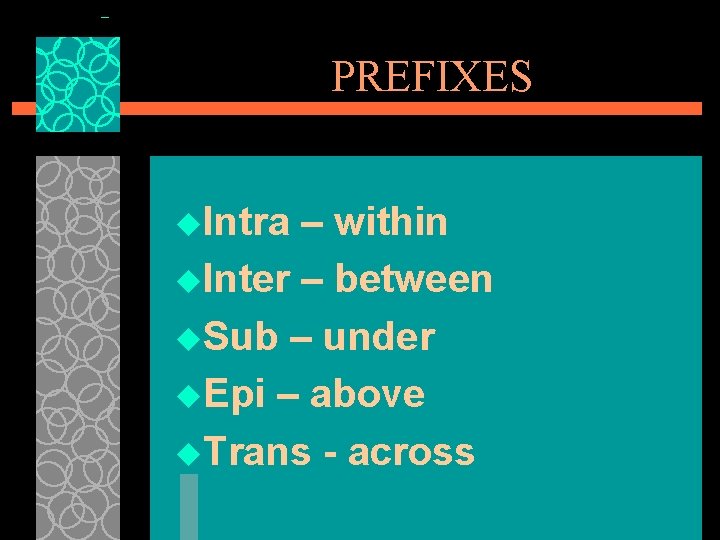
PREFIXES u. Intra – within u. Inter – between u. Sub – under u. Epi – above u. Trans - across
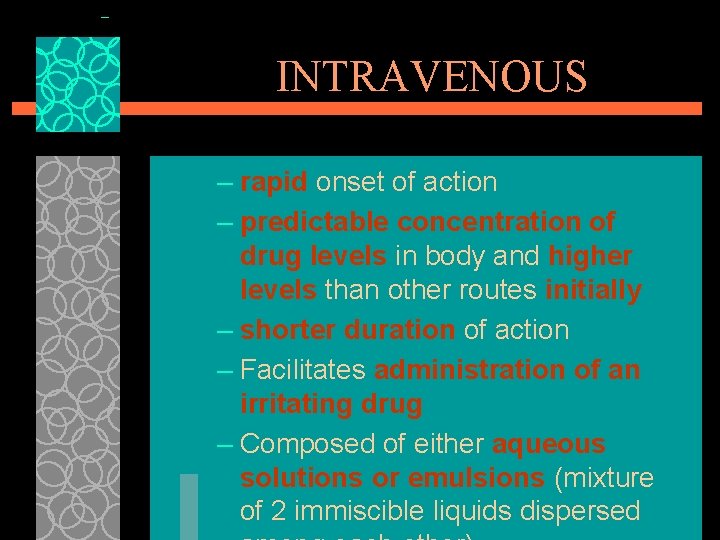
INTRAVENOUS – rapid onset of action – predictable concentration of drug levels in body and higher levels than other routes initially – shorter duration of action – Facilitates administration of an irritating drug – Composed of either aqueous solutions or emulsions (mixture of 2 immiscible liquids dispersed
Intravenous cont’d IV injections are given in 3 different ways: u BOLUS: injecting a concentrated mass of a drug in a minute amount of fluid with only a needle and syringe. Used to achieve immediate high concentrations of drugs. u INTERMITTENT: diluting a drug dose in a small volume of fluid and administering it during a 30 -
Intravenous cont’d u INFUSION – administration of large volumes of fluid continuously over extended periods of time
IV RISKS u drug could be administered too rapidly u injection not performed in a sterile manner u drugs not properly mixed u risk of air or foreign particles causing an embolus
INTRAMUSCULAR u Onset of action within ~30 minutes u Provides reliable blood levels u Longer duration of action than IV, shorter duration of action than oral u No irritating solutions u Option for fractious animals
INTRAMUSCULAR u Rate of absorption depends on formulation (solution vs. suspension) or vehicle u Solution – clear liquid preparation that contains u Suspension – liquid preparation that contains solid u Repository/Depot Preparation – Placing an one or more solvents and one or more solutes. Blood levels within 5 minutes. drug particles suspended in a suitable medium. Absorbed more slowly – prolonged introduction into the bloodstream. injectable drug in a substance (such as an oil) that delays absorption (ex: Depo-Medrol). Depo = long acting
INTRAMUSCULAR u THINGS TO REMEMBER: u Always pull back on the plunger to be sure that you are not in a blood vessel before you inject. u Don’t give the injection too shallow; you risk not getting the drugs into the muscle. u IM injections can be painful.
SUBCUTANEOUS Placing a drug into the connective tissue underneath the dermis of the skin u Faster onset than oral, slower than IM (fewer blood vessels) u Longer duration of action than IM u No irritating solutions u Can inject large volumes (SC fluids) u Blood levels are similar to oral administration
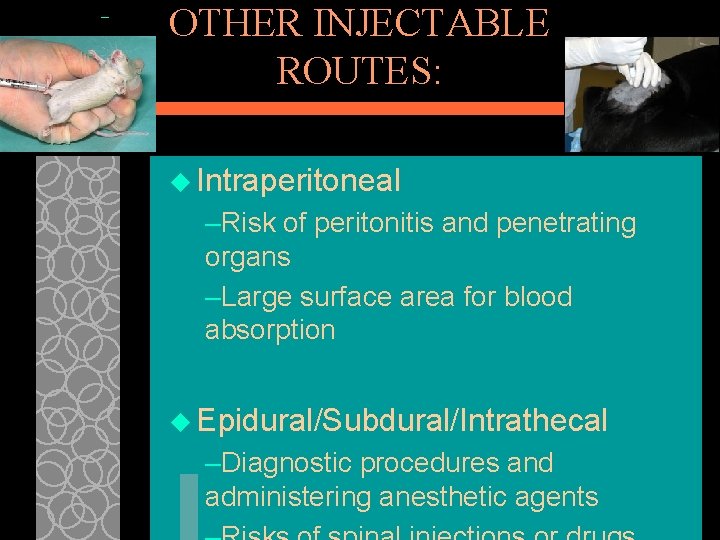
OTHER INJECTABLE ROUTES: u Intraperitoneal –Risk of peritonitis and penetrating organs –Large surface area for blood absorption u Epidural/Subdural/Intrathecal –Diagnostic procedures and administering anesthetic agents
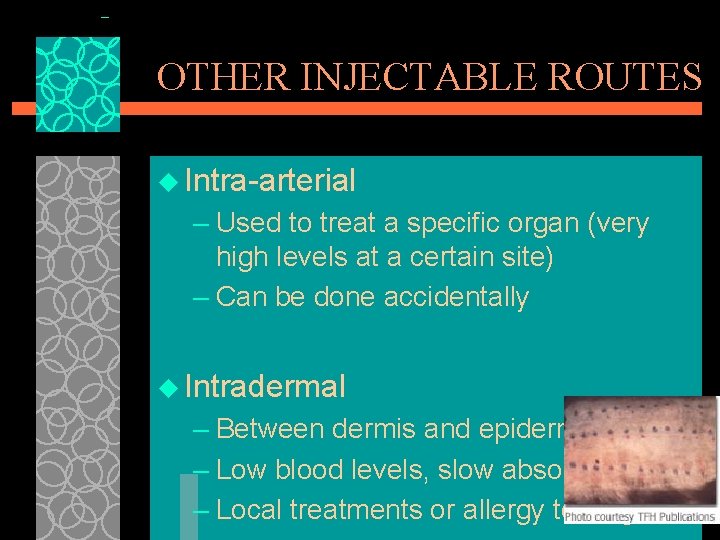
OTHER INJECTABLE ROUTES u Intra-arterial – Used to treat a specific organ (very high levels at a certain site) – Can be done accidentally u Intradermal – Between dermis and epidermis – Low blood levels, slow absorption – Local treatments or allergy testing
OTHER INJECTABLE ROUTES: u Intracardiac – Rapid blood levels – Emergencies and euthanasias u Intra-articular – Must use aseptic technique u Intramedullary/Intraosseous – Rapid blood levels – Not common, painful – Rapid fluid administration