
Chapter 3 Theories of International Relations Realism and

- Slides: 34
Chapter 3 Theories of International Relations: Realism and Liberalism
Learning Objectives 1. Identify the major assumptions of the realist and liberal approaches. 2. Distinguish the major strands of theory within each approach. 3. Understand the normative positions of realism and liberalism. Copyright © 2014 Cengage Learning. All rights reserved. 2
Learning Objectives 4. 5. 6. Summarize the major critiques of each approach. Identify ways in which each approach can be linked to policy problems. Articulate and defend an argument concerning the relative merits of the different approaches. Copyright © 2014 Cengage Learning. All rights reserved. 3
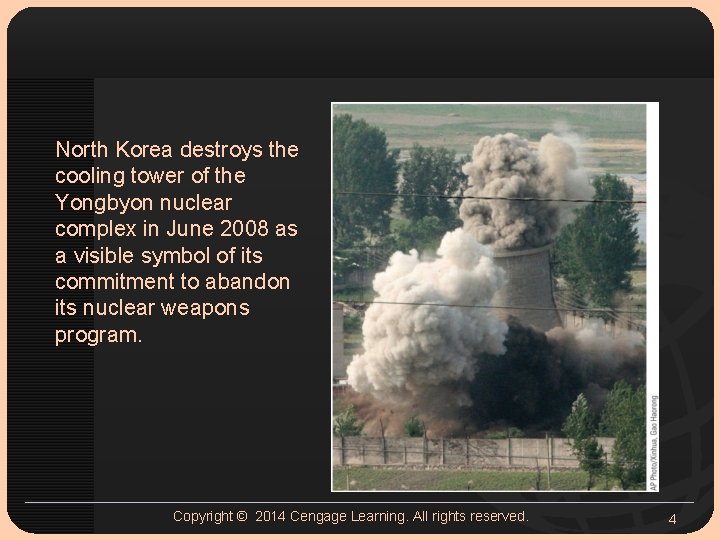
North Korea destroys the cooling tower of the Yongbyon nuclear complex in June 2008 as a visible symbol of its commitment to abandon its nuclear weapons program. Copyright © 2014 Cengage Learning. All rights reserved. 4
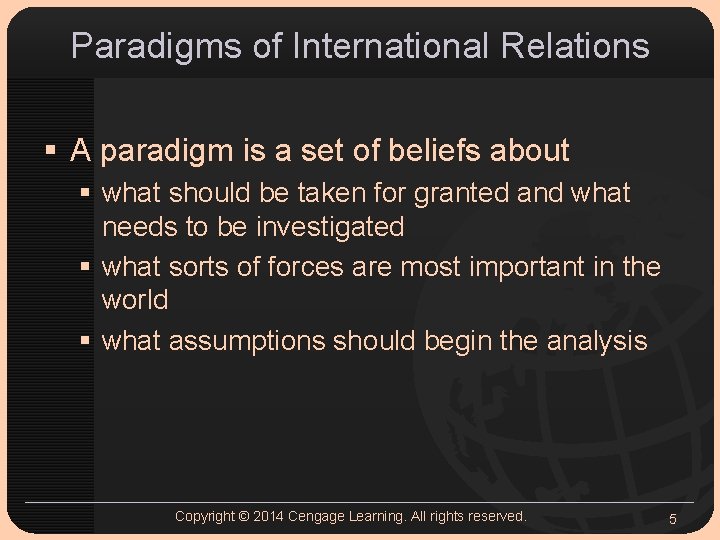
Paradigms of International Relations § A paradigm is a set of beliefs about § what should be taken for granted and what needs to be investigated § what sorts of forces are most important in the world § what assumptions should begin the analysis Copyright © 2014 Cengage Learning. All rights reserved. 5
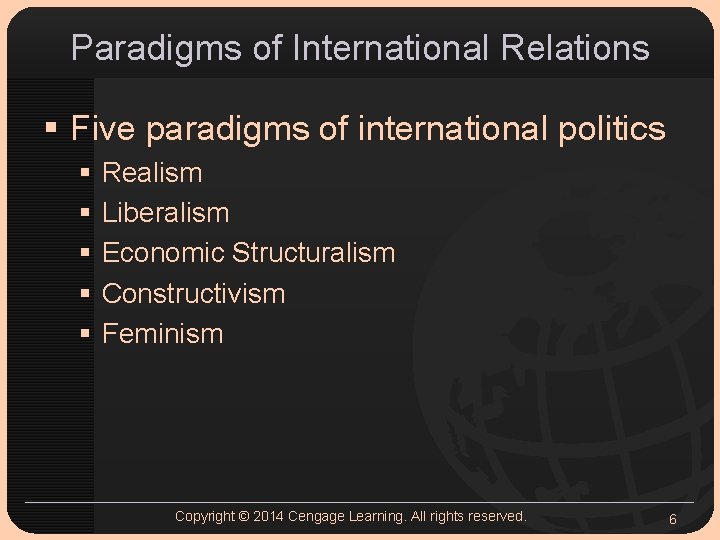
Paradigms of International Relations § Five paradigms of international politics § § § Realism Liberalism Economic Structuralism Constructivism Feminism Copyright © 2014 Cengage Learning. All rights reserved. 6
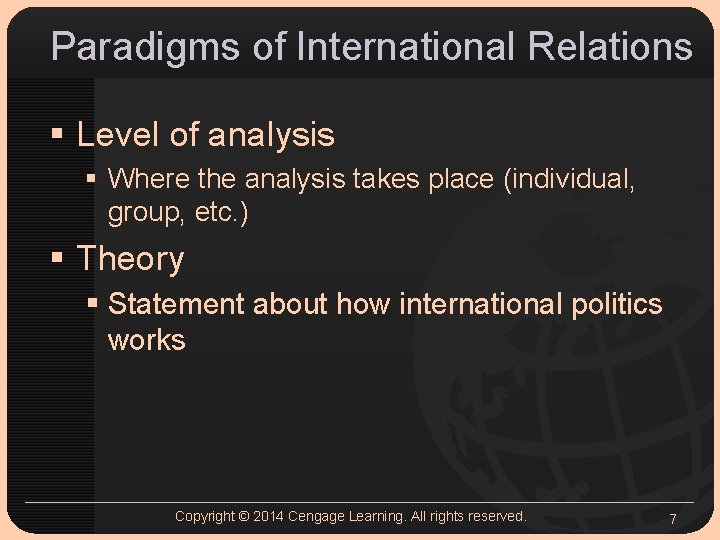
Paradigms of International Relations § Level of analysis § Where the analysis takes place (individual, group, etc. ) § Theory § Statement about how international politics works Copyright © 2014 Cengage Learning. All rights reserved. 7
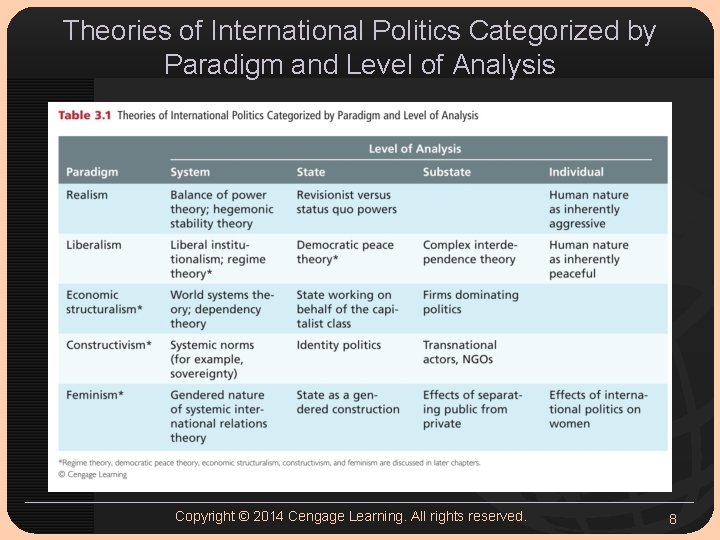
Theories of International Politics Categorized by Paradigm and Level of Analysis Copyright © 2014 Cengage Learning. All rights reserved. 8
Realism § Thucydides’ insights into international politics § International politics is about the exercise of power by states § Distribution of power determines state options § Humans are motivated by power (to rule others) § Distribution of power is cause of war and peace § International politics is beyond morality § Realism focuses on the problems of international conflict, wars in particular Copyright © 2014 Cengage Learning. All rights reserved. 9
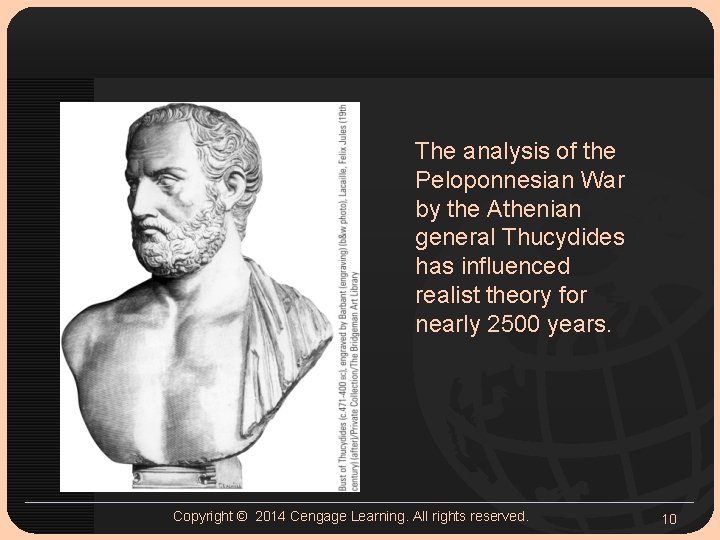
The analysis of the Peloponnesian War by the Athenian general Thucydides has influenced realist theory for nearly 2500 years. Copyright © 2014 Cengage Learning. All rights reserved. 10
Realism § Central Assumptions § Anarchy – no central ruler § States as the central actors – international politics is politics between states § States as unitary actors – behavior is driven by the conditions in the system, not by internal politics § States as rational actors – act in a national interest Copyright © 2014 Cengage Learning. All rights reserved. 11
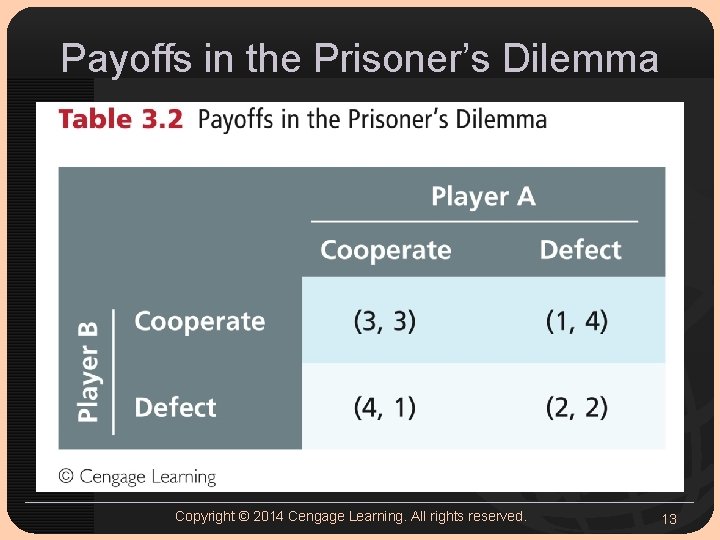
Realism § The Security Dilemma § Primary motivation of a state is survival, and the state must rely on self-help to survive § Insecurity leads states to arm themselves § Can lead to an arms race, less security § Game theory § Prisoner’s dilemma in international politics § Arm (defect) § Don’t arm (cooperate) Copyright © 2014 Cengage Learning. All rights reserved. 12
Payoffs in the Prisoner’s Dilemma Copyright © 2014 Cengage Learning. All rights reserved. 13
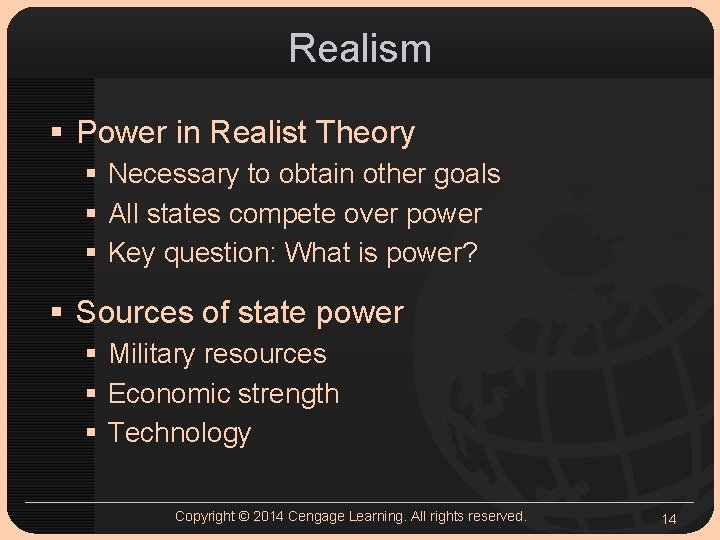
Realism § Power in Realist Theory § Necessary to obtain other goals § All states compete over power § Key question: What is power? § Sources of state power § Military resources § Economic strength § Technology Copyright © 2014 Cengage Learning. All rights reserved. 14
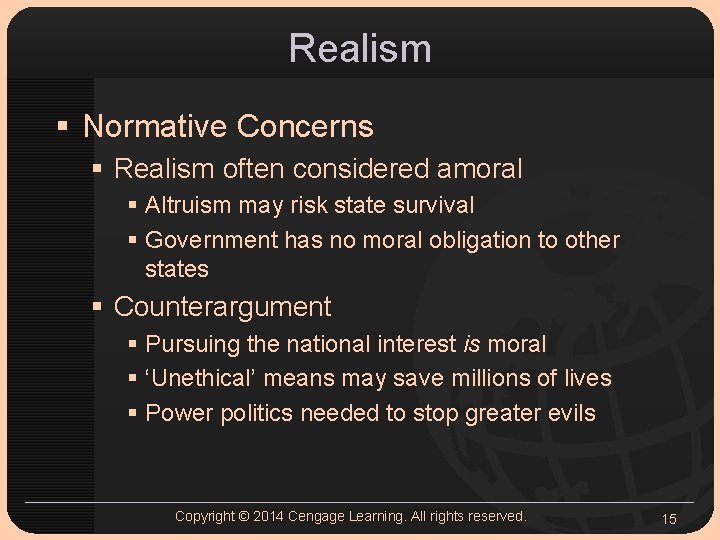
Realism § Normative Concerns § Realism often considered amoral § Altruism may risk state survival § Government has no moral obligation to other states § Counterargument § Pursuing the national interest is moral § ‘Unethical’ means may save millions of lives § Power politics needed to stop greater evils Copyright © 2014 Cengage Learning. All rights reserved. 15
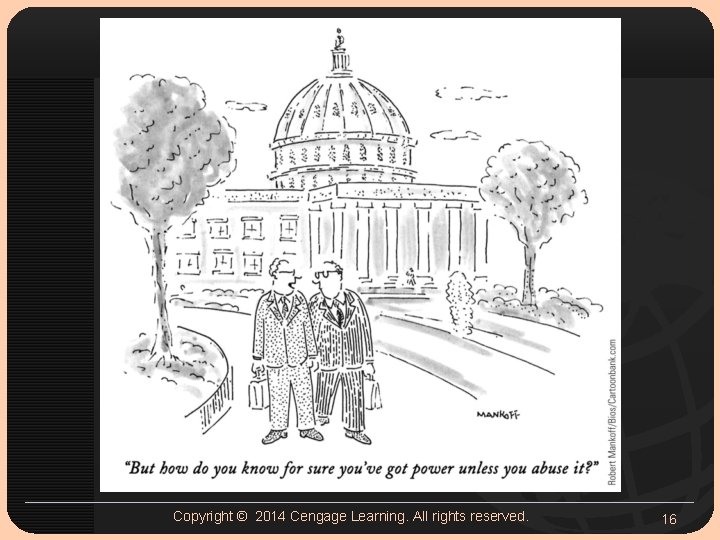
Copyright © 2014 Cengage Learning. All rights reserved. 16
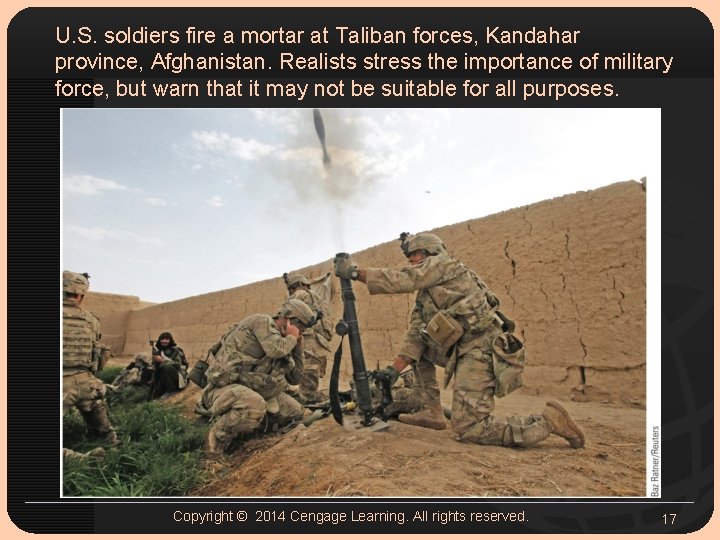
U. S. soldiers fire a mortar at Taliban forces, Kandahar province, Afghanistan. Realists stress the importance of military force, but warn that it may not be suitable for all purposes. Copyright © 2014 Cengage Learning. All rights reserved. 17
Realism § Variants of Realism § Balance of Power Theory § International stability will result from balancing power among the most powerful states § Hegemonic Stability Theory § International stability from one dominant power that ensures a degree of order in the system § Realism at the State Level Copyright © 2014 Cengage Learning. All rights reserved. 18
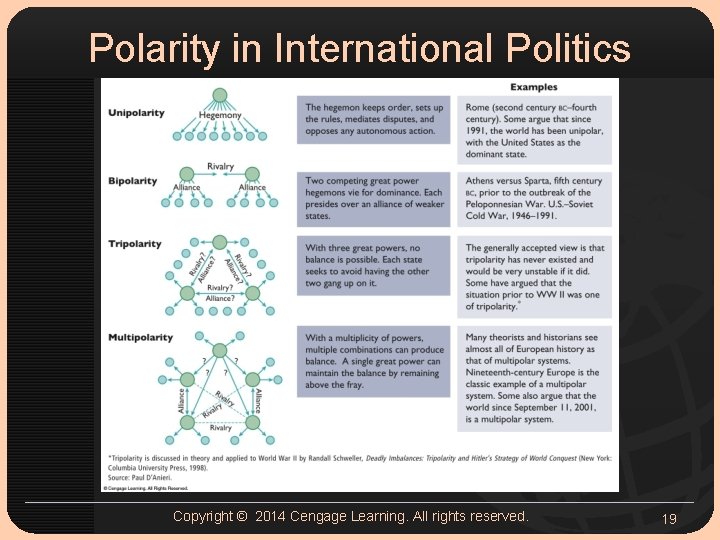
Polarity in International Politics Copyright © 2014 Cengage Learning. All rights reserved. 19
Destroying poached elephant tusks. What does realism’s focus on power politics tell us about international problems such as protection of endangered species. Copyright © 2014 Cengage Learning. All rights reserved. 20
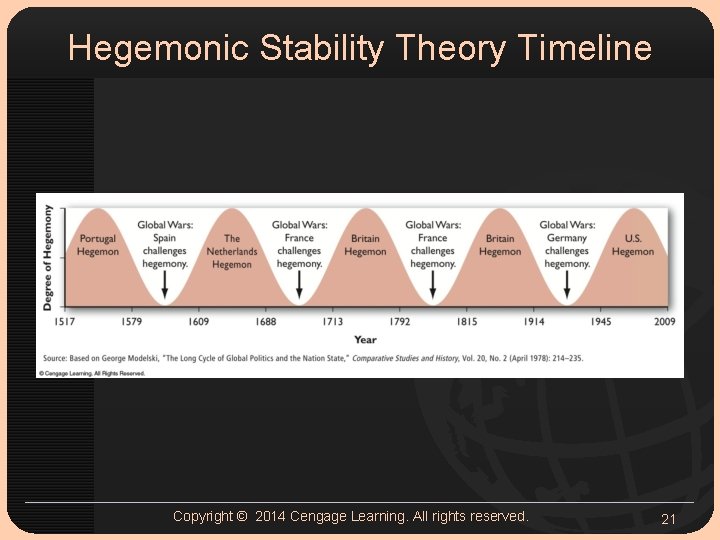
Hegemonic Stability Theory Timeline Copyright © 2014 Cengage Learning. All rights reserved. 21
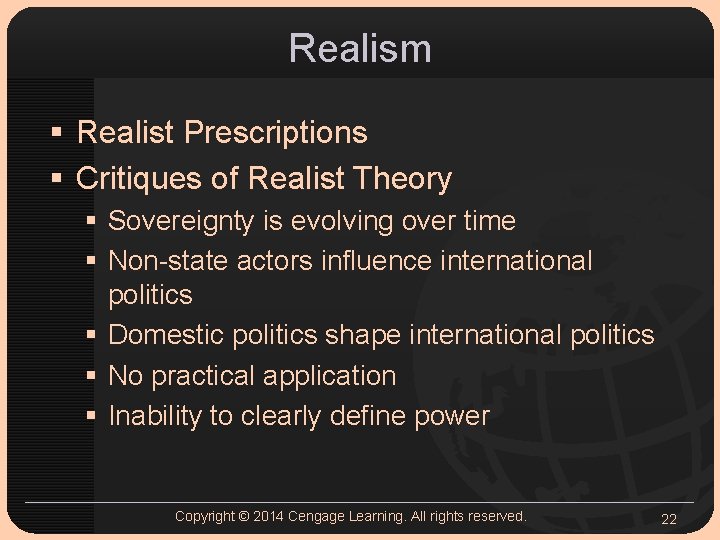
Realism § Realist Prescriptions § Critiques of Realist Theory § Sovereignty is evolving over time § Non-state actors influence international politics § Domestic politics shape international politics § No practical application § Inability to clearly define power Copyright © 2014 Cengage Learning. All rights reserved. 22
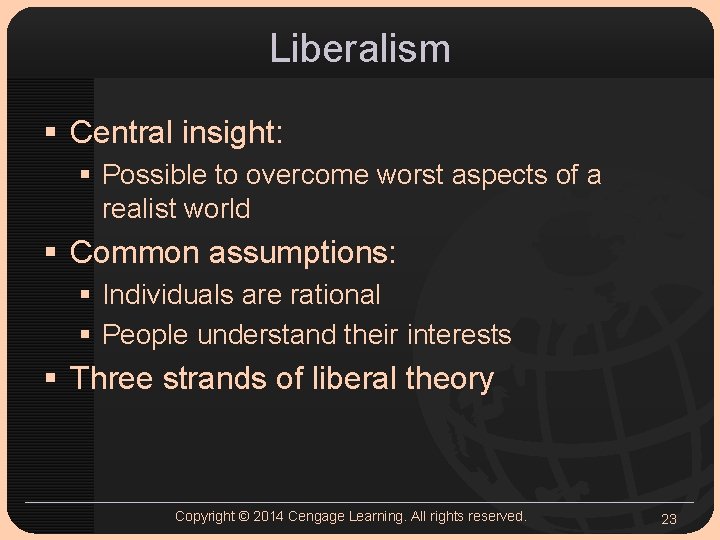
Liberalism § Central insight: § Possible to overcome worst aspects of a realist world § Common assumptions: § Individuals are rational § People understand their interests § Three strands of liberal theory Copyright © 2014 Cengage Learning. All rights reserved. 23
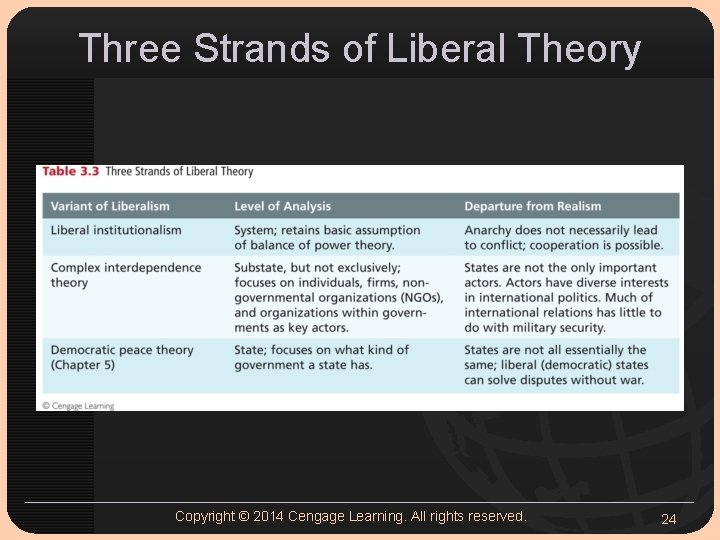
Three Strands of Liberal Theory Copyright © 2014 Cengage Learning. All rights reserved. 24
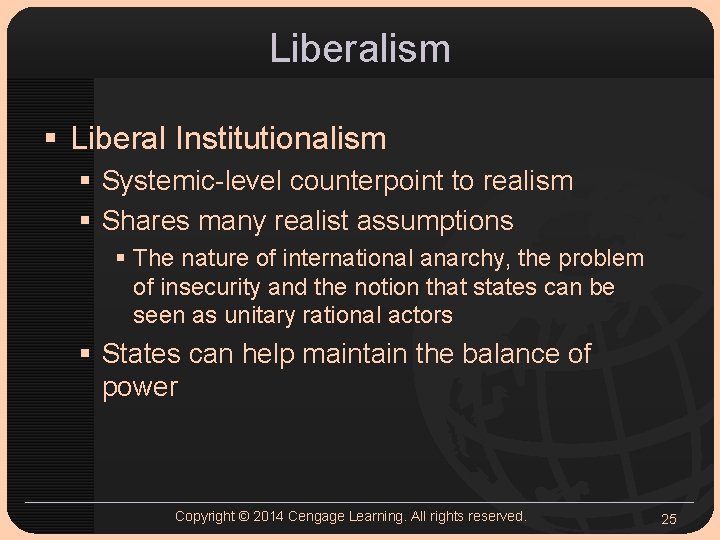
Liberalism § Liberal Institutionalism § Systemic-level counterpoint to realism § Shares many realist assumptions § The nature of international anarchy, the problem of insecurity and the notion that states can be seen as unitary rational actors § States can help maintain the balance of power Copyright © 2014 Cengage Learning. All rights reserved. 25
Liberalism § Liberalism and the Prisoner’s Dilemma § International politics is not a zero-sum game § States have incentive and ability to overcome the security dilemma § Reciprocity can persuade even selfish states to cooperate Copyright © 2014 Cengage Learning. All rights reserved. 26
Liberalism § Institutions and Anarchy § Institutions: sets of agreed upon norms, rules, and practices § Formal: treaties, laws, organizations § Informal: summits, conferences, norms § Collaboration among states can increase benefits without threatening survival Copyright © 2014 Cengage Learning. All rights reserved. 27
Liberalism § Institutionalism in practice § Concert of Europe § SALT and START agreements § Brazilian-Argentine Agreement on the Peaceful Use of Nuclear Energy § Cheating and Enforcement § Possibility of cheating is disincentive to cooperate § Cooperation can result from rational pursuit of self-interest Copyright © 2014 Cengage Learning. All rights reserved. 28
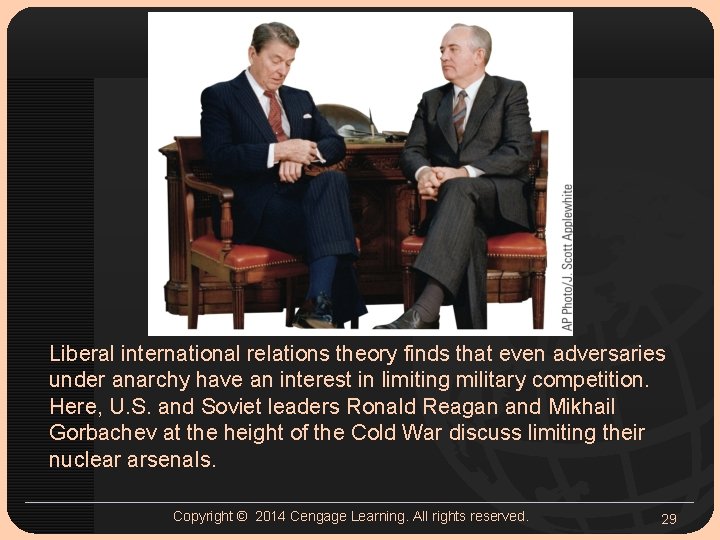
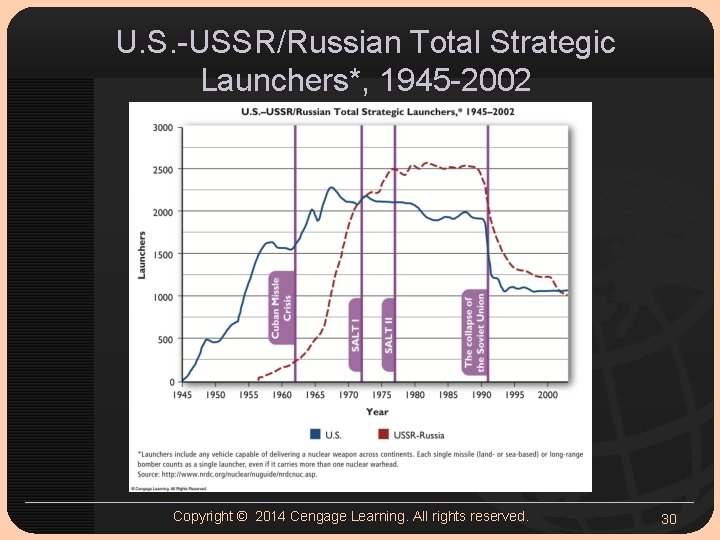
Liberal international relations theory finds that even adversaries under anarchy have an interest in limiting military competition. Here, U. S. and Soviet leaders Ronald Reagan and Mikhail Gorbachev at the height of the Cold War discuss limiting their nuclear arsenals. Copyright © 2014 Cengage Learning. All rights reserved. 29
U. S. -USSR/Russian Total Strategic Launchers*, 1945 -2002 Copyright © 2014 Cengage Learning. All rights reserved. 30
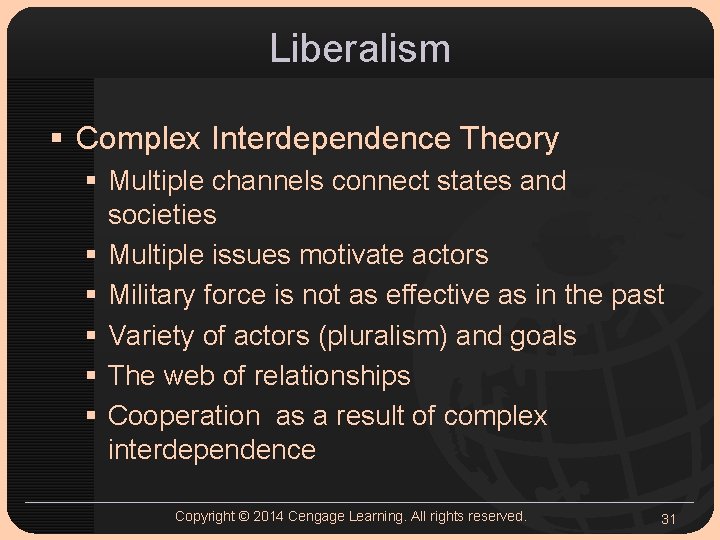
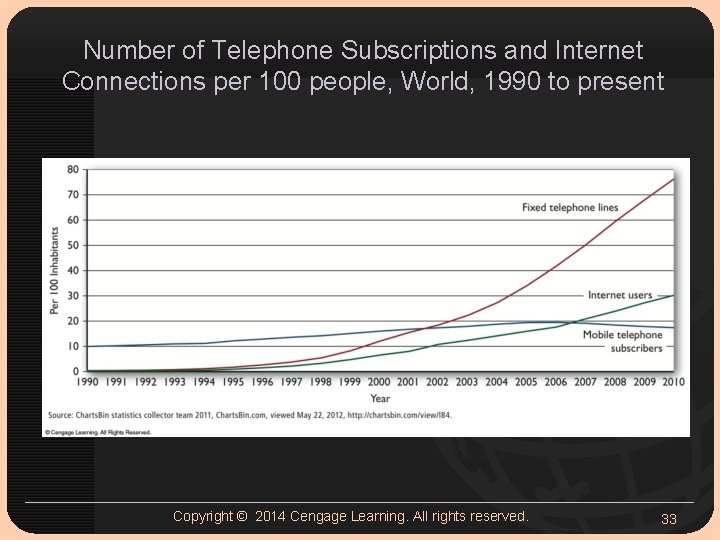
Liberalism § Complex Interdependence Theory § Multiple channels connect states and societies § Multiple issues motivate actors § Military force is not as effective as in the past § Variety of actors (pluralism) and goals § The web of relationships § Cooperation as a result of complex interdependence Copyright © 2014 Cengage Learning. All rights reserved. 31
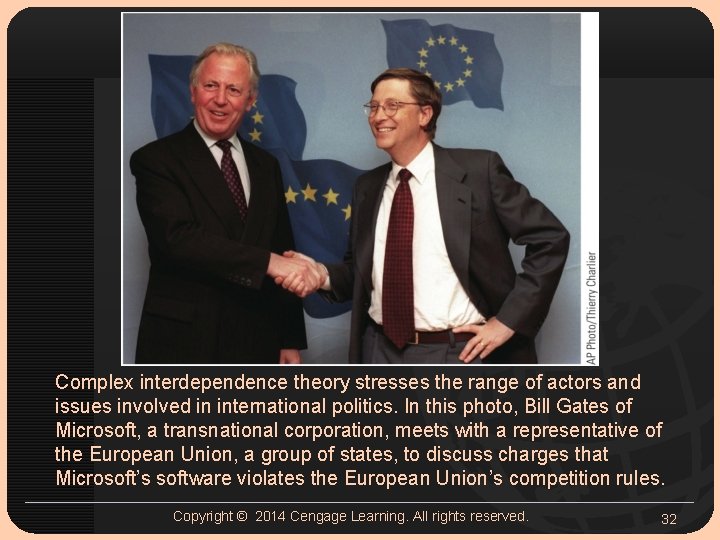
Complex interdependence theory stresses the range of actors and issues involved in international politics. In this photo, Bill Gates of Microsoft, a transnational corporation, meets with a representative of the European Union, a group of states, to discuss charges that Microsoft’s software violates the European Union’s competition rules. Copyright © 2014 Cengage Learning. All rights reserved. 32
Number of Telephone Subscriptions and Internet Connections per 100 people, World, 1990 to present Copyright © 2014 Cengage Learning. All rights reserved. 33
Liberalism § Liberalism’s Normative Position § Collaboration should be a priority in international affairs § Peace and progress are attainable § The Realist Reply § Liberal theory is too idealistic, makes states less secure § Anarchy is immutable § Security is foremost Copyright © 2014 Cengage Learning. All rights reserved. 34