
Chapter 3 The Visual Elements The Elements of















- Slides: 69
Chapter 3 The Visual Elements
The Elements of Art (The Visual Elements) The basic components or tools of visual communication. What we use to “make” art.
What are the Elements of Art? • Line • Shape • Mass (Form) • Light (Value) • Time • Texture • Space • Color • Motion
Prebles: LINES An extension of a point The basic means for recording and symbolizing ideas, observations and feelings. Primary means of visual communication.
Line Element of Art which refers to the mark(s) made on a surface by a moving point.
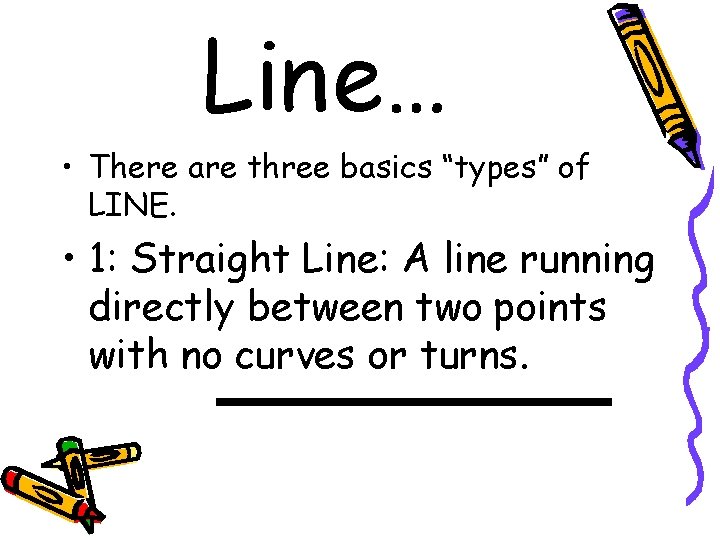
Line… • There are three basics “types” of LINE. • 1: Straight Line: A line running directly between two points with no curves or turns.
Line… • 2: Curved or Curvy: A line that changes direction gradually.
Line… • 3: Zig-Zag: A line that makes sudden or sharp changes in direction.
Line… In addition to the three basic types of line, we can also categorize lines by what direction they are running… Horizontal Vertical Diagonal
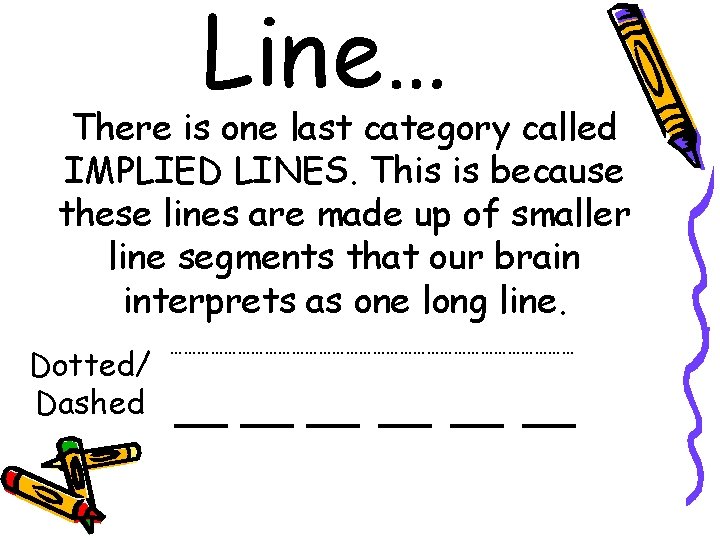
Line… There is one last category called IMPLIED LINES. This is because these lines are made up of smaller line segments that our brain interprets as one long line. Dotted/ Dashed ………………………………………
There also different properties or characteristics of line… Length Width And these characteristics are RELATIVE.
Prebles: In addition to the characteristics (or variations) of lines covered in CC, Prebles also talks about hard and soft lines, ragged/ irregular lines and lines created by an edge. (pg. 37)
Prebles • The expanse within the outline of a twodimensional area or within the outer boundaries of a three-dimensional object.
Shape Element of Art that refers to an enclosed area of two-dimensional space defined by its external edge. Has HEIGHT and WIDTH 2 basic types Geometric Organic
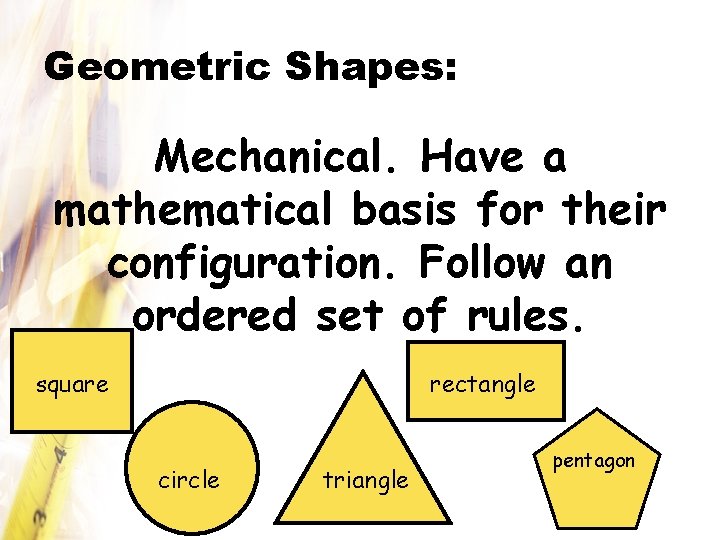
Geometric Shapes: Mechanical. Have a mathematical basis for their configuration. Follow an ordered set of rules. square rectangle circle triangle pentagon
Organic Shapes that occur in nature. Free form.
Organic Shapes…
Prebles n Most common Although there are geometric shapes in human made shapes that occur in nature (name a world are few) most shapes geometric… in nature are organic.
Prebles Figure: The dominate shapes in a composition. Also called POSITIVE SHAPES. n Ground: Background areas. Also called NEGATIVE SHAPES. n What is figure – ground reversal? n
Prebles: • Mass: A three dimensional area. • The physical bulk of a solid body of material. • When mass encloses space, the space is called volume.
• The Element of Art that refers to the three dimensional quality of art. • Has Height Width and Depth • Encloses Volume Depth Height Width
• Just like shape, there are two types of form… –Geometric- Forms that are mechanical, mathematical –Organic- Forms that occur in nature; Free forms,
What forms correspond with these shapes? • What is the 3 -dimensional form of the: – CIRCLE – SQUARE – TRIANGLE If I lay my hand flat on a piece of paper and draw around it, I have created a shape. What is that shapes corresponding form?
The Thinker Rodin
Prebles: What is a closed form and what is an open form. Give an example of each from the book. Explain mass in two dimensions.
Prebles • Visual Arts often referred to as the spatial arts because they occur in space. • Musical Arts is temporal art because it’s organized in time. • What is implied depth and how do we achieve it?
Space • Refers to the area around, between, above, below or within objects or forms in a piece of artwork. • 2 types • Positive and Negative
Positive Space The primary images, objects or forms in a piece of artwork.
Negative Space The areas around 2 -D or 3 -D shapes or forms which defines those objects. The background.
There are seven methods artist use to create the illusion of SPACE (Depth) Size: The smaller an object is, the farther away it appears. Position: The higher on the picture plane an object is the farther away it appears. (Prebles calls it vertical placement. )
OVERLAP An object in front of another object in your picture plane will appear closer to the viewer.
Color • Objects that are farther away will appear lighter, duller and have less contrast. • Bright colors can only be seen on near objects. • Warm colors can only be seen on close objects.
Detail • Objects that are closer will have more details. • Details fade the farther away from the viewer an object is.
We call this AERIAL or ATMOSPHERIC PERSPECTIVE
AERIAL or ATMOSPHERIC PERSPECTIVE The tendency for objects that are farther away to appear lighter, duller and have less contrast and detail.
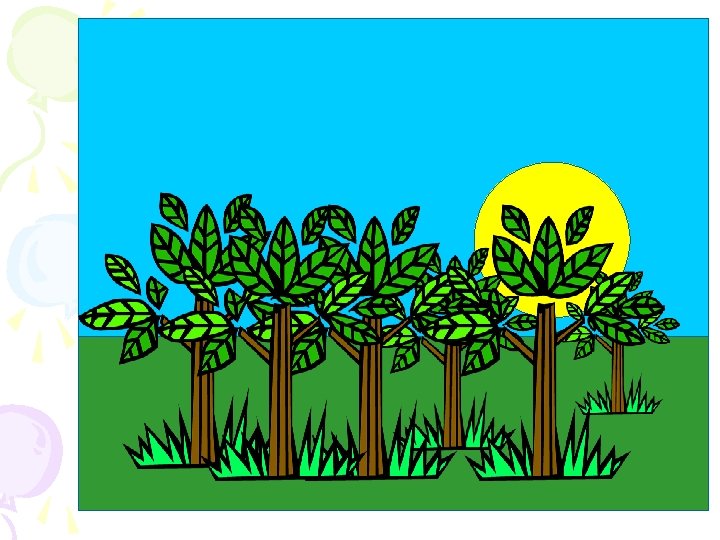
Linear Perspective… The sixth method artists use to create the illusion of space is Linear Perspective. Any way of representing threedimensional objects in space on a two-dimensional surface.
Linear Perspective… • Horizon Line: Place where the sky and ground appear to meet. Also represents eye level as you look at the scene. • Vanishing Point: Point at which lines representing converging parallel lines appear to meet. • Eye Level: Imaginary plane, the height of the artist’s eyes, parallel with the ground and extending to the horizon.
School of Athens
…a new concept… • Time and motion: Time: A non-spatial continuum (4 th dimension) in which events occur in succession. • Implied Motion: Creating a sense of motion. • Actual Motion: Kind of self-explanatory. • In KCC we call this Movement and it’s a Principle of Design…
Movement: Combines elements to produce the look of action or to cause the viewer’s eye to sweep over the work in a certain manner The Starry Night Vincent van Gogh Oil on Canvas, 1889
The Meeting of Saint Anthony and Saint Paul Prebles also talks about showing the passage of time…
Can also refer to movement of an artwork.
another new concept… LIGHT!!! Prebles talks about how we are surrounded by light and that light is made up of the visible light spectrum…
Prebles The text goes on to say value (sometimes called tone) refers to the relative lightness and darkness of a surface. So light is closely associated with…
VALUE Element of Art that refers to the degree and qualities of lightness or darkness
Circular Chimney Barnbaum
Pepper #30 Weston
Monolith: The Face of Half Dome Ansel Adams 1927
Value… Each color has a corresponding value…
Value…
So basically implied light is… Using Value to create the illusion of depth.
Prebles… The tactile qualities of surfaces or the visual representation of those surfaces.
The Element of Art that refers to the perceived surface quality or “feel” of an object. Its ROUGHNESS, SMOOTHNESS, SOFTNESS, etc.
Actual Texture The actual physical texture of a surface. What it would feel like when you touch it.
Actual Texture
Implied or Visual Texture(or simulated…) How a surface looks like it feels. What you think a surface would feel like if you could touch it. The Conversion of Saint Paul Caravaggio, 1601, Oil on Canvas