
Chapter 3 The Stack ADT Chapter 3 The
- Slides: 61
Chapter 3 The Stack ADT
Chapter 3: The Stack ADT 3. 1 – Stacks 3. 2 – Collection Elements 3. 3 – Exceptional Situations 3. 4 – Formal Specification 3. 5 – Array-Based Implementation 3. 6 – Application: Well-Formed Expressions 3. 7 – Link-Based Implementation 3. 8 – Case Study: Postfix Expression Evaluator
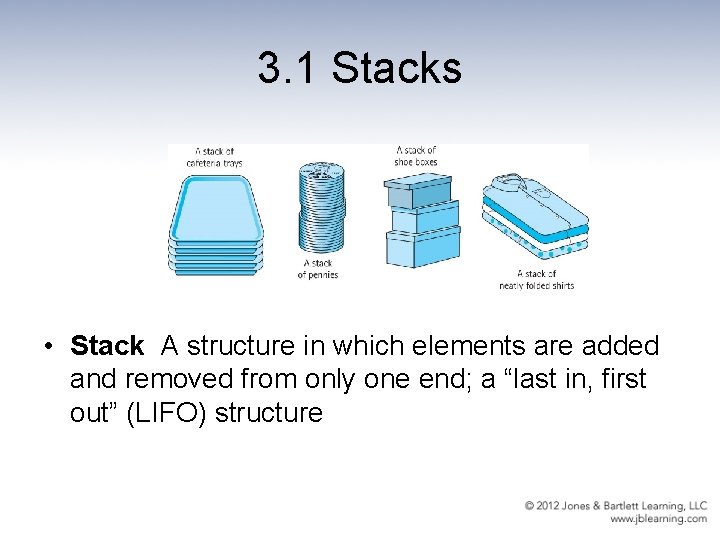
3. 1 Stacks • Stack A structure in which elements are added and removed from only one end; a “last in, first out” (LIFO) structure
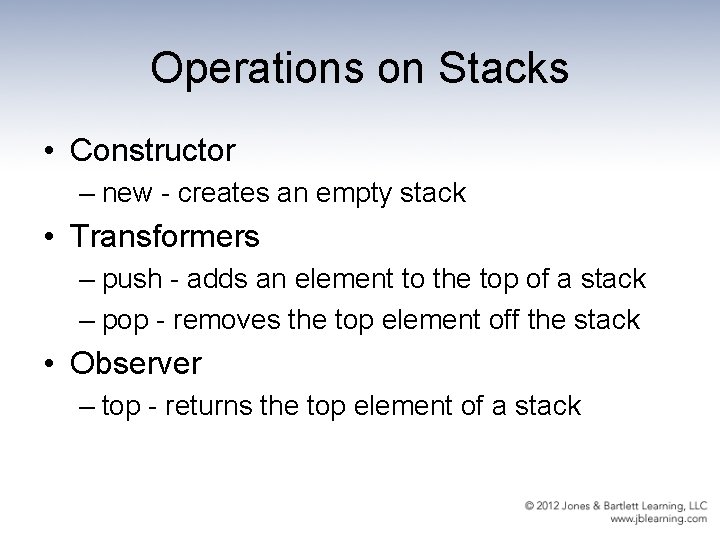
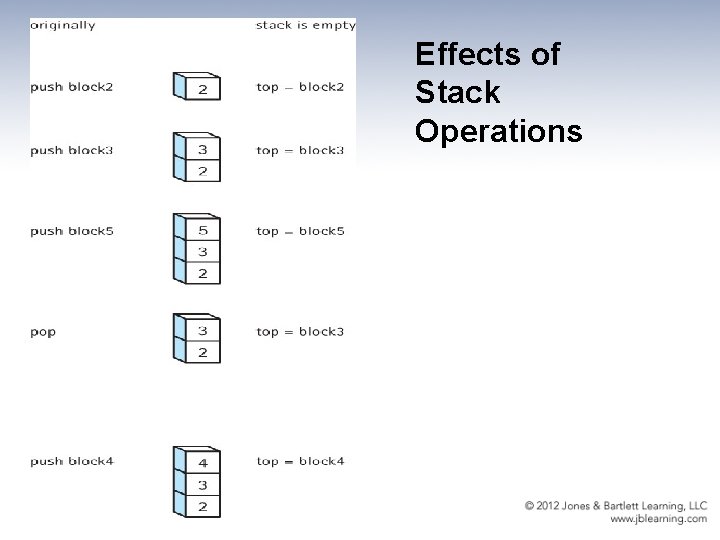
Operations on Stacks • Constructor – new - creates an empty stack • Transformers – push - adds an element to the top of a stack – pop - removes the top element off the stack • Observer – top - returns the top element of a stack
Effects of Stack Operations
Using Stacks • Stacks are often used for “system” programming: – Programming language systems use a stack to keep track of sequences of operation calls – Compilers use stacks to analyze nested language statements – Operating systems save information about the current executing process on a stack, so that it can work on a higher-priority, interrupting process
3. 2 Collection Elements • Collection An object that holds other objects. Typically we are interested in inserting, removing, and iterating through the contents of a collection. • A stack is an example of a Collection ADT. It collects together elements for future use, while maintaining a first in – last out ordering among the elements.
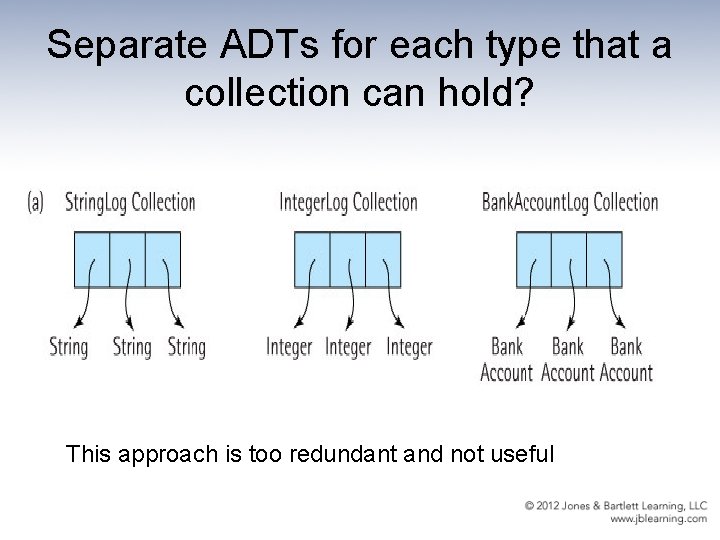
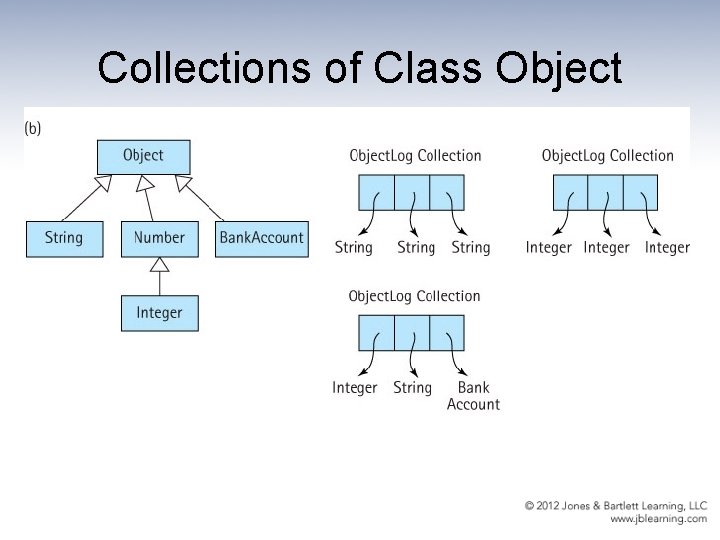
Separate ADTs for each type that a collection can hold? This approach is too redundant and not useful
Collections of Class Object
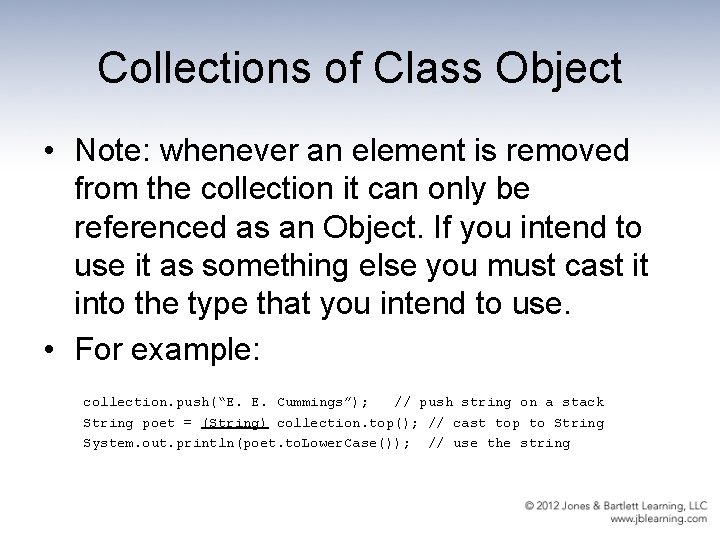
Collections of Class Object • Note: whenever an element is removed from the collection it can only be referenced as an Object. If you intend to use it as something else you must cast it into the type that you intend to use. • For example: collection. push(“E. E. Cummings”); // push string on a stack String poet = (String) collection. top(); // cast top to String System. out. println(poet. to. Lower. Case()); // use the string
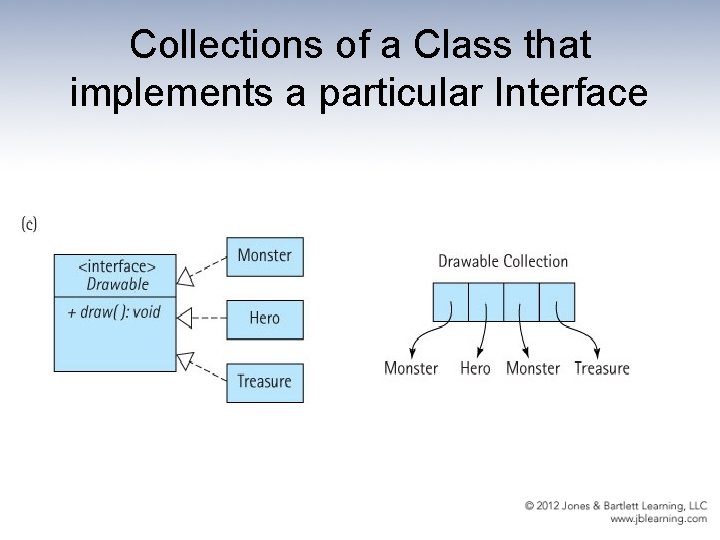
Collections of a Class that implements a particular Interface
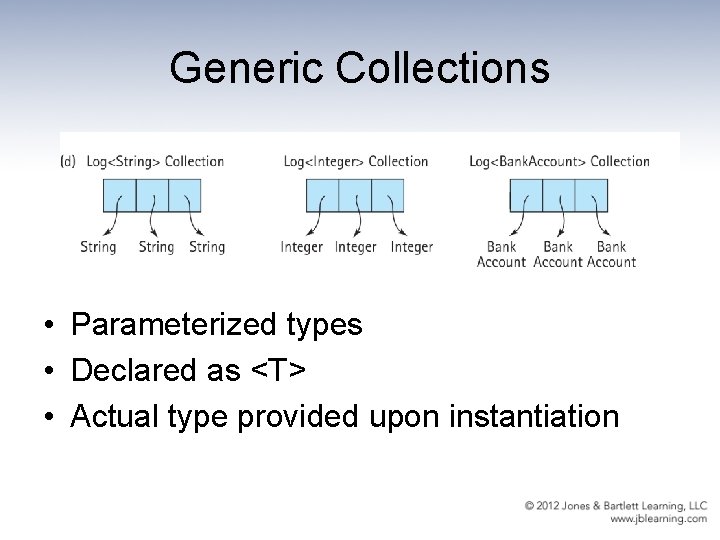
Generic Collections • Parameterized types • Declared as <T> • Actual type provided upon instantiation
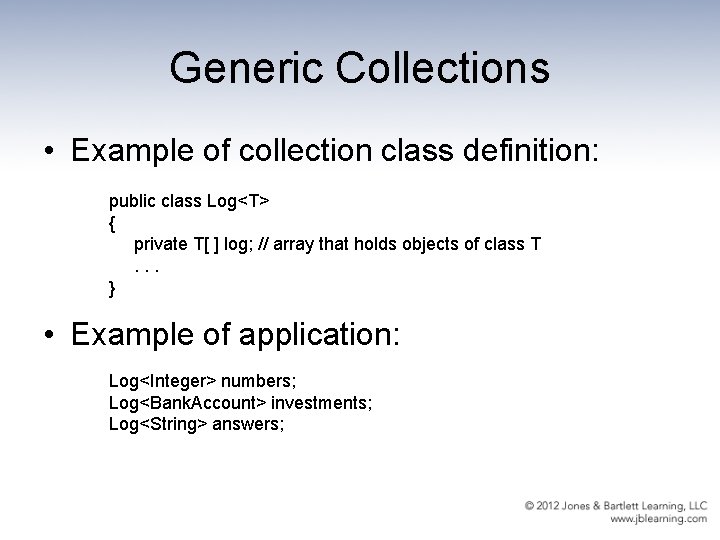
Generic Collections • Example of collection class definition: public class Log<T> { private T[ ] log; // array that holds objects of class T. . . } • Example of application: Log<Integer> numbers; Log<Bank. Account> investments; Log<String> answers;
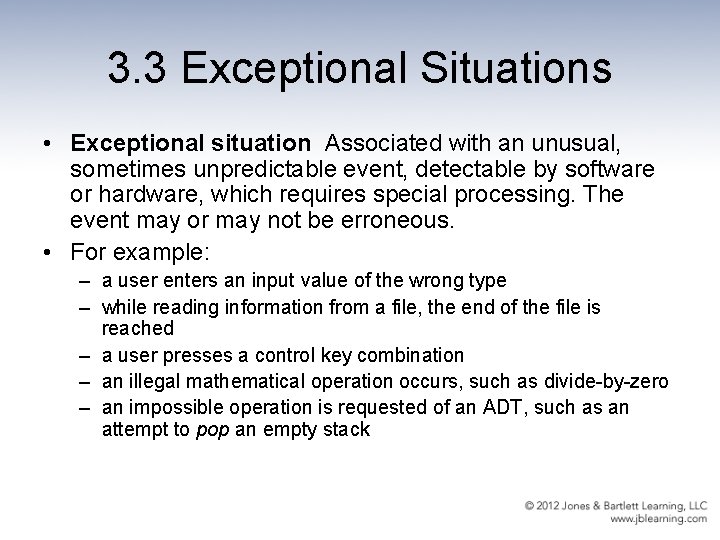
3. 3 Exceptional Situations • Exceptional situation Associated with an unusual, sometimes unpredictable event, detectable by software or hardware, which requires special processing. The event may or may not be erroneous. • For example: – a user enters an input value of the wrong type – while reading information from a file, the end of the file is reached – a user presses a control key combination – an illegal mathematical operation occurs, such as divide-by-zero – an impossible operation is requested of an ADT, such as an attempt to pop an empty stack
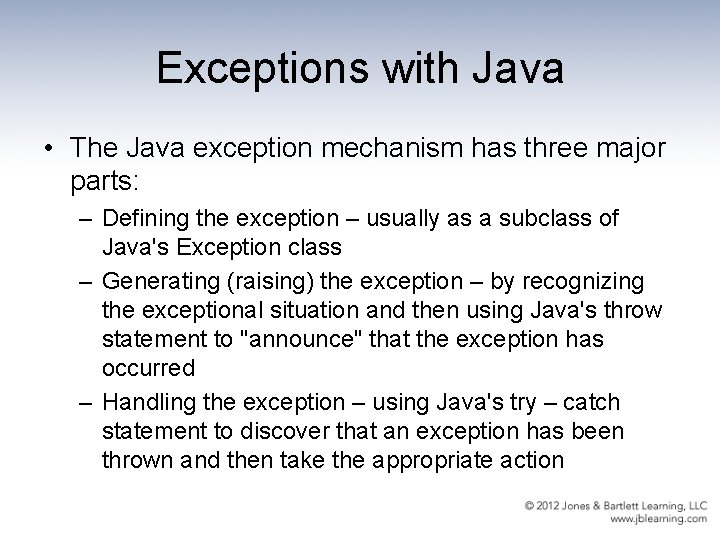
Exceptions with Java • The Java exception mechanism has three major parts: – Defining the exception – usually as a subclass of Java's Exception class – Generating (raising) the exception – by recognizing the exceptional situation and then using Java's throw statement to "announce" that the exception has occurred – Handling the exception – using Java's try – catch statement to discover that an exception has been thrown and then take the appropriate action
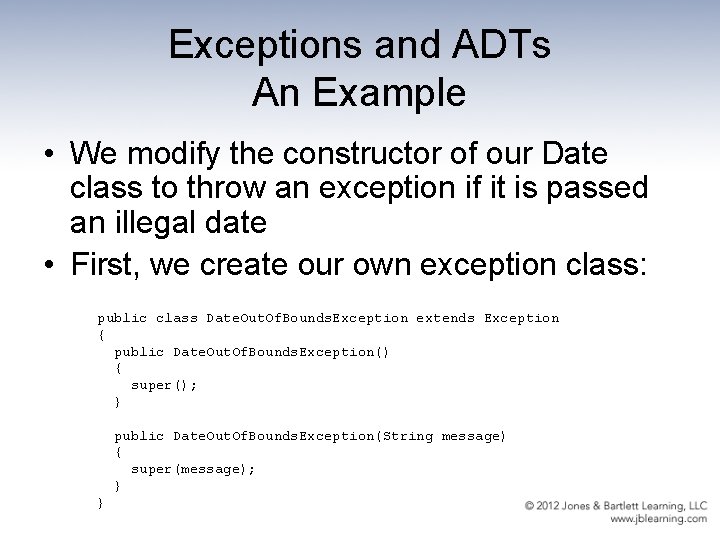
Exceptions and ADTs An Example • We modify the constructor of our Date class to throw an exception if it is passed an illegal date • First, we create our own exception class: public class Date. Out. Of. Bounds. Exception extends Exception { public Date. Out. Of. Bounds. Exception() { super(); } public Date. Out. Of. Bounds. Exception(String message) { super(message); } }
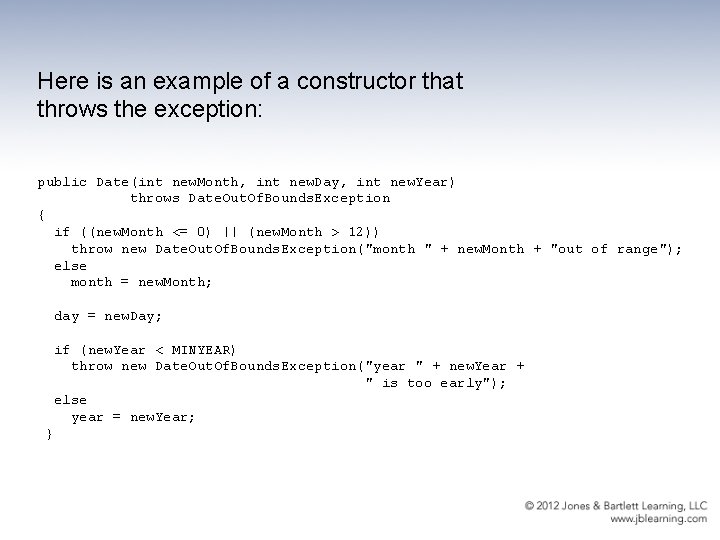
Here is an example of a constructor that throws the exception: public Date(int new. Month, int new. Day, int new. Year) throws Date. Out. Of. Bounds. Exception { if ((new. Month <= 0) || (new. Month > 12)) throw new Date. Out. Of. Bounds. Exception("month " + new. Month + "out of range"); else month = new. Month; day = new. Day; if (new. Year < MINYEAR) throw new Date. Out. Of. Bounds. Exception("year " + new. Year + " is too early"); else year = new. Year; }
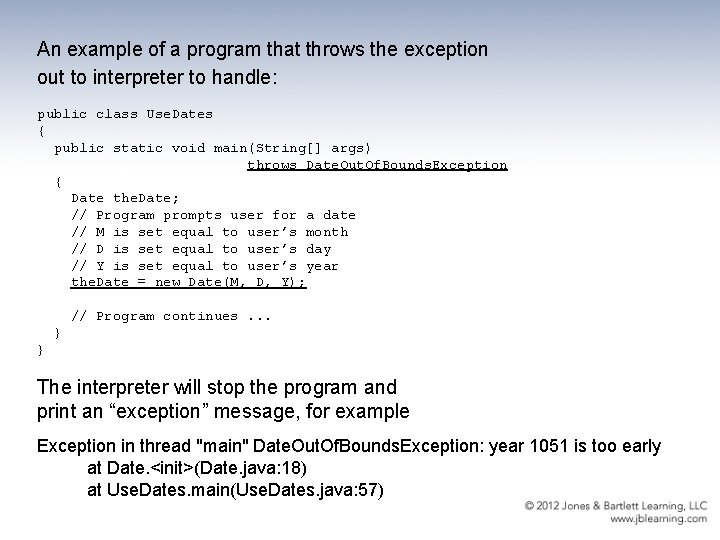
An example of a program that throws the exception out to interpreter to handle: public class Use. Dates { public static void main(String[] args) throws Date. Out. Of. Bounds. Exception { Date the. Date; // Program prompts user for a date // M is set equal to user’s month // D is set equal to user’s day // Y is set equal to user’s year the. Date = new Date(M, D, Y); // Program continues. . . } } The interpreter will stop the program and print an “exception” message, for example Exception in thread "main" Date. Out. Of. Bounds. Exception: year 1051 is too early at Date. <init>(Date. java: 18) at Use. Dates. main(Use. Dates. java: 57)
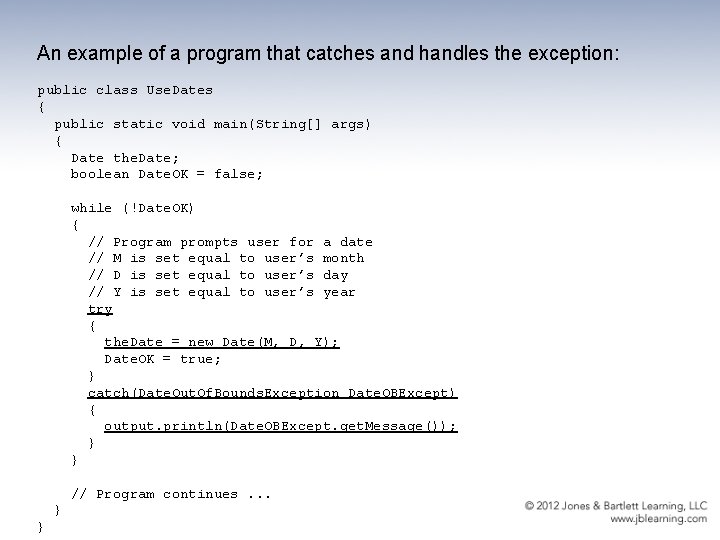
An example of a program that catches and handles the exception: public class Use. Dates { public static void main(String[] args) { Date the. Date; boolean Date. OK = false; while (!Date. OK) { // Program prompts user for a date // M is set equal to user’s month // D is set equal to user’s day // Y is set equal to user’s year try { the. Date = new Date(M, D, Y); Date. OK = true; } catch(Date. Out. Of. Bounds. Exception Date. OBExcept) { output. println(Date. OBExcept. get. Message()); } } // Program continues. . . } }
General guidelines for using exceptions • An exception may be handled any place in the software hierarchy—from the place in the program module where it is first detected through the top level of the program. • Unhandled built-in exceptions carry the penalty of program termination. • Where in an application an exception should be handled is a design decision; however, exceptions should always be handled at a level that knows what the exception means. • An exception need not be fatal. • For non-fatal exceptions, the thread of execution can continue from various points in the program, but execution should continue from the lowest level that can recover from the exception.
Java Run. Time. Exception class • Exceptions of this class are thrown when a standard run-time program error occurs. • Examples of run-time errors are division-by-zero and array-index-out-of-bounds. • These exceptions can happen in virtually any method or segment of code, so we are not required to explicitly handle these exceptions. • These exceptions are classified as unchecked exceptions.
Error Situations and ADTs • When dealing with error situations within our ADT methods, we have several options: – Detect and handle the error within the method itself. This is the best approach if the error can be handled internally and if it does not greatly complicate design. – Detect the error within the method, throw an exception related to the error and therefore force the calling method to deal with the exception. If it is not clear how to handle a particular error situation, this approach might be best - throw it out to a level where it can be handled. – Ignore the error situation. Recall the “programming by contract” discussion, related to preconditions, in Chapter 2. With this approach, if the preconditions of a method are not met, the method is not responsible for the consequences.
3. 4 Formal Specification (of our Stack ADT) • Recall from Section 3. 1 that a stack is a "last-in first-out" structure, with primary operations – push - adds an element to the top of the stack – pop - removes the top element off the stack – top - returns the top element of a stack • In addition we need a constructor that creates an empty stack • Our Stack ADT will be a generic stack. – The class of elements that a stack stores will be specified by the client code at the time the stack is instantiated.
Completing the Formal Specification • To complete the formal specification of the Stack ADT we need to – Identify and address any exceptional situations – Determine boundedness – Define the Stack interface or interfaces
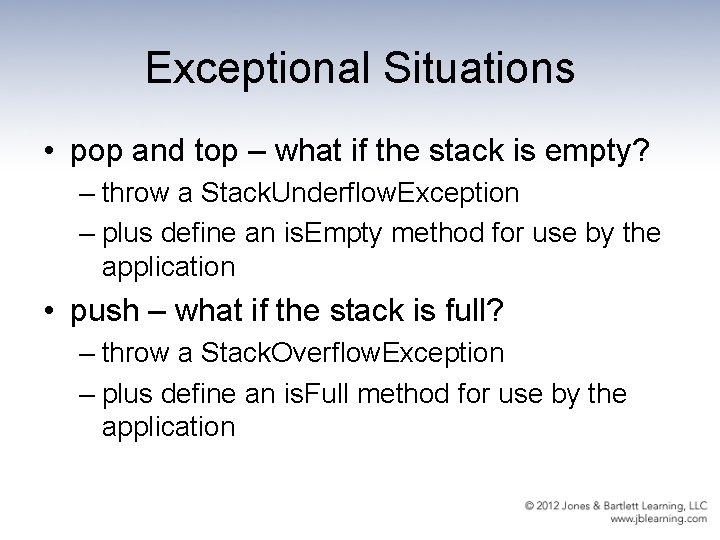
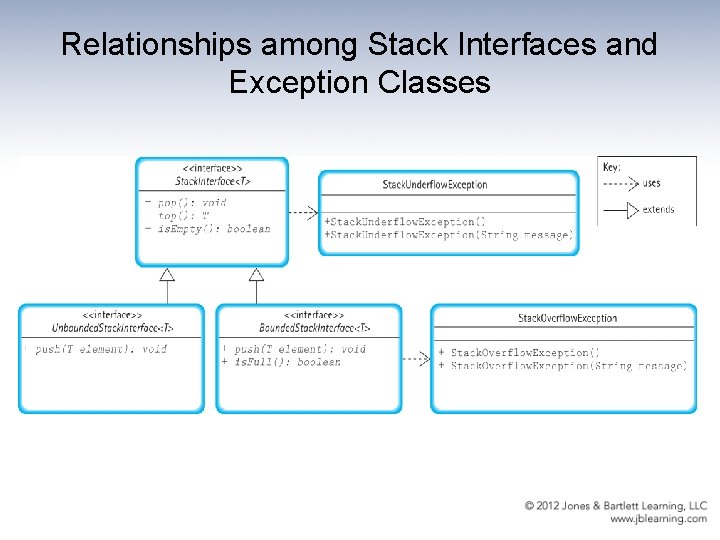
Exceptional Situations • pop and top – what if the stack is empty? – throw a Stack. Underflow. Exception – plus define an is. Empty method for use by the application • push – what if the stack is full? – throw a Stack. Overflow. Exception – plus define an is. Full method for use by the application
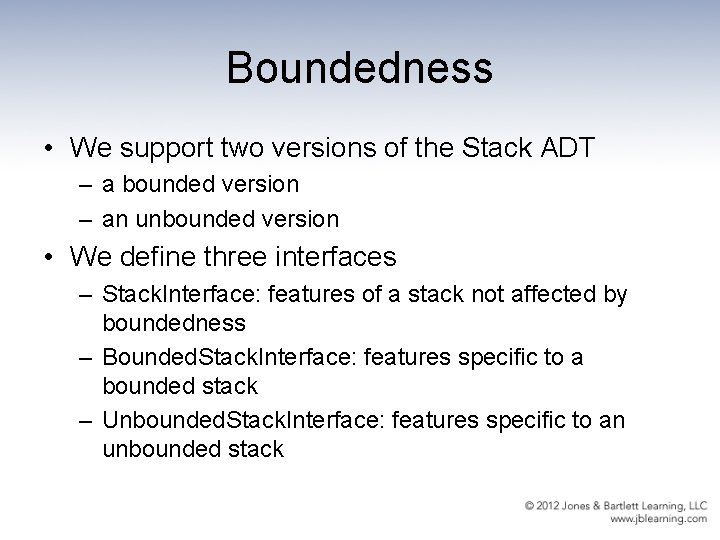
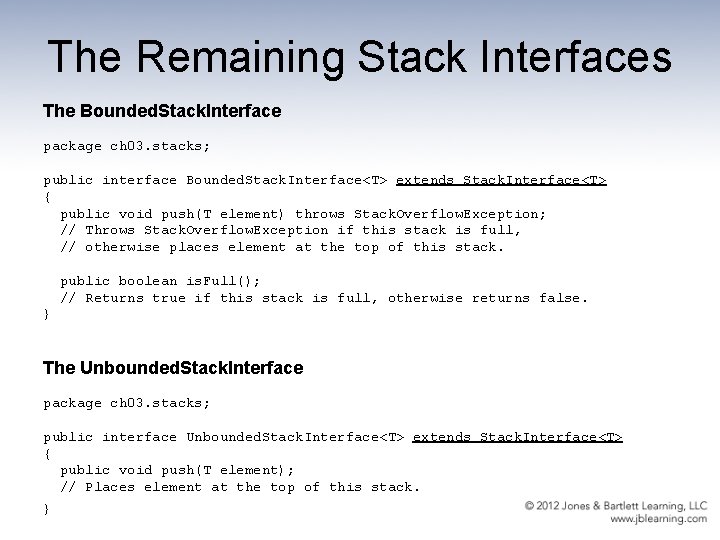
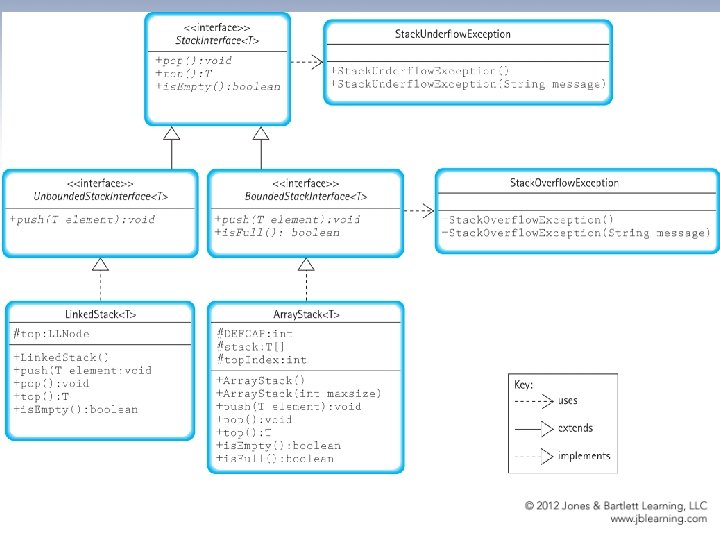
Boundedness • We support two versions of the Stack ADT – a bounded version – an unbounded version • We define three interfaces – Stack. Interface: features of a stack not affected by boundedness – Bounded. Stack. Interface: features specific to a bounded stack – Unbounded. Stack. Interface: features specific to an unbounded stack
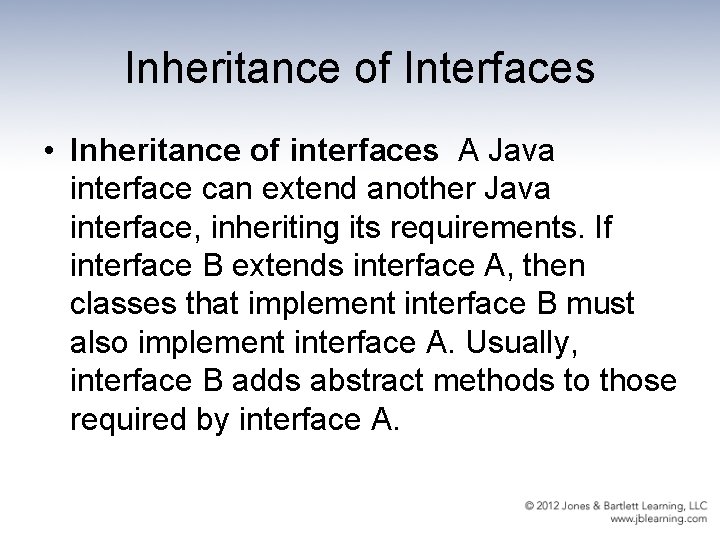
Inheritance of Interfaces • Inheritance of interfaces A Java interface can extend another Java interface, inheriting its requirements. If interface B extends interface A, then classes that implement interface B must also implement interface A. Usually, interface B adds abstract methods to those required by interface A.
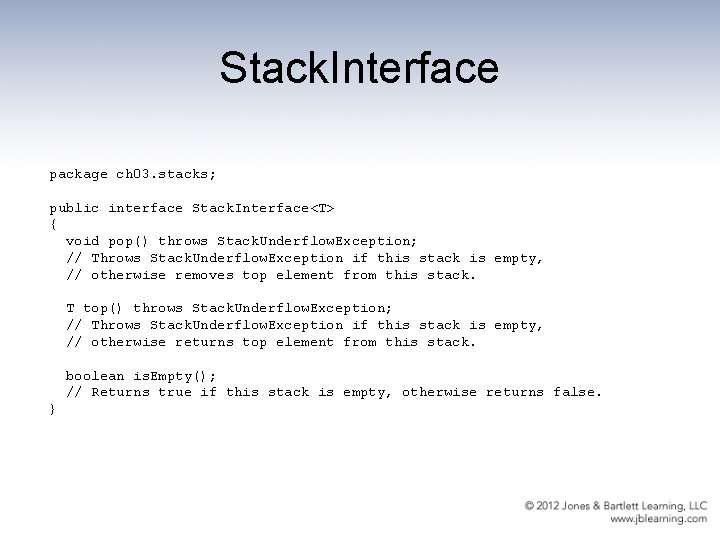
Stack. Interface package ch 03. stacks; public interface Stack. Interface<T> { void pop() throws Stack. Underflow. Exception; // Throws Stack. Underflow. Exception if this stack is empty, // otherwise removes top element from this stack. T top() throws Stack. Underflow. Exception; // Throws Stack. Underflow. Exception if this stack is empty, // otherwise returns top element from this stack. boolean is. Empty(); // Returns true if this stack is empty, otherwise returns false. }
The Remaining Stack Interfaces The Bounded. Stack. Interface package ch 03. stacks; public interface Bounded. Stack. Interface<T> extends Stack. Interface<T> { public void push(T element) throws Stack. Overflow. Exception; // Throws Stack. Overflow. Exception if this stack is full, // otherwise places element at the top of this stack. public boolean is. Full(); // Returns true if this stack is full, otherwise returns false. } The Unbounded. Stack. Interface package ch 03. stacks; public interface Unbounded. Stack. Interface<T> extends Stack. Interface<T> { public void push(T element); // Places element at the top of this stack. }
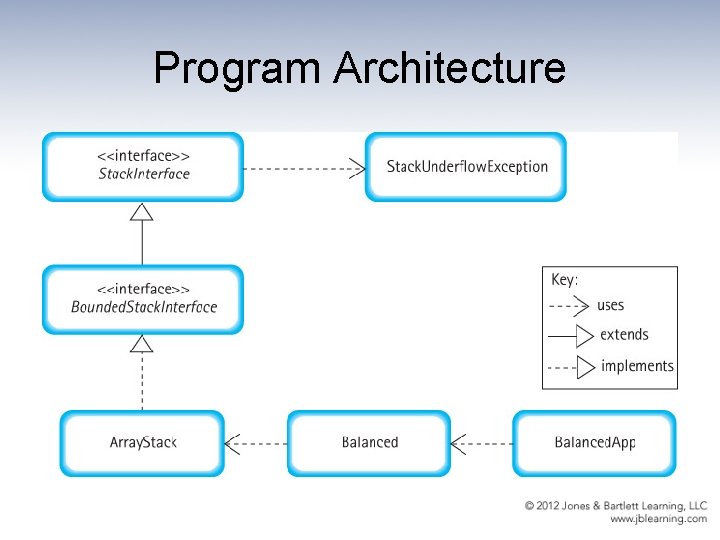
Relationships among Stack Interfaces and Exception Classes
3. 5 Array-Based Implementations • In this section we study an array-based implementation of the Stack ADT. • Additionally, in a feature section, we look at an alternate implementation that uses the Java Library Array. List class.
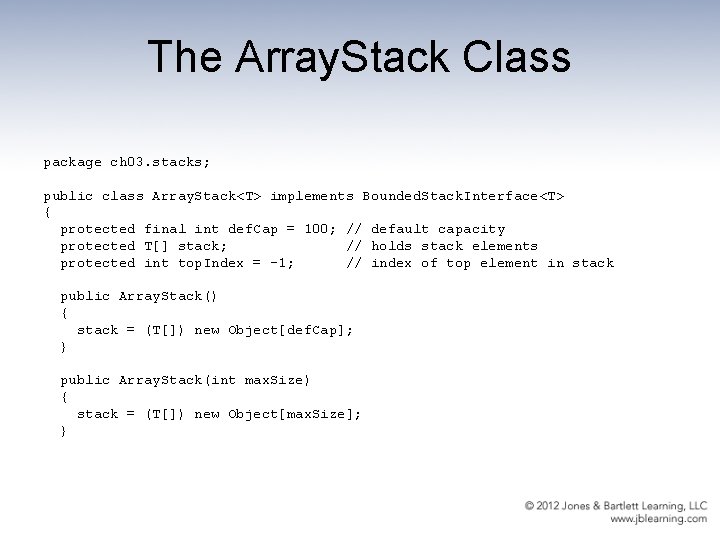
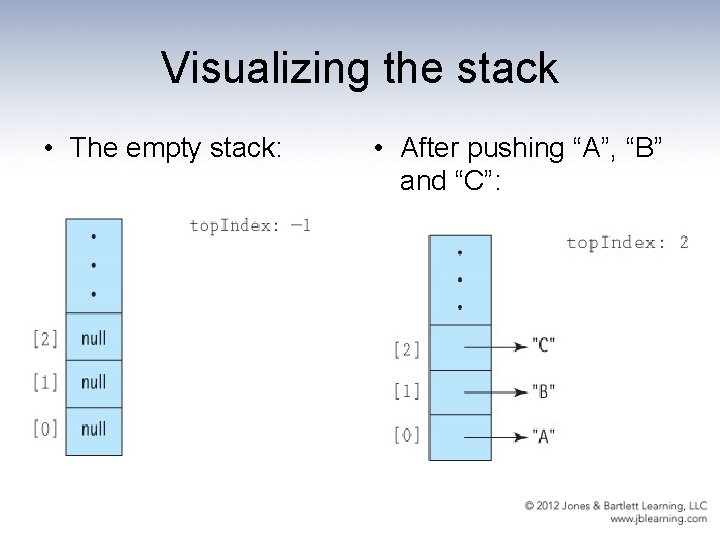
The Array. Stack Class package ch 03. stacks; public class Array. Stack<T> implements Bounded. Stack. Interface<T> { protected final int def. Cap = 100; // default capacity protected T[] stack; // holds stack elements protected int top. Index = -1; // index of top element in stack public Array. Stack() { stack = (T[]) new Object[def. Cap]; } public Array. Stack(int max. Size) { stack = (T[]) new Object[max. Size]; }
Visualizing the stack • The empty stack: • After pushing “A”, “B” and “C”:
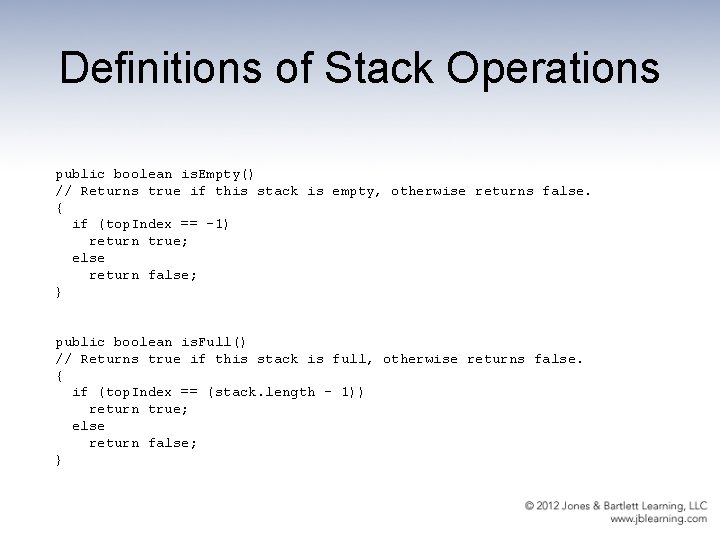
Definitions of Stack Operations public boolean is. Empty() // Returns true if this stack is empty, otherwise returns false. { if (top. Index == -1) return true; else return false; } public boolean is. Full() // Returns true if this stack is full, otherwise returns false. { if (top. Index == (stack. length - 1)) return true; else return false; }
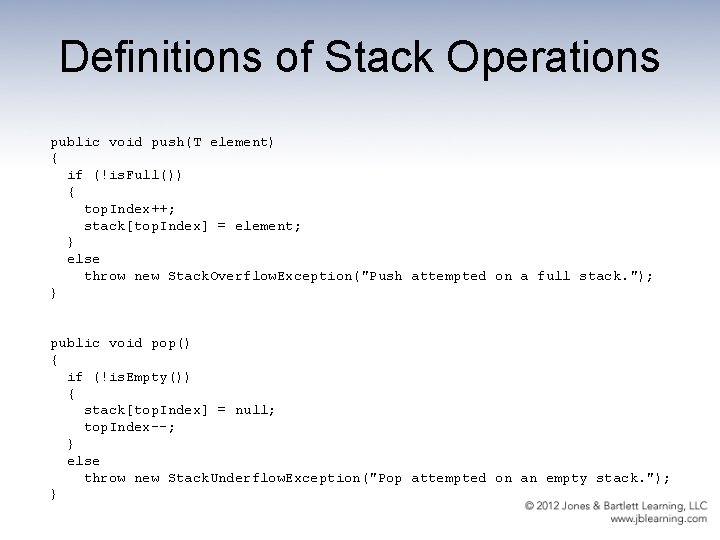
Definitions of Stack Operations public void push(T element) { if (!is. Full()) { top. Index++; stack[top. Index] = element; } else throw new Stack. Overflow. Exception("Push attempted on a full stack. "); } public void pop() { if (!is. Empty()) { stack[top. Index] = null; top. Index--; } else throw new Stack. Underflow. Exception("Pop attempted on an empty stack. "); }
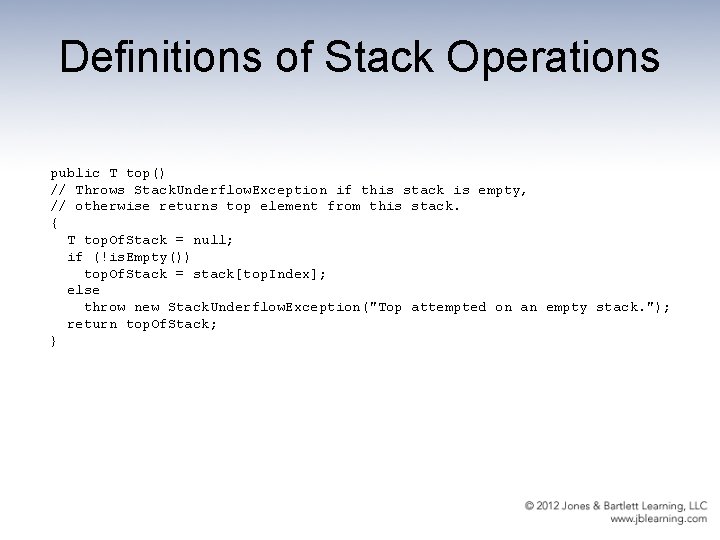
Definitions of Stack Operations public T top() // Throws Stack. Underflow. Exception if this stack is empty, // otherwise returns top element from this stack. { T top. Of. Stack = null; if (!is. Empty()) top. Of. Stack = stack[top. Index]; else throw new Stack. Underflow. Exception("Top attempted on an empty stack. "); return top. Of. Stack; }
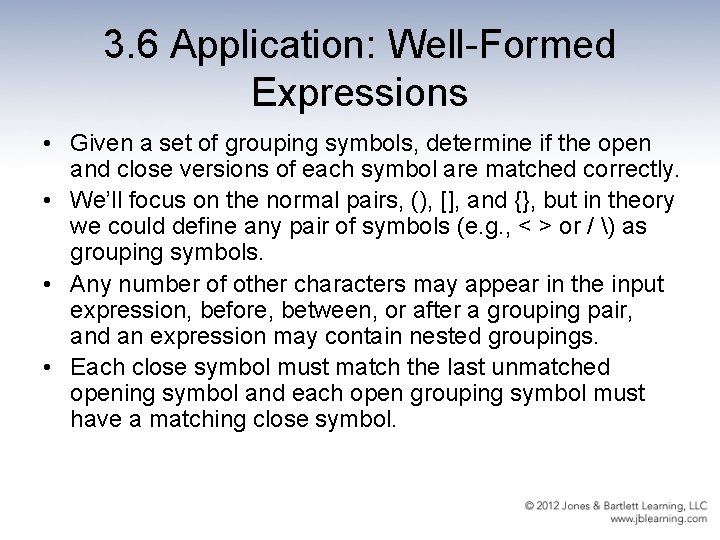
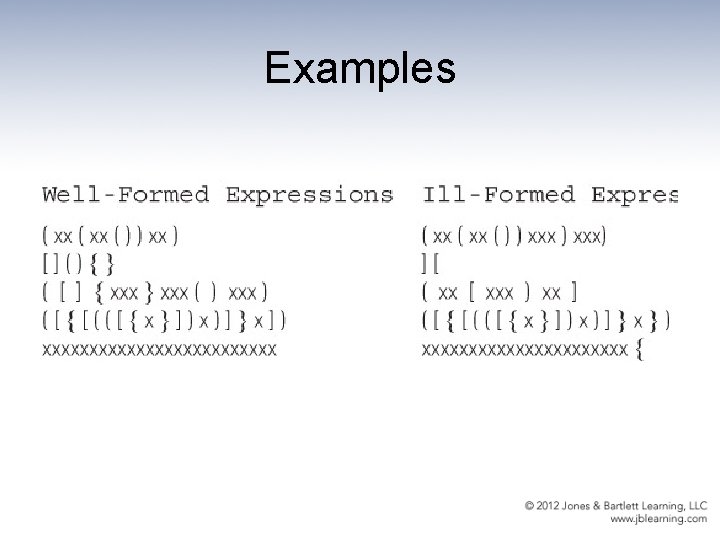
3. 6 Application: Well-Formed Expressions • Given a set of grouping symbols, determine if the open and close versions of each symbol are matched correctly. • We’ll focus on the normal pairs, (), [], and {}, but in theory we could define any pair of symbols (e. g. , < > or / ) as grouping symbols. • Any number of other characters may appear in the input expression, before, between, or after a grouping pair, and an expression may contain nested groupings. • Each close symbol must match the last unmatched opening symbol and each open grouping symbol must have a matching close symbol.
Examples
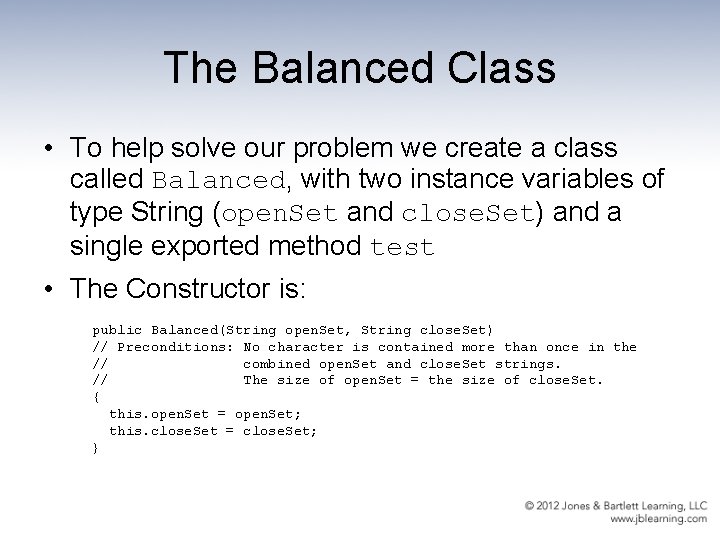
The Balanced Class • To help solve our problem we create a class called Balanced, with two instance variables of type String (open. Set and close. Set) and a single exported method test • The Constructor is: public Balanced(String open. Set, String close. Set) // Preconditions: No character is contained more than once in the // combined open. Set and close. Set strings. // The size of open. Set = the size of close. Set. { this. open. Set = open. Set; this. close. Set = close. Set; }
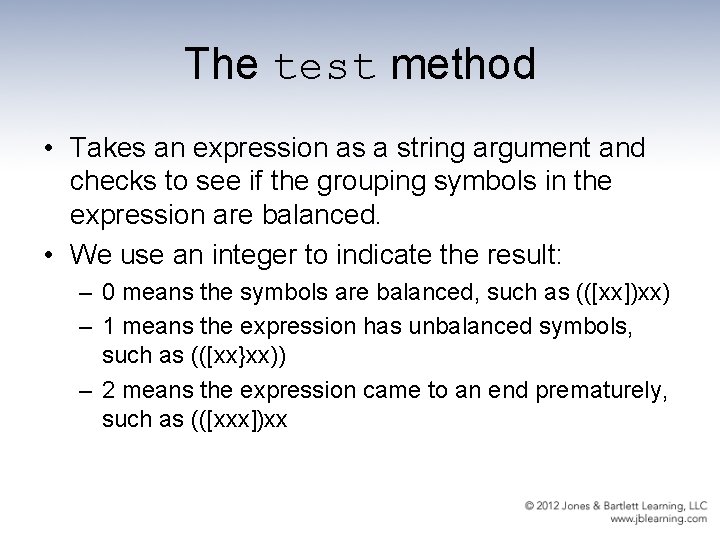
The test method • Takes an expression as a string argument and checks to see if the grouping symbols in the expression are balanced. • We use an integer to indicate the result: – 0 means the symbols are balanced, such as (([xx])xx) – 1 means the expression has unbalanced symbols, such as (([xx}xx)) – 2 means the expression came to an end prematurely, such as (([xxx])xx
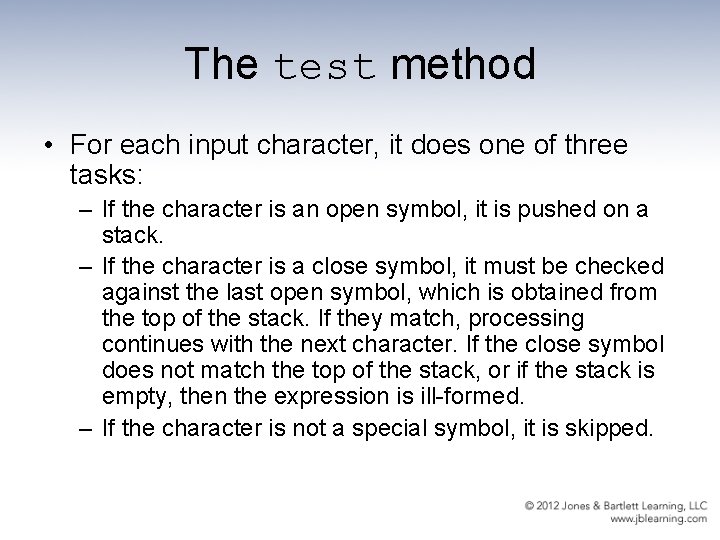
The test method • For each input character, it does one of three tasks: – If the character is an open symbol, it is pushed on a stack. – If the character is a close symbol, it must be checked against the last open symbol, which is obtained from the top of the stack. If they match, processing continues with the next character. If the close symbol does not match the top of the stack, or if the stack is empty, then the expression is ill-formed. – If the character is not a special symbol, it is skipped.
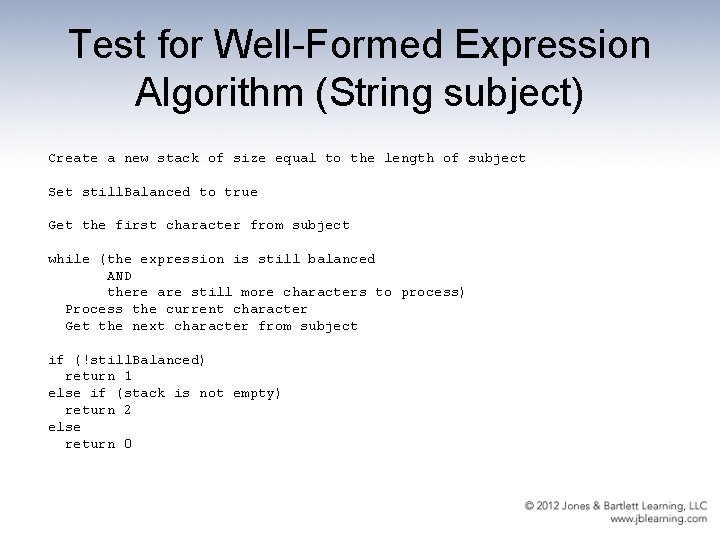
Test for Well-Formed Expression Algorithm (String subject) Create a new stack of size equal to the length of subject Set still. Balanced to true Get the first character from subject while (the expression is still balanced AND there are still more characters to process) Process the current character Get the next character from subject if (!still. Balanced) return 1 else if (stack is not empty) return 2 else return 0
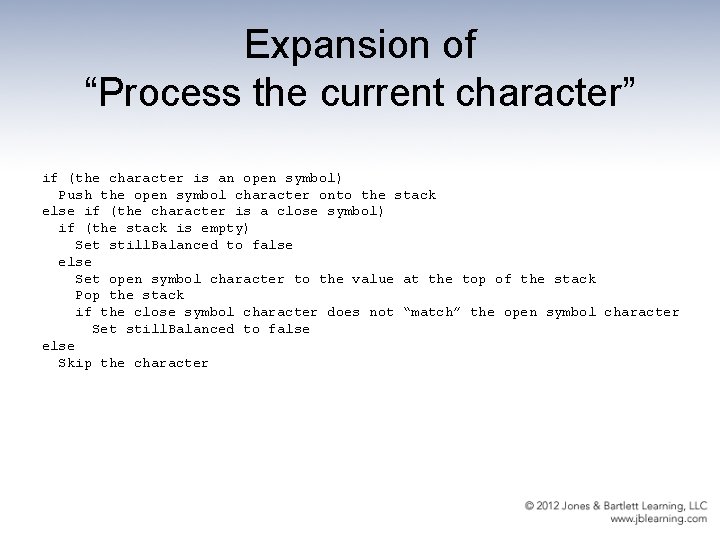
Expansion of “Process the current character” if (the character is an open symbol) Push the open symbol character onto the stack else if (the character is a close symbol) if (the stack is empty) Set still. Balanced to false else Set open symbol character to the value at the top of the stack Pop the stack if the close symbol character does not “match” the open symbol character Set still. Balanced to false else Skip the character
Code and Demo • Instructors can now walk through the code contained in Balanced. java and Balanced. App. java, review the notes on pages 197 and 198, and demonstrate the running program.
Program Architecture
3. 7 Linked-Based Implmentation • In this section we study a link-based implementation of the Stack ADT. • To support this we first define a LLNode class • After discussing the link-based approach we compare our stack implementation approaches.
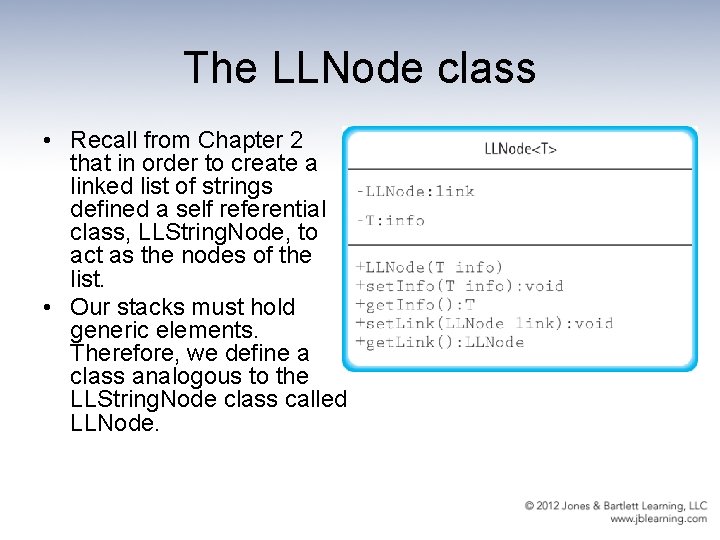
The LLNode class • Recall from Chapter 2 that in order to create a linked list of strings defined a self referential class, LLString. Node, to act as the nodes of the list. • Our stacks must hold generic elements. Therefore, we define a class analogous to the LLString. Node class called LLNode.
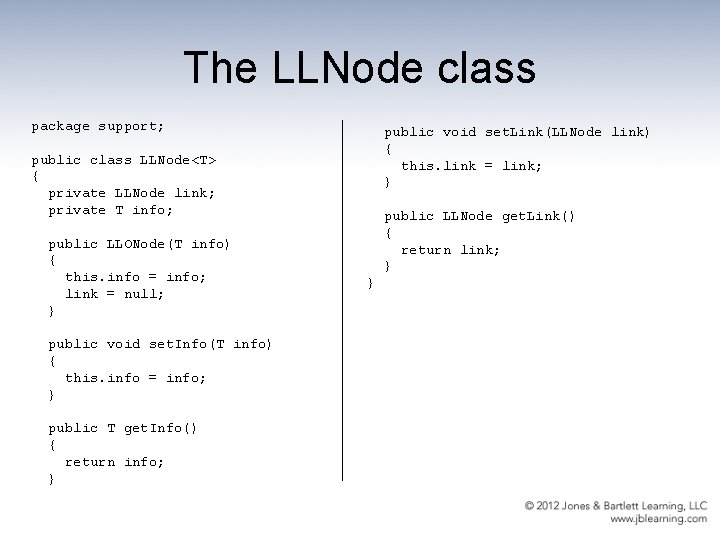
The LLNode class package support; public void set. Link(LLNode link) { this. link = link; } public class LLNode<T> { private LLNode link; private T info; public LLONode(T info) { this. info = info; link = null; } public void set. Info(T info) { this. info = info; } public T get. Info() { return info; } public LLNode get. Link() { return link; } }
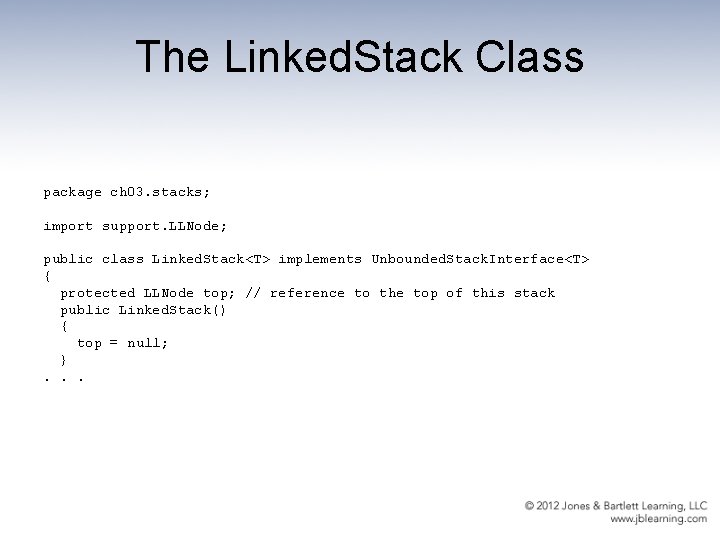
The Linked. Stack Class package ch 03. stacks; import support. LLNode; public class Linked. Stack<T> implements Unbounded. Stack. Interface<T> { protected LLNode top; // reference to the top of this stack public Linked. Stack() { top = null; }. . .
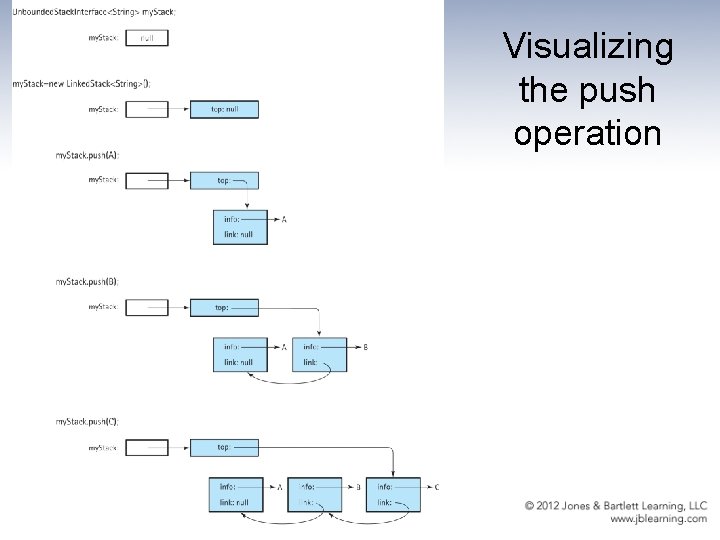
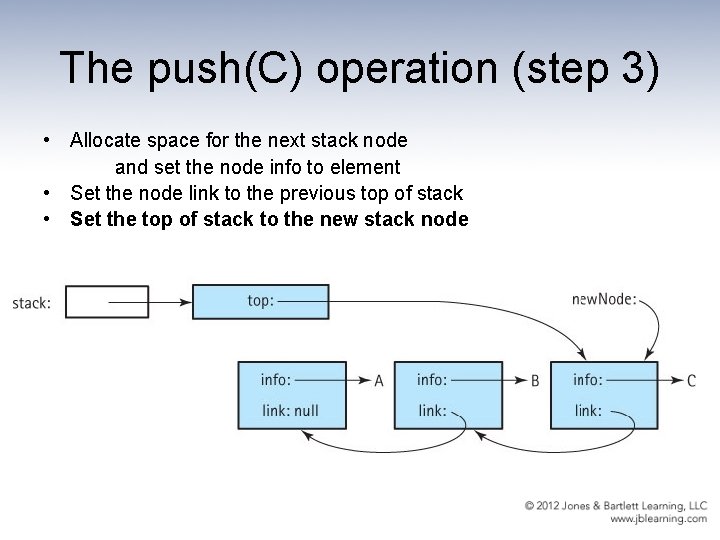
Visualizing the push operation
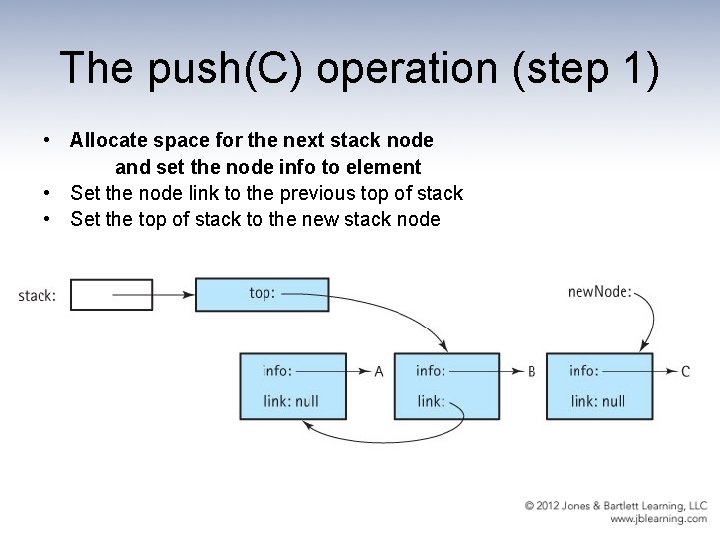
The push(C) operation (step 1) • Allocate space for the next stack node and set the node info to element • Set the node link to the previous top of stack • Set the top of stack to the new stack node
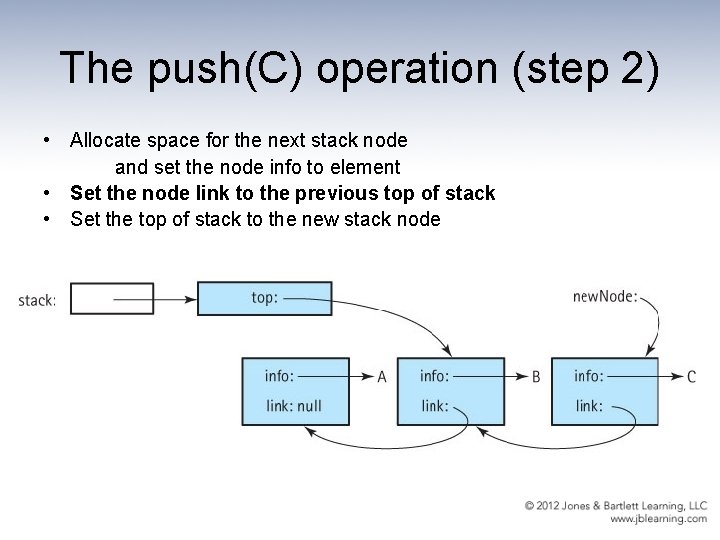
The push(C) operation (step 2) • Allocate space for the next stack node and set the node info to element • Set the node link to the previous top of stack • Set the top of stack to the new stack node
The push(C) operation (step 3) • Allocate space for the next stack node and set the node info to element • Set the node link to the previous top of stack • Set the top of stack to the new stack node
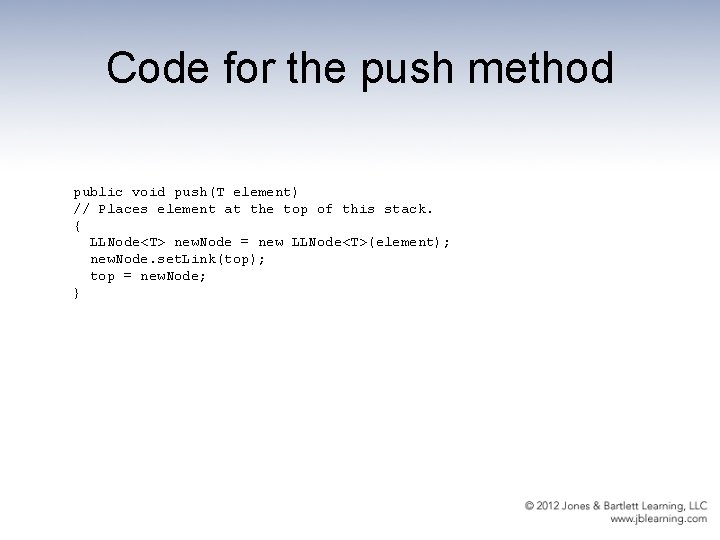
Code for the push method public void push(T element) // Places element at the top of this stack. { LLNode<T> new. Node = new LLNode<T>(element); new. Node. set. Link(top); top = new. Node; }
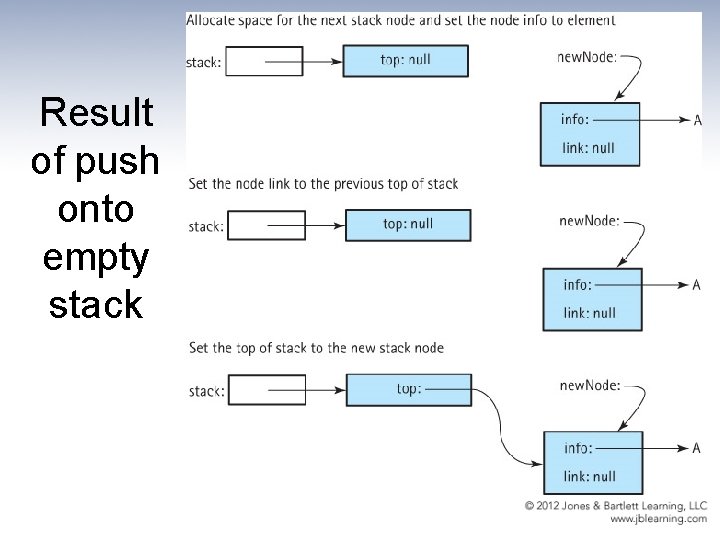
Result of push onto empty stack
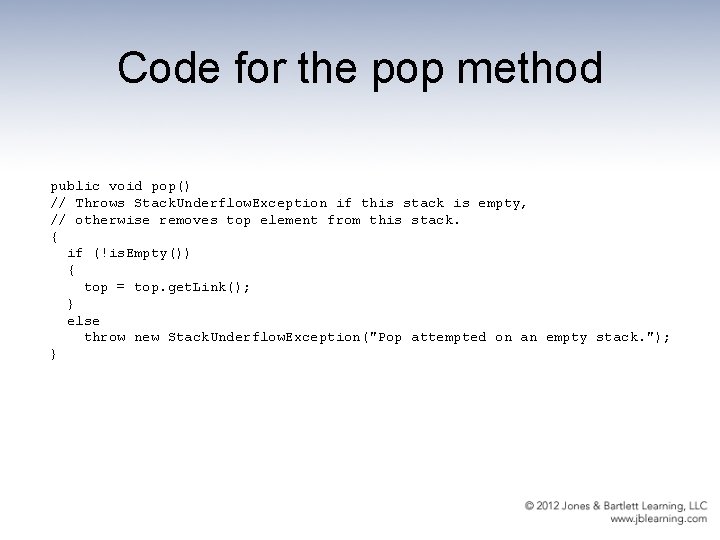
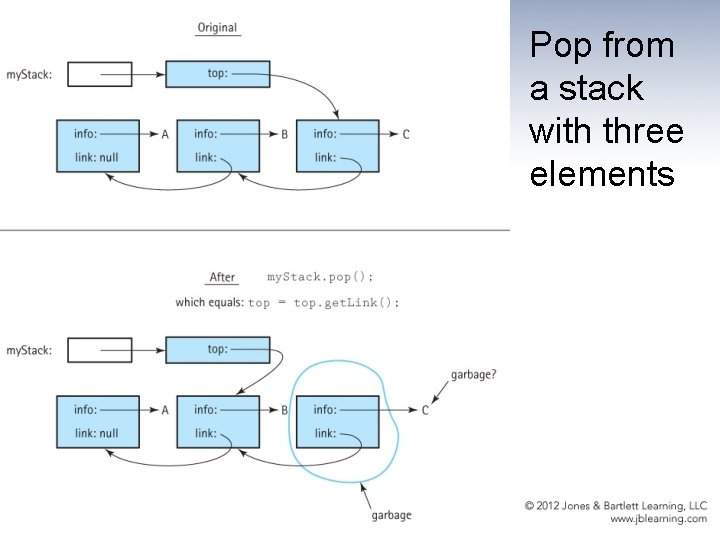
Code for the pop method public void pop() // Throws Stack. Underflow. Exception if this stack is empty, // otherwise removes top element from this stack. { if (!is. Empty()) { top = top. get. Link(); } else throw new Stack. Underflow. Exception("Pop attempted on an empty stack. "); }
Pop from a stack with three elements
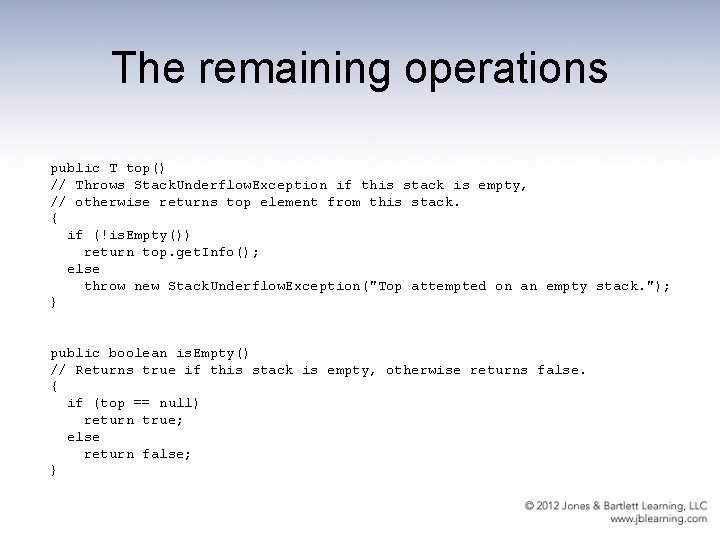
The remaining operations public T top() // Throws Stack. Underflow. Exception if this stack is empty, // otherwise returns top element from this stack. { if (!is. Empty()) return top. get. Info(); else throw new Stack. Underflow. Exception("Top attempted on an empty stack. "); } public boolean is. Empty() // Returns true if this stack is empty, otherwise returns false. { if (top == null) return true; else return false; }
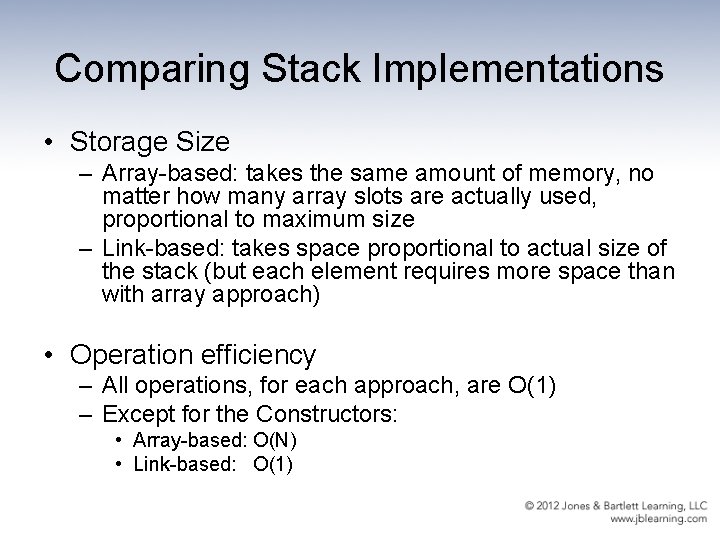
Comparing Stack Implementations • Storage Size – Array-based: takes the same amount of memory, no matter how many array slots are actually used, proportional to maximum size – Link-based: takes space proportional to actual size of the stack (but each element requires more space than with array approach) • Operation efficiency – All operations, for each approach, are O(1) – Except for the Constructors: • Array-based: O(N) • Link-based: O(1)
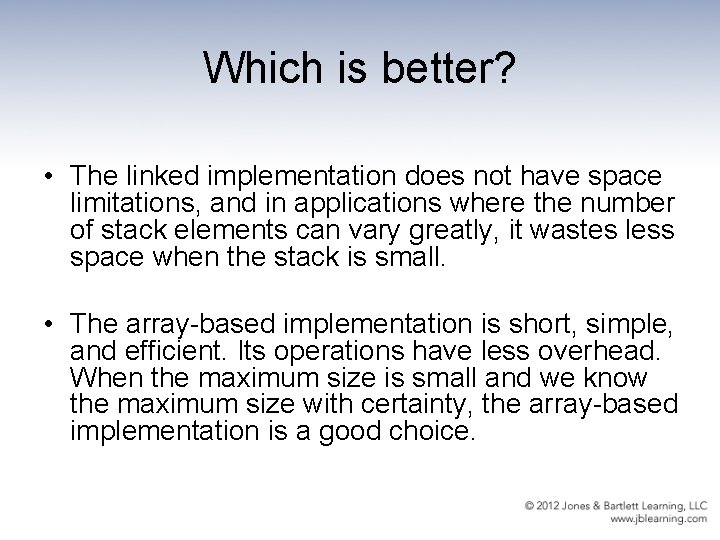
Which is better? • The linked implementation does not have space limitations, and in applications where the number of stack elements can vary greatly, it wastes less space when the stack is small. • The array-based implementation is short, simple, and efficient. Its operations have less overhead. When the maximum size is small and we know the maximum size with certainty, the array-based implementation is a good choice.