
Chapter 3 The Research Process Key Concepts Specifying
- Slides: 11
Chapter 3: The Research Process Key Concepts: Specifying the Research Question and Hypothesis
Evaluating the Research Question § The question is logically related to the identification of the problem area. § The question can be answered through research; it is not in the values domain. § The question has not been answered. If it has been, what related questions might you ask? § Answering the question will be useful for informing social work practice, developing social policy, or advancing theory. § The question is sensitive to issues of culture. 2
Specifying the Question(s) § Concept § Abstract or general idea, a symbol for some observable attribute or phenomenon. § “What is the recidivism rate of juvenile girls? ” § Recidivism Concepts § Juvenile § Girl 3
Defining Concepts § Nominal Definition – Like a dictionary § E. g. Juvenile: a young person not fully grown or developed. § Operational Definition – In a way that can be measured or counted. § E. g. Juvenile: any human being between the ages of 8 and 17. § Definition of the concept has implications for the meaning and accuracy of the research. 4
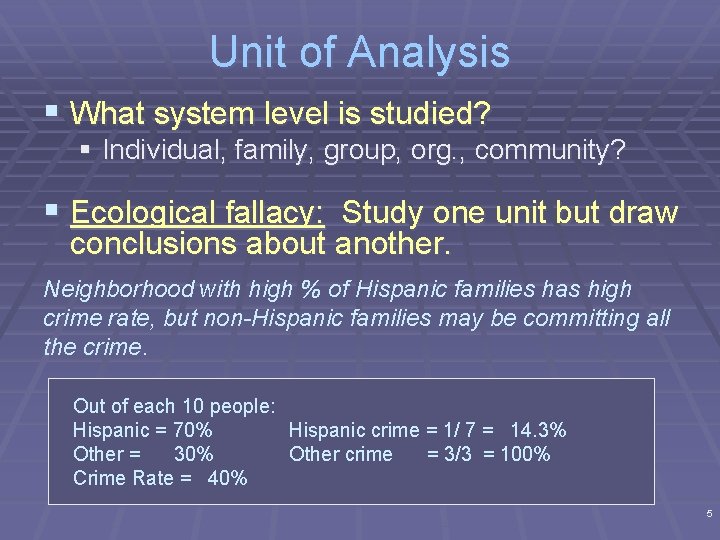
Unit of Analysis § What system level is studied? § Individual, family, group, org. , community? § Ecological fallacy: Study one unit but draw conclusions about another. Neighborhood with high % of Hispanic families has high crime rate, but non-Hispanic families may be committing all the crime. Out of each 10 people: Hispanic = 70% Hispanic crime = 1/ 7 = 14. 3% Other = 30% Other crime = 3/3 = 100% Crime Rate = 40% 5
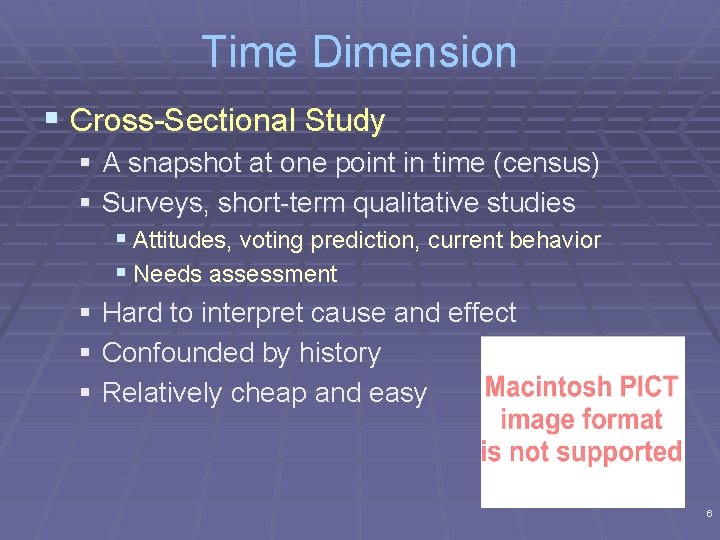
Time Dimension § Cross-Sectional Study § A snapshot at one point in time (census) § Surveys, short-term qualitative studies § Attitudes, voting prediction, current behavior § Needs assessment § Hard to interpret cause and effect § Confounded by history § Relatively cheap and easy 6
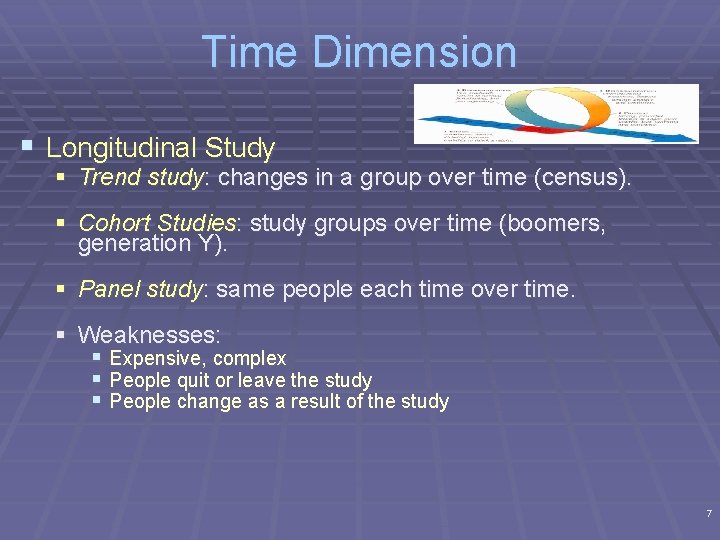
Time Dimension § Longitudinal Study § Trend study: changes in a group over time (census). § Cohort Studies: study groups over time (boomers, generation Y). § Panel study: same people each time over time. § Weaknesses: § Expensive, complex § People quit or leave the study § People change as a result of the study 7
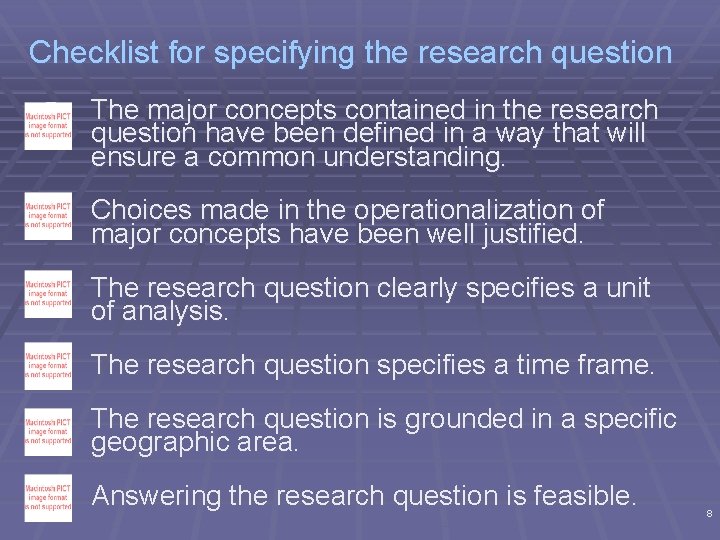
Checklist for specifying the research question § The major concepts contained in the research question have been defined in a way that will ensure a common understanding. § Choices made in the operationalization of major concepts have been well justified. § The research question clearly specifies a unit of analysis. § The research question specifies a time frame. § The research question is grounded in a specific geographic area. § Answering the research question is feasible. 8
Formulating Hypotheses § Hypothesis: A tentative answer to a research question written as a statement, usually expressed as a relationship between variables. § Variable: A concept that can vary; can have a range of numeric values or attributes. § Constant: A concept that does not vary; has only one numeric value or attribute. A hypothesis is a statement about the relationship between two or more variables. 9
Types of Hypotheses § Null Hypothesis: no difference or relationship § “There is no relationship between self-esteem and recidivism. ” § Research or Alternative Hypothesis: § Nondirectional hypothesis: there is a difference / relationship § “There is a relationship between self-esteem and recidivism” § Directional hypothesis: There is a positive or inverse relationship § “The greater the self-esteem, the less likely the recidivism” § Extraneous variables represent alternative explanations for the observed relationships. § “Income causes both self-esteem and lack of recidivism. ” 10
Checklist for Hypotheses § The hypotheses are in the form of a tentative answer to the research question and are not phrased as questions. § The hypotheses are specifically stated. § The hypotheses are justified by either theory or prior research. § Statement of a directional hypothesis is justified on the basis of existing theory or research. § The hypotheses can be tested through research and are capable of being refuted. 11