
Chapter 3 The Relational Model 2 Objectives Terminology
Chapter 3 The Relational Model
2 Objectives • Terminology of relational model. • How tables are used to represent data. • Connection between mathematical relations and relations in the relational model. • Properties of database relations. • How to identify CK, PK, and FKs. • Meaning of entity integrity and referential integrity. • Purpose and advantages of views.
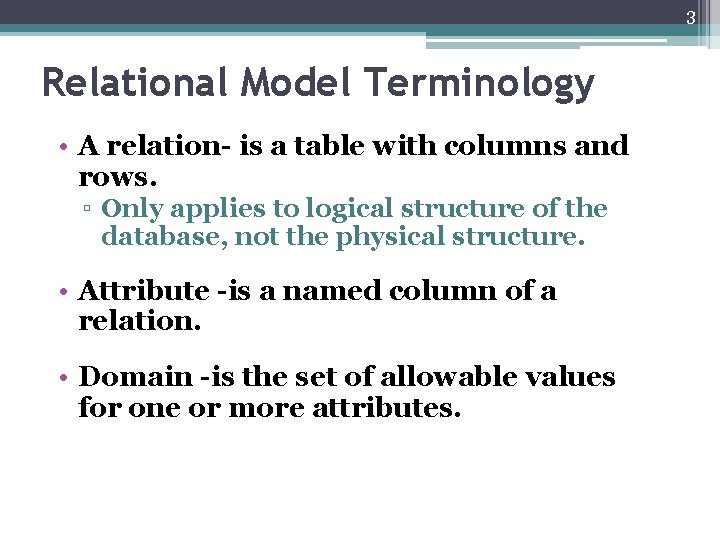
3 Relational Model Terminology • A relation- is a table with columns and rows. ▫ Only applies to logical structure of the database, not the physical structure. • Attribute -is a named column of a relation. • Domain -is the set of allowable values for one or more attributes.
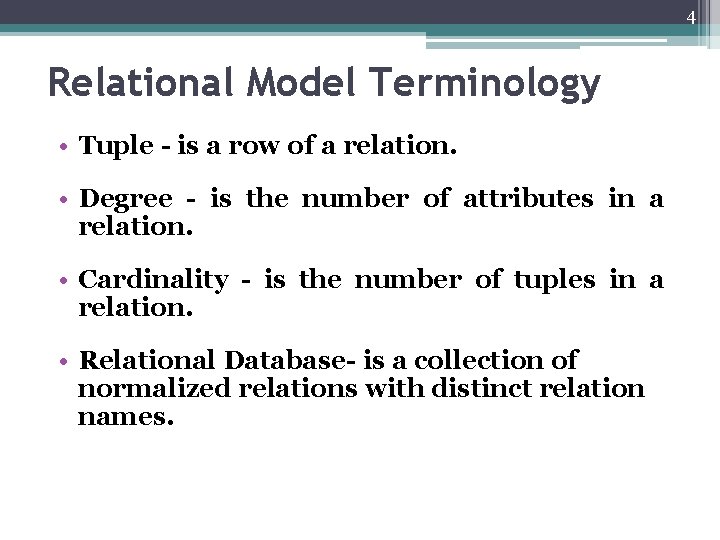
4 Relational Model Terminology • Tuple - is a row of a relation. • Degree - is the number of attributes in a relation. • Cardinality - is the number of tuples in a relation. • Relational Database- is a collection of normalized relations with distinct relation names.
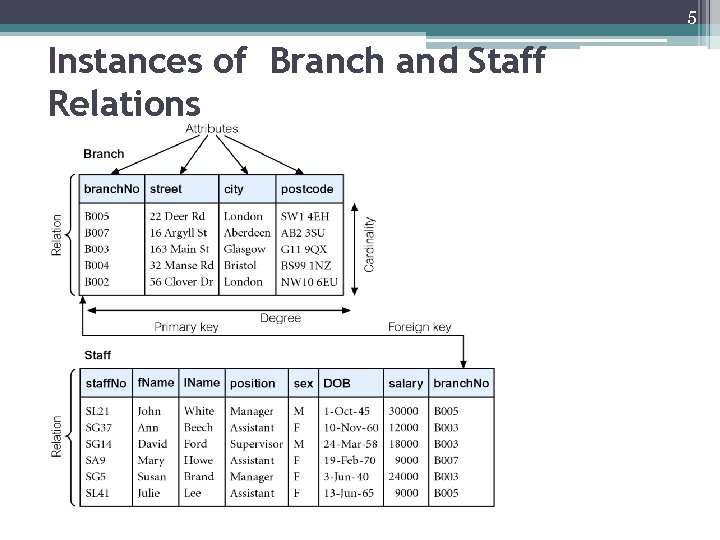
5 Instances of Branch and Staff Relations

6 Examples of Attribute Domains
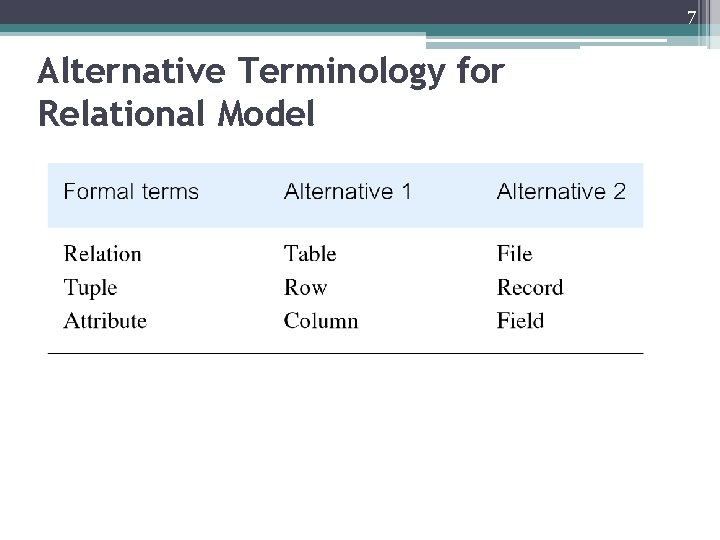
7 Alternative Terminology for Relational Model
8 Database Relations • Relation schema ▫ Named relation defined by a set of attribute and domain name pairs. • Relational database schema ▫ Set of relation schemas, each with a distinct name.
9 Properties of Relations • Relation name is distinct from all other relation names in relational schema. • Each cell of relation contains exactly one atomic (single) value. • Each attribute has a distinct name. • Values of an attribute are all from the same domain.
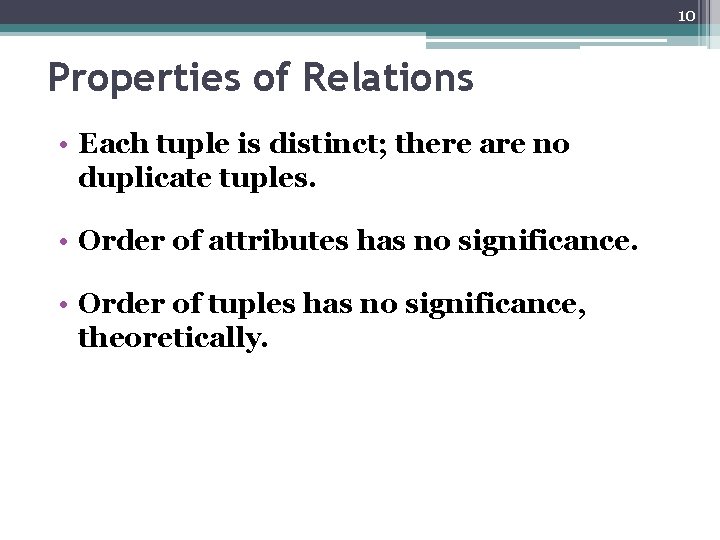
10 Properties of Relations • Each tuple is distinct; there are no duplicate tuples. • Order of attributes has no significance. • Order of tuples has no significance, theoretically.
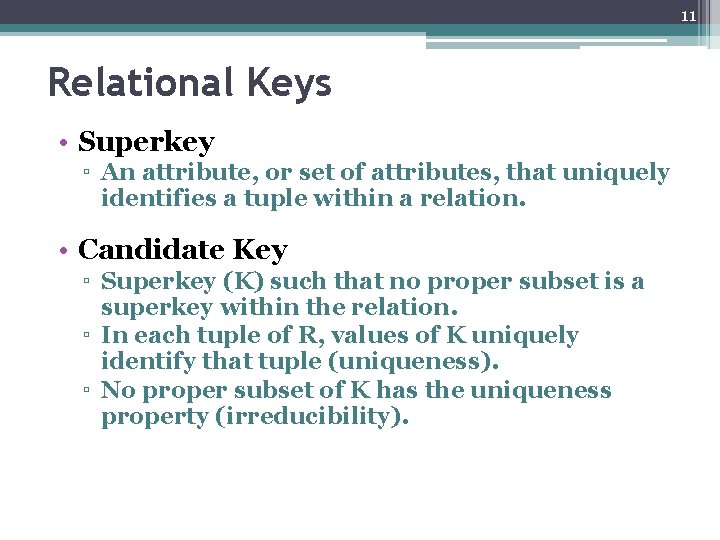
11 Relational Keys • Superkey ▫ An attribute, or set of attributes, that uniquely identifies a tuple within a relation. • Candidate Key ▫ Superkey (K) such that no proper subset is a superkey within the relation. ▫ In each tuple of R, values of K uniquely identify that tuple (uniqueness). ▫ No proper subset of K has the uniqueness property (irreducibility).
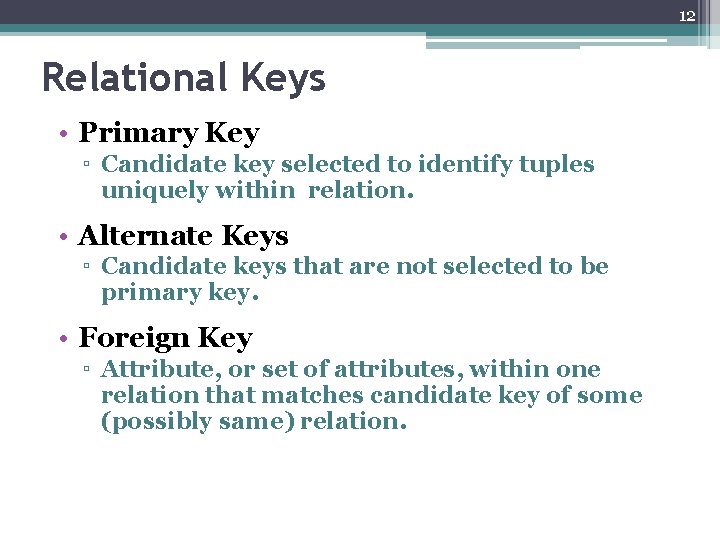
12 Relational Keys • Primary Key ▫ Candidate key selected to identify tuples uniquely within relation. • Alternate Keys ▫ Candidate keys that are not selected to be primary key. • Foreign Key ▫ Attribute, or set of attributes, within one relation that matches candidate key of some (possibly same) relation.
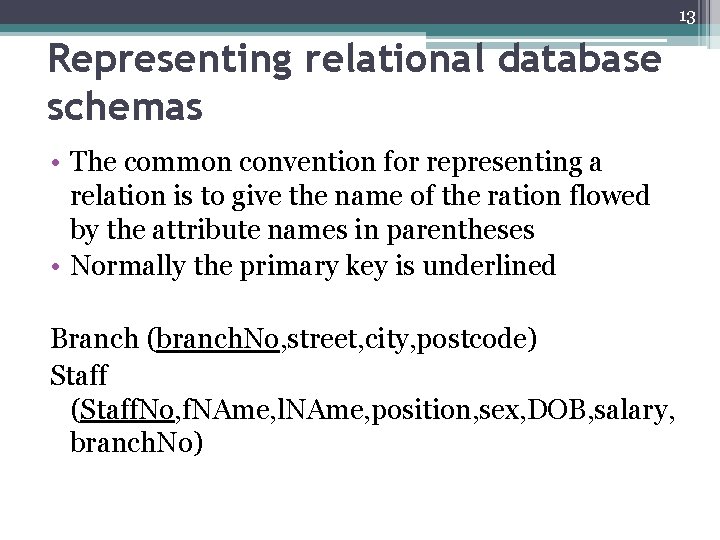
13 Representing relational database schemas • The common convention for representing a relation is to give the name of the ration flowed by the attribute names in parentheses • Normally the primary key is underlined Branch (branch. No, street, city, postcode) Staff (Staff. No, f. NAme, l. NAme, position, sex, DOB, salary, branch. No)
14 Integrity Constraints • Null ▫ Represents value for an attribute that is currently unknown or not applicable for tuple. ▫ Deals with incomplete or exceptional data. ▫ Represents the absence of a value and is not the same as zero or spaces, which are values.

15 Integrity Constraints • Entity Integrity ▫ In a base relation, no attribute of a primary key can be null. • Referential Integrity ▫ If foreign key exists in a relation, either foreign key value must match a candidate key value of some tuple in its home relation or foreign key value must be wholly null.
16 Integrity Constraints • General Constraints ▫ Additional rules specified by users or database administrators that define or constrain some aspect of the enterprise.
17 Views • Base Relation ▫ Named relation corresponding to an entity in conceptual schema, whose tuples are physically stored in database. • View ▫ Dynamic result of one or more relational operations operating on base relations to produce another relation.
18 Views • A virtual relation that does not necessarily actually exist in the database but is produced upon request, at time of request. • Contents of a view are defined as a query on one or more base relations. • Views are dynamic, meaning that changes made to base relations that affect view attributes are immediately reflected in the view.
19 Purpose of Views • Provides powerful and flexible security mechanism by hiding parts of database from certain users. • Permits users to access data in a customized way, so that same data can be seen by different users in different ways, at same time. • Can simplify complex operations on base relations.
20 Updating Views • All updates to a base relation should be immediately reflected in all views that reference that base relation. • If view is updated, underlying base relation should reflect change.
21 Updating Views • There are restrictions on types of modifications that can be made through views: ▫ Updates are allowed if query involves a single base relation and contains a candidate key of base relation. ▫ Updates are not allowed involving multiple base relations. ▫ Updates are not allowed involving aggregation or grouping operations.
22 Updating Views • Classes of views are defined as: ▫ theoretically not updateable; ▫ theoretically updateable; ▫ partially updateable.
23 Review questions • Discuss each of the following concepts in the context of the relational data model: ▫ ▫ ▫ Relation Attribute Domain Tuple Intension and extension Degree and cardinality • What is a view? Discuss the difference between a view and a base relation.
- Slides: 23