
Chapter 3 The Power of Verbal and Nonverbal
Chapter 3 The Power of Verbal and Nonverbal Communication in the Global Workplace
Identity • Response we get from others to what we say and do • We can only partially control our identity Monitoring • Checking the accuracy of your perceptions regarding how the messages you believe you sent were actually interpreted • Questioning the cultural and contextual factors that may lead to different perceptions about your communication.
Equity The principle that we should be treated fairly by others and, in turn, should treat them fairly. Based on four key assumptions: People work for rewards. 1. • Rewards are what people derive from their work in relation to what it costs them People seek empowerment. 2. Empowerment is the process of enabling and motivating employees • 3. People become stressed when they feel they are treated unfairly. 4. People who experience stress will try to restore equity by: 1. 2. 3. Seeking mental equity seeking actual restitution seeking narrative equity
Verbal Communication Clarity and ambiguity Upward and downward communication Inclusive and exclusive messages Confirming and disconfirming messages Supportive and nonsupportive messages Gendered talk
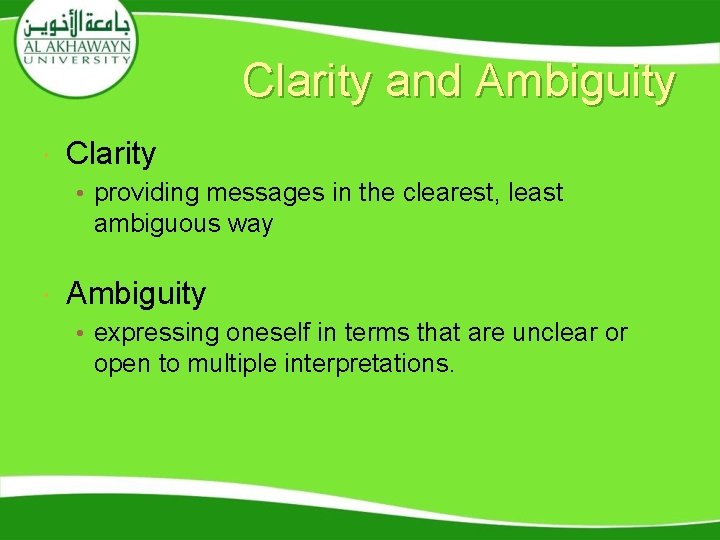
Clarity and Ambiguity Clarity • providing messages in the clearest, least ambiguous way Ambiguity • expressing oneself in terms that are unclear or open to multiple interpretations.
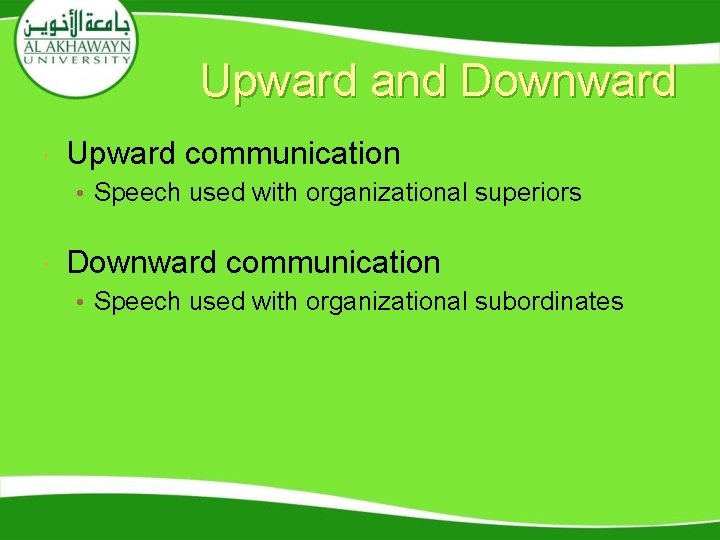
Upward and Downward Upward communication • Speech used with organizational superiors Downward communication • Speech used with organizational subordinates
Enhancing Power Enhance Power Upward Enhance Power Downward balancing politeness with a clear task orientation listening openly to employees’ communication balancing friendliness with respect and deference to authority responding honestly to inquiries and requests balancing self-interest with company needs asking for information prior to evaluating a situation or problem asking for feedback on the accomplishment of tasks providing feedback on tasks avoiding sexist, racist, or classist remarks balancing personal and professional respect with a task orientation and accountability
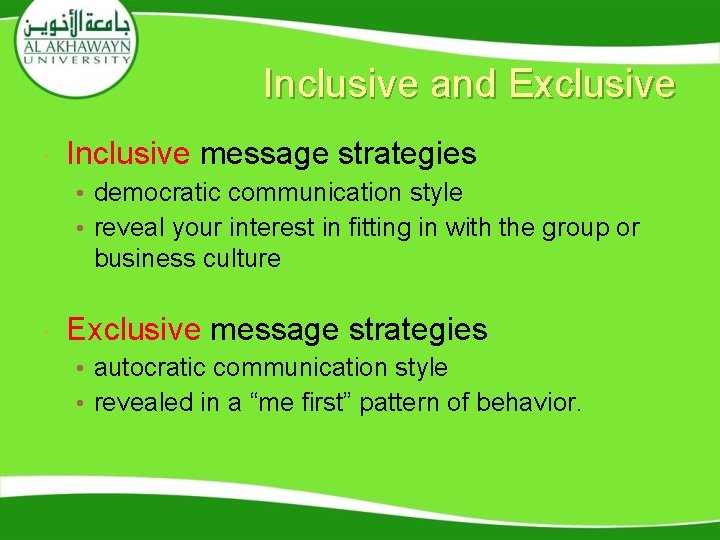
Inclusive and Exclusive Inclusive message strategies • democratic communication style • reveal your interest in fitting in with the group or business culture Exclusive message strategies • autocratic communication style • revealed in a “me first” pattern of behavior.
Confirming and Disconfirming Confirming messages • support and enhance the identities we seek Disconfirming messages • deny or harm our identities
Supportive and Nonsupportive Supportive messages • communicate concern and respect for others and indicate cooperation Nonsupportive messages • associated with an inflated ego and self- centeredness • communicate disrespect of others and lack of cooperation
Credibility The authority and trust listeners or audiences give to speakers. • Enhanced by: 1. 2. 3. 4. 5. 6. 7. becoming informed and knowledgeable about the work assigned to you behaving in a trustworthy manner by keeping secrets and confidences being open, honest, and authentic in your dealings with everyone demonstrating that you are capable of being a friend and coworker doing what you say you will do graciously accepting criticism and corrective feedback from others accepting personal responsibility for your actions
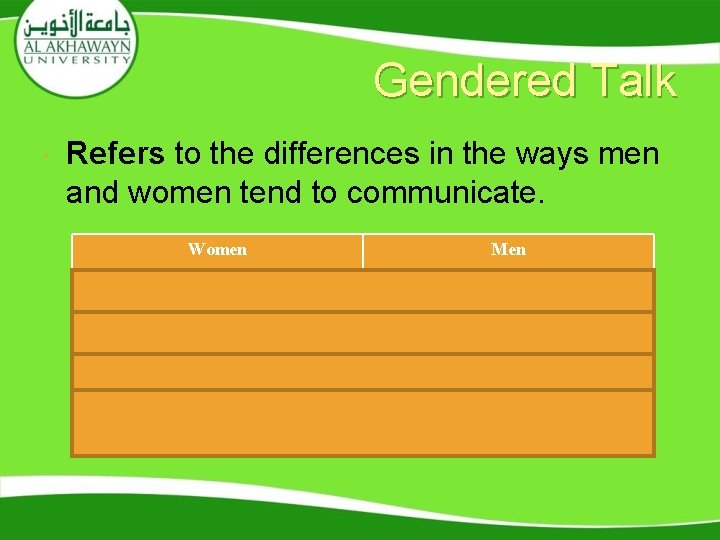
Gendered Talk Refers to the differences in the ways men and women tend to communicate. Women Men build rapport make reports expressive instrumental more tentative reflect more certainty use talk to create and maintain relationships use talk to gain control over situations and others.
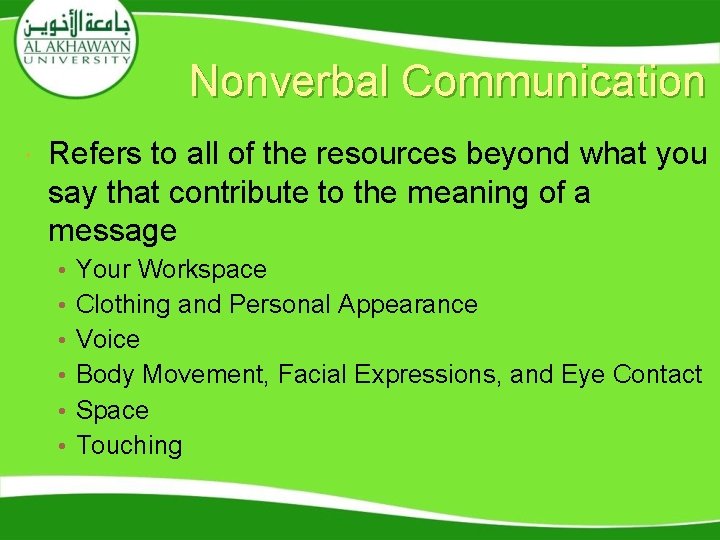
Nonverbal Communication Refers to all of the resources beyond what you say that contribute to the meaning of a message • • • Your Workspace Clothing and Personal Appearance Voice Body Movement, Facial Expressions, and Eye Contact Space Touching
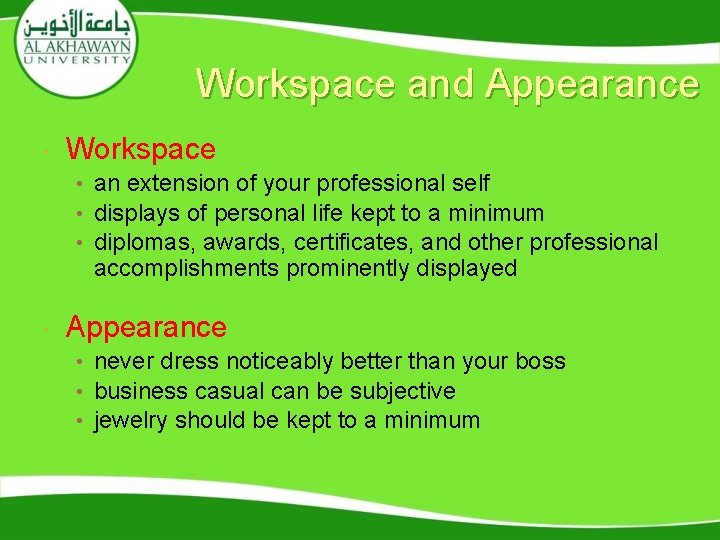
Workspace and Appearance Workspace • an extension of your professional self • displays of personal life kept to a minimum • diplomas, awards, certificates, and other professional accomplishments prominently displayed Appearance • never dress noticeably better than your boss • business casual can be subjective • jewelry should be kept to a minimum
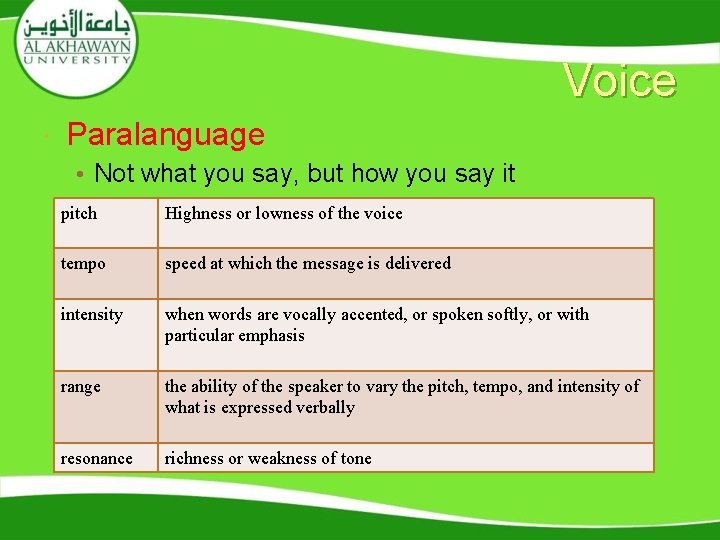
Voice Paralanguage • Not what you say, but how you say it pitch Highness or lowness of the voice tempo speed at which the message is delivered intensity when words are vocally accented, or spoken softly, or with particular emphasis range the ability of the speaker to vary the pitch, tempo, and intensity of what is expressed verbally resonance richness or weakness of tone
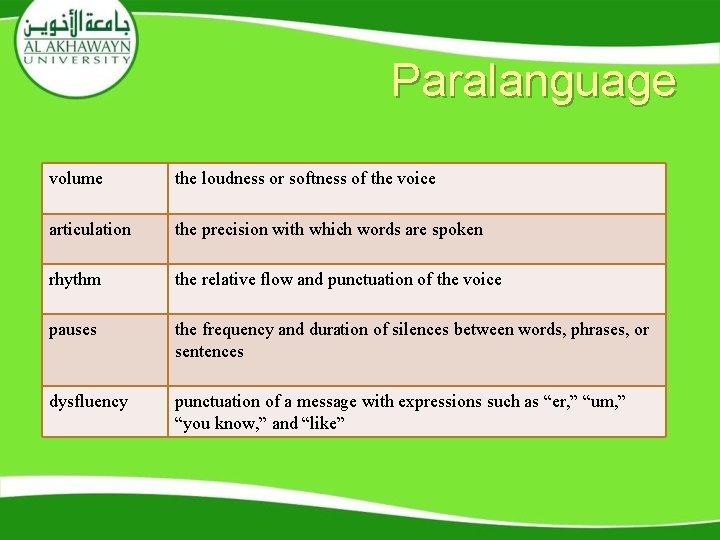
Paralanguage volume the loudness or softness of the voice articulation the precision with which words are spoken rhythm the relative flow and punctuation of the voice pauses the frequency and duration of silences between words, phrases, or sentences dysfluency punctuation of a message with expressions such as “er, ” “um, ” “you know, ” and “like”
Body Movement Kinesics • The study of body movement, including facial expressions, eye contact, and gestures Oculesics • The specific study of the eyes as a source of communication Display rules • • • simulation intensification neutralization or inhibition deintensification masking
Space Proxemics • the study of interpersonal space and distance Territoriality Crowding and Density Personal space • • Intimate zone Casual or personal zone Social-consulting zone Public zone
Touching Haptics • The study of touching as a form of nonverbal communication. Five basic types of touching behavior • • • Functional-professional. Social-polite. Friendship-warmth. Love-intimacy. Sexually arousing.
Harassment sexual harassment • any form of sexually explicit verbal or nonverbal communication that interferes with someone’s work Types of sexual harassment. • quid pro quo (“this for that”) based on the threat of retaliation or the promise of workplace favoritism or promotion in exchange for dating or sexual favors. • hostile work environment created through sexually explicit verbal or nonverbal communication that interferes with someone’s work or that is perceived as intimidating or offensive.
Taking Action Confront the harasser and ask him or her to stop the offensive behavior. Keep a diary in which you record the dates, times, and places of offensive or harassing actions. Complain about the harasser within the channels prescribed for such action by the policies of your employer. File a legal complaint with the federal EEOC or with your state agency for workplace discrimination.
- Slides: 21