
Chapter 3 The Marketing Environment Social Responsibility and
Chapter 3 The Marketing Environment, Social Responsibility, and Ethics
Objectives • Recognize importance of environmental scanning and analysis • Understand how competitive/economic factors affect organizations’ ability to compete and customers’ ability/willingness to buy products • Identify political forces in marketing environment • Understand how laws, government regulations, and selfregulatory agencies affect marketing • Explore effects of new technology on society and on marketing • Analyze sociocultural issues marketers must deal with as they make decisions. Copyright © Houghton Mifflin Company. All rights reserved. 3|2
Responding to the Marketing Environment • The marketing environment consists of external forces that directly or indirectly influence organizations, both: – in acquisition of inputs (human, financial, and natural resources and raw materials, and information) and – creation of outputs (goods, services, or ideas). • These influences can create opportunities and pose threats for marketers. Copyright © Houghton Mifflin Company. All rights reserved. 3|3
Environmental Scanning Environmental scanning is “the process of collecting information about the forces in the marketing environment”. Environmental scanning can give marketers an edge over competitors in taking advantage of current trends. Copyright © Houghton Mifflin Company. All rights reserved. 3|4
Scanning Involves: • Observation • Secondary Sources, such as: – – Business Trade Government General-interest publications • Marketing research • Cautions: ü Know how to use information ü Don’t gather too much information Copyright © Houghton Mifflin Company. All rights reserved. 3|5
Environmental Analysis • Environmental analysis is “the process of assessing and interpreting the information gathered through scanning”. • Marketers evaluate the information for accuracy, try to resolve inconsistencies in the data, and assignificance to the findings. • Environmental analysis enables marketers to identify potential threats and opportunities linked to environmental changes. Copyright © Houghton Mifflin Company. All rights reserved. 3|6
Responding To Environmental Forces • Some marketers view environmental forces as uncontrollable and remain passive - reactive to the environment. While • Other marketers believe that environmental forces can be shaped (through economic, psychological, political, or promotional skills), and these marketers are, to a certain extent, proactive. • Which approach is most appropriate for a particular firm depends on its managerial philosophies, objectives, financial resources, customers, human skills, and other environmental forces. Copyright © Houghton Mifflin Company. All rights reserved. 3|7
Environmental forces There are six environmental forces that must be considered in strategic planning: 1. Competitive forces 2. Economic forces 3. Political forces 4. Legal and regulatory forces 5. Technological forces 6. Sociocultural forces Copyright © Houghton Mifflin Company. All rights reserved. 3|8
1. Competitive Forces • Competition can be defined as “other firms that market products similar to or that can be substituted for its products in the same geographic area. • Types of Competitors: classified into four types: 1. Brand competitors: firms that market products with similar features and benefits to the same customers at similar prices. 2. Product competitors: firms that compete in the same product class, but their products have different features, benefits, and prices. 3. Generic competitors: firms that provide very different products that solve the same problem or satisfy the same basic customer need. 4. Total budget competitors: firms that compete for the limited financial resources of the same customers. Copyright © Houghton Mifflin Company. All rights reserved. 3|9
1. Competitive Forces (continued) All the four types of competition can affect a firm’s marketing performance, but Brand competitors are the most significant because buyers typically see the different products of these firms as direct substitutes. Copyright © Houghton Mifflin Company. All rights reserved. 3 | 10

Types of competitive structures 1. Monopoly, exists when a firm offers a product that has no close substitute, making it the sole source of supply. 2. Oligopoly, exists when a few sellers control the supply of a large proportion of a product. 3. Monopolistic competition, exists when a firm with many potential competitors attempts to develop a marketing strategy to differentiate its product. 4. Pure competition, exists when a large number of sellers, no one of which could significantly influence price or supply. Copyright © Houghton Mifflin Company. All rights reserved. 3 | 11
Monitoring Competition • Marketers need to monitor the actions of major competitors to determine what specific strategies competitors are using and how those strategies affect their own. • It is not enough to analyze available information; the firm must develop a system for gathering ongoing information about competitors. Copyright © Houghton Mifflin Company. All rights reserved. 3 | 12
Pure Competition A market structure characterized by an extremely large number of sellers, none strong enough to significantly influence price or supply. Copyright © Houghton Mifflin Company. All rights reserved. 3 | 13
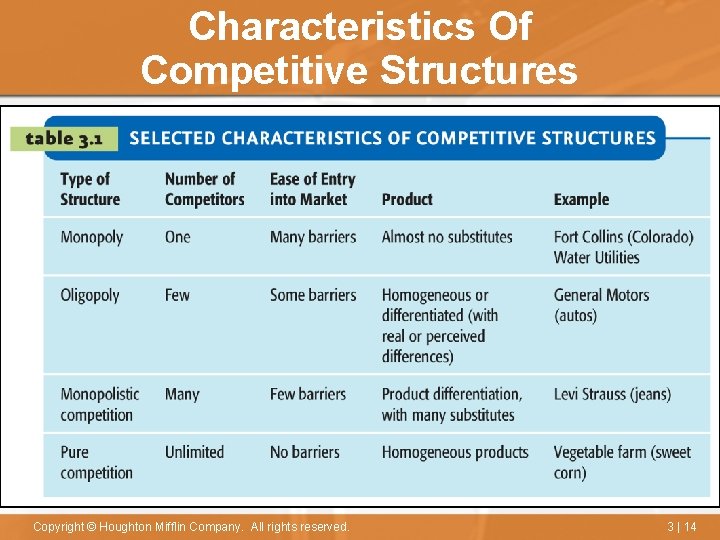
Characteristics Of Competitive Structures Copyright © Houghton Mifflin Company. All rights reserved. 3 | 14
2. Economic Forces • Economic forces in the marketing environment influence both marketers’ and customers’ decisions and activities. • Relevant issues include: Ø Economic Conditions Ø Business cycles Ø Buying Power Ø Income and Wealth Ø Willingness to Spend Copyright © Houghton Mifflin Company. All rights reserved. 3 | 15
Economic Conditions Changes in the economy which affect (and are affected by) supply and demand, buying power, willingness to spend, consumer expenditure levels, and the intensity of competition Copyright © Houghton Mifflin Company. All rights reserved. 3 | 16
Business Cycle A Business Cycle is “a pattern of economic fluctuations that has four stages: § Prosperity § Recession § Depression § Recovery Copyright © Houghton Mifflin Company. All rights reserved. 3 | 17
Business Cycle (continued) • Prosperity- low unemployment, high total income, which together increase buying power. Marketers often expand their product offerings to take advantage of increased buying power • Recession- unemployment rises, total buying power declines, both consumer and business spending decrease. Marketers should focus on marketing research during a recession to determine precisely what functions buyers want and integrate these functions into their product. Promotion efforts should emphasize value and utility. • Depression- high unemployment, wages are low, total disposable income is at a minimum, consumers lack confidence in the economy. • Recovery- economy moves from recession or depression to prosperity. Marketers should be as flexible as possible to be able to adjust their strategies as economy improves and buying power increases. Copyright © Houghton Mifflin Company. All rights reserved. 3 | 18
Buying Power includes “resources, such as money, goods, and services that can be traded in an exchange”. Obviously, the strength of a person’s buying power depends on economic conditions and the size of the resources that enable the individual to make purchases. Copyright © Houghton Mifflin Company. All rights reserved. 3 | 19
Sources of Buying Power Major sources of buying power are income, credit, and wealth. • Income is money received through wages, rents, investments, pensions, and other sources for a given period – Disposable income (or after-tax income) is used for spending or saving. It is affected by wage levels, rate of unemployment, interest rates, dividend rates, and tax rates. – Discretionary income is disposable income available for spending and saving after an individual has purchased the basic necessities of food, clothing, and shelter. • Credit enables people to spend future income now or in the near future, but it increases current buying power at the expense of future buying power. • Wealth is the accumulation of past income, natural resources, and financial resources. Copyright © Houghton Mifflin Company. All rights reserved. 3 | 20
Why should marketers care about buying power? because they directly affect the types and quantities of goods and services that consumers purchase. Copyright © Houghton Mifflin Company. All rights reserved. 3 | 21
Willingness To Spend An inclination to buy because of expected satisfaction from a product, influenced by: – ability to buy (buying power) – Several psychological and social forces – product’s price and its value – The amount of satisfaction received from a product already owned – Expectations about future employment, income levels, prices, family size, and general economic conditions Copyright © Houghton Mifflin Company. All rights reserved. 3 | 22
3. Political Forces • Political, legal, and regulatory forces of the marketing environment are closely interrelated. • Marketers must understand adjust to political conditions and legislation enacted. • Although some marketers view political forces as beyond their control, others seek to influence political forces through lobbying decision makers, public protests or campaigning. Copyright © Houghton Mifflin Company. All rights reserved. 3 | 23
4. Legal and regulatory forces • Each country has its own laws that influence marketing decisions and activities. So it is difficult to generalize on this issue. • In general, laws may be designed to deal with various issues, such as: ü Ensuring smooth running of businesses ü preserving fair competition ü protecting consumer rights (i. e. consumer safety, hazardous materials, information disclosure, and specific unethical marketing practices, … etc) Copyright © Houghton Mifflin Company. All rights reserved. 3 | 24
Example: Federal Trade Commission The FTC is an agency that regulates a variety of business practices and curbs false advertising, misleading pricing, and deceptive packaging and labeling. For example: – The FTC influences many marketing activities (bans advertising for tobacco). – It can issue complaints and require companies to run corrective advertising. – It also assists businesses in complying with laws. Copyright © Houghton Mifflin Company. All rights reserved. 3 | 25
5. Technological Forces • Technology is the application of knowledge and tools to solve problems and perform tasks more efficiently. • Impact of Technology – Technology determines how society satisfies its needs (i. e. improved communications). – Technology can help marketers and consumers become more productive. But, it also raises controversial issues (i. e. dark side of technology, such as air travel … etc). – Technology expands opportunities for e-commerce (e- commerce is defined as “the sharing of business information and conduct marketing transactions via telecommunications networks”), which leads changing the relationship between marketers and consumers. Copyright © Houghton Mifflin Company. All rights reserved. to 3 | 26
Adoption and Use of Technology ü It is important for firms to determine when a technology is changing, and thus define the strategic influence of the new technology. ü A firm’s ability to protect its inventions also influences the use of technology (positive correlation). Copyright © Houghton Mifflin Company. All rights reserved. 3 | 27
Technology assessment A procedure by which managers try to foresee the effects of new products and processes on: ü the firm’s operations ü other business organizations ü society in general. Copyright © Houghton Mifflin Company. All rights reserved. 3 | 28
6. Sociocultural Forces • Sociocultural forces: are the influences in a society and its culture that bring about changes in attitudes, beliefs, norms, customs, and lifestyles. • Population’s demographic characteristics (i. e. age, gender, race, ethnicity, marital and parental status, income, and education) have a significant impact on relationships and individual behavior. • Changes in sociocultural forces lead to: – changes in how people live and consume products, and – unique problems and opportunities for marketers. Copyright © Houghton Mifflin Company. All rights reserved. 3 | 29
6. Sociocultural Forces (continued) • Cultural Values Changes in values dramatically influence people’s needs and desires for products. Examples: ü issues of health, nutrition, exercise, changing family concept, have increased in importance, affecting behavior, lifestyles, and product choices ü Today, many consumers are more concerned about the natural environment. • Consumerism involves organized efforts by individuals, groups, and organizations to protect consumers’ rights. • These efforts may include, for example: Ø Ø writing letters to companies lobbying government agencies broadcasting public service announcements boycotting companies whose activities are deemed irresponsible Copyright © Houghton Mifflin Company. All rights reserved. 3 | 30
The Nature of Social Responsibility • Social responsibility – an organization’s obligation to maximize its positive impact and minimize its negative impact on society. It deals with the total effect of all marketing decisions on society”. • Stakeholders include those groups who have a “stake” or claim in some aspect of a company’s products, operations, markets, industry, and outcomes (i. e. customers, employees, investors and shareholders, suppliers, governments, communities, and many others). • Ignoring stakeholders’ demands for responsible marketing can destroy customers’ trust and even prompt government actions. • Socially responsible efforts have positive effects on local communities and indirectly help the sponsoring organization by attracting goodwill, publicity, and potential customers and employees. • While social responsibility is a positive concept in itself, most organizations embrace it in the expectation of indirect long-term benefits. Copyright © Houghton Mifflin Company. All rights reserved. 3 | 31
The Nature of Social Responsibility (continued) • Socially responsible organizations strive for marketing citizenship. • Marketing citizenship refers to the adoption of a strategic focus for fulfilling the economic, legal, ethical, and philanthropic social responsibilities that their stakeholders expect of them. • Companies that consider the diverse perspectives of stakeholders in their daily operations and strategic planning are said to have a “stakeholder orientation”. • Stakeholder orientation is an understanding and addressing the needs of all stakeholders, including communities and special interest groups. • As a result, organizations are now under pressure to undertake initiatives that demonstrate a balanced perspective on stakeholder interests. Copyright © Houghton Mifflin Company. All rights reserved. 3 | 32
Dimensions Of Social Responsibility is viewed to have four dimensions: 1. Economic: at the most basic level, all companies have an economic responsibility to be profitable so they can provide a return on investment to their owners and investors, create jobs for the community, and contribute goods and services to the economy. 2. Legal: Marketers are expected to respect and obey all laws and regulations. 3. Ethical: Ethical marketing fosters trust, which helps build long-term marketing relationships. ü Marketing ethics refers to Principles and standards that define acceptable marketing conduct as determined by various stakeholders and the organization itself. 4. Philanthropic responsibilities go beyond marketing ethics. They are not required of a company, but they promote human welfare or goodwill, as do the economic, legal, and ethical dimensions of social responsibility. Copyright © Houghton Mifflin Company. All rights reserved. 3 | 33
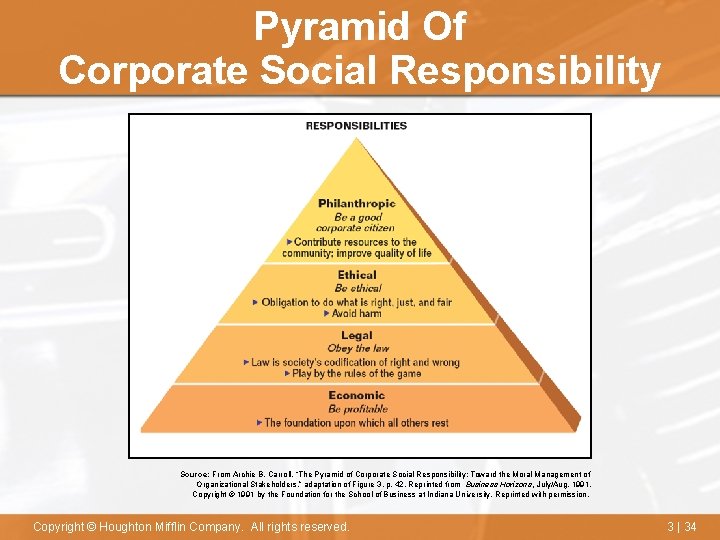
Pyramid Of Corporate Social Responsibility Source: From Archie B. Carroll, “The Pyramid of Corporate Social Responsibility: Toward the Moral Management of Organizational Stakeholders, ” adaptation of Figure 3, p. 42. Reprinted from Business Horizons, July/Aug. 1991. Copyright © 1991 by the Foundation for the School of Business at Indiana University. Reprinted with permission. Copyright © Houghton Mifflin Company. All rights reserved. 3 | 34
Cause-Related Marketing It refers to a practice in which a firm links its products to a particular social cause on an ongoing or short-term basis. (It is related to the concept of philanthropy) Copyright © Houghton Mifflin Company. All rights reserved. 3 | 35
Strategic Philanthropy The synergistic use of organizational core competencies and resources to address key stakeholders’ interests and achieve both organizational and social benefits. Copyright © Houghton Mifflin Company. All rights reserved. 3 | 36
Consumerism • Consumerism involves organized efforts by individuals, groups, and organizations to protect consumers’ rights. • These efforts may include, for example: Ø Ø writing letters to companies lobbying government agencies broadcasting public service announcements boycotting companies whose activities are deemed irresponsible Copyright © Houghton Mifflin Company. All rights reserved. 3 | 37
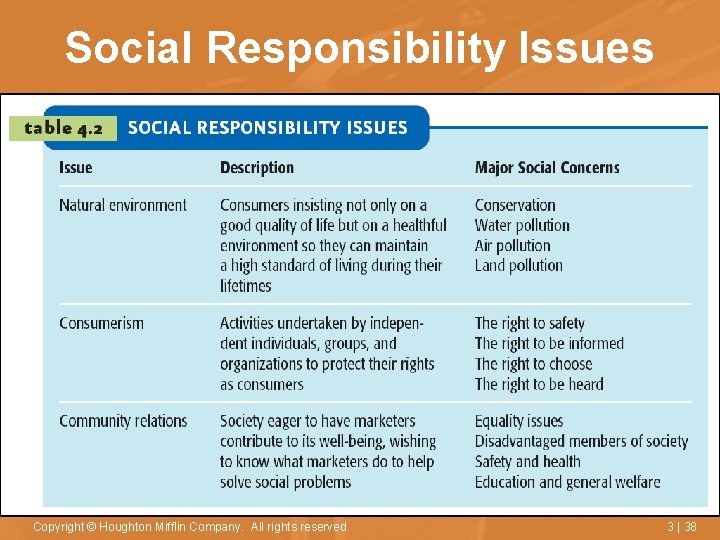
Social Responsibility Issues Copyright © Houghton Mifflin Company. All rights reserved. 3 | 38
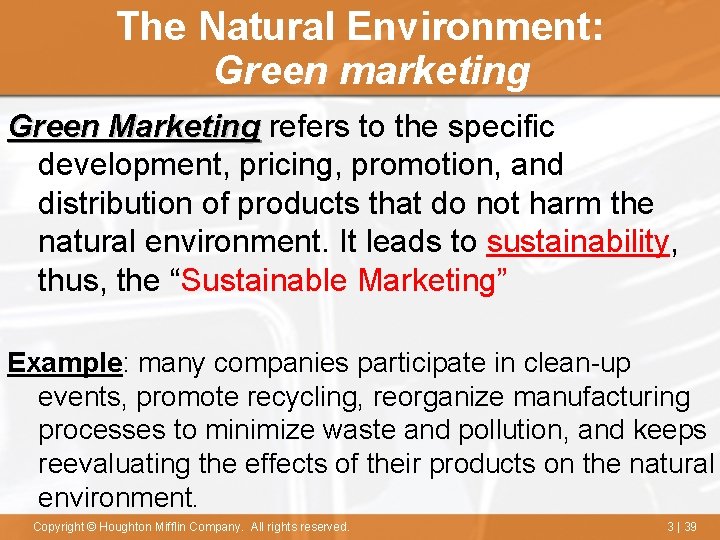
The Natural Environment: Green marketing Green Marketing refers to the specific development, pricing, promotion, and distribution of products that do not harm the natural environment. It leads to sustainability, thus, the “Sustainable Marketing” Example: many companies participate in clean-up events, promote recycling, reorganize manufacturing processes to minimize waste and pollution, and keeps reevaluating the effects of their products on the natural environment. Copyright © Houghton Mifflin Company. All rights reserved. 3 | 39
Marketing Ethics • Marketers should be aware of ethical standards for acceptable conduct from several viewpoints — company, industry, special interest groups, government, customers, and society at large. • When marketing activities deviate from accepted standards, the exchange process can break down, resulting in customer dissatisfaction, lack of trust, and lawsuits. • Marketing ethics go beyond legal issues. Often, the distinction between the two issues is blurred in decision making. • The legal system should provide a formal venue for marketers to resolve ethical disputes as well as legal ones. Copyright © Houghton Mifflin Company. All rights reserved. 3 | 40
- Slides: 40