
Chapter 3 The Interview Copyright 2020 by Elsevier

Chapter 3 The Interview Copyright © 2020 by Elsevier Inc. All rights reserved.
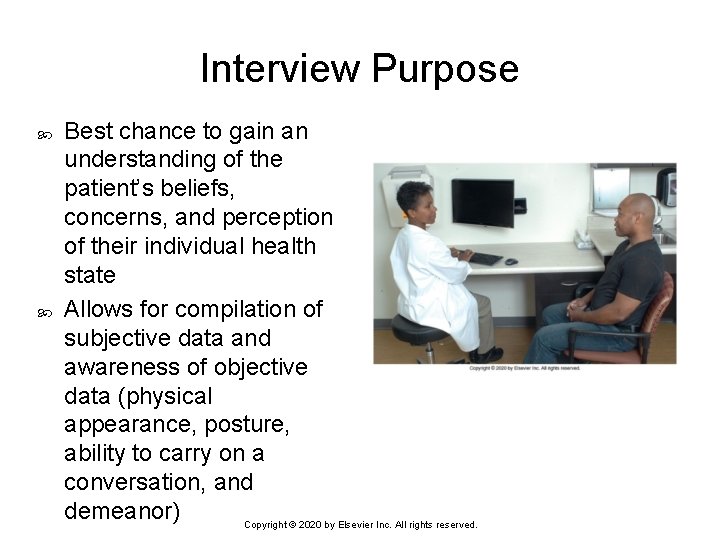
Interview Purpose Best chance to gain an understanding of the patient’s beliefs, concerns, and perception of their individual health state Allows for compilation of subjective data and awareness of objective data (physical appearance, posture, ability to carry on a conversation, and demeanor) Copyright © 2020 by Elsevier Inc. All rights reserved.
Successful Interview Characteristics Gather complete and accurate data about person’s health state including description and chronology of any symptoms. Establish trust to foster acceptance and allow for data sharing. Teach the person about their individual health state. Build rapport to continue therapeutic relationship. Discuss health promotion and disease prevention. Copyright © 2020 by Elsevier Inc. All rights reserved.
The Interview Contract Terms Location: Time and place with follow-up for physical exam Explanation: Introduction and delineation of role Purpose: Mutual goal is optimal health. Time frame: Length of time for process Participation: Expected participation and/or presence of others Confidentiality: Reasonable and/or limited as it applies to legal/ethical standards Cost: Disclosure of any financial costs Copyright © 2020 by Elsevier Inc. All rights reserved.
Process of Communication: Sending Verbal communication Words you speak—vocalization Ø Tone used in conversation Ø Nonverbal communication Body language helps to provide cues which may be correlated with truer feelings. Ø Recognize importance of unconscious messages Ø Copyright © 2020 by Elsevier Inc. All rights reserved.
Process of Communication: Internal Factors Specific to you as the health care team member which can help you to maximize communication skills Internal factors Liking others—using a “genuine” approach Ø Empathy—develop an understanding and sensitivity for others feeling’s Ø Ability to listen—using an “active” process Ø Self-awareness—be aware of “implicit bias” Ø Copyright © 2020 by Elsevier Inc. All rights reserved.
Process of Communication: External Factors Defining the environment so as to foster communication External factors Ensure privacy—aim for “geographic” privacy but ensure “psychological” privacy Ø Avoid interruptions—minimize and/or refuse Ø Physical environment—“equal status” seating Ø Dress—appearance and comfort Ø Note-taking—keep to a minimum, offer “focused” attention Ø Copyright © 2020 by Elsevier Inc. All rights reserved.
Electronic Health Record (EHR) Federal government mandates so as to improve quality and safety. Technology interface can affect communication in the health care provider-patient relationships. Capturing of biomedical, psychological, and emotional information may not always be captured. Do not allow the computer to become a “barrier” in the communication exchange process. Copyright © 2020 by Elsevier Inc. All rights reserved.
Techniques of Communication Introducing the interview—keep it short and formal Working phase Data-gathering phase Ø Verbal skills include questions to patient and your responses to what is said. Ø Two types of questions Ø • Open-ended—asks for narrative information • Closed—asks for specific information leading to a forced choice (yes or no) • Each has a different place and function in interview. Copyright © 2020 by Elsevier Inc. All rights reserved.
Verbal Responses: Assisting the Narrative (1 of 2) Nine types of verbal responses that fall under patient perspective and interviewer perspective Patient leads and reactions obtained from interviewer Facilitation—encourages patient to say more Ø Silence—directed attentiveness Ø Reflection—echoes to help express meaning Ø Empathy—names a feeling and allows its expression Ø Clarification—asking for confirmation Ø Copyright © 2020 by Elsevier Inc. All rights reserved.
Verbal Responses: Assisting the Narrative (2 of 2) Interviewer leads and expression of own thoughts based on obtained information Confrontation—clarifying inconsistent information Ø Interpretation—makes association to identify cause or conclusion Ø Explanation—informing person by sharing factual and objective information Ø Summary—provides conclusion based on verified information which in turn identifies that the interview process is closing Ø Copyright © 2020 by Elsevier Inc. All rights reserved.
Ten Traps of Interviewing 1. Providing false assurance or reassurance 2. Giving unwanted advice 3. Using authority 4. Using avoidance language 5. Engaging in distancing 6. Using professional jargon 7. Using leading or biased questions 8. Talking too much 9. Interrupting 10. Using “why” questions Copyright © 2020 by Elsevier Inc. All rights reserved.
Nonverbal Skills—Congruency When verbal and nonverbal messages are congruent, the verbal message is reinforced. When they are incongruent, nonverbal message is viewed as the truer one as it is under unconscious control. Can be viewed as either positive or negative thereby prompting the importance of selfawareness in order to promote communication Copyright © 2020 by Elsevier Inc. All rights reserved.
Nonverbal Modes of Communication (1 of 2) Physical appearance Ø Image as an initial perception Posture Ø Interpretation of body language affecting engagement Gestures Ø Sending messages—be aware Facial expression Ø Reflects emotion and culture Copyright © 2020 by Elsevier Inc. All rights reserved.
Nonverbal Modes of Communication (2 of 2) Eye contact Ø Maintain within the realm of interest but be mindful of cultural diversity. Voice Ø Be aware of tone, intensity, and rate of speech. Touch Ø Interpretation is influenced by age, gender, cultural background, past experience, and current setting. Copyright © 2020 by Elsevier Inc. All rights reserved.
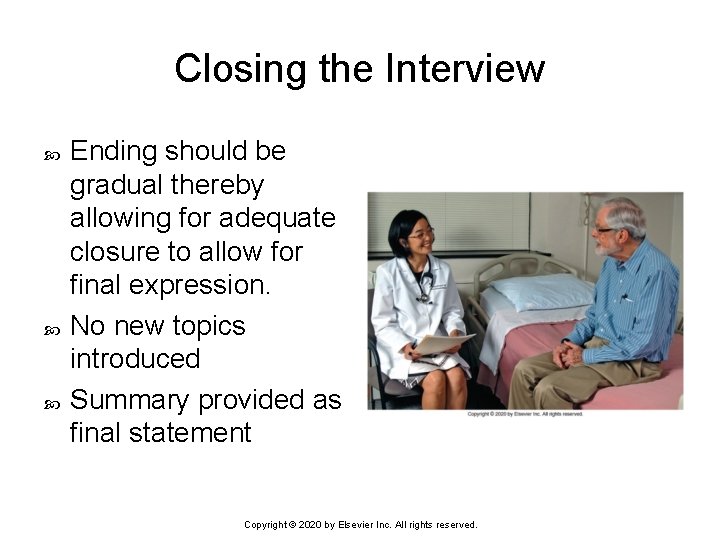
Closing the Interview Ending should be gradual thereby allowing for adequate closure to allow for final expression. No new topics introduced Summary provided as final statement Copyright © 2020 by Elsevier Inc. All rights reserved.
Developmental Competence Interviewing the parent or caregiver of a child or children Focus on both individuals so as to encourage participation. Ø Obtain information and relevant data. Ø Address by name to help foster engagement. Ø Be aware of physical relationships to promote sense of self. Ø Be aware of nonverbal behaviors so as to maintain engagement. Ø Copyright © 2020 by Elsevier Inc. All rights reserved.
Communicating with Different Ages Use “Stages of cognitive development” as a guideline to facilitate communication. Consider the maturity level of the child. Take into account that a health care crisis can lead to regression as a common response. Copyright © 2020 by Elsevier Inc. All rights reserved.
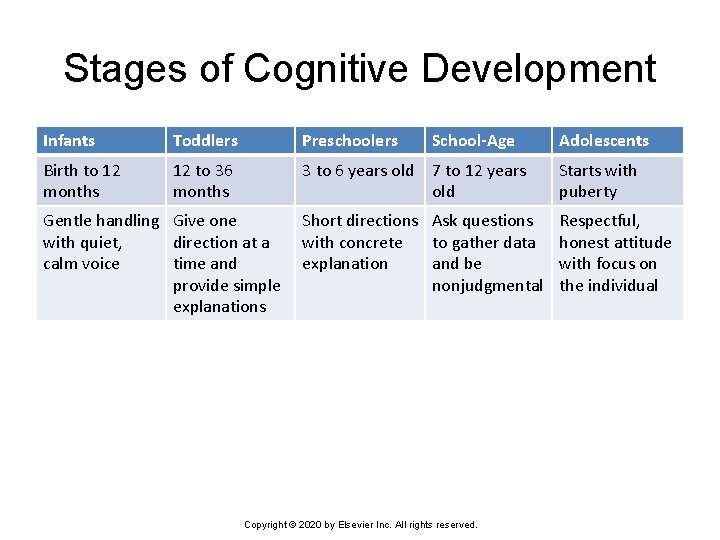
Stages of Cognitive Development Infants Toddlers Preschoolers Birth to 12 months 12 to 36 months 3 to 6 years old 7 to 12 years old Starts with puberty Short directions Ask questions with concrete to gather data explanation and be nonjudgmental Respectful, honest attitude with focus on the individual Gentle handling Give one with quiet, direction at a calm voice time and provide simple explanations School-Age Copyright © 2020 by Elsevier Inc. All rights reserved. Adolescents
The Older Adult Developmental task of finding purpose and evaluating existence Address respectfully Typically the interview process will take longer. Consider appropriate pacing Ø Physical limitations Ø May need increased response time to process Ø May have more information to provide Ø Use therapeutic touch to provide empathy. Copyright © 2020 by Elsevier Inc. All rights reserved.
Interviewing People with Special Needs Consider key elements that will address vulnerable populations. Ø Acutely ill, drug/alcohol abuse, sexually aggressive, emotionally distraught (crying), angry and/or threatening violence and anxious Use appropriate resources as they relate to the context of the situation. Be alert to “personal question” queries as they may indicate ulterior motives: Ø Provide appropriate response based on personal ethics. Copyright © 2020 by Elsevier Inc. All rights reserved.
Culture and Genetics Gender Being aware of maintaining cultural norms during interview and examination process Ø Maintaining privacy and modesty Ø Sexual orientation LGBTQ (Lesbian, gay, bisexual, and transgender) Ø Maintaining neutrality r/t patient’s presentation by being mindful of communication patterns Ø Being aware of your own personal bias and baggage Ø Copyright © 2020 by Elsevier Inc. All rights reserved.
Working with (and without) an Interpreter Potential exists for language barrier to be a key element in health care interactions due to crosscultural communications Consider both verbal and nonverbal cues in communication pattern. Bilingual team member or trained medical interpreter preference same gender Language alone does not imply understanding of cultural diversity. Copyright © 2020 by Elsevier Inc. All rights reserved.
Health Literacy This is more than just the ability to read but rather includes understanding and following directions that lead to effective communication between the patient and the health care provider. A patient may be literate but not have health literacy. Involves the use of quantitative measurement and memory aspects Tools for determining literacy Several available vary in terms of reliability and validity and time needed to administer Ø Follow established policy and procedure in clinical practice settings Ø Copyright © 2020 by Elsevier Inc. All rights reserved.
Techniques to Improve Health Literacy Oral teaching Provide simple, easy instructions. Ø Use conversational structure rather than medical jargon. Ø Written materials Based on standard educational levels Ø Use of 12 point font, avoiding all “CAPS” with use of bullet points Ø Teach back Encourages verification of understanding. Ø Opens the door for clarification if needed Ø Copyright © 2020 by Elsevier Inc. All rights reserved.
Communicating with Other Professionals Promoting effective interpersonal communication Occurs between two or more individuals of the interdisciplinary health care team Ø Creates an environment of mutual respect and enhances collaboration Ø Impact of ineffective interpersonal communication Ø Linked to poor outcomes attributed to delay in treatment, medication errors, clinical misdiagnosis, patient injury, and death Maintaining open lines of communication Ø Provide timely updates in an organized manner Copyright © 2020 by Elsevier Inc. All rights reserved.
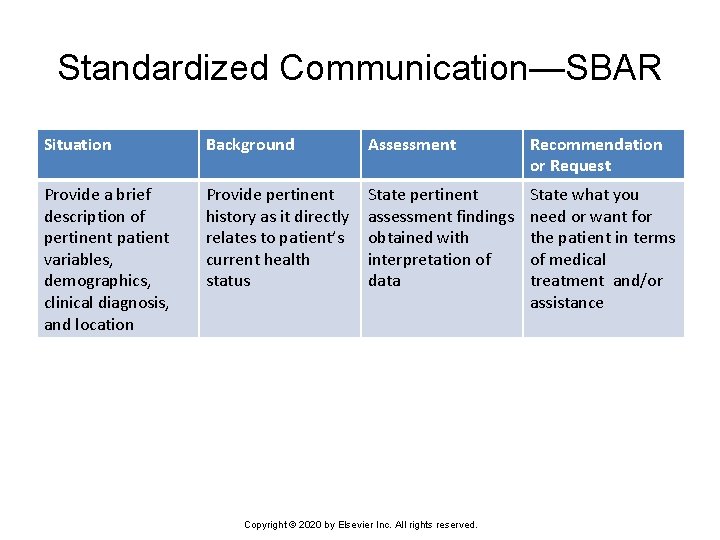
Standardized Communication—SBAR Situation Background Assessment Recommendation or Request Provide a brief description of pertinent patient variables, demographics, clinical diagnosis, and location Provide pertinent history as it directly relates to patient’s current health status State pertinent assessment findings obtained with interpretation of data State what you need or want for the patient in terms of medical treatment and/or assistance Copyright © 2020 by Elsevier Inc. All rights reserved.
- Slides: 27